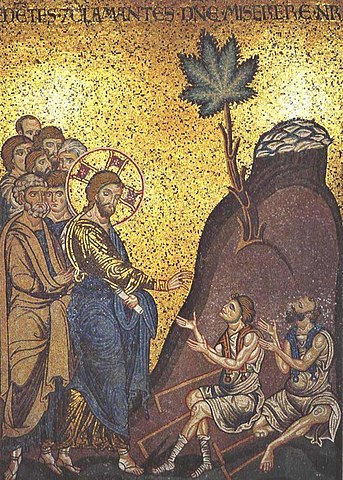
Jesus healing two blind men, 11th century mosaic, Sicily
As Jesus went on from there, two blind men followed him, calling out, “Have mercy on us, Son of David!”
When he had gone indoors, the blind men came to him, and he asked them, “Do you believe that I am able to do this?”
“Yes, Lord,” they replied.
Then he touched their eyes and said, “According to your faith let it be done to you”; and their sight was restored. Jesus warned them sternly, “See that no one knows about this.” But they went out and spread the news about him all over that region.
While they were going out, a man who was demon-possessed and could not talk was brought to Jesus. And when the demon was driven out, the man who had been mute spoke. The crowd was amazed and said, “Nothing like this has ever been seen in Israel.”
But the Pharisees said, “It is by the prince of demons that he drives out demons.” (New International Version)
Every day the news is a steady stream of disease, death, war, and outright human suffering. It’s as if the phrase, “slow news cycle,” is a thing of the past.
As we stare into the face of trouble, I find myself uttering the ancient prayer of the Church: “Lord have mercy. Christ, have mercy. Lord have mercy and grant us your peace.”
We collectively feel the weight of the world’s suffering, experience the heaviness of concern for family and friends, and perhaps wonder how much more people can take.
It’s in the topsy-turvy times that I come back again and again to the deep spiritual convictions which inform what I do each day. One of those underlying creeds and affirmations is this:
Jesus is trustworthy, no matter whether my faith or the faith of others is small or great.
In our Gospel lesson for today, two blind men were healed according to their faith in Jesus. The diverse healing accounts of Jesus in the New Testament, whether the faith was large or small in those healed, leads me to the conclusion that:
It isn’t faith itself that heals, saves, or transforms – it is Jesus.
All the healing accounts in the New Testament Gospels have something in common: They all directly point to Jesus as the object of faith.
It isn’t about the level or amount of faith, but about where the faith is placed.
For the Christian, faith itself doesn’t mean much if it isn’t in Jesus.
If I place a large and sincere faith in an inanimate object such as money; in a position of power; or, even in my own independence, my faith isn’t worth much.
If I have a huge faith in a doctor or a psychiatrist to heal my body or my mind, I will quickly discover there are limits to their abilities.
If I have a confident faith that my family will meet all my needs, my faith will eventually run into failure when they let me down. That’s because the ultimate object of faith is Jesus.
If all my faith eggs are in the church basket, my faith will eventually face a crisis because it is a misplaced faith. Furthermore, the answer I provide for others is not simply getting them to attend church or to adopt my moral code.
There should be a consistency that runs through us all. For Jesus doesn’t change—yesterday, today, tomorrow, he’s always totally himself.
Hebrews 13:8, MSG
We know with certainty that circumstances change, as everyday seems to bring new levels and permutations of unprecedented alterations to our lives – and through it all, Jesus remains as the ever-present Savior, seated at the right hand of God ceaselessly interceding on behalf of those who offer even the slightest mustard seed of faith.
“For truly I tell you, if you have faith the size of a mustard seed, you will say to this mountain, ‘Move from here to there,’ and it will move, and nothing will be impossible for you.”
Jesus (Matthew 17:20-21, NRSV)
It says something about our modern Western society that whenever we hear the words of Jesus on faith that we interpret the mountain moving as an immediate event that happens almost instantaneous, like a snap of the finger. Yet, there is nothing in those words that says that. There is also nothing that says an individual necessarily does it.
The fact of the matter is this: Jesus heals, transforms, and delivers people from sickness, sin, trouble, and overwhelming circumstances in his own good time, not ours.
Just because we pray without ceasing for days, weeks, months, and even years for something doesn’t mean we lack faith if the prayer isn’t answered immediately. It could be that God wants others involved, maybe even across generations, for the impossible mountain to be moved.
It is misplaced faith which expects microwave results. Faith placed appropriately in Jesus as the object of belief discerns that faithful prayer is consistently prayed until there is an answer.
Healing and restoration will happen – just maybe not always how or when we think it will.
Almighty God, you know that we have no power in ourselves to help ourselves: Keep me both outwardly in my body and inwardly in my soul, that I may be defended from all adversities which may happen to the body, and from all evil thoughts which may assault and hurt the soul; through Jesus Christ our Lord, who lives and reigns with you and the Holy Spirit, one God, forever and ever. Amen.
Brothers and sisters, let me take an example from everyday life. Just as no one can set aside or add to a human covenant that has been duly established, so it is in this case. The promises were spoken to Abraham and to his seed. Scripture does not say “and to seeds,” meaning many people, but “and to your seed,” meaning one person, who is Christ. What I mean is this: The law, introduced 430 years later, does not set aside the covenant previously established by God and thus do away with the promise. For if the inheritance depends on the law, then it no longer depends on the promise; but God in his grace gave it to Abraham through a promise.
Why, then, was the law given at all? It was added because of transgressions until the Seed to whom the promise referred had come. The law was given through angels and entrusted to a mediator. A mediator, however, implies more than one party; but God is one.
Is the law, therefore, opposed to the promises of God? Absolutely not! For if a law had been given that could impart life, then righteousness would certainly have come by the law. But Scripture has locked up everything under the control of sin, so that what was promised, being given through faith in Jesus Christ, might be given to those who believe. (New International Version)
If the Apostle Paul were living in our day, I’m pretty sure he could have his own reality show, if he wanted. Paul is a terribly interesting man. Within church circles, his adventures are legendary.
One of the most interesting things about Paul is his piercing intellect and flawless rhetoric. Today’s New Testament lesson has Paul taking on a Galatian heresy. Maybe we could call it “Law and Grace: SFU (Special Faith Unit).”
The folks who were holding to the law were reminded by Paul that the promise to Abraham was a contract or covenant made by God that was binding, permanent, and divinely ratified. The law, on the other hand, was not – it was designed to be in effect for a specific amount of time, temporary, and only bound the people of God until the promise was fulfilled in Christ.
So, why in the world was there a law to begin with if it is no longer in effect?
Paul said the law was added because of transgressions. It was as if God’s people were precocious and disobedient little children who needed some firm boundaries and rules in order to keep them safe and lead them to the time when they would grow to maturity.
My friends, stop thinking like children. Think like mature people and be as innocent as tiny babies.
1 Corinthians 14:20, CEV
With the arrival of adulthood, there is no longer any need for the law.
The law was never designed to be permanent. So, when Christians cling to a rules-based faith, they are showing their immaturity. They need to grow up and embrace the permanent reality of living in the Spirit.
Although you should have been teachers by now, you need someone to teach you an introduction to the basics about God’s message. You have come to the place where you need milk instead of solid food. Everyone who lives on milk is not used to the word of righteousness, because they are babies. But solid food is for the mature, whose senses are trained by practice to distinguish between good and evil. (Hebrews 5:12-14, CEB)
We must press on toward spiritual maturity, not being simpletons who embrace the law as if it were the actual faith itself. Instead, we need to pursue an adult faith – one which is thoroughly permeated and bathed in grace.
Grace is the permanent and pervasive reality that governs everything Christians are to do and say. Grace cannot be earned, only accepted, not achieved, but only given by God.
Until we can grasp this fundamental truth of Christianity, the Christian life will never make sense. Only until we release our expectations of rules and let go of our orienting around law will we discover the liberation of a grace-filled existence.
Jesus said, “In a word, what I’m saying is, Grow up. You’re kingdom subjects. Now live like it. Live out your God-created identity. Live generously and graciously toward others, the way God lives toward you.” (Matthew 5:48, MSG)
We spread the message about Christ as we instruct and teach everyone with all the wisdom there is. We want to present everyone as mature Christian people.
Colossians 1:28, GW
The believer’s task is to grow in the grace and knowledge of our Lord Jesus. That happens not through the law but by grace – utilizing the God given gifts of faith, hope, and love.
Gracious God, you saved me through Christ alone by faith alone. Now help me to live by grace alone as the highest and greatest truth operative in the universe and in the kingdom of God. Amen.
Christ has generously divided out his gifts to us. As the Scriptures say,
“When he went up to the highest place, he led away many prisoners and gave gifts to people.”
When it says, “he went up,” it means that Christ had been deep in the earth. This also means that the one who went deep into the earth is the same one who went into the highest heaven, so he would fill the whole universe.
Christ chose some of us to be apostles, prophets, missionaries, pastors, and teachers, so his people would learn to serve, and his body would grow strong. This will continue until we are united by our faith and by our understanding of the Son of God. Then we will be mature, just as Christ is, and we will be completely like him.
We must stop acting like children. We must not let deceitful people trick us by their false teachings, which are like winds that toss us around from place to place. Love should always make us tell the truth. Then we will grow in every way and be more like Christ, the head of the body. Christ holds it together and makes all of its parts work perfectly, as it grows and becomes strong because of love. (Contemporary English Version)
The Body of Christ, without love as its skeletal structure, would be as ridiculous and silly as a boneless chicken ranch.
The Apostle Paul, a concerned spiritual father, was encouraging the Church toward maturity, to act as adults in the faith and not like immature children.
Just as the physical body begins small, then grows and matures over time, so the spiritual body (the church) is to focus on incremental slow growth across the years so that it realizes maturity. And the consummate evidence of that spiritual development is strong bonds of love.
Ten days after the Lord Jesus ascended to heaven, the Day of Pentecost occurred. On that day, the Holy Spirit came upon the small band of believers and the church became a full-fledged phenomenon, growing and expanding. (Acts 2:1-47)
The gracious gifts of the Spirit are given to each and every Christian so that growth and strength will come to the Body of Christ through love. Each spiritual gift might be different from person to person, but every one of them is meant to be used in love for the benefit of the entire church.
Without any bones or skeleton, the church will be weak and ineffective. It might look like a church but will not be able to do anything in the world.
For spiritual maturity to happen, it is necessary for every single Christian in the church to discover their spiritual gift, and then, use it in love to build up the entire Body. This is the God-ordained means of realizing a healthy functioning church.
It may appear that you and I, as believers in and followers of Jesus, have the luxury of pursuing other interests rather than providing loving and gifted service to Christ’s Church. After all, church attendance, Christian mission and service are all voluntary, right? A volunteer can choose to sit out, right?
Uh-hem (clearing of throat). Wrong. That sort of thinking is based in the goofy notion that the Church is a voluntary society which we choose to become a part of, or not. It isn’t. The Body of Christ, the Church, the people for whom Christ died, was chosen by God – and not the other way around.
Before we chose God, God chose us. We can no more choose to decline Christian mission and service anymore than a physical heart or bodily organ can decide it needs to go do something else – as if they could simply leave the Body or just stop doing what they’re doing without consequence.
No, my friends, for the Body to function, it must work in concert, paying attention to the unique parts which keep it alive and thriving, while at the same time, maintaining the overall health of all the Bodily systems.
Bottom line: We need one another. Going off and continually doing my own thing or picking up my marbles and going home because I’m mad or frustrated, is what children do. When adults act like children, we rightly discern they are immature and need to grow up.
So, instead of lacking self-awareness or being pouty about my blog post, focus on the following questions:
What is your passion and desire for Christ’s church?
What issues stir you emotionally?
What group of people do you feel most attracted to reach?
What area of Christian mission or church ministry would you most like to influence?
Are there people whom you notice that others seem to ignore?
Will you step out in faith and learn how God has wired you for ministry?
Will you speak and serve in the name of Jesus through the enablement of the Spirit?
Loving God, I ask you to give me a heart of faith to trust the Spirit and the Spirit’s work in my life. I ask for a heart that desires the gifts of the Spirit for the common good of all persons. I ask you to help me be open to the gifts of the Spirit in others. I ask for jealousy of others’ gifts to be quieted in me. I pray that my gifts would build up the church. Most of all, I ask for the gift of love. Use me for the strengthening of Christ’s church, and for a positive influence in the world. Amen.
Therefore, since we have been justified through faith, we have peace with God through our Lord Jesus Christ, through whom we have gained access by faith into this grace in which we now stand. And we boast in the hope of the glory of God. Not only so, but we also glory in our sufferings, because we know that suffering produces perseverance; perseverance, character; and character, hope. And hope does not put us to shame, because God’s love has been poured out into our hearts through the Holy Spirit, who has been given to us. (New International Version)
Today, there are millions, perhaps billions, of people without peace in this world.
Maybe…
Maybe there isn’t much peace in your life. Because of that unsettled icky sense of agitation, your mind is somewhere else. It could be that you are upset about something that has happened or are worried about something that is going to happen.
Maybe the lack of peace has to do with another person. They did or said something, and it’s been grinding on you. So, you are having conversations with that person in your head for which you will probably never say aloud.
Maybe you have to deal with someone else who doesn’t have peace, and it’s creating stress for you. And you are wondering when things will settle down.
Maybe the lack of peace runs much deeper than your immediate circumstances and plans.
Maybe every day, day-in-and-day-out, you are not quite sure about where you stand with a person or a group of people.
Maybe you aren’t sure about how you stand with God. You wonder whether God is really pleased with you, or not.
Maybe you aren’t even in touch with your lack of peace because you are an expert at pushing whatever feelings you have so far down that you think you’re fine. But you really aren’t.
Maybe you are a perfectionist…
Perfectionists are never at peace. The specter of perfectionism always hangs in the air. There’s a steady stream of “should have’s,” and “could have’s” making noise in your head. Your work, no matter how good, is never good enough. “I should have done better.” “I ought to do better.” “I must be better.”
Instead of viewing life’s opportunities as challenges to be welcomed, the perfectionist sees life as one unending mountain to climb, never quite reaching the top.
The constant companions of perfectionistic people are disappointment, condemnation, frustration, and perceived failure. There is, for them, an internal world of self-loathing based on the lie that I am not enough – I have to be perfect. Peace, for the perfectionist, is a pipe dream.
Maybe we could focus a bit on God…
The Christian God is a triune God, existing in three persons – Father, Son, and Spirit – the great Three-in-One. The Trinity is the basis for all we are and all we do.
All of life is grounded in the triune God. God exists in perfect unity and harmony. God is God’s own community of glorious love. God’s glory is primarily seen on this earth through creation, through us, God’s creatures.
Glory is revealed as we reflect the image of God stamped on us in creation. Since God is love, God’s people are to be characterized by love – loving God, loving one another, and loving neighbor. God’s people are meant to exist together in unity and harmony, reflecting the very nature of the Holy Trinity.
Yet, after the creation of the world and humanity, man and woman fell into guilt and shame through bucking God’s design for people. Ever since, God has been on a mission to reclaim the lost glory.
Maybe we need to focus on the Son…
The ultimate expression of God’s mission was the sending of the Son to this earth. It is through Christ’s life, death, resurrection, and ascension that the way has been opened to a renewed relationship with our triune God.
The way is now clear for us to experience real practical peace. It has been achieved through the cross of Jesus Christ.
Therefore, since God has initiated a rescue mission for us by sending the Son, since we have been justified through faith, we have peace with God.
To be justified means God made us righteous – has made things right between us. God has also provided access for us to be right with each other and the rest of creation. To put this in a contemporary vernacular, we ask God, “Are we good?” and God responds, “We’re good.”
Since then, we’re good with God, we have peace with God.
Since then, that is true, we cannot try and get peace by another way.
Peace does not come through doing the right things, and by being a good person.
Peace does not come through trying to obtain feelings of peace.
Peace is not merely the absence of conflict – of just keeping people from strangling each other and harming one another.
Peace cannot be achieved by trying to relieve anxiety through better effort.
Maybe grace is the answer…
The antidote to perfectionism, the resolution to feeling a lack of peace is unconditional approval from God.
Grace is the elixir of life.
Grace is the thing a perfectionist cannot work to obtain, and the thing that truly helps.
Grace is freely given; it is a gift.
Grace (God’s loving unconditional acceptance of us) is the true way of peace.
Some folks have so tied themselves to impossible performances and conditional love that the gift of grace is hard to accept.
Change won’t happen overnight, and that’s okay – because God deals with us according to grace, not by earning spiritual merit badges.
The renewal that brings transformation is a process, not an event. In Scripture it’s called “sanctification.” So, it’s important to enjoy the process.
When you’ve caught yourself going back to the pigsty of perfectionism, instead of beating yourself up, go ahead and laugh at yourself and your own fallibility. Perfectionists take themselves way too serious. Anytime they can lighten up, it lights up the face of God (in a non-performance sort of way!).
Maybe peace is possible…
Peace delivers us from our brokenness. Again, let’s return to the triune God. There is perfect peace within Father, Son, and Spirit. God is perfect unity, harmony, and love.
Peace means living, working, and playing together.
Peace means experiencing wholeness, integrity, and contentment, even in the midst of hard circumstances.
Peace means being a peacemaker.
The late Fred Rogers, from Mister Rogers’ Neighborhood, got into television because he didn’t like TV. During spring break of his senior year in seminary he encountered television for the first time. What he saw repulsed him because he saw people demeaning each other and not having peace.
Fred Rogers worried that TV programming would create a generation of emotionally-bankrupt children. Faced with the decision to either sour on television itself or work to restore the medium, he chose the latter. He dropped out of seminary and began pursuing a career in broadcasting. Fourteen years later, he created a television show that shaped entire generations of children, running on PBS from 1968-2001.
Mr. Rogers was a devout Christian who rarely talked about his faith on the air. Yet, his show infused our society with beauty and grace. “You’ve made this day a special day by just your being you,” he’d famously sign off. “There is no person in the whole world like you, and I like you just the way you are.”
In many ways, the lasting legacy of Mr. Rogers will not only be the greater emotional stability of generations of children, but also his wonderful example of peace and how to restore the world through basic human kindness.
Maybe the path of peace is different than I believed…
Having all our circumstances like we want them is not the basis of experiencing peace. That’s being delusional. Peace doesn’t happen whenever everything goes our way.
Instead, we are to rejoice in all our circumstances, even the ones which cause suffering – because they the Holy Spirit’s means of teaching us to experience the peace we long for.
Suffering is our triune God’s way of weaning us off all that divides and antagonizes so that we can attach ourselves to God’s peace.
One of the most read Christian books of all time was written in the 1500’s by a French woman known as Madame Guyon. She saw the disunity of the world and the lack of peace in our individual lives as stemming from our lack of practicing God’s ways.
Much of the world doesn’t know what to do with suffering, and does not accept it, because people want their own way with everything.
War and Peace by U.S. Air Force Staff Sgt. Jamal D. Sutter
To know God’s peace, we must practice just the opposite – by refusing all personal desires we have, whether good or bad. Why? Because the practice of refusing our own will breaks it free so it can attach to God’s will.
We need our brains to be rewired in saying “no” to ourselves.
The other part of Madame Guyon’s practice is to accept every circumstance, even difficulty and suffering, with joy and thanksgiving.
We can learn to say “yes, thank you” for each hard circumstance, whether good or bad. As in the case of Mr. Rogers, the evil we observe can spur us toward making peace in this world. We detach from personal desires so we can attach to what God wants to do.
Peace, on the practical level, comes from persevering under suffering and rejoicing in it. Why rejoice? Because suffering produces character and character hope. There cannot be hope without suffering.
God the Father called God the Son to suffer; and God the Spirit leads us into suffering so that we might know peace and hope on a daily basis.
Conclusion
Abandon everything to God. Let it go – every dream, every personal desire, everything you have so that you are free to know God’s will for your life.
Accept each circumstance you face with joy and thanksgiving. The Trinitarian love of God is poured into our hearts through every circumstance of life, even if it is difficult and hard.
When we practice abandonment of our wills and acceptance of our circumstances, the result gives us hope, the confident expectation that nothing in our lives happens in vain.
Every situation can lead us to know God and experience peace. This is very different from simply believing in the Trinity; it is to daily experience the Trinity.
Glorious God, make your presence known through our worship, our prayer, and our reading of your Word.Father, Son, and Holy Spirit, within you lies unity, love, justice, peace, and power.
Fill our outstretched hearts with your Spirit and encircle us with your love.Make yourself known to us in new and challenging ways.Empower us to forsake every will but your own. Inspire us toward your peace. Do with us what you will, through Christ our Lord in the power of the Holy Spirit. Amen.






 Rev. Tim Ehrhardt