
Matthew 20:20-28 – Leadership as Service to Others

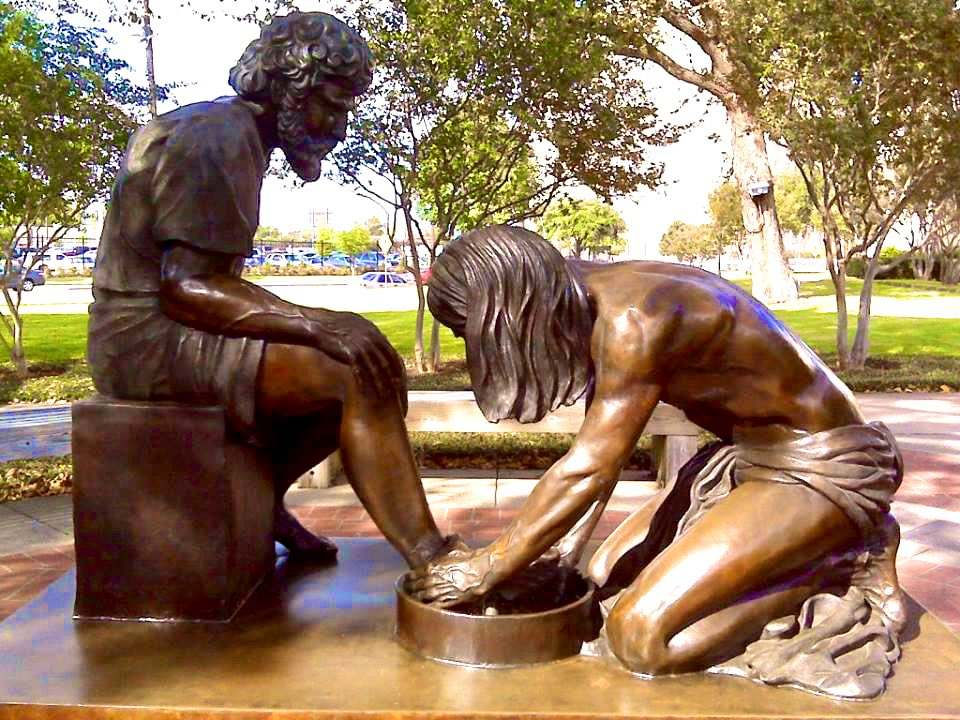
Statue of Jesus washing Peter’s feet, in Pittsburgh, Texas. Photo by Carol Highsmith

The mother of Zebedee’s sons came to Jesus with her sons and, kneeling down, asked a favor of him.

“What is it you want?” he asked.

She said, “Grant that one of these two sons of mine may sit at your right and the other at your left in your kingdom.”

“You don’t know what you are asking,” Jesus said to them. “Can you drink the cup I am going to drink?”

“We can,” they answered.

Jesus said to them, “You will indeed drink from my cup, but to sit at my right or left is not for me to grant. These places belong to those for whom they have been prepared by my Father.”

When the ten heard about this, they were indignant with the two brothers. Jesus called them together and said, “You know that the rulers of the Gentiles lord it over them, and their high officials exercise authority over them. Not so with you. Instead, whoever wants to become great among you must be your servant, and whoever wants to be first must be your slave—just as the Son of Man did not come to be served, but to serve, and to give his life as a ransom for many.” (New International Version)

Jesus and his disciples were not on the same page. That’s because they each had differing agendas.

Jesus was clear with the disciples about how things were going to shake out with him: torture, insults, crucifixion, and death was ahead. It seems the disciples and the mother of James and John missed the memo on this. Christ’s words went way over their heads.

It could be the disciples simply did not hear what Jesus was saying to them (repeatedly!). It’s more likely that the message of Jesus got filtered through an existing agenda of how they believed things ought to go.

The disciples, along with a lot of other Jewish folk in the first century, were looking for a Messiah in the mold of King David – a strong leader who would come and beat up the Romans, exert all kinds of power and influence, and establish an earthly rule over all the people they don’t like.

Submission to torture, humility before the very people they detested, and being killed by them were not factors into the disciples understanding of leadership and government.

Much like the powerful Aslan who had a thorough understanding of the world’s deep magic and submitted himself to the White Witch and death in C.S. Lewis’s The Lion, the Witch, and the Wardrobe – Jesus knew what he was doing, while everyone else seemed clueless about the true power which exists in the universe.

Let’s be clear about what that true power really is: grace. Yes, grace. Powerful, resplendent, subversive, scandalous, and radical grace.

Mercy was the missing factor in the disciples’ agenda. Jesus is not like other rulers. He does not operate by throwing his weight around to forcefully impose a crushing my-way-or-the-highway kind of rule (even though, ironically, he is The Way).

No, Jesus freely and unabashedly uses grace with its merciful tools of humility, gentleness, kindness, goodness, and love to introduce and establish a new kind of rule which is not posturing for self-serving authority.

Power, authority, and the positions which go with them are to be used for the common good of all persons. To be in any sort of leadership position is to be a servant of grace for the benefit of humanity and the world.

If Christ’s disciples had looked a bit closer into the Scriptures, they might have noticed, for all his power and authority, that King David trafficked in grace.

David, at the pinnacle of power, looked over the kingdom to see who from the family of his enemy, the former King Saul (who was into the power thing for himself) was around so he could show grace (2 Samuel 9). It was typical of ancient kings to secure their rule and power through killing-off rivals and family members of previous kings. Not so with David. And not so with Jesus.

Wherever there is posturing for position, preening for power, and a pestering for privilege – there you will find everything grace is not:

  • Reliance on making and calling-in favors
  • Arrogant and overinflated egos
  • Unrealistic expectations
  • Hatred and suspicion of others
  • Judgment and condemnation
  • An insistence on recognition
  • Compulsive manipulation and control over everything and everyone
  • Unilateral decision-making
  • Shaming of others
  • Hoarding resources
  • Coups and in-fighting
  • A demand of rights

We in the western world may not be in the habit of offing leaders and killing others to consolidate power, yet we still too often rely on violent speech and language, partisan policies, and good-old-boy systems which are foreign to the way of Christ.

In contrast to this, grace exists. It is the deep magic which resides within. Wherever grace operates, there you will find the heart of a servant:

Attending to the needs of all persons, especially the least, the last, and the lost

  • Freely consulting and collaborating with others
  • Focusing on responsibility
  • Loving discipline
  • Embracing accountability
  • Pursuing truth and integrity
  • Sharing power and resources
  • Encouraging feedback
  • Giving generously
  • Looking for ways to show mercy

This old world desperately needs leaders with a dutiful sense of public service which is compassionate and kind. Wielding authority is not about a show of strength; it is in the understanding that when I am weak, then I am strong.

Yes, this approach to leadership may bring some short-term suffering. Grace, however, results in longevity of righteousness and peace for those who have been trained by it. True service is being a servant of grace.

May it be so, to the glory of God, and for the blessing of the world. Amen.

Philippians 3:17-20 – Follow a Good Example

Join together in following my example, brothers and sisters, and just as you have us as a model, keep your eyes on those who live as we do. For, as I have often told you before and now tell you again even with tears, many live as enemies of the cross of Christ. Their destiny is destruction, their god is their stomach, and their glory is in their shame. Their mind is set on earthly things. But our citizenship is in heaven. And we eagerly await a Savior from there, the Lord Jesus Christ. (New International Version)

Who do you imitate? What examples do you follow? How are you influenced by others?

Good Examples Are Virtuous

Because we are social creatures, we mimic and then pass on things we learn from others. So, it’s imperative we learn from people who demonstrate the values and ideals we aspire to possess ourselves.

In the people we listen to, either virtually or in person, as well as the authors we read, we are to live according to an example of virtue, sacrifice, and commitment.

We must imitate those Christian leaders who have a proven character in persevering in faith in the face of pain and suffering and have done it with great humility.

This does not necessarily mean we emulate those who eruditely speak the Word of God, have superior gifts and abilities, and enjoy success in ministry. It does mean, however, we ought to imitate, and have as mentors, those persons who imitate Christ.

We can leave behind and ignore those who are self-promoting peacocks, concerned with pursuing admiration and praise. Let’s, instead, mimic those who have proved themselves in hardship.

A Christian leader who has not undergone fiery trials and been purged of sinful pride are more easily seduced by their own importance. However, leaders who have seen their share of hard circumstances, pain, and suffering, and have come through it loving God and serving others out of grace and humility, are leaders worth imitating. They will likely serve well as good models of faith and ministry.

Good Examples Are In Community

Please notice there is more in today’s New Testament lesson than individually following a good example; we are to join with others in doing so. Community is needed for proper spiritual mimicking to take place.

Watch what God does, and then you do it, like children who learn proper behavior from their parents. Mostly what God does is love you. Keep company with him and learn a life of love. Observe how Christ loved us. His love was not cautious but extravagant. He didn’t love in order to get something from us but to give everything of himself to us. Love like that.

Ephesians 5:1-2, MSG

This is why the Apostle Paul wrote a letter telling Titus to ensure that he was being an example within the church community – and why he gave detailed instructions on virtue to make sure the older saints of God were teaching and mentoring the younger generations with a good example to show them. (Titus 1:5, 2:1-4, 3:1-2)

Following an example doesn’t take place in isolation. Like a duckling, we need to be with other ducklings following Mama Duck. Otherwise, we are at risk of getting lost and losing our faith, maybe even our lives.

Be a Good Example

It is also good to consider the kind of example we ourselves are displaying for others. In all our words and behaviors, whether we recognize it or not, we are modeling what is genuinely important to us. And sometimes what we do not say, or choose not to do, says as much or more about our character, beliefs, and ethics.

Our character is revealed in the way we treat people. How we treat those who cannot give something back to us tells more about our character than how we treat people we think are important.

People who are honest, kind, and fair – only when there’s something to gain – shouldn’t be confused with people of real character who demonstrate virtuous qualities habitually, under every circumstance. Individuals and groups of people are never to be handled as things or mechanisms to get what we want and achieve our goals.

Character is also revealed in the way we deal with the pressures and temptations which come our way. If we are one way whenever situations are going well, and then another way when things go sideways, it reveals something of our inner self.

Doing the right thing, whether someone is watching, or not, is always a hallmark of a good example.

It takes a lot of confidence in our way of life to say to another, like the Apostle Paul did, “follow my example.” If we have learned with humility and curiosity the words and ways of Jesus, and lovingly put them into practice, then we can be emboldened to mentor others in the faith and demonstrate for them what laboring for justice, righteousness, holiness, and godliness looks like in this fallen world.

Good Examples Together

More than ever, we need a cadre of solidly committed folks who have been mentored well in the ways of grace to serve as a beacon of light in the darkness of this world’s besetting sins of structural racism, hedonistic consumerism, discriminatory ageism, oppressive patriarchalism, biased hierarchism, disparity classism, religious anarchism, and a hundred other “isms” which keep people from flourishing in this life as God intended.

It is vital we learn from and emulate others who have a proven track record of promoting the common good of all persons. And it is equally important we become part of the ranks of those who are good examples of citizens in God’s benevolent and ethical kingdom.

Lord God, help me as your disciple to follow you in every thought, word, and deed. Give me a heart of faith and obedience so that I will live with confidence in the example and in the way of Jesus. Enable me to recognize your good and perfect will, even when it may seem nonsensical to me. I want to follow you all the days of my life. Please give me the strength to do so in the strength of your Holy Spirit. Amen.

1 Timothy 3:1-9 – Be, Not Just Do

Photo by Krivec Ales on Pexels.com

Here is a trustworthy saying: Whoever aspires to be an overseer desires a noble task. Now the overseer is to be above reproach, faithful to his wife, temperate, self-controlled, respectable, hospitable, able to teach, not given to drunkenness, not violent but gentle, not quarrelsome, not a lover of money. He must manage his own family well and see that his children obey him, and he must do so in a manner worthy of full respect. (If anyone does not know how to manage his own family, how can he take care of God’s church?) He must not be a recent convert, or he may become conceited and fall under the same judgment as the devil. He must also have a good reputation with outsiders, so that he will not fall into disgrace and into the devil’s trap.

In the same way, deacons are to be worthy of respect, sincere, not indulging in much wine, and not pursuing dishonest gain. They must keep hold of the deep truths of the faith with a clear conscience. (New International Version)

For the Church everywhere, Jesus Christ is to form and inform everything we do – including leadership.

This is why character formation is at the core of being an elder and a deacon in Christ’s Church – because the elder’s ministry of oversight, shepherding, and discernment of God’s will comes from the inner resources of knowing Christ; and a deacon’s ministry of outreach and service comes from a close walk of faith with Jesus, who desires to work through those individuals. 

Church leaders are to be the light of Jesus to their congregations. It is a high calling. The Apostle Paul gave to the Church seven requirements of Christian morality and seven requirements of a daily walk for leaders. Together, these fourteen requirements are the basis for Christian leaders so that the responsibility of the Church’s mission might be kept on track of bringing people to Jesus and bringing those who know Jesus to know him better.

The first set of seven requirements have to do with the morals of the person. A church leader is to:

1) Be trustworthy. Have a good reputation in both the church and the world

2) Be devoted in the marriage relationship (This doesn’t mean that a church leader must be married, because then even Jesus wouldn’t qualify as a church leader!)

3) Be clear-minded, even-keeled, and consistent

4) Be self-controlled (and not controlling others)

5) Be brave, possessing moral courage, through speaking truth with grace and not being a complainer

6) Be a friend of strangers through practicing hospitality

7) Be an able teacher, gently and carefully instructing others in a way that builds them up and does not tear them down 

The second set of seven requirements have to do with the ethical conduct of the person in everyday life. A church leader is to: 

1) Be sober and not a drunkard, conducting oneself in all moderation

2) Be respectable and not given to anger outbursts and constantly carrying a chip on their shoulder about something

3) Be gentle with everyone and in all situations

4) Be cordial and foster healthy relations, and not always picking a fight about something

5) Be generous and not thinking about the all-mighty dollar in every decision

6) Be caring in the family and give rules with relationship, so as to curb rebellion in a child

7) Be mature and not a novice in the faith so that those outside the church can see there is something wonderfully different about the way things are handled and done among those who profess Jesus Christ.

In addition to this, we have seven related requirements for deacons: 

1) Be dignified in every kind of relation, a person worthy of respect

2) Be sincere and not double-tongued, saying one thing to one person and something different to another

3) Be moderate in all things, especially when it comes to drink

4) Be benevolent and altruistic, and not greedy for either stuff or attention

5) Be holy and pure, keeping very close to faith in Christ with a good heart

6) Be a servant who is able to handle attention without falling apart

7) Be faithful, keeping promises and vows, especially in marriage and with family

God calls and sets apart individuals for service so that the Divine presence might be manifested among the people. Jesus Christ wants the church to be built up through faithful service. Notice what today’s New Testament lesson does not say about church leaders:

  • Be a listener to complaints.

Do everything without complaining or arguing (Philippians 2:14, ERV)

  • Be a representative of the people. Nowhere in Scripture do we find church leaders are supposed to operate like an American form of democracy. Instead of being representatives of the people to do their will, church leaders are rather representatives of God to the people so that God’s will is done in all things. 

Guard yourselves and God’s people. Feed and shepherd God’s flock—his church, purchased with his own blood—over which the Holy Spirit has appointed you as leaders. (Acts 20:28, NLT)

  • Be ingenious. Church leaders are not called to be the smartest, most creative, and best idea people in the room. They are to be servants, leading others in prayer, outreach, and acts of mercy.

I have a special concern for you church leaders. I know what it’s like to be a leader, in on Christ’s sufferings as well as the coming glory. Here’s my concern: that you care for God’s flock with all the diligence of a shepherd. Not because you have to, but because you want to please God. Not calculating what you can get out of it but acting spontaneously. Not bossily telling others what to do, but tenderly showing them the way. (1 Peter 5:1-3, MSG)

These requirements of Holy Scripture are not just for leaders; they are to be sought after by every member of God’s holy Church. We are all together to aspire to the highest of ideals of Christ in the way we operate in the church and in the world. 

Let no debt remain outstanding except the continuing debt to love one another (Romans 13:8). Godly leaders help us to maintain that biblical mandate.

Now may the God of peace, who through the blood of the eternal covenant brought back from the dead our Lord Jesus, that great Shepherd of the sheep, equip you with everything good for doing his will, and may he work in us what is pleasing to him, through Jesus Christ, to whom be glory for ever and ever. Amen. (Hebrews 13:20-21, NIV)

Mark 10:42-45 – True Leadership

Jesus called them together and said, “You know that those who are regarded as rulers of the Gentiles lord it over them, and their high officials exercise authority over them. Not so with you. Instead, whoever wants to become great among you must be your servant, and whoever wants to be first must be slave of all. For even the Son of Man did not come to be served, but to serve, and to give his life as a ransom for many.” (New International Version)

Leadership as Service

I remember a time when all politicians, government officials, and police were known as “public servants.” It was routinely assumed that such persons served the common good of all persons, regardless of who they are. I am also not delusional about the fact that, back in the day, just as today, there are those who served themselves first. However, at least, the ideal and vision of service was continually before the people.

Power is to be wielded for the benefit of the powerless. Authority is to be used to help those who cannot help themselves. Contemporary understandings of authority for many people today often do not have the common good as their guiding principles of leadership.

Misuse of Leadership

Rather, authority becomes the means of convincing others of the leader’s opinion or position. Power is used to influence, even arm-twist people toward the leader’s ideas. What’s more, those who enabled the leader to come to power expect that leader to use authority to benefit a particular agenda and only one slice of the human population. Lost is the vision of meeting needs for everyone, not just a certain constituency.

The ultimate use of power is to share it, even lay it down. Jesus did it in his incarnation, life, and death. He only took it up again after his mission was finished. We are to follow his cues on power and authority. We have opportunities galore to follow Christ in his leadership practice. For example, I once lived in a community with a large single parent family population. After talking with the elders of my church about this situation, they became excited about the prospects of reaching moms and children struggling to make it day to day.

The discussion did a hard turn of direction when I suggested we have some of those moms come in, sit around the table with us, and dictate what would constitute effective ministry which meets their needs. I was intentionally proposing that we, as church authority figures, share our power with the moms. The elders weren’t having it. One of them said outright, “Well, we can’t do that! We know better!” (than the moms do)

Whenever those in power and authority believe it is their mandate to make decisions without even having conversations with those whom those decisions effect, then they have become masters of small worlds, lords of folly, and ideational bullies. It is not the way of Jesus.

Appropriate Use of Leadership

Proper use of authority doesn’t mean we boss people around. It means we do what we need to do to help everyone in our scope of power. Taking charge must always begin with self. The self-control and self-discipline of the leader is the basis of leadership.

The heart of Christianity is loving service to one another as Christians, and humble service to a world which doesn’t believe, or act like us. Christian leaders are to focus on others’ well-being, success, and growth. They are to value character over career.

Christian disciples follow Jesus in the use of power and authority through:

  • Taking a humble posture of consulting and collaborating with others. And when decisions are made, they maintain relational connections.
  • Including others, and never vilifying or casting blame when stating a case for something.
  • Dealing with trouble and working to clear a toxic environment of noxious attitudes.
  • Directly confronting those they have an issue with, without creating destructive triangles to diffuse responsibility.
  • Encouraging a healthy dynamic of love and service which seeks listening before acting.

Leadership is more about being than about doing. Responsible use of authority comes from the person who understands themselves, is curious about others, and seeks to wisely apply Christ’s compassion to meet human need.

The Leadership of Jesus

Jesus healed people and delivered them from evil, sometimes at great risk to himself. He continually eschewed the perks of power to single-mindedly pursue the Father’s will. Even in his selection of disciples, Jesus purposely overlooked others to choose a rather motley band of men made up of uneducated country bumpkins, the poor, and the overzealous.

The Lord Jesus proclaimed a kingdom that belongs to children, using power to drive out demons and forgive sins. Christ delegated his authority to the disciples to do this same sort of work.

Jesus isn’t offering leadership theories; he is offering himself. Christ is our model of the appropriate use of power. Therefore, humbling ourselves must become our ambition! Our Lord, the ultimate authority above all authorities, humbled himself. Though being powerfully divine, he took the form of a servant, and became obedient to death, even the particularly shameful death on a cross—the ultimate humiliation. Yet God exalted Jesus Christ as Lord of the universe. (Phil 2:5-11)

Will you divest yourself of the pride in believing you know what is best for everyone around you? Will you cease speaking and start listening? Will you follow Jesus to the risky place of sharing power and authority with the powerless?

God, I am far too often influenced by what others think of me. I am always pretending to be either richer or smarter or nicer than I really am. Please prevent me from trying to attract attention. Don’t let me gloat over praise on one hand or be discouraged by criticism on the other. Nor let me waste time weaving imaginary situations in which the most heroic, charming, witty person present is myself. Show me how to be humble of heart, like you. Amen.
