Matthew 6:19-24 – Where Is Your Loyalty Placed?

Jesus said, “Do not store up for yourselves treasures on earth, where moths and vermin destroy, and where thieves break in and steal. But store up for yourselves treasures in heaven, where moths and vermin do not destroy, and where thieves do not break in and steal. For where your treasure is, there your heart will be also.

“The eye is the lamp of the body. If your eyes are healthy, your whole body will be full of light. But if your eyes are unhealthy, your whole body will be full of darkness. If then the light within you is darkness, how great is that darkness!

“No one can serve two masters. Either you will hate the one and love the other, or you will be devoted to the one and despise the other. You cannot serve both God and money. (New International Version)

Nobody can pursue two diametrically opposed commitments. 

Trying to live in both worlds of pursuing earthly treasure and heavenly treasure is not possible. 

Jesus has no place for any of his followers to ride the fence between those two worlds.

We cannot practice God’s will, and at the same time have a moonlighting job with the world.

As followers of God, we must have a single-minded loyalty to kingdom values. 

We are to do the will of God, from a right and sincere heart, and follow Christ’s teaching alone. 

We may give of ourselves, and give of our money, with sincerity, but if we walk away from that and believe the rest of my money, time, talents, and resources are mine to use as I want (since I fulfilled my duty) then we have a divided loyalty between the kingdom of God and the domain of darkness.

Jesus, as he typically does in the Gospels, used metaphors to communicate that we must have an unswerving loyalty to God’s kingdom values.

The Treasure Metaphor

Do not store up for yourselves treasures on earth. So, what are earthly treasures? 

Stuff, money, possessions, control, power, position, and recognition from others. 

You may rightly ask in response, “Is any of that really, in and of itself, wrong?” 

No. However, that’s not the real issue. The real question is this:

Do we use our earthly treasure to build heavenly treasure, or do we hoard earthly treasure for our own purposes apart from Christ’s kingdom values?

A man in a crowd said to Jesus, “Teacher, tell my brother to give me my share of what our father left us when he died.”

Jesus answered, “Who gave me the right to settle arguments between you and your brother?”

Then he said to the crowd, “Don’t be greedy! Owning a lot of things won’t make your life safe.”

So, Jesus told them this story:

A rich man’s farm produced a big crop, and he said to himself, “What can I do? I don’t have a place large enough to store everything.”

Later, he said, “Now I know what I’ll do. I’ll tear down my barns and build bigger ones, where I can store all my grain and other goods. Then I’ll say to myself, ‘You have stored up enough good things to last for years to come. Live it up! Eat, drink, and enjoy yourself.’ ”

But God said to him, “You fool! Tonight, you will die. Then who will get what you have stored up?”

“This is what happens to people who store up everything for themselves but are poor in the sight of God.” (Luke 12:13-21, CEV)

Earthly possessions are tools to be used. Jesus warns that we must not accumulate personal wealth, esteem, and success for the sake of placing ultimate security in money, but for advancing God’s kingdom values. 

Why do that? 

Because earthly treasure is temporary, and heavenly treasure is permanent. 

Heavenly treasure is righteousness; it’s right and just relationships. Humility, peace, grace, mercy, purity, and forgiveness are all relational values. The only thing that we will take with us when we die is relationships; it’s the only thing that’s permanent.

If I am genuinely committed to God’s kingdom, my most cherished values will be established by God. 

Whatever it is that we value, those values consume our thoughts and our efforts. In other words, what’s truly in our hearts directs our work.

And what we value derives from how we perceive our identity. For many Americans, we are defined primarily not as citizens or workers, but consumers. Jesus is neither advocating that we take vows of poverty, nor that we ought not to enjoy the good things in life. Rather, Jesus wants us to define where our loyalties truly lie.

The Light Metaphor

In the ancient world, the eye represented what you fixed your gaze on, or what your focus was. In our culture, we could replace the word “eye” with the word “goal.” The word “body” represents the entirety of one’s life.  So, we may interpret Christ’s words in this way: 

A goal is the focus of a life. If your goals are good, your whole life will be full of proper focus. But if your goals are bad, your whole life will be full of blindness. If then, the focus within you is only really blindness, how great is that darkness!

If the goals and dreams of life are toward earthly treasure, you will blindly move in that direction and your life will end up in disordered love and misplaced values. At death, you will have nothing to take with you because all the eggs have been put in the temporal basket.

The Slavery Metaphor

Jesus flatly stated that we cannot simultaneously serve God and money. Pick and choose. You must go one way or the other; there is no middle ground. 

The question Jesus is posing is: “Who’s your Master?” 

  • When deciding between two jobs, or two homes, or how to spend your time or your money, what set of values comes into play?… values that define me as a follower of Jesus?… or values that define me as an American consumer? 
  • Will I be a bondservant of Jesus, or a slave to credit card debt? 
  • Will I serve God, or serve the lifestyle that I believe I deserve?

Conclusion

None of us are immune from the temptations of all the world’s shiny things, of ambling into misdirected goals.  If you find that you are slave to the wrong god, then there is good news: There is an infinite storehouse of grace that flows from the very heart of God through Jesus Christ. 

If we confess our sins, he is faithful and just to forgive us our sins and cleanse us from everything we’ve done wrong. (1 John 1:9, CEB)

Choose this day whom you will serve.

Our Father in heaven,
may your name always be kept holy.
May your kingdom come
and what you want, be done,
    here on earth as it is in heaven.
Give us the food we need for each day.
Forgive us for our sins,
    just as we have forgiven those who sinned against us.
And do not cause us to be tempted,
but save us from the Evil One.

The kingdom, the power, and the glory are yours forever. Amen. (Matthew 6:9-13, NCV)

John 6:41-51 – The Bread of Life

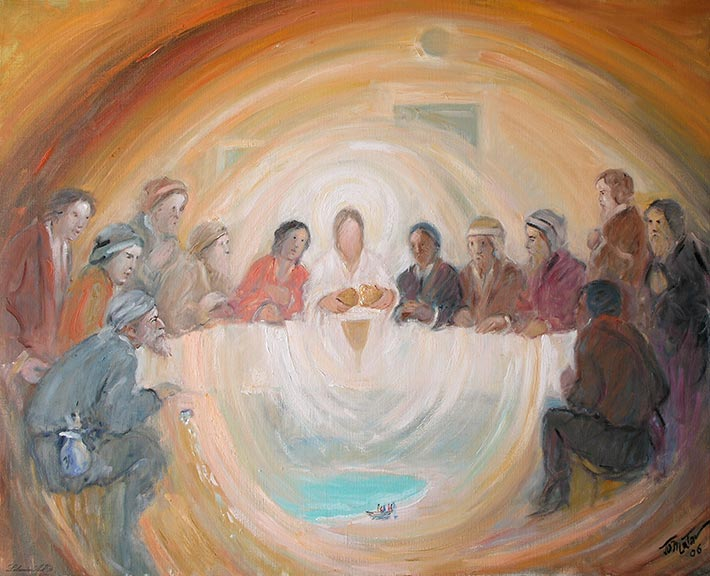
“I Am the Bread of Life” by Lebanese painter Joseph Matar

The Jews there began to grumble about him because he said, “I am the bread that came down from heaven.” They said, “Is this not Jesus, the son of Joseph, whose father and mother we know? How can he now say, ‘I came down from heaven’?”

“Stop grumbling among yourselves,” Jesus answered. “No one can come to me unless the Father who sent me draws them, and I will raise them up at the last day.It is written in the Prophets: ‘They will all be taught by God.’ Everyone who has heard the Father and learned from him comes to me. No one has seen the Father except the one who is from God; only he has seen the Father. Very truly I tell you, the one who believes has eternal life.

I am the bread of life. Your ancestors ate the manna in the wilderness, yet they died. But here is the bread that comes down from heaven, which anyone may eat and not die. I am the living bread that came down from heaven. Whoever eats this bread will live forever. This bread is my flesh, which I will give for the life of the world.” (New International Version)

Christians everywhere hold to Jesus as the Son of God, Lord of the universe, and Savior of all.

However, for most people who were following Jesus around in the first century, this was not their understanding of Christ. In his earthly ministry, Jesus spoke in ways that introduced people to who he really was and sought to bring them to a point of following him based on his identity. 

Jesus wanted the crowds to see him for who he really is – themselves for what they really needed – and follow him based on the deepest needs of their lives.

I believe Jesus is the hope of all nations and all people, and in him humanity’s most basic and profound needs are met for forgiveness, love, and purpose in life. To address this, I ask three basic philosophical and theological questions of life:

What should human beings seek in life?

The responses in history are legion. The ancient Greek philosopher Aristotle thought a proper appreciation for an ethical and virtuous life found in practical wisdom was where people’s most concerted efforts should be. 

Karl Marx, the father of communism and socialism believed the proletariat should use their heads and their hands to rise above their economic conditions and oppression.

In the late 1960’s, Bobby Kennedy said we ought to be working the hardest to achieve justice and not advance ourselves on the misfortunes of others.

In more recent times, the Harvard Business Review is continually on the lookout for the best ways of being efficient, productive, and making the most of time because work itself is paramount.

Jesus insisted that people are not to work for food that spoils, but for food that endures to eternal life. Christ positioned himself as the bread of life – the one who is able to sustain humanity and enable to thrive and flourish in life.

By literally feeding thousands of people, Jesus wanted the people to understand the source of life itself comes from him. Jesus aspired beyond providing a supper for folks – he desired the people to feast on himself – to ingest him, to take him into their lives in a deep and profound way as the fulfillment of all the hope and promises of the Old Testament. 

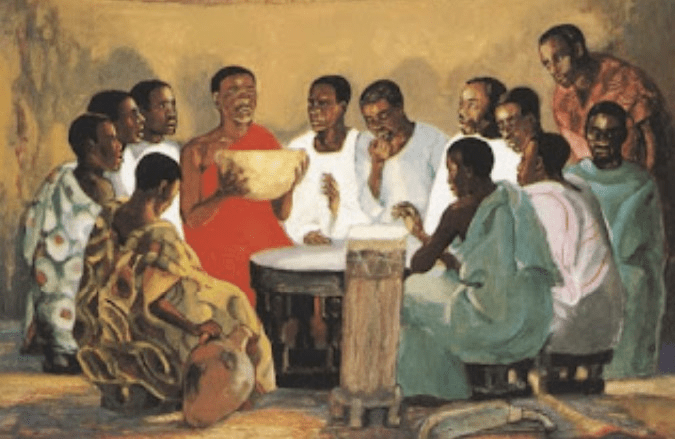
“The Lord’s Supper” by Cameroon artist Jesus Mafa, 1973

Jesus is the bread, the basic staple of life, that meets the cravings and needs of all people everywhere. Starving people, in both body and soul, find in Jesus a meal which keeps on giving, a feast of grace that is both delectable and unending.

The answer to my own question is that, for me, one’s highest pursuit and greatest quest is Jesus. Apart from Christ, I will starve. Furthermore, Jesus is not some cheap fast food off a value menu; he is real soul food to be ingested and enjoyed with others.

I believe people need Jesus. A passionate seeking of Jesus, to follow him, live for him, center life around him, is my most ardent desire. I do not simply desire Jesus for what he can do for me; I vigorously chase after him because if I do not have Jesus, I will die, I will starve to death. 

For me, Jesus is so much more than a nice addition to my life, like a new puppy; Jesus is Lord and Savior. I must consume him, or I will be completely undone, and I will not survive! Jesus is my bread, my food, my life!  I cannot survive on a daily crumb, but I feast on every word that comes from the mouth of Jesus because in Christ there is the life that is truly life.

What should human beings do in life?

Believe. To have and keep faith in the One God has sent, Jesus, is the primary “work” that pleases God.

Jesus communicated to the crowd that they can do so much more than follow him for another earthly meal – they can place their faith and hope in him for food that will last, food that will transcend the three-dimensional world.

Faith is more than an intellectual recognition to some facts about Christianity.

Belief is not about always having clarity and certainty to every facet and loci of Christian doctrine. Rather, Christian faith is a complete trust in Jesus as our hope and our life.

Education, economic uplift, political stability, and institutional peace and justice are important activities for this world. For the Christian, the accomplishment of these and so much more comes from the grace of God in Christ. As people come to the end of themselves with their homebrewed and half-baked attempts at being satisfied, Jesus stands at the door and knocks, the Living Bread who offers himself for humanity’s deepest needs.

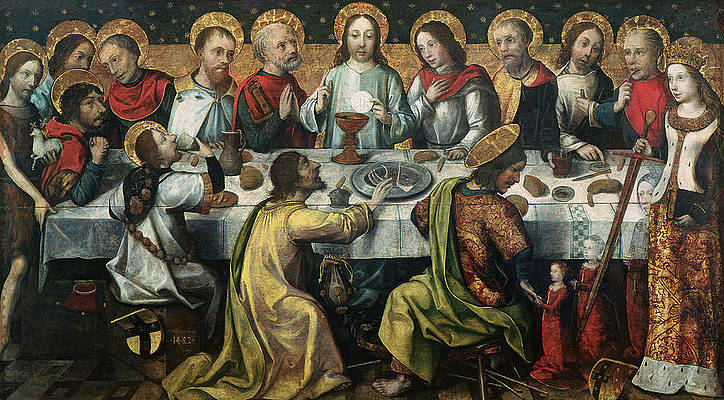
“The Last Supper” by Godefroy, 1482, C.E.

Giving kudos to Jesus might be nice, yet Christ himself cares about folks placing their trust in him for grace, forgiveness, and hope in their world. Jesus longs to reconnect people with God through giving himself as the means of making that happen.

All the works we do in this life, every good deed we accomplish, and each positive action we do are all helpful and necessary… and they all pale in comparison to the greatest work of all, to believe in Jesus Christ as the hope of this world, the hope of your family, the hope of the church, and the hope of your life. It’s all accessed by faith in the Son of God who loved me and gave himself for me.

Church buildings and furniture, stained-glass windows, pews, and even the Bible are not Jesus – they are simply and hopefully signs which point to him. They are all designed to lead us to Christ so that we may come to him. And coming to Christ is what the Lord’s Supper, Holy Communion, the Eucharist, and any other description you want to give about ingesting Jesus is about. The elements of bread and cup bring us to Christ so that we can experience Jesus and be joined to him by faith in a mystical union of human and divine in the unseen heaven.

Conclusion

Where will you find true satisfaction and hope? Probably not in the clearance aisle at Wal-Mart. Likely not in conforming to cultural Christianity or embracing generic forms of Jesus as merely a good teacher and moral example.

Furthermore, life’s ultimate satisfaction and hope are not to be found in a spotless house and perfect kids; in working more hours and making more money. Nor will we find contentment and peace in the radical independence of doing things my way.

Jesus is the Bread of Life. Through ingesting him, passionately pursuing him, believing in him, and coming to him in everything, we find the life that is truly life. Do not settle for any substitutes to Jesus. Come to the real person.

Lord God, you said that when we seek you with all our hearts, you will be found.  As the deer pants for streams of water, so we, your people, long for you in a dry and weary land.  We hunger and thirst for your righteousness.  We deeply desire your presence in all things. So, we die to ourselves and surrender to your will and way for us, by faith trusting you will come into our lives and completely take over. May your blessing rest upon us as we seek Jesus. Amen.

John 17:20-26 – The Need for and Importance of Unity

“My prayer is not for them alone. I pray also for those who will believe in me through their message, that all of them may be one, Father, just as you are in me, and I am in you. May they also be in us so that the world may believe that you have sent me. I have given them the glory that you gave me, that they may be one as we are one—I in them and you in me—so that they may be brought to complete unity. Then the world will know that you sent me and have loved them even as you have loved me.

“Father, I want those you have given me to be with me where I am, and to see my glory, the glory you have given me because you loved me before the creation of the world.

“Righteous Father, though the world does not know you, I know you, and they know that you have sent me. I have made you known to them and will continue to make you known in order that the love you have for me may be in them and that I myself may be in them.” (New International Version)

What is the Church’s identity?

What is the Church all about?

Why is the Church important?

The Church’s Identity

The Church is made up of people who have been reconciled to God through Christ’s sacrificial death on the cross and brought to new life in the Spirit. This special relationship that believers and Jesus enjoy with their God is a covenant relationship, and, so, the Church is a covenant community – receiving the blessings first promised to Abraham in the Old Testament that all nations would be blessed by grace through faith. 

God mercifully acts on the Church’s behalf through choosing, adopting, and redeeming people. This new covenant community receives the promises of God and exists to follow Jesus Christ in all things. 

So then, the Church is not a voluntary society, like other human institutions. Rather, it is divinely called by God. The Church is the community of the redeemed whom God has joined through the Spirit to Christ. Therefore, an individual, theologically speaking, does not join a church; instead, God joins the Church to Jesus.

The Nicene Creed

This ancient ecumenical creed describes the Church with four identifying marks:

  1. The Church is one. The unity of the Church comes from being in fellowship with God through Jesus in the Spirit – expressed through the bond of love and a common worship which includes the spiritually forming practices of preaching, liturgy, and sacraments. Since believers serve a triune God of Father, Son, and Spirit who exists in unity, so Christians are to work toward maintaining their unity through the bond of peace.
  2. The Church is holy. The Church is holy by virtue of Christ’s finished work. Therefore, the members of the Church are saints, called by God to live in holiness and participate with him in carrying out his purposes on earth. As God is holy, so believers are to be holy in all they do. Since Christians are holy through God’s justification in Christ, so the Church as saints must uphold justice in the world.
  3. The Church is catholic. This means that God’s people are found in all parts of the world throughout all times in history, including every race, class, gender, and ethnicity. Since the Church includes all kinds of people from different cultures, these believers must work together. The Church, across all kinds of denominations, ought to minister together to the total life of all people through gospel proclamation and good works done in the Spirit.
  4. The Church is apostolic. Apostolic means “to be sent.” The Church is not only a people who are gathered for worship and teaching; they are also sent into the world as salt and light to those who remain in darkness. Where the Church goes, the rule and reign of Jesus goes with them so that good news is spread to all nations.

The Church’s Mission

  1. The Church is called to love God.  The Church is the temple of the Holy Spirit, and the house where God dwells. The Church exists to glorify God and enjoy him forever. Christians are to develop intimacy with Jesus through the Spirit.
  2. The Church is called to love one another. The Church is the Body of Christ and is to be a haven for saints. The Church exists for community and is the place where believers are strengthened in faith through the proclamation of the Word in preaching and sacrament.
  3. The Church is called to love its neighbors. The Church is the people of God, being a hospital for sinners. The Church exists to serve the kingdom of God so that God’s benevolent and gracious rule might extend to all creation.

These three dimensions define the Church as being a “missional” community of redeemed persons who are concerned and focused on making disciples of Jesus Christ. The forward direction of the Church is to come ever closer to Christ through faith, be strengthened in that faith together through the Word of God, confidently stepping into the world to engage it with the love and grace of God so that others may come to faith in Jesus Christ.

The Church’s Importance

  1. The Church is a Trinitarian community, birthed as a free expression of God’s love through Word and Spirit. As people created in the image and likeness of God and redeemed for his purposes, believers reflect the image of the triune God.  The Church was important enough for Christ to die for.
  2. What the Church “does” flows from its identity as a redeemed community, being the people of God. So, then, the Church’s mission is not so much about establishing evangelistic programs so much as it is to listen to the Spirit of God and live in the power of the Spirit as it rubs shoulders with unbelievers.
  3. Just as the Father sent the Son, and the Son sent the Spirit, so the Church is sent into the world armed with the grace and love of God as if believers were ambassadors for Christ in a ministry of reconciliation.
  4. God has moved in a “downwardly mobile” way to bring reconciliation to all of creation. God has gathered the Church on earth to be sent as witnesses of Christ’s person and work through humility, meekness, and gentleness so that God’s mercy and peace might become realities in this world.

Therefore, the Church is to glorify the triune God by embracing its missional identity and mandate by making disciples of Jesus Christ through worship, community, and outreach. The Church is to aim its love toward God, one another, and neighbor through Jesus Christ in the power of the Spirit.

The Belhar Confession

This Reformed Confession of faith directly addresses the need for and importance of Christian unity, which was of great significance to Jesus in his high priestly prayer.

We believe in one holy, universal Christian church, the communion of saints called from the entire human family.

We believe that Christ’s work of reconciliation is made manifest in the church as the community of believers who have been reconciled with God and with one another.

We believe that this unity of the people of God must be manifested and be active in a variety of ways:

That we love one another;

That we experience, practice, and pursue community with one another; that we are obligated to give ourselves willingly and joyfully to be of benefit and blessing to one another;

That we share one faith, have one calling, are of one mind; have one God and Father, are filled with one Spirit, are baptized with one baptism, eat of one bread and drink of one cup, confess one name, are obedient to one Lord, work for one cause, and share one hope.

That together we come to know the height and the breadth and the depth of the love of Christ;

Together are built up to the stature of Christ, to the new humanity;

Together know and bear one another’s burdens, thereby fulfilling the law of Christ that we need one another and upbuild one another, admonishing and comforting one another;

That we suffer with one another for the sake of righteousness; pray together; together serve God in this world; and together fight against all which may threaten or hinder this unity.

Amen.

1 John 3:1-7 – Children of God, Loved by God

Welcome, friends! The Christian’s true status and identity cannot be changed any more than a tiger can change his stripes. An abundant life of love flows freely and organically from the person secure in their identity in Christ. Click the videos below and let us bask in the reality of our position in Jesus Christ….

1 John 3:1-7, Pastor Tim Ehrhardt
Who You Say I Am Lyric Video – Hillsong Worship, 2018. Written by Reuben Morgan and Ben Fielding.

May the love of the Lord Jesus draw you to himself.
May the power of the Lord Jesus strengthen you in his service.
May the joy of the Lord Jesus fill your hearts.
And may the blessing of God almighty – the Father, the Son, and the Holy Spirit – be among you and remain with you always. Amen.