Hang In There (1 Corinthians 7:17-24)

Nevertheless, each person should live as a believer in whatever situation the Lord has assigned to them, just as God has called them. This is the rule I lay down in all the churches. Was a man already circumcised when he was called? He should not become uncircumcised. Was a man uncircumcised when he was called? He should not be circumcised. Circumcision is nothing and uncircumcision is nothing. Keeping God’s commands is what counts. Each person should remain in the situation they were in when God called them.

Were you a slave when you were called? Don’t let it trouble you—although if you can gain your freedom, do so. For the one who was a slave when called to faith in the Lord is the Lord’s freed person; similarly, the one who was free when called is Christ’s slave. You were bought at a price; do not become slaves of human beings. Brothers and sisters, each person, as responsible to God, should remain in the situation they were in when God called them. (New International Version)

Whenever a person converts to Christianity and becomes a follower of Jesus, they experience new life. They don’t, however, experience reincarnation. They’re still the same person – not a different one altogether.

If the convert was married, it doesn’t matter if their spouse is a convert, or not; they’re still married and need to hang in there and remain married, albeit with a new way of being with them.

There is no magical wiping away of situations, circumstances, jobs, family, and relationships with becoming a Christian. Hopefully, a new orientation of grace, truth, and love begins to permeate it all. But all those people and situations are still there, and need to be dealt with.

So, the Apostle Paul gave some very practical social instruction to the Corinthian converts to Christ. He was rather pointed in communicating to them in not using the occasion of conversion to go someplace else and/or be with someone else. Nor is it proper to daydream of a reincarnated life; stick with the new redeemed life you have received.

The place where you became a Christian is the place to start living the Christian life. Obey God, follow the Lord’s words and ways, live out your redemption right there. Why? Because your new identity as belonging to God – not your marital status, vocation, or anything else – defines your life and determines how you are to live. And Paul was consistent on that instruction in all of the churches he established.

For the Jew in Paul’s day, circumcision was the defining mark of religion and identity. To marry an uncircumcised non-Jewish person was unthinkable; it defiled a relationship and made it impure. But the Apostle insisted that Jewishness (or non-Jewishness) isn’t actually the point of living the Christian life. What’s really important is obeying God’s call and following Christ’s commands, period.

Therefore, the convert ought to stay where they are – no matter what their marital status or social position is. Believing in Christ and following Jesus transcends all of it. Whether one is a slave, or not, faith obliterates any and all obstacles to God. If a person comes to faith and converts to Christianity, they still might be in human bondage; but they have freedom in Christ.

Hopefully, the slave’s spiritual freedom will work itself out in actual physical freedom. The point, however, is that – whether slave or free – the person belongs to God and neither bondage nor freedom will ever hinder the individual from realizing spiritual redemption.

In many different ways, we are all both slaves and free persons. The best situation is to be a bondservant of Christ and a slave to no one else. Yet, if circumstances are not ideal, the reality is that one’s union with Christ can never be severed by any human institution or authority.

Once we convert, and enter into a life-giving free relationship with God in Christ, Paul exhorts all believers to be vigilant: Don’t slip back into old ways of spiritual bondage and capitulate to a shameful society. After all, Christ – whom the convert serves – has paid the true ultimate sacrifice of himself on the cross for the sake of all humanity.

So, hang in there, stay in the place and position where you were called by God, and reorient your life with Christ in the middle of it. In doing this, every believer can persevere through adversity, hold onto the gift of faith, and make a difference in the society to which one belongs.

Blessed and holy God, grant us the Spirit of wisdom and discernment so that we may know Christ better and love you more. Give us an understanding heart so that we may be open to hear your divine voice, and the courage to walk in the way of your commands.

Use us, your people who belong to Christ, to be your hands and feet – your voice and heart, so that we may be a channel through which you pour out your grace to help others – may we decrease and Christ increase, so that Jesus is seen in our lives, through the power of the Holy Spirit. Amen.

Baptism of the Lord (Mark 1:4-11)

The Baptism of Jesus, by Rosalind Hore

So John the Baptist showed up in the desert and told everyone, “Turn back to God and be baptized! Then your sins will be forgiven.”

From all Judea and Jerusalem crowds of people went to John. They told how sorry they were for their sins, and he baptized them in the Jordan River.

John wore clothes made of camel’s hair. He had a leather strap around his waist and ate grasshoppers and wild honey.

John also told the people, “Someone more powerful is going to come. And I am not good enough even to stoop down and untie his sandals. I baptize you with water, but he will baptize you with the Holy Spirit!”

About that time Jesus came from Nazareth in Galilee, and John baptized him in the Jordan River. As soon as Jesus came out of the water, he saw the sky open and the Holy Spirit coming down to him like a dove. A voice from heaven said, “You are my own dear Son, and I am pleased with you.” (Contemporary English Version)

Why is the baptism of Jesus important?    

The baptism of the Lord is a regular staple each year on the Christian Calendar, because Christ’s baptism is a theologically profound event that announces the fact of his divinity in a dramatic way. The story of his baptism helps us understand Christ’s identity, as well as his mission.

Because God the Father acknowledged Jesus as God the Son, we are encountering God’s will for us through the words and actions of Christ. Jesus is the hinge upon which all history turns. The centrality of Jesus for everything we say and do is confirmed and expected through the event of his baptism.

Baptism is a ritual that signals new life. Jesus came to be baptized by John in the Jordan River – not because he personally needed to repent of sin – but so that he might identify with us as humans and signal for us the true way of life for people.

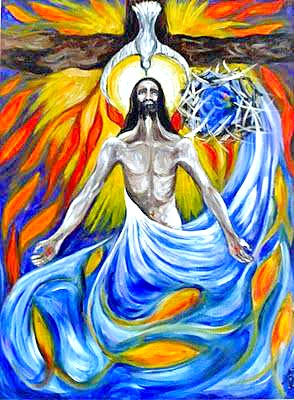
Jesus’ Baptism, by Laura James

With the Father’s affirmation of Christ, the Lord Jesus is our authority. All authority on heaven and earth has been given to him. He is the author and finisher of our faith. So we must pay careful attention to Jesus.

Here we are, two millennia removed from the earthly ministry of Christ. For some, the name of Jesus might be so familiar that they end up ignoring him. Or, others might become so disappointed with Jesus that, over time, they simply slip away from him. That’s why the author of the book of Hebrews exhorted: 

We must give our full attention to what we were told, so we won’t drift away. The message spoken by angels proved to be true, and all who disobeyed or rejected it were punished as they deserved. So if we refuse this great way of being saved, how can we hope to escape? The Lord himself was the first to tell about it, and people who heard the message proved to us that it was true. (Hebrews 2:1-3, CEV)

By remembering our own baptisms, and the authoritative claim Christ has upon us, we are able to keep what is most important in front of us at all times.

Why is the descent of the Holy Spirit significant?

If God the Father established the authority of Jesus over all things, then the Holy Spirit coming upon Jesus empowered him to exercise that authority over everything, especially the demonic realm. Jesus was given the Spirit so that he would confront evil in the world.

Our own baptisms are a participation in the baptism of Christ. We receive the same power. We are called to the same practice of self-denial in order to confront evil in our lives and in the world. The descent of the Spirit in Christ’s baptism opens to us a road of carrying our cross daily, and losing our lives in order to save them.

In Christ, we died to guilt and shame. We were baptized into Christ, and were therefore baptized into his death.  That means Jesus has opened the way for us to live a new life and no longer be slaves to sin. It furthermore means that we have been given the Spirit to deal with the continuing presence of sin in this life. 

Through Jesus Christ the Spirit of life set us free from sin and death. Therefore, we have been given the power to resist the devil and set our minds on what the Spirit desires. 

Baptism of Christ, by He Qi

So, we have an obligation, and it’s not to the sinful nature. Our responsibility is to put to death the misdeeds of the body. We can do this because we have not been given a spirit that makes us slaves to fear, but have received the spirit of sonship. (Romans 8:1-17)

Thus, God is not only Father of Jesus, but our Father, as well. We can cry “Abba and have all the help of heaven behind us in our quest to follow Jesus. This is all possible because of the descent of the Spirit in Christ’s baptism – a baptism that we participate in through our own baptisms.

How does heaven opening help me today?

Heaven was ripped and torn open, letting us know the striking reality that God does not remain far away, but has come near to us in the Son, the Lord Jesus.

Long ago in many ways and at many times God’s prophets spoke his message to our ancestors. But now at last, God sent his Son to bring his message to us. God created the universe by his Son, and everything will someday belong to the Son. God’s Son has all the brightness of God’s own glory and is like him in every way. By his own mighty word, he holds the universe together. After the Son had washed away our sins, he sat down at the right side of the glorious God in heaven. (Hebrews 1:1-3, CEV)

Heaven was again ripped open at the death of Christ. The curtain of the temple that separated the inner sanctuary from everything else was torn in two from top to bottom – signifying that once and for all, God is near, and has become close to us in the person of Jesus Christ.

So whenever we are in need, we should come bravely before the throne of our merciful God. There we will be treated with undeserved grace, and we will find help. (Hebrews 4:16, CEV)

What is our appropriate response to the baptism of the Lord?

Since Jesus is the rightful ruler of the universe; the authority over all things; a faithful high priest always living to intercede for us; the power to transform and give new life; the Deliverer from sin, death, and hell; then our proper response is confession, repentance, and the expectation of change.

The Lord’s baptism exposes all the things we rely upon other than Jesus, such as our own ability to set goals and accomplish them through sheer willpower; ideas and ingenuity; hard work and experience.

Yet we can rely on Jesus, and have the sort of change that he can bring. Rather than expecting everyone else, and every circumstance to change, God calls us to change through the empowering presence of the Holy Spirit – the same Spirit given to Jesus.

We have the opportunity and the invitation to trust Jesus. Just as it took humility for Jesus to be baptized by John in the Jordan River, so it takes humility for us to come to Christ and admit our need for help and inner transformation.

Almighty ever-living God,
who, when Christ had been baptized in the River Jordan,
and as the Holy Spirit descended upon him,
solemnly declared him your beloved Son,
grant that your children by adoption,
reborn of water and the Holy Spirit,
may always be well pleasing to you. Amen.

A Great Number of People Believe (Acts 11:19-26)

Now those who had been scattered by the persecution that broke out when Stephen was killed traveled as far as Phoenicia, Cyprus and Antioch, spreading the word only among Jews. Some of them, however, men from Cyprus and Cyrene, went to Antioch and began to speak to Greeks also, telling them the good news about the Lord Jesus. The Lord’s hand was with them, and a great number of people believed and turned to the Lord.

News of this reached the church in Jerusalem, and they sent Barnabas to Antioch. When he arrived and saw what the grace of God had done, he was glad and encouraged them all to remain true to the Lord with all their hearts. He was a good man, full of the Holy Spirit and faith, and a great number of people were brought to the Lord.

Then Barnabas went to Tarsus to look for Saul, and when he found him, he brought him to Antioch. So for a whole year Barnabas and Saul met with the church and taught great numbers of people. The disciples were called Christians first at Antioch. (New International Version)

The earliest of believers in Jesus Christ were Jews. Jewish converts to Christianity were not typically received well amongst their families, communities, and culture. So, when Stephen, one of those converts, retold Jewish history emphasizing a stubborn lack of awareness amongst their ancestors – and then connected it with present day attitudes – a full fledged persecution of Christians broke out.

As a result, the Church – located almost exclusively in Jerusalem – was scattered throughout Judea and across the Roman Empire in a Christian diaspora. In Christ’s ascension, he told the disciples that they would be witnesses beginning at Jerusalem, and then to Judea and outside the Middle East. Little did the small band of believers know, at the time, how that plan would come about.

As it turns out, although life was hard being a Christian refugee in a strange location, the believers spread the good news of Jesus wherever they went. Thus, gospel seeds were planted all across the land.

There is no place we can go where God is not already there.

And so, the displaced Christians discovered God was with them in their sojourning. Their faithful proclamation of good news was the impetus to bringing about many more converts to Jesus Christ.

What was happening in Judea and the Empire came back to the church leaders in Jerusalem. They then, smartly, sent one of their own, Barnabas, to Antioch in order to check out the scene and bring the new believers some encouragement. Since Barnabas was the consummate encourager, the church was emboldened, with even more converts entering into faith in Christ.

Barnabas, as an encourager, had the knack for knowing what he could do and not do; he also knew someone who could supply what he couldn’t do. He was so sure that Saul (Paul) was the right person for the job that he went to Tarsus – which was about 400 miles from Antioch – in order to find him and get him to the new believers as soon as possible. The result was an explosion of fresh converts coming to faith and into the church.

It’s no coincidence that the man with the biggest heart in the church is described in today’s text as a good man who was filled with the Holy Spirit. The Spirit is the One who makes all the difference with the growth of Christianity and the establishment of the Church.

Barnabas could see the evidence of God’s grace in the city of Antioch because he was filled to the full, with God’s own Spirit. He observed people with changed lives; an incredibly diverse and connected international community of believers; and so, encouraged them all in this good work brought about by the Spirit of God.

More and more people were added to the fellowship because of the robust spiritual dynamic that took place. This was not a matter of people using slick marketing strategies to make the name of Jesus Christ known; instead, the adding was all God. The Lord added to the Lord, and not people adding people to the Church. In other words, God is both the subject and the object, the source and the goal, of all good Christian ministry.

Then, when the Lord connected Barnabas together with Saul (Paul) who was also filled with the Holy Spirit and many spiritual gifts from God, the result was nothing less than large numbers of persons coming to faith in Christ and being added to the Church.

The believers in Antioch were so chatty about their faith that the first reference of being called “Christians” were to these converted Jewish believers in Jesus. Even though the moniker of “Christian” was probably a term of derision and meant to mock the Antiochene Church, it stuck, and was held up proudly by the believers. They were completely okay with being called “little Christ’s.”

After all, since they were truly Christ-centered in all they did, it was a fitting title for the fledging and growing Church. It clearly identified them as the people who serve and follow Christ. We, too, these many centuries later, have the very same Spirit of God that they did – and therefore, the same opportunity to speak of Jesus and see the Holy Spirit do the work of adding to the Church.

We pray, almighty God, that all who confess your Name may
be united in your truth, live together in your love, and reveal
your glory in the world.

Guide people everywhere, and of all the nations, in the
ways of justice and peace; that we may honor one another
and serve the common good.

Give us all a reverence for the earth as your own creation,
that we may use its resources rightly in the service of others
and to your honor and glory.

Bless all whose lives are closely linked with ours, and grant
that we may serve Christ in them, and love one another as he
loves us.

Comfort and heal all those who suffer in body, mind, or
spirit; give them courage and hope in their troubles, and
bring them the joy of your salvation.

Lord, in your mercy, hear our prayer. Amen.

Family Dynamics (Matthew 12:46-50)

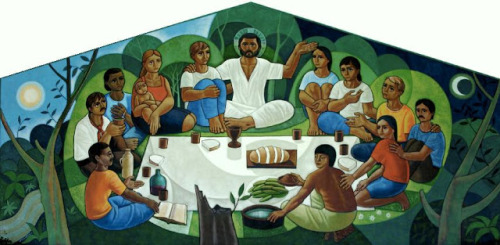
En la Cena ecológica del Reino (At the Ecological Kingdom Dinner) by Spanish artist Cerezo Barredo

While Jesus was speaking to the crowds, his mother and brothers stood outside trying to speak with him.Someone said to him, “Look, your mother and brothers are outside wanting to speak with you.”

Jesus replied, “Who is my mother? Who are my brothers?” He stretched out his hand toward his disciples and said, “Look, here are my mother and my brothers. Whoever does the will of my Father who is in heaven is my brother, sister, and mother.” (Common English Bible)

Jesus obviously did not get the cultural memo that blood is thicker than water.

When his own blood family were waiting outside for him, Jesus used the occasion to speak of what makes up a true follower of God. Christ boldly asserted that his true family is made up of people who do God’s will. By saying this, Jesus brought the point home that the kingdom of God turns on obedience.

Rather than merely confessing a belief, or appealing to a family heritage of faith, Jesus said that a genuine believer in God is one who listens to God’s words and then promptly obeys them. Therefore:

A Christian is defined by allegiance to Jesus, and not by having a certain bloodline. 

Identity determines activity. For example, if I identify myself primarily as…

  • a worker at my job, my activity will show it – I will spend long hours at my labor, and will do whatever it takes to please my boss and gain promotions.
  • an athlete, I will spend long hours honing my skills, and do whatever it takes to please the coach and to win.
  • a spouse and a parent, I will focus most of my attention on my family and seek to please them in all things. 

But if my identity is first and foremost as a Christian, I will seek to please Jesus. With my identity in Christ:

  • I will view my job as an opportunity to express the ethics of God’s kingdom, as a calling from God, and as a means for God to transform me for his glory.
  • I will view athletics as means to glorify God, and not as an end in and of itself but as a special gift for God to teach me about the importance of community and working together. 
  • I will view my kids as belonging to God and I will steward the trust of children given me by doing whatever it takes to teach and train them in the way of Jesus. I will thank God for my family and not confuse them with being God by idolizing them.

Jesus was inside a house, with his family on the outside. So, why were the family members of Jesus not inside the house sitting at his feet, taking the posture of a disciple?

The disciple Matthew wanted to communicate more than physical distance between Jesus and his physical family – being “outside” was meant to convey the posture of Christ’s family as spiritually distant, skeptical of him, and indecisive about who he was and what he was up to. The disciple Mark made this spiritual and emotional distance clear:

Jesus entered a house. A crowd gathered again so that it was impossible for him and his followers even to eat. When his family heard what was happening, they came to take control of him. They were saying, “He’s out of his mind!” (Mark 3:20-21, CEB)

Christ’s earthly family were not looking for Jesus to give them warm-fuzzies and have a big family hug. They were there to essentially say to him, “Cut it out, Jesus, because you’re acting like a nut-cake and embarrassing us all!”

Jesus was saying that identifying only with a biological family leads to only pleasing that family. However, identifying with Jesus leads to a radical form of following God that seeks to please him instead of submitting to family practices, mores, and beliefs which are inconsistent with the kingdom of God. 

Ethiopian Orthodox Church depiction of Christ and his disciples

For the Christian, the church is the family of God, and we are to act consistent with being in such a family.  We are to pursue God’s will, serve one another, and adopt outsiders into our family. The church is a family, not a restaurant. When we go to a restaurant, we either like the food and the service, or not. If the experience was unpleasant, we might complain to the waitress and may or may not come back. Try doing that with your mother and see where it gets you! 

As a biological family, we are committed to each other. There is no complaining about mom because of dad’s wrath. Instead, we are expected to clear our plates and put them in the dishwasher, to sweep the floor and clean the table, and to work together for the benefit of the entire family. In the same way, following Jesus means being committed to his family, the church.

Priority is to be given in doing God’s will, regardless of blood, because obedience to Christ identifies us as being in the family of God. Our actions and the way we live points to what we honestly believe and where our commitments truly lie. 

The first step of God’s desire for us is quality focused time in sitting at Christ’s feet and listening to him, because this is at the heart of all Christian discipleship. We can only do God’s will if we have clearly heard it; and we can only hear God’s will by taking the time to be at the feet of Jesus. 

Both listening and doing are necessary. Listening without engaging the world is a failure of mission; and doing without first listening leads to misguided acts and eventual burn-out. Allow Jesus to call the shots and let him instruct us so that we can live wisely and obediently. 

Jesus did not devalue blood relatives as irrelevant. Rather, the kingdom of God seeks to restore and redeem all things, including family. Both church and family are important. The relationships within each are to be nurtured.

The family of Jesus, the church, is important because Christ suffered and died for her. So, we are to be committed to the church, love the church, and serve the church because we are family. If we have a good grasp of this, we will make decisions based in what we believe God’s will is, instead of whether a relative will get upset, or not. 

We need to persistently pray for spiritually lost family members, and those whom we are estranged from. Most families have at least a few toxic persons in their orbit. Here is how we might pray for them:

  • That God will arrange divine appointments between them and others who love Jesus.
  • That God will draw them to the mercy of Christ.
  • That God will hinder the devil’s schemes against them.
  • That they will understand and respond to the good news of God’s grace.

O God, you made us in your own image and redeemed us through Jesus your Son: Look with compassion on the whole human family; take away the arrogance and hatred which infect our hearts; break down the walls that separate us; unite us in bonds of love; and work through our struggle and confusion to accomplish your purposes on earth; that, in your good time, all nations and races may serve you in harmony around your heavenly throne; through Jesus Christ our Lord. Amen.