Matthew 25:31-46 – Meeting Jesus

On a bright Sunday morning, Lefty and his wife Goatrude were sitting at home enjoying a leisurely cup of coffee together. Lefty was slowly going through some of his emails.

And then, it happened.

“Oh, my goodness, look at this!” said Lefty to Goatrude. “I got an e-mail from Jesus! It says he will be here at 10am on Sunday. Egad! That’s any minute now!”

“The house is a mess! Hurry! Let’s get this all picked up.” said Goatrude. “And, for God’s sake, where is that big Bible? It needs to be here on the coffee table when Jesus gets here!”

“I think I know where that Bible is….” said Lefty. After rummaging around a junk closet, Lefty found the Bible dusted it off, and placed it prominently on the coffee table as the centerpiece of the living room.

As Goatrude and Lefty were hurriedly trying to make everything just right for Jesus, there was a knock at the door.

“That must be Jesus!” said Goatrude. “Answer it, Lefty. And, for goodness sake, stand up straight and be polite. We want Jesus to see us at our best.”

Lefty answered the door, surprised to see a ragged looking young man on the step.

“I’m sorry to bother you on a Sunday morning, but I haven’t had anything to eat all weekend. Might you have some food to spare?”

Perturbed with this interruption, Lefty answered the young man harshly. “No, I don’t. You need to go, right away. I have an important guest coming, and he’ll be here anytime now.” And he slammed the door shut.

Lefty had barely began getting back to tidying the living room when another knock came at the door.

“He’s here!” said Goatrude, moving quickly toward the door. But when she opened it, there stood a harried looking woman.

“Hello. My car broke down and I can’t get it started. And my cell phone died. Might I come in for just a few minutes so that I can get a bit warmed up and make a phone call?” said the woman.

Goatrude rudely responded, “We all have problems lady. I’ve got my own right now. You try and get ready for a visit from Jesus at the last minute. Try someone else.” And with that, Goatrude shut the door.

Lefty and Goatrude continued their hasty preparations for a visit from Jesus, when yet a third knock came at their door. This time, they answered it together, believing this to be Jesus for sure.

But when they opened the door, a frantic husband immediately said, “My wife just fell on the sidewalk. Please help me!”

“For God’s sake, man, we’re about to have Jesus here! We can’t be seen with a woman lying in front of our house! Get her up and go next door. And make it quick!”

Together, Goatrude and Lefty shut the door. Then, they sat down and anticipated Jesus to show.

Minutes pass… It’s now 10:15 and no Jesus. So, Goatrude, looking at Lefty, says, “I never figured Jesus to be somebody who is late. Maybe he got held up.”

“Hey, how about if I open this Bible and read something. When Jesus gets here, we’ll impress him with some knowledge. We’ll be the talk of the town, hosting Jesus.”

So, Lefty opened the big book, randomly turned to a page, and began reading….

“When the Son of Man comes in his glory, and all the angels with him, he will sit on his glorious throne. All the nations will be gathered before him, and he will separate the people one from another as a shepherd separates the sheep from the goats. He will put the sheep on his right and the goats on his left.

“Then the King will say to those on his right, ‘Come, you who are blessed by my Father; take your inheritance, the kingdom prepared for you since the creation of the world. For I was hungry, and you gave me something to eat, I was thirsty, and you gave me something to drink, I was a stranger and you invited me in, I needed clothes and you clothed me, I was sick, and you looked after me, I was in prison, and you came to visit me.’

“Then the righteous will answer him, ‘Lord, when did we see you hungry and feed you, or thirsty and give you something to drink? When did we see you a stranger and invite you in, or needing clothes and clothe you? When did we see you sick or in prison and go to visit you?’

“The King will reply, ‘Truly I tell you, whatever you did for one of the least of these brothers and sisters of mine, you did for me.’

“Then he will say to those on his left, ‘Depart from me, you who are cursed, into the eternal fire prepared for the devil and his angels. For I was hungry, and you gave me nothing to eat, I was thirsty, and you gave me nothing to drink, I was a stranger, and you did not invite me in, I needed clothes and you did not clothe me, I was sick and in prison and you did not look after me.’

“They also will answer, ‘Lord, when did we see you hungry or thirsty or a stranger or needing clothes or sick or in prison, and did not help you?’

“He will reply, ‘Truly I tell you, whatever you did not do for one of the least of these, you did not do for me.’

“Then they will go away to eternal punishment, but the righteous to eternal life.” (New International Version)

Revelation 3:14-22 – Here I Am!

To the angel of the church in Laodicea write:

“These are the words of the Amen, the faithful and true witness, the ruler of God’s creation. I know your deeds, that you are neither cold nor hot. I wish you were either one or the other! So, because you are lukewarm—neither hot nor cold—I am about to spit you out of my mouth. You say, ‘I am rich; I have acquired wealth and do not need a thing.’ But you do not realize that you are wretched, pitiful, poor, blind and naked. I counsel you to buy from me gold refined in the fire, so you can become rich; and white clothes to wear, so you can cover your shameful nakedness; and salve to put on your eyes, so you can see.

Those whom I love I rebuke and discipline. So be earnest and repent. Here I am! I stand at the door and knock. If anyone hears my voice and opens the door, I will come in and eat with that person, and they with me.

To the one who is victorious, I will give the right to sit with me on my throne, just as I was victorious and sat down with my Father on his throne. Whoever has ears, let them hear what the Spirit says to the churches.” (New International Version)

Christianity holds that the Lord Jesus is the rightful sovereign of the universe. Christ uses that power and authority to rule with justice and equity. He delivers people from guilt, shame, disobedience, and the realm of darkness. All of life hinges on God’s ability, not ours.

Yet, having said that, this does not mean we lack responsibility before God, as if whatever is going to happen is going to happen, and I’m just a passive spectator.

Today’s New Testament lesson is Christ’s words to the ancient church in the city of Laodicea. It seems the church folk in that city were less than zealous about their faith. Maybe they thought God was going to do whatever God was going to do and felt no compunction to act. Perhaps the Laodiceans believed that if they were “hot” that they’d have to go to Africa, be around snakes, and wear polyester all day.

So, likely out of some fear they might lose their wealth or livelihood, the church took a “Meh, whatever” kind of response to the Christian life. It appears the Laodiceans thought God wasn’t even noticing, resulting in a middle of the road approach of just getting by.

Well, of course, the Laodicean believers got noticed – enough to warrant a letter to them from Jesus. I’d say someone was watching! 

Whereas we might get frustrated with milquetoast responses and try to light a fire under the passive person’s behind, the response of Jesus to the Laodiceans was to calmly stand at the door and knock, waiting to be invited in. 

Jesus didn’t go full emergency response on them and break down their church door, forcefully going inside to assert his will. Rather than imposing himself on the Laodiceans, the Lord of all simply and persistently knocked, patiently waiting for a response. 

As it turns out, the ones not paying attention are us, not Jesus. Christ longs for meaningful fellowship and interaction with us. Jesus wants us to respond to divine overtures to meet with him. The Lord is at your doorstep exclaiming, “Here I am!”

Will you let him in today? Or are you afraid that he will take something away from you?

God is trying to get our attention. The Lord does it through all kinds of ways – adverse circumstances, other people (even and especially the ornery ones) – knocking on our door. Yes, God is the one knocking on our door – and not the other way around. 

This is anything but an aloof God who is unconcerned for what is going on in our lives. In fact, just the opposite is true. We seem a bit unconcerned, even “lukewarm” about God, not noticing the good purposes being worked out all around us.

Jesus stands at the door. We don’t get many post-resurrection accounts of Jesus standing. That’s because sitting is a sign and symbol that the work is finished. And, indeed, the work of the cross is done. We are the ones sitting in the recliner. We are the people who need to be standing because our work is not yet done.

So, amazingly, Jesus gets up from his throne, comes to us, standing at the door knocking, graciously meeting us when we aren’t moving.

The watershed issue of our day, from a Christian perspective, is our response, or lack thereof, to Christ’s overtures to let him in our house.

Maybe we can’t hear him because we are busy vacuuming. Perhaps we don’t hear because of the headphones we have on. It could be that we are just too deaf and dull to notice the racket going on at our front porch while we watch TV. Whatever it is, the only cure for being lukewarm is inviting Jesus into the house. 

If Jesus is on the outside, he wants to be on the inside. He could break your door down if he wanted to, but he chooses to respond to the invitation for hospitality. Jesus wants to meet with us.

For the times we neglect to care for our brothers and sisters in Christ, please forgive us, Lord. 

For the times we fail to welcome new people who look or act different from ourselves, please forgive us, Lord. 

For the times we neglect to notice and pay attention to the Spirit, please forgive us, Lord.

And for the times we pretend not to be home when you are knocking, please forgive us, Jesus.

Lord, have mercy. Christ, have mercy, Lord, have mercy upon us, and grant us your peace. Amen.

Luke 5:27-32 – Included Through Hospitality

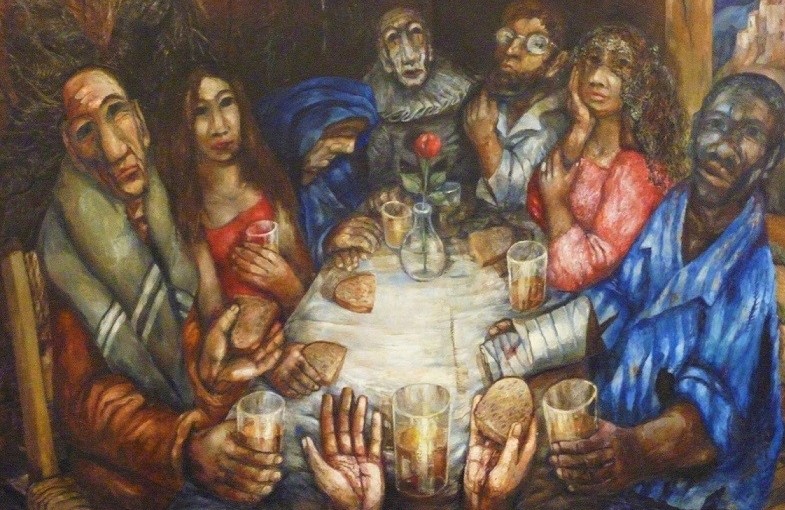
Jesus Eats with Tax Collectors and Sinners by Sieger Köder (1925-2013)

After this, Jesus went out and saw a tax collector by the name of Levi sitting at his tax booth. “Follow me,” Jesus said to him, and Levi got up, left everything and followed him.

Then Levi held a great banquet for Jesus at his house, and a large crowd of tax collectors and others were eating with them. But the Pharisees and the teachers of the law who belonged to their sect complained to his disciples, “Why do you eat and drink with tax collectors and sinners?”

Jesus answered them, “It is not the healthy who need a doctor, but the sick. I have not come to call the righteous, but sinners to repentance.” (New International Version)

Eating meals together in the Ancient Near East was much more than simply taking in sustenance and having some social interaction. It was also a deeply religious affair of spiritual connection and sharing.

So, it was rather surprising for a lot of people, not just the religious leaders, that Jesus freely ate and drank with people of dubious reputation.

Tax collectors were a hated lot by the Jewish people. Most were Jewish themselves, and so, were understandably seen as traitors and turncoats, colluding with the Romans to squeeze as much tax money out of their compatriots as they could.

Jesus actually calls one of these despised persons into his group. Then, even eats with him and his Mafia friends. This is a radical and unheard of inclusion, completely reversing the exclusion tax collectors had from the Jewish community and synagogue.

The religious leaders, of course, want an explanation for such unacceptable behavior by Jesus. He gave them a simple answer, short and sweet: It’s unhealthy people who need help, not healthy ones. I came to help.

For the malady of sin with all its guilt, shame, and exclusion, a powerful remedy is the act of hospitality.

“Hospitality is not to change people, but to offer them space where change can take place.”

Henri Nouwen

The word “hospitality” literally means “love of the stranger.” It is an invitation to accept another into our home that we do not know very well and befriend them. 

Hospitality is what Jesus did. Because of our sin and disobedience, humanity we were estranged from God – we were on the outside. But because of God’s great love, the Son was sent, the Lord Jesus, to come and dwell among us. 

Jesus invited us into the life of God. He is now standing at the door and knocking, and we are to invite Jesus in (Revelation 3:20). Christ has so closely identified with his people that when we invite others into our homes and lives, we are inviting Jesus in. 

Keep in mind that for Matthew to invite Jesus into his life and home cost him time, effort, and negative attention from those not around the table. There was no grumbling or belligerence by neither the tax collectors nor Jesus. 

In an ideal world, we always receive something back for our own work of hospitality – an invitation from the other person, or, at least, a simple thank you. But that does not always happen, and it cannot be the driving reason why we practice hospitality. 

Hospitality must be a work of love that comes from a heart that has been touched by the hospitality of God. Our earthly hospitality is to be a form of saying “thank you” to God for his great grace to us. And that is precisely what I believe Matthew was doing with his own hospitality. 

Complaining comes when we expect to receive and don’t get it. Yet, if you truly receive another person as though she were Christ himself, you will not complain but will rejoice in your service. Jesus has said, “Whoever receives you, receives me.” (Matthew 10:40)

In ancient Christianity, a concrete expression of love to other believers was providing food and shelter for Christians traveling throughout the Roman Empire. Many times, the traveling strangers were itinerant evangelists spreading the message of the gospel from place to place (3 John). 

At other times, believers were deprived of some basic necessities due to the occasional waves of persecution that broke out. They were often poor and needy because of their situation, and of being different; and the townspeople were not typically hospitable.  So, Christians had to rely on the love and hospitality of those believers they could connect with who had the means to help.

Hospitality is an important means of showing and providing love. 

Contribute to the needs of God’s people, and welcome strangers into your home. (Romans 12:13, CEB)

One of the qualifications for church leadership is that they are hospitable.

An elder… must be respected by others. He must be ready to help people by welcoming them into his home. (1 Timothy 3:2, ERV) 

There is a great need for hospitality in our world. Many people are lonely, isolated, and withdrawn, sometimes even excluded because of their mental illness or struggles with addiction. Being in a pandemic certainly doesn’t help that situation whatsoever. They have no one to talk to about important matters.

Hospitality cuts both ways for us. We are to invite the lonely into our hearts and homes; and the lonely are to invite others into their hearts and homes, instead of waiting for somebody to just show up.

Jesus fully understood that eating a meal together with Matthew and the other tax collectors was a sacred affair – communicating mutual acceptance, care, and friendship. This is why the religious leaders had such difficulty seeing Jesus eat with “sinners.” By eating with outsiders and those excluded from the community, Jesus was broadcasting his love and acceptance of such persons.

Our dining room tables are little mission stations. 

When my wife and I were new believers, there was a Christian couple who often had us into their home. Both of us had learned some unhealthy relations through our families of origin.  Here we were, not really knowing what a Christian family should look like. 

Through hospitality, eating together and sharing around the table, we began to learn how a family dedicated to Christ lives. We learned life lessons that we probably could not have learned in any other way.

Jesus, on the cusp of his Passion, enjoyed a meal with his disciples. He said…

While they were eating, Jesus took a loaf of bread, and after blessing it he broke it, gave it to the disciples, and said, “Take, eat; this is my body.” Then he took a cup, and after giving thanks he gave it to them, saying, “Drink from it, all of you; for this is my blood of the covenant, which is poured out for many for the forgiveness of sins.” (Matthew 26:26-28, NRSV)

One thing Jesus meant by those words is that, eating and ingesting the elements of bread and wine, serve as a very tangible way of understanding what life is to be like. 

We are to take Jesus into the depths of our lives. We are to ingest him, that is, to engage in a very close and intimate relationship with him to the degree that the two of us cannot ever be separated. 

The same is to be true of our relationship with one another in the Body of Christ, the Church.  We are to do life together. We are to enjoy eating and drinking together. 

We are to share with others, in a radical act of hospitality which emulates our Lord, not only our food, but our hearts.

Let your heart and your home be open today.

Soli Deo Gloria

Luke 4:14-30 – Why Is Our Ministry Important?

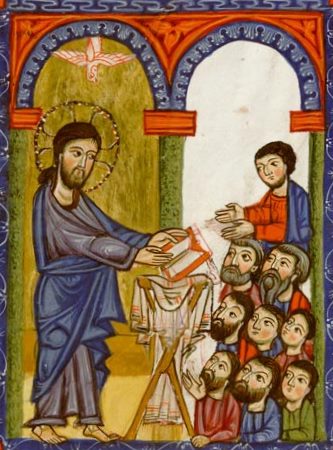
Jesus Unrolls the Scroll in the Synagogue, by French artist James Tissot (1836-1902)

Jesus returned to Galilee in the power of the Spirit, and news about him spread through the whole countryside. He was teaching in their synagogues, and everyone praised him.

 He went to Nazareth, where he had been brought up, and on the Sabbath day he went into the synagogue, as was his custom. He stood up to read, and the scroll of the prophet Isaiah was handed to him. Unrolling it, he found the place where it is written:

 “The Spirit of the Lord is on me,
    because he has anointed me
    to proclaim good news to the poor.
He has sent me to proclaim freedom for the prisoners
    and recovery of sight for the blind,
to set the oppressed free,
     to proclaim the year of the Lord’s favor.”

Then he rolled up the scroll, gave it back to the attendant and sat down. The eyes of everyone in the synagogue were fastened on him. He began by saying to them, “Today this scripture is fulfilled in your hearing.”

All spoke well of him and were amazed at the gracious words that came from his lips. “Isn’t this Joseph’s son?” they asked.

Jesus said to them, “Surely you will quote this proverb to me: ‘Physician, heal yourself!’ And you will tell me, ‘Do here in your hometown what we have heard that you did in Capernaum.’”

“Truly I tell you,” he continued, “no prophet is accepted in his hometown. I assure you that there were many widows in Israel in Elijah’s time, when the sky was shut for three and a half years and there was a severe famine throughout the land. Yet Elijah was not sent to any of them, but to a widow in Zarephath in the region of Sidon. And there were many in Israel with leprosy in the time of Elisha the prophet, yet not one of them was cleansed—only Naaman the Syrian.”

All the people in the synagogue were furious when they heard this. They got up, drove him out of the town, and took him to the brow of the hill on which the town was built, in order to throw him off the cliff. But he walked right through the crowd and went on his way. (New International Version)

Jesus was the hometown boy of Nazareth, the rising star who was putting the small village on the map. He walked into the synagogue on the Sabbath with the people all watching with pride, their chests puffed with delight over one of their own making it to the big time. 

It just so happened that on that day the Old Testament reading was from the prophet Isaiah – a prophecy of grace and healing that fit the budding ministry of Jesus. Here was the hope of Israel. It was all bunnies and butterflies, until Jesus decided to say a few words to them all….

Jesus took the prophecy of Isaiah about proclaiming liberty to captives and the oppressed and then applied it, not to his fellow Jews who were present, but to, of all people, Gentiles! 

Jesus just had to open his mouth and point out that in the days of Elijah, the prophet was sent to a Gentile woman. In addition, Jesus let everyone know the prophet Elisha cleansed a Gentile. The gathered synagogue worshipers understood exactly what Jesus was doing – claiming to be the ultimate prophet, sent for those people. 

It was too much for the people gathered for worship. All hell broke loose as the “worshipers” became so angry and insolent that they drove Jesus out of town and tried to kill him. Jesus had that kind of effect throughout his earthly ministry by saying and doing the unexpected. 

The people of Nazareth seemed to have always interpreted the message of Isaiah and the prophets as being for themselves, not others. Whenever any believer or church loses sight of a biblical message and re-interprets it as being for only us, then we end up like the Nazarenes of old who did not recognize Jesus for who he really is and what he really came to do. 

Some believers and churches need a question asked of them: Are you ready to throw Jesus off a cliff?

Our faith is not merely individual; it is meant to impact the world. In the beginning the earth was created by God and it was good. Yet, it didn’t take long for things to go sideways. The fall of humanity into sin and disobedience brought death and decay to the world. Ever since, the human condition has been dominated by guilt, shame, indifference, violence, taking advantage of others, pride, and selfishness.

However, God did not leave the world to its own demise. The Lord began the process of reconciliation, culminating in the person and work of Jesus Christ. And now, Christians are a new society, the community of the redeemed, the church. As the people of God, we are called to do justice, love mercy, and walk humbly.

Jesus came to save us from our predicament, and to proclaim good news to the poor, freedom for prisoners, recovery of sight for the blind, and freedom for those oppressed by others. The kingdom of God is to extend over every square inch of this earth, every nation, every race and ethnicity, every institution and organization, and every individual. It all belongs to God’s rule and reign in Christ.

Jesus has made us, his disciples, ambassadors of reconciliation. Ever since the fall of humanity, God is reclaiming and redeeming, even now, all of creation back to himself. The Lord is seeking to bring people back into the harmony that existed in the Garden of Eden. Although this will only be fully realized when Christ returns, we presently now have the responsibility to be gracious agents of God’s kingdom, restoring all areas of this world and all people to their rightful place, at peace with God.

There is every reason to hope because a new world began emerging at the resurrection of Jesus Christ from death. As Christians, we accept struggle and hardship in this life and endure all things because, even though disease, destruction, and death claim so many lives, the love of God in Christ will never change nor die.

Because of the risen and ascended Christ, who is the light for all people everywhere, Christ’s disciples are able to respond to the great mass of human suffering with compassion.

This is important since compassion might not be our initial reaction to human suffering. Like the villagers in Christ’s hometown of Nazareth, we can chafe at the thought of compassionately reaching out to the poor, the prisoner, the blind, and the oppressed. We might either resist ministry to the “other” because we believe they caused their own poverty and adverse situation, or because we simply don’t believe we are wired for ministry to them.

If you knew me before I was a Christian, you might not recognize me. I didn’t love anybody. I had no compassion for anyone. It wasn’t until I experienced the love and compassion of Jesus Christ that my life turned upside-down. I began responding to human need with a deep concern. I sought to connect with all kinds of people. I wanted to make a difference in the world.

Back then I was (and to some degree still am) something of an agitator. Maybe that’s one reason I am so drawn to the compassion of Christ. For compassion is actually a radical form of criticism, declaring that our pains and our hurts are to be taken seriously, that they are not to be accepted as natural but abnormal and unacceptable for the human condition. It’s not supposed to be this way!

The compassion of Jesus needs to be understood as a totally subversive action against the kingdom of darkness, a bold and daring affront against all that keeps people locked into systems of oppression and poverty.

The world needs to experience the Church everywhere as a place and a people of good news – expressed in both word and deed – in which they are hospitably invited into the very life of God and experience the fullness of peace and joy in the Holy Spirit. In other words, we are not only in the personal transformation business, but we are also in the business of transforming society so that the common good of all persons is upheld.

As the church proclaims and seeks to establish the kingdom of God, it comes to see that all human need is important – whether it is spiritual, physical, mental, or emotional. We “do justice” by helping others experience the reality of God’s love in Christ and compassionately meet their holistic needs. We “love mercy” by showing hospitality and inviting folks very different from ourselves into our lives. We “walk humbly” with our God by emulating the compassionate ministry of Jesus to all people.

What is your “compassion quotient?” That is, how much compassion do you have in your life right now?

What are some tangible ways we can work on raising our level of compassion and demonstrating compassionate action to those around us and in our city?

It is questions like these that enable us to sync our lives with the heart of Jesus, who still desires to bring good news to the world.

Almighty God, you sent your Son Jesus Christ to reconcile the world to yourself: We praise and bless you for sending your people in the power of the Spirit to preach the Gospel to all nations. We thank you that in all parts of the earth a community of love has been gathered together by many prayers and labors, and that your people share in your mission of restoring all people to unity with yourself and one another in Christ; for the kingdom and the power and the glory are yours forever. Amen.