1 John 2:18-28 – Who Is the Real Enemy?

Dear children, this is the last hour; and as you have heard that the antichrist is coming, even now many antichrists have come. This is how we know it is the last hour. They went out from us, but they did not really belong to us. For if they had belonged to us, they would have remained with us; but their going showed that none of them belonged to us.

But you have an anointing from the Holy One, and all of you know the truth.I do not write to you because you do not know the truth, but because you do know it and because no lie comes from the truth. Who is the liar? It is whoever denies that Jesus is the Christ. Such a person is the antichrist—denying the Father and the Son. No one who denies the Son has the Father; whoever acknowledges the Son has the Father also.

As for you, see that what you have heard from the beginning remains in you. If it does, you also will remain in the Son and in the Father. And this is what he promised us—eternal life.

I am writing these things to you about those who are trying to lead you astray. As for you, the anointing you received from him remains in you, and you do not need anyone to teach you. But as his anointing teaches you about all things and as that anointing is real, not counterfeit—just as it has taught you, remain in him. (New International Version)

Identifying the Antichrist is almost a spectator sport amongst some Christians. They seem to enjoy advancing particular persons as the archenemy of Christ and the Church.

Throughout Christian history, bloodthirsty kings and ruthless dictators have typically received the moniker of Antichrist. When the Protestant Reformation came along, five-hundred years ago, the Catholic Church often got labeled as the great enemy of Christianity.

The mudslinging that has gone on between different Christian traditions throughout the centuries can make any contemporary political war look like a powder puff football game.

Although some Christian groups tend to view the antichrist as a single enemy, setting-off a bomb of world-ending trauma, the earliest Church, following the teaching of the Apostle John, understood antichrist not as an individual, but as a class of people who deny Jesus is the Christ. 

It has become much too vogue in some circles of Christianity to identify and label enemies outside their small groups, leading to a xenophobic attitude of distrust and finger-pointing toward all kinds of people.

 

The fingers, however, must first be directed within our own house. It behooves us all to take up the instruction of John to let what we have heard from the beginning abide in us. If what you heard from the beginning abides in you, then you too will abide in the Son and in the Father. 

We are to embrace basic core cardinal truth given us. Then we will not be deceived by some supposed enlightened teacher who detracts from Trinitarian theology.

It is the last hour – but not because of some politician, tyrant, or religious figure. It is the end-times because Jesus has accomplished redemption for us, and the only event left is the return of Jesus to judge the living and the dead. 

Therefore, we must all live with the possibility and tension that it could be today. We are to be prepared. Proper preparation comes through proclaiming Jesus in all we say and do – not by obnoxiously ginning up fearmongering through pointing fingers at those we don’t like. Rather, we emulate our Lord in the way of loving God and neighbor.

When a person or group gets labeled by us as “enemy” or “antichrist” then our hate for them seems divinely justified and sanctioned. God, however, is the judge; not us. We are to follow the ethical instruction of Jesus to love our enemies, not curse them through declaring certain persons a “monster,” “devil,” “animal,” or some other non-human label.

Weaponizing words in a verbal war, which supposedly defends Christianity, only shifts the focus off Jesus and onto how horrible another is.

One of the great problems in our world, including many corners of Christianity, is that we assume we already know what another believes. So, we fail to listen. We cannot care as we ought because we’ve already formed our judgment.

“The moment someone attaches you to a philosophy or a movement, then they assign all the baggage and all the rest of the philosophy that goes with it to you. And when you want to have a conversation, they will assert that they already know everything important there is to know about you because of that association. And that’s not the way to have a conversation.”

Neil deGrasse Tyson

Within Christianity, there is more we have in common across the various traditions, than that which is different. Yes, spiritual charlatans exist. Let’s just make sure we have done our due diligence in listening to another and being curious before we form our opinions.

Despite the differences, the exchange of ideas and debate among various Christian groups in the early centuries of the church helped to clarify and form a sound Christology. While it may be difficult to avoid labeling individuals in an increasingly complex society, we must act in good faith and make the effort.

Perhaps we have already met the real enemy… us.

Gracious God, you are the Divine Gardener who cares for us with love. You call us to see the beauty of each branch united to the vine, the beauty of each person united to you in Christ through the Holy Spirit.

And yet, too often the differences in others make us afraid. We withdraw into ourselves. Our trust in you is forsaken. Enmity develops between us. Come and direct our hearts. Help us to live from your forgiveness so that we may be together and praise your name.

Lord Jesus, Prince of Peace, light the fire of your love in us so that suspicions, contempt and misunderstanding cease in the church. May the walls that separate us fall. Amen.

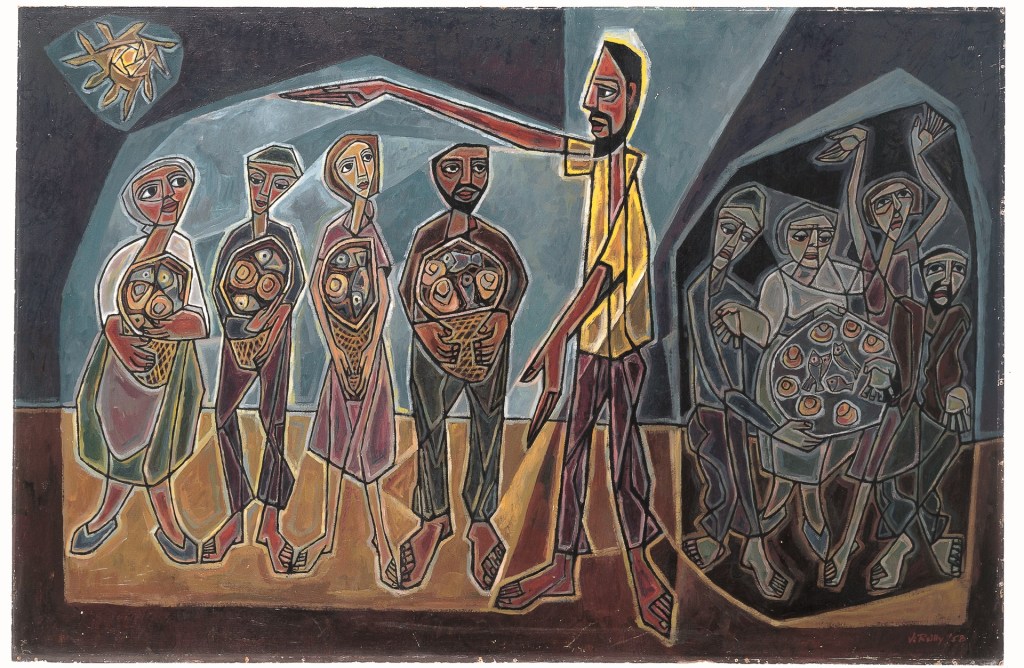
Luke 9:10-17 – Jesus Feeds Five-Thousand

The Feeding of the Five Thousand by John Reilly, 1958

When the apostles returned, they reported to Jesus what they had done. Then he took them with him, and they withdrew by themselves to a town called Bethsaida, but the crowds learned about it and followed him. He welcomed them and spoke to them about the kingdom of God and healed those who needed healing.

Late in the afternoon the Twelve came to him and said, “Send the crowd away so they can go to the surrounding villages and countryside and find food and lodging, because we are in a remote place here.”

He replied, “You give them something to eat.”

They answered, “We have only five loaves of bread and two fish—unless we go and buy food for all this crowd.” (About five thousand men were there.)

But he said to his disciples, “Have them sit down in groups of about fifty each.” The disciples did so, and everyone sat down. Taking the five loaves and the two fish and looking up to heaven, he gave thanks and broke them. Then he gave them to the disciples to distribute to the people. They all ate and were satisfied, and the disciples picked up twelve basketfuls of broken pieces that were left over. (New International Version)

Jesus feeding five thousand people is not just an incredible story that happened a long time ago. Today, Jesus is still in the miracle business because he is still in the kingdom business. Christ still takes our meager resources and turns them into something that has a large impact on a lot of people. 

For that to happen, all we need do, is follow the Lord’s simple instructions: “You give them something to eat,” and, “Bring them [five loaves and two fish] here to me.” Jesus, using a simple act of obedience by his disciples, did one of the most famous miracles in history.

Jesus can multiply whatever little we possess to accomplish his kingdom work through us. 

It is true that Jesus most certainly can do miracles without us. And yet, Christ chooses to use us simple folk to participate in his work. God uses our simple prayers for the miracle of a transformed life. The Lord uses our imperfect speech to bring new life to others. Jesus takes our miniscule bank account to bring a river of financial resources to many through a small act of giving. 

Faith is our true work – to believe God can do the extraordinary through our ordinary loaf of bread and piece of fish.

The Compassion of Jesus Motivates Him To Do Miracles

Jesus withdrew to a solitary place. The crowd, however, did not leave him alone. But rather than being annoyed by the situation because this interruption was not on his divine day planner, Jesus looked at the large group of people and had compassion on them. 

Christ’s heart went out to thousands of people, so he set about the work of healing the sick. Please know that God does not begrudgingly deal with you, as if you were an interruption to his day; the Lord has compassion for you.

The Desire of Jesus is For Us to Participate in the Miracles He Does

After a full day of healing, Christ’s disciples came to him as if he was unaware of the people’s need for food.  They had a very rational and realistic answer to the problem of hunger in front of them; dismiss the crowd so they can go out to eat. 

Jesus calmly responded, “They don’t need to go away; you give them something to eat.” 

I detect perhaps a hint of sarcasm and a slight eye roll in the reply of the disciples, “We have only five loaves of bread and two fish.” But their math was way off because they did not count Jesus. 

The Five Thousand by Eularia Clarke, 1962

Jesus simply said, “Bring them here to me.” My friends, if we have ears to hear, Jesus is still saying this today to us – bring them here to me. Through simple prayer and active obedience, we must give Jesus what we have, no matter how little or insignificant.

Most of what happens in Western Christianity, much like the ancient disciples, is a reasonable doing of rational ministry. Many ministries have little to nothing to do with the impossibility of faith and seeing God work in ways that are incomprehensible to our modern sensibilities.

The earthly miracles of Christ were not an isolated instance. God has always been taking the impossible and making it possible.

Now there was a woman who had been married to a member of a group of prophets. She appealed to Elisha, saying, “My husband, your servant, is dead. You know how he feared the Lord. But now someone he owed money to has come to take my two children away as slaves.”

Elisha said to her, “What can I do for you? Tell me what you still have left in the house.”

She said, “Your servant has nothing at all in the house except a small jar of oil.”

He said, “Go out and borrow containers from all your neighbors. Get as many empty containers as possible. Then go in and close the door behind you and your sons. Pour oil into all those containers. Set each one aside when it’s full.”

She left Elisha and closed the door behind her and her sons. They brought her containers as she kept on pouring. When she had filled the containers, she said to her son, “Bring me another container.”

He said to her, “There aren’t any more.” Then the oil stopped flowing, and she reported this to the man of God.

He said, “Go! Sell the oil and pay your debts. You and your sons can live on what remains.” (2 Kings 4:1-7, CEB)

What if we were to live as if God was interested in doing the miraculous? Would it change the way we pray, and the way we act? 

What if we understood just enough of Jesus, of what he can and wants to do, that we are bold to say:

  • “This might sound crazy, but what if we found out the names of everyone in our community who needs food and go love on them and feed them?” (instead of only the rational means of a food pantry)
  • “This might sound crazy, but what if we used our property to create a community garden and help people grow their own food?” (instead of only the rational means of government aid) 
  • “This might sound crazy, but what if we prayed for one-hundred people, by name, to be healed?” (instead of only the rational means of relying on the pastor to pray)

Most of our plans are humanly possible and doable. Maybe we ought, instead, to seek the impossible.

We may often do nothing out of a sense that God either cannot or does not want to use me or what I have. However, it just won’t do to stand afar off and expect God to work without us giving what we have, whether that something is time, money, conversation, food, hospitality, or whatever. 

Our excuses won’t do for Jesus – my home is too small, I don’t have enough money, I am not smart enough, my schedule won’t allow it, I don’t have enough resources…. In God’s economy you don’t need much, at all. Just a mustard seed worth of faith will do. Jesus wants us to be a part of the miracles he is doing.

Conclusion

I can visualize the disciples befuddled by Christ’s words. I can imagine hearing their excuses. “You want me to do what?  Feed thousands?  Lead someone to Jesus?  Pray in front of others?….” 

The miracle for many a believer is to be open, real, and transparent enough to believe that Christ can do the impossible through confessing sin, participating in ministry, having a spiritual conversation with an unbeliever, or just naming out loud what one actually thinks and feels.  

The question is never, “Can God use me?” The real question is, “What miracle does God want to do through me, and through us as a community of faith?”

It is no accident that when Jesus distributed the bread, it sounds a lot like communion. The Lord’s Supper may seem to be irrelevant – only something we do to remember Jesus, or a mere ritual. But God’s design is much bigger. The Lord wants to do a miracle. 

God wants our observance of Christian communion to bring a healing which the world cannot give. It appears irrational that Jesus can use a small Table to feed and reach thousands. Yet, we don’t serve a God who is limited to work through rational means. 

O God, our heavenly Father, you have blessed us and given us dominion over all the earth. Increase our faith and our reverence for the mystery of life. Give us new insight into your purposes for the human race, and new wisdom and determination in making provision for its future, no matter whether it makes sense, or not, in accordance with your goodwill, through Jesus Christ our Lord. Amen.

Luke 13:18-21 – What is the Kingdom of God Like?

A mustard seed

Jesus asked, “What is God’s kingdom like? What can I compare it to? It’s like a mustard seed that someone planted in a garden. It grew and became a tree, and the birds nested in its branches.”

He asked again, “What can I compare God’s kingdom to? It’s like yeast that a woman mixed into a large amount of flour until the yeast worked its way through all the dough.” (God’s Word Translation)

I grew up on a rural Mid-West America farm. Working with seeds was our livelihood. And making bread was second nature to us. Even though my parents worried incessantly about the weather and the price of groceries, there were two things they were never anxious about: seeds and yeast.

My dad knew that when we planted seeds in the Spring, there would be a harvest in the Fall. That’s because he knew the seed already has within itself everything it needs to germinate, take root, grow, and produce a harvest. His role was simply to tend to it all by keeping the fields free of weeds, worms, and critters.

My mom knew that when she put the bread in the oven, it would bake and rise into a glorious loaf. That’s because she had full confidence that the little bit of yeast she worked into the dough would do it’s job. Her role was simply to ensure the proper amount of ingredients and oversee the time and temperature of baking.

Since I was the youngest, I typically got the grunt work of our massive garden. I was always excited when we planted things because I knew what was coming in a few months: some delicious veggies on my dinner plate which were fresh from the garden I tended. I never wondered whether there would be food on the table, or not.

Seeds are, of course, small. If you think about it, they appear quite unimpressive. Yet, we know better. We understand that when planted, watered, and cultivated, those seeds turn into amazing plants. 

But it takes time. Even as dumb little kid, I clearly knew that my planting seeds would not result in seeing anything above ground the next day. I understood it would take a few weeks before new growth would break the ground.

The kingdom of God, Jesus told us, is like a mustard seed – a very small seed which can grow into a tree big enough for birds to nest. Unlike the mighty Roman Empire, or contemporary powerful national governments, the kingdom of God had humble beginnings. It grows, over a long period of time, to become a force greater than anything the world can produce.

While our world races forcefully on with the speed of the hare, Jesus is carefully and patiently building his church at the pace of a tortoise. In the end, the kingdom of God will rule over all creation, while the kingdoms of this world shall no longer exist. 

Even though many of us now live in a society where the quick, the fast, and the strong dominate everything, still the best things in life come as a result of tedious perseverance over an extended period of time. 

We are in such a hurry to accomplish our goals, make as much money as we can, and keep constant vigilance over our work. And for what purpose?

“What an unspeakable comfort it is to know that in the midst of humanity’s mischief, in the midst of their scheming and bad speculations, their shaping and misshaping, their activism and their failures, there is still another stream of events flowing silently on, that God is letting divine seeds grow and achieving divine ends.” 

Helmut Theilicke

Quiet, humble submission to King Jesus is at the heart of the kingdom. God is working-out good purposes in and through us with all the care of the farmer expecting to eventually reap a harvest. To get ourselves into the groove of God’s unforced rhythms of grace, we must learn to slow down, so as to not miss Christ’s benevolent kingdom. So, how do we do that?

  • Listen to yourself. Our bodies send us signals all the time, telling us what we need. There is a time for work and a time for rest, a time to hurry and a time to slow down. If we continually stressed, it could be that we are trying to force God’s kingdom into our lives or the lives of others.

But if you listen to me,
you will be safe and secure
    without fear of disaster. (Proverbs 1:33, CEV)

  • Practice gratitude. Count your blessings. Keep things in proper perspective. Sit with joy and happiness. Whenever something really good happens, slow down and savor the moment – don’t just quickly move on to the next thing. The kingdom of heaven revolves on thankfulness, not criticism.

O give thanks to the Lord, for he is good,
    for his steadfast love endures forever.
O give thanks to the God of gods,
    for his steadfast love endures forever.
O give thanks to the Lord of lords,
    for his steadfast love endures forever. (Psalm 136:1-3, NRSV)

  • Use breath prayers. Take some deep breaths. While inhaling, pray, “More of you, Lord.” And exhale saying, “Less of me.” Or inhale, praying, “Fill me with your Spirit,” then exhaling, “So that I may be a blessing.” Go ahead and develop your own prayers, as well.

“Speak, Lord, for your servant is listening.” (1 Samuel 3:10, NRSV)

  • Say, “no.” If we are in the habit of helping others, it can be hard to say “no.” But if we are working to understand how to slow down, learning to say “no” is a skill we need to develop. We must set boundaries and manage our time responsibility. That means leaving plenty of time to slow down, rest, observe, and relax.

Just say ‘yes’ and ‘no.’ When you manipulate words to get your own way, you go wrong. (Matthew 5:37, MSG)

  • Walk outdoors. Nature walks are an opportunity to stroll through God’s creation and notice the wonder that is all around us.

The heavens proclaim the glory of God.
    The skies display his craftsmanship.
Day after day they continue to speak;
    night after night they make him known.
They speak without a sound or word;
    their voice is never heard.
Yet their message has gone throughout the earth,
    and their words to all the world. (Psalm 19:1-4, NLT)

  • Ask for help. To ask for what we need and want is neither selfish nor a sign of weakness. Rather, piling on responsibilities only causes us to run ragged and never get around to slowing down. Asking for help requires humility, which is the very thing needed to enter the kingdom of heaven.

Jesus said, “Ask and it will be given to you; seek and you will find; knock and the door will be opened to you. For everyone who asks receives; the one who seeks finds; and to the one who knocks, the door will be opened.” (Matthew 7:7-8, NIV)

Spiritual formation and development are dependent upon slow growth over a long period of time. Don’t short circuit the process through accumulating more and more responsibility and constant busyness. Let God’s grace do its work and sense the kingdom of God near you.

Lord God, everlasting Father, you have brought me to this point in time.  Preserve me according to your unassuming power so that I might not be seduced by worldly might, nor be overcome by the rantings of politicians, but in all things daily direct me to the fulfilling of your purpose, through Jesus Christ, my Lord.  Amen.

Romans 2:12-16 – Doing, Not Just Hearing, Makes the Difference

If you sin without knowing what you’re doing, God takes that into account. But if you sin knowing full well what you’re doing, that’s a different story entirely. Merely hearing God’s law is a waste of your time if you don’t do what he commands. Doing, not hearing, is what makes the difference with God.

When outsiders who have never heard of God’s law follow it more or less by instinct, they confirm its truth by their obedience. They show that God’s law is not something alien, imposed on us from without, but woven into the very fabric of our creation. There is something deep within them that echoes God’s yes and no, right and wrong. Their response to God’s yes and no will become public knowledge on the day God makes his final decision about every man and woman. The Message from God that I proclaim through Jesus Christ considers all these differences. (The Message)

Every single person on planet earth has been created by a good Creator in the image and likeness of God, without exception.

Because we are all stamped with the Lord’s divine image deep within us, there is a universally inherent sense of justice, rightness, fairness, integrity, morality, and love. Particulars of ethics may differ from culture to culture, yet all persons and societies have a broadly similar innate understanding of right and wrong.

Within the ancient Roman Church were a mix of Jews (the historical people of God who were given the law and the covenant through Moses) and Gentiles (non-Jewish persons). The Apostle Paul wrote his lengthy and probing letter to them because the two groups of Jew and Gentile were at odds with one another.

The Gentile Christians could not understand the Jewish Christian fondness and insistence on ancient rules and particular commands, and so, they looked down on their brothers and sisters in the faith as being hopelessly locked into outdated traditions and practices.

Conversely, the Jewish Christians could not understand the Gentile Christian affinity for a freedom that seemed to not care about the religious importance of food and eating, seasons and holy days, and outward signs of Christianity, and so, they tended to look down on their brothers and sisters in the faith as ignorant, immature, and in need of ritual practices.

We are made right with God by placing our faith in Jesus Christ. And this is true for everyone who believes, no matter who we are.

Romans 3:22, NLT

The Church back then was almost like putting a group of people with O.C.D. (Obsessive-Compulsive Disorder) with a group of people with A.D.D. (Attention-Deficit Disorder). At the least, it’s going to very interesting to watch them try to live and worship together; at the worst, it’s going to spark an all-out battle for supremacy.

Paul was intervening somewhere in the middle between the interesting situation and the pitched battles so that the Church would not turn into total war. The last thing he wanted was two churches: one Jewish and one Gentile. No, there is one church, just as there is one God. Paul was determined that these knuckleheads are going to have to learn to get along.

Since Paul himself was a Jewish Christian, he tended to get pretty testy with his fellow Jews. Although Paul often went back-and-forth throughout his letter to the Romans, addressing Jews, then Gentiles, he most often had more to say to the Jewish brothers and sisters.

And that is what’s happening in today’s New Testament lesson. The Apostle Paul is directing his words chiefly toward the Jewish believers. He is lifting the Gentile believers and placing them on the same level as the Jews. Although the Gentiles weren’t the ones who received the law, they’ve always had that law deep inside them.

God is not only the God of the Jews. He is also the God of those who are not Jews. There is only one God. He will make Jews right with him by their faith, and he will also make non-Jews right with him through their faith.

Romans 3:29-30, ERV

Not only ought the Gentile Christians to be respected because of their inherent sense of God’s law, but this also makes them accountable for their own words and actions. In other words, there’s no excuse for any sinful talk or behavior.

What’s more, the real issue isn’t whether one group has the law, or not. The rub is whether one actually obeys and does the will of God. It doesn’t matter whether one hears the law read aloud in a Jewish synagogue or whether one hears the law spoken in the individual conscience. All are responsible for acting on that voice and engaging in deeds of justice, peace, and love. All must connect with the stamped image of God within us.

I’m not sure what is worse: committing overt sins or observing the sin and doing nothing about it. Indifference is at the core of most sin – both for the perpetrator and the passive spectator seeing it. Each one is living against both their conscience and by what they’ve heard and been taught.

The Word of God has not been truly received until it is put into practice. This is a consistent theme in the New Testament: 

Jesus said, “The people who are really blessed are the ones who hear and obey God’s message!”

Luke 11:28, CEV

Obey God’s message! Don’t fool yourselves by just listening to it. If you hear the message and don’t obey it, you are like people who stare at themselves in a mirrorand forget what they look like as soon as they leave. But you must never stop looking at the perfect law that sets you free. God will bless you in everything you do, if you listen and obey, and don’t just hear and forget. (James 1:22-25, CEV)

Listening to the Word without obedience is just that – it is mere hearing.

Profession of faith in Jesus means nothing without a practice of that faith.

Learning the Bible is useless without living it.

Acceptance of the Word is nothing more than a mental exercise without action to back it up.

Profession, knowledge, and acceptance alone does not satisfy God’s plan for our lives. 

The danger is that we have the potential to deceive ourselves into thinking we are okay just because we know the right things and believe the right things. Christianity is a vital love relationship with Jesus, and, so, is not merely a matter of hearing and affirming orthodox truth; it also involves orthopraxy, that is, having right practice, the doing of truth.

Whenever the Gentile Christians in Rome refused to love the Jewish Christians, they were not hearing God and doing his will.

Whenever the Jewish Christians listened to law and gospel, but then had no intention of changing to accommodate the Gentile Christians, they were being disobedient.

And whenever we hear about how God forgives us in Jesus’ name, but then we insist on not forgiving another person, we are not being doers of the Word.

So, let’s take a lesson from the ancient Roman Church: Live by faith. Be attentive to all persons in the Body of Christ. Include them and care for them. Pay attention to God’s Word. Include it and engraft into your life. Because care of the Body and care of the Word go hand-in-hand together.

May the God who created a world of diversity and vibrancy,
Go with us as we embrace life in all its fullness.

May the Son who teaches us to care for stranger and foreigners,
Go with us as we try to be good neighbors in our communities.

May the Spirit who breaks down our barriers and celebrates community,
Go with us as we find the courage to create a place of welcome for all. Amen.