Acts 7:44-53 – Pickle Barrel Christians

“The Holy Tent where God spoke to our ancestors was with them in the desert. God told Moses how to make this Tent, and he made it like the plan God showed him. Later, Joshua led our ancestors to capture the lands of the other nations. Our people went in, and God forced the other people out. When our people went into this new land, they took with them this same Tent they had received from their ancestors. They kept it until the time of David, who pleased God and asked God to let him build a house for him, the God of Jacob. But Solomon was the one who built the Temple.

“But the Most High does not live in houses that people build with their hands. As the prophet says:

‘Heaven is my throne,
    and the earth is my footstool.
So do you think you can build a house for me? says the Lord.
    Do I need a place to rest?
Remember, my hand made all these things!’”

Stephen continued speaking: “You stubborn people! You have not given your hearts to God, nor will you listen to him! You are always against what the Holy Spirit is trying to tell you, just as your ancestors were. Your ancestors tried to hurt every prophet who ever lived. Those prophets said long ago that the One who is good would come, but your ancestors killed them. And now you have turned against and killed the One who is good. You received the law of Moses, which God gave you through his angels, but you haven’t obeyed it.” (New Century Version)

Every year it’s a guarantee that some folks will complain about the weather. In the summer it’s too hot; in the winter, too cold. Can’t wait for autumn to come, then when it’s here, the murmuring comes out about how the weekend weather won’t cooperate with personal plans.

No matter the season, no matter the weather, somebody will be grumbling about it.

A big reason why I personally hold to the Christian Calendar with its liturgical seasons is that it helps shape me spiritually so that I can avoid being a stubborn complaining fool.

It seems like some folks have been baptized in pickle juice and inhabit a church resembling a pickle barrel. They have something negative to say about everything. And even when they acknowledge they don’t really understand something, they’ll still give a stone-faced retort, “I’m against it.”

They’re, ironically, surprised when they find themselves in a pickle.

The liturgical calendar, when properly observed, keeps us grounded in faith, hope, and love. There are plenty of things in this old fallen world which can take our eyes off our calling as Christians. Pandemics, politics, poverty, and pain can mess with us.

If we aren’t on solid spiritual ground, all the misfortunes of this life can take a significant toll on us. And for all the tangible things we see which creates angst within us, we miss the invisible God because our spiritual eyes are blind from all that vinegar in the pickle barrel.

Like the ancient Israelites for whom Stephen railed against in our New Testament lesson for today, we might become stubborn, hard-headed, and inflexible. We get lost in doing things our own way, and wanting our way, to the neglect of what God wants. 

Whenever that happens, there is damage to God’s people, God’s name, and God’s law. Rather than tongues being used for praising the Lord and encouraging others, God’s prophets who are calling us to holiness are verbally decapitated.

Anytime someone believes they have piously figured out everything, they will soon find themselves fighting against God.

The Lord of All has not called us to figure out every mystery and nail down each uncertainty. Those who claim to have done it are living in a pickle barrel. Perhaps they will eventually discover how large and immense God really is – much bigger than our puny thoughts and misguided practices. 

How then shall we live?

Let go of our illusions of power and privilege.

Submit afresh to the Lord for whom we must bow in all things. 

Open our spiritual eyes so that we can see the God who made the universe.

Take up our holy calling as Christ’s ambassadors, instead of expecting Jesus to be the ambassador for us.

If we can do that, then we are well on our way to seeing the grand and immense God of all.

So be humble under God’s powerful hand. Then he will lift you up when the right time comes.

1 Peter 5:6, ERV

The following practices can help us become more spiritually flexible and open to the Spirit’s work:

  • Stretch your faith muscle. Physical muscles which get little to no use will atrophy – which is why people who are confined to bed or with limitations need physical therapists to help work the muscles. Spiritually, if we are rarely or never in positions which work our faith muscle, then that faith will diminish and eventually atrophy. Faith is not static, but dynamic. It needs to be worked.
  • Breathe deeply. Proper breathing is essential in using our bodies. The same is true spiritually. Fear, worry, and anxiety cause us to have shallow breathing and unable to think straight. When we are amped-up about something, focus on doing some breath prayers, i.e., breathing in saying, “More of you,” and breathing out saying, “Less of me.”
  • Avoid extreme positions. A hyper-extended muscle will tear and cause a lot of damage. An acceptance of limitations and an awareness of our body’s true capacity prevents us from trying to do something our body simply cannot do. Our faith will not support extreme positions which alienate people and put God to the test.
  • Move more. Getting in bodily shape does not have to be dramatic and involve triathlons. Most of us simply need to get out of our chairs and move a bit more and we would be a lot healthier. Faith is mostly lived in the mundane daily decisions of life. Consistently taking small steps of faith each day will go a long way toward our spiritual health and vitality – not to mention helping us see a big God at work.
  • Listen. It is always best to listen to your body— only push it as far as it can handle, even if it is little by little. Many people would be better served if they would just listen to their gut and the spirit God put within them – rather than pushing themselves and others beyond what they can handle. Behind the attempt at doing too much is typically an issue of wanting the kind of control God possesses.

To do the will of God, we must have a growing awareness of a big unlimited God who cannot be contained in a tent or a building; and a small, limited self who is dependent upon God.

This will take relaxing the puckered pickle face and opening to greater flexibility. If you are not in the habit of following the Christian Calendar through the year, now is a good time to start. After all, nobody wants to smell like they just crawled out of a pickle barrel.

Holy God, heaven is your throne and the earth your footstool. You cannot be kept within any one church or any single place.  You are much too big for that!  Forgive me for my small thoughts of you and my weak faith. I humble myself before you so that you can live in and through me for the sake of Jesus. Amen.

Matthew 24:15-27 – Everything Will Change

“The prophet Daniel said that the disgusting thing that will cause destruction will stand in the holy place. When you see this (let the reader take note), those of you in Judea should flee to the mountains. Those who are on the roof should not come down to get anything out of their houses. Those who are in the field should not turn back to get their coats.

“How horrible it will be for the women who are pregnant or who are nursing babies in those days. Pray that it will not be winter or a day of rest, a holy day, when you flee. There will be a lot of misery at that time, a kind of misery that has not happened from the beginning of the world until now and will certainly never happen again. If God does not reduce the number of those days, no one will be saved. But those days will be reduced because of those whom God has chosen.

“At that time don’t believe anyone who tells you, ‘Here is the Messiah!’ or ‘There he is!’ False messiahs and false prophets will appear. They will work spectacular, miraculous signs and do wonderful things to deceive, if possible, even those whom God has chosen.Listen! I’ve told you this before it happens. So, if someone tells you, ‘He’s in the desert!’ don’t go out looking for him. And don’t believe anyone who says, ‘He’s in a secret place!’ The Son of Man will come again just as lightning flashes from east to west.” (God’s Word Translation)

Midwest American summers can be brutally hot and humid. And the winters can be terribly frigid and full of snow. 

Having lived in various university towns and worked with many college students, every Fall there are always new international students, and students from the American Deep South, that have never experienced a Midwest winter and snow. 

I might tell them, repeatedly, of the need for a sturdy winter coat before the snow flies. Yet, having never known sub-freezing, let alone sub-zero temperatures, it’s difficult to imagine such cold when the weather is warm. 

There is little belief that everything around them will change in a few short months to the point that it will be felt down to the bone.

At the coming of winter, I, or someone else, helped ensure they had a suitable coat. Even then, those students often bodily shake all winter and never take their scarves off.

Since none of us have yet experienced it, it might be difficult to imagine that someday Christ will return to judge the living and the dead. 

So, in order to help the disciples to grasp the coming future, Jesus told them to use discernment. Although it may seem improbable now, a time is coming which will be loaded with cosmic and cataclysmic changes. 

Sometimes, even for myself who has lived through many hard winters, it’s incredible to know that the landscape, as it is right now, will be completely different in another six months.

Seasons come and go. Eventually, the sky and the earth as we know it now will pass away. However, the words and ways of Jesus Christ will endure for all time. 

If we are attentive and alert, we will be ready. We will have a warm winter parka on hand.

For now, it means taking off the old clothes of fear, insecurity, hopelessness, and hate; and putting on the new clothes of righteousness, peace, and love in the Holy Spirit. 

You may not think winter is coming. But it is. It may even be here sooner than you believe.

Do you feel that chill in the air?

Almighty and everlasting Father, we long for the coming of your kingdom in Jesus Christ our Lord. We lament before you the signs that your kingdom has not yet come in its fullness. The signs of brokenness and divisions, oppression and abuse, poverty and loneliness, are everywhere present in this present world.

So, we cry out from the depths of our being for you to come and bring us humility, wisdom, discernment, comfort, and hope. Dispel the shadows of the night and turn our darkness into light, through Jesus Christ, your Son, our Lord who with you and the Holy Spirit reign as one God, now and forevermore. Amen.

Hebrews 10:32-39 – Don’t Throw Away Your Confidence

Remember those earlier days after you had received the light, when you endured in a great conflict full of suffering. Sometimes you were publicly exposed to insult and persecution; at other times you stood side by side with those who were so treated. You suffered along with those in prison and joyfully accepted the confiscation of your property, because you knew that you yourselves had better and lasting possessions. So, do not throw away your confidence; it will be richly rewarded.

You need to persevere so that when you have done the will of God, you will receive what he has promised. For,

“In just a little while,
    he who is coming will come
    and will not delay.”

And,

“But my righteous one will live by faith.
    And I take no pleasure
    in the one who shrinks back.”

But we do not belong to those who shrink back and are destroyed, but to those who have faith and are saved. (New International Version)

Confidence is necessary for the Christian life. It’s not optional. One can only persevere through trouble with some confident hope.

It’s one thing to bear up under a hard circumstance for a few days or weeks. It’s altogether another thing for that same hardship to continue for months, even years.

Living with such adversity everyday makes one tired… really tired. Feelings of hopelessness slowly creep within. And, after a while, the person or group of people just want the madness to end. So, they simply give up, being lost in their troubles, feeling alone and bereft of options.

Without the confident expectation of better days ahead, while in the throes of difficulty, a failure of faith can too easily happen.

To realize better days, it’s important to remember the earlier days. I’m not talking about living in the past and wishing it were the 1950s again with Beaver Cleaver across the street. This is not about believing that the past was the good old days, and that the present is bad.

Instead, we can recall and remember the ways we endured and persevered with joy in past experiences.

The original Christian recipients of the message of Hebrews needed to recall the various ways they stood firm and tall in their faith, despite the adversity.

In earlier times, they were insulted and persecuted. Yet, they showed solidarity with others in similar situations. The believers were attentive to prisoners and sought to meet their needs. And they responded to the confiscation of their property with joy because they knew there was so much more than this present life and it’s possessions.

But the persecution and the insults continued… day after day… with no apparent end….

The Christians began to lose their grip on faith. They needed to reconnect with their purpose, with why they were Christians to begin with.

Originally, the reason they had such incredible attitudes while enduring hard things is because they were pursuing heavenly treasure. Their earthly possessions were merely temporary things, not of eternal value. They understood that people have eternal value, not stuff, so the believers willingly focused their efforts in helping others.

However, over time, the band of believers lost their focus. All they could see was the pain and the difficulty. They became disconnected with their purpose. And so, they were in danger of losing their faith and becoming utterly hopeless.

What to do? Give up? Renege on faith? Adopt a “whatever will be, will be,” sort of philosophy?

No. Instead,

Remember what God has done for you.

Affirm what is right, just, and true.

Embrace faith and patience.

That’s what the prophet Habakkuk did. And his resilience helped to bring proper perspective to present troubles.

“Nothing that is worth doing can be achieved in a lifetime; therefore, we must be saved by hope.”

Reinhold Niebuhr (1892-1971)

Habakkuk was distressed over the corruption of his fellow Israelites. Things were askew and not right. So, he complained to God about it. 

God responded by informing Habakkuk that judgment was coming to Israel through the Babylonians. This was neither what Habakkuk expected nor wanted. The prophet grumbled even more because the Babylonians were more corrupt than the Israelites. 

The prophet was having a hard time, and it seemed God was only making things worse, not better.

Habakkuk struggled to come to terms with what God was doing, and not doing. Finally, he concluded the matter by reconnecting with his faith: 

Even though the fig trees have no blossoms,
    and there are no grapes on the vines;
even though the olive crop fails,
    and the fields lie empty and barren;
even though the flocks die in the fields,
    and the cattle barns are empty,
yet I will rejoice in the Lord!
    I will be joyful in the God of my salvation!
The Sovereign Lord is my strength!
    He makes me as surefooted as a deer,
    able to tread upon the heights. (Habakkuk 3:17-19, NLT)

Perhaps the most significant faith experience we can have, is to come to the point of complete trust in God so that our happiness is not dependent upon good circumstances. 

The truth we all must eventually come around to is that joy and security is independent of what’s going on around us. 

Even though we face difficulty, and even evil, confidence can still exist and thrive within us. We can still rejoice because we don’t need everything to go our way in order to be happy.

Faith, patience, and joy are neither cheap, nor easy. For them to remain rooted within us, we must affirm our commitment to Christ daily. And that requires remembering.

What’s more, there is a reward ahead if we persevere to the end.

We can remain patient, express faith, kindle hope, and remember necessary things whenever we stop doing unimportant things which do not add value to our ultimate goals.

So, be mindful of the things which are most important to you; and move through life at a pace of hope, not anxiety. Don’t throw away your spiritual confidence, just because things are continually hard.

God, give us grace to accept with serenity
the things that cannot be changed,
Courage to change the things
which should be changed,
and the Wisdom to distinguish
the one from the other.

Living one day at a time,
Enjoying one moment at a time,
Accepting hardship as a pathway to peace,
Taking, as Jesus did,
This sinful world as it is,
Not as I would have it,
Trusting that You will make all things right,
If I surrender to Your will,
So that I may be reasonably happy in this life,
And supremely happy with You forever in the next.

Amen. – The Serenity Prayer by Reinhold Niebuhr

Hebrews 11:1-7 – Live By Faith

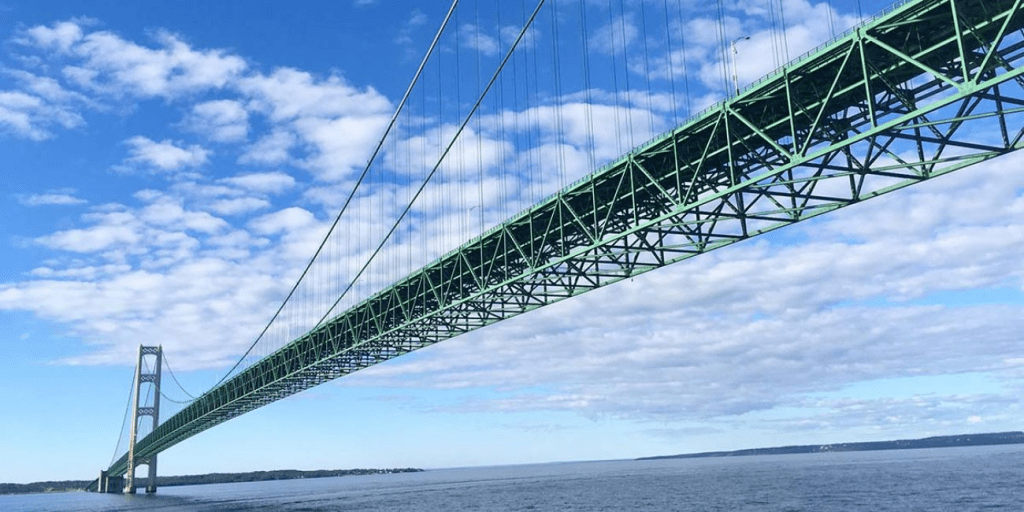
The Mackinac Bridge, joining the upper and lower peninsulas of Michigan

Now faith is confidence in what we hope for and assurance about what we do not see. This is what the ancients were commended for.

By faith we understand that the universe was formed at God’s command, so that what is seen was not made out of what was visible.

By faith Abel brought God a better offering than Cain did. By faith he was commended as righteous when God spoke well of his offerings. And by faith Abel still speaks, even though he is dead.

By faith Enoch was taken from this life, so that he did not experience death: “He could not be found, because God had taken him away.” For before he was taken, he was commended as one who pleased God. And without faith it is impossible to please God because anyone who comes to him must believe that he exists and that he rewards those who earnestly seek him.

By faith Noah, when warned about things not yet seen, in holy fear built an ark to save his family. By his faith he condemned the world and became heir of the righteousness that is in keeping with faith. (New International Version)

“Faith does not eliminate questions. But faith knows where to take them.” Elisabeth Elliot

Faith is dynamic, not static. Faith is both knowledge and mystery. Faith encompasses past, present, and future.

The Mackinac Bridge is the longest suspension bridge in the Western hemisphere at 26,372 feet long. At its highest, the roadway is 200 feet above the strait that separates the upper and lower peninsulas of Michigan in the United States. 

All suspension bridges are designed to move to accommodate wind, change in temperature, and weight. It is possible that the deck at center span could move as much as 35 feet either east or west, due to severe wind conditions.

It’s one thing to know facts about the bridge, and it’s another thing to actually drive on it and cross the strait. 

Some people don’t try it. I’ve driven the Mackinac Bridge many times, and it’s a hoot! In order to cross the bridge, we need to know it will hold us up above the water. And then, we actually need to drive on it.

True biblical faith is neither an existential leap into darkness, nor a simple recognition of certain facts. 

Rather, Christian faith is a reliance upon and commitment to Jesus that results in taking a risk. 

Faith is knowledge that God exists. Faith is stepping out and acting. Faith requires both knowledge and action. 

One can read all the facts about the Mackinac Bridge, but it isn’t the same thing as crossing it. Conversely, one can cross the bridge, even daily, and have no real appreciation for its true magnificence and structural wonder.

The New Testament of the Bible wants us to know Jesus, both intellectually and experientially. Only through those two elements of faith will anyone have a sustainable faith which perseveres throughout life. 

A lack of high-level commitment from professing Christians points to the reality that many believers are missing a crucial part of faith. There are those who rush into situations half-cocked without a solid base of understanding. And then, there are others who talk an issue to death and never act. 

A full-orbed biblical faith seeks knowledge and understanding so that it may respond in loving action.

Faith is important. It’s part of us. We are all people of faith – maybe not sharing the same faith – but it is faith, none-the-less.

“Never be afraid to trust an unknown future to a known God.” Corrie ten Boom

Belief transcends time. Faith is rooted in the past, experienced in the present, and future-oriented. In Christianity, faith is historically moored to the redemptive events of Christ’s incarnation, life, death, resurrection, and ascension. This historic faith has continuing ramifications into the present time. And it is a faith which believes Christ is coming again to judge the living and the dead.

All of this means our salvation encompasses past, present, and future. So, it is appropriate and accurate to say the Christian has been saved, is being saved, and will be saved.

Deliverance from sin, death, and hell was achieved on the cross. We are presently in the process of being delivered from our sinful nature and the effects of a fallen world. And we will be completely delivered at the end of the age from disease, disaster, and death.

The New Testament brings out all these dimensions of time. Whereas the Apostle Paul tended to continually look back to the past of God’s action in history, the author of Hebrews consistently looks ahead and brings out the future orientation of our faith.

And that is what the great Hall of Faith in chapter eleven of Hebrews is about – giving repeated examples of individuals who transcended their present hard circumstances through realizing what will be eventually coming. All of them acted particular ways in the present time because of what they believed would happen in the future.

People of faith allow their belief in what is coming to shape how they live now in daily life.

Abel took the absolute best of his flock and made it an offering, with the intent of giving God an appropriate gift. Whereas his brother Cain cobbled together some of the leftovers from his vegetable harvest and gave them a nonchalant toss to God. Then, he got upset when God looked with disfavor on it.

Abel’s actions demonstrated the attitude of his heart. His knowledge and action worked together. The gift he gave to God cost him his life, as Cain was inflamed with anger and killed his brother. Only by looking ahead and seeing that God’s reward is better than anything this world can offer, can we endure hardship.

Enoch focused on pleasing God through his three-hundred year life, knowing he would then enjoy an eternity with the Lord who provides good rewards. Enoch displayed his faith through obedience to God. He believed God existed and that God is good, and then proceeded to live a life of goodness.

Noah, despite the jeering of his neighbors, took one-hundred years of his life to build a big ark, believing without a doubt that God’s judgment was coming. The daily grind of constructing an ark for such a long time was made possible because Noah was looking ahead. His present actions were shaped by his forward thinking faith.

In each individual’s life, their daily actions were a result of their unshakable belief in what was to come.

Faith enables us to persevere patiently through any kind of adversity.

Knowing we have a better reward ahead; realizing our present trouble will not last forever; and believing Christ will eventually make all things right in this world – forms the foundation of our faith. Such a faith buoys us so that we do not drown in a sea of injustice, microaggressions, unhealthy power dynamics, as well as plain old meanness and insensitivity from others.

So, when we face those times which tempt us to get lost or stuck in an ever-enclosing existential angst, take a pause, check the facts, and then confidently cross the bridge.

Live by faith. You’ll be glad you did.

Christ be with me, Christ within me,

Christ behind me, Christ before me,

Christ beside me, Christ to win me,

Christ to comfort and restore me.

Christ beneath me, Christ above me,

Christ in quiet, Christ in danger,

Christ in hearts of all that love me,

Christ in mouth of friend and stranger.

Amen. – A Prayer of St. Patrick