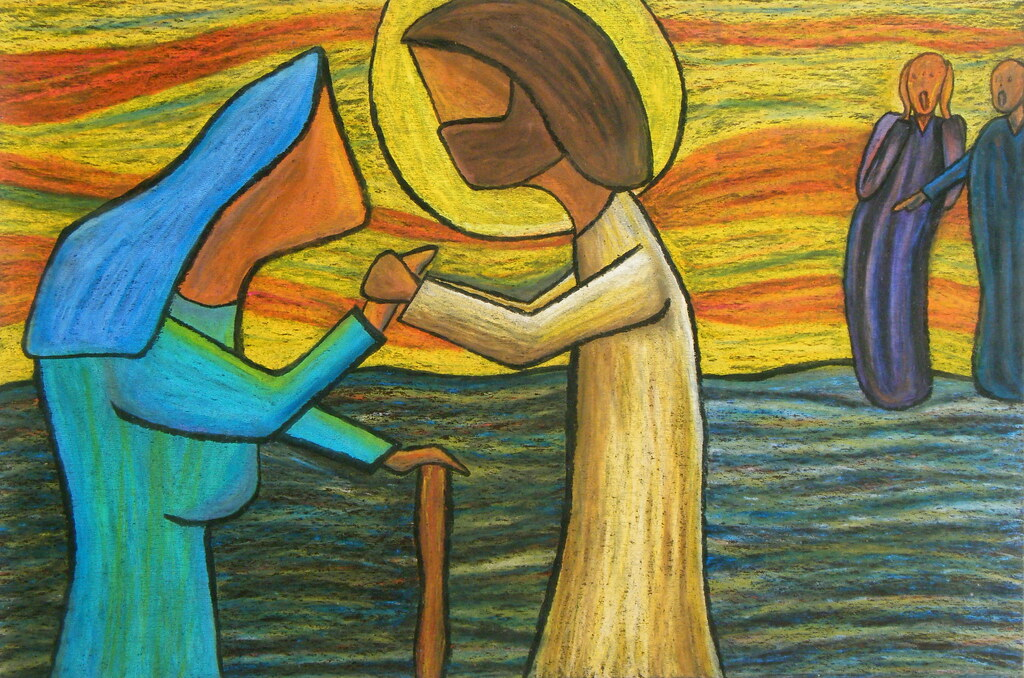
Overwhelming Victory in Overcoming Suffering (Romans 8:31-39)

What shall we say about such wonderful things as these? If God is for us, who can ever be against us? Since he did not spare even his own Son but gave him up for us all, won’t he also give us everything else? Who dares accuse us whom God has chosen for his own? No one—for God himself has given us right standing with himself. Who then will condemn us? No one—for Christ Jesus died for us and was raised to life for us, and he is sitting in the place of honor at God’s right hand, pleading for us.

Can anything ever separate us from Christ’s love? Does it mean he no longer loves us if we have trouble or calamity, or are persecuted, or hungry, or destitute, or in danger, or threatened with death? (As the Scriptures say, “For your sake we are killed every day; we are being slaughtered like sheep.”) No, despite all these things, overwhelming victory is ours through Christ, who loved us.

And I am convinced that nothing can ever separate us from God’s love. Neither death nor life, neither angels nor demons, neither our fears for today nor our worries about tomorrow—not even the powers of hell can separate us from God’s love. No power in the sky above or in the earth below—indeed, nothing in all creation will ever be able to separate us from the love of God that is revealed in Christ Jesus our Lord. (New Living Translation)

There is a way to overcome suffering; there’s a path you can follow, leading to the overcoming of your struggle.

That struggle with suffering comes in many forms:

  • Wrestling with guilt and shame;
  • Dealing with the meanness of others
  • Chronic physical pain
  • Continual financial trouble
  • Ongoing estranged relationships
  • Past bad decisions that keep coming up to bite you in the present
  • Constant feelings of angst about the state of the world’s great needs and problems
  • A crippling Anfechtung (spiritual oppression and depression)

These and a hundred other reasons for suffering in this broken old world can discourage and debilitate us.

I invite you to consider that the road ahead will likely be counter-intuitive to how you may currently be thinking about overcoming suffering. In fact, it might be so far off your radar that you might simply discard what I’m about to say to you.

But before I get to that, I’ll say first, that suffering is endemic to the human condition. Everyone suffers. Since we live in a fallen world, there is not one person who hasn’t suffered in some way, whether it is physical, spiritual, mental, or emotional. 

None of us will ever be immune to affliction. There is no way to insulate yourself from pain. If you are not currently suffering in some way, it means that you are either coming off a time of hardship or are about to enter a new period of distress.

Holiness and godliness don’t keep suffering at bay. Just the opposite. The Lord Jesus promised us that following him will involve suffering: 

“While you are in this world, you will have to suffer.” (John 16:33)

The Apostle Peter, who was part of Christ’s inner circle of followers, came to understand the reality of suffering. Peter understood that all Christians are not above their Lord.  If Christ suffered, his followers shall suffer, as well.

“Dear friends, don’t be surprised or shocked that you are going through testing that is like walking through fire. Be glad for the chance to suffer as Christ suffered.” (1 Peter 4:12-13, CEV) 

James, the Lord’s brother, wisely discerned that suffering could become a teacher for the Christian; all the adversity the believer faces are the means of producing maturity, strengthening faith, and developing patience.

“My friends, be glad, even if you have a lot of trouble. You know that you learn to endure by having your faith tested.” (James 1:2-3, CEV) 

The Apostle Paul was more acquainted with suffering than any follower of Jesus; he continually faced terrible circumstances. His reflections on the matter are sage and true:

“Anyone who belongs to Christ Jesus and wants to live right will have trouble from others.” (2 Timothy 3:12, CEV) 

“Suffering helps us to endure. And endurance builds character, which gives us a hope that will never disappoint us.” (Romans 5:3-5, CEV)

“It has been granted to you on behalf of Christ not only to believe in him, but also to suffer for him.” (Philippians 1:29, NIV)

The New Testament writers have a perspective on suffering which is very different than how we typically think of it. Although suffering is a part of being in the world, yet Jesus said:

“In this world you will have trouble. But take heart! I have overcome the world” (John 16:33, NIV)

Now, let’s wheel back around to the overcoming of suffering. Here is the truth and the practice we must adopt when it comes to suffering: 

The truth about overcoming suffering comes not from us, but through Christ; and the practice of overcoming suffering doesn’t come from fighting against it but by sitting with it and learning from it.

Stated a different way: Jesus has overcome the world through his death, resurrection, and ascension. On the cross, he absorbed all the sin and suffering of everyone. Your suffering, then, may hurt and it might be senseless; yet no matter it’s source, that suffering will always rule over you unless you invite it to take a seat with you and have a conversation with it.

More pointedly: Quit fighting against your suffering. Stop kicking and screaming long enough to look your suffering square in the face and learn from it.

Your suffering is trying to tell you something. 

If you keep taking the stance of a pugilist trying to punch it away, it will just keep moving forward at you. You can’t beat suffering. You can only learn from it. And you’ll only learn from it, even overcome it, when you embrace it. 

So, here’s the counter-intuitive, counter-cultural practice that you might not like and might think I’m off my rocker for suggesting: Submit to suffering.

Don’t hear what I’m not saying. I’m not trying to sanitize your troubles or trauma. Evil is evil, and no amount of saying otherwise will change the leopard’s spots. However, only through submitting to the process of what suffering teaches us will we ever have power over it.

Perhaps an illustration is in order. Let’s liken suffering to encountering a bear in the wilderness. The National Park Service gives us this advice if facing a bear while out hiking:

“Once a bear has noticed you and is paying attention to you, these strategies can help prevent the situation from escalating:”

  • Identify yourself by talking calmly so the bear knows you are a human and not a prey animal. Remain still; stand your ground but slowly wave your arms. Help the bear recognize you as a human. It may come closer or stand on its hind legs to get a better look or smell. A standing bear is usually curious, not threatening.
  • Stay calm and remember that most bears do not want to attack you; they usually just want to be left alone. Bears may bluff their way out of an encounter by charging and then turning away at the last second. Bears may also react defensively by woofing, yawning, salivating, growling, snapping their jaws, and laying their ears back. Continue to talk to the bear in low tones; this will help you stay calmer, and it won’t be threatening to the bear. A scream or sudden movement may trigger an attack. Never imitate bear sounds or make a high-pitched squeal.
  • Hike and travel in groups. Groups of people are usually noisier and smellier than a single person. Therefore, bears often become aware of groups of people at greater distances, and because of their cumulative size, groups are also intimidating to bears.
  • If the bear is stationary, move away slowly and sideways; this allows you to keep an eye on the bear and avoid tripping. Moving sideways is also non-threatening to bears. Do not run, but if the bear follows, stop and hold your ground. Bears can run as fast as a racehorse both uphill and down. Like dogs, they will chase fleeing animals. Do not climb a tree. Both grizzlies and black bears can climb trees.

Fighting suffering is about as useful as taking on a bear. Both bears and suffering can be dangerous. We don’t blame bears if they act like bears. Likewise, we ought not be surprised when suffering hurts. But we can learn a lot about suffering and even come to the point of oddly admiring it for its large ability to teach us things we would not learn otherwise.

Face suffering like facing a bear in the wilderness of trouble. Calmly identify yourself. Talk in low tones to your suffering. Speak to it. Remember who you are. You belong to God. Treat suffering as if it is curious about you. Stay calm. Freaking-out only encourages suffering to attack. 

If you’re alone, that’s not good. Walking with others in Christian community is one of the best practices of the Christian life. Suffering is intimidated by groups of people encouraging one another and showing hospitality to each other. Keep your eye on suffering. Don’t ignore it, or pretend it isn’t there. 

Don’t run. The Lord is with you. Face suffering. Keep it in front of you. It will pass, but you must be patient and calm. Once it is gone, then you can reflect on what happened and debrief with others about the experience.

The path to overcoming suffering is to acknowledge it, respect it, submit to it, and let it pass. Then, you will be able to consider it joy whenever you face various struggles, knowing that your faith is being exercised, and perseverance developed. (James 1:2-4)

Stop fighting. Stop going it alone. Don’t be a martyr. Be silent. Listen. Change suffering from an adversary to fight to a companion to learn from.

You and I have nothing to lose. For nothing can separate us from the love of God in Christ Jesus our Lord. Amen.

1 Timothy 4:6-16 – Train Yourself to Be Godly

If you explain these things to the brothers and sisters, Timothy, you will be a worthy servant of Christ Jesus, one who is nourished by the message of faith and the good teaching you have followed. Do not waste time arguing over godless ideas and old wives’ tales. Instead, train yourself to be godly. “Physical training is good, but training for godliness is much better, promising benefits in this life and in the life to come.” This is a trustworthy saying, and everyone should accept it. This is why we work hard and continue to struggle, for our hope is in the living God, who is the Savior of all people and particularly of all believers.

Teach these things and insist that everyone learn them. Don’t let anyone think less of you because you are young. Be an example to all believers in what you say, in the way you live, in your love, your faith, and your purity. Until I get there, focus on reading the Scriptures to the church, encouraging the believers, and teaching them.

Do not neglect the spiritual gift you received through the prophecy spoken over you when the elders of the church laid their hands on you. Give your complete attention to these matters. Throw yourself into your tasks so that everyone will see your progress. Keep a close watch on how you live and on your teaching. Stay true to what is right for the sake of your own salvation and the salvation of those who hear you. (New Living Translation)

There are several metaphors throughout the New Testament illustrating the nature of the Christian life and Christian community.

God’s people are the temple of the Holy Spirit, the house where the Lord dwells; the Body of Christ, a group working together and strengthening one another in faith; the army of the Lord, advancing with the shared purpose of proclaiming good news and extending God’s benevolent rule – just to name a few.

All the metaphors are embedded with the need for training, for spiritual disciplines and practices which strengthen faith and promote spiritual health.

Just as an army of recruits needs intense basic training and ongoing discipline; and just as the body needs hourly movement and daily exercise of its muscles; so, Christian communities require spiritual development with a variety of forms and functions to elicit and establish a solid godly life.

The curriculum in the school of faith; the liturgy within the spiritual temple; the boot camp for the Lord’s soldier; and the repetitions for Christ’s Body, all involve reading and listening to Holy Scripture. And furthermore, to do so with rhythms of personal and corporate integrity, confident faith, steadfast love, encouraging words, and virtuous behavior.

If we dedicate ourselves to these things, there will be no room for entertaining wacky stories which have no basis in truth. Instead, there will be lush spiritual growth, teachable spirits, humble service, supportive beliefs, compassionate ministry, and open fellowship.

The high values of the worthy servant of Christ need to be both used and guarded. With all of our treasured earthly possessions, whatever they may be, we handle them appropriately and carefully – keeping them in a secure place when not used – and using them with care when out.

Our faith, our life and doctrine, is both a precious possession to be guarded, as well as a necessary tool to do the will of God.

Just as our bodies have physical muscles, so the Body of Christ has spiritual muscles.

Faith is a muscle which needs to be stretched, exercised, rested, and supplied with plenty of protein and necessary nutrients. Overtaxed muscles will fatigue and can be damaged through too much exertion. And underused muscles will wither and atrophy, unable to handle even the smallest of strain when we need them.

So, it is best to have proper spiritual hygiene and exercise through a regimen of tried and true practices designed to improve and maintain healthy faith. If you want to build your faith, consider the following 10 ways:

  1. Increase your amount of reading. There is no substitute for daily repetitions of reading the Bible. Supporting a growing faith will require more voluminous reading.
  2. Focus on listening to the biblical text. Reading is only as good as our listening skills. For the Christian, paying attention to the Holy Spirit’s gentle whispers is a must.
  3. Decrease your media time. For all the good stuff out there, a lot of media information is based in myth, half-truths, and opinions masked as facts – not to mention all the hack and huckster preachers.
  4. Pray more. In fact, pray continually.
  5. Practice gratitude – not complaining. Need I say more?
  6. Snack on good spiritual reading. Consuming a good book before bed keeps the faith muscle fed longer.
  7. Rest! When God created and instituted seven days, the first day was a day of rest; the workdays came after. Don’t flip-flop the divine order.
  8. Supplement with good spiritual conversation. Half-baked theological ideas come from remaining in one’s own cave-like head. Consultation, collaboration, and fellowship help create a rich and full faith.
  9. Don’t overtrain. Good idea: Read the Bible in a year. Bad idea: Read the Bible in a month. Good idea: Digest the contents of ecumenical Creeds and church Confessions. Bad idea: Stuff a bunch of knowledge down your gullet without any love to wash it down. Savor the meal. Don’t be a pig.
  10. Don’t lift too heavy for your faith muscle. The ancient desert fathers spent years developing their faith and could do incredible feats of spiritual strength. Christianity isn’t a competition of keeping up with the Francis of Assisi’s and Martin Luther’s of history. Use the measure of faith given to you and focus on those small daily decisions of trust.

Christianity is a marathon, not a 100-meter sprint. We persevere to the end, not flame out after taxing ourselves with expectations and responsibilities God never gave us.

Be safe. Be strong. Be smart. Be spiritual. We are all in this together.

Gracious God, fill your Church with truth, the truth with peace, and the peace with love. Where our faith is weak, make it strong; where it is misguided and in error, correct and direct it; where it is amiss, reform it; where it is in want, provide for it; where it is divided, reunite it, for the sake of Jesus Christ your Son our Savior. Amen.

1 Peter 3:8-12 – Bless and Do Not Curse

Ethiopian artist depiction of Jesus teaching on love

Finally, all of you be harmonious, sympathetic, affectionate, compassionate, and humble. Do not return evil for evil or insult for insult, but instead bless others because you were called to inherit a blessing. For

The one who wants to love life and see good days must keep his tongue from evil and his lips from uttering deceit.
And he must turn away from evil and do good;
he must seek peace and pursue it.
For the eyes of the Lord are upon the righteous and his ears are open to their prayer.
But the Lord’s face is against those who do evil.
(New English Version)

It’s one thing to bestow a blessing to folks when they seem worthy of it – but it’s quite another thing when you have stinkers in your life. Bless the very ones who are abusive toward me? Some might think the Apostle Peter was off his rocker to instruct believers to bless the insufferable persons in their lives.

Peter, however, was only passing on what he had learned from the Lord Jesus:

“You have heard that it was said: You must love your neighbor and hate your enemy. But I say to you, love your enemies and pray for those who harass you so that you will be acting as children of your Father who is in heaven. He makes the sun rise on both the evil and the good and sends rain on both the righteous and the unrighteous. 

If you love only those who love you, what reward do you have? Don’t even the tax collectors do the same? And if you greet only your brothers and sisters, what more are you doing? Don’t even the Gentiles do the same? Therefore, just as your heavenly Father is complete in showing love to everyone, so also you must be complete. (Matthew 5:43-48, CEB)

The instruction to bless the hateful ingrates in our lives only seems strange when the avoidance of suffering and experiencing a pain-free existence is the summum bonum of life.

I get it. We don’t like to suffer. I don’t like to suffer. It hurts! I’m not really into pain. I’m not a high tolerance pain kind of guy. I have no problem taking a pain pill at the first sign of discomfort. Even so, I know there will be times I am going to have pain – physical, mental, emotional, and spiritual – and there is going to be no way around it. 

To live in this broken world is to experience suffering. To suffer as a Christian, however, is different because we are following the way of our Lord Jesus Christ.

Just as Christ suffered, we can expect to suffer as his followers, as well. We are not above our Master. The real issue is whether we will suffer because of our own foolishness and selfishness, or because of our devotion to Christ in being kind, humble, and gracious. 

When insults come our way, we don’t need to respond in the same way with our own insults. Verbal cruelty is not the way of Christ. Anger, slander, gossip, lies, manipulative words, and belligerent bullying have absolutely no place in the kingdom of God for any reason. 

God takes a zero-tolerance policy toward hate speech, manipulation, and gaslighting.

The consistent witness of the New Testament is to bless and do not curse, to love and not to hate, to use our tongues for spreading words of encouragement and not of condemnation. Peter’s instruction and Christ’s teaching also totally jives with the Apostle Paul:

The Apostle Paul also learned from the Lord Jesus and upholds the need to bless and not curse:

Bless those who persecute you; bless and do not curse…. Live in harmony with one another…. Do not repay anyone evil for evil. Be careful to do what is right in the eyes of everyone. If it is possible, as far as it depends on you, live at peace with everyone. 

Do not take revenge, my dear friends, but leave room for God’s wrath, for it is written: “It is mine to avenge; I will repay,” says the Lord. On the contrary:

“If your enemy is hungry, feed him;
    if he is thirsty, give him something to drink.
In doing this, you will heap burning coals on his head.”

Do not be overcome by evil but overcome evil with good. (Romans 12:14-21, NIV)

Christians are to us their words for blessing, not cursing; for love, not hate; for truth, not lies; for building-up, not tearing-down; for proclaiming good news, not bad news laced with insults. 

If we suffer because of love, we shall receive blessing from God. If we suffer for giving-in to retaliation and our base desires for revenge, then we will suffer the consequences of our own stupidity.

God has called us to bless the world, not condemn it. 

Christians are to be on the front lines of spreading respect, civility, kindness, and the gospel. It is no problem showing love and respect to people we like. It’s a whole other ballgame to do the same for those who treat us with disrespect and hate.

Yet, God watches over all who obey him, and listens to their prayers. God will handle the hate-filled person; that’s not something we are to do.

Our task is to have a deep concern for humanity, both the ones we like, as well as the ones we don’t.

Loving Lord Jesus, you suffered and died on my behalf. It is a small thing for me to follow you and walk in the way of suffering. I know and have the confident expectation that blessing awaits. Keep me true to following you through all the adversity I face in this fallen broken world. Even so, come Lord Jesus, you who lives and reigns with the Father and the Spirit, one God, now and forever. Amen.

Luke 13:10-17 – Healing on the Sabbath

Jesus Healing the Bent-Over Woman by Glenda Skinner-Noble

On a Sabbath Jesus was teaching in one of the synagogues, and a woman was there who had been crippled by a spirit for eighteen years. She was bent over and could not straighten up at all. When Jesus saw her, he called her forward and said to her, “Woman, you are set free from your infirmity.” Then he put his hands on her, and immediately she straightened up and praised God.

Indignant because Jesus had healed on the Sabbath, the synagogue leader said to the people, “There are six days for work. So come and be healed on those days, not on the Sabbath.”

The Lord answered him, “You hypocrites! Doesn’t each of you on the Sabbath untie your ox or donkey from the stall and lead it out to give it water? Then should not this woman, a daughter of Abraham, whom Satan has kept bound for eighteen long years, be set free on the Sabbath day from what bound her?”

When he said this, all his opponents were humiliated, but the people were delighted with all the wonderful things he was doing. (New International Version)

The way in which we interpret events says a lot about who we are and what we need. The story sounds different, depending upon which person(s) are viewing it….

The Crippled Woman

She had gotten used to looking at people out of the corner of her eye, by looking up and sideways.

After eighteen years, she could hardly remember any other way of seeing the world. On this particular Sabbath, there was a special excitement at the synagogue, where she regularly went to worship. A Galilean preacher and prophet, Jesus of Nazareth, had arrived in town and would be teaching there.

She and the others in town had heard reports about Jesus–how he talked about God’s reign arriving soon and how he healed sick people. She was not sure how many of the rumors to believe, but she was trying not to get her hopes up. Her life already had too many disappointments to count.

When she entered the synagogue, the place was abuzz. As Jesus began to teach, however, the room was hushed. Moments later, his words turned from teaching to invitation. He had caught her eye–no mean feat, given that he had to lean over and incline his head to do so. “Come here,” he said to her. She slowly made her way to the front of the assembly.

Jesus and the Bent-Over Woman by Marg Mowczko

What happened next amazed the whole congregation. “Woman, you are set free from your ailment.” When this man, Jesus, spoke those words and put his hands on her broken, bent body, she felt power surge through her. Without hesitation, she straightened her once crooked back. She stood tall and praised her God . . .

The Synagogue Leader

He has come to the synagogue every Saturday. Each Sabbath day the synagogue leader stands and faithfully reads the Torah. On this particular Sabbath, a Galilean preacher is coming. Some say his is a prophet, even Messiah. The leader has seen his share of would-be messiahs come and go, claiming to speak for God. He doubts anything will come of this. Just another man.

But what is this? A synagogue full of people! And just as the leader thought this may just be good for the people, getting them to pay attention to the law and the prophets, this preacher calls a woman forward, and of all things, heals her!? This is not good. This is not how things are to be done!

In the Torah, the seventh day was set aside by God for Israel’s rest. Work is prohibited. Non-life-threatening illnesses and conditions can be treated on the other six days. The synagogue leader is not opposed to healing. In fact, he welcomes it. But at an appropriate time, on the right day. He says to himself, “This all must be done decently and in order. Who does Jesus think he is? We cannot have such insubordination amongst the people, and in the synagogue, of all places!”

And so, the synagogue leader is beside himself with both anger and fear that the Law will not be properly upheld, and that God will be displeased and take away their place of worship.

Coptic Church depiction of Jesus healing the crippled woman, 12th century

Jesus

Jesus comes, looking forward to being with the people in the synagogue on the Sabbath. He understands that since the Sabbath law commemorates and celebrates Israel’s liberation, it ought to be a day for enacting — not inhibiting — the present-day liberation of Israelites. Yes, it is a good day for a healing. Every day is a good day for healing.

As Jesus enters the synagogue, it is full of people, charged with the atmosphere of anticipation. During the service, Jesus sees a woman. Although he rightly discerns that the synagogue leader and some of the congregants will not be happy about this, he calls her forward, intent on freeing her from her satanic bondage. And also knowing that placing his hands upon this woman will appear scandalous, he does it anyway.

Sure enough, the synagogue leader is livid. The leader feels the need to correct Jesus. Yet, Jesus unmoved by this, calmly retorts, without budging an inch, that given the custom of providing water for thirsty livestock on the Sabbath, it is surely appropriate to heal a long-suffering Israelite on the Sabbath.

In none of this does Jesus abolish the Sabbath commandment. Rather he follows it faithfully. Jesus enters an ongoing Jewish debate about how to interpret the Sabbath law, locating himself at the less stringent end of the opinion spectrum.

Jesus is determined to uphold the spirit of the Law, to practice compassion, to do what leads to human betterment. He is doing God’s will. He is allowing the Sabbath to serve this old woman, rather than letting the woman serve the Sabbath as a bent over crippled person.

The People

They come, as they do each Sabbath, to gather and listen to Torah read, to pray to God, and to strengthen one another in their common faith. Yes, the synagogue leader can be a bit tedious. The synagogue service can be a bit boring. But he is a good man doing good work.

Today, however, is different. Jesus, the one they have heard so much about, is there. And what a synagogue service it is! Jesus teaches us, and with authority! But, to our astonishment, he calls one of our women forward. And he touches her! Then heals her! This is the woman who has been tortured with such crippling pain and bent over all the time!

Oh, my, the synagogue leader is upset! We are so full of joy for our healed sister, yet also confused. This is a good thing that Jesus did – God’s kingdom breaking into this world. Yet, here is the synagogue leader and Jesus debating Torah. Does freedom from Satan only come on six days, not seven? Surely, God is especially honored on such a holy day as the Sabbath to do such important work. But work, it is. And Jesus did it. Is this really a good thing, or not?

Syrian Church depiction of Jesus and the crippled woman, 6th century

Conclusion

This is a story about the role and function of our religious traditions, our claims about what could and should be practiced, when and where it ought to take place, and who is allowed within the walls of our faith communities. Special religious practices may become hindrances to including folks. We must be diligent to recognize what theological ideas we hold dear that disallow full participation from others.

Jesus was no Sabbath breaker. He operated well within Jewish tradition of the day. At the same time Christ is also not one to allow the tradition to exclude people from access to the community and the potential for their healing. Even though the synagogue leader and some others disagreed, many in the crowd agreed.

Today’s story is about the community and addresses questions such as, “What kind of community do we want to be?” “Do our religious traditions help us to become that kind of community or do they hinder it?” “If we want to be a healing community, how can we make that happen?”

O God the Father, whose will for us and for all your people is health and salvation, O God the Son, who came that we might have life and have it in abundance, O God the Holy Spirit, whose indwelling makes our bodies the temples of your presence, have mercy on us.

O Triune God, we pray you to hear us, and that you will grant your grace to all who stand in need of healing of both of body and spirit, and lead them to look with confidence in you;

That you will grant patience and perseverance to all who are disabled by injury or illness, and increase their courage;

That you will grant peace to all who are troubled by confusion or pain, and set their minds at rest;

That you will grant relief from suffering to all sick children, and give them a sure sense of your tender love and care;

That you will grant rest to all whose increasing years bring weariness, distress, or loneliness, and give them the abiding comfort of your presence;

That you will grant confidence to all about to undergo surgery or difficult procedures, and keep them free from fear;

That you will grant purpose to the church as it seeks to carry on Christ’s ministry of healing to suffering humanity, and keep it always true to the gospel of Christ;

That you will grant skill and compassion to doctors, nurses, technicians, aides, and all who are called to  practice medical arts, and make strong their dedication to help others;

That you will grant to all people the peace of quiet sleep and the joy of resting in your everlasting arms, that we may rejoice in your care while we are on earth, and in the world to come, have eternal life.

O God, who in Jesus Christ called us out of darkness into your marvelous light; enable us always to declare your wonderful deeds, thank you for your steadfast love, and praise your with heart, soul, mind, and strength, now and forever. Amen.