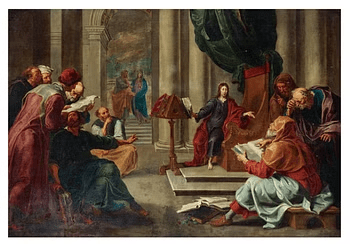
First Sunday after Christmas Day – Where Is Jesus? (Luke 2:41-52)

The Boy Jesus In the Temple, by He Qi

Now every year his parents went to Jerusalem for the festival of the Passover. And when he was twelve years old, they went up as usual for the festival. When the festival was ended and they started to return, the boy Jesus stayed behind in Jerusalem, but his parents were unaware of this. Assuming that he was in the group of travelers, they went a day’s journey.

Then they started to look for him among their relatives and friends. When they did not find him, they returned to Jerusalem to search for him. After three days they found him in the temple, sitting among the teachers, listening to them and asking them questions. And all who heard him were amazed at his understanding and his answers. 

When his parents saw him they were astonished, and his mother said to him, “Child, why have you treated us like this? Your father and I have been anxiously looking for you.” 

He said to them, “Why were you searching for me? Did you not know that I must be in my Father’s house?” But they did not understand what he said to them. 

Then he went down with them and came to Nazareth and was obedient to them, and his mother treasured all these things in her heart.

And Jesus increased in wisdom and in years and in divine and human favor. (New Revised Standard Version)

Luke is the only New Testament Evangelist who included a story of Jesus’s childhood. It provides us some interesting biographical information. Yet, more importantly, the story gives us a sense of Christ’s destiny, of why Jesus grew up to  engage in his unique earthly ministry.

In many ways, Jesus was a typical Jewish boy, in a non-descript pious Jewish family. The family was careful to be observant, and annually made their pilgrimage to Jerusalem for Passover.

Joseph and his family traveled in a large caravan of people, which was common for that day. They were on their camels an entire day before they discovered Jesus was missing.

Mary likely assumed Jesus was riding on the other camel with Uncle Zechariah and his cousin John. 

But Jesus was neither with them nor with Aunt Elizabeth. So, the second day, Joseph and Mary backtracked to Jerusalem, hoping and praying they wouldn’t find Jesus in the ditch, like in the story of the Good Samaritan.

Having not found their son along the road, Joseph and Mary spent the third day scouring Jerusalem in search of Jesus. 

It seems to me that far too many people go about their daily lives without realizing Jesus is even missing. They simply assume he’s here. But he isn’t.

So, let’s search for him. And in finding him, may we see Jesus as we have never seen him before, so that our faith in God might be strengthened, and so that we do not end up losing him yet again.

Turns out, the entire time, Jesus was at the temple. As a parent and grandparent myself, I’m not a bit surprised that a twelve-year-old stayed behind and thought nothing of it. 

Jesus was curious and inquisitive with the rabbis at the temple. Those ancient teachers taught in a different way than Christians preachers today. They gave instruction more like a modern day counselor or therapist.

The rabbis didn’t just impart information; they asked questions to help people discover truth for themselves. And the rabbis were amazed at Jesus’s ability to discover truth.

Keep in mind that Jesus was not a thirty-year-old adult in a twelve-year-old body. Christ was sinless, indeed; but still immature.

The human experience involves growth and maturation. Jesus shared fully in our humanity, not partially. When Christ was born, he was not a fully aware adult looking through the eyes of a baby.

Because Jesus is fully human, he had to grow up just like us and learn in every way, just like us. (Hebrews 4:15; 5:8)

Staying in Jerusalem was not a rebellious act by Jesus. It was typical. Twelve-year-old’s do all kinds of things without saying anything to their parents.

There’s a world of difference between defiant rebellion, and just plain old garden variety immaturity. It’s unwise for adults to expect adult behavior from adolescent kids.

Jesus felt a deep need to stay and talk with the rabbis. As a human boy, he had to go through the process of self-discovery… of finding out that he was the Son of God… of reading the scriptures for himself and learning… and finding that he was reading about himself! 

To say that Jesus simply knew everything because he was God is to fall into a heresy the early church condemned at the Council of Nicaea called Docetism – a belief that Jesus is fully God and only appeared to be human.

No, the Nicaean Council said, Jesus is really a human being and did not simply appear to be one. He is like us, in every way, except sin.

Well, of course, Joseph and Mary finally found Jesus. And Jesus got the third degree from his mother: “What do you mean putting your father and I through this? I gave you birth, and you treat us like this?  What were you thinking?  What part of meeting at the two-humped camel at 9:00 don’t you understand!?”

Since Jesus grew in wisdom and stature and in favor with God and others, how much more do we need to put ourselves in a position to grow and learn and develop and mature? 

There is no spiritual machine in which God miraculously zaps into our brains all the wisdom and knowledge we need.

Rather, emulating our Lord, we must learn, grow, read, pray, ask questions, struggle, and dialogue about the good news of Jesus Christ with each other. In short, we must discover the truth of God.

Perhaps Jesus is asking us, as he did to Mary and Joseph, “Why were you searching for me?  Didn’t you know that I had to be in my Father’s house?” 

The answer of Jesus to his parents’ anxious searching of him points to Christ’s growing self-awareness about his messianic mission. The story centers around Jesus, as all stories do in the Gospel narratives, and not so much around the others.

Since Christ is the proper middle to everything for the Christian, we will, like Joseph and Mary, struggle to know where in the heck Jesus is, and why he is where he is, whenever we find him.

But it isn’t really all that hard to find Jesus, at least, once you know where to look, and where he typically hangs out.

When looking for Jesus, he will be doing the things of his Father. In the Gospel of Luke, those things are clearly connected to the prophet Isaiah’s description:

“The Spirit of the Lord is upon me,
    because he has anointed me
        to bring good news to the poor.
He has sent me to proclaim release to the captives
    and recovery of sight to the blind,
        to set free those who are oppressed,
to proclaim the year of the Lord’s favor.” (Luke 4:18-19, NRSV; cf. Isaiah 61:1-2)

The ones rejoicing at Christ’s birth, and why they were filled with such joy, is very much connected to the messianic mission of Jesus. They understood that freedom and deliverance had just been born.

O God, from our mother’s womb you have known us. You call us to follow you every single day of our lives. And you seek us out whenever we wander from you. As we grow up and grow older, clothe us with your love, so that we may mature in grace and find favor in your sight; through Jesus Christ our Savior and Lord. Amen.

What Should We Do? (Acts 2:37-42)

Apostle Peter Preaching, by Lorenzo Veneziano, c.1370

When the crowd heard this, they were deeply troubled. They said to Peter and the other apostles, “Brothers, what should we do?”

Peter replied, “Change your hearts and lives. Each of you must be baptized in the name of Jesus Christ for the forgiveness of your sins. Then you will receive the gift of the Holy Spirit. This promise is for you, your children, and for all who are far away—as many as the Lord our God invites.” With many other words he testified to them and encouraged them, saying, “Be saved from this perverse generation.” Those who accepted Peter’s message were baptized. God brought about three thousand people into the community on that day.

The believers devoted themselves to the apostles’ teaching, to the community, to their shared meals, and to their prayers. (Common English Bible)

The Apostle Peter, follower of Jesus, had a fire in his belly and fresh wind in his lungs.

Pentecost will do that to a person.

The promised Holy Spirit came – the Spirit of fire and wind – and the result was an impassioned, reasoned, and convicting message from Peter.

The crowd of people listening to Peter understood clearly that he was saying the person and work of Jesus was the activity of God.

And Christ was killed because of his presence and ministry. But three days later, he was raised from death. And then, ascended to heaven, promising the Spirit’s continual involvement.

The people listening to Peter were cut to the heart, convicted in the depths of their soul, and beside themselves as to their culpability in Christ’s situation. They cried out to Peter and asked him what they should do, how they could possibly be a part of what God is doing in the world.

Peter’s response to the crowd was to change – to repent and be baptized, receiving the gift of the Holy Spirit. The Apostle was telling them to turn away from the old way, and turn toward the new coming kingdom of God.

Baptism assures people that God has received their repentance, and has forgiven them. It initiates the believer into the new community of the redeemed, the church.

This was not only for Jewish people, but also for Gentiles; and for everyone, both far and near.

Celebration, by John August Swanson (1938-2021)

The four qualities which characterized the earliest church were these:

  1. The new community followed apostolic teaching (the story of Jesus)
  2. The church continually engaged in fellowship (mutual encouragement and working together in unity)
  3. The believers broke bread together (kept meeting together in shared meals to remember the person and work of Jesus)
  4. They prayed (as the Lord had taught them to pray – for God’s gracious and benevolent kingdom to come, and God’s ethical and moral will to be done, right now on this earth, as it is always done in God’s heaven)

For those who are established in the faith of Christianity, all of this material raises several questions to reflect upon in how our life together as Christians is going:

How do Christians understand the word “repentance?”

Because this determines a great deal of how we live as believers. If we discern repentance as following the rules – both written and unwritten – then we are likely behaving more in the old ways that the earliest believers were to repent of.

But if we see repentance as a way of life, of continually offering prayers of confession to God, and seeking to align our life with the words and ways of Jesus, then we are living more into the spirit of Peter’s original exhortation to the people.

Is the Church living as the baptized community of the redeemed?

Again, how do we understand the word “baptism?” If baptism is nothing more than a personal decision to outwardly show one’s faith, then we have severely truncated Peter’s meaning of the word.

Baptism is the outward sign that we belong to God. And belonging to God is something God does, not us.

One good way of understanding the whole of the Christian life is that we are to ‘live into our baptism,’ that is, we are to daily live our lives cognizant that our life is not our own.

We belong to God. Long before we happened to choose God, God chose us. And we must always remember that.

Are believers in Jesus living in the Spirit?

The Spirit has been given as the continuing presence of Jesus on this earth. The Spirit reminds us of Christ’s words and ways, his person and work. To live in the Spirit is to be continually reminded that what is important to Jesus, needs to be important to us.

“You’re blessed when you’re at the end of your rope. With less of you there is more of God and his rule.

“You’re blessed when you feel you’ve lost what is most dear to you. Only then can you be embraced by the One most dear to you.

“You’re blessed when you’re content with just who you are—no more, no less. That’s the moment you find yourselves proud owners of everything that can’t be bought.

“You’re blessed when you’ve worked up a good appetite for God. He’s food and drink in the best meal you’ll ever eat.

“You’re blessed when you care. At the moment of being ‘care-full,’ you find yourselves cared for.

“You’re blessed when you get your inside world—your mind and heart—put right. Then you can see God in the outside world.

“You’re blessed when you can show people how to cooperate instead of competing or fighting. That’s when you discover who you really are, and your place in God’s family.

“You’re blessed when your commitment to God provokes persecution. The persecution drives you even deeper into God’s kingdom. (Matthew 5:3-10, MSG)

Are individual Christians and the Church communicating the promise to those who are far away? In other words, are we seeking to include others in the community?

Too many churches are closed groups who have a lot of extraneous rules and ancillary beliefs in order to truly be a part of their local church.

This does not mean we are to have no rules or guidelines or any teaching about our particular Christian tradition. However, it does mean that make sure we are proclaiming good news (which is what the word “gospel” means) because the gospel is radically inclusive, not exclusive.

Therefore, to have a community of people who genuinely love one another by spiritually changing and growing, serving and helping, sharing and encouraging, praying and opening up, is to have a group of redeemed persons who give a compelling proclamation of good news through both their gracious words and their loving actions.

If we have little Christ’s walking about this world and living according to his words and ways, and being full of the Spirit, then we give other people a big reason for faith, hope, and love in a world that is too often characterized by being overwhelmed, jaded, and hopeless.

One can never go wrong with living a blessed life as Jesus has defined it; and as the early apostles and believers lived it.

May it be so, to the glory of God, and for the blessing of the church and the world. Amen.

The Coming Judgment (Revelation 11:1-14)

Then I was given a measuring stick, and I was told, “Go and measure the Temple of God and the altar, and count the number of worshipers. But do not measure the outer courtyard, for it has been turned over to the nations. They will trample the holy city for 42 months. And I will give power to my two witnesses, and they will be clothed in burlap and will prophesy during those 1,260 days.”

These two prophets are the two olive trees and the two lampstands that stand before the Lord of all the earth. If anyone tries to harm them, fire flashes from their mouths and consumes their enemies. This is how anyone who tries to harm them must die. They have power to shut the sky so that no rain will fall for as long as they prophesy. And they have the power to turn the rivers and oceans into blood, and to strike the earth with every kind of plague as often as they wish.

When they complete their testimony, the beast that comes up out of the bottomless pit will declare war against them, and he will conquer them and kill them. And their bodies will lie in the main street of Jerusalem, the city that is figuratively called “Sodom” and “Egypt,” the city where their Lord was crucified. And for three and a half days, all peoples, tribes, languages, and nations will stare at their bodies. No one will be allowed to bury them. All the people who belong to this world will gloat over them and give presents to each other to celebrate the death of the two prophets who had tormented them.

But after three and a half days, God breathed life into them, and they stood up! Terror struck all who were staring at them. Then a loud voice from heaven called to the two prophets, “Come up here!” And they rose to heaven in a cloud as their enemies watched.

At the same time there was a terrible earthquake that destroyed a tenth of the city. Seven thousand people died in that earthquake, and everyone else was terrified and gave glory to the God of heaven.

The second terror is past, but look, the third terror is coming quickly. (New Living Translation)

There are many people who look upon Christians as oppressors and persecutors in history. And they aren’t wrong. From calls to war for the Crusades, to the Spanish Inquisition, and much more, a great deal of blood has been spilled in the name of Christianity.

The Book of Revelation, however, knows nothing of that history, simply because it pre-dates all of it. Many people forget, in it’s first few hundred years, that Christianity was a persecuted religion by all sorts of people.

Christians were often the scapegoats to many a leader’s problems. From throwing Christians to the lions in the Roman Coliseum, to burning them at the stake because of their faith, many a martyr has faced a bloody death.

The Apostle John’s Apocalypse, which is known to us as the Book of Revelation, was a vision given to John in order to encourage the persecuted Christian Church that God knows their suffering; and that Jesus will return to judge the living and the dead.

John’s vision had a message of judgment on those who were persecuting Christians for their faithful witness of Jesus. The believers in Jesus who were suffering at the hands of oppressors, cried out for vindication and retribution against their persecutors.

Today’s portion of Revelation is situated between the sixth and seventh trumpets of God’s judgment (which are the second and third woes upon the earth). This interlude has to do with two godly witnesses. And the whole world is able to see them.

The space which the two witnesses occupy is in the outer courtyard of the Temple. The two of them symbolize all the faithful people of God in the world. They are attacked and killed, having carried out their witness for 1,260 days (42 months).

This is a time, related to the Old Testament prophecy of Daniel, appointed for the godless to overcome the city. But this time of suffering and woe will not last.

The two witnesses are not named or identified. The point is that whomever they are, these two maintain their prophetic witness to the Lord consistently to their martyrdom.

Like their Lord before them, the two witnesses lay dead for three days. Their bodies visible for all to see. The godless inhabitants of earth gloat over them, and celebrate their demise.

But again, like Jesus, the two are raised from death and ascend to heaven. This evokes a mass of fear throughout the world. The fact that the event causes fear and terror, instead of repentance  and penitence, speaks to how warped the people of earth have become.

Indeed, the Book of Revelation is highly symbolized reading, and John’s vision is not easy to understand. Yet, there are a few things we can reflect upon in light of this passage; and some questions we can ask of ourselves:

  1. It is important to be faithful and persevere to the very end of our lives. How will we respond to this present darkness in the world?
  2. The way in which we live our lives is the legacy we leave for others when we are gone. What will we be remembered for?
  3. Our lives speak to others about who the God of heaven is. Therefore, it is profoundly important how we go about living our current mundane daily existence. How, then, shall you and I live?
  4. Our short lives have eternal ramifications, not only for ourselves, but for future generations. In what ways will you build into the next generation and help them persevere in faith?
  5. Everything you and I see today will change. There is a Judgment Day coming, just as sure as summer will transition to autumn and then into winter. What will you do today that prepares for the final season of the earth as we know it?

Although much of John’s apocalyptic vision deals with wickedness reaching a ripeness which releases the wrath of God’s judgment; it is also simultaneously the church’s entrance into her eternal inheritance. Systemic sin, structural evil, and devilish deeds shall be no more.

Even so, come Lord Jesus. May peace soon come to this world, and within our hearts. Amen.

Be Ready (Mark 13:9-23)

Art by Mark Keathley

“As for yourselves, beware, for they will hand you over to councils, and you will be beaten in synagogues, and you will stand before governors and kings because of me, as a testimony to them. And the good news must first be proclaimed to all nations. 

“When they bring you to trial and hand you over, do not worry beforehand about what you are to say, but say whatever is given you at that time, for it is not you who speak but the Holy Spirit. 

“Sibling will betray sibling to death and a father his child, and children will rise against parents and have them put to death, and you will be hated by all because of my name. But the one who endures to the end will be saved.

“But when you see the desolating sacrilege set up where it ought not to be (let the reader understand), then those in Judea must flee to the mountains; the one on the housetop must not go down or enter to take anything from the house; the one in the field must not turn back to get a coat. Woe to those who are pregnant and to those who are nursing infants in those days! Pray that it may not be in winter. 

“For in those days there will be suffering, such as has not been from the beginning of the creation that God created until now and never will be. And if the Lord had not cut short those days, no one would be saved, but for the sake of the elect, whom he chose, he has cut short those days. 

“And if anyone says to you at that time, ‘Look! Here is the Messiah!’ or ‘Look! There he is!’—do not believe it. False messiahs and false prophets will appear and produce signs and wonders, to lead astray, if possible, the elect. But be alert; I have already told you everything. (New Revised Standard Version)

The genuineness and strength of one’s faith is demonstrated through the testing of it. A believer’s faith must and will be tried. How will that faith hold up when the world is angry and pours out its hate against them?

Jesus teaching in the Temple, by Willem van Herp (1614-1677)

The follower of Jesus will undergo afflictions and be oppressed by others. They will suffer.

Since that is true, the Christian must ensure that whatever suffering they endure is not because they have been obnoxious and unhelpful to people in this world; but that they are suffering because of their commitment to the words and ways of Jesus, because of their humility, gentleness, righteousness, purity, mercy, and peace.

Christians are meant to bear the cross, so that they may be conformed to the image of their Lord Jesus. There will be times when believers are the brunt of ungodly rage and fury, gossip and slander, opposition and injustice.

Jesus was warning his disciples that they needed to be prepared for endurance, to persevere over the long haul for their faith in him. Otherwise, they might be overwhelmed by temptation.

Christ followers are to remain steady in their purpose of living into the words of Jesus, and living out his ways in a world that prizes the opposite of Christian values.

The godly person values humility. The ungodly persons values pride.

The godly grieve and mourn over injustice in the world. The ungodly celebrate getting ahead by any means possible in this world.

The godly are meek. The ungodly are mean.

The godly seek right relationships with God and others. The ungodly leverage relationships to get what they want.

The godly prize mercy. The ungodly champion being merciless.

The godly are pure in heart. The ungodly have spiders in their heart, and garlic in their soul.

The godly engage in peacemaking. The ungodly engage in warmongering.

The godly end are persecuted for embracing the virtues of Jesus. The ungodly are the persecutors of good people.

The godly will be comforted, inherit the earth, receive mercy, see God, and belong to the kingdom of heaven. The ungodly will be judged, inherit the wind, receive condemnation, see nothing, and belong to the kingdom of darkness.

Sermon on the Mount, by Jorge Cocco Santángelo

The Lord wants us relieved of anxiety, and cheerfully living life with our burdens laid upon Jesus, for he gently and ably carries them. We can cast all our cares on him, because he cares for us. (Matthew 11:28-30; 1 Peter 5:7)

Whenever we are in the position of being afflicted by others, wisdom shall be granted to the godly who follow in the way of Christ.

The grace of God exists for those who seek to do justice, love mercy, and walk humbly. But there is nothing for the proud and arrogant, who believe they themselves are sufficient – because they refuse to receive any gift of God being offered to them.

All sorts of false prophets come along to try and deceive the godly into listening and following them. They make empty promises and blame others for unwanted situations. Know that whatever they say about others, is actually true of themselves.

So, when they accuse another of lying, cheating, stealing, murdering, etc. you can be sure that this is precisely what they themselves do to get ahead and get what they want in this life. Therefore, don’t be tempted by any rhetoric which demeans others.

Love of God and humanity is to be kindled hot, and not cooled through ingratitude and treachery. For whenever courage is weakened, a flood of violent speech and behavior follows.

We must strive against anything which harms the whole of humanity, and puts God at a distance. Instead, good news needs to be proclaimed.

The end will eventually come. Yet, we need not wander around in darkness, as if we don’t know what to do or where to go. We will indeed go through testing and many trials to our faith.

The desolating sacrilege, the abomination of desolation, will appear – which will be the sign that the time is short. An abomination, or desolation, means to profane something, to make it unclean or impure, to treat a holy thing as if it were simply not significant nor important.

In other words, whenever and wherever corruption is rife, and people (and God) are treated as disposable, then you know destruction is at hand. Thus, you must flee, because there is danger.

In such a situation, the rule of law will not help you. Services which were once helpful will be abolished and thrown away like garbage. And it could all happen rather quickly. So, don’t run back and try to save pieces of that previous life and existence; it isn’t worth it. You life is on the line.

Malicious motives and meanness of heart have no intention for the common good of all persons on this earth. A few people want what they want, and they don’t care who gets hurt in the process.

None of this awful behavior will go on forever. God’s judgment can and will deal with it. Yet, no one knows the time or date when that judgment will be rendered. For the sake of the godly, those days will be shortened.

Jesus was not attempting scare his disciples, but to exhort and arouse them to beware of the ungodly; and to keep watch, so that they would not fall into temptation and have their faith weakened.

As believers, we may experience troubles, but we need not be troubled.

The Good Shepherd of the sheep, Jesus Christ, is watching over us so that we don’t need to become distressed and discouraged.

My sheep hear my voice. I know them, and they follow me. I give them eternal life, and they will never perish. No one will snatch them out of my hand. My Father, in regard to what he has given me, is greater than all, and no one can snatch them out of the Father’s hand.  (John 10:27-29, NRSV)

The permanence of our deliverance from guilt, shame, sin, death, and hell does not depend on any of us. It is relies firmly upon the grace of God in Christ. And none who have been given to God shall perish. (John 17:12)

Be encouraged. But also be ready.

Keep watch, dear Lord, with those who work, or watch, or weep this night, and give your angels charge over those who sleep. Tend the sick, Lord Christ; give rest to the weary, bless the dying, soothe the suffering, pity the afflicted, shield the joyous; and all for your love’s sake. Amen.