Real Forgiveness (Hebrews 9:23-28)

By Marc Chagall, 1941

It was necessary, then, for the copies of the heavenly things to be purified with these sacrifices, but the heavenly things themselves with better sacrifices than these. For Christ did not enter a sanctuary made with human hands that was only a copy of the true one; he entered heaven itself, now to appear for us in God’s presence. Nor did he enter heaven to offer himself again and again, the way the high priest enters the Most Holy Place every year with blood that is not his own. Otherwise Christ would have had to suffer many times since the creation of the world. 

But he has appeared once for all at the culmination of the ages to do away with sin by the sacrifice of himself. Just as people are destined to die once, and after that to face judgment, so Christ was sacrificed once to take away the sins of many; and he will appear a second time, not to bear sin, but to bring salvation to those who are waiting for him. (New International Version)

In truth, I could preach on the Cross every Sunday and never exhaust the immensely rich implications of Jesus Christ’s death for us. 

Perhaps, for many Christians, today’s New Testament lesson seems like a re-hashing of things we already know. Yet, it is important to keep plumbing the depths of Christ’s once-for-all sacrifice, because, through continual examination of Christ and the Cross:

  • We will know, both intellectually and experientially, that our forgiveness is real. 
  • We will be able, both spiritually and emotionally, to extend real forgiveness to others.

The original recipients of Hebrews were experiencing spiritual fatigue due to their difficult circumstances. The believers were so worn down from swimming upstream of their problems, that they considered throwing in the towel and giving up on Christianity (or at least the Church). 

The author of Hebrews truly believed that the way to combat this tiredness was through a robust understanding of Christ and the Cross. So, he sought to demonstrate that Jesus is superior to the old sacrificial system and has superseded it. 

There are three main distinctions between the old sacrificial system and the new way of Christ so that we will be encouraged to know that our forgiveness is real.

Reality vs. Simulation

The Old Testament sacrificial system, and its worship rituals in dealing with the sin issue, were only a copy and a shadow of the real sacrifice, which is Christ. The Temple sacrifices, in other words, were merely a facsimile of the real thing.

The difference between the old temple sacrifices and the sacrifice of Christ, is like the difference between riding a mechanical horse and an actual horse. Mechanical horses are merely a simulation of real riding.

Since Christ has come as the real sacrifice for sin, we need no longer be content with simulations and copies of the real deal. The Christian’s forgiveness is neither a simulation nor a copy because Christ is the real thing. 
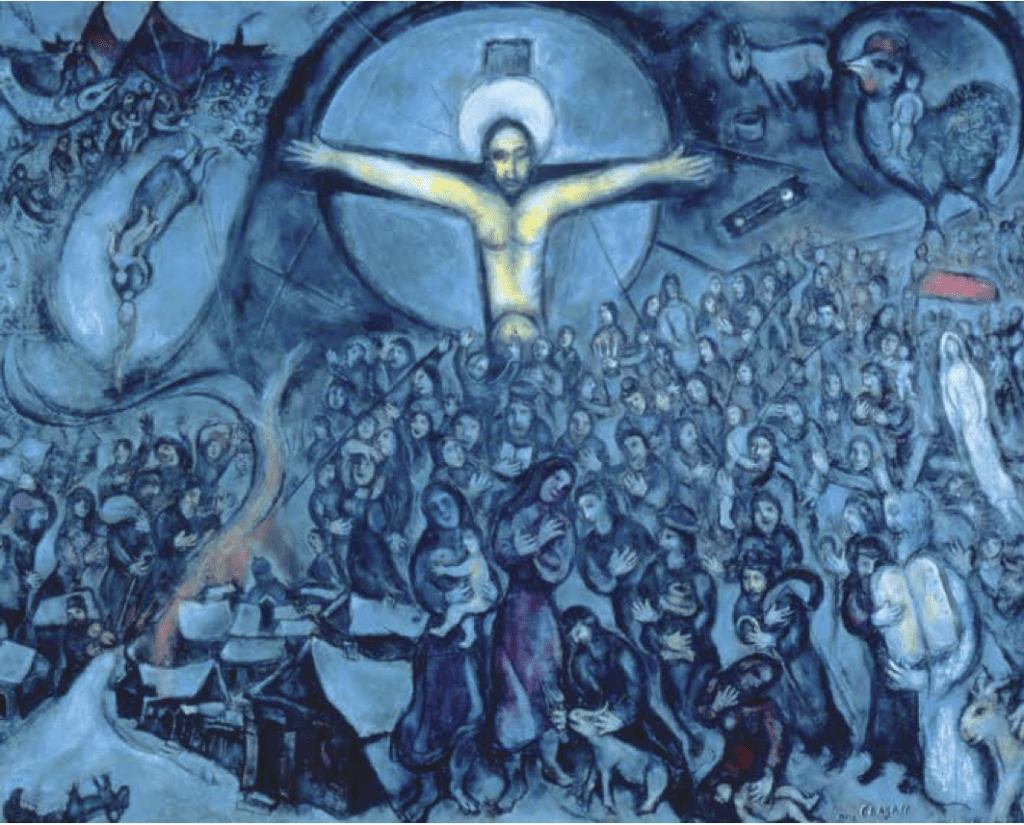
By Marc Chagall, 1952

Jesus did not just mechanically mouth words of forgiveness to us; Christ secured real forgiveness through his death on a cross. This is no cheap imitation of forgiveness. Christ died an actual violent death.

The emphasis in Scripture on blood and sacrifice can be upsetting for many people. Yet, we need to understand that the brokenness of this world is so bad that it requires drastic action. Christ’s death reflects the horrible sin of humanity. Since Jesus has secured forgiveness for us at such a steep price, we are to receive it with great humility and joy, knowing that God loves us that much.

Permanent vs. Temporary

Jesus Christ dealt with the sin issue once and for all through his blood. He came to do away with sin, not just veneer over it. The old sacrificial system was like whitewashing a barn – it took care of the issue for a while, but it would need to be done over and over again.

We are familiar with temporary arrangements. For example, annual fees need to be paid and renewal stickers have to be put on a car’s license plate every year. Christ’s atonement, however, is no temporary arrangement. The forgiveness Jesus offers is permanent.

There is no need to keep offering sacrifices over and over because Christ is the sacrifice to end all sacrifices. The forgiveness we possess is not like paying an annual fee and getting a forgiveness sticker for the year. In Jesus Christ, we are forgiven! And this forgiveness was purchased with Christ’s own blood.

The cross that held Christ’s naked and marred body, exposed the violence and injustice of this world. The Cross revealed what kind of world we have and what kind of God we have: a world of gross unfairness, and a God of sacrificial love. Because Jesus was willing to do this on our behalf, we have a permanent forgiveness, settled once and for all, through his blood.

This old world needs real forgiveness that lasts forever – not a cheap sentimental forgiving that is merely a flash in the pan. 

Salvation vs. Judgment

A lot of religious energy can be spent trying to figure out how to make ourselves acceptable to God.

Part of the good news is that, in Christ, we do not need to fear the future. We have been made right with God through the death of Jesus. Through Christ’s sacrifice, the doors to heaven and earth get flung wide open. The way has been secured, the trail has been blazed, and the road has been made smooth to come to God.

Jesus, unlike any Levitical priest, has entered God’s presence, providing access to the living God. Christ did not need to offer sacrifice for his own sins but offered himself solely on our behalf. Jesus did more than offer the sacrifice; he himself became the sacrifice. It was a sacrifice to bring deliverance to humanity, not judgment.

Either to justify or to judge is God’s business, not ours. Our concern is to believe in the once-for-all sacrifice of Jesus that brings a permanent forgiveness; and, to share that life-giving message with others so that they, too, can experience deliverance from sin, death, and hell.

We can have such a hard time forgiving others because we struggle with experiencing our own forgiveness. The path to extending grace to others is in deepening our knowledge, understanding, and awareness of God’s grace in Christ.

Conclusion

The author of Hebrews meant for the Christian life to be an exciting and abundant adventure of following Jesus, the pioneer of our salvation.

And yet, many Christians do not know anything about this kind of life. They only see the Christian life as a duty and a chore, a kind of cross to bear. We must recognize that it is the Savior, Jesus Christ, the object of our faith, who has delivered us so that we can live a new life of freedom, enjoying our forgiveness and inviting others on the journey.

For he has rescued us from the kingdom of darkness and transferred us into the Kingdom of his dear Son, who purchased our freedom and forgave our sins.

Colossians 1:13-14, NLT

Jesus didn’t die on a cruel cross, then rise from death so that we could live ho-hum Christian lives.

Christ has granted us forgiveness so that we will enjoy the Christian life, appreciate the Word of God; relish in laboring together for the Gospel; and look forward with anticipation to how the Spirit will transform lives through Christ’s forgiveness. 

Real forgiveness opens our minds, hearts, and energies to live for Jesus, the pioneer of our salvation.

Lord Jesus Christ, you stretched out your arms of love on the hard wood of the cross that everyone might come within the reach of your saving embrace. Clothe us in your Spirit that we, reaching forth our hands in love, may bring those who do not know you to the knowledge and love of you; for the honor of your Name. Amen.

What’s the Point of All This Suffering? (2 Thessalonians 1:3-12)

We ought always to thank God for you, brothers and sisters, and rightly so, because your faith is growing more and more, and the love all of you have for one another is increasing. Therefore, among God’s churches we boast about your perseverance and faith in all the persecutions and trials you are enduring.

All this is evidence that God’s judgment is right, and as a result you will be counted worthy of the kingdom of God, for which you are suffering. God is just: He will pay back trouble to those who trouble you and give relief to you who are troubled, and to us as well. This will happen when the Lord Jesus is revealed from heaven in blazing fire with his powerful angels. He will punish those who do not know God and do not obey the gospel of our Lord Jesus. They will be punished with everlasting destruction and shut out from the presence of the Lord and from the glory of his might on the day he comes to be glorified in his holy people and to be marveled at among all those who have believed. This includes you because you believed our testimony to you.

With this in mind, we constantly pray for you, that our God may make you worthy of his calling, and that by his power he may bring to fruition your every desire for goodness and your every deed prompted by faith. We pray this so that the name of our Lord Jesus may be glorified in you, and you in him, according to the grace of our God and the Lord Jesus Christ. (New International Version)

There are 66 books in the Bible. Every one of them, without exception, addresses human suffering. What’s the point of all this suffering? Isn’t salvation supposed to deliver me from all that mess? Why should I even read this dumb blog post?

All of the Apostle Paul’s epistles (a fancy way of saying “letters”) contain a perspective on suffering. And Paul’s reasoning and understanding of suffering goes like this:

  1. Jesus suffered. Throughout his earthly ministry, Christ endured opposition, trouble, and malevolence, especially in a cruel crucifixion and death. Yet, his suffering was the means of redeeming the world.
  2. Christians suffer. Throughout our earthly ministry, we will endure opposition, trouble, and malevolence; especially in a commitment to live the words and ways of Jesus. Yet, our suffering is the means of participating with Christ in redeeming the world.
  3. Suffering is mandatory. It is a significant means of spiritual growth for the Christian. And it is an important way of displaying Christianity’s virtues to a spiritually lost world.
  4. Misery is optional. There’s no solid biblical reason to become miserable or nihilistic with all the seemingly random suffering of the world. It’s hubris to think that my perspective on the subject of suffering and God is the right one.
  5. God is just. And Jesus is the rightful Judge of malevolent troublemakers.
  6. Christians, too, are to be just. Christians, however, are not the rightful judges; thus, there is to be neither executing of judgment on troublemakers nor any judgmentalism in Christ’s church.
  7. Suffering before glory. We are not above our Lord. Jesus rose from death, ascended to heaven, and is glorified. It had to happen that way. It has to happen that way for us, too. There must be suffering before there is glory.
  8. Suffering is temporary. Just like their Lord, Christians, too, shall rise from death, ascend to heaven, and participate in God’s glory. The suffering is for but a moment, but the glory is everlasting.

This reality of suffering and its purpose begs several questions of us. If this is all true (which it is) then:

  • Why do Christians spend so much of their spiritual energy praying and working toward avoiding suffering at any and all costs?
  • What does this tell us about ourselves?
  • Where do we feel the pull to resist change?
  • Will we allow suffering to be our teacher, or not?
  • How might our suffering bring justice and righteousness to a lost world?

Suffering is the mechanism by which spiritual growth is activated. If Christians never faced suffering, there would be no need for faith. That’s because faith is not static but active; it is meant to be regularly used, and if it is not, then belief atrophies and is worth nothing. Much like a muscle, faith needs daily exercise.

Furthermore, the Christian’s exercise of faith is not only for personal spiritual wellness but also for the benefit of others. To put the matter another way, Christians put blood, sweat, and tears into justice for the common good of everyone – thereby putting themselves in a position to be leveled with unjust vitriol. Whenever we challenge the power of another’s unjust actions, the inevitable consequence is fireworks in the form of catching some suffering.

This is why suffering for the right reasons is a sign of God’s grace in one’s life. We aren’t supposed to suffer because of our own stupidity and bad decisions; we are to suffer by our advocacy of the  powerless and the voiceless, thus redeeming time, energy, and resources for God’s kingdom. And it won’t be just a little bit of suffering; it will be a lot.

“If we are to enter God’s kingdom, we must pass through many troubles.”

Acts 14:22, CEB

We may get rather impatient with all this suffering. Yet, it’s also a sign and demonstration of God’s great patience – not wanting anyone to perish but all to enter eternal life. The least we can do is endure hardship for the sake of another’s life.

The Lord isn’t slow to do what he promised, as some people think. Rather, he is patient for your sake. He doesn’t want to destroy anyone but wants all people to have an opportunity to turn to him and change the way they think and act. (2 Peter 3:9, GW)

And if we persevere to the end, we will be vindicated; and malevolent troublemakers will have to contend with God. When we see the injustice of evil winning and good people suffering, it’s easy to get discouraged. But it won’t always be this way. Evil is temporary. Love is eternal.

There must be suffering. Yet, there will also be glory. Our trials and tribulations are but for a moment. But God’s favor lasts forever.

So then, earnest and heartfelt prayer is in order and always in season:

Great God of justice and righteousness, we pray that you will make us perfectly fitted for what you have called us to be. We ask that you fill our good ideas and acts of faith with divine energy so that it all amounts to something. May you cause our lives to honor the name of Jesus; and may we soon experience the day when Christ honors us. Your grace is sufficient for us – whether in good times or bad, through Jesus Christ our Lord in the power of the Holy Spirit. Amen.

Pay Attention to the Word (2 Peter 1:16-21)

For we did not follow cleverly devised stories when we told you about the coming of our Lord Jesus Christ in power, but we were eyewitnesses of his majesty. He received honor and glory from God the Father when the voice came to him from the Majestic Glory, saying, “This is my Son, whom I love; with him I am well pleased.” We ourselves heard this voice that came from heaven when we were with him on the sacred mountain.

We also have the prophetic message as something completely reliable, and you will do well to pay attention to it, as to a light shining in a dark place, until the day dawns and the morning star rises in your hearts. Above all, you must understand that no prophecy of Scripture came about by the prophet’s own interpretation of things. For prophecy never had its origin in the human will, but prophets, though human, spoke from God as they were carried along by the Holy Spirit. (New International Version)

The Bible is a set of living documents. It breathes with a revitalizing and reliable message about Jesus Christ.

Rather than being merely an ancient book to be displayed as some sort of museum artifact on a coffee table, Holy Scripture has demonstrated amazing resilience of use and pertinence throughout the ages.

Millions of people have discovered it’s riches; and have found the Bible’s message of knowing Christ and him crucified, died, risen, and coming again as their hope and salvation. Indeed, God’s Word to people is a gracious revealing of God to humanity so that all persons may reconnect with divinity.

The earthly ministry of Christ had eyewitnesses and earwitnesses. The witness above all witnesses was the Most High who audibly affirmed Jesus with a voice from heaven:

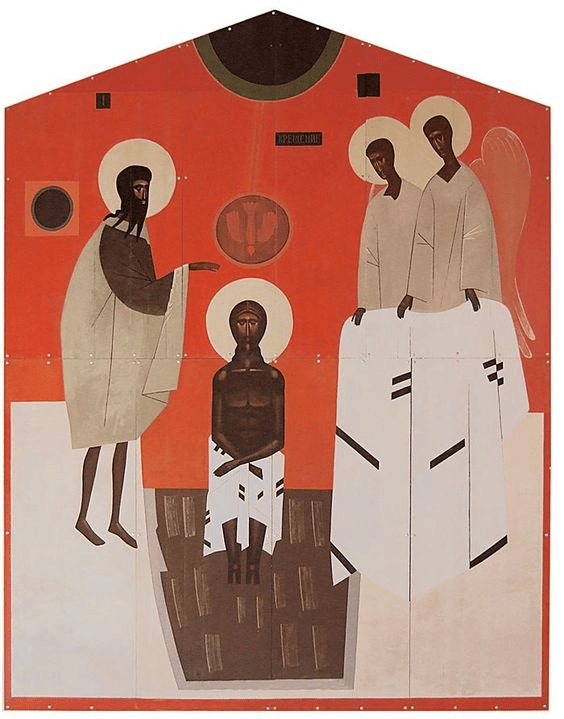
“This is my dearly loved Son, who brings me great joy.” (Matthew 3:17, NLT)

Baptism of Christ, by Vitaly Melnichuk, 2009

Christianity is a religion of the book. Scripture unites us with believers across the world and throughout history. The Bible is to the Christian what weights and barbells are to a bodybuilder. 

The people of God need Holy Scripture, God’s Word, in order to spiritually grow and become mature. Christian character formation cannot truly occur apart from the continuous repetitions of reading the text of Scripture, and letting it build strength into the muscles of the soul.

Scripture is a powerful unifying force within the life of God’s people. We may not all explain every Bible verse in exactly the same way (hence the many different Christian traditions) but believers share a common desire to honor, apply, and obey God’s Word. Ultimately, a passion to listen, talk about, and apply God’s Word brings believers in Jesus together, rather than separates us. 

Perhaps because the average American household today has at least three or four Bibles, we take for granted the availability of God’s Word. It is always at our fingertips, on our smartphones and computers. Yet, because it is always present and available, we may let the busyness and business of life keep us from paying attention to it. 

A commitment to reading and listening to Holy Scripture ought not be done quickly or mechanically, and certainly not half-heartedly. For the Word to penetrate and seep into our souls, we must take the time to listen carefully and slowly.

A first century rabbi, Akiva, once noticed a tiny stream trickling down a hillside, dripping over a ledge on its way toward the river below. Below was a massive boulder. The rock bore a deep impression. The drip, drip, drip of water over the centuries had hollowed away the stone. Rabbi Akiva commented, “If mere water can do this to hard rock, how much more can God’s Word carve a way into my heart of flesh?”

Water flowing over a rock, all at once, leaves it unchanged. It is the slow but steady impact of each small droplet, year after year, decade after decade, that completely reforms the stone.

O how we desire quick answers to our questions! Yet we must take the time to prayerfully listen and reflect on God’s Word and allow it to do it’s work on us and in us. Truth is revealed over many days, months, and years. Big splashes aren’t usually God’s way of doing things. Instead, the slow drip of careful study, contemplative prayer, and meditative reflection, day after day, year after year, shapes us and spiritually forms us into the likeness of Christ.

Thus, a patient, humble, and teachable spirit is necessary. Sometimes the Bible is not apparently relevant. We oftentimes need others to help us and to encourage one another to stick with reading and learning, even when we aren’t sure about what it is saying. 

Rightly interpreting Scripture happens in community, both in present local churches and small groups and in the community of saints who have gone before us. It doesn’t occur in isolation.

Always an appropriate response to hearing God’s Word is to address and the problems of others and the issues of our day. That’s because God is not just concerned about you and me, but about other people, as well. 

What do you suppose would happen if we all committed to carefully reading and listening and meditating, even memorizing God’s Word on a daily basis? Would it transform our worship? Make a difference in our relationships? Change how we do life together?

Attention, people of God and of the Book! God is our God, the One and only!

Love the Lord your God with your whole heart:

Love God with all that is in you; love the Lord with all you’ve got! 

Write these foundational commands I’ve given you on your hearts. Get them inside of you. Then, get them inside your children. 

For this to happen, talk about God’s Word at home when you are eating supper together and when you are working or playing with each other. Start your day with God’s Word when you get up in the morning and end your day with God’s Word when you go to bed at night. 

Put God’s Word on your refrigerator and your car’s dashboard; have it on your smartphones and let it be available to you anywhere and anytime. Use every opportunity you have to incessantly chatter about God’s Holy Word.

(Deuteronomy 6:4-9, contemporary paraphrase)

Pay attention to the Word made flesh and the written Word proclaimed. It makes all the difference.

Our Great Physician, Your Word is like alcohol – when poured on an infected wound, it burns and stings, but only then can it kill germs. If it doesn’t burn, it doesn’t do any good. 

Father, we are all hungry baby birds this morning. Our heart-mouths are gaping wide, waiting for you to fill us. A cold wind seems to have chilled us. Wrap us in the blanket of your Word and warm us up. 

Lord, we find your Word like cabbage. As we pull down the leaves, we get closer to the heart. And as we get closer to the heart, it is sweeter.

–Daily Prayers of Haitian Christians, translated by Eleanor Turnbull (1924-2020) missionary to Haiti for over 50 years

Keep Your Conscience Clear (Acts 24:10-23)

When the governor motioned for him to speak, Paul replied:

“I know that for a number of years you have been a judge over this nation; so I gladly make my defense. You can easily verify that no more than twelve days ago I went up to Jerusalem to worship. My accusers did not find me arguing with anyone at the temple or stirring up a crowd in the synagogues or anywhere else in the city. And they cannot prove to you the charges they are now making against me. 

However, I admit that I worship the God of our ancestors as a follower of the Way, which they call a sect. I believe everything that is in accordance with the Law and that is written in the Prophets, and I have the same hope in God as these men themselves have, that there will be a resurrection of both the righteous and the wicked. So I strive always to keep my conscience clear before God and man.

After an absence of several years, I came to Jerusalem to bring my people gifts for the poor and to present offerings. I was ceremonially clean when they found me in the temple courts doing this. There was no crowd with me, nor was I involved in any disturbance. 

But there are some Jews from the province of Asia, who ought to be here before you and bring charges if they have anything against me. Or these who are here should state what crime they found in me when I stood before the Sanhedrin—unless it was this one thing I shouted as I stood in their presence: ‘It is concerning the resurrection of the dead that I am on trial before you today.’”

Then Felix, who was well acquainted with the Way, adjourned the proceedings. “When Lysias the commander comes,” he said, “I will decide your case.” He ordered the centurion to keep Paul under guard but to give him some freedom and permit his friends to take care of his needs. (New International Version)

Without exception, everyone has a conscience. It is our internal moral compass, an intangible guidance system.

Conscience is humanity’s hard-wired epistemic sense of knowing what and what not to do, beyond the five senses. The still small voice inside us continually gives discernment that transcends objective facts – even though we may not be able to articulate or explain why we know something is right or wrong.

Our conscience keeps us from being morally empty, bereft of direction, and aimless in this world. Paying attention to our conscience serves us quite well. The conscience is the angel on our shoulder, directing us to do and be better; it is the inner compunction to live a beautiful, good, and ethical life.

By allowing the conscience to chart for us a course forward, we can then avoid inaction in the face of stress, as well as immoral words and actions. The conscience tempers our inbred fight-or-flight syndrome so that we might respond wisely to adverse situations. 

The Apostle Paul, as was usual with him, was in a pickle. Yet, Paul never seemed to be shaken with circumstances which most of us would probably consider so distressing as to fall into despair.

In today’s New Testament lesson, Paul is in custody. While standing trial before Governor Felix, Paul used the opportunity to give a clear and rather relaxed testimony to his Christian faith. 

I suggest that the Apostle was able to give a cogent apologetic for his life and ministry – not because he was trying to get off the hook or because he thought it was his duty – but because of his well-attuned inner compass. That inner guidance system led him to say:

“I have committed myself to maintaining a clear conscience before God and with all people.” (Acts 24:16, CEB)

Statue of St. Paul in St. Peter’s Square, the Vatican, Rome

Living with an awareness of the conscience, and carefully listening to it, creates the ability to speak from that place of insight.

There’s no need to do all sorts of mental gymnastics or spin-doctoring. Although Paul gave a clear defense of his actions and attitudes, he did it without having an insecure defensiveness. Because of his conscience, he could articulate truth and steer clear of white lies and propping-up his ego.

I also suggest that the Apostle Paul’s effective engagement with others came from his God-given inner conscience. So, I wonder: 

  • How might my life be different if I shared the same concern as Paul to always have my conscience clear before both God and others? How might the world be different if this was a dedicated commitment?
  • What would happen if I sought to continually be in dialogue with my conscience and make decisions based on that connection? And what if I consistently brought before God the musings and inklings of my conscience?

The human conscience is not static but dynamic. It can be strong or weak. If it doesn’t get regular use, the conscience withers, eventually becomes calcified, and results in a hardening of the heart.

The following are just a few ways of gaining a healthy conscience and keeping it clear and clean:

Acknowledge

Make an acknowledgment of God. The Lord gave us an internal conscience of law and also an external code of law. They are both meant to operate together. The conscience needs to be formed from God’s revelation, that is, God’s written and natural laws; and then, we live life as God intends. 

The conscience is like a law written in the human heart. And it will show whether we are forgiven or condemned. (Romans 2:15, CEV)

“Conscience is like God’s herald and messenger; it does not command things on its own authority, but commands them as coming from God’s authority, like a herald when he proclaims the edict of the king. This is why conscience has binding force.”

St. Bonaventure

Let us draw near to God with a sincere heart and with the full assurance that faith brings, having our hearts sprinkled to cleanse us from a guilty conscience and having our bodies washed with pure water. (Hebrews 10:22, NIV)

Affirm

Let your own good deeds and the works of others be affirmed. Have realistic expectations. The lack of affirmation slowly and imperceptibly poisons the soul and infects the conscience.

“I give thanks to God, whom I serve with a clear conscience, as my ancestors did. I thank him as I remember you always in my prayers night and day.” (2 Timothy 1:3, GNT)

Ask

Petition God for help. Pray for divine resources to assist you. Divine wisdom guides human affairs. Divine authority governs human community. Divine love gives shape to the human conscience.

Pray for us. Our consciences are clear, and we always try to live right. (Hebrews 13:18, CEV)

Allow

Let other people into your life, whether Christian, or not. Sharing thoughts and ideas, feelings and emotions, concerns and celebrations, are all a path toward a healthier spirit, a better awareness of self and others, and a stronger conscience.

If someone who isn’t a believer asks you home for dinner, accept the invitation if you want to. Eat whatever is offered to you without raising questions of conscience. (But suppose someone tells you, “This meat was offered to an idol.” Don’t eat it, out of consideration for the conscience of the one who told you. It might not be a matter of conscience for you, but it is for the other person.). (1 Corinthians 10:27-28, NLT)

Acquire

Develop the necessary spiritual skill set of wisdom and holiness to feed the conscience. Let grace be the primary teacher.

We can say with confidence and a clear conscience that we have lived with a God-given holiness and sincerity in all our dealings. We have depended on God’s grace, not on our own human wisdom. That is how we have conducted ourselves before the world, and especially toward you. (2 Corinthians 1:12, NLT)

Pay attention to your conscience. Keep it clean and clear. It’s there to serve you well. So, let it.

Gracious God, you provide everything we need for life and godliness in this world. Help me to keep my conscience clear in all my words and actions; and keep it tender toward your will so that, through me, others might experience through the life-giving message of Jesus Christ, in the power of the Holy Spirit. Amen.