Don’t Lose Heart (2 Corinthians 4:1-12)

Therefore, since through God’s mercy we have this ministry, we do not lose heart. Rather, we have renounced secret and shameful ways; we do not use deception, nor do we distort the word of God. On the contrary, by setting forth the truth plainly we commend ourselves to everyone’s conscience in the sight of God. And even if our gospel is veiled, it is veiled to those who are perishing. The god of this age has blinded the minds of unbelievers, so that they cannot see the light of the gospel that displays the glory of Christ, who is the image of God. 

For what we preach is not ourselves, but Jesus Christ as Lord, and ourselves as your servants for Jesus’ sake. For God, who said, “Let light shine out of darkness,” made his light shine in our hearts to give us the light of the knowledge of God’s glory displayed in the face of Christ.

But we have this treasure in jars of clay to show that this all-surpassing power is from God and not from us. We are hard pressed on every side, but not crushed; perplexed, but not in despair; persecuted, but not abandoned; struck down, but not destroyed. We always carry around in our body the death of Jesus, so that the life of Jesus may also be revealed in our body. 

For we who are alive are always being given over to death for Jesus’ sake, so that his life may also be revealed in our mortal body. So then, death is at work in us, but life is at work in you. (New International Version)

We all face times of adversity and seasons of life which stretch our faith and press the limits of what we can handle. 

You will find no promise within Holy Scripture that believers will avoid trouble. In fact, it’s just the opposite. Jesus promised that those who follow him will experience trouble. (John 15:18-20; 1 John 3:13; 2 Timothy 2:12) 

The pressures of life can sometimes be so overwhelming that we may lose heart. We might blame ourselves for the adversity we’re experiencing and wish things were different. Or we may blame others for our troubles and believe that if they would just get their act together, all would be well with my soul. 

Yet, no matter the source or nature of the problem, believers need a point of focus to direct their troubled hearts. We all need to be reminded of the grace we possess in Jesus Christ.

The resurrection of Jesus from the dead is both a spiritual and a physical reality. If we believe this truth in our hearts we will be raised both spiritually and physically (Romans 10:9-10). This faith in Christ gives shape to the hope that, although we might be experiencing the effects of mortality and the fall of humanity, we are, at the same time, being spiritually renewed day by day. 

The same afflictions that cause our bodies to degenerate and dispirit us are the means to achieving a glorious, resurrected existence (2 Corinthians 4:13-18). There cannot be the glory of spiritual and bodily resurrection without a shameful death. The way of Jesus was to absorb the shame of the world’s violent ways on the cross so that we might be raised with him in his resurrection. 

However, this victory through Christ’s cross and resurrection does not mean that the church will never experience difficulty in this present life. In fact, daily spiritual renewal can and does happen through adverse circumstances. 

There must be suffering before glory, both for Jesus and for us. Just because we have spiritual deliverance, does not mean we are inoculated from daily stress and pressure. That’s because it’s the troubles of this life that teach us to trust God; it is the adversity which weans us from all that we have previously trusted upon to cope with those troubles. All of this begs several questions for each believer and every church: 

  • Do we give inordinate attention to either the tangibly physical or the intangible spiritual? 
  • How does the gospel impact us today? 
  • How do we interpret our earthly troubles? 
  • What place does faith in God have in our daily decisions? 
  • As we become older, are we being renewed in Christ? 
  • Does the Lord’s Table, as a tangible sign and seal of our intangible faith, shape our hope?

We must learn to embrace our troubles as the means of growing our faith. And the first step to this is by acknowledging those troubles. There is no accepting, coping, and transcending difficult circumstances apart from this awareness. Troubles only have power over us for ill if we ignore them or put up a false front to hide them. 

We do not want you to be uninformed, brothers and sisters, about the troubles we experienced in the province of Asia. We were under great pressure, far beyond our ability to endure, so that we despaired of life itself. Indeed, we felt we had received the sentence of death. But this happened that we might not rely on ourselves but on God, who raises the dead. (2 Corinthians 1:8-9, NIV)

The Apostle Paul wasn’t asking anything of the believers that he himself hadn’t already faced. Paul’s Christian experience sometimes resulted in beatings, stoning and shipwreck, hunger and poverty, danger and trouble, not to mention all the pressures of his concern for all the churches he established. Yet, through it all, Paul was transparent and named his troubles so he could apply the poultice of God’s grace to his afflictions. 

It is our brokenness, and not the pretension of having it all together, that shows the grace of God to others.

Over and over again, Paul described his life and ministry in apparent paradoxes: strength in weakness; glory through shame; life through death; riches through poverty. Although we experience the fallen nature of the world, God bends each situation for divine purposes so that what seems to be our downfall becomes the means to our spiritual renewal. 

Every church is inherently paradoxical, a strange amalgam of victory and defeat, faith and doubt, full of sorrow and joy. So, let us then embrace this reality and allow God to use whatever means to shape believers in Jesus for good and benevolent purposes. 

May it be so, to the glory of God.

Exposing Hypocrisy (Mark 7:1-8)

Old Men and Christ by Ivan Filichev, 1992

The Pharisees and some of the teachers of the law who had come from Jerusalem gathered around Jesus and saw some of his disciples eating food with hands that were defiled, that is, unwashed. (The Pharisees and all the Jews do not eat unless they give their hands a ceremonial washing, holding to the tradition of the elders. When they come from the marketplace they do not eat unless they wash. And they observe many other traditions, such as the washing of cups, pitchers and kettles.)

So the Pharisees and teachers of the law asked Jesus, “Why don’t your disciples live according to the tradition of the elders instead of eating their food with defiled hands?”

He replied, “Isaiah was right when he prophesied about you hypocrites; as it is written:

“‘These people honor me with their lips,
    but their hearts are far from me.
They worship me in vain;
    their teachings are merely human rules.’

You have let go of the commands of God and are holding on to human traditions.” (New International Version)

Reading the Gospel text for today, I try to imagine what emotions Jesus might have experienced when confronted by some religious leaders about his lack of attention to traditional and ritual hand washings – maybe frustration, anger, sadness, exasperation, disappointment, irritation, aggravation, or discouragement.

Perhaps Christ felt all those emotions. Whatever Jesus was feeling at the time, I can easily see him taking a deep breath and exhaling a great big *sigh* over the hypocrisy displayed in front of him.

Hypocrisy is a disconnect between espoused values and actual behavior. Whenever there is an incongruence between what we say is important and how we really live, this is being two-faced and duplicitous.

The men who came to see Jesus were plain old insincere hacks who practiced religious quackery. And Jesus saw right through their fake pretention of righteousness.

First off, this narrative is neither a blanket condemnation of Pharisees nor a dig on rituals themselves. Instead, Christ’s words were directed to specific persons using their rituals to leverage an appearance of religious superiority over others.

That type of motivation for engaging traditional rituals completely ignores the ethical and moral intention of those practices.

Sometimes folks can get so doggone wrapped up in how faith is represented that they lose sight of the faith itself.

Jesus and Old Men by Ivan Filichev, 1993

Hypocrisy has to do with our motives – not so much what we do but why we do it. Rituals themselves are good. Why we do them, or not, or how we go about doing them, gets at the heart of our objectives for engaging religious practices.

We need to ask ourselves:

Are our spiritual practices truly a worship offering to God, or are they merely mechanisms for keeping up the appearance of holiness?

Hypocrisy is acting a part which is not our true self. It is, instead, to live from the false self through the attempt of providing an idealized person to the public. What we ought to be doing is embracing the true self and realizing our common humanity with one another in genuine devotion to God and service to others.

Religious hypocrisy is particularly insidious because it uses what is sacred for selfish purposes. It damages the credibility of the religion, creates idolatry, and papers over hate with a veneer of pretentious piety.

The hypocrite is one who is a bundle of disparate parts. They have a massive need of integration to a whole and real self. The cost to facing this is the vulnerability of exposing oneself as flawed, imperfect, even ugly. Many persons have no willingness to be viewed by others as such, and so they maintain their play-acting and continue to seek the attention and accolades as a model religious person.

We all must come to grips with the reality that God cares a whole lot about why we do what we do.

If and when the forms of faith become tools of oppression to place heavy burdens upon others backs, then those forms have supplanted the faith itself.

Out of the overflow of the heart the mouth speaks, and from the heart the hands and feet move. Whenever we care more about being and appearing right than getting it right and becoming better, then we have a heart problem. The heart of the issue is the heart itself. Clean up the heart, and everything else follows – not the other way around.

The probity of today’s Gospel lesson is that we might misinterpret what is important to God. We may be playing the hypocrite yet have the belief we are genuine. The capacity for our hearts to enlarge with love is in direct relation to an awareness of the hidden motives buried within those hearts.

Evil intentions and motivations are what separate us from God – not our race, class, age, gender, religion, ethnicity, behavior, rituals, or anything else on the outside.

If we find ourselves being nit-picky of others, this is usually a clue that the unconscious self is trying to protect us from facing the pain of our own sins by projecting and focusing on another’s supposed missteps with tradition or ritual.

Fortunately, Jesus came to this earth full of grace and truth. There were times that Christ set aside niceness and decorum to go for the heart. In shining a light on the motives behind the deeds of people, some repented and received the good news of the kingdom of God; and others resisted to maintain their illusion of control and superiority.

Nobody could ride the fence with Jesus around. You either loved him or hated him.

The beauty of grace is that when we squarely and uncompromisingly face our sins and let go of the things we consider so important, and turn to God with authenticity, we are welcome at his Table.

Most holy and merciful Father, we acknowledge and confess before you our sinful nature, prone to evil and slow to do good, and all our shortcomings, offenses, and malevolent motives. You alone know how often we have sinned in wandering from Christ’s way of grace and truth, in wasting your gifts of compassion and justice, and in forgetting your love.

O Lord have mercy on us. We are ashamed and sorry for all the ways we have displeased you. Teach us to hate our errors; cleanse us from our secret faults; and forgive us our sins; for the sake of your dear Son, our Lord, Jesus Christ. Amen.

Changing the System (Philemon 1-25)

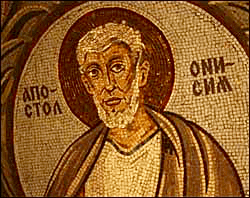
A mosaic of Philemon’s slave, Onesimus

Paul, a prisoner of Christ Jesus, and Timothy our brother,

To Philemon our dear friend and fellow worker—also to Apphia our sister and Archippus our fellow soldier—and to the church that meets in your home:

Grace and peace to you from God our Father and the Lord Jesus Christ.

I always thank my God as I remember you in my prayers, because I hear about your love for all his holy people and your faith in the Lord Jesus. I pray that your partnership with us in the faith may be effective in deepening your understanding of every good thing we share for the sake of Christ. Your love has given me great joy and encouragement, because you, brother, have refreshed the hearts of the Lord’s people.

Therefore, although in Christ I could be bold and order you to do what you ought to do, yet I prefer to appeal to you on the basis of love. It is as none other than Paul—an old man and now also a prisoner of Christ Jesus—that I appeal to you for my son Onesimus, who became my son while I was in chains. Formerly he was useless to you, but now he has become useful both to you and to me.

I am sending him—who is my very heart—back to you. I would have liked to keep him with me so that he could take your place in helping me while I am in chains for the gospel. But I did not want to do anything without your consent, so that any favor you do would not seem forced but would be voluntary. Perhaps the reason he was separated from you for a little while was that you might have him back forever—no longer as a slave, but better than a slave, as a dear brother. He is very dear to me but even dearer to you, both as a fellow man and as a brother in the Lord.

So if you consider me a partner, welcome him as you would welcome me. If he has done you any wrong or owes you anything, charge it to me. I, Paul, am writing this with my own hand. I will pay it back—not to mention that you owe me your very self. I do wish, brother, that I may have some benefit from you in the Lord; refresh my heart in Christ. Confident of your obedience, I write to you, knowing that you will do even more than I ask.

And one thing more: Prepare a guest room for me, because I hope to be restored to you in answer to your prayers.

Epaphras, my fellow prisoner in Christ Jesus, sends you greetings. And so do Mark, Aristarchus, Demas and Luke, my fellow workers.

The grace of the Lord Jesus Christ be with your spirit. (New International Version)

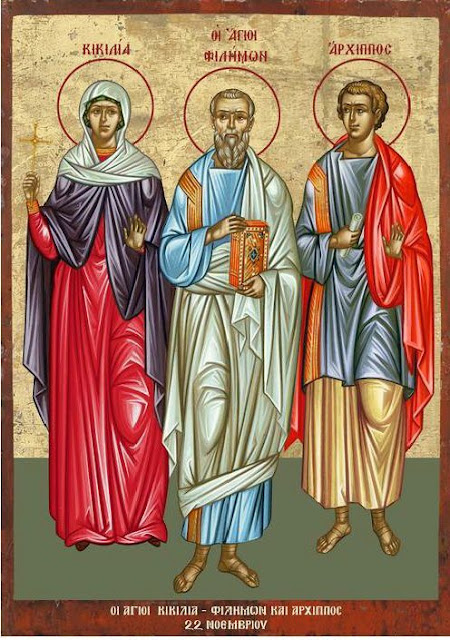
Orthodox depiction of Saints Apphia, Philemon, and Archippus

Tucked away near the end of the 66 books of the Holy Bible is the little letter of Philemon. Many Christians have neither heard a sermon preached on it, nor ever discussed it. Yet, there it is, contained as part of the New Testament canon. So, it could use some attention from us.

The letter is an appeal to Philemon concerning his slave Onesimus – who fled from his master and subsequently ended up converting to Christianity through the Apostle Paul’s influence.

At the time, Paul was imprisoned and Onesimus attended to his needs. Although Paul desired to keep Onesimus with him, he sent the slave back to Philemon. The Apostle was wanting the master to receive the slave as a beloved brother in the Lord, and not just as a servant. Then, Paul hoped Philemon would send Onesimus back to him, thus smoothing out the master/slave relationship and having his own needs met, as well.

The bottom line of the letter is that Paul very much desired that Onesimus be freed from his servitude by Philemon. He didn’t want to pull rank and twist Philemon’s arm to do it. Even though we don’t precisely know what happened in response to Paul’s letter, it’s likely that Onesimus was freed, since the appeal was included in the New Testament.

Christianity, ideally, is meant to transform lives, to change social relationships, to establish a truly egalitarian society in which the status of humans owning other humans would be done away with. Men ought to become brothers with one another and not highly stratified and separated with gross power inequities between them.

Now, in Christ, it doesn’t matter if you are a Jew or a Greek, a slave or free, male or female. You are all the same in Christ Jesus.

Galatians 3:28, ERV

Sitting where we are now, a few millennia later, we might find it curious that Paul and other biblical writers didn’t simply call for the outright abolition of slavery altogether. And yet, slavery was such an ensconced part of the ancient world (some places in the Roman Empire had up to 70% of the population as slaves) that to do so immediately would have likely brought such shock to the system that more harm than good may result.

In Paul’s experience, he continually went about the business of agitating for change by proclaiming a gospel of grace for all people. And the places where he did so saw great societal transformation – which is why Paul got so much pushback from so many authorities who benefited from keeping others under their feet.

In the household of faith, all persons are sisters and brothers and useful servants of one another and of the Lord.

The healings by Jesus in the Gospels not only restored one’s physical health but also restored the individual back to the community. The leper’s social stigma was lifted; the woman’s isolation due to bleeding was done away with; and stereotypes of those born with disabilities were overturned.

No one is inferior in the kingdom of God. Everyone is inherently worthy and has a vital purpose in God’s new society. Since the cross of Christ has erased all barriers, Christian community is to be realized through respectful equality, mutual love, and caring fellowship.

That’s how the system is changed.

Almighty God, by your Holy Spirit you have made us one with your saints in heaven and on earth. May our earthly pilgrimage be always supported by this fellowship of love and prayer, and know ourselves surrounded by their witness to your power and mercy; through Jesus Christ our Lord. Amen.

Keep the Main Thing the Main Thing (Galatians 2:1-10)

Fourteen years after that first visit, Barnabas and I went up to Jerusalem and took Titus with us. I went to clarify with them what had been revealed to me. At that time I placed before them exactly what I was preaching to the non-Jews. I did this in private with the leaders, those held in esteem by the church, so that our concern would not become a controversial public issue, marred by ethnic tensions, exposing my years of work to denigration and endangering my present ministry.

Significantly, Titus, non-Jewish though he was, was not required to be circumcised. While we were in conference we were infiltrated by spies pretending to be Christians, who slipped in to find out just how free true Christians are. Their ulterior motive was to reduce us to their brand of servitude. We didn’t give them the time of day. We were determined to preserve the truth of the Message for you.

As for those who were considered important in the church, their reputation doesn’t concern me. God isn’t impressed with mere appearances, and neither am I. And of course these leaders were able to add nothing to the message I had been preaching. It was soon evident that God had entrusted me with the same message to the non-Jews as Peter had been preaching to the Jews.

Recognizing that my calling had been given by God, James, Peter, and John—the pillars of the church—shook hands with me and Barnabas, assigning us to a ministry to the non-Jews, while they continued to be responsible for reaching out to the Jews. The only additional thing they asked was that we remember the poor, and I was already eager to do that. (The Message)

The former devout Jew, Saul, had become the Christian apostle and missionary, Paul. His ministry was as radical and dramatic as his conversion to Christianity was.

The Struggle

Keep in mind that the earliest church was predominantly made up of Jewish Christians. They had to struggle with the relationship between their historic Judaism and their newfound Christianity. For many of them, Paul was doing the unthinkable; he not only purposely sought to reach Gentiles (non-Jewish people) with the message of Jesus Christ, but he also did not require them to be circumcised. For Paul, one did not have to first become Jewish before becoming Christian.

Paul doggedly sought to preserve the core essence and spirit of Christ’s message, that is, to proclaim the good news of forgiveness and new life through the person and work of Jesus – and not by means of retaining Jewish customs or laws, including circumcision.

The Main Thing

Christianity is more than set of beliefs and practices; it’s a way of life which can be summed up in three important words: faith, hope, and love. 

Both new believers in Jesus and veterans in the faith know from experience how difficult it can be to live the Christian life. One reason for this difficulty, even when we want to please the Lord, is due to the confusion that occurs between our inner feelings and our outer actions.

The Confusion

The confusion starts with the creation and fall of humanity. In the beginning, God created humans as persons with a divine/human relationship as central to daily life. (Genesis 1:26; 2:16-25) 

What’s more, God created people with the capacity to receive divine revelation through our ability to think and reason. (Ephesians 4:24; Colossians 3:10) 

Before disobedience entered the world, in the original state before humanity’s fall, all human functions were under complete control with an inner experience of unity and harmony with one another and God. (Genesis 1:31; 2:7, 16-25) 

It is imperative for us to recognize the distinction between our personal being and our personal functions. (Romans 1:21-32; 6:16-22; 1 Corinthians 9:27; Ephesians 4:21-32)

If we don’t grasp how cataclysmic the fall of humanity was, we are going to have big struggles with living the Christian life – illustrated in the way that Paul needed to fend off a bunch of professing Christians who still seemed spiritually stuck. 

The Disobedience

In Adam and Eve’s original disobedience to God, the authority for life was transferred from God to us so that our sinful bent is to call our own shots without God. The source of authority also got whacky, transferred from a holistic and synergistic approach of body, mind, emotions, and spirit to a one-dimensional approach of simply how we feel at any given moment.

If we fail to understand this dynamic, we will be continually frustrated with people because they do irrational things. For example, many church pastors are flabbergasted that parishioners do not simply take what they teach them and go and do it. Yet, if it were that simple, there would be no place for the Holy Spirit!

Unfortunately, there’s more. In humanity’s fall, we lost control of our capacity to function well. We are all now vulnerable to manipulation, too easily swayed by the surrounding culture, and, of course, Satan. (Ephesians 2:2-3; Galatians 5:16-21) 

As a result, our inner conscience has become confused. We are not always certain of right and wrong. We misunderstand what life is really supposed to be all about. 

We lose sight of the main thing. And, in that state, there’s no way we can keep the main thing the main thing.

Instead, we become obsessed with feeling comfortable and secure; so, we pursue false gods – leaving usdisappointed and with a lack of fulfillment in life.

The Good News

However, the good news is that through the redeeming work of Jesus Christ, new life emerges; the bondage of sin is broken in our lives, and we are legally reinstated in a relationship with God in which the Lord is central in our daily life and the final authority. 

In this new relationship we can again receive truth through the Holy Spirit and the Holy Scriptures. We regain control of our functions. 

Yet, unless we learn the Scriptures and growin a daily walk with Jesus, the practical experience of this relationship with all its freedom, joy, assurance,  power, and fruitfulness may be greatly limited. (Romans 7:14-25; 1 Corinthians 3:1-4)

Even though we have redemption and faith, it is still possible to regress and give in to our old ways of functioning. This is a big reason why Christians can experience conflict, doubt, fear, anxiety, frustration, disappointment, and confusion.

To live keeping the main thing the main thing means to grow in the experience and application Christ’s centrality and authority in our lives. 

The Awareness

We must, therefore, make daily decisions of faith, hope, and love based in who we are in Christ and recognize his authority in our lives. The following seven recognitions and awareness may be helpful for you in experiencing Christian freedom and unity:

  1. You are a person with the ability to function in faith, hope, and love as God’s beloved child in Christ (2 Corinthians 7:1; Romans 8:14-17)
  2. There is a difference between who you are and what you do (or don’t do).  Evil thoughts and emotions do not make you evil, anymore than fantasizing about being a unicorn makes you a unicorn.
  3. You can take charge of your actions and your life (Galatians 5:22-23)
  4. The key is the use of your will through living in harmony with revealed biblical truth. In other words, you really can make choices of faith, hope, and love, no matter the situation. (Romans 4:17-21; Psalm 56:3; Psalm 43:5-11)  
  5. Reject whatever is contrary to Scripture, reason, and conscience. Listen to your whole self. Unhealthy patterns of acting and speaking must be broken in Jesus’ name. (Ephesians 4:22; Colossians 3:5-9; Titus 2:11-12)
  6. Choose to obey the Holy Spirit and the Holy Scriptures. Learn to think and act on the basis of truth. (Acts 27:25)
  7. Practicing the truth results in freedom, a re-patterning of thinking and functions, as well as the fruit of the Spirit. (John 8:32; Titus 2:11-14; Philippians 2:12-16)

The church is intended to be a supportive community of fellow redeemed people who worship and love Jesus together. 

Without sharing our collective learning of the Scriptures and daily struggles of faith, hope, and love, believers will inevitably be spiritually immature over the long haul. Instead, talk about your shared experiences of worship, Scripture reading, and Christian living. 

In doing so, God is glorified, the church is strengthened, and the cranky circumcisers are seen as the legalistic lunkheads they really are.