
Living Water and Real Food (John 4:5-42)

Jesus and the Samaritan Woman, by He Qi

So he came to a town in Samaria called Sychar, near the plot of ground Jacob had given to his son Joseph. Jacob’s well was there, and Jesus, tired as he was from the journey, sat down by the well. It was about noon.

When a Samaritan woman came to draw water, Jesus said to her, “Will you give me a drink?” (His disciples had gone into the town to buy food.)

The Samaritan woman said to him, “You are a Jew and I am a Samaritan woman. How can you ask me for a drink?” (For Jews do not associate with Samaritans.)

Jesus answered her, “If you knew the gift of God and who it is that asks you for a drink, you would have asked him and he would have given you living water.”

“Sir,” the woman said, “you have nothing to draw with and the well is deep. Where can you get this living water? Are you greater than our father Jacob, who gave us the well and drank from it himself, as did also his sons and his livestock?”

Jesus answered, “Everyone who drinks this water will be thirsty again, but whoever drinks the water I give them will never thirst. Indeed, the water I give them will become in them a spring of water welling up to eternal life.”

The woman said to him, “Sir, give me this water so that I won’t get thirsty and have to keep coming here to draw water.”

He told her, “Go, call your husband and come back.”

“I have no husband,” she replied.

Jesus said to her, “You are right when you say you have no husband. The fact is, you have had five husbands, and the man you now have is not your husband. What you have just said is quite true.”

“Sir,” the woman said, “I can see that you are a prophet. Our ancestors worshiped on this mountain, but you Jews claim that the place where we must worship is in Jerusalem.”

“Woman,” Jesus replied, “believe me, a time is coming when you will worship the Father neither on this mountain nor in Jerusalem. You Samaritans worship what you do not know; we worship what we do know, for salvation is from the Jews. Yet a time is coming and has now come when the true worshipers will worship the Father in the Spirit and in truth, for they are the kind of worshipers the Father seeks. God is spirit, and his worshipers must worship in the Spirit and in truth.”

The woman said, “I know that Messiah” (called Christ) “is coming. When he comes, he will explain everything to us.”

Then Jesus declared, “I, the one speaking to you—I am he.”

Just then his disciples returned and were surprised to find him talking with a woman. But no one asked, “What do you want?” or “Why are you talking with her?”

Then, leaving her water jar, the woman went back to the town and said to the people, “Come, see a man who told me everything I ever did. Could this be the Messiah?” They came out of the town and made their way toward him.

Meanwhile his disciples urged him, “Rabbi, eat something.”

 But he said to them, “I have food to eat that you know nothing about.”

Then his disciples said to each other, “Could someone have brought him food?”

“My food,” said Jesus, “is to do the will of him who sent me and to finish his work. Don’t you have a saying, ‘It’s still four months until harvest’? I tell you, open your eyes and look at the fields! They are ripe for harvest. Even now the one who reaps draws a wage and harvests a crop for eternal life, so that the sower and the reaper may be glad together. Thus the saying ‘One sows and another reaps’ is true. I sent you to reap what you have not worked for. Others have done the hard work, and you have reaped the benefits of their labor.”

Many of the Samaritans from that town believed in him because of the woman’s testimony, “He told me everything I ever did.” So when the Samaritans came to him, they urged him to stay with them, and he stayed two days. And because of his words many more became believers.

They said to the woman, “We no longer believe just because of what you said; now we have heard for ourselves, and we know that this man really is the Savior of the world.” (New International Version)
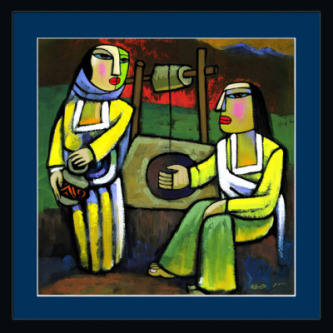
Samaritan Woman and Jesus at the Well, by He Qi

Samaria, back in Christ’s day, was viewed by many as an infamous place, full of untrustworthy people who were a mongrel mix of Jewish and ancient Assyrian blood. And their religion was most suspect of all – an unholy blend of Jewish and Gentile practices. So, no respectable Jewish person ever got near Samaria or even talked with a Samaritan.

Jesus, however, saw things differently. He did not avoid the territory but confidently walked through Samaria. Christ had no problem stopping to rest on his journey in a foreign area. That’s because Jesus didn’t class people into groups, nor did he attach adjectives to people, such as “those” Samaritans. He had no obstacles between himself and others.

Which is why an organic conversation happened between Jesus and a Samaritan woman. Christ simply saw a human being who happened to be a woman and a Samaritan. He acknowledged both her gender and her ethnicity without those being a problem. Not even Christ’s knowledge of her string of husbands was an issue in conversing with her.

Every time I read this narrative of Jesus interacting with the Samaritan woman, I imagine what all the non-verbal communication was like. I’m sure the conversation was as much about Christ’s affect, gestures, and tone of voice, as it was his well-placed words. I fully believe both his verbal and non-verbal communication was perfectly congruent with each other, giving the woman a compelling sense that her ultimate needs could be met with the living well of a person in front of her.

Water gives life. And Jesus, as living water, gives new life. A bunch of failed relationships testified to the woman’s dissatisfaction. Even though we hear no more about her after this story in the Bible, we as readers get the overwhelming sense that the woman finally found satisfaction. The love which kept slipping through her fingers now had staying power.

Jesus stood and said in a loud voice, “Let anyone who is thirsty come to me and drink. Whoever believes in me, as Scripture has said, rivers of living water will flow from within them.” (John 7:37-38, NIV)

We need the living water of Jesus as a river flowing straight from him to us — replenishing, renewing, sustaining, and breaking through every barrier in its path like a mighty flood overcoming and pushing everything out of the way that blocks its path so that our love can overflow onto all sorts of people, like a Samaritan woman.

The disciples come along, seemingly confused about this scene of Jesus and a Samaritan woman. So they blurt out something like the stereotypical mother concerned for her son saying, “Sit down and eat some of Mama’s pasta. You need some food!” As if preparing and serving a meal will make everything better.

Food has both the power to bring us together, as well as separate us. A meal can create the conditions for fellowship, acceptance, and enjoyment. On the other hand, sitting down to eat can also be a way to avoid painful emotions, and so, becomes an obstacle, keeping love at bay.

The disciples were uncomfortable and maybe a bit stressed. Looking to fill up with food instead of with God, their sense of unfulfillment was coming out sideways by opening the pantry and looking for comfort food. Jesus saw through the situation and put the focus on the disciples’ spiritual hunger.

Paying attention to our vocation and discovering humble work in the service of God, rather than a vacation to the fridge to cover unwanted feelings, is the essence of Christ’s interaction with his disciples.

People are much more ready for the gospel than we think. There are times we can become insular, lost within our own heads, that we are then unable to see the world as ripe for a harvest of people who are eager to be gathered into a community of redemption and love.

Jesus had a significant interaction with the Samaritan woman – despite the social prohibitions of the time. Shenanigans like this, by Christ, got a lot of people’s  undies in a bundle. The disciples, having a front seat to most of Christ’s ways, did a few too many palms to the forehead, believing their Rabbi’s behavior was going to make him unpopular. They feared no one would follow him.

Looks like the disciples didn’t quite get that one right.

The Samaritan woman received Jesus as Living Water, having her ultimate needs met by the Lord of all. The disciples hadn’t quite caught up to this, so fell back on their old ways of physical food and drink to assuage the awkward uncomfortable feelings happening inside them.

The woman became a wellspring of good news to her community. Whereas the disciples eventually became a fountain of the gospel after Christ’s death and resurrection, they are here only an annoying drip from the kitchen faucet. A non-descript ethnically suspect woman of dubious character coming to faith was meant by Jesus to open the disciples’ eyes to a new reality:

The good news of Christ is meant for the world, not just Jewish men.

The disciples were given the opportunity to participate a mission of bringing the love of God where love wasn’t present, of helping all kinds of people awaken to the deep spirituality within them, of lifting their downcast faces of guilt and shame to see the Living God bless the world with the body and blood of Jesus.

All of our work, no matter how big or small, is made possible by God, the great Chef of the universe. God has done all the preparations of chopping the onions, mincing the garlic, slicing the carrots, and peeling the potatoes so that we, his followers, can make a savory stew of diverse people sharing a common pot of God’s love and hospitality. It is, therefore, our privilege to be the wait staff who serves the meal to a whole host of persons.

O God, you made us in your own image, and you have redeemed us through your Son Jesus Christ: Look with compassion on the whole human family; take away the arrogance and hatred which infect our hearts; break down the walls that separate us; unite us in bonds of love; and work through our struggle and confusion to accomplish your purposes on earth; that, in your good time, all nations and races may serve you in harmony around your heavenly throne; through Jesus Christ our Lord. Amen.

The True Nature of Faith (Luke 7:1-10)

Jesus heals the servant of a Roman Centurion

After Jesus finished presenting all his words among the people, he entered Capernaum. A centurion had a servant who was very important to him, but the servant was ill and about to die. When the centurion heard about Jesus, he sent some Jewish elders to Jesus to ask him to come and heal his servant. When they came to Jesus, they earnestly pleaded with Jesus. “He deserves to have you do this for him,” they said. “He loves our people and he built our synagogue for us.”

Jesus went with them. He had almost reached the house when the centurion sent friends to say to Jesus, “Lord, don’t be bothered. I don’t deserve to have you come under my roof. In fact, I didn’t even consider myself worthy to come to you. Just say the word and my servant will be healed. I’m also a man appointed under authority, with soldiers under me. I say to one, ‘Go,’ and he goes, and to another, ‘Come,’ and he comes. I say to my servant, ‘Do this,’ and the servant does it.”

When Jesus heard these words, he was impressed with the centurion. He turned to the crowd following him and said, “I tell you, even in Israel I haven’t found faith like this.” When the centurion’s friends returned to his house, they found the servant restored to health. (Common English Bible)

Jesus the Jew used his authority to heal and transform a Gentile.

This particular Gentile, a Roman Centurion, clearly understood his place and who Jesus was. The Centurion felt unworthy to even have the Lord Jesus come into his house. And his profession of faith amazed even Jesus. “Just say the word,” he said in recognition of Christ’s authority.

The power and authority of Jesus is big enough to heal without even being present. In the ancient Roman Empire, Centurions were the backbone of the Roman military machine, and so, were hated by the Jews. Yet, Jesus the Jew not only responded to the Centurion’s request, but he also affirmed this Gentile’s faith as greater than any he had seen amongst his own people.

Grace answers to need, and not to smug self-confidence. The Roman Centurion asked for healing, not for himself, but for his servant. And Jesus graciously and mercifully listened and answered.

The Centurion neither demanded nor claimed healing; but instead, he came in a spirit of humility and asked with confidence that Jesus could heal his servant if he wanted to. The Centurion simply threw himself on God’s mercy. So, Jesus lifted him up as a model of faith for us all.

Real and genuine faith always serves as a solemn warning to the self-righteous – that their lack of humility and their pretentious faith will land them outside of God’s benevolent realm. In a great reversal, the insiders will become the outsiders, and the outsiders become the insiders.

Independently proud folk do not experience healing and transformation because they don’t even know they are sick with sin. They see no need for an intervention by Jesus because they already have their righteous deeds to boast about. Such persons are more concerned about looking good and saving face, and so, are unaware of their own unworthiness. 

The self-righteous approach to handling problems and difficult situations is to come up with good ideas and clever strategies. They rely on hard work, personal effort, and sheer willpower. Prayer may or may not happen after the plans are laid; there is no sense of addressing a problem or need with beseeching God. 

These are merely delusional thoughts of personal autonomy; they only serve to separate us from the grace of God that we so desperately need. 

There is a spiritual dimension to every situation and trouble we face – including sickness. If we only examine the medical end of physical problems, we may be dealing with symptoms instead of the root issue that plagues us.

Are you hurting? Pray. Do you feel great? Sing. Are you sick? Call the church leaders together to pray and anoint you with oil in the name of the Master. Believing-prayer will heal you, and Jesus will put you on your feet. And if you have sinned, you will be forgiven—healed inside and out. Make this your common practice: Confess your sins to each other and pray for each other so that you can live together whole and healed. (James 5:13-16, MSG)

Jesus healed and transformed outsiders. So, followers of Christ need to consistently ask:

  • Who are the outsiders among us?
  • Do we care about strangers? 
  • Are we willing to touch aliens and immigrants? 
  • Will we intercede in prayer for those who are foreign to us? 
  • Will we search for and pursue those on the periphery of society? 
  • Do we believe the risen and ascended Christ can and will heal, deliver, and transform people?

Jesus cannot be domesticated into some figurehead which suits our desires and conforms to our ideas about how things ought to be.

Instead, Christ is portrayed as eager to heal, wanting to show grace to the least and the lowly among society.

Our Father in heaven,
    may your name be kept holy.
May your Kingdom come soon.
May your will be done on earth,
    as it is in heaven.
Give us today the food we need,
and forgive us our sins,
    as we have forgiven those who sin against us.
And don’t let us yield to temptation,
    but rescue us from the evil one. Amen. (Matthew 6:9-13, NLT)

Encouragement to Be Faithful (2 Timothy 1:3-7)

Orthodox icon of St. Timothy
Orthodox icon of St. Paul the Apostle

Timothy, I thank God for you—the God I serve with a clear conscience, just as my ancestors did. Night and day I constantly remember you in my prayers. I long to see you again, for I remember your tears as we parted. And I will be filled with joy when we are together again.

I remember your genuine faith, for you share the faith that first filled your grandmother Lois and your mother, Eunice. And I know that same faith continues strong in you. This is why I remind you to fan into flames the spiritual gift God gave you when I laid my hands on you. For God has not given us a spirit of fear and timidity, but of power, love, and self-discipline. (New Living Translation)

Every individual person I meet is interesting. Everyone has a story. Each person has values which are important to them.  

The Apostle Paul had quite the story of conversion to Christianity. And so, he understandably had a high value of passing on the faith to reliable and competent persons who would then do the same. Timothy was one of those persons, a protégé of his mentor Paul.

Paul reminded Timothy of his identity, rooted in a faithful family, and encouraged him to tap into that robust spirit which resides within him. The Apostle encouraged him to fully express that spirit without fear or timidity.

For example, I care about kids. Children are a high value to both me and my wife. When meeting and engaging a family for the first time, we will inevitably talk to the child before addressing the parents. We care about any issue in the world which has to do with children – and we have a strong sense of morality concerning children because we love kids.

Be faithful to your calling, and to the values and ethics which undergird it. Whatever is important to us is where our sense of morality and ministry lie.

“Wherever your treasure is, there the desires of your heart will also be.”

Jesus (Matthew 6:21, NLT)

Everyone is moralistic because everyone cares about something. And we will live and die by our code of ethics, grounded in the values we most cherish.

In Holy Scripture, although there are hundreds of laws in the Bible, the highest standard of ethics and morality is contained in just a few chapters: The Ten Words (Commandments) found in the Old Testament chapter of Exodus 20; and Christ’s Sermon on the Mount found in the New Testament chapters of Matthew 5-7. 

These few chapters can be distilled into a few short ethical phrases:

“Love God with all your heart, soul, mind, and strength.” And “Love your neighbor as yourself.” (Matthew 22:37-39)

This means that every teaching found in the Bible comes down to love. (Mark 12:30-31)

Throughout the history of the church, the highest ethical values have always had to do with knowing and loving the Creator, Sovereign, and triune God – Father, Son, and Spirit – and the majesty of people who are created in the divine image and likeness.

The movement and trajectory of Holy Scripture is that a good and benevolent God makes and keeps promises to people. Even when they fall and try to create small petty worlds of their own, a gracious God is active, wooing lost people to return to the spirit which resides within them.

Therefore, the Bible is an unfolding drama of redemption in which a loving God goes out of the way to bring back straying, hurting, helpless people. (Luke 15)

Which is why, for me, attending to the inner soul, teaching people the words and ways of Jesus, and providing spiritual care to others is a very high value. I love God, and I love people. It’s easy to understand, then, why I treasure the following:

  1. Practicing solitude, silence, and other spiritual disciplines.
  2. Connecting with God daily in contemplative prayer and meditative Bible reading.
  3. Paying attention to hurting people and bringing them grace, mercy, faith, hope, love, and gentleness.
  4. Seeking to act with civility and respect toward others I disagree with, or just don’t like very well.
  5. Engaging others who don’t share my values of faith in God.
  6. Praying and hoping for people to be healed and whole.
  7. Pursuing the common good of all people, no matter who they are.

My deep conviction is that the care of the soul is just as important as the care of the body; that attention to exercising the mind with Holy Scripture is just as important to overall health and well-being as cardio workouts and sensible eating; and that the hope of the world resides with knowing Jesus Christ (and not with a lesser hope that wishes things will work out in the end if I’m sincere to my personal ethical beliefs).

Paul wanted Christians to engage in the care of souls, to fan into flame the spiritual gifts which already lie within us, even if they may seem dormant or non-existent.

So, be faithful to who you are, to what you have been called to, and especially to the good news:

For there is one God and one Mediator who can reconcile God and humanity—the man Christ Jesus. He gave his life to purchase freedom for everyone. This is the message God gave to the world at just the right time. (1 Timothy 2:5-6, NLT)

Great God and Father of all, remember the multitudes who have been created in your image but have not known the redeeming work of our Savior Jesus Christ; and grant that, by the prayers and labors of your Church, they may be brought to know and worship you as you have been revealed in your Son, who lives and reigns with you and the Holy Spirit, one God, now and forever. Amen.

Ash Wednesday (Matthew 6:16-34)

“When you fast, do not look somber as the hypocrites do, for they disfigure their faces to show others they are fasting. Truly I tell you, they have received their reward in full. But when you fast, put oil on your head and wash your face, so that it will not be obvious to others that you are fasting, but only to your Father, who is unseen; and your Father, who sees what is done in secret, will reward you.

“Do not store up for yourselves treasures on earth, where moths and vermin destroy, and where thieves break in and steal. But store up for yourselves treasures in heaven, where moths and vermin do not destroy, and where thieves do not break in and steal. For where your treasure is, there your heart will be also.

“The eye is the lamp of the body. If your eyes are healthy, your whole body will be full of light. But if your eyes are unhealthy, your whole body will be full of darkness. If then the light within you is darkness, how great is that darkness!

“No one can serve two masters. Either you will hate the one and love the other, or you will be devoted to the one and despise the other. You cannot serve both God and money.

“Therefore I tell you, do not worry about your life, what you will eat or drink; or about your body, what you will wear. Is not life more than food, and the body more than clothes? Look at the birds of the air; they do not sow or reap or store away in barns, and yet your heavenly Father feeds them. Are you not much more valuable than they? Can any one of you by worrying add a single hour to your life?

“And why do you worry about clothes? See how the flowers of the field grow. They do not labor or spin. Yet I tell you that not even Solomon in all his splendor was dressed like one of these. If that is how God clothes the grass of the field, which is here today and tomorrow is thrown into the fire, will he not much more clothe you—you of little faith? So do not worry, saying, ‘What shall we eat?’ or ‘What shall we drink?’ or ‘What shall we wear?’ For the pagans run after all these things, and your heavenly Father knows that you need them. 

But seek first his kingdom and his righteousness, and all these things will be given to you as well. Therefore do not worry about tomorrow, for tomorrow will worry about itself. Each day has enough trouble of its own. (New International Version)

Traditional Ash Wednesday services focus on the brevity of life and remind worshippers that they came from dust and will soon enough return back to the earth, dust once more. For our many of our parents in the faith, Lent was typically a sad season in which they gave up something in order to prepare themselves for eternal life.

The salvation promised and hoped for led them to look away from the joys of Spring and the beauties of the earth. Faithful Christians, in generations past, trained their eyes on heaven, forsaking time for eternity.

Yes, life is serious and risky business, and no one gets out alive. Yet is salvation really all about escaping this world of constant grief and death? Or is it seeing everlasting beauty in each passing moment?

It could be that you struggle with Ash Wednesday services and the season of Lent precisely because of its focus on giving up something, or because when you were a kid this time of year seemed like such a downer. Maybe your typical approach to Lent in the past has been a shoulder shrug and a response of “meh.”

So, therefore, I want us to get a different take on the meaning of Ash Wednesday and look at it from a different angle.

I will take away the ashes on their head, and I will give them a crown. I will take away their sadness, and I will give them the oil of happiness. I will take away their sorrow, and I will give them celebration clothes. 

Isaiah 61:3, ERV

The uncertainty of life can invite us to praise and wonder, to seize the moment—for this is the day the Lord has made and I will rejoice in it! All that I love and care for is mortal and fleeting, but mortality is the inspiration to celebration and love.

This is the sort of approach I saw in a dear friend who died fifteen years ago from a very long struggle with cancer. Bea always found ways to rejoice in her suffering, to be attentive to the working of God around her, and to bless those who needed God’s grace more than she did. More than once I found Bea, in one of her many hospital stays, out of the bed and in someone else’s room playing her dulcimer (she had once been a music teacher) and singing a hymn of praise to a fellow patient.

This Ash Wednesday, I’m not only fasting and giving up a few meals a week; I’m also letting go of everything that keeps me from rejoicing in the passing beauty of the earth.

Yes, we are dust, but we are real earthly sacred dust. Dust is good, after all, emerging from God’s intergalactic creativity. We are frail, but we are also part of a holy adventure reflecting God’s love over thousands of years.

Ash Wednesday is a time for us to pause, notice, wake up, and discover that God is in this place. This day invites us to take a much needed break and open up to the precarious yet beautiful world in which we live. So in this season of Lent, I plan on considering the lilies and the birds of the air.

In some Christian traditions, the imposition of ashes is accompanied by the words, “repent and believe the gospel.” And that I plan to do this year. I plan to turn around and be more present to the moment, appreciating God’s grandeur, and believing the good news—the embodied, everlasting, beautiful, wondrous, and gracious good news of walking with the Lord who is with me, surrounds me, and goes before me and after me.

Pastor and author, Jan Richardson, lost her husband to cancer several years ago during the season of Lent. She chose to cremate her husband so that his ashes might remind her and her family that there is beauty in the dust.  She wrote the following poem at her first Ash Wednesday without him:

Blessing the Dust

All those days
you felt like dust,
like dirt,
as if all you had to do
was turn your face
toward the wind
and be scattered
to the four corners

or swept away
by the smallest breath
as insubstantial—

did you not know
what the Holy One
can do with dust?

This is the day
we freely say
we are scorched.

This is the hour
we are marked
by what has made it
through the burning.

This is the moment
we ask for the blessing
that lives within
the ancient ashes,
that makes its home
inside the soil of
this sacred earth.

So let us be marked
not for sorrow.
And let us be marked
not for shame.
Let us be marked
not for false humility
or for thinking
we are less
than we are

but for claiming
what God can do
within the dust,
within the dirt,
within the stuff
of which the world
is made
and the stars that blaze
in our bones
and the galaxies that spiral
inside the smudge
we bear.

Amen.