Encouragement to Be Faithful (2 Timothy 1:3-7)

Orthodox icon of St. Timothy
Orthodox icon of St. Paul the Apostle

Timothy, I thank God for you—the God I serve with a clear conscience, just as my ancestors did. Night and day I constantly remember you in my prayers. I long to see you again, for I remember your tears as we parted. And I will be filled with joy when we are together again.

I remember your genuine faith, for you share the faith that first filled your grandmother Lois and your mother, Eunice. And I know that same faith continues strong in you. This is why I remind you to fan into flames the spiritual gift God gave you when I laid my hands on you. For God has not given us a spirit of fear and timidity, but of power, love, and self-discipline. (New Living Translation)

Every individual person I meet is interesting. Everyone has a story. Each person has values which are important to them.  

The Apostle Paul had quite the story of conversion to Christianity. And so, he understandably had a high value of passing on the faith to reliable and competent persons who would then do the same. Timothy was one of those persons, a protégé of his mentor Paul.

Paul reminded Timothy of his identity, rooted in a faithful family, and encouraged him to tap into that robust spirit which resides within him. The Apostle encouraged him to fully express that spirit without fear or timidity.

For example, I care about kids. Children are a high value to both me and my wife. When meeting and engaging a family for the first time, we will inevitably talk to the child before addressing the parents. We care about any issue in the world which has to do with children – and we have a strong sense of morality concerning children because we love kids.

Be faithful to your calling, and to the values and ethics which undergird it. Whatever is important to us is where our sense of morality and ministry lie.

“Wherever your treasure is, there the desires of your heart will also be.”

Jesus (Matthew 6:21, NLT)

Everyone is moralistic because everyone cares about something. And we will live and die by our code of ethics, grounded in the values we most cherish.

In Holy Scripture, although there are hundreds of laws in the Bible, the highest standard of ethics and morality is contained in just a few chapters: The Ten Words (Commandments) found in the Old Testament chapter of Exodus 20; and Christ’s Sermon on the Mount found in the New Testament chapters of Matthew 5-7. 

These few chapters can be distilled into a few short ethical phrases:

“Love God with all your heart, soul, mind, and strength.” And “Love your neighbor as yourself.” (Matthew 22:37-39)

This means that every teaching found in the Bible comes down to love. (Mark 12:30-31)

Throughout the history of the church, the highest ethical values have always had to do with knowing and loving the Creator, Sovereign, and triune God – Father, Son, and Spirit – and the majesty of people who are created in the divine image and likeness.

The movement and trajectory of Holy Scripture is that a good and benevolent God makes and keeps promises to people. Even when they fall and try to create small petty worlds of their own, a gracious God is active, wooing lost people to return to the spirit which resides within them.

Therefore, the Bible is an unfolding drama of redemption in which a loving God goes out of the way to bring back straying, hurting, helpless people. (Luke 15)

Which is why, for me, attending to the inner soul, teaching people the words and ways of Jesus, and providing spiritual care to others is a very high value. I love God, and I love people. It’s easy to understand, then, why I treasure the following:

  1. Practicing solitude, silence, and other spiritual disciplines.
  2. Connecting with God daily in contemplative prayer and meditative Bible reading.
  3. Paying attention to hurting people and bringing them grace, mercy, faith, hope, love, and gentleness.
  4. Seeking to act with civility and respect toward others I disagree with, or just don’t like very well.
  5. Engaging others who don’t share my values of faith in God.
  6. Praying and hoping for people to be healed and whole.
  7. Pursuing the common good of all people, no matter who they are.

My deep conviction is that the care of the soul is just as important as the care of the body; that attention to exercising the mind with Holy Scripture is just as important to overall health and well-being as cardio workouts and sensible eating; and that the hope of the world resides with knowing Jesus Christ (and not with a lesser hope that wishes things will work out in the end if I’m sincere to my personal ethical beliefs).

Paul wanted Christians to engage in the care of souls, to fan into flame the spiritual gifts which already lie within us, even if they may seem dormant or non-existent.

So, be faithful to who you are, to what you have been called to, and especially to the good news:

For there is one God and one Mediator who can reconcile God and humanity—the man Christ Jesus. He gave his life to purchase freedom for everyone. This is the message God gave to the world at just the right time. (1 Timothy 2:5-6, NLT)

Great God and Father of all, remember the multitudes who have been created in your image but have not known the redeeming work of our Savior Jesus Christ; and grant that, by the prayers and labors of your Church, they may be brought to know and worship you as you have been revealed in your Son, who lives and reigns with you and the Holy Spirit, one God, now and forever. Amen.

Ash Wednesday (Matthew 6:16-34)

“When you fast, do not look somber as the hypocrites do, for they disfigure their faces to show others they are fasting. Truly I tell you, they have received their reward in full. But when you fast, put oil on your head and wash your face, so that it will not be obvious to others that you are fasting, but only to your Father, who is unseen; and your Father, who sees what is done in secret, will reward you.

“Do not store up for yourselves treasures on earth, where moths and vermin destroy, and where thieves break in and steal. But store up for yourselves treasures in heaven, where moths and vermin do not destroy, and where thieves do not break in and steal. For where your treasure is, there your heart will be also.

“The eye is the lamp of the body. If your eyes are healthy, your whole body will be full of light. But if your eyes are unhealthy, your whole body will be full of darkness. If then the light within you is darkness, how great is that darkness!

“No one can serve two masters. Either you will hate the one and love the other, or you will be devoted to the one and despise the other. You cannot serve both God and money.

“Therefore I tell you, do not worry about your life, what you will eat or drink; or about your body, what you will wear. Is not life more than food, and the body more than clothes? Look at the birds of the air; they do not sow or reap or store away in barns, and yet your heavenly Father feeds them. Are you not much more valuable than they? Can any one of you by worrying add a single hour to your life?

“And why do you worry about clothes? See how the flowers of the field grow. They do not labor or spin. Yet I tell you that not even Solomon in all his splendor was dressed like one of these. If that is how God clothes the grass of the field, which is here today and tomorrow is thrown into the fire, will he not much more clothe you—you of little faith? So do not worry, saying, ‘What shall we eat?’ or ‘What shall we drink?’ or ‘What shall we wear?’ For the pagans run after all these things, and your heavenly Father knows that you need them. 

But seek first his kingdom and his righteousness, and all these things will be given to you as well. Therefore do not worry about tomorrow, for tomorrow will worry about itself. Each day has enough trouble of its own. (New International Version)

Traditional Ash Wednesday services focus on the brevity of life and remind worshippers that they came from dust and will soon enough return back to the earth, dust once more. For our many of our parents in the faith, Lent was typically a sad season in which they gave up something in order to prepare themselves for eternal life.

The salvation promised and hoped for led them to look away from the joys of Spring and the beauties of the earth. Faithful Christians, in generations past, trained their eyes on heaven, forsaking time for eternity.

Yes, life is serious and risky business, and no one gets out alive. Yet is salvation really all about escaping this world of constant grief and death? Or is it seeing everlasting beauty in each passing moment?

It could be that you struggle with Ash Wednesday services and the season of Lent precisely because of its focus on giving up something, or because when you were a kid this time of year seemed like such a downer. Maybe your typical approach to Lent in the past has been a shoulder shrug and a response of “meh.”

So, therefore, I want us to get a different take on the meaning of Ash Wednesday and look at it from a different angle.

I will take away the ashes on their head, and I will give them a crown. I will take away their sadness, and I will give them the oil of happiness. I will take away their sorrow, and I will give them celebration clothes. 

Isaiah 61:3, ERV

The uncertainty of life can invite us to praise and wonder, to seize the moment—for this is the day the Lord has made and I will rejoice in it! All that I love and care for is mortal and fleeting, but mortality is the inspiration to celebration and love.

This is the sort of approach I saw in a dear friend who died fifteen years ago from a very long struggle with cancer. Bea always found ways to rejoice in her suffering, to be attentive to the working of God around her, and to bless those who needed God’s grace more than she did. More than once I found Bea, in one of her many hospital stays, out of the bed and in someone else’s room playing her dulcimer (she had once been a music teacher) and singing a hymn of praise to a fellow patient.

This Ash Wednesday, I’m not only fasting and giving up a few meals a week; I’m also letting go of everything that keeps me from rejoicing in the passing beauty of the earth.

Yes, we are dust, but we are real earthly sacred dust. Dust is good, after all, emerging from God’s intergalactic creativity. We are frail, but we are also part of a holy adventure reflecting God’s love over thousands of years.

Ash Wednesday is a time for us to pause, notice, wake up, and discover that God is in this place. This day invites us to take a much needed break and open up to the precarious yet beautiful world in which we live. So in this season of Lent, I plan on considering the lilies and the birds of the air.

In some Christian traditions, the imposition of ashes is accompanied by the words, “repent and believe the gospel.” And that I plan to do this year. I plan to turn around and be more present to the moment, appreciating God’s grandeur, and believing the good news—the embodied, everlasting, beautiful, wondrous, and gracious good news of walking with the Lord who is with me, surrounds me, and goes before me and after me.

Pastor and author, Jan Richardson, lost her husband to cancer several years ago during the season of Lent. She chose to cremate her husband so that his ashes might remind her and her family that there is beauty in the dust.  She wrote the following poem at her first Ash Wednesday without him:

Blessing the Dust

All those days
you felt like dust,
like dirt,
as if all you had to do
was turn your face
toward the wind
and be scattered
to the four corners

or swept away
by the smallest breath
as insubstantial—

did you not know
what the Holy One
can do with dust?

This is the day
we freely say
we are scorched.

This is the hour
we are marked
by what has made it
through the burning.

This is the moment
we ask for the blessing
that lives within
the ancient ashes,
that makes its home
inside the soil of
this sacred earth.

So let us be marked
not for sorrow.
And let us be marked
not for shame.
Let us be marked
not for false humility
or for thinking
we are less
than we are

but for claiming
what God can do
within the dust,
within the dirt,
within the stuff
of which the world
is made
and the stars that blaze
in our bones
and the galaxies that spiral
inside the smudge
we bear.

Amen.

Don’t Be Afraid (Matthew 17:1-9)

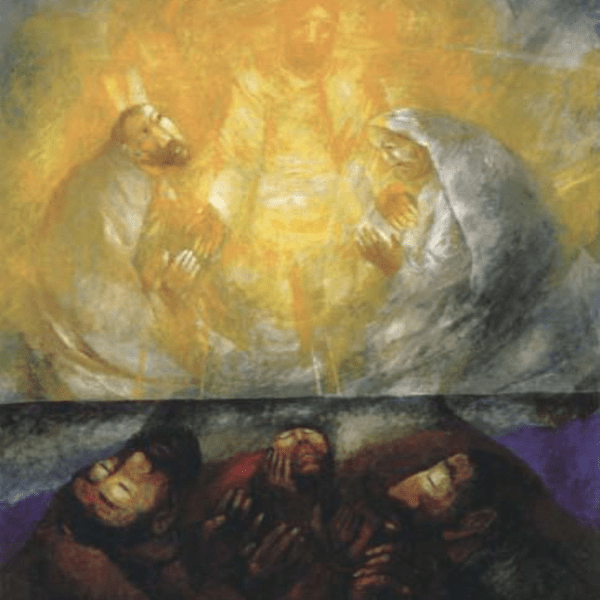
Transfiguration by Sieger Köder (1925-2015)

After six days Jesus took with him Peter, James and John the brother of James, and led them up a high mountain by themselves. There he was transfigured before them. His face shone like the sun, and his clothes became as white as the light. Just then there appeared before them Moses and Elijah, talking with Jesus.

Peter said to Jesus, “Lord, it is good for us to be here. If you wish, I will put up three shelters—one for you, one for Moses and one for Elijah.”

While he was still speaking, a bright cloud covered them, and a voice from the cloud said, “This is my Son, whom I love; with him I am well pleased. Listen to him!”

When the disciples heard this, they fell facedown to the ground, terrified. But Jesus came and touched them. “Get up,” he said. “Don’t be afraid.” When they looked up, they saw no one except Jesus.

As they were coming down the mountain, Jesus instructed them, “Don’t tell anyone what you have seen, until the Son of Man has been raised from the dead.” (New International Version)

Fear is a universal feeling and experience. None of us has to work at being afraid – but we all have to work at being brave and having the courage to face our fears.

Sometimes, we adults teach children not to fear because we assume they are afraid of the dark, high places, and monsters in the closet. But I tend to think a lot of our own adult fear is projected on kids. Why? Because some of the bravest folks I have ever known are children. 

Kids don’t understand near as much as we adults do, yet they conquer their fears every day by facing the world with courage. If you were to go to any children’s hospital today, I believe you would be amazed at the kind of courage you would find amongst kids. We adults have a whole lot to learn about being brave because we have become far too sophisticated in hiding our fears and avoiding courage.

This is why the most repeated exhortation is all of Holy Scripture is to not be afraid. We need courage to live the way God wants. Every day is a fresh opportunity to practice courage.

We need the courage to stand alone

Korah son of Izhar, the son of Kohath, the son of Levi, and certain Reubenites—Dathan and Abiram, sons of Eliab, and On son of Peleth—became insolent,and rose up against Moses. With them were 250 Israelite men, well-known community leaders who had been appointed members of the council. They came as a group to oppose Moses and Aaron and said to them, “You have gone too far! The whole community is holy, every one of them, and the Lord is with them. Why then do you set yourselves above the Lord’s assembly?” (Numbers 16:1-3, NIV)

When Moses heard this, he responded with prayer to God – because he clearly understood that this was all a big power play by Korah, who got others stirred up to take action against him. 

Moses stood alone. Out of the millions of Israelites, not one single person stood with Moses. To be sure, the majority of Israelites did not side with Korah; but neither did they come and stand with Moses. Why? They were too afraid to be involved and took the posture of bystanders. 

God did a miraculous thing, never done before or since, by opening up the ground and having the earth swallow Korah and his followers. The Lord wasn’t only upset with Korah; God was also angry with the people for fearfully standing in the safety of numbers and doing nothing. In fact, God was so mad that he was ready to wipe them all off the face of the earth. But, yet again, Moses, in humility, prayed and pleaded with God to spare them – and God did.

There will always be someone opposing you when you are just trying to obey God and do the right thing. And there will always be a crowd of people who do not want to be involved because they are afraid.

The church everywhere needs to be what Jesus wants it to be, and not what a particular person or group of people want it to be. Courageous people need to stand up to people who want positions of power in order to lead in self-serving ways.

We need the courage to love people

Now while he was in Jerusalem at the Passover Festival, many people saw the signs he was performing and believed in his name. But Jesus would not entrust himself to them, for he knew all people. He did not need any testimony about mankind, for he knew what was in each person. (John 2:23-25, NIV)

Jesus did not get carried away with his own press. Whether people responded to him by the hundreds, or whether they refused him altogether and tried to throw him off a cliff, Jesus was consistently the same. He did not need people’s responsive affirmation in order to do his mission on earth. Christ loved people just because he wanted to, and not because he was trying to get them to love him in return, like insecure and fearful people do.

We need the courage to love the unlovely. And we must understand that perfect love casts out fear.

“We should not only love our brothers and sisters, but also not consider ourselves better than them. Instead, we should show compassion and acceptance to others. We want to have others strictly reprimanded for their offenses, but we will not be reprimanded ourselves. We are inclined to think the other person has too much freedom, but we ourselves will not put up with any restraint to our freedom. There must be rules for everyone else, but we must be given free rein. It is seldom that we consider our neighbor equally with ourselves. If everyone was perfect, what would we have to endure for the love of God?… for we cannot live in this world without adversity. Those who can suffer well will enjoy the most peace, for such persons are brave, courageous, not afraid of pain, have Christ as their friend, and heaven as their reward.”

Thomas à Kempis, The Imitation of Christ, c.1425, C.E.

It is no test of virtue to be on good terms with easy-going people. And, of course, all of us want to live in peace and prefer those who agree with us. Yet, in this mortal life, our peace consists in the humble bearing of suffering and contradictions, not in being free of them.

We need the courage to please God

The devil took him to a very high mountain and showed him all the kingdoms of the world and their splendor. “All this I will give you,” he said, “if you will bow down and worship me.” Jesus said to him, “Away from me, Satan! For it is written: ‘Worship the Lord your God, and serve him only.’” (Matthew 4:8-10, NIV)

Jesus is our model of courage. He sought to please the Father, and not anyone else. Jesus bravely resisted becoming someone other than he was called to be. 

On the Mount of Transfiguration, Jesus courageously refused to remain on the mountain, instead choosing to go into the valley and undertake a new and risky ministry. 

Christ fearlessly came to this earth in the incarnation and resisted the comfort of security. He valiantly confronted sin, overturned the money-changers’ tables, and did his Father’s will, instead of shrinking in fear about what people would think. 

Jesus heroically faced crucifixion, even though he was terribly stressed about it, in order to offer forgiveness in the face of persecution. Jesus gallantly said “No!” to the power of sin by rising from death. And he boldly ascended to heaven and confidently passed the work of ministry to a motley group of people who did not show any promise to carry the mantle of his teaching.

The Son found his identity in relation to the Father. For us to please God, we need the courage to play to an audience of One. 

If we need other people’s acceptance and approval in order to do anything, then we will never have the courage to act for God. 

We must live by conviction, and not by sticking our finger to the wind to see which way popular opinion is blowing.

Conclusion

History is filled with men and women who said “no” to destructive fear and changed the world. But imagine if they had succumbed to the paralyzing effects of fear in their lives. Imagine if…

The Apostle Paul, fearing resistance or rejection, chose to stay home rather than embarking on the missionary journeys that took the message of Christ throughout the known world.

Martin Luther King Jr. gave speeches filled with gentle hints about the evils of segregation, because he feared pushing too hard.

Jackie Robinson refused to enter major league baseball so as to not rock the boat; or Branch Rickey, the owner of the Brooklyn Dodgers, just going with the way baseball had always operated. But neither of them went that way. In the film, “42,” Robinson asks Rickey:

“You want a player that doesn’t have the guts to fight back?” “No. No.” replies Rickey. “I want a player who has the guts not to fight back. People aren’t going to like this. They’re going to do anything to get you to react. Follow a curse with a curse and they’ll hear only yours. Follow a blow with a blow and they’ll say the Negro lost his temper; that the Negro does not belong. Your enemy will be out in force and you cannot meet him on his own low ground. We win with hitting, running, fielding—only that. We win only if the world is convinced of two things: That you are a fine gentleman, and a great ball player. Like our Savior, you’ve got to have the guts to turn the other cheek. Can you do it?”  Robinson replies, “You give me a uniform; you give me a number on my back; and I’ll give you the guts.”

42 (2013 film)

Now imagine yourself, fully aware of the mission and vision God has placed in your heart to advance his gracious and benevolent rule in this world – and yet there is also present all the phobias, irrational worries, and destructive fears of failure, harm, or rejection. So I ask:

If you don’t fulfill the mission God assigned to you, who will?

What Must Come (Mark 9:9-13)

As they were coming down the mountain, Jesus gave them orders not to tell anyone what they had seen until the Son of Man had risen from the dead. They kept the matter to themselves, discussing what “rising from the dead” meant.

And they asked him, “Why do the teachers of the law say that Elijah must come first?”

Jesus replied, “To be sure, Elijah does come first, and restores all things. Why then is it written that the Son of Man must suffer much and be rejected? But I tell you, Elijah has come, and they have done to him everything they wished, just as it is written about him.” (New International Version)

Christ’s disciples, bless their wondering hearts, always seemed to be a few steps behind in following Jesus. And, truth be told, so are we, much of the time.

Since we know the end of the story, it’s easy for us to observe how clueless the original disciples of Jesus were, and how slow to the uptick they were on what their Lord was telling them.

The disciples were confused about Christ’s transfiguration on the mountain; puzzled about why they needed to keep their mouths shut about it; and betwixt about what the heck “rising from the dead” even means.

As they scratched their heads, trying to get a handle on things, they ended up asking about something they thought they knew about: Elijah. After all, if you don’t understand something, like a student in class, maybe you can ask about something else in order to get the teacher diverted from the thing you don’t understand. But bringing up Elijah only muddled their spiritual distraction.

The beauty of Christ is that he takes any discussion, any question, and turns it toward what must happen, what we must come to grips with.

What goes up, must come down

The disciples had the incredible experience of seeing a glorified Christ on the Mount of Transfiguration. There is a time for bright illumined mountain top encounters, but there is also a time to come down off the mountain and walk through the shadowy dark valley.

Christ’s exhortation to stay silent about the mountain top meeting may be a reminder that following Jesus is not all glory; it also involves the hard slog of dealing with adversity because of one’s spiritual commitment.

A fundamental truth about the nature of God is consistency and constancy, much like a mountain. And we can always look up, remember, and find strength in our time of need.

I raise my eyes toward the mountains.
    Where will my help come from?
My help comes from the Lord,
    the maker of heaven and earth.
God won’t let your foot slip.
    Your protector won’t fall asleep on the job. (Psalm 121:1-3, CEB)

What goes down, must come up

Just as life is not all mountain experiences, so it is not all about the valley. Jesus was letting his disciples know that they were about to face the darkest time of their lives. He would be rejected and suffer much – to the point of death. But the grave would not be able to hold him. A resurrection was coming; Christ would rise from death.

There cannot be a resurrection without a crucifixion – and the agony of the cross is not the final word. Resurrection, ascension, and glorification all result from the terrible suffering and ignominy of death. And since we have died with Christ, we will also be raised to life, as well.

For if we have been united with him in a death like his, we will certainly be united with him in a resurrection like his. (Romans 6:5, NRSV)

What goes first, must come last

Jesus linked the Old Testament prophet Elijah with John the Baptist. Just as Elijah put the Lord first and was God’s servant, so also John considered Jesus as first, and himself as last.

John testified concerning him [Jesus]. He cried out, saying, “This is the one I spoke about when I said, ‘He who comes after me has surpassed me because he was before me…

I baptize with water,” John replied, “but among you stands one you do not know. He is the one who comes after me, the straps of whose sandals I am not worthy to untie….”

The next day John saw Jesus coming toward him and said, “Look, the Lamb of God, who takes away the sin of the world! This is the one I meant when I said, ‘A man who comes after me has surpassed me because he was before me.” (John 1:15, 26-27, 29-30, NIV)

What goes around, must come around

I’m not referring to karma, nor to a circular view of history, but to the reality that suffering and death is a result of life, and paradoxically, glory and life come from death.

Christianity is, I believe, inherently paradoxical. The way up is down; in order to save our lives we must give them up; to be great is to be a servant; and the last shall be first, and the first, last.

We neither need to understand every jot and tittle of the Bible, nor have every word of Jesus fully comprehended in order to be a Christian and serve Christ’s Church. There is a great deal of mystery to faith, and so much yet to discover and learn. We will spend an eternity getting to know God and never plumb the breadth and depth of comprehending the Lord.

So, we need to learn to enjoy this awesome God and embrace the paradox of divine sovereignty and human responsibility so that we may worship, fellowship, and live in grace and freedom. In doing so, we are witnesses to a faith that transcends understanding, and allows us to serve within our churches, families, and communities without having every loci of theology nailed down.

All things shall eventually come back around to the Garden – a place of unhindered fellowship with God and one another without any sin or deceit to get in the way. Disaster, disease, and death are temporary; Love is permanent and shall come around to being the overwhelming and only force in this big universe.

We bless you, O God, for our creation, preservation, and all the blessings of this life; but above all for your immeasurable love in the redemption of the world by our Lord Jesus Christ; for the means of grace, and for the hope of glory.

Give us such an awareness of your mercies, that with truly thankful hearts, we may show forth your praise, not only with our lips, but in our lives, by giving up ourselves to your service, and by walking before you in holiness and righteousness all our days; through Jesus Christ our Lord, to whom, with you and the Holy Spirit, be honor and glory forever. Amen.