
Walk on Water? Why? (Matthew 14:22-33)

Jesus Walks on Water, by Konstantin Alexejewitsch Korowin, 1890 

Immediately Jesus made the disciples get into the boat and go on ahead of him to the other side, while he dismissed the crowd. After he had dismissed them, he went up on a mountainside by himself to pray. Later that night, he was there alone,and the boat was already a considerable distance from land, buffeted by the waves because the wind was against it.

Shortly before dawn Jesus went out to them, walking on the lake. When the disciples saw him walking on the lake, they were terrified. “It’s a ghost,” they said, and cried out in fear.

But Jesus immediately said to them: “Take courage! It is I. Don’t be afraid.”

“Lord, if it’s you,” Peter replied, “tell me to come to you on the water.”

“Come,” he said.

Then Peter got down out of the boat, walked on the water and came toward Jesus. But when he saw the wind, he was afraid and, beginning to sink, cried out, “Lord, save me!”

Immediately Jesus reached out his hand and caught him. “You of little faith,” he said, “why did you doubt?”

And when they climbed into the boat, the wind died down. Then those who were in the boat worshiped him, saying, “Truly you are the Son of God.” (New International Version)

In the New Testament Gospels, we see Jesus for who he is – Son of God and true Sovereign of the universe – seeking to reconcile people to God through his life, miracles, and teaching. In the Gospels we also see Christ’s disciples for who they are – a rag-tag bunch who express both belief and doubt, and experience both faith and failure.

The reality of the Christian life is that it is a sort of three-steps-forward and two-steps-backward kind of experience. The expectation that we will “succeed” and have everything go hunky-dory each time we step out in faith, is far from how things actually work in both the world and in God’s kingdom. Doubt and failure are important experiences for the believer in Jesus.

Without failure, there is no Christian life. Why? Because it means we are still in the boat.

It’s evidence that we never left the safety of established routines and responded to God’s command to step out of our comfort zone, and boldly go where we’ve never gone before.

Our failures may, like Peter, be colossal bellyflops. Yet, Jesus is there – extending grace to Peter and helping him, even in his failure of faith. Failure does not define us; it isn’t our identity. Jesus is Lord over everything, including storms, hardship, and trouble. 

Yes, there are a lot of scary things in life. Learning to ride a bike was scary. Driving for the first time on an icy road was scary. Getting married and having kids was scary. Admitting a fault, mistake, or weakness is scary. Being vulnerable with another person is scary.

It can even be scary to be at church. Why? Because we might fail, and it may crush us.

The fear of failure, however, need not control our lives. Why? Because grace overcomes everything.

We all find ourselves, at times, caught midway between faith and doubt. But to know this situation is to experience grace. If the worst scenario you worry about in your head would actually come to pass, it will still never change the reality that God loves you! And it will not stop Jesus from extending his hand to you in a life-saving grip of grace. 

Fear melts away when we keep our eyes on Jesus. So, we must focus on Christ, instead of fixating on the waves around us. The truth sets us free. Therefore, let’s notice five truths about Jesus that help us overcome the fear of failure and embrace a life of faith.

1. Jesus is a person of prayer

Jesus was deeply dependent on his heavenly Father. His life exhibited the necessities of simple prayer and obedience. If Jesus found the need for solitude and prayer for his life and ministry, how much more to we need it!? 

The Lord had his disciples get into the boat and go out on the lake. Jesus knew they were about to face a storm. The boat ended up getting thrown around by the waves. Even though the disciples were doing God’s will by going out on the lake, they were not spared from adversity.  

Jesus wanted his disciples to experience the storm. Why? Because it is through the storm that we learn faith.  

Faith is developed through experience and adversity. Faith that never endures distress, never grows and matures. Faith must be exercised – and if it isn’t, it atrophies and becomes useless. 

Show me a person with great faith, and I’ll show you a person that has gone through a boatload of adversity and hurt, having allowed Jesus to grace them with healing.

2. Jesus is present with us, and this presence brings an end to fear

Being in the middle of a lake during a storm did not prevent Jesus from being present with the disciples – he just walked on the water to be with them. Even though the disciples had just participated in the miracle of Jesus feeding the five thousand, another miracle was not on their radar – which is why they did not recognize Jesus and were afraid when they saw him.

While afraid, we don’t see Jesus, even when he’s right in front of our faces. Why? Because we don’t expect him to be there and mistake him for a ghost.  

When the disciples cried out in fear, Jesus responded. I used to have a factory job, training workers. When the training was completed, I had the trainees evaluate our time together. The top response I received is that my presence helped them to learn their job – the freedom to fail time and time again without judgment. Having me there to rescue them, when things got too much, built confidence that they could do it on their own.

3. Jesus desires those who follow him to imitate him

Jesus walked on water. Jesus invited Peter to walk on water. Peter was not chided by Jesus for getting out of the boat, but for doubting that he could continue in the miracle that was happening. 

Jesus isn’t merely interested in disciples being able to regurgitate his teaching. Why? Because he wants us to exercise our learning through actual deeds of faith.  

Once the command of Jesus was given to Peter, “Come”, then walking on water became only a matter of trust.

“Christianity has not been tried and found wanting. It has been found difficult and left untried.”

G.K. Chesterton

We understandably get nervous when a crazy Jesus and an unpredictable Holy Spirit call us to change by getting out of the friendly confines of the boat. Why? After all, we might fail. 

However, it is at those times that we bank on God’s Word and promises. The Apostle James said that if we find ourselves lacking wisdom to deal with the unpredictable and unknowable, we are to ask God who gives generously to all without finding fault and will be given to us. (James 1:5)
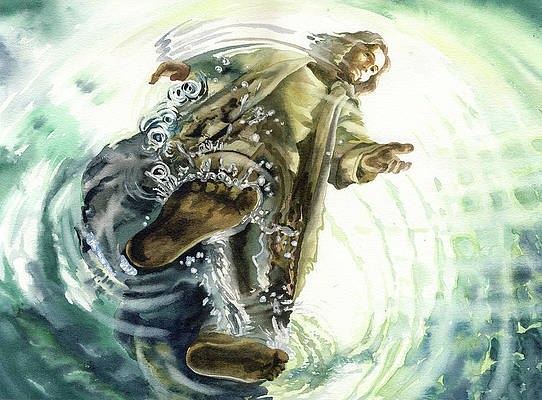
Christ Walking on the Sea, by Natali Fedorova

Peter responded to his predicament by crying out to Jesus, “Lord, save me!” Jesus immediately reached out and saved Peter from his own doubt and lack of faith. Jesus called Peter a “little-faith.”

Many people have lived too long with the notion that God is some stern angry deity who is constantly displeased with sinful people, and that only through perfection will God ever be happy with us. The truth is that Jesus wants us to imitate him; and, when we fail, he is there to pick us up. 

4. Jesus has the authority to settle the storm when he is ready to do it

Jesus is King. Christ is Sovereign of the world. He will bring the crisis to an end according to his own good pleasure and good timing. Rather than spending all our emotional capital by worrying or conniving to get out of a situation, we can trust God and keep our eyes on Jesus.  Our job is to believe; God’s job is everything else.

5. Jesus’ power led the disciples to acknowledge who he is

Worship happens when we see Jesus as he really is, the Son of God. Flat, dull, boring worship comes from flat, dull, boring Christians who are unable to see the power of Jesus in their lives. We discover the power of God when we are in a situation which requires God’s strength to deliver us. Grasping Jesus as the Son of God is more than a verbal confession of faith; it is being able to trust him, like getting out of a boat in the middle of a lake.

We are to live by faith in the Son of God who loved us and gave himself for us (Galatians 2:20). It doesn’t require much faith to pray that Aunt Mable’s bunions will feel better. It only requires a little faith to give a dollar when you have ten dollars. It takes no faith to discuss the weather and steer clear of hard conversations.

But it does require faith:

  • to pray for a miraculous healing every day without giving up for a little boy who is racked by epilepsy, and trust God to spare his life
  • to write a check for $100 to someone in need when you have exactly $100 in your checking account, and trust God to provide for you own necessities. 
  • to go off the grid of the routine schedule to have a difficult discussion about social justice, and trust God to act on Christ’s teachings. 
  • to live as though the mission of God in this world is the most important thing we could ever do, and trust God to step out and do it.

It would be great if we could pray and act without ever doubting or failing, yet the only way to do that is to never step out of the boat. Instead, live life. Trust God. And see what happens.

Holy God, help us, your people, to embrace the life that is truly life by stepping out of the boat.  May Jesus define our lives instead of letting failure define us. May we accept the grace that is ours in Jesus Christ our Lord, in whose name we are bold to pray. Amen.


Imitate the Right Use of Power (1 Corinthians 4:14-20)

I am writing this not to shame you but to warn you as my dear children. Even if you had ten thousand guardians in Christ, you do not have many fathers, for in Christ Jesus I became your father through the gospel. Therefore I urge you to imitate me. For this reason I have sent to you Timothy, my son whom I love, who is faithful in the Lord. He will remind you of my way of life in Christ Jesus, which agrees with what I teach everywhere in every church.

Some of you have become arrogant, as if I were not coming to you. But I will come to you very soon, if the Lord is willing, and then I will find out not only how these arrogant people are talking, but what power they have. For the kingdom of God is not a matter of talk but of power. (New International Version)

We need to talk about power.

And we need solid sacred examples of how to wield power rightly and justly.

Power is a lot like sex. Everyone wants it, but not everyone respects it and uses it well.

Humanity was created by God to exercise power. True human power has always been intended by our Creator as a means of giving love to others. Wherever you find love being extended by people in power to the powerless, there you will see that it works.

Yet, here’s the rub for many of us: This godly use of power may not (and likely will not) achieve instant results. That’s probably why we so often associate humanity’s possession of power with threats, bullying, and violence – because they usually work to get the immediate results of obtaining power and keeping others in subservience to that power.

The right use of power rarely gets rolled out smoothy without any wrinkles to it. Instead, wielding power through love makes its way by means of suffering. It comes from the humble servants like Mother Teresa, and from those who could throw their weight around, but instead choose to use their influence for self-giving love.

This sort of just and right authority is realized when we are aware of our own weaknesses and failures. Believing that “might=right” is merely a prescription for working out our own complexes on other people; it will only result in extending hate, not love, when others resist our authority.

The ones who hold true power are those who know they are unworthy of it, and incapable of using it without humility and divine help. Real power is like a shepherd looking after a flock of sheep – and not like pulling out a sword to kill the bad guys when they come to challenge authority.

Believers everywhere need awareness that the Christian message offers a profound reversal of what we think we know about power. All signs of real power lead us to the foot of the cross. National governments seems to think that power must be both achieved and sustained by the threat of violence. But the power of God’s kingdom is exercised through giving, serving, and loving.

And it is that sort of power which transforms the world in ways that probably won’t make headlines on the nightly news. The power of Christ is passed on throughout the generations of believers – learned by imitating people, like the Apostle Paul, who demonstrated humble service, instead of arrogant authority.

Faith is passed from person to person; and not just handed down from individuals reading their bibles in seclusion. Power and authority are given to those who are capable of handling it with justice and righteousness.

“You have heard me teach things that have been confirmed by many reliable witnesses. Now teach these truths to other trustworthy people who will be able to pass them on to others.”

The Apostle Paul to his protégé Timothy (2 Timothy 2:2, NLT)

Christians learn from leaders how the faith is lived out, and how power is used, by imitating what they see and hear. Therefore, an important question is this: Who do I imitate?

“Dear brothers and sisters, pattern your lives after mine, and learn from those who follow our example.”

The Apostle Paul to the Philippian Church (Philippians 3:17, NLT)

Our great desire is that you will keep on loving others as long as life lasts, in order to make certain that what you hope for will come true. Then you will not become spiritually dull and indifferent. Instead, you will follow the example of those who are going to inherit God’s promises because of their faith and endurance. (Hebrews 6:11-12, NLT)

Remember your leaders who taught you the word of God. Think of all the good that has come from their lives, and follow the example of their faith. (Hebrews 13:7, NLT)

Those who hold authority and power in the Christian Church must exemplify a proven character of persevering love in the face of pain and suffering. Such persons, having shown humility through it all, are worthy to imitate.

This does not necessarily mean that we emulate those who eruditely speak the Word of God, have superior gifts and abilities, and enjoy success in ministry. It does mean that we ought to imitate, and have as mentors, those persons who imitate Christ and are not self-promoting peacocks who go after being admired and praised.

A cocky Christian leader who has not focused on suffering love, and who has not experienced the purgative fiery trials of this life, may easily become seduced by their own importance. However, leaders who have seen their share of hard circumstances, pain, and suffering, and have come through it loving God and serving others out of grace and humility, are leaders worth imitating. 

Character shapes power, and never the other way around.

God of unchangeable and unending power: Look with mercy on your Church everywhere, and carry out your good and loving purposes through us your people. We trust that your power and love will have it’s way in this old fallen world – and that your plan of salvation shall be carried out, through Jesus Christ our Lord, in the strength of the Holy Spirit. Amen.

Endure Patiently to the End (Revelation 14:12-20)

God’s holy people must endure persecution patiently, obeying his commands and maintaining their faith in Jesus.

And I heard a voice from heaven saying, “Write this down: Blessed are those who die in the Lord from now on. Yes, says the Spirit, they are blessed indeed, for they will rest from their hard work; for their good deeds follow them!”

Then I saw a white cloud, and seated on the cloud was someone like the Son of Man. He had a gold crown on his head and a sharp sickle in his hand.

Then another angel came from the Temple and shouted to the one sitting on the cloud, “Swing the sickle, for the time of harvest has come; the crop on earth is ripe.” So the one sitting on the cloud swung his sickle over the earth, and the whole earth was harvested.

After that, another angel came from the Temple in heaven, and he also had a sharp sickle. Then another angel, who had power to destroy with fire, came from the altar. He shouted to the angel with the sharp sickle, “Swing your sickle now to gather the clusters of grapes from the vines of the earth, for they are ripe for judgment.” So the angel swung his sickle over the earth and loaded the grapes into the great winepress of God’s wrath. The grapes were trampled in the winepress outside the city, and blood flowed from the winepress in a stream about 180 miles long and as high as a horse’s bridle. (New Living Translation)

The Scripture meditations I offer each day are based in the daily readings of the Revised Common Lectionary. The readings are designed to move us through the whole of the Bible in a three year cycle. And they are arranged so that Thursday, Friday, and Saturday readings anticipate the Sunday scriptures, and the Monday, Tuesday, and Wednesday readings reflect on Sunday’s texts. Today’s New Testament lesson is such a reflection on Sunday’s Gospel reading of Christ’s Parable of the Weeds (Parable of the Wheat and Tares).

Jesus made it clear in the parable that it is not our job to weed out evil. This will be done by the angels at the end of the age. In Revelation, we look forward into the future as to what happens with the plants and the weeds. As you can readily see, it is a grim picture. Those who are visual learners, and picture the words in their minds, their stomachs might be turning after the reading of today’s text.

The entire book of Revelation was originally meant to encourage believers in Jesus to persevere, endure, and keep going in their commitment to Christ. As they were undergoing difficulty and even persecution for their faith, this apocalyptic vision of the Apostle John was to instill hope: It will not always be this way.

There is a time coming soon in which the problem of evil is taken care of, once and for all. Until that final day of judgment comes, we are to hold fast to our faith, and continue to keep the commandments of Christ.

The wrath of God has always been an issue with various people throughout history. In contemporary theology, it is common to have groups of folks polarized between either making God out to be constantly angry and looking to zap people; or dismissing God’s wrath altogether as some outdated and antiquated idea. Neither of these approaches will do.

God’s anger and wrath exist, yet is never divorced from God’s love. Rather than viewing wrath and love as two sides of the same coin, I believe a healthier and more biblical understanding is to discern God’s wrath as an expression of God’s love. I will explain….

When God bends to observe us in the world and sees injustice, war, poverty, oppression, trauma, and abuse from narcissistic people who exalt themselves above others and use them for selfish purposes, God is not okay with this!

Whenever God looks at the world and sees governments, institutions, corporations, and even churches which maintain structures that keep others from becoming all that God intends for them to become, divine compassion is stirred up, along with a determination to bring about justice and righteousness.

Only God has the combination of willingness, power, and ability to handle the evil of this world, in a way which is both just and loving.

I realize there are many times when we wonder if God is really watching, or not, and are curious if the Lord is aloof and uncaring to our plight. There is a day when the dramatic will happen, but that day is not today. For now, God is patiently and carefully working divine love into the fabric of this world, in such a way that it will not destroy the innocent and compromise the integrity of the righteous.

Until the time is ripe for God to act in a more decisive manner by equipping angels with scythes and bringing in the final harvest, we experience pain and hurt.

We sometimes are misjudged and misunderstood by others. We often get shafted by systems which are supposed to be helping us. We can, however, be assured that God is working behind the scenes, planting seeds of love and grace. The Lord is pastorally tending to our growth, till the time is right to gather the abundant crop.

Acting too soon, and going off half-cocked without enough information, is what we humans tend to do. Not so with God.

The fact of the matter is: Justice and injustice will co-exist side-by-side for a while. Righteousness and evil will be found together everywhere we go, including our own hearts – holding both our altruistic motives and our evil inclinations.

Sisters and brothers, let us endure, persevere, and be patient. God is good, and will not forget your deeds done in faith; your actions inspired by hope; and your work animated by love.

Lord Christ, you came into the world as one of us, and suffered as we do. As I go through the trials of life, help me to realize that you are with me at all times and in all things; that I have no secrets from you; and that your loving grace enfolds me for eternity. In the security of your embrace I pray. Amen.

A Solemn Pledge of Hope (Hebrews 6:13-20)

When God gave Abraham his promise, he swore by himself since he couldn’t swear by anyone greater. He said, “I will certainly bless you and multiply your descendants.” So Abraham obtained the promise by showing patience. People pledge by something greater than themselves. A solemn pledge guarantees what they say and shuts down any argument.When God wanted to further demonstrate to the heirs of the promise that his purpose doesn’t change, he guaranteed it with a solemn pledge. So these are two things that don’t change, because it’s impossible for God to lie.

He did this so that we, who have taken refuge in him, can be encouraged to grasp the hope that is lying in front of us. This hope, which is a safe and secure anchor for our whole being, enters the sanctuary behind the curtain. That’s where Jesus went in advance and entered for us, since he became a high priest according to the order of Melchizedek. (Common English Bible)

“We must accept finite disappointment, but never lose infinite hope.”

Martin Luther King, Jr.

Humanity needs hope. We all require a confident expectation that things will be different or better. Hope is what our ancestors in the faith possessed in abundance.

How did Abraham receive what was promised by God?

Abraham latched onto hope. He believed God’s promise of having a place to belong. His faith caused him to make a major move from the city where he had always lived. What’s more, Abraham understood that the promises of God don’t end in this life. He looked forward to being a permanent resident in the eternal city.

By faith Abraham obeyed when he was called to go out to a place that he was going to receive as an inheritance. He went out without knowing where he was going. By faith he lived in the land he had been promised as a stranger. He lived in tents along with Isaac and Jacob, who were coheirs of the same promise. He was looking forward to a city that has foundations, whose architect and builder is God. (Hebrews 11:8-10, CEB)

Why did God make a solemn pledge, a sacred oath, to Abraham?

The Lord wanted to reinforce Abraham’s faith and encourage him. God desired to convincingly show that divine promises are sure.

The Lord spoke to Abram in a vision and said to him, “Do not be afraid, Abram, for I will protect you, and your reward will be great.” But Abram replied, “O Sovereign Lord, what good are all your blessings when I don’t even have a son?…. You have given me no descendants of my own, so one of my servants will be my heir.”

Then the Lord said to him, “No, your servant will not be your heir, for you will have a son of your own who will be your heir.” Then the Lord took Abram outside and said to him, “Look up into the sky and count the stars if you can. That’s how many descendants you will have!” And Abram believed the Lord, and the Lord counted him as righteous because of his faith. (Genesis 15:1-6, NLT)

What are two things that do not change?

God’s promise and God’s solemn pledge. God promised Abraham:

“I will make you into a great nation,
    and I will bless you;
I will make your name great,
    and you will be a blessing.
I will bless those who bless you,
    and whoever curses you I will curse;
and all peoples on earth
    will be blessed through you.”(Genesis 12:2-3, NIV)

God confirmed the promise with a sacred oath:

“I swear by myself, declares the Lord, that because you have done this and have not withheld your son, your only son, I will surely bless you and make your descendants as numerous as the stars in the sky and as the sand on the seashore. Your descendants will take possession of the cities of their enemies, and through your offspring all nations on earth will be blessed, because you have obeyed me.” (Genesis 22:16-18, NIV)

Is there a way to be motivated and encouraged in the Christian life?

Yes. Hope in God’s promises. Confidence that our efforts to live for Christ are being seen. Knowledge that our labor in the Lord is not in vain.

To remain encouraged, and to keep persevering in faith and hope, we need one another. So, it is important to maintain significant relationships with other believers so that we will not lose our spiritual vitality and become discouraged. The author of Hebrews stated:

We should keep on encouraging each other to be thoughtful and to do helpful things. Some people have gotten out of the habit of meeting for worship, but we must not do that. We should keep on encouraging each other, especially since you know that the day of the Lord’s coming is getting closer. (Hebrews 10:24-25, CEV)

Faith and patience, fueled by an unshakable hope, has always been the way believers have lived their lives. For the Christian, we have a promised inheritance. And that promise is focused on the person and work of Christ – because all of God’s good promises are fulfilled in Jesus.

Our energy, resources, time, and work are finite. Yet God is infinite. God has always been and always will be. And Jesus is the same yesterday, today, and forever. As we tether ourselves to these unchangeable realities, we have a sure foundation of hope in which to build a solid life of confidence.

God of hope, in these times of change, unite us and encourage us with your promise and oath. Help us overcome our fears and enable us to build a future in which all may prosper and share, through Jesus Christ our Lord. Amen.