A Great Number of People Believe (Acts 11:19-26)

Now those who had been scattered by the persecution that broke out when Stephen was killed traveled as far as Phoenicia, Cyprus and Antioch, spreading the word only among Jews. Some of them, however, men from Cyprus and Cyrene, went to Antioch and began to speak to Greeks also, telling them the good news about the Lord Jesus. The Lord’s hand was with them, and a great number of people believed and turned to the Lord.

News of this reached the church in Jerusalem, and they sent Barnabas to Antioch. When he arrived and saw what the grace of God had done, he was glad and encouraged them all to remain true to the Lord with all their hearts. He was a good man, full of the Holy Spirit and faith, and a great number of people were brought to the Lord.

Then Barnabas went to Tarsus to look for Saul, and when he found him, he brought him to Antioch. So for a whole year Barnabas and Saul met with the church and taught great numbers of people. The disciples were called Christians first at Antioch. (New International Version)

The earliest of believers in Jesus Christ were Jews. Jewish converts to Christianity were not typically received well amongst their families, communities, and culture. So, when Stephen, one of those converts, retold Jewish history emphasizing a stubborn lack of awareness amongst their ancestors – and then connected it with present day attitudes – a full fledged persecution of Christians broke out.

As a result, the Church – located almost exclusively in Jerusalem – was scattered throughout Judea and across the Roman Empire in a Christian diaspora. In Christ’s ascension, he told the disciples that they would be witnesses beginning at Jerusalem, and then to Judea and outside the Middle East. Little did the small band of believers know, at the time, how that plan would come about.

As it turns out, although life was hard being a Christian refugee in a strange location, the believers spread the good news of Jesus wherever they went. Thus, gospel seeds were planted all across the land.

There is no place we can go where God is not already there.

And so, the displaced Christians discovered God was with them in their sojourning. Their faithful proclamation of good news was the impetus to bringing about many more converts to Jesus Christ.

What was happening in Judea and the Empire came back to the church leaders in Jerusalem. They then, smartly, sent one of their own, Barnabas, to Antioch in order to check out the scene and bring the new believers some encouragement. Since Barnabas was the consummate encourager, the church was emboldened, with even more converts entering into faith in Christ.

Barnabas, as an encourager, had the knack for knowing what he could do and not do; he also knew someone who could supply what he couldn’t do. He was so sure that Saul (Paul) was the right person for the job that he went to Tarsus – which was about 400 miles from Antioch – in order to find him and get him to the new believers as soon as possible. The result was an explosion of fresh converts coming to faith and into the church.

It’s no coincidence that the man with the biggest heart in the church is described in today’s text as a good man who was filled with the Holy Spirit. The Spirit is the One who makes all the difference with the growth of Christianity and the establishment of the Church.

Barnabas could see the evidence of God’s grace in the city of Antioch because he was filled to the full, with God’s own Spirit. He observed people with changed lives; an incredibly diverse and connected international community of believers; and so, encouraged them all in this good work brought about by the Spirit of God.

More and more people were added to the fellowship because of the robust spiritual dynamic that took place. This was not a matter of people using slick marketing strategies to make the name of Jesus Christ known; instead, the adding was all God. The Lord added to the Lord, and not people adding people to the Church. In other words, God is both the subject and the object, the source and the goal, of all good Christian ministry.

Then, when the Lord connected Barnabas together with Saul (Paul) who was also filled with the Holy Spirit and many spiritual gifts from God, the result was nothing less than large numbers of persons coming to faith in Christ and being added to the Church.

The believers in Antioch were so chatty about their faith that the first reference of being called “Christians” were to these converted Jewish believers in Jesus. Even though the moniker of “Christian” was probably a term of derision and meant to mock the Antiochene Church, it stuck, and was held up proudly by the believers. They were completely okay with being called “little Christ’s.”

After all, since they were truly Christ-centered in all they did, it was a fitting title for the fledging and growing Church. It clearly identified them as the people who serve and follow Christ. We, too, these many centuries later, have the very same Spirit of God that they did – and therefore, the same opportunity to speak of Jesus and see the Holy Spirit do the work of adding to the Church.

We pray, almighty God, that all who confess your Name may
be united in your truth, live together in your love, and reveal
your glory in the world.

Guide people everywhere, and of all the nations, in the
ways of justice and peace; that we may honor one another
and serve the common good.

Give us all a reverence for the earth as your own creation,
that we may use its resources rightly in the service of others
and to your honor and glory.

Bless all whose lives are closely linked with ours, and grant
that we may serve Christ in them, and love one another as he
loves us.

Comfort and heal all those who suffer in body, mind, or
spirit; give them courage and hope in their troubles, and
bring them the joy of your salvation.

Lord, in your mercy, hear our prayer. Amen.

The Hound of Heaven (2 Timothy 2:8-13)

Remember Jesus Christ, who was raised from the dead and descended from David. This is my good news. This is the reason I’m suffering to the point that I’m in prison like a common criminal. But God’s word cannot be imprisoned. This is why I endure everything for the sake of those who are chosen by God so that they too may experience salvation in Christ Jesus with eternal glory. This saying is reliable:

“If we have died together, we will also live together.
        If we endure, we will also rule together.
        If we deny him, he will also deny us.
If we are disloyal, he stays faithful”
    because he can’t be anything else than what he is. (Common English Bible)

C.S. Lewis once described God as the Hound of Heaven. By that phrase he meant that God doggedly pursued him and would not let go. Lewis came into Christian faith, in his own words, “kicking and screaming” as God’s faithful pursuit won out in his life. 

The Apostle Paul reminded his young protégé Timothy of some basic theology to keep him on track and encouraged in a tough ministry. Paul gave Timothy a trustworthy saying that he could easily remember and say to himself day after day, especially when the going got tough: 

If we died with Christ,
    we will live with him.
If we don’t give up,
    we will rule with him.
If we deny
    that we know him,
he will deny
    that he knows us.
If we are not faithful,
    he will still be faithful.
Christ cannot deny
    who he is. (CEV)

The beauty, wonder, and distinction of God is his amazing grace. There is no ambiguity with God. The Lord is not fickle but loves and holds tight even when we are unlovely and practice avoidance. When God pursues, God finds; when God holds on, there is no letting go.

This trustworthy saying of Scripture is a good, short, solid expression of theological truth to memorize, meditate upon, and say to ourselves repeatedly. We belong to Jesus Christ. God is with us. The Hound of Heaven will always sniff us out and bring us to himself.

Lewis likely got his phrase “Hound of Heaven” from an English poem of the same name by Francis Thompson (1859-1907). Thompson was a tortured soul who flirted in and out of depression, opium addiction, and suicidal thoughts for much of his adult life. Yet, he understood, perhaps better than most, that a loving God never stops pursuing a wayward heart. The poem’s beginning and end says this:

I fled Him, down the nights and down the days;
I fled Him, down the arches of the years;
I fled Him, down the labyrinthine ways
Of my own mind; and in the mist of tears
I hid from Him, and under running laughter….

How hast thou merited—
Of all man’s clotted clay the dingiest clot?
Alack, thou knowest not
How little worthy of any love thou art!
Whom wilt thou find to love ignoble thee,
Save Me, save only Me?
All which I took from thee I did but take,
Not for thy harms,
But just that thou might’st seek it in My arms.
All which thy child’s mistake
Fancies as lost, I have stored for thee at home:
Rise, clasp My hand, and come.”
Halts by me that footfall:
Is my gloom, after all,
Shade of His hand, outstretched caressingly?
“Ah, fondest, blindest, weakest,
I am He Whom thou seekest!
Thou dravest love from thee, who dravest Me.

Theology is not an impersonal affair. Personal religion still exists. The individual’s wax and wane between faith and faithlessness shall never negate divine grace.

The Lord of the universe loves you. There is a deep Divine desire to shower grace on you, to shelter and protect you. There is no need to run. Yet, if you do, God remains steadfast in his dogged pursuit. The hunt will continue….

Thank you, O God, for your great faithfulness, even to me. I believe. Help me in my unbelief! I give unceasing praise and undying devotion to you for your grace of being the One who never lets up, through Jesus Christ my Lord. Amen.

Family Dynamics (Matthew 12:46-50)

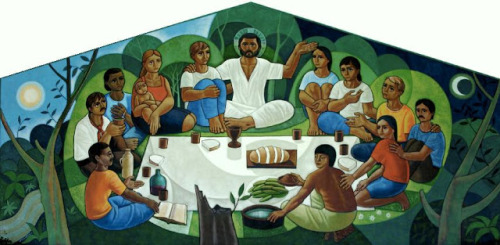
En la Cena ecológica del Reino (At the Ecological Kingdom Dinner) by Spanish artist Cerezo Barredo

While Jesus was speaking to the crowds, his mother and brothers stood outside trying to speak with him.Someone said to him, “Look, your mother and brothers are outside wanting to speak with you.”

Jesus replied, “Who is my mother? Who are my brothers?” He stretched out his hand toward his disciples and said, “Look, here are my mother and my brothers. Whoever does the will of my Father who is in heaven is my brother, sister, and mother.” (Common English Bible)

Jesus obviously did not get the cultural memo that blood is thicker than water.

When his own blood family were waiting outside for him, Jesus used the occasion to speak of what makes up a true follower of God. Christ boldly asserted that his true family is made up of people who do God’s will. By saying this, Jesus brought the point home that the kingdom of God turns on obedience.

Rather than merely confessing a belief, or appealing to a family heritage of faith, Jesus said that a genuine believer in God is one who listens to God’s words and then promptly obeys them. Therefore:

A Christian is defined by allegiance to Jesus, and not by having a certain bloodline. 

Identity determines activity. For example, if I identify myself primarily as…

  • a worker at my job, my activity will show it – I will spend long hours at my labor, and will do whatever it takes to please my boss and gain promotions.
  • an athlete, I will spend long hours honing my skills, and do whatever it takes to please the coach and to win.
  • a spouse and a parent, I will focus most of my attention on my family and seek to please them in all things. 

But if my identity is first and foremost as a Christian, I will seek to please Jesus. With my identity in Christ:

  • I will view my job as an opportunity to express the ethics of God’s kingdom, as a calling from God, and as a means for God to transform me for his glory.
  • I will view athletics as means to glorify God, and not as an end in and of itself but as a special gift for God to teach me about the importance of community and working together. 
  • I will view my kids as belonging to God and I will steward the trust of children given me by doing whatever it takes to teach and train them in the way of Jesus. I will thank God for my family and not confuse them with being God by idolizing them.

Jesus was inside a house, with his family on the outside. So, why were the family members of Jesus not inside the house sitting at his feet, taking the posture of a disciple?

The disciple Matthew wanted to communicate more than physical distance between Jesus and his physical family – being “outside” was meant to convey the posture of Christ’s family as spiritually distant, skeptical of him, and indecisive about who he was and what he was up to. The disciple Mark made this spiritual and emotional distance clear:

Jesus entered a house. A crowd gathered again so that it was impossible for him and his followers even to eat. When his family heard what was happening, they came to take control of him. They were saying, “He’s out of his mind!” (Mark 3:20-21, CEB)

Christ’s earthly family were not looking for Jesus to give them warm-fuzzies and have a big family hug. They were there to essentially say to him, “Cut it out, Jesus, because you’re acting like a nut-cake and embarrassing us all!”

Jesus was saying that identifying only with a biological family leads to only pleasing that family. However, identifying with Jesus leads to a radical form of following God that seeks to please him instead of submitting to family practices, mores, and beliefs which are inconsistent with the kingdom of God. 

Ethiopian Orthodox Church depiction of Christ and his disciples

For the Christian, the church is the family of God, and we are to act consistent with being in such a family.  We are to pursue God’s will, serve one another, and adopt outsiders into our family. The church is a family, not a restaurant. When we go to a restaurant, we either like the food and the service, or not. If the experience was unpleasant, we might complain to the waitress and may or may not come back. Try doing that with your mother and see where it gets you! 

As a biological family, we are committed to each other. There is no complaining about mom because of dad’s wrath. Instead, we are expected to clear our plates and put them in the dishwasher, to sweep the floor and clean the table, and to work together for the benefit of the entire family. In the same way, following Jesus means being committed to his family, the church.

Priority is to be given in doing God’s will, regardless of blood, because obedience to Christ identifies us as being in the family of God. Our actions and the way we live points to what we honestly believe and where our commitments truly lie. 

The first step of God’s desire for us is quality focused time in sitting at Christ’s feet and listening to him, because this is at the heart of all Christian discipleship. We can only do God’s will if we have clearly heard it; and we can only hear God’s will by taking the time to be at the feet of Jesus. 

Both listening and doing are necessary. Listening without engaging the world is a failure of mission; and doing without first listening leads to misguided acts and eventual burn-out. Allow Jesus to call the shots and let him instruct us so that we can live wisely and obediently. 

Jesus did not devalue blood relatives as irrelevant. Rather, the kingdom of God seeks to restore and redeem all things, including family. Both church and family are important. The relationships within each are to be nurtured.

The family of Jesus, the church, is important because Christ suffered and died for her. So, we are to be committed to the church, love the church, and serve the church because we are family. If we have a good grasp of this, we will make decisions based in what we believe God’s will is, instead of whether a relative will get upset, or not. 

We need to persistently pray for spiritually lost family members, and those whom we are estranged from. Most families have at least a few toxic persons in their orbit. Here is how we might pray for them:

  • That God will arrange divine appointments between them and others who love Jesus.
  • That God will draw them to the mercy of Christ.
  • That God will hinder the devil’s schemes against them.
  • That they will understand and respond to the good news of God’s grace.

O God, you made us in your own image and redeemed us through Jesus your Son: Look with compassion on the whole human family; take away the arrogance and hatred which infect our hearts; break down the walls that separate us; unite us in bonds of love; and work through our struggle and confusion to accomplish your purposes on earth; that, in your good time, all nations and races may serve you in harmony around your heavenly throne; through Jesus Christ our Lord. Amen.

Real Life (1 Thessalonians 3:6-13)

But Timothy has just now come to us from you and has brought good news about your faith and love. He has told us that you always have pleasant memories of us and that you long to see us, just as we also long to see you. Therefore, brothers and sisters, in all our distress and persecution we were encouraged about you because of your faith. 

For now we really live since you are standing firm in the Lord. How can we thank God enough for you in return for all the joy we have in the presence of our God because of you? Night and day we pray most earnestly that we may see you again and supply what is lacking in your faith.

Now may our God and Father himself and our Lord Jesus clear the way for us to come to you. May the Lord make your love increase and overflow for each other and for everyone else, just as ours does for you. May he strengthen your hearts so that you will be blameless and holy in the presence of our God and Father when our Lord Jesus comes with all his holy ones. (New International Version)

What does it mean to really live? Everyone has their own conceptions of what the good life is. But to live life to the full, to really live in sync with how life actually is (and is supposed to be) brings us true satisfaction, contentment, and meaning.

In the radical individualism of the West, it may seem foreign or strange to us that the Apostle Paul’s life was very much bound up in the lives of others – in the churches he established and with the believers who had come to faith in Christ. For Paul, to really live was to see spiritual growth and development in the places where he ministered.

The thing that really got Paul excited, what really melted his butter, was leading others to Christ, forming them into churches, and watching them carry out their missional mandate by doing the same things that he did with them. I can relate to Paul’s joy and satisfaction over Christian discipleship.

There’s nothing quite like mentoring others in the faith, helping them mature in that faith, and sending them out to live according to the model of faith that you’ve demonstrated for them. To see the Word of God take root in individuals and communities of people is like no other sort of joy and contentment.

In the midst of discouraging circumstances of persecution and distressing situations of opposition, it was gratifying, encouraging, and motivating for Paul to hear a good spiritual report from his protégé Timothy about the Thessalonian church’s faith.

Whether we acknowledge it or not, or like it or not, every one of us is inextricably connected to the other. And that is especially true in families, and in the family of God. The Thessalonian believers’ steadfast commitment to Christ and the Christian faith was a crucial and important dimension of Paul’s own persevering faith.

The Apostle had been on the front lines of faith – taking the good news of grace and forgiveness in Christ to the nations. To have his churches endure through all their own troubles and challenges is a great boon to Paul. They each derive confidence and inspiration from the other. Everyone’s faith is confirmed and strengthened when everyone is striving to live for Christ.

All the believers in Christ were really living because they stood firm in the Lord and were immovable in their faith commitments. Assurance and reassurance comes not in isolation, but through the interdependence and interaction with others who share the same values.

Parents don’t really live, unless they see their children living a life of abundant joy and satisfaction. And it’s the same with spiritual mothers and fathers; they truly live when their spiritual children are walking in faith and patience with the Lord.

This is why Paul was grateful and could not thank God enough for the Thessalonians’ life of faith. God’s powerful and gracious work in the church brought out all kinds of thanksgiving. With that sort of dynamic happening, Paul could face any tribulation with the confidence and trust needed to keep going.

Prayer is the logical response to a healthy spiritual and relational dynamic of faith. The greater the good relations, the greater the desire to come and keep imparting needed teaching and encouragement for the Christian life. In other words, spiritual growth begets spiritual growth.

The best way the Thessalonian converts and all the churches become rooted in faith is by God helping them to have their love increase and overflow for each other, and for everyone else. What’s more, God intends that the love Christians have for one another be a model and a witness to and for the world.

Christian community is the place we learn to love. As we practice again and again how to love one another in the church, we then take this love into the world in loving even our enemies. For if we are to follow our model and leader, Jesus Christ, then we will infuse each word and every action with the love of God in Christ – which is the light that draws others into a healthy spiritual and relational dynamic.

We must pray, as Paul did, for love to increase amongst us, so that our hearts are strengthened with genuine purity and holiness of life. For unless love grows and flowers, selfish desires will increase and turn our love inward to the point of taking love away from God and the world.

It is imperative that we have a genuinely loving stance toward each other as believers, and toward others in the world. Apart from this love – given graciously to us through the cross and resurrection of Christ – there is little hope for anything bad in this old fallen world to ever be better.

The bottom line is that churches wither and die because they lose sight of love; Christians lose faith and go their own way because they forget about love; and believers throughout the world continue on because loving prayers, loving ways, and loving words come their way, despite difficulty and hardship they face.

So, let us love one another as Christ loved us. For this is the way our faith is strengthened and our hope is kindled to keep enduring until Jesus returns to this earth and makes all things new and right. This is real life.

May almighty God give you grace to persevere with joy, so that the work of love begun in you may be completed, through Jesus Christ our Lord. Amen.