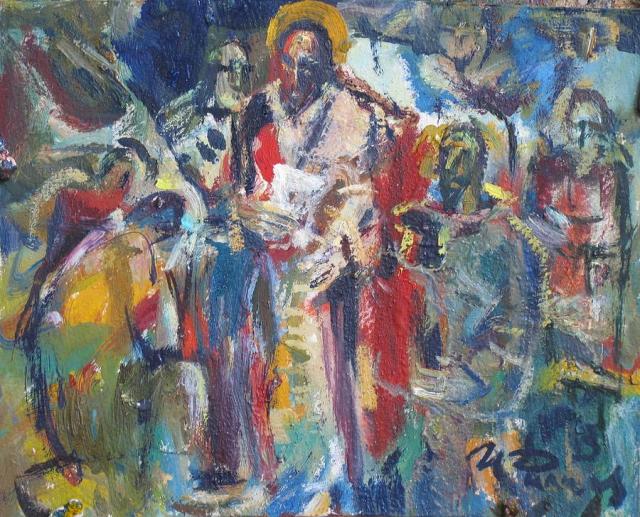
Saved for a Reason (Ephesians 2:1-10)

At one time you were like a dead person because of the things you did wrong and your offenses against God. You used to live like people of this world. You followed the rule of a destructive spiritual power. This is the spirit of disobedience to God’s will that is now at work in persons whose lives are characterized by disobedience. At one time you were like those persons. All of you used to do whatever felt good and whatever you thought you wanted so that you were children headed for punishment just like everyone else.

However, God is rich in mercy. He brought us to life with Christ while we were dead as a result of those things that we did wrong. He did this because of the great love that he has for us. You are saved by God’s grace! And God raised us up and seated us in the heavens with Christ Jesus. God did this to show future generations the greatness of his grace by the goodness that God has shown us in Christ Jesus.

You are saved by God’s grace because of your faith. This salvation is God’s gift. It’s not something you possessed. It’s not something you did that you can be proud of. Instead, we are God’s accomplishment, created in Christ Jesus to do good things. God planned for these good things to be the way that we live our lives. (Common English Bible)

Humanity is spiritually hard-wired to do good in this world. 

From a Christian perspective, we live in a fallen world and experience the evils of disasters, diseases, and decision-making that is off, as well as personal and corporate corruption. However, this is not our original design. 

In the Christian tradition, believers in Jesus are not delivered from sin, death, and hell so that they can idly sit in a worldly holding tank until Christ returns. Deliverance is the initial dimension of God’s plan – and not the end game. We are saved for good works to be done in the here-and-now.

Christians know that they are saved from individual and systemic sin through the forgiving work of Jesus Christ. It’s an act of sheer grace on God’s part. A believer in Jesus is not spiritually reborn through her effort any more than a baby’s birthed because of her own doing. It is thoroughly the work of God. Even the faith needed to believe is a gift graciously provided by God.

This, however, is far from the whole story. God has plans and purposes in mind for people. Christians are birthed into a new spiritual community with new commitments to do all kinds of good deeds. It’s as if sin is a weight or an obstacle that has been removed, so that living a life full of goodness can now move forward and do its work. 

To be saved is to be freed for a vigorous moral life that is deeply concerned with altruistic actions in a world full of need.

There is a profound spiritual wound which underlies the great problems of our world. Behind so many of our world issues are matters of the spirit. The unseen world is just as real as the world which is seen. Just as we know germs are present, are real, and we must account for them – so there is spiritual world very much real, and we ignore it at our great peril. 

And so, it seems to me that spiritual people, including Christians delivered for the purpose of good deeds, are to agitate for earthly change graciously, wisely, and lovingly. Expecting human governments or corporate systems to take the lead in moral transformation is like asking the fox to guard the hen house.

I will admit to you that I don’t much have the stomach for what seems to me to be useless emotional debates amongst some Christian communities about all sorts of political issues and religious dogmatic opinions. As redeemed people, delivered for a purpose, I believe it is sage to put our focus on discovering how we can support and bless the essential services laboring to keep humans surviving, and hopefully, thriving. God has raised us up for this, that is, if we have the spiritual eyes to see.

Christians, churches, and spiritual communities must labor at the gates of hell for the lives of women caught in sex trafficking; provide uplift and the tools to a better life for those in grinding poverty and hunger; challenge the idolatry of a materialist culture; and, hundreds of other realities of living in a fallen broken world.

As Christians, God has delivered us from sin, death, and hell so that we will do good in this world. God has sovereignly placed you and I in places and positions for just this time so that we will do good works, both big and small, tackling immense issues as well as little acts of kindness. 

Doing good comes in all sizes, and all of us are to share our lives for the betterment of humanity. After all, we really are our brother’s and our sister’s keeper.

God Almighty, I pray that your people may not lose heart in this world. May you strengthen your church with spiritual power so that the words and ways of Jesus will ground them for faithful service to this planet you have created. May Christians everywhere be rooted and established in the divine love which supports good works done in the humility of a gentle spirit; through Jesus Christ our Lord, who lives and reigns with you and the Holy Spirit, one God, now and forever.  Amen.

It’s About Love (1 Corinthians 8:1-13)

Now concerning meat that has been sacrificed to a false god: We know that we all have knowledge. Knowledge makes people arrogant, but love builds people up. If anyone thinks they know something, they don’t yet know as much as they should know. But if someone loves God, then they are known by God.

So concerning the actual food involved in these sacrifices to false gods, we know that a false god isn’t anything in this world, and that there is no God except for the one God. Granted, there are so-called “gods,” in heaven and on the earth, as there are many gods and many lords. However, for us believers,

There is one God the Father.
        All things come from him, and we belong to him.
And there is one Lord Jesus Christ.
        All things exist through him, and we live through him.

But not everybody knows this. Some are eating this food as though it really is food sacrificed to a real idol, because they were used to idol worship until now. Their conscience is weak because it has been damaged. Food won’t bring us close to God. We’re not missing out if we don’t eat, and we don’t have any advantage if we do eat.But watch out or else this freedom of yours might be a problem for those who are weak. 

Suppose someone sees you (the person who has knowledge) eating in an idol’s temple. Won’t the person with a weak conscience be encouraged to eat the meat sacrificed to false gods? The weak brother or sister for whom Christ died is destroyed by your knowledge. You sin against Christ if you sin against your brothers and sisters and hurt their weak consciences this way. This is why, if food causes the downfall of my brother or sister, I won’t eat meat ever again, or else I may cause my brother or sister to fall. (Common English Bible)

Consider an issue you care about… 

Likely, one of the big reasons you care is that you either see some abuse, neglect, inattention, or lack of love applied toward someone or a group of people. So, you want to see it be different. 

Now, here comes the interesting part: We are motivated by love, but we often end up addressing the problem or issue in the realm of thought and/or belief. We may rely on the political, theoretical, and intellectual to solve the problem.

Our hearts might be open and attuned, and yet we may turn to knowledge and rules to achieve the change we deeply desire.

The Apostle Paul knew that we are primarily lovers – not thinkers or believers. Thinkers and believers traffic in knowledge and belief systems. Although these are important, they are not the primary or ultimate ends for the Apostle. 

Instead of leading with the head, Paul led with the heart. He tackled the divisive issue in the Corinthian Church about whether one can eat food sourced from a pagan temple and originally sacrificed to idols by saying:

“Knowledge makes us proud of ourselves, while love makes us helpful to others.”

Paul began with love and ended with love. The issue of particular kinds of food was neither an intellectual nor a faith issue – it was a love issue. 

Paul’s answer to the problem dividing the Christian believers on food was that food is a secondary issue. Rather, to look at the food issue through the lenses of love, makes it clear what you ought to, or ought not to do. In coming at the issue from this angle, it doesn’t make our thinking and our believing somehow irrelevant; it just places it in its proper place, and supports love.

Whenever our opinions and thoughts, and our faith and beliefs are handled without love, then special interest groups begin to form. A division occurs based upon what we think and believe about certain things. But when love is supreme, knowledge is no longer the tail wagging the dog.

Love is meant to enlighten us. Love illumines not only to the problems among us, but love is also the answer to those issues we care about most. And if we will keep this in both our minds and in our hearts, then we have both added to our knowledge so that we can encourage and build-up others, without discouraging others and tearing them down. 

It really is all about love.

Love rejoices in the truth,
    but not in evil.
Love is always supportive,
loyal, hopeful,
    and trusting.
Love never fails! (1 Corinthians 13:6-8a, CEV)

Loving God, you demonstrated your own love for us through sending us your Son, the Lord Jesus, who is the perfect embodiment of love. May Christ be so manifested within me that love becomes not only the motivator to change, but also the answer to change; through the power and help of the Holy Spirit. Amen.

The Idea of Spiritual Separation (2 Corinthians 6:14-7:1)

Do not be yoked together with unbelievers. For what do righteousness and wickedness have in common? Or what fellowship can light have with darkness? What harmony is there between Christ and Belial? Or what does a believer have in common with an unbeliever? What agreement is there between the temple of God and idols? For we are the temple of the living God. As God has said:

“I will live with them
    and walk among them,
and I will be their God,
    and they will be my people.”

Therefore,

“Come out from them
    and be separate,
says the Lord.
Touch no unclean thing,
    and I will receive you.”

And,

“I will be a Father to you,
    and you will be my sons and daughters,
says the Lord Almighty.”

Therefore, since we have these promises, dear friends, let us purify ourselves from everything that contaminates body and spirit, perfecting holiness out of reverence for God. (New International Version)

There are entire Protestant denominations built upon verses such as today’s. They take the admonition to be separate as a cornerstone value. Ever since the Reformation, various Christian groups have struggled to maintain their witness in the world through, essentially, having nothing to do with the world whatsoever.

The dogma of separation inevitably leads to defining precisely what is “worldly” and what isn’t. This is where the idea of creating lists of what’s not acceptable come from. Each group or denomination has it’s own teaching about how to identify oneself as a Christian, and what sorts of behaviors communicate one isn’t a Christian. And the lists often vary quite a bit.

The Puritans had detailed lists and laws of what must be done and not done in order to remain in the community and be pure without spiritually contaminating oneself. For example, here are just a few of the many puritanical laws in Massachusetts in the 1600’s:

Sunday was a holy day. Trade and business were not allowed. No other public meetings could be held (except church services). No travel, except for walking to and from church and for emergencies. No entertainment. Church attendance was required. If a person missed church, they had to go to court (on Monday) and pay a fine.

All the other days were holy, too. Immodest and ostentatious clothes was illegal. Long hair for men was illegal. Smoking was illegal in the street. Courting a girl without her parents’ consent was illegal. Kissing in public was illegal. The following behaviors were illegal: using bad words, drinking too much alcohol, laziness, gluttony, fighting, poorly made products, having a bad attitude, and gossip.

Any violation, in Puritan thought, put the entire community at risk of raising the ire of God – who may punish them with various natural disasters. With all of these laws and lists, there was no opportunity for anyone to ever marry an unbeliever or be in business with a non-Christian, simply because it was illegal to be anything but a Christian!

None of this is meant to pick on the Puritans. It’s commendable that a group of people would want to be holy in all that they do and say. Yet, attempting to legislate every facet of another’s life isn’t so admirable – especially against their own Christian convictions.

Because, the reality of it all is that, in such systems, the few (usually old white guys) make the laws and decisions for everyone else – whether everyone likes it, or not. And worse, the old guys would couch their laws in the pious language of maintaining the common good of all persons (that is, themselves).

That sort of practice is still done today, in every system and every institution; the few call the shots for everyone else. And yes, even in a stated democracy like the United States of America.

So, if that isn’t what the Apostle Paul was getting at with the Corinthian Church, what then did he mean when he talked of separating from unbelievers, not being contaminated, and maintaining purity amongst the community?

Paul was speaking about the reality that the Corinthians – who had been ardent pagan worshipers before their conversion to Christianity – were still making significant accommodations to their surrounding pagan environment. Like a pair of ox yoked together, it just did not work. The two were greatly mismatched; they would not be able to go anywhere or get anything done.

In a series of rhetorical questions, Paul sought to illustrate the incompatibility of being a spiritual square peg trying to fit into a round hole. To be holy means to be set apart for the specific purpose of and devotion to God.

Rather than making holiness be the avoidance of dancing, drinking, playing cards, and dressing up, holiness and purity is to be characterized by righteous humility and gentleness; warm and compelling light; peace and peacemaking, like Christ did; love for fellow believers; and commitment to Christian community.

Put another way, avoiding spiritual contamination means to work on separating from sinful pride; giving into the shadows and the darkness of one’s heart; fostering arguments and division; and being unmerciful.

If the Apostle were to write to us today, on this topic of separation, what would he say to us? Maybe his rhetorical questions would be something like this:

What are you doing, failing to make a distinction between good and bad, right and wrong? How can you partner up with people who have ethics which are opposed to Christ? Can the light of justice ever be best friends with unjust darkness? Do Jesus and Satan ever have a midnight stroll holding hands with each other? Would anyone ever set up a worship altar to the wealthy or powerful in a church building?

Paul may argue, even today, that we contaminate ourselves in rather creative ways by employing illegitimate means to try and accomplish a legitimate need.

The truth is that anything that hinders us from doing God’s will; anyone who draws us away from a good relationship with Jesus; and whatever causes us to put the Christian life on the back burner of life, needs to be jettisoned. It will make us impure, ineffective, and eventually bite us in the backside.

We can always look at other groups of people whom we believe didn’t get things quite right. Yet, we really must deal with ourselves in this moment and for this time. Comparative holiness will get us nowhere (except maybe hell). Instead, let us contend with God and God’s people in ways that are redemptive, life-giving, and helpful for us and for our salvation.

Almighty God,
to whom all hearts are open,
all desires known,
and from whom no secrets are hidden:
cleanse the thoughts of our hearts
by the inspiration of your Holy Spirit,
that we may love you completely,
and rightly magnify your holy name;
through Christ our Lord. Amen.

How to Handle Criticism (2 Corinthians 12:11-21)

A mosaic of the Apostle Paul in St Isaac’s Cathedral, St. Petersburg, Russia

Well, now I’ve done it! I’ve made a complete fool of myself by going on like this. But it’s not all my fault; you put me up to it. You should have been doing this for me, sticking up for me and commending me instead of making me do it for myself. You know from personal experience that even if I’m a nobody, a nothing, I wasn’t second-rate compared to those big-shot apostles you’re so taken with. All the signs that mark a true apostle were in evidence while I was with you through both good times and bad: signs of portent, signs of wonder, signs of power. Did you get less of me or of God than any of the other churches? The only thing you got less of was less responsibility for my upkeep. Well, I’m sorry. Forgive me for depriving you.

Everything is in readiness now for this, my third visit to you. But don’t worry about it; you won’t have to put yourselves out. I’ll be no more of a bother to you this time than on the other visits. I have no interest in what you have—only in you. Children shouldn’t have to look out for their parents; parents look out for the children. I’d be most happy to empty my pockets, even mortgage my life, for your good. So how does it happen that the more I love you, the less I’m loved?

And why is it that I keep coming across these whiffs of gossip about how my self-support was a front behind which I worked an elaborate scam? Where’s the evidence? Did I cheat or trick you through anyone I sent? I asked Titus to visit, and sent some brothers along. Did they swindle you out of anything? And haven’t we always been just as aboveboard, just as honest?

I hope you don’t think that all along we’ve been making our defense before you, the jury. You’re not the jury; God is the jury—God revealed in Christ—and we make our case before him. And we’ve gone to all the trouble of supporting ourselves so that we won’t be in the way or get in the way of your growing up.

I do admit that I have fears that when I come you’ll disappoint me and I’ll disappoint you, and in frustration with each other everything will fall to pieces—quarrels, jealousy, flaring tempers, taking sides, angry words, vicious rumors, swelled heads, and general bedlam. I don’t look forward to a second humiliation by God among you, compounded by hot tears over that crowd that keeps sinning over and over in the same old ways, who refuse to turn away from the pigsty of evil, sexual disorder, and indecency in which they wallow. (The Message)

Apostle Paul by Ivan Filichev

Criticism is hard to take. It’s even tougher when the criticism is off because you have been misinterpreted or misunderstood. And it’s more difficult to deal with criticism whenever you know you’ve done your best and accomplished good things. There are people who ought to have your back, but instead they do just the opposite and throw you under the bus.

This was the situation with the Apostle Paul. He had spent a good deal of time in the city of Corinth proclaiming the good news of Jesus and establishing a church. It was a rough ministry, filled with plenty of relational drama. (Acts 18:1-18)

Perhaps then, it is no surprise that as the church developed and grew, the people gathered themselves into special interest groups according to both their class and their affinity for particular preachers. Add to this the reality that many of the new Christians continued to embrace some of their old unhealthy practices, and you have the makings of a contentious and critical group of people. (1 Corinthians 1:10-12; 3:1-4; 11:17-22)

It is oddly surreal for Paul to have to defend himself – especially since he put so much ministry effort and wise exhortation into their church and their spiritual lives. Yet here he is needing to remind the Corinthians of his abilities, what he has done, and his credentials as a legitimate Apostle.

The following are some ways I observe how the Apostle Paul dealt with criticism:

  1. Accepting that criticism is going to happen. Paul knew that his life as an Apostle was on full display for all to see and evaluate. He did not always get things right. No one does. Yet Paul was on target about most things. He rarely got stuck on any one leadership decision. And he never let criticism, pushback, or even persecution deter him from his missionary purpose.
  2. Evaluating all things according to Christian standards. The farther people are from the problem, the less context and understanding they have. That’s why Paul planned to see them face to face. The story the Corinthians were telling themselves was inaccurate – filled with perceived motives and false conjectures about Paul and his ministry. Paul stayed focused on the gospel and the values it espouses.
  3. Keeping shame out of the conversation. We all naturally feel defensive when attacked, especially if it feels unjust, exaggerated, or inaccurate. And we may want to shame people into feeling guilt and becoming repentant. But any defensiveness on our part will only fuel people’s derision.
  4. Being transparent and vulnerable. Paul told them how he felt without making it a guilt trip. He was even sarcastic, at times. Maybe it seems counterintuitive, but more transparency works in our favor, and not against it. People get frustrated, hurt, angry, and confused about what we do and say. Our job isn’t to determine whether those feelings are legitimate or not, but instead to demonstrate empathy and concern. Doing anything that conveys dismissiveness risks making people feel like you’re gaslighting them.
  5. Acting on the problem. Paul doubled down on his commitment to transmitting Christian core values, and ensuring that a culture of Christian ethics reached every corner of the church.

It doesn’t feel good to get criticized, especially when it seems unwarranted. If we can stay focused on caring about our values and other people, we will likely handle it well. Because it’s not a matter of if we get criticized, but when.

Almighty and everlasting God, help me to have no corrupt communication proceed out of my mouth, but only words which are good, gracious, and edifying. And I pray for Christ’s Church everywhere, that all of our conversations will influence others for good and build up one another in the faith, through Jesus our Lord, in the strength of the Holy Spirit. Amen.