Micah 5:1-5a – The Shepherd Leader

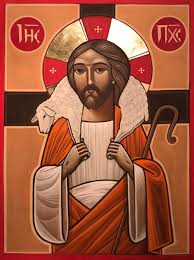
Coptic Church icon of Jesus the Good Shepherd

Jerusalem, enemy troops
    have surrounded you;
they have struck Israel’s ruler
    in the face with a stick.

Bethlehem Ephrath,
you are one of the smallest towns
    in the nation of Judah.
But the Lord will choose
one of your people
    to rule the nation—
someone whose family
    goes back to ancient times.
The Lord will abandon Israel
    only until this ruler is born,
and the rest of his family
    returns to Israel.
Like a shepherd
    taking care of his sheep,
this ruler will lead
    and care for his people
by the power and glorious name
    of the Lord his God.
His people will live securely,
and the whole earth will know
    his true greatness,
because he will bring peace. (CEV)

In Micah’s day there was no peace on earth, goodwill to all. In the eighth century B.C.E. the powerful Assyrian Empire came and conquered the northern kingdom of Israel, deporting many of the people and re-populating the cities with their own.

The Assyrian takeover of Israel not only left the northern kingdom in shambles but had a large impact on the southern kingdom of Judah.  All of Judah and Jerusalem were in extreme duress.  Even though Judah had not been conquered and was intact, they were still forced to pay tribute to the Assyrians to keep them at bay. 

The problem became even more exacerbated because the leadership of Judah sought to maintain their power and lifestyle.  The leaders neither looked to God for help nor looked out for the interests of the people.  Instead, they expected the already burdened poor to shoulder the burden of the tribute to the Assyrians.

What is more, thousands of refugees from Israel flooded into Judah and Jerusalem.  So, the already scant resources in Judah were pushed to the brink. Those in authority, the ones with resources who could make something of a difference, ended up taking advantage of the situation by buying fields and land at a fraction of its worth.  In some cases, they leveraged their power by simply pushing people of their land and taking it over. It was anything but a time of security, peace, and actions of goodwill.

Into this terrible situation of hardship and survival, Micah prophesied judgment upon the leaders who were oppressing the poor and displaced.  Micah’s message of hope was that a new kind of leader will come from humble origins, just like the common oppressed people of Judah.  The refugees, the displaced farmers, and the poor will have a champion.  He will feed and shepherd them, leading them to green pastures.  This leader will serve the people instead of the people serving the leader.

Christians see Jesus in Micah’s prophecy. Just as the ancient Jews needed hope and the promise of a different ruler, so today we, too, need hope and the anticipation of the leader who will come again using his power for security, peace, and goodwill.

Christ’s authority is different than earthly politicians and officials.  Israel and Judah had been so filled with bad kings and self-serving leadership over the centuries that Christ’s disciples could barely conceive of a different kind of rule. So, Jesus called his disciples together and said:

“You know that those who are regarded as rulers of the Gentiles lord it over them, and their high officials exercise authority over them.  Not so with you.  Instead, whoever wants to become great among you must be your servant, and whoever wants to be first must be slave of all.  For even the Son of Man did not come to be served, but to serve, and to give his life as a ransom for many” (Mark 10:42-43, NIV).

The people of Micah’s day needed to see beyond their terrible circumstances to hope of better days with food, peace, and protection.  We, too, feel insecure and anxious. We want leaders to be wise and just toward the vulnerable, the poor, and the displaced.  But while we look to our politicians and election cycles for our hope, the prophet Micah is jumping up and down, pointing us to a different leader – a shepherd leader.

Micah said the shepherd leader will come from Bethlehem.  When Micah proclaimed this, King David, the original shepherd king, had been dead for nearly three-hundred years. The people immediately made the connection between the coming leader and David.  There would be restoration and renewal!  A benevolent kingly reign is coming! 
Ethiopian Orthodox Church depiction of Jesus the Bread of Life

“Bethlehem” is two Hebrew words put together: beth (“house”) and lechem (“bread”) thus being “House of Bread.” God was communicating that the coming shepherd leader would provide abundant food and care for them. God wanted, and still wants, a society that does not feed on itself, but is a house of bread for others. Jesus is the Bread of Life. Christ feeds us so that we will become a people who offer bread to others – both physical and spiritual bread.

Jesus is the bread for all the hungers we have in this life. We hunger for security in our world; satisfaction in our daily work; loved ones to be healthy and happy. In short, we hunger for peace. Our spiritual stomachs growl with hunger for spiritual food.  Many are spiritually starving because they are searching for peace and goodwill in places without food.

Satisfaction, contentment, and peace have come from the most unlikely places of Bethlehem and Nazareth. Can anything good come from villages in Judea that do not even show up on most maps of the ancient world?  Peace, hope, and goodwill can and do come from the least expected places and people. 

Christ was not born in the halls of power. Yet, through him there is peace, in the complete sense of the word. Jesus is the One who brings a full-orbed wholeness and wellness to life, no matter the situations around us. Jesus is our peace:

Like a shepherd, God will tend the flock; he will gather lambs in his arms and lift them onto his lap. He will gently guide the nursing ewes. (Isaiah 40:11, CEB)

“Yes, I will feed my flock, and I will lead them to a place of rest. I will search for the lost sheep. I will bring back the sheep that were scattered and put bandages on the sheep that were hurt. I will make the weak sheep strong, but I will destroy the fat and powerful shepherds. I will feed them the punishment they deserve.” (Ezekiel 34:15-16, ERV)

 “I am the Good Shepherd. I know my own sheep and my own sheep know me. In the same way, the Father knows me, and I know the Father. I put the sheep before myself, sacrificing myself if necessary. You need to know that I have other sheep in addition to those in this pen. I need to gather and bring them, too. They’ll also recognize my voice. Then it will be one flock, one Shepherd.” (John 10:14-16, MSG)

“I am the bread of life. He who comes to Me shall never hunger.” (John 6:35, NKJV)

When Jesus originally said those words, it was scandalous, unheard of rhetoric. So, Jesus, the stinker he could be, pressed it even more:

“I am the bread of life. Your ancestors ate the manna in the wilderness, yet they died. But here is the bread that comes down from heaven, which anyone may eat and not die. I am the living bread that came down from heaven. Whoever eats this bread will live forever. This bread is my flesh, which I will give for the life of the world… Very truly I tell you, unless you eat the flesh of the Son of Man… you have no life in you. (John 6:48-51, 53, NIV)

We are to ingest Jesus – to be filled with him. We need Jesus because he is our house of bread, our peace, our shepherd, and our king. Believing in him is to give our lives to him. The greatest Christmas gift we can give this season is the gift of our lives to Jesus Christ, the promised Messiah.

Lord Jesus, I have strayed far from your flock and taken matters into my own hands. I have chosen to feed in pastures that will never take care of my real hunger.  I need Your forgiveness. I believe You died on the cross for all the things I have done and left undone.  You rose from the grave to give me life. So, I want to stop going my own way and start going yours. Amen.

Matthew 24:15-31 – Being Prepared

“So when you see standing in the holy place ‘the abomination that causes desolation,’ spoken of through the prophet Daniel—let the reader understand— then let those who are in Judea flee to the mountains. Let no one on the housetop go down to take anything out of the house. Let no one in the field go back to get their cloak. How dreadful it will be in those days for pregnant women and nursing mothers! Pray that your flight will not take place in winter or on the Sabbath. For then there will be great distress, unequaled from the beginning of the world until now—and never to be equaled again.

“If those days had not been cut short, no one would survive, but for the sake of the elect those days will be shortened. At that time if anyone says to you, ‘Look, here is the Messiah!’ or, ‘There he is!’ do not believe it. For false messiahs and false prophets will appear and perform great signs and wonders to deceive, if possible, even the elect. See, I have told you ahead of time.

“So, if anyone tells you, ‘There he is, out in the wilderness,’ do not go out; or, ‘Here he is, in the inner rooms,’ do not believe it. For as lightning that comes from the east is visible even in the west, so will be the coming of the Son of Man. Wherever there is a carcass, there the vultures will gather.

“Immediately after the distress of those days, the sun will be darkened,
    and the moon will not give its light;
the stars will fall from the sky,
    and the heavenly bodies will be shaken.

“Then will appear the sign of the Son of Man in heaven. And then all the peoples of the earth will mourn when they see the Son of Man coming on the clouds of heaven, with power and great glory. And he will send his angels with a loud trumpet call, and they will gather his elect from the four winds, from one end of the heavens to the other. (NIV)

I live in the upper Midwest of the United States. The summers can be brutally hot and humid. The winters can be incredibly frigid and full of snow. Having lived in various university towns and worked with many college students, every Fall there is always at least one international student, or a student from the American Deep South, that has never experienced a Midwest winter and snow. I could tell them repeatedly of the need for a sturdy winter coat before the snow flies. Yet, having never known sub-freezing, let alone sub-zero, temperatures it is difficult to imagine such cold when the weather is warm. At the coming of winter, I, or someone else, had to help ensure they had a suitable coat.  Even then, they usually shake all winter and never take their scarves off.

It might be difficult to imagine, because none of us have yet experienced it, that someday Christ will return to judge the living and the dead. Therefore, Jesus told his disciples about using discernment concerning a change of environment around them. Although it may seem improbable now, a time is coming which will be loaded with cosmic and cataclysmic changes. Sometimes, even for myself who has lived through many hard winters, it is incredible to know that the landscape as it is right now will be completely different.

The sky and the earth as we know it now will pass away; yet Christ’s words will endure for all time. If we are attentive and alert, we will be ready. We will have a warm winter parka on hand. And, for now, it means taking off the old clothes of fear, insecurity, hopelessness, and hate, and putting on the new clothes of righteousness, peace, and love in the Holy Spirit. Winter is nearly here. There is a chill in the air.

God Almighty, we long for the coming of your kingdom in Jesus Christ our Lord. We lament before you the signs that your kingdom has not yet come in its fullness. The signs of brokenness and divisions, oppression and abuse, poverty and loneliness, are everywhere present in the world. So, we cry out from the depths of our being, “O come, O come, Immanuel. Bring us comfort. Dispel the shadows of the night and turn our darkness into light.” Through Jesus Christ our Lord. Amen.

John 5:19-40 – The Centrality of Christ

The Risen Lord by Chinese artist He Qi

Jesus gave them this answer: “Very truly I tell you, the Son can do nothing by himself; he can do only what he sees his Father doing, because whatever the Father does the Son also does. For the Father loves the Son and shows him all he does. Yes, and he will show him even greater works than these, so that you will be amazed. For just as the Father raises the dead and gives them life, even so the Son gives life to whom he is pleased to give it. Moreover, the Father judges no one, but has entrusted all judgment to the Son, that all may honor the Son just as they honor the Father. Whoever does not honor the Son does not honor the Father, who sent him.

“Very truly I tell you, whoever hears my word and believes him who sent me has eternal life and will not be judged but has crossed over from death to life. Very truly I tell you, a time is coming and has now come when the dead will hear the voice of the Son of God and those who hear will live. For as the Father has life in himself, so he has granted the Son also to have life in himself. And he has given him authority to judge because he is the Son of Man.

“Do not be amazed at this, for a time is coming when all who are in their graves will hear his voice and come out—those who have done what is good will rise to live, and those who have done what is evil will rise to be condemned. By myself I can do nothing; I judge only as I hear, and my judgment is just, for I seek not to please myself but him who sent me.

“If I testify about myself, my testimony is not true. There is another who testifies in my favor, and I know that his testimony about me is true.

“You have sent to John and he has testified to the truth. Not that I accept human testimony; but I mention it that you may be saved. John was a lamp that burned and gave light, and you chose for a time to enjoy his light.

“I have testimony weightier than that of John. For the works that the Father has given me to finish—the very works that I am doing—testify that the Father has sent me. And the Father who sent me has himself testified concerning me. You have never heard his voice nor seen his form, nor does his word dwell in you, for you do not believe the one he sent. You study the Scriptures diligently because you think that in them you have eternal life. These are the very Scriptures that testify about me, yet you refuse to come to me to have life. (NIV)

There are many things in this world of great importance: how we govern ourselves as a free people; addressing issues of poverty, disease, education, taxes, healthcare, racism, and international relations; building local community relationships; supporting small business; working to make a decent contributive living; being a responsible citizen; and, loving our families and faith communities. It is my unshakable conviction that all these issues need more than mental and physical attention; they need our spiritual resources. People need the Lord.

Seasons, years, centuries, and even millennia come and go. People are born, live, and die. Generations exist and then are no more. Civilizations rise and fall. Yet, through it all and above it all is Jesus.

Christ is alive, and he continually brings life from dust, beauty from ashes, and everlasting meaning from apparent meaninglessness.

Today, Christ is still on the throne of all creation. 

Human elections and institutions only have authority as given by Jesus, the Ruler of all. Presently, Jesus remains attentive to people, even interceding for us at the right hand of his Father in heaven.  At this very moment, God’s Holy Spirit roams the earth and continues to apply all the redemptive consequences of Christ’s cross mysteriously and graciously to the lives of millions. 

Sometimes we need to do the occasional spiritual fact check, to remember what is really of ultimate significance in this old broken world.  If people need the Lord, then it only makes sense to live in ways that foster connection with Jesus. 

So, this morning I did what I do every morning: I began the day with Scripture reading, prayer, reflection, and gratitude – all done with the realization that Christ’s authority is real and pervasive, and his reign is supreme.

No matter the Christian tradition, Jesus Christ is the exalted and glorified Son of God, the Sovereign authority over every dominion. Jesus is God. God the Father works through God the Son. The works of Jesus bear testimony to the cosmic reality that he is Lord of all. And, if that were not enough, Jesus shares his divine power with us, his people.

In the face of the greatness and majesty of the Lord Jesus, the only valid and appropriate response is sheer submission to Christ’s authority.  Just as Jesus listened to the Father and obeyed the Father’s will, so we need to listen to Jesus and carry out his will.  Just as Jesus enjoyed his relationship with the Father, so we are to bask in our wonderful relationship with Jesus. 

Since Jesus submitted to death on a cross and rose from the dead through God’s power, we now have access to that power by God’s grace through faith in Christ.

We need not bend to any other master other than King Jesus, the rightful ruler of the universe.  Let us put away all other “gods” in which we depend for solace and help.  Jesus is the pioneer of our salvation who guides us with grace into God’s will for us. Thanks be to God!

Almighty God, to you all hearts are open, all desires known, and from you no secrets are hid: Cleanse the thoughts of our hearts by the inspiration of your Holy Spirit, that we may perfectly love you, and worthily magnify your holy Name; through Christ our Lord. Amen.

Matthew 12:46-50 – Family

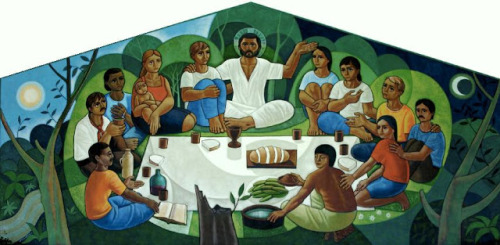
En la Cena ecológica del Reino (At the Ecological Kingdom Dinner) by Spanish artist Cerezo Barredo

While Jesus was still talking to the crowd, his mother and brothers stood outside, wanting to speak to him. Someone told him, “Your mother and brothers are standing outside, wanting to speak to you.”

He replied to him, “Who is my mother, and who are my brothers?” Pointing to his disciples, he said, “Here are my mother and my brothers. For whoever does the will of my Father in heaven is my brother and sister and mother.” (NIV)

Jesus obviously did not get the memo that blood is thicker than water. When his own blood family were waiting outside for him, Jesus used the occasion to speak of what makes up a true follower of God. Christ boldly asserted that his true family is made up of people who do God’s will.  By saying this, Jesus brought the point home that the kingdom of God turns on obedience.

Rather than solely confessing belief, or appealing to a family heritage of faith, Jesus said that a genuine believer in God is one who listens to God’s words and then promptly obeys them. Therefore, a Christian is defined by allegiance to Jesus, and not by having a certain bloodline. 

Identity determines activity. For example, if I identify myself primarily as a worker at my job, my activity will show it – I will spend long hours at my labor, and will do whatever it takes to please my boss and gain promotions. If I identify myself primarily as an athlete, I will spend long hours honing my skills, and do whatever it takes to please the coach and to win. If my identity is mostly wrapped around being a husband and father, I will focus most of my attention on my family and seek to please my spouse and children in all things. 

If my identity is first and foremost as a Christian, I will always seek to please Jesus. I will then view my job as an opportunity to express the ethics of God’s kingdom, as a calling from God, and as a means for God to transform me for his glory. I will view athletics as means to glorify God, and not as an end in and of itself but as a special gift for God to teach me about the importance of community and working together. 

If my identity is clearly in Christ, I will view my kids as belonging to God and I will steward the trust of children given me by doing whatever it takes to teach and train them in the way of Jesus. I will thank God for my family and not confuse them with being God by idolizing them.

In today’s Gospel lesson, Jesus was inside a house, with his family on the outside. So, why were the family members of Jesus not inside the house sitting at his feet, taking the posture of a disciple? The disciple Matthew wanted to communicate more than physical distance between Jesus and his physical family – being “outside” was meant to convey the posture of Christ’s family as spiritually distant, skeptical of him, and indecisive about who he was and what he was up to. In fact, the disciple Mark made this spiritual and emotional distance clear:

Jesus entered a house. A crowd gathered again so that it was impossible for him and his followers even to eat. When his family heard what was happening, they came to take control of him. They were saying, “He’s out of his mind!” (Mark 3:20-21, CEB)

Christ’s earthly family were not looking for Jesus to give them warm-fuzzies and have a family group hug. They were there to tell him: “Cut it out, Jesus, because you’re acting like a nut-cake and embarrassing us all!” The kid brothers of Jesus (James and Jude) would go on to become powerful Christian preachers and each pen a New Testament letter, but that does not happen till after Jesus’ resurrection.

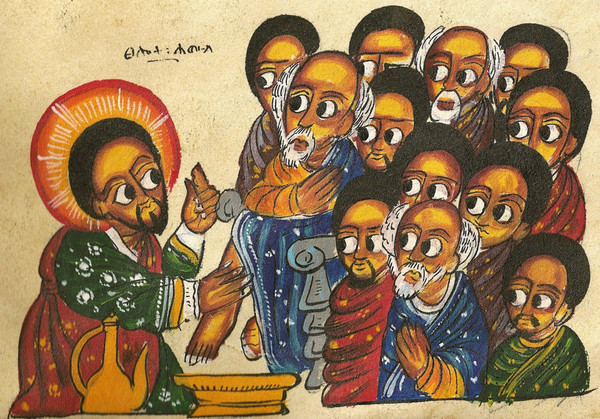
Ethiopian Orthodox Church depiction of Christ and his disciples

Jesus was saying that identifying only with a biological family leads to only pleasing that family. However, identifying with Jesus leads to a radical form of following God that seeks to please him instead of submitting to family practices, mores, and beliefs which are inconsistent with the kingdom of God. 

For the follower of Christ, the church is the family of God, and we are to act consistent with being in such a family.  We are to go hard after God’s will, serve one another, and adopt outsiders into our family.  The church is a family, not a restaurant.  When we go to a restaurant, we either like the food and the service, or not. If the experience was unpleasant, we might complain to the waitress and may or may not come back.  Try doing that with your mother and see where it gets you!  As a biological family, we are committed to each other. There is no complaining about mom because of dad’s wrath. Instead, we are expected to clear our plates and put them in the dishwasher, to sweep the floor and clean the table, and to work together for the benefit of the entire family.  In the same way, following Jesus means being committed to his family, the church.

Priority is to be given in doing God’s will, regardless of blood, because obedience to Christ identifies us as being in the family of God.  Our actions and the way we live points to what we honestly believe and where our commitments truly lie. 

The first step of God’s desire for us is quality focused time in sitting at Christ’s feet and listening to him because this is at the heart of all Christian discipleship. We cannot do God’s will until we have clearly heard it; and we cannot hear God’s will unless we take the time to be at the feet of Jesus. 

Both listening and doing are necessary.  Listening without engaging the world is a failure of mission; and doing without first listening leads to misguided acts and eventual burn-out. Allow Jesus to call the shots and let him instruct us so that we can act wisely and obediently. 

Jesus did not devalue blood relatives as irrelevant. Rather, Christ emphasized that our primary allegiance is to him, and not to our biological family.  The kingdom of God seeks to restore and redeem all things, including family. Both church and family are important. The relationships within each are to be nurtured.

The family of Jesus, the church, is important because Christ suffered and died for her. So, we are to be committed to the church, love the church, and serve the church because we are family. If we have a good grasp of this, we will make decisions based in what we believe God’s will is, instead of whether a relative will get upset, or not. 

Our biological families are important.  Jesus never pitted one against the other, because he wants to see families redeemed and work together as the family of God. Every Christian family can do this:

  • Appoint a time to read Scripture together and listen to Jesus and discuss it.
  • Show hospitality so that we can eat and drink our way into the kingdom of God. 

We need to persistently pray for spiritually lost family members, and those whom we are estranged from. Most families have at least a few toxic persons in their orbit. Here is how we might pray for them:

  • That God will arrange divine appointments between them and other believers who love Jesus.
  • That God will draw them to the mercy of Christ.
  • That God will hinder the devil’s schemes against them.
  • That they will understand and respond to the good news of God’s grace.

Soli Deo Gloria