John 12:1-11 – Broken and Poured Out

Six days before the Passover, Jesus came to Bethany, where Lazarus lived, whom Jesus had raised from the dead. Here a dinner was given in Jesus’ honor. Martha served, while Lazarus was among those reclining at the table with him. Then Mary took about a pint of pure nard, an expensive perfume; she poured it on Jesus’ feet and wiped his feet with her hair. And the house was filled with the fragrance of the perfume.

But one of his disciples, Judas Iscariot, who was later to betray him, objected, “Why wasn’t this perfume sold and the money given to the poor? It was worth a year’s wages.” He did not say this because he cared about the poor but because he was a thief; as keeper of the money bag, he used to help himself to what was put into it.

“Leave her alone,” Jesus replied. “It was intended that she should save this perfume for the day of my burial. You will always have the poor among you, but you will not always have me.”

Meanwhile a large crowd of Jews found out that Jesus was there and came, not only because of him but also to see Lazarus, whom he had raised from the dead. So, the chief priests made plans to kill Lazarus as well, for on account of him many of the Jews were going over to Jesus and believing in him. (NIV)

Jack Klugman as Quincy, M.E. (1976-1983)

When I was a kid there was a show on TV called “Quincy.” Quincy was a coroner. Every episode was him performing an autopsy on someone who appeared to have a rather normal death. But Quincy always found something suspicious and spent his time prying into people’s lives to confirm his investigation. His boss and the police chief would chide and warn him saying, “Leave it alone, Quincy.” Quincy’s typical response was: “But I can’t leave it alone. There’s more here than what meets the eye!”

Indeed, the Apostle John was the Quincy of his ancient generation. In his gospel there is always more going on than what meets the eye. There are double-meanings, sometimes even triple-meanings to the events unfolding.  There are deeply symbolic encounters, as well as tangible events serving as almost metaphors pointing to the spiritual.

Mary, a woman with a sordid background, had her life transformed through meeting Jesus.

Near the end of Christ’s life, as he was about to enter Jerusalem and be arrested, tried, tortured, and killed, Mary sensed what was happening. In fact, she was aware of what was happening when others did not. Mary’s own brokenness cracked open to her the true reality of life.

The surface event itself is a touching and tender moment in history. This woman, whom everyone knew as a damaged person, took a high-end perfume, and broke the entire thing open. She then proceeded to anoint Christ’s feet with it. You can imagine the aroma filling the house with an expensive perfume for all to smell.  Giving what she had to Jesus, Mary demonstrated the path of true discipleship.

But there’s more here than what meets the eye. Let’s observe some of John’s expert autopsy work:

  • The broken jar of perfume shows us the brokenness of Mary and our need to be broken. (Matthew 5:3-4)
  • Mary used an extraordinary amount of perfume, picturing her overflowing love for Jesus. (John 20:1-18)
  • Mary applied the perfume to Jesus with her hair; hair is culturally symbolic for submission and respect. (1 Corinthians 11:14)
  • The perfume directs us to the death of Jesus. (John 19:38-42)
  • The perfume highlights for us the aroma of Christ to the world. (2 Corinthians 2:15-17)
  • There is more to Judas than his words about perfume; he is not actually concerned for the poor. (Matthew 26:15)
  • Judas and Mary serve as spiritual contrasts: Mary opens herself to the sweet aroma of Christ; Judas just plain stinks.
  • The perfume presents a powerful picture of the upcoming death of Christ, for those with eyes to see; he was broken and poured out for our salvation. (Luke 23:26-27:12)

Christianity was never meant to be a surface religion which merely runs skin deep. The follower of Christ is meant for deep personal transformation, inside and out, so that there is genuine healing, spiritual health, and authentic concern for the poor and needy. 

Keeping up appearances is what the Judas’s of this world do. But the Mary’s among us dramatically point others to Jesus with their tears, humility, openness, and love.

In our social landscape of fragmented human ecology, our first step toward wholeness and integrity begins with a posture of giving everything we have – body, soul, and spirit – to the Lord Jesus. Methinks Quincy was on to something.

Loving Lord Jesus, my Savior, and my friend, you have gone before us and pioneered deliverance from an empty way of life and into a life of grace and gratitude. May I and all your followers emulate the path of Mary and realize the true freedom which comes from emptying oneself out for you. Amen.


Hebrews 4:14-5:4 – What is Your View of God?

Photo by Pixabay on Pexels.com

Since we have a great high priest who has ascended into heaven, Jesus the Son of God, let us hold firmly to the faith we profess. For we do not have a high priest who is unable to empathize with our weaknesses, but we have one who has been tempted in every way, just as we are—yet he did not sin. Let us then approach God’s throne of grace with confidence, so that we may receive mercy and find grace to help us in our time of need.

Every high priest is selected from among the people and is appointed to represent the people in matters related to God, to offer gifts and sacrifices for sins. He can deal gently with those who are ignorant and are going astray, since he himself is subject to weakness. That’s why he has to offer sacrifices for his own sins, as well as for the sins of the people. And no one takes this honor on himself, but he receives it when called by God, just as Aaron was. (NIV)

Metaphors matter. How we view, imagine, and picture God influences the way we live.

Recently, I met with a young man who was severely distressed, depressed, and had attempted suicide several times in the past several months. After listening to his story, I asked him a question: “How do you see or picture God?”  Without hesitation, he answered, “God is my CO (Commanding Officer).”  He went on to portray and picture General God who gives commands and of good soldiers who obey what’s expected of them. 

As a soldier, you would never walk up to your CO and vent all your feelings. You wouldn’t have a dialogue.  There would be no extended conversations. In the throes of trying to deal with emotional trauma, General God isn’t a metaphor that’s helpful.

Today’s New Testament lesson reminds and invites us to consider Jesus, the Son of God. Christ is pictured as our great high priest. A priest is a person who intercedes for you with God. He stands in the gap and effectively communicates your needs, desires, and feelings to a gracious and loving God.

When you are too emotionally tired to face another day, Jesus our great high priest, has our back and is graciously present with us.

Soldiers don’t have confidence to approach General God with their abject weakness or their ongoing temptations. There is only the giving and receiving of orders and strategies to be implemented. Far too many Christians have such an understanding of God and think there is something wrong with them when they cannot live up to be the kind of soldier that would make others proud.

Grace and mercy, however, are found through the confidence of approaching our great high priest. It is Jesus who thoroughly, completely, and mercifully has a first-hand understanding of what you are dealing with and is able and desirous to help.

As our permanent high priest, Jesus is uniquely positioned to hear us, empathize with our situation, and care for us in ways which truly aid us.

It’s easy to get discouraged. It takes no effort to find yourself on the outside of happiness and on the inside of a black hole. Living in this broken world can sting and hurt like hell. Yet, we have a Savior who has brought deliverance from hell by taking on hell itself.  Jesus, the pioneer of our salvation, knows better than anyone what brokenness feels like. Christ absorbed all the sin of the world on the cross. 

Jesus is presently, this very moment, sitting at the right hand of the Father in heaven, awaiting your approach with merciful eyes, a compassionate heart, and listening ears. Jesus is our risen and ascended Lord. Christ is so much more than a military officer. Jesus is our ample and able great high priest. He is awaiting you now….

Ascended and living Lord Jesus, you are my colossal high priest. You live to intercede for me. What a privilege!  May you strengthen my nascent faith today and bolster my confidence as I consider your grace and mercy in this messed-up world. Thank you for your kindness, empathy, and ability. Amen.

The Greatest Ever

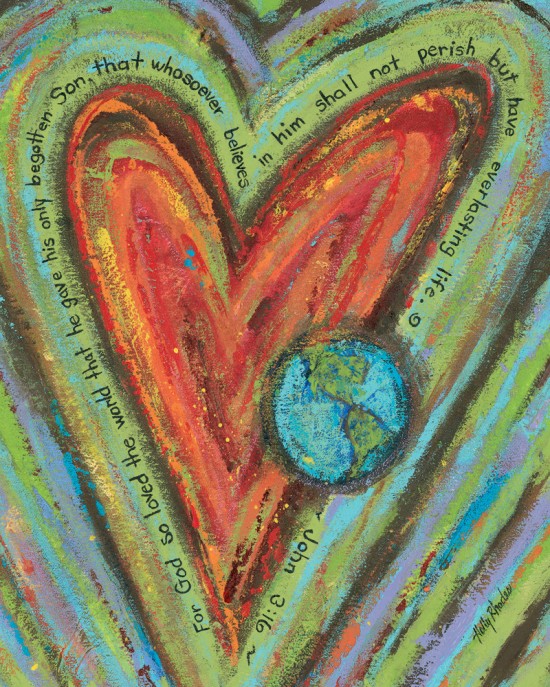
John 3:16 by Holly Rhodes

For God so loved the world that he gave his one and only Son, that whoever believes in him shall not perish but have eternal life. (John 3:16, NIV)

John 3:16 is a Bible verse so familiar as to be cliché. But when Jesus originally said these words, they were both tremendously freeing and incredibly scandalous. When something is familiar, we tend not to explore it any further. We need a closer look at the message of John 3:16 so we can not only see why some people embrace its light, but why others remain in darkness.

Perhaps another examination the gospel will dispel dullness and impel us toward praise, as well as to share its life-giving message not because we must, but because we want to. John 3:16 contains nine of the greatest spiritual realities we could ever experience.

1.“God” is the greatest subject ever.

The Bible contains lots of messages, promises, and commands. However, those are not the primary purpose for having the Holy Scriptures. The Bible has been given to us as a revelation of God to us so that we might know God. Every time the Scriptures are used, read, quoted, prayed, taught, learned, and heard – we know God a bit better. Anything short of knowing God falls short of the Bible’s intended purpose.

I constantly encourage a regular daily regimen of Bible-reading because it is the primary means of knowing God. Yes, we get to know God in creation and through experience, yet one of the best ways of experiencing God is through taking time for reading, meditating, memorizing, and praying of the Scriptures. Some of my most encouraging times are when I hear what people are learning about the Lord in God’s Word. With the Holy Spirit being our teacher, we discover more and more that God is the greatest subject we could ever learn about, talk about, and give our lives to.

2. “So” is the greatest extent ever.

There is a great wideness to God. God is a huge Being! Nothing is outside of God’s reach. So, when God decides to do something, nothing can stop it. We might be limited in our strength and abilities to accomplish things. But God’s extent is limitless. Knowing God means becoming familiar with an all-knowing and all-powerful Being. Prayer, then, becomes a response to God. God speaks to us through the Word, and we speak back with prayer so that the Word and prayer go like a hand in a glove. Our extent is temporary and small. Yet God takes our human prayers and uses them to accomplish divine purposes on this earth.

3. “Loved” is the greatest demonstration ever.

There is no greater demonstration of love than our triune God loving us with a sacrificial self-emptying love that saw our great need for deliverance and went to the greatest lengths possible to accomplish it. Our own love for God, each other, and the world is a direct result of God’s love for us.

This is how we know what love is: Jesus Christ laid down his life for us. And we ought to lay down our lives for our brothers and sisters…. This is how God showed his love among us: He sent his one and only Son into the world that we might live through him. This is love: not that we loved God, but that he loved us and sent his Son as an atoning sacrifice for our sins. Dear friends, since God so loved us, we also ought to love one another. (1 John 3:16; 4:9-11, NIV)

Where there is a lack of love there is an absence of God. Every human on planet earth needs the love of God in Christ. Without it we are lost. You are loved with sacrificial love. The greatest thing that can be said of you is that you are “loved.” Whatever has happened, is happening, and will happen that breaks you down, belittles you, hurts you, or causes you to feel like the north end of a southbound cow, is not what defines you. All may be going to hell around you, but nothing will change the unalterable reality that in Christ you are “loved!”

4. “The world” is the greatest object ever.

Up to this point you might not have sensed anything scandalous about this message of God’s grace and love. But this was the game-changing term for the original hearers of Christ’s words: God so loved the world. Many of Christ’s listeners could easily understand God loved the nation of Israel. But to say that God loved the world was going too far. It meant God loved Gentiles, specifically, Romans who occupied their land and oppressed them.

To capture the punch of this, it would be like Jesus showing up in our world today and saying that God so loved whomever we despise or hate. We often tend to assume that God hates who we hate. Right? Wrong. Yes, God hates evil and is opposed to all that destroys. Yet, God loves people for whom is placed the divine image within. For God to love the world is an incredible because there are so many unlovely people in the world.

Since God loves the world and demonstrated it in through Jesus, Christ’s Church is to reflect and embody this same love for the world. This has enormous implications for followers of Jesus. The Church is must embrace the same pejorative title as given its leader, Jesus: “Friend of Sinners.”  People come to know Jesus through the love given us in Christ. Since this is our title, Christian ministry then becomes not about my personal preferences but about what will most effectively love the world to Jesus.

5. “That he gave his one and only Son” is the greatest gift ever.


John 3:16 by an 11 year old

For God did not send his Son into the world to condemn the world, but to save the world through him. (John 3:17, NIV)

We do not get God’s leftovers or second-hand items. God gave the dearest, best, and most beloved gift he could ever give: his Son. Therefore, the greatest and dearest gift we can give to another person is Jesus. Sharing such a gift Jesus must come freely from the depths of divine love. Apart from love we are only a resounding gong or a clanging cymbal. If it takes cajoling and exhortation for us to give the gift of the gospel, then the problem lies in our hearts. It takes coming back to God’s Word and knowing the love of God in Christ through the Scriptures.

6. “That whoever” is the greatest opportunity ever.

If the greatest gift a person can receive is Jesus, then the best opportunity one could take advantage of is Jesus. We are all at differing places in our relationship with Jesus. Yet no matter the person, the opportunity for grace and love is more than anything you could hope or ask for. 

We are fortunate to have such a grace to know Jesus as Lord, Savior, teacher, healer, and friend. Those familiar with the name of Jesus all their lives but it has not gone much further than that, then the next point is vitally important….

7. “Believes in him” is the greatest commitment ever.

Jesus wants more than our acknowledgment of him; he wants us. Whenever I go home, my dog, Max Power, gets extremely excited. Honestly, I don’t really get excited about him. My typical response to him is, “Yes, Max, I acknowledge your existence.” I say it in hopes he will just kind of leave me alone and let me go about my business. But Max wants more. He wants my affection, my love, and my commitment. He wants a pet, a walk, food, and water.

God does not want to be treated like an annoying puppy. God wants our commitment. The Lord desires more than the tepid response, “I acknowledge your existence.”  The most common response I get from people when sharing the gift of Jesus is “Yes, I believe in Jesus.”  It is their way of saying they acknowledge his existence but are not much interested in giving their lives to him because they want to go about their business without God pestering them about anything. But God does demand something from us – our very souls. If we gain a view of God as gracious and loving, then we willingly desire an intimate commitment.

8. “Shall not perish” is the greatest rescue ever.

People perish not because God is unloving but because their theology is twisted – not to mention that we like our sin, and we don’t want to accommodate a holy God. The Titanic lost hundreds of people not for a lack of lifeboats. In fact, most of the lifeboats went into the water about three-fourths capacity. Many people simply did not believe they were perishing. They trusted in the ship’s reputation as being “unsinkable.” Jesus is our lifeboat.

9. “But have eternal life” is the greatest promise ever.

The promise begins now, not someday. Everlasting life means experiencing a life-saving and life-giving relationship with Jesus today.

Conclusion

If you ever had the feeling there is something more to life than what you are experiencing; if you ever wished you could start over; if you ever felt you cannot do this on your own; then, I have the greatest news ever. God has made a way to handle all your guilt, shame, and darkness. God loves you deeply in the person of Jesus Christ. There is new life in Jesus.

1 Peter 3:8-18 – How to Live in a Messed-Up World

Stations of the Cross at Holy Hill, Hubertus, Wisconsin

Finally, all of you be of one mind, sympathetic, lovers of your fellow believers, compassionate, and modest in your opinion of yourselves. Do not pay back evil for evil or insult for insult. Instead, give blessing in return. You were called to do this so that you might inherit a blessing.

For those who want to love life
    and see good days
should keep their tongue from evil speaking
    and their lips from speaking lies.
They should shun evil and do good;
    seek peace and chase after it.
The Lord’s eyes are on the righteous
    and his ears are open to their prayers.
But the Lord cannot tolerate those who do evil.

Who will harm you if you are zealous for good? But happy are you, even if you suffer because of righteousness! Do not be terrified or upset by them. Instead, regard Christ the Lord as holy in your hearts. Whenever anyone asks you to speak of your hope, be ready to defend it. Yet do this with respectful humility, maintaining a good conscience. Act in this way so that those who malign your good lifestyle in Christ may be ashamed when they slander you. It is better to suffer for doing good (if this could possibly be God’s will) than for doing evil.

Christ himself suffered on account of sins, once for all, the righteous one on behalf of the unrighteous. He did this to bring you into the presence of God. Christ was put to death as a human but made alive by the Spirit. (CEB)

If there were a sign-up sheet for suffering, I am confident no one put their name to it. We like to avoid suffering. After all, it hurts! I would make a terrible masochist. I am not a high tolerance for pain kind of guy. I have no problem taking a Tylenol at the first sign of discomfort. Yet, I know there will be times when I am going to have to experience pain – physical, emotional, and spiritual – and there is no way around it. To live in this broken world is to experience suffering. To suffer as a Christian, however, is different because we are following the way of our Lord Jesus Christ.

The stark reality of the New Testament is that there must be suffering before glory. Just as Christ suffered, we ought to expect we will suffer as his followers. As Christians walk with Jesus during the season of Lent, they journey through the desert full of temptation and hard circumstances. At the end of the journey will be the glory of Easter, a celebration of the resurrection. Christian theology confidently practices hope based on the redemptive events of Christ’s cross and resurrection, suffering and glory.

Stations of the Cross at Holy Hill, Hubertus, Wisconsin

We are not above our Master. We, too, will suffer. The real question is whether we will suffer because of our own foolishness and selfishness, or because of our devotion to Christ in being kind, humble, and gracious.  When insults come our way, we avoid responding with insults of our own. Verbal cruelty is not the way of Christ. Anger, slander, gossip, lies, manipulative words, and belligerent bullying have absolutely no place in the kingdom of God for any reason. God takes a zero-tolerance policy toward hate speech.

Christians are to us their tongues exclusively for blessing, not cursing; for love, not hate; for truth, not lies; for building-up, not tearing-down; for proclaiming good news, not shame-laced bad news. If we suffer for being Christians in solidarity with our Lord, we shall receive blessing from God. But if we suffer for giving-in to retaliation and our base desires for revenge, then we will suffer the consequences of our own stupidity.

God has called us to bless the world, not condemn it. Christians are to be on the frontlines of the mobilizing others for mercy, leading the charge of spreading respect, civility, kindness, and the gospel. Jesus said that it is no problem to show love and respect to people we like. However, it is a whole other ballgame to do the same for those who treat us with disrespect and hate. Yet, God watches over all who obey him, and he listens to their prayers. God will handle the hate-filled person; judgment is for neither you nor me to dish out. Our task is to have a deep concern for humanity, both the ones we like and the ones we do not.

I encourage you to take some time today or in the next few days to read the epistle of 1 Peter slowly and carefully in one sitting. It is a short book. Pay attention to how the adversity of living in this fallen world gives Christians the opportunity, hope, and encouragement to live well. 

May it be so, to the glory of God.

Loving Lord Jesus, you suffered and died on my behalf.  It is a small thing for me to follow you and walk in the way of suffering. I know and have the confident expectation that blessing awaits. Keep me true to following you through all the adversity I must face in this fallen broken world. Even so, come Lord Jesus. Amen.