Take the Stairs Out of the Basement Shame Lounge

Since then, you have been raised with Christ, set your hearts on things above, where Christ is, seated at the right hand of God. Set your minds on things above, not on earthly things. For you died, and your life is now hidden with Christ in God. When Christ, who is your life, appears, then you also will appear with him in glory. (Colossians 3:1-4, NIV)

A century ago, the English novelist, G.K. Chesterton, observed that in the house of life, many people are content to live in the cellar. In fact, they assume the cellar is the only room in the house. Cellars and basements have certainly changed in the past one hundred years, yet Chesterton’s observation still holds true – that people often seem content to dwell in conditions far beneath what they could experience. 

Maybe the basements of today provide a way to extend Chesterton’s metaphor. Rather than take the stairs and dwell in the house itself, we create spaces in the basement, game rooms and family rooms, to avoid dwelling in the main part of the house. We might even make the basement a shame lounge, complete with old purple shag carpeting, dimly lighted with a lava lamp, and stocked with cheap $2 a bottle wine. Its where we go when we are down on ourselves.

It’s hard to be joyful in the basement, especially when it’s a shame lounge, because it is a place where people hate themselves because of their failures, are disappointed with God for what has been allowed to happen in their lives, and blame others for their sadness.

The Apostle Paul wrote to the Colossian Church to lay a solid foundation of teaching on who Jesus Christ is and what he has done (chapters 1 & 2); and to give some solid encouragement and exhortation on what that theological foundation means for daily life (chapters 3 & 4). 

The Colossian believers were to avoid getting sidetracked by false teachers telling them they belong in the basement of life, in the shame lounge, and that the only way up the stairs and out of the cellar is through a crazy, circuitous route of constant rule-keeping.

The truth Paul wanted the Colossians to grasp is that Jesus has made the stairway clear through his cross and resurrection. Those who believe in these redemptive events are full participants in the death and life of Jesus. Christ rising from death is not merely a doctrine to believe; it is a powerful reality to be lived! Christian doctrine always has the upward trajectory of changed lives. Paul gave three reasons why we must live upstairs instead of hanging around the shame lounge….

1. We must take the stairway out of the shame lounge and live upstairs because Christ’s resurrection makes it possible.

Paul made up a word that takes five words for us to communicate in English (συνηγέρθητε – “you have been raised with”). It is meant to communicate the truth that we have a vital connection and union with Jesus (co-raised with Christ). Jesus has so closely identified with us that it is as if we are his body. 

The bond existing between Jesus and the believer is so intimate and so close that when Jesus was raised from death, we took part with him in that event. The incredible implication of this is that our life is to be the life of Christ. Our task, then, is to live up to who we are in Christ. 

Paul exhorts us toward that end by telling us to set our hearts on things above. Today, on Easter Sunday, is the day to get our hearts out of the shame lounge and live upstairs with Jesus, who is seated at the right hand of God. 

Empty Tomb by Anneli Anderson

Being seated at the right hand is a symbolic picture that the work of Jesus on the cross is finished. Therefore, the only work left to do is to believe, and to participate in the life of Christ. We do that by living upstairs with Jesus. Christ’s heart was set on giving us eternal salvation from sin and death, and he accomplished it. 

Now, Jesus Christ has his heart set on seeing us experience freedom from the habits of shame and addictive practices which keep us from living upstairs with him. Jesus wants our hearts. Christ does not want us getting headaches from smoking nasty cheap cigars in the shame lounge any longer because his resurrection has made it possible to be with him in the clear bright sunshine of grace. 

We are to set our minds on things above, not on earthly things. We must get our heads out of the cellar and get them upstairs with Jesus. If our heads are not in the main part of the house, shame thoughts will fill the void. The shame lounge becomes a prison because our thoughts do not rise above the bad circumstances we have experienced. You, however, have been raised with Christ. We can ascend the stairs of grace and enjoy life.

The believer in Jesus will follow him up the stairs and dwell with him in God’s house. The Christian will develop the life of the mind by being seeped in the living water of Jesus and not the cheap wine of shame. The follower of Jesus will take the stairs with a heart of prayer that talks to Jesus on a regular basis, instead of sitting in the shame lounge, mumbling speeches to oneself.

The person raised with Christ will take the stairs and serve the Lord with all their heart, mind, and strength because staying in the confining walls of the basement shame lounge prevents the believer from seeing the immense need of people in the neighborhood who are lost, sick, dying, hurting, hungry, depressed, and longing for someone to show them the stairway of grace out of the hopeless basement they are in.

So, take the stairs!

  • Take the stairs and leave the shame lounge behind with its anger, rage, malice, slander, and filthy language (Colossians 3:8).
  • Take the stairs as God’s chosen people who dwell in the upstairs grace by embracing the house rules of compassion, kindness, humility, gentleness, and patience, bearing with one another in love. (Colossians 3:12) 
  • Take the stairs to forgiving whatever grievances we have against one another because the Lord has forgiven us. (Colossians 3:13)
  • Take the stairs to love, which binds every good virtue together. (Colossians 3:14) 
  • Take the stairs into the large living room of peace, since as members of one body we were called to peace. (Colossians 3:15)
  • Take the stairs and let God’s house shape you as we enter the rooms of teaching and admonishing one another with all wisdom; singing psalms, hymns, and spiritual songs with gratitude in our hearts; and doing all things in the name of the Lord Jesus, giving thanks to God the Father through him for raising us up with him. (Colossians 3:16-17)

Take the stairs and live the resurrected life!

2. We must take the stairway out of the shame lounge and live upstairs because we possess new life in Christ.

We died, and our lives are now hidden with Christ in God. The shame lounge is now dead to us. We can ascend the stairs and live a new life. One of my friends in college was a party girl; she partied every chance she got. Then, she became a follower of Jesus. She received an invitation to a kegger and sent this response back: “I regret to inform you that I will be unable to attend your party because I have recently died.”

I have been crucified with Christ and I no longer live, but Christ lives in me. The life I now live in the body, I live by faith in the Son of God, who loved me and gave himself for me. (Galatians 2:20, NIV)

Since the shame lounge is dead to us, take the stairs and then burn them behind you so that you not go back there again. The basement may feel safe and familiar, but as a believer in Jesus, you and I now belong to God. Our security is firmly with Jesus upstairs, not downstairs.  God has called and gathered us upstairs out of the shame lounge.

Don’t go back downstairs. If we don’t burn that old stairway we will eventually go back down into the basement. Then, someday, someone will find your lifeless corpse down there. Put to death, therefore, whatever belongs to the shame lounge: sexual immorality, impurity, lust, evil desires, and greed, which is idolatry. (Colossians 3:5)

3. We must take the stairway out of the shame lounge and live upstairs because of the future glory that awaits us.

Christ is coming again. When Jesus returns, the believer will share in God’s glory forever.  Christ has not returned yet because he wants to live through us here on this earth for a while longer. Jesus desires to spread good news of grace and forgiveness through us. Jesus Christ wants others to have the chance to ascend the stairs and live a new life. He is patient, not wanting any to perish in the cellar, but for all to experience the resurrected life. The Apostle Paul himself struggled to put all his energy into living the resurrected life:

I want to know Christ—yes, to know the power of his resurrection and participation in his sufferings, becoming like him in his death, and so, somehow, attaining to the resurrection from the dead. Not that I have already obtained all this, or have already arrived at my goal, but I press on to take hold of that for which Christ Jesus took hold of me. Brothers and sisters, I do not consider myself yet to have taken hold of it. But one thing I do: Forgetting what is behind and straining toward what is ahead, I press on toward the goal to win the prize for which God has called me heavenward in Christ Jesus. (Philippians 3:10-14, NIV)     

Move to another level. Leave the shame lounge basement behind. The first step up the stairway of grace is always a step of surrender so that our heart, mind, soul, time, possessions, and energy are revitalized to new ways of living.

Christ is risen! He is risen indeed! Alleluia!

Praise the God and Father of our Lord Jesus Christ.

He has given us new life and hope.

He has raised Jesus from the dead.

God has claimed us as his own.

He has brought us out of darkness.

He has made us light to the world.

Christ is risen! He is risen, indeed! Alleluia!

John 13:1-17, 31-35 – Maundy Thursday

Jesus Washes Peter’s Feet

It was before Passover, and Jesus knew that the time had come for him to leave this world and to return to the Father. He had always loved his followers in this world, and he loved them to the very end.

Even before the evening meal started, the devil had made Judas, the son of Simon Iscariot, decide to betray Jesus.

Jesus knew that he had come from God and would go back to God. He also knew that the Father had given him complete power. So, during the meal Jesus got up, removed his outer garment, and wrapped a towel around his waist. He put some water into a large bowl. Then he began washing his disciples’ feet and drying them with the towel he was wearing.

But when he came to Simon Peter, that disciple asked, “Lord, are you going to wash my feet?”

Jesus answered, “You don’t really know what I am doing, but later you will understand.”

“You will never wash my feet!” Peter replied.

“If I don’t wash you,” Jesus told him, “you don’t really belong to me.”

Peter said, “Lord, don’t wash just my feet. Wash my hands and my head.”

Jesus answered, “People who have bathed and are clean all over need to wash just their feet. And you, my disciples, are clean, except for one of you.” Jesus knew who would betray him. That is why he said, “except for one of you.”

After Jesus had washed his disciples’ feet and had put his outer garment back on, he sat down again. Then he said:

Do you understand what I have done? You call me your teacher and Lord, and you should, because that is who I am. And if your Lord and teacher has washed your feet, you should do the same for each other. I have set the example, and you should do for each other exactly what I have done for you. I tell you for certain that servants are not greater than their master, and messengers are not greater than the one who sent them. You know these things, and God will bless you, if you do them….

Now the Son of Man will be given glory, and he will bring glory to God. Then, after God is given glory because of him, God will bring glory to him, and God will do it very soon.

My children, I will be with you for a little while longer. Then you will look for me, but you won’t find me. I tell you just as I told the people, “You cannot go where I am going.” But I am giving you a new command. You must love each other, just as I have loved you. If you love each other, everyone will know that you are my disciples. (CEV)

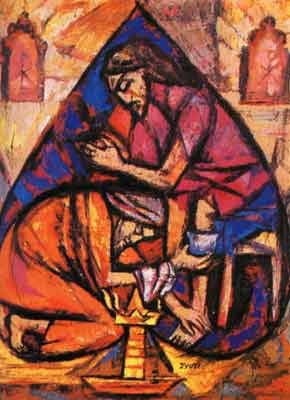
Jesus Washing the Feet of His Disciple by Japanese artist Sadao Watanabe (1913-1996)

We all need to receive love and to give love. Without love, there is little to live for. Apart from love, relationships devolve into silent standoffs and destructive triangles. Indeed, with an absence of love the world ceases to spin on its axis.

Yet, where love is present all things are beautiful. Personal relations have meaning and joy. All seems right and just in the world.

Love, however, comes at a cost. Because we live in a broken world full of pride and hubris, greed, and avarice, hate and envy, we are victims of loveless systems and unjust actions. We need love to rescue us, to redeem us from the sheer muck of existence. It’s as if we are constantly walking knee deep through sludge so thick, we can barely get anywhere. We need saving. We need Jesus.

Christians everywhere around the world are journeying through Holy Week, the most sacred time of the year for followers of Christ. When we think about Holy Week, we are familiar with Good Friday and certainly Easter, but Maundy Thursday? 

On this day, the Church remembers the final evening Jesus shared with his disciples in the upper room before his arrest and crucifixion. The experiences in the upper room were highly significant because this was the last teaching, modeling, and instruction Jesus gave before facing the cross. Jesus was careful and deliberate to communicate exactly what was important to him: to love one another.

Maundy Thursday marks three important events in Christ’s Last Supper with his disciples: 

  • The washing of the disciples’ feet (the action of loving service)
  • The instituting of the Lord’s Supper (the remembrance of loving sacrifice)
  • The giving of a “new” commandment to love one another (the mandate of a loving lifestyle). 

For Jesus, his last night with the disciples was all about love, God’s love. On that fateful night, having loved his disciples for the past three years, Jesus showed them the full extent of his love by taking the posture of a servant and washing each one of the disciples’ feet, including Judas. After demonstrating for them humble service, Jesus said,

“I have set you an example that you should do as I have done for you” (John 13:15, NIV). 

This was an incredible act of love. Jesus Christ loves me just as I am, and not as I should be. He loves me even with my dirty stinky feet, my herky-jerky commitment to him, and my pre-meditated sin. 

The Last Supper by Indian artist Francis Newton Souza (1924-2002)

Not only did Jesus wash the disciples’ feet, but he lifted the cup of wine and boldly asserted: 

“Take this and divide it among you.  For I tell you I will not drink again of the fruit of the vine until the kingdom of God comes.”  And he took the bread, gave thanks, and broke it, and gave it to them, saying, “This is my body given for you, do this in remembrance of me.”  In the same way, after the supper he took the cup saying, “This cup is the new covenant in my blood, which is poured out for you” (Luke 22:17-20, NIV). 

Because of these words, the church throughout the world, for two millennia, have practiced this communion so that we might have the redemptive events of Jesus pressed firmly into our minds and our hearts by means of the visceral and common elements of bread and wine. We are to not just know about Jesus; we are to experience being united with him.

Having washed the disciples’ feet, and proclaiming to them the meaning of his impending death, Jesus gave them a clear commandment: 

“A new command I give you: Love one another. As I have loved you, so you must love one another.  By this everyone will know that you are my disciples, if you love one another.” (John 13:34-35, NIV)

Love one another, insisted Jesus, by imitating his humble service. We represent Christ on this earth when we carefully, diligently, and persistently practice love. Although love was not a new concept for the disciples, in the form and teaching of Jesus love was shown with four distinctions: 

  1. Jesus is the new model of love.
  2. A new motive of love, that Christ first loved me.
  3. A new motivator to help us love, the Holy Spirit.
  4. A new mission, the evangelization of the world, utilizing the power of Christ’s love to accomplish it.

Maundy Thursday is a highly significant day on the Church Calendar – one which deserves to be observed, and an opportunity to remember the important words and actions of Jesus on our behalf.  Through Jesus Christ we are to live always in love, modeling our life and church ministry after him. 

In Christ, love is to characterize our life together as we proclaim God’s love in both word and deed. A watching world will only take notice and desire to be a part of our fellowship if we are deeply and profoundly centered in the love of God in Christ. This is the reality Maundy Thursday brings to us.

Acts 2:14-24 – From Flaky to Faithful

Preaching of the Apostles (crayon on paper) by Peter Gorban, 1990

Peter stood up with the Eleven, raised his voice and addressed the crowd: “Fellow Jews and all of you who live in Jerusalem, let me explain this to you; listen carefully to what I say. These people are not drunk, as you suppose. It’s only nine in the morning! No, this is what was spoken by the prophet Joel:

“‘In the last days, God says,
    I will pour out my Spirit on all people.
Your sons and daughters will prophesy,
    your young men will see visions,
    your old men will dream dreams.
Even on my servants, both men and women,
    I will pour out my Spirit in those days,
    and they will prophesy.
I will show wonders in the heavens above
    and signs on the earth below,
    blood and fire and billows of smoke.
The sun will be turned to darkness
    and the moon to blood
    before the coming of the great and glorious day of the Lord.
And everyone who calls
    on the name of the Lord will be saved.’

“Fellow Israelites listen to this: Jesus of Nazareth was a man accredited by God to you by miracles, wonders and signs, which God did among you through him, as you yourselves know. This man was handed over to you by God’s deliberate plan and foreknowledge; and you, with the help of wicked men, put him to death by nailing him to the cross. But God raised him from the dead, freeing him from the agony of death, because it was impossible for death to keep its hold on him. (NIV)

In the New Testament Gospels of the Holy Bible, the Apostle Peter was a flake. He sometimes got it, and sometimes didn’t. Peter could discern Jesus was Messiah, but then would turn around and refuse that Christ had to die on a cross. He would get bold and walk on water, then, end up falling short and needing help from drowning. Peter stood tall for Jesus, and then denied him three times.

However, following the Gospels in the Acts of the Apostles, Peter is a completely changed man. He now gets it. He is brave. He confesses Christ with confidence and boldness. And, while the reader might be waiting for the other shoe to drop yet again, all the while Peter does not falter, flinch, or back down. Alright, Peter, way to go!

So, what is the difference between the Gospels and Acts with Peter? Why is there such a turnaround from flaky to faithful? The Scriptures make it plain: The Holy Spirit comes upon Peter. And he is never the same again. Everything falls into place for Peter. He proclaimed the life and death of Jesus in such a way that thousands changed their way of thinking, as well as their way of life, and placed their faith and hope in Christ as Savior and Lord. Not a bad day’s work for a former fisherman.

Peter’s message was pointed and straightforward: God raised Jesus up, forever changing the nature of death. Peter was dogmatic about stating that it wasn’t even possible for death to get a grip on Jesus. Oh, death thought it had him, the Grim Reaper believed he had Christ nailed to death for certain. Not so. The grave could not contain the immense and incredible power of divine love for humanity.

Inherit the Mirth

If it was impossible for death to keep its grip on Jesus, then there is absolutely nothing that can deter Jesus or hold him back from accomplishing what he wants to accomplish. Flaky believers are not going to frustrate Jesus or upset his plans; he’ll just send the Holy Spirit. 

We too often imprison ourselves in self-made spiritual jail cells, flaking-out in the Christian life, sometimes getting it right and once-in-a-while hitting upon some right combination we can’t explain, like a golfer who hits an amazing shot but can’t reproduce it no matter how hard he tries. The truth is: Jesus has conquered sin, death, and hell. By faith, we have forgiveness of sins in Christ and have the way opened to a new life in the Spirit. It isn’t a secret; it is a new reality.

The season of Lent is a time of remembering those things which hinder us in our walk with Jesus and repenting of our sins so that we can live anew. As we quickly approach Holy Week, the golf clubs of vulnerability, confession and prayer will keep us in God’s fairway and allow us to shoot par.

Gracious God, who raised Jesus from the dead, may the same power reside in me so that I can do your will in every situation through the power and presence of your Holy Spirit.  Amen.

Life by Death

Photo by Pixabay on Pexels.com

A lot of people don’t like change. That is likely an understatement. Change means adjusting to a different reality and adjusting is not something we prefer doing. Many folks would much rather keep things the way they are. Routine, consistency, predictable outcomes—these are things we rely on for a sense of safety and stability in our lives.

Even good change is difficult, if for no other reason than what it takes to get there. Becoming debt-free, getting in shape, or starting a new job are all good changes to make, but to making them can take a lot of determination and effort on our part. In many cases, to change something about ourselves, we must be willing to admit what we are doing is not working and try something different.

God’s love in Jesus Christ changes everything. The kind of change Jesus talked about and died for was not making a few alterations to our lives or re-arranging some of our schedule. For Jesus, change is neither about exerting more effort nor adding things to an already full to-do list.

The change Jesus embraces is a complete transformation from the inside-out. For that to happen, to have a new life, the old life must die. What’s more, Jesus does not want us half dead because then we are only spiritual zombies, not really living the life God intended for us. No, if there is to be a resurrection and new life, there must be a death (John 12:20-33). There are three ways people need to die to live the life that God desires….

1.We need to die to our plans.

Jesus had a crowd of people following him wherever he went. He was interesting and compelling, even magnetic. Christ taught like no other person before him and healed all kinds of people. In the first century, Jesus became the latest fad.  With his fame, there were people who looked to Jesus to further their own agenda and their plans about how things should go.

Earlier in chapter twelve of John’s Gospel, the Apostle recorded a contrast between two people: Mary and Judas. Mary is a picture of dying to her own plans of how things should go. Mary took some expensive perfume, the kind that could have set her up for some needed financial security and poured it all on Jesus’ feet. Then, she humbly wiped it on him with her hair. It is a picture of giving herself completely and wholly to Jesus, no matter the cost, with no strings attached and no other agenda other than total devotion.

Judas, on the other hand, piously objected to Mary’s act of worship. We might hear him rationally pushback on what Mary was doing, saying to his fellow disciple, “My friends, this is a lot of money – money that could be used for the poor instead of needlessly wasting it. A little perfume is fine, but to use the whole bottle is over the top – it isn’t fiscally responsible!” Judas had a secret agenda. He was not thinking of giving himself completely to Jesus, but of how he could use the cash for himself and his own purposes. 

Judas is the picture of a spiritual zombie – half dead, walking around saying all kinds of spiritual things, but only devoted to Jesus and God’s kingdom when it agreed with him. Judas had his own ideas of how the kingdom operation ought to go. When he became convinced Jesus was not going to operate according to his agenda and plans, Judas betrayed him.

I have been crucified with Christ and I no longer live, but Christ lives in me. The life I now live in the body, I live by faith in the Son of God, who loved me and gave himself for me.

galatians 2:20, niv

In John 12:20-22, we have some Greeks (Gentiles) who want to see Jesus. They are interested in him. Unlike Judas and Mary, we are not told why they wanted to meet with him. But the fact that Jesus does not jump on the chance to interact with them probably says something about their motives. 

It is the nature of many people to want to observe whatever big thing is going on. They want to be in the know and talk about the latest happenings. Whenever we see “the crowd” in the Gospels, it is typically a negative connotation, a statement of by-standers, just looking on. 

Much of Christ’s ministry was to teach, heal, cajole, and do whatever he could to press the crowd, the by-standers, into not just following him as a novelty. Jesus wanted them to really follow him by dying to themselves and adopting a new life in the kingdom of God.

When I was a senior in high school the Pope came to Iowa, of all places! Never had that happened. 350,000 people came to see him. It was on a Friday, and we got two days off from school, mainly because trying to get around those two days was nearly impossible. Literally, everything shut down for the event. There were so many people that John Paul II got dropped in on one of Jimmy Carter’s presidential helicopters. 

I lived exactly thirteen miles from where the Pope spoke and had mass with the Catholic faithful. Protestants and Jews flocked to see him, as well. No car was allowed within a five-mile radius of the Pope. People had to park miles away and get shuttled-in. I knew several people from my small town that walked the thirteen miles one way just to see John Paul II. It was exciting and incredible, and is still talked about today in Iowa, forty years later.

Not everyone there that day in Iowa was a faithful Christ follower. Most people do not remember much about what John Paul II said, other than affirming the work of farmers as a needed vocation. Jesus was not at all interested in being a king in the conventional sense. He did not seek popularity or work to consolidate power through sheer force of will or personality. Instead, he died. And he calls us to die, as well – to die to our plans and to our perceived need to be in the know and hob-nob with a celebrity.

2. We must die to self.

This was the message of Jesus. There is no wiggle room to it. There are no walking dead zombies. Jesus responded to the request of the Greeks to see him by not even dealing with it but going on about what people really need to do: die to self.

To make his message clear and understandable, Jesus used the illustration of a seed that must die before it bears fruit.  Seeds wait to germinate until three needs are met: proper amounts of water, warm temperature, and good soil. During its early stages of growth, the seedling relies upon the food supplies stored within the seed until it is large enough for its own leaves to begin making food through photosynthesis. The seedling’s roots push down into the soil to anchor the new plant and to absorb water and minerals from the soil. And its stem with new leaves pushes up toward the light.

This is exactly the kind of process Jesus said needs to happen with people in the kingdom of God. People must never settle for remaining as seeds because that is not what we are designed for. Jesus wants us to be transformed, to experience new life, and to bear righteous fruit. To follow Jesus means to die being a seed and growing into a fruit bearing plant with more seeds to have the whole process occur again.

Jesus said that the person who “hates” their life will gain eternal life. That is, the person who is willing to give up everything to follow Jesus will find true life in Christ. The one who serves Jesus will follow him. Hate is simply a biblical term that means we make the choice to avoid one path in favor of another.

When living in West Michigan, my family enjoyed summers on the beaches of Lake Michigan. My girls loved being there on hot summer days. The beaches are actual sand, not with any gravel or dirt. I would tell my girls to follow me and walk in my footprints. I told them that not only because it would be easier for them to walk, but so they would not stray from me.

Lent is a season designed for us to remember Jesus, to remember we belong to God, and to repent of anything that keeps us away from the Lord.  This brings us to the third way we need to die….

3. We are to die to the world.

Now is the time for judgment on the world. The prince of this world is driven out. The death of Jesus means we can now die to the world. “World” is not the people of this world, in the sense of John 3:16 that God loves the world. This is “world” as the unjust systems that operate within it. Christ achieved victory over this world. He died so that we no longer need to be locked into the oppressive ways of bondage and evil.

Do not love this world nor the things it offers you, for when you love the world, you do not have the love of the Father in you. For the world offers only a craving for physical pleasure, a craving for everything we see, and pride in our achievements and possessions. These are not from the Father, but are from this world. And this world is fading away, along with everything that people crave. But anyone who does what pleases God will live forever.

1 John 2:15-17, NLT

Jesus lived in a vastly different manner than people expected. He was quite counter-cultural. Christ rarely submitted to the usual way of doing things. Jesus did not operate like a worldly king. He did not teach like a worldly instructor. He died not only to redeem individuals but also to redeem entire systems and transform them into instruments of godliness. 

God cares about systemic evil, about ways of operating which keep people in bondage. Jesus cares about politics, economics, and social structures. He cares about governments and municipalities. The Lord cares about school systems and family systems and, yes, even church systems. Jesus died so that we can die to the world’s broken systems. God desires all our institutional ways of operation come under the lordship of Jesus Christ.

It will not do to only focus on private spirituality because Jesus wants to redeem the entire planet, systems included. Jesus is the Judge, and he is currently about the business by means of the Holy Spirit of making all things new. Eventually, the new creation will completely take over when Jesus returns. Now, in the present time, we have this crazy mixture of good and evil everywhere we go. Christians are to follow Jesus personally and privately, as well as corporately and publicly.

For example, the “factory system” is an actual phrase. The factory system is designed to mass produce products with the greatest efficiency possible. And it works. However, in the process, people become extensions of the machines they operate. With efficiency and production as the highest priorities, people can be replaced like cogs in the machine. 

Walk into many American factories and you will see sagging morale and deep animosities between workers and management because the system itself is inherently flawed. Simply implementing some safety protocols and giving a few raises are merely zombie tactics. The system still needs redemption.

When we take seriously the call to follow Christ, we see that the world and its systems are fundamentally broken and in need of redemption. Jesus has deposed the ruler of this world, Satan, through crucifixion and resurrection. We need to die to this world and to systemic evil.

Conclusion

We all become frustrated and discouraged at times, either with ourselves and/or with the world’s evil that exists around us, making our lives hard and even unbearable. Jesus knows how you feel. His soul was troubled with all the sin of the world. And he faced agony beyond anything we will ever know by allowing himself to die. The kind of death Jesus died was awful. It was that way because that is how horrible sin and sinful systems are.

Today Jesus is calling us to die – die to our plans of how we think things should go; die to ourselves by following in his footsteps; and die to participating in the sinful structures and systems of this evil world. We are to live differently. We are to live new lives – which means not simply tweaking some things but completely re-orienting our lives to serve the Lord.

Jesus is drawing us to himself. He is making himself known. Let us not treat Jesus as a novelty, but as the rightful Ruler of the universe by dying to our plans, ourselves, and the world.