1 Timothy 4:6-16 – Build Your Faith Muscle

If you point these things out to the brothers and sisters, you will be a good minister of Christ Jesus, nourished on the truths of the faith and of the good teaching that you have followed. Have nothing to do with godless myths and old wives’ tales; rather, train yourself to be godly. For physical training is of some value, but godliness has value for all things, holding promise for both the present life and the life to come. This is a trustworthy saying that deserves full acceptance. That is why we labor and strive, because we have put our hope in the living God, who is the Savior of all people, and especially of those who believe.

Command and teach these things. Don’t let anyone look down on you because you are young, but set an example for the believers in speech, in conduct, in love, in faith and in purity. Until I come, devote yourself to the public reading of Scripture, to preaching and to teaching. Do not neglect your gift, which was given you through prophecy when the body of elders laid their hands on you.

Be diligent in these matters; give yourself wholly to them, so that everyone may see your progress. Watch your life and doctrine closely. Persevere in them, because if you do, you will save both yourself and your hearers. (New International Version)

There are several metaphors throughout the New Testament illustrating the nature of the Christian life and Christian community.

God’s people are the temple of the Holy Spirit, the house where the Lord dwells; the Body of Christ, a group working together and strengthening one another in faith; the army of the Lord, advancing with the shared purpose of proclaiming good news and extending God’s benevolent rule – just to name a few.

All the metaphors are embedded with the need for training, for spiritual disciplines and practices which strengthen faith and promote spiritual health.

Just as an army of recruits needs intense basic training and ongoing discipline; and just as the body needs hourly movement and daily exercise of its muscles; so, Christian communities require spiritual development with a variety of forms and functions to elicit and establish a solid godly life.

The curriculum in the school of faith, the liturgy within the spiritual temple, the boot camp for the Lord’s soldier, and the sets and repetitions for Christ’s Body are reading and listening to Scripture with a life rhythm of personal and corporate integrity, confident faith, steadfast love, encouraging words, and virtuous behavior.

If we dedicate ourselves to these things, there will be no room for entertaining wacky stories which have no basis in truth. Instead, there will be lush spiritual growth, teachable spirits, humble service, supportive beliefs, compassionate ministry, and open fellowship.

The high values of our faith need to be both used and guarded. Our treasured possessions, whatever they may be, are handled appropriately and carefully – being kept in a secure place when not used – and being used with care when out.

Our faith, our life and doctrine, is both a precious possession, as well as a necessary muscle to do the will of God. Like our own physical muscles, faith needs to be stretched, exercised, rested, and supplied with plenty of protein and necessary nutrients. Overtaxed muscles will fatigue and can be damaged through too much exertion. And underused muscles will wither and atrophy, unable to handle even the smallest of strain when we need them.

So, it is best to have proper spiritual hygiene and exercise through a regimen of tried and true practices designed to improve and maintain healthy faith. If you want to build your faith, consider the following 10 ways:

  1. Increase your amount of reading. There is no substitute for daily repetitions of reading the Bible. Supporting a growing faith will require more voluminous reading.
  2. Focus on listening to the biblical text. Reading is only as good as our listening skills. For the Christian, paying attention to the Holy Spirit’s gentle whispers is a must.
  3. Decrease your media time. For all the good stuff out there, a lot of media information is based in myth, half-truths, and opinions masked as facts – not to mention all the hack and huckster preachers.
  4. Pray more. In fact, pray continually.
  5. Practice gratitude – not complaining. Need I say more?
  6. Snack on good spiritual reading. Consuming a good book before bed keeps the faith muscle fed longer.
  7. Rest! When God created and instituted seven days, the first day was a day of rest; the workdays came after. Don’t flip-flop the divine order.
  8. Supplement with good spiritual conversation. Half-baked theological ideas come from remaining in one’s own cave-like head. Consultation, collaboration, and fellowship help create a rich and full faith.
  9. Don’t overtrain. Good idea: Read the Bible in a year. Bad idea: Read the Bible in a month. Good idea: Digest the contents of ecumenical Creeds and church Confessions. Bad idea: Stuff a bunch of knowledge down your gullet without any love to wash it down. Savor the meal. Don’t be a pig.
  10. Don’t lift too heavy for your faith muscle. The ancient desert fathers spent years developing their faith and could do incredible feats of spiritual strength. Christianity isn’t a competition of keeping up with the Francis of Assisi’s and Martin Luther’s of history. Use the measure of faith given to you and focus on those small daily decisions of trust.

Christianity is a marathon, not a 100-meter sprint. We persevere to the end, not flame out after taxing ourselves with expectations and responsibilities God never gave us.

Be safe. Be strong. Be smart. Be spiritual. We are all in this together.

Gracious God, fill your Church with truth, the truth with peace, and the peace with love. Where our faith is weak, make it strong; where it is misguided and in error, correct and direct it; where it is amiss, reform it; where it is in want, provide for it; where it is divided, reunite it, for the sake of Jesus Christ your Son our Savior. Amen.

John 15:16-25 – On Facing Hatred

 The Face of the Savior by Noehani Harsono

You did not choose me, but I chose you and appointed you so that you might go and bear fruit—fruit that will last—and so that whatever you ask in my name the Father will give you. This is my command: Love each other.

“If the world hates you, keep in mind that it hated me first. If you belonged to the world, it would love you as its own. As it is, you do not belong to the world, but I have chosen you out of the world. That is why the world hates you. Remember what I told you: ‘A servant is not greater than his master.’ If they persecuted me, they will persecute you also. If they obeyed my teaching, they will obey yours also. They will treat you this way because of my name, for they do not know the one who sent me. If I had not come and spoken to them, they would not be guilty of sin; but now they have no excuse for their sin. Whoever hates me hates my Father as well. If I had not done among them the works no one else did, they would not be guilty of sin. As it is, they have seen, and yet they have hated both me and my Father. But this is to fulfill what is written in their Law: ‘They hated me without reason.’” (New International Version)

In his earthly ministry, Jesus suffered on this earth. He was hated, persecuted, and killed. Although Christians readily recognize this, somehow we still seem surprised when, following Jesus, there are people who downright dislike us. 

Yet, Jesus clearly and unequivocally stated that we ought to expect persecution. Emotional, psychological, verbal, and even physical abuse can and does occur against God’s people who seek to follow the words and ways of Jesus. 

There was a time in the first few centuries of the church that becoming a martyr for one’s faith was welcomed. It was considered a privilege to imitate Christ in his suffering and death.  Even many modern day Christian martyrs around the globe have estimated martyrdom as an opportunity to experience solidarity with their Savior.

God has generously granted you the privilege, not only of believing in Christ but also of suffering for Christ’s sake. (Philippians 1:29, CEB)

This kind of thinking may sound quite strange to Westerners who tend toward the notion that, if we do everything with excellence and effectiveness, then there will be no reason for persecution and suffering. 

However, the Christian reality is that Jesus promised his devout followers that there will indeed be those who seethe with hatred toward us. We are not above our Master. If he suffered, we will, as well.

So, the question is not whether we can or ought to avoid suffering. Rather, our consideration needs to be how we will respond to the inevitable persecution of verbal violence, physical violence, or both – not to mention the various forms of discrimination, abuse, and oppression we might face.

“They gave our Master a crown of thorns. Why do we hope for a crown of roses?”

Martin Luther

First off, there is no honor for any Christian suffering because of one’s own stupidity or obnoxiousness. If we face persecution because we have initially made others suffer through our bullhorn presentations of the gospel, or metaphorically clubbing groups of people with oversized King James Version Bibles, then whatever consequences come are of our own making and have nothing to do with being united with Christ.

And second, paying no attention to the real human needs of people locked in poverty or dismissing the body as secondary to the soul is a gross misrepresentation of Christ – not to mention the sheer ignoring of multiple books in Holy Scripture which point to caring about such things.

If, however, we endure abuse because of being humble, merciful, gentle, pure in heart, and an unflinching peacemaker amid conflict, then we can enjoy the smile of heaven. If we communicate good news with grace and compassion, seeking love-laced words of truth, along with genuine acts of mercy – and then are repaid with unmerciful oppression from prideful persons – then we understand the type of hate Jesus faced.

We gladly suffer, because we know that suffering helps us to endure. And endurance builds character, which gives us a hope. (Romans 5:3-4, CEV)

The genuine article withstands the test of adversity. It doesn’t fall apart in the vigorous agitation of the first washing. People who oppose Christians with persecuting words and actions need to discover an authentic believer who is ready and willing to absorb the hatred, repackage it as love, and along with the gospel of grace, gift it back to the persecutors as an offering to God.

Experiencing the hatred of others is not the worst thing which could ever happen. Knowing Jesus better is of utmost value – even if, at times, comes through the worst of circumstances.

God, who shows you his kindness and who has called you through Christ Jesus to his eternal glory, will restore you, strengthen you, make you strong, and support you as you suffer for a little while. (1 Peter 5:10, GW)

Almighty God, thank you for sending your Son, the Lord Jesus, on my behalf.  Just as he suffered for me, I willingly suffer for him, since his infinite grace has delivered me from sin, death, and hell.  I only ask to be found faithful at the end of the age when he returns to judge the living and the dead.  Amen.

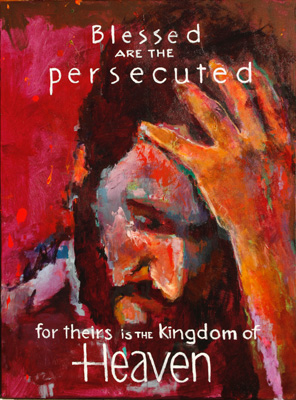
Matthew 5:10-12 – Blessed are Those Who are Persecuted Because of Righteousness

Painting by Hyatt Moore

“You’re blessed when your commitment to God provokes persecution. The persecution drives you even deeper into God’s kingdom.

“Not only that—count yourselves blessed every time people put you down or throw you out or speak lies about you to discredit me. What it means is that the truth is too close for comfort, and they are uncomfortable. You can be glad when that happens—give a cheer, even! —for though they don’t like it, I do! And all heaven applauds. And know that you are in good company. My prophets and witnesses have always gotten into this kind of trouble. (The Message)

No matter our vocation or avocation, what we do, or don’t do, what we say, or don’t say, we will not avoid insult and persecution. Just ask Jesus.

The issue is not if we will suffer but why we suffer. The Apostle Peter devoted his first epistle to helping Christians deal with their suffering. He made his point clear about suffering: 

If you suffer, it should not be as a murderer or thief or any other kind of criminal, or even as a meddler. However, if you suffer as a Christian, do not be ashamed, but praise God that you bear that name. (1 Peter 4:15-16, NIV)

That’s Peter’s way of saying, “Blessed are those who are persecuted because of righteousness.”  We will endure abuse, in some form, from others. So, let’s make sure it’s for being characterized by Christ’s Beatitudes, and not for being obnoxious.

Christ’s followers take up their cross and share with him in the world’s hatred directed toward us. This kind of living is blessed and receives the approval of God.

What is persecution?

Persecution is not only physical abuse. It is also verbal abuse, ridicule, slander, discrimination, and generally making one’s life harder just because of a commitment to Christ. Persecution is not necessarily a sign of doing something wrong. It could be that something right is being done. 

Thomas à Kempis (1380-1471) wrote what has become one of the best-selling Christian books of all-time, The Imitation of Christ. Thomas had the right perspective on the subject of persecution:

“Sometimes it is to our advantage to endure misfortunes and adversities, for they make us enter into our inner selves and acknowledge that we are in a place of exile and that we ought not to rely on anything in this world.  And sometimes it is good for us to suffer contradictions and know that there are those who think ill and badly of us, even though we do our best and act with every good intention.  Such occasions are aids in keeping us humble and shield us from pride. When men ridicule and belittle us, we should turn to God, who sees our innermost thoughts, and seek His judgment.

Therefore, we should so firmly establish ourselves in God that we have no need to seek much human encouragement. It is when a person of good will is distressed, or tempted, or afflicted with evil thoughts, that they best understand the overwhelming need for God, without whom we can do nothing. While enduring these afflictions they take themself to prayer with sighs and groans; they grow tired of this life and wish to be undone in order to live with Christ. It is in such times of trial they realize that perfect security and full peace are not to be found in this world.”

Insult, negativity, and verbal abuse can trip us up and discourage us. It doesn’t feel good to be disliked. Trouble and conflict is something most of us would like to avoid, as much as possible.

We might be able to steel ourselves for a large persecution against denying Christ and would be willing to die a martyr’s death to hold on to our faith. Yet, conversely, we may:

  • Crumble in a heap if we think someone is mad or displeased with us.
  • Worry that our lives will get complicated and difficult if we uphold the righteousness and justice of God.
  • Be afraid of others who might think bad of us if we showed mercy by standing with the unpopular person or if we actively and overtly engage in peacemaking.
George Reeves in The Adventures of Superman (1952-1958)

It is the “small” abuses which can cause us so much grief. We are determined to stand tall when the bullets of blatant, oppressive, and systemic persecution comes. Then, when the gun is thrown at us, we may flinch, duck, and fret over one person being upset.

Back when I was a kid, I watched old reruns of the original Superman television series. In more than one episode, Superman stood tall and faced the person peppering him with bullets. Then, when the bullets ran out, the villain threw his gun at Superman, who then promptly flinched and ducked the gun!

It is not our job to ensure that everyone is happy – it is our business to do God’s will and to embody Christ’s Beatitudes. Our calling as believers in Jesus is not to worry about what people (including family) are going to think if we live a humble, righteous life of mourning over the world’s sins, exhibiting a meek and gentle spirit, standing for grace when others want blood, refusing to defile our hearts with impure thoughts and actions, and standing up to do something about the injustice around us.

How and why do respond to persecution?

            The proper response to persecution is joy! There are two reasons why we can face persecution and come away glad instead cringing and discouraged:

  1. Because being characterized by the Beatitudes of Jesus brings heavenly reward. Show me a person who puts all their eggs in the earthly basket, and I’ll show you a person who is never satisfied and constantly unhappy. Show me a person who lives to please God and pursues the blessing of Christ, accepting any flak from others, and I’ll show you a person who is inwardly rejoicing that they are a Christian, loved by God, and counting it a privilege to suffer for the Name of Jesus. (Acts 5:27-29, 40-42)
  2. Because we are in good company. God’s people throughout history have endured the same kinds of sufferings and received a Christian purple heart award. We are not just to face persecution with a stoic, grind-it-out mentality, but with rejoicing! (Hebrews 11:36-40)

Who does the persecuting?

            The ones who persecuted the prophets were religious folks. I wish I could say the worst persecution I ever received was from evil people who live ungodly lives. However, the most insult, hardship, and slander I have ever endured has come from the lips and the efforts of people who claim the name of Christ. The reason abuse happens is because there are people not characterized by the Beatitudes of Jesus, so they become the persecutors, instead of the persecuted. 

            All the sufferings and hardships of Jesus, all the persecution he faced did not come from the world, but from his own people, including a person from his inner circle of disciples. Although the church, throughout its history, has done immense good, it also has had a chronic problem of shooting its wounded.

Far too many people have adopted a legalistic form of righteousness that focuses on outward conformity and myriad rules and regulations. Abundant grace is needed. Not judgment.

Conclusion

If we are persecuted, let’s make sure it is because we are advocating for others who need mercy and are facing injustice; addressing the brokenness of this world through specifically Christian lenses; and desiring the applause of heaven.

See if you can hear the Beatitudes in what the Apostle Peter, had to say about persecution:

For it is commendable if someone bears up under the pain of unjust suffering because they are conscious of God. But how is it to your credit if you receive a beating for doing wrong and endure it? But if you suffer for doing good and you endure it, this is commendable before God. To this you were called, because Christ suffered for you, leaving you an example, that you should follow in his steps. (1 Peter 2:19-21, NIV)

Be like-minded and sympathetic. Love one another. Be compassionate and humble. Do not repay evil with evil or insult with insult. On the contrary, repay evil with blessing, because to this you were called so that you may inherit a blessing. For,

“Whoever would love life
    and see good days
must keep their tongue from evil
    and their lips from deceitful speech.
They must turn from evil and do good;
    they must seek peace and pursue it.

 For the eyes of the Lord are on the righteous
    and his ears are attentive to their prayer,
but the face of the Lord is against those who do evil.” (1 Peter 3:8-12, NIV)

Dear friends, do not be surprised at the fiery ordeal that has come on you to test you, as though something strange were happening to you. But rejoice inasmuch as you participate in the sufferings of Christ, so that you may be overjoyed when his glory is revealed. If you are insulted because of the name of Christ, you are blessed, for the Spirit of glory and of God rests on you. (1 Peter 4:12-14, NIV)

May you know the blessing of solidarity with Christ through the afflictions of this present life.

Luke 11:5-13 – Pray

Then Jesus said to them, “Suppose you have a friend, and you go to him at midnight and say, ‘Friend, lend me three loaves of bread; a friend of mine on a journey has come to me, and I have no food to offer him.’ And suppose the one inside answers, ‘Don’t bother me. The door is already locked, and my children and I are in bed. I can’t get up and give you anything.’ I tell you, even though he will not get up and give you the bread because of friendship, yet because of your shameless audacity he will surely get up and give you as much as you need.

“So, I say to you: Ask and it will be given to you; seek and you will find; knock and the door will be opened to you. For everyone who asks receives; the one who seeks finds; and to the one who knocks, the door will be opened.

“Which of you fathers, if your son asks for a fish, will give him a snake instead? Or if he asks for an egg, will give him a scorpion? If you then, though you are evil, know how to give good gifts to your children, how much more will your Father in heaven give the Holy Spirit to those who ask him!” (New International Version)

Jesus, in his teaching ministry on earth, often used the lesser-to-greater argument in getting his point across. And that is precisely what he was doing with his disciples in today’s Gospel lesson, instructing them about the nature and motivation of prayer.

The lesser-to-greater argument implies a comparison of values. It’s grounded on a common sense and logical convention that if this lesser thing is true, then, of course, how much more is this greater thing! If something less likely to happen is true, then something more likely to happen will probably be true as well. The technical phrase for this is the a fortiori argument. It is a Latin term meaning, “for a still stronger reason.”

So, then, Jesus wanted his followers to understand that prayer has value because God is a loving Father, not a begrudging friend. Whereas the friend in the story was badgered just so the person could get some real necessities, God needs no badgering to generously give good gifts that may or may not be considered as necessities by us.

Jesus desired to highlight that prayer has veracity because of whom those prayers are directed.

”Our prayers may be awkward. Our attempts may be feeble. But since the power of prayer is in the one who hears it and not in the one who says it, our prayers do make a difference.” 

Max Lucado

In the ancient world, it was common understanding you needed to get the local gods attention if you wanted something. Which is why, for example, in the prophet Elijah’s showdown with the prophets of Baal, that Baal’s worshipers were yelling, gesticulating, and even cutting themselves for hours. They fully expected to put a lot of work into getting Baal’s attention, maybe even needing to convince him of intervening in their ancient version of a wild West shootout.

In contrast to four-hundred prophets of Baal, a single prophet of the Lord utters one simple prayer, then fire comes rushing down from heaven. Much like the person who badgered the friend for bread, the prophets pestered Baal for hours.

It all comes down to who really cares. The friend? Not enough to jump out of bed right away and meet a need. Baal? Not so much. God? Now we’re talking.

We typically don’t ask, seek, or knock, if we believe we will not get a response – or if it will take a lot of energy, time, and effort we don’t have. Yet, if we are confident of being heard and our requests taken seriously with care, then we are likely to have a habit of asking, seeking, and knocking.

If a friend begrudgingly gives to you because of persistent knocking, how much more will God graciously, generously, and with gaiety give you goodness when you ask? Because God is good, God gives. The largess of the Lord is willing and ready to dispense grace from an infinite storehouse of mercy.

This is why Jesus encouraged people to not pray like those who don’t know God, babbling on because they think they’ll be heard because of the sheer volume of words. (Matthew 6:7-8)

Two misconceptions of prayer which existed in Christ’s day, and even today, come from non-Christian sources:

  1. There must be a lot of prayer before prayer “works.” Although I believe repetition is important for forming good habits, praying the same prayers over and over again so as to be heard betrays an ignorance of God, not to mention an actual lack of faith. Many ancient religions were based in learning how to manipulate the spiritual forces out there to get what we need. It’s kind of like a divine version of hustling for love in all the wrong places. Christians need to know they don’t need to have thousands of people praying in order to get God’s attention to answer prayer.
  2. I must convince God of the need to answer my prayer. God is not a reluctant listener. The reason the Lord already knows what we need before we ask is because God has been paying close attention to us well before we got around to asking, seeking, and knocking on the divine door. God’s ear is already inclined to hear us – expectantly and anxiously awaiting our petitions. This is a tremendously freeing idea, that I can come to God openly and honestly, without drudgery, and without wondering if I am heard, or not.

May we be encouraged to pray, to truly connect with God, because the Lord is available without appointment, and is waiting for us to ask with bended ear.

Eternal God, by whose power we are created and by whose love we are redeemed: Guide and strengthen us by your Spirit so that we may give ourselves to your service and live today and every day in love to one another and to you, through Jesus Christ our Lord, in the strength of the Holy Spirit. Amen.