Luke 13:31-35 – Blessed Is He Who Comes In the Name of the Lord

“If Thou Had’st Known” by William Brassey (1846-1917) Royal Scottish Academy of Art & Architecture; http://www.artuk.org/artworks/if-thou-hadst-known-186809

At that time some Pharisees came to Jesus and said to him, “Leave this place and go somewhere else. Herod wants to kill you.”

He replied, “Go tell that fox, ‘I will keep on driving out demons and healing people today and tomorrow, and on the third day I will reach my goal.’ In any case, I must press on today and tomorrow and the next day—for surely no prophet can die outside Jerusalem!

“Jerusalem, Jerusalem, you who kill the prophets and stone those sent to you, how often I have longed to gather your children together, as a hen gathers her chicks under her wings, and you were not willing. Look, your house is left to you desolate. I tell you – you will not see me again until you say, ‘Blessed is he who comes in the name of the Lord.’” (New International Version)

King Herod of Judea, who was in the pocket of the Roman Empire, was issuing threats against Jesus. And those threats had some teeth behind them. Herod had recently beheaded Christ’s friend and cousin, John the Baptist (Luke 9:7-9). Yet, Jesus seemed unconcerned by the warnings. He made it clear that he was going to keep doing what he was doing, unfazed by Herod’s bluster.

Jesus had no intention of halting his travels, even because of a credible threat by the governing powers. Christ emphasized his words by assuring his listeners that the work he is doing will be done today, and the next, and the day after that—building ultimately to his greatest work of securing redemption through his crucifixion and resurrection. 

I hope to be always journeying towards Jerusalem with a heart full of compassion that will not waver in the midst of violent killing and injustice. That isn’t easy, yet I know that my humble pilgrimage with Jesus will be worth it all, in the end.

A pilgrimage is an apt description for the Christian season of Lent. Believers journey with Jesus, making the slow trek with him through his earthly ministry and to Jerusalem, up the Mount of Olives. There Christ is crucified – and we with him:

I have been crucified with Christ and I no longer live, but Christ lives in me. The life I now live in the body, I live by faith in the Son of God, who loved me and gave himself for me. (Galatians 2:20, NIV)

So far, we have made a stop in Bethlehem, following the star to the place where the newborn king was laid in a simple stinky feeding trough. The juxtaposition of that reality could not be more pronounced. The rightful Lord of all, far more powerful than old King Herod or the Roman Emperor, comes to earth not to be served, but to serve, and give his life as a ransom for many. (Mark 10:42-45)

In our walk with Jesus, we observe him deliberately posturing himself as a lowly servant throughout his earthly ministry. Whereas Herod acted the predictable part of a power hungry worldly ruler, squelching all rivals to the throne, Jesus shared his authority with others, along with a promise of continual presence. (Matthew 2:16-18, 28:16-20)

There is nothing romantic about this journey, this walk with Christ. It is often a hard road, and many count the cost of discipleship and choose to walk away.

Yet, Jesus is down for the struggle. He knows that injustice and systemic evil must be carefully rooted out. He understands that hearts and minds aren’t changed overnight. It will take time. So, we walk slowly with our Lord because Christ is in it for the long haul. We see Jesus is patiently, and sometimes imperceptibly, using divine power and authority to preserve the good and weed out the bad.

Dealing with human sin and the awful fallenness of this world will take a while. It will be an extended process because there are so many hard hearts. Jesus was ready, willing, and able to gather people together, as a mother hen gathers her chicks – yet there was an unwillingness to it.

And Christ, the heavenly ruler, isn’t in the business of twisting arms and manipulating others, like Herod, the earthly ruler.

Instead, Jesus invites. He doesn’t squeeze people like an orange to get their juice. Christ carefully prepares a meal. He sets the table himself. He gives of himself. Like some wildly potent superfood, a bit of wine and morsel of bread is more than enough to fill the hungry soul and the thirsty spirit.

With Jesus, there is always room at the Table.

There is room for you and for me. There is room for every kind of person – from every nation, race, gender, ethnicity, class – no matter the distinctions and no matter the past. It is the love of God in Christ, not the judgment, which brings people peace and salvation. It comes through a baby who grew and learn and suffered, just like us, and not through some wily old fox of a ruler.

Eventually, the phrase will be uttered, “Blessed is he who comes in the name of the Lord.” Jesus pulled this phrase from the Old Testament psalms. He did this, knowing quite well the context surrounding the verse:

The stone the builders rejected
    has become the cornerstone;
the Lord has done this,
    and it is marvelous in our eyes.
The Lord has done it this very day;
    let us rejoice today and be glad.

Lord, save us!
    Lord, grant us success!

Blessed is he who comes in the name of the Lord. (Psalm 118:22-26, NIV)

The chicks may scatter and refuse to be gathered. The builders might reject the crucial cornerstone and still try to build. Yet, it will not always be this way. As we journey with Jesus, eventually along the Via Dolorosa, the way of suffering, the road to Calvary, with an eye to where this will all culminate at an empty tomb and a great celebration of new life.

We will not be looking down at our feet forever in sorrow but will lift our faces toward the clouds. Just as we see Jesus ascending, we shall see Christ coming again. The time is near….

Look! He comes with the clouds of heaven.
    And everyone will see him—
    even those who pierced him.
And all the nations of the world
    will mourn for him.
Yes! Amen! (Revelation 1:7, NLT)

The triumphal entry of Jesus on Palm Sunday is followed by a triumphal entry into my heart, and the hearts of many. And there is coming yet another triumphal entry, back to this earth. All things will made new….

“There will be no more death, no more grief or crying or pain. The old things have disappeared.” Then the one who sits on the throne said, “And now I make all things new!” (Revelation 21:4-5, GNT)

May it be so, to the glory of God.

Almighty God, you know that we have no power in ourselves to help ourselves: Keep us both outwardly in our bodies and inwardly in our souls so that we may be defended from all adversities that may happen to the body, and from all evil thoughts that may assault and hurt the soul, through Jesus Christ our Lord, who lives and reigns with you and the Holy Spirit, one God, for ever and ever. Amen.

1 John 2:1-6 – Live as Jesus Did

Photo by RODNAE Productions on Pexels.com

My dear children, I write this to you so that you will not sin. But if anybody does sin, we have an advocate with the Father—Jesus Christ, the Righteous One. He is the atoning sacrifice for our sins, and not only for ours but also for the sins of the whole world.

We know that we have come to know him if we keep his commands. Whoever says, “I know him,” but does not do what he commands is a liar, and the truth is not in that person. But if anyone obeys his word, love for God is truly made complete in them. This is how we know we are in him: Whoever claims to live in him must live as Jesus did. (New International Version)

Jesus is our advocate, the one who speaks on our behalf, our mediator, who stands in the gap between heaven and earth, standing-up for us when we have no leg to stand on. 

Christ has atoned for all our sin, guilt, and shame through his “propitiation” which means that his death satisfied all demands of justice and put to rest the sin issue once for all through his blood. Christ’s gracious intervention has saved us from ourselves. 

Jesus Christ has made it possible for us to experience forgiveness, restoration, and new life. Whenever we are so broken and so full of tears that we cannot even speak words at all, Jesus steps in and speaks on our behalf with words that mean something because they have been backed up with the action of the cross.

“But” as the late Ron Popeil used to say on the old commercials, “that’s not all!” Not only do we have deliverance from sin, death, and hell, Christ’s followers have both the means and the opportunity to give back and be a blessing to one another and the world. The Spirit enables us to obey God’s commands and is the continuing presence of Jesus to us and on this earth.

Christians are called to be little advocates, practicing the ministry of coming alongside and interceding for one another before God. We can agents of spiritual healing in a world of brokenness. Our gospel proclamation, a message of grace and forgiveness, gets to the very root of human problems and travails.

  • Anyone who harms and hurts others as a matter of habit in the name of Christ, and does not heal, is no follower of Jesus but is a victimizer.
  • Any person who talks a good talk, and walks a bad walk, is not living as Jesus did, and is a spiritual pettifogger.
  • Anybody who claims the name of Christ and avoids reading and studying and praying over the New Testament Gospels, is a slovenly lout, no matter whether they have prayed a “sinners prayer.”

Whoever claims to live for Christ must live as Jesus did. So, how did Jesus live?

“If any of you wants to be my follower, you must give up your own way, take up your cross, and follow me.”

Jesus (Matthew 16:24, NLT)

“You know that the rulers of the non-Jewish people love to show their power over the people. And their important leaders love to use all their authority. But it should not be that way among you. Whoever wants to become great among you must serve the rest of you like a servant. Whoever wants to become first among you must serve the rest of you like a slave. In the same way, the Son of Man did not come to be served. He came to serve others and to give his life as a ransom for many people.” (Matthew 20:25-28, NCV)

He came to tell about the light and to lead all people to have faith.

John 1:7, CEV

“You call me Teacher and Lord—and you are right, for that is what I am. So if I, your Lord and Teacher, have washed your feet, you also ought to wash one another’s feet. For I have set you an example, that you also should do as I have done to you.” (John 13:13-15, NRSV)

Your life must be controlled by love, just as Christ loved us and gave his life for us as a sweet-smelling offering and sacrifice that pleases God.

Ephesians 5:2, GNT

Adopt the attitude that was in Christ Jesus:

Though he was in the form of God,
        he did not consider being equal with God something to exploit.
But he emptied himself
        by taking the form of a slave
        and by becoming like human beings.
When he found himself in the form of a human,
        he humbled himself by becoming obedient to the point of death,
        even death on a cross. (Philippians 2:5-8, CEB)

Don’t be angry with each other but forgive each other. If you feel someone has wronged you, forgive them. Forgive others because the Lord forgave you.

Colossians 3:13, ERV

But if you suffer for doing good and you endure it, this is commendable before God. To this you were called, because Christ suffered for you, leaving you an example, that you should follow in his steps.

“He committed no sin,
    and no deceit was found in his mouth.”

When they hurled their insults at him, he did not retaliate; when he suffered, he made no threats. Instead, he entrusted himself to him who judges justly. (1 Peter 2:20-23, NIV)

This is how we know love: Jesus laid down his life for us, and we ought to lay down our lives for our brothers and sisters.

1 John 3:16, CEB

Christians inhabit unlovely places for the purpose of putting sacrificial love there. This is what it means to live as Jesus did.

O Lord, you have taught us that without love whatever we do is worth nothing. Send your Holy Spirit and pour into my heart your greatest gift, which is the love of God in Christ, the true source of healing and the real bond of peace. Amen.

Luke 9:28-43 – Transfiguration Sunday: Listen to Jesus

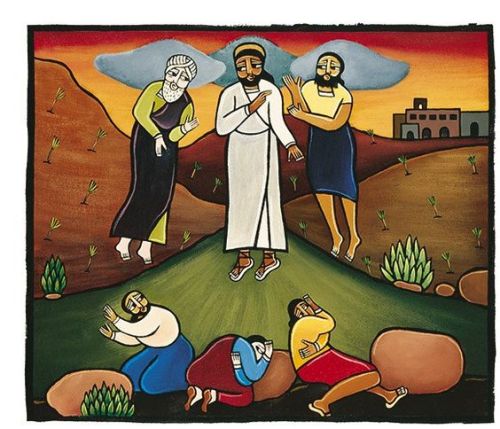
Transfiguration by Laura James

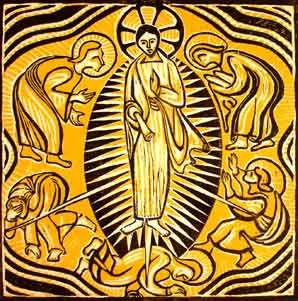
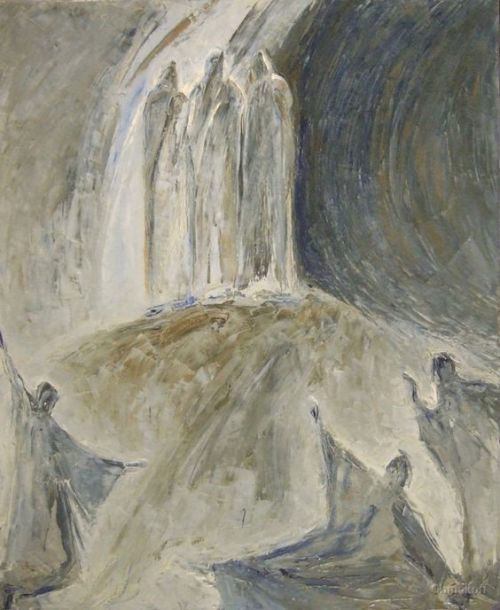
Jesus took Peter, John and James with him and went up onto a mountain to pray. As he was praying, the appearance of his face changed, and his clothes became as bright as a flash of lightning. Two men, Moses and Elijah, appeared in glorious splendor, talking with Jesus. They spoke about his departure, which he was about to bring to fulfillment at Jerusalem. Peter and his companions were very sleepy, but when they became fully awake, they saw his glory and the two men standing with him. As the men were leaving Jesus, Peter said to him, “Master, it is good for us to be here. Let us put up three shelters—one for you, one for Moses and one for Elijah.” (He did not know what he was saying.)

While he was speaking, a cloud appeared and covered them, and they were afraid as they entered the cloud. A voice came from the cloud, saying, “This is my Son, whom I have chosen; listen to him.” When the voice had spoken, they found that Jesus was alone. The disciples kept this to themselves and did not tell anyone at that time what they had seen.

The next day, when they came down from the mountain, a large crowd met him. A man in the crowd called out, “Teacher, I beg you to look at my son, for he is my only child. A spirit seizes him, and he suddenly screams; it throws him into convulsions so that he foams at the mouth. It scarcely ever leaves him and is destroying him. I begged your disciples to drive it out, but they could not.”

“You unbelieving and perverse generation,” Jesus replied, “how long shall I stay with you and put up with you? Bring your son here.”

Even while the boy was coming, the demon threw him to the ground in a convulsion. But Jesus rebuked the impure spirit, healed the boy and gave him back to his father. And they were all amazed at the greatness of God. (New International Version)

When Jesus is around, extraordinary things happen. And yet, sometimes we just don’t perceive it. The three disciples of Jesus – Peter, James, and John – experienced something incredible, yet they were not really aware of what it meant, at the time. The Transfiguration of Jesus on the mountain was unimaginable and awesome. The disciples, however, were confused, sleepy, and walked away silent about the whole affair. 

Woodcut of the Transfiguration by Sister Mary Grace Thul

Coming down from the mountain, the other disciples were found scratching their heads about a boy in need of healing. Jesus seemed rather perturbed about the all-around lack of faith. After curing the boy, everyone was amazed, as if they did not expect such a thing to occur.

We are not always told in the Gospels why Christ’s disciples often did not understand or perceive the significance of the miraculous, supernatural, or extraordinary events that took place right in front of them. Maybe their minds were somewhere else.

It could be that Peter had ADD (Attention Deficit Disorder) and was having trouble focusing.

Perhaps James trying to do some sort of ancient multi-tasking. 

Maybe John had some road rage on his way to the meeting on the mountain and was having a hard time thinking straight.

It could be that the three disciples were caught up in the anxiety of wondering where their next shekel was coming from.

Perhaps they were just up too late the night before binge watching the fishermen on the lake. But whatever was going on with the disciples, they were distracted.

So, we actually have God the Father step into the scene at the Transfiguration of Jesus on the mountain and speak. God isn’t typically in the business of exhorting people to listen unless they are not paying attention. The heavenly Father is clear, succinct, and to the point:

“This is my Son, whom I have chosen; listen to him.”

We are to listen to Jesus because he is God’s Son. Everything centers round him. 

Jesus is the full bodily and human representation of God on earth. Jesus is Savior, Lord and Master, Teacher and Healer.

Jesus is the complete fulfillment of all the Old Testament promises, and the one who will come again to judge the living and the dead.

Jesus is the mid-point of history, the hinge upon which all the universe swings. Jesus is the one whom we must listen to when he speaks and acts.

Therefore, our identity is to be fully bent, molded, and shaped in Jesus Christ. This spiritual formation of our lives happens as we intentionally seek to be with Jesus, listen to him, and do what he says. 

Transfiguration by Macha Chmakoff 

Jesus took Peter, James, and John up the mountain to experience his Transfiguration in a prayer meeting. Extraordinary things happen in prayer meetings. The early church gathered often in prayer meetings, following the example of their Lord Jesus. As the church listened to God and responded (in a rhythm of revelation and response) they saw Peter miraculously delivered from jail; ordinary people delivered from empty lives and demonic influence; and guidance in how to proceed as followers of Christ. 

Prayer is as much or more about listening to God as it is talking to him. It is in listening to God that we are filled with God’s Spirit and empowered to come down from the mountain and engage in God’s mission.

Jesus wanted the disciples to learn and discern something on the mountain. Jesus was changed in front of them. Moses and Elijah showed up and talked with him about his “departure,” that is, his “exodus.”

Moses was the one who listened to God and led the people in a mass exodus from slavery in Egypt to the freedom of the Promised Land.

Elijah was a prophet who listened to God and led the people out of centuries of idol worship and dead religion into the freedom of spiritual and national revival in Israel. 

And Jesus came to lead people in an exodus out of sin, death, and hell so that they can experience a new life of freedom, hope, peace, and joy.

Changed lives are God’s goal for us.  And a changed life will occur when we listen to God’s Son, Jesus, learn from him, and lean into faith in him – all of which takes humility.

Eventually, Jesus and his disciples came down from the mountain. Prayer meetings are great, but there is a time to descend the mountain and engage in God’s mission.

We are to participate with God in seeing changed lives through the work of Jesus.

We must bear witness to the redemptive saving events of Jesus to a world which desperately needs him – his healing work of both body and spirit.

The glory of God is presently here among us. We need to perceive it and be aware of it.  But to do so, we must listen well. 

Erik Weihenmayer is blind, yet on May 25, 2001, he reached the peak of Mount Everest. Suffering from a degenerative eye disease, he lost his sight when he was thirteen years old. But that did not stop him from mountain climbing. On a mountain where 90% of climbers never make it to the top—and 165 have died trying since 1953—Erik succeeded in large measure because he listened well. 

He listened to the little bell tied to the back of the climber in front of him, so he would know what direction to go. He listened to the voice of teammates who would shout back to him, “Death-fall two feet to your right!” so he would know what direction not to go. He listened to the sound of his pick jabbing the ice, so he would know whether the ice was safe to cross. 

When we journey through this life, listening well makes all the difference. So, how might we listen well to Jesus?  Here are some basic principles of active listening:

  1. Stop talking.  It was Mark Twain who said: “If we were supposed to talk more than we listen, we would have two tongues and one ear.” Proverbs 12:15 says, “The way of a fool seems right to him (therefore he has no need to listen) but a wise person listens to advice.”
  2. Prepare yourself to listen to God.  One of the ways I do this is by sitting in a quiet spot, free of distraction, and repeat several times to God, “Speak Lord, for your servant is listening” (1 Samuel 3:10). Then, I am quiet… and listen….  If this practice is way off your radar then I would recommend, at first, being quiet for only a few minutes. Then, after a few weeks, be quiet in longer stretches so that you can go 20-30 minutes or even an hour. We might even consider a silent retreat in which the sole purpose is to listen to what God is saying to us.
  3. Slowly and carefully read God’s Word. Scripture is meant to be digested in small bites and thoroughly savored. Slow down and be quiet enough to hear God speak through the Word. A contemplative and meditative readings of Holy Scripture will always yield spiritual health and vitality.
  4. Pray back to God what you hear him saying to you. This is active listening – a genuine dialogue between us and God. “Come, now, let us reason together,” the Lord has said (Isaiah 1:18). God wants a conversation with us.

God speaks, if we have ears to hear, through so much more than an audible voice.

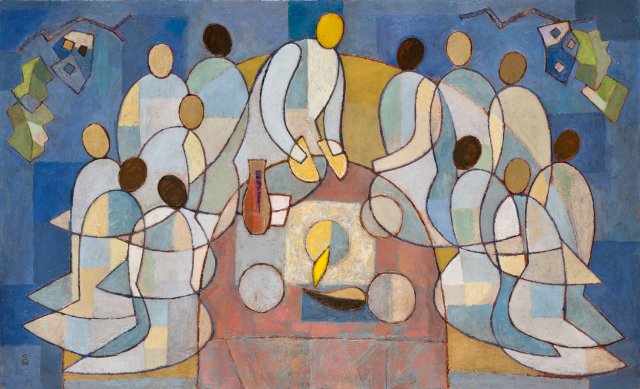
The Lord’s Supper is a tangible proclamation of the person and work of Jesus Christ. It speaks to us, and, so, we must listen well. The Table proclaims Christ’s identity as God’s Son, the one who came to live a holy life, teaches us the way to live, and how Jesus died a cruel death so that we might be born again and experience new life. 

We Are All One in Jesus Christ by Soichi Watanabe, 2009

The Table proclaims our mission, that as often as we share in communion, we proclaim the Lord’s death until he comes again. That is, we witness to the reality of Christ’s redemption in our own lives. We share our own changed lives with others. We pray for them so that they will experience new life, as well. 

The Table proclaims our spiritual formation in Christ. At the Table, we are lifted and joined with Christ through the Holy Spirit. It is a mysterious joining that defies description, just as the disciples had a mysterious encounter that they could not fully explain. Yet they experienced it, nonetheless.

May we listen well, without distraction, to God’s Son. May we know God’s purpose for our life. And may we encounter Jesus at the Table, and in all of life, so that we experience new life. 

O God, teach us to listen to those nearest to us, our family, our friends, our co-workers. Caring God, teach us to listen to those far from us – the whisper of the hopeless, the plea of the forgotten, and the cry of the anguished. Holy Spirit of God, teach us to listen for your voice — in busyness and in boredom, in certainty and doubt, in noise and in silence. Gracious God, teach us to listen well to the message of your Table. May you change and transform us to be like Jesus. Teach us, Lord, to listen. Amen.

When Will We Engage Our Ministry?

Welcome, friends!

Acts 1:1-11 contains the final words of Christ on this earth. Jesus gave his followers a mandate, not to sit idly and wait for his return, but to embody their identity as witnesses to what they have seen and heard for a world in need of God’s deliverance and love. Click the videos below, and let us embrace our purpose and mission as the people of God….

Pastor Tim Ehrhardt, Acts 1:8

God of hope and courage, you call each of us to bear witness to your abundant love in a frightened world. All around us are signs the world is struggling and the future is unclear. Strengthen our confidence in your unfailing grace and grant us the courage to move onward even when we cannot see the way, knowing that you will guide our every step. Amen.