
John 12:20-36 – Tuesday of Holy Week

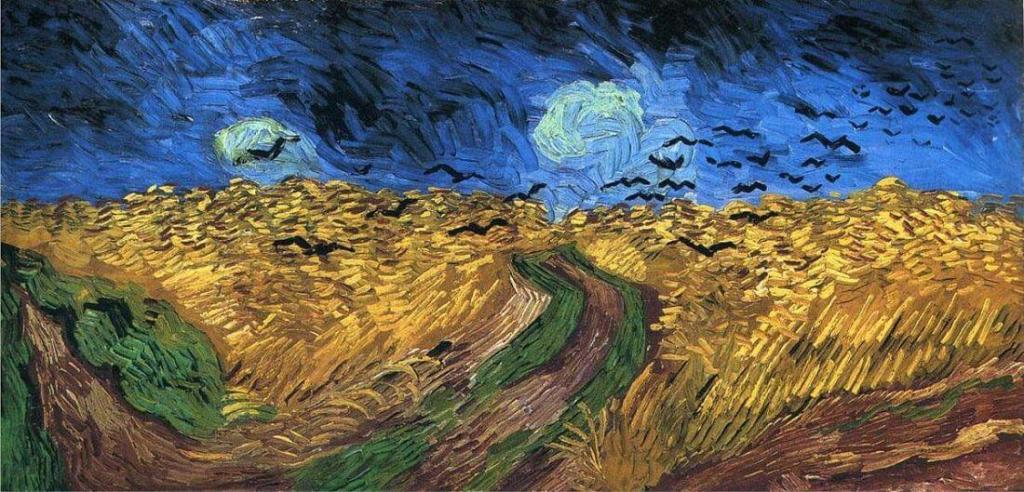
Wheatfield with Crows by Vincent Van Gogh, 1890

Some Greeks were among those who had gone to Jerusalem to worship during the festival. They went to Philip (he was from Bethsaida in Galilee) and said, “Sir, we want to see Jesus.”

Philip went and told Andrew, and the two of them went and told Jesus. Jesus answered them, “The hour has now come for the Son of Man to receive great glory. I am telling you the truth: a grain of wheat remains no more than a single grain unless it is dropped into the ground and dies. If it does die, then it produces many grains. Those who love their own life will lose it; those who hate their own life in this world will keep it for life eternal. Whoever wants to serve me must follow me, so that my servant will be with me where I am. And my Father will honor anyone who serves me.

“Now my heart is troubled—and what shall I say? Shall I say, ‘Father, do not let this hour come upon me’? But that is why I came—so that I might go through this hour of suffering. Father, bring glory to your name!”

Then a voice spoke from heaven, “I have brought glory to it, and I will do so again.”

The crowd standing there heard the voice, and some of them said it was thunder, while others said, “An angel spoke to him!”

But Jesus said to them, “It was not for my sake that this voice spoke, but for yours. Now is the time for this world to be judged; now the ruler of this world will be overthrown. When I am lifted up from the earth, I will draw everyone to me.” (In saying this he indicated the kind of death he was going to suffer.)

The crowd answered, “Our Law tells us that the Messiah will live forever. How, then, can you say that the Son of Man must be lifted up? Who is this Son of Man?”

Jesus answered, “The light will be among you a little longer. Continue on your way while you have the light, so that the darkness will not come upon you; for the one who walks in the dark does not know where he is going. Believe in the light, then, while you have it, so that you will be the people of the light.”

After Jesus said this, he went off and hid himself from them. (Good News Translation)

Today is another step in our journey together with Jesus. The path we are on together leads to a cruel cross. For the past six weeks the Christian has been on a Lenten walk. To keep the long sojourn going, believers focus on spiritual discipline, prayer, and repentance. 

Shadow

Along the way we come face-to-face with the shadow parts of ourselves. We discover that within us there is the pull to hold-on to unhealthy rhythms and habits of life. There is an inner push to arrange our lives with the fragmentation of disordered love.

Our reflexive response to things we do not like about ourselves might be to either use sheer willpower to change, or to try and manage our brokenness – as if we could boss our spiritual selves out of the darkness. However, the problem and the solution are much more radical than we often would like to admit.

While on this journey, Jesus invites us to die to ourselves. The pull and push of sin cannot be managed or willed away – it must be eradicated and completely cut out, like the cancer it is. Transformation and new life can only occur through death. 

A tiny little seed can grow, break the ground, and develop into something which provides sustenance for others.  It does no good to remain a seed in the ground. The little kernel must change beyond it’s current recognition if it is to reach for the sky and become food for the world.

Suffering

Christ is the ultimate example of the one who died to himself and for us. Only through suffering and death did he secure deliverance and freedom from sin, death, and hell. By his wounds we are healed. Through his tortuous death, new life became possible – because there must be a death if there is to be a resurrection; there must be suffering before there is glory.

Through dying to self and following Jesus, a transformative experience happens. As we change, mature, and produce a crop, we bring the kind of spiritual sustenance the world so desperately needs. Following Jesus, leaving all to walk with him, is true repentance and authentic discipleship.

Perhaps you protest, thinking I’m being too forceful or insistent about this Jesus stuff. Yes, you have perceived rightly. Within some corners of Christianity, a wrongheaded notion has developed that believes suffering is not God’s will.

Jesus, however, is insistent that dying to self is necessary. And it hurts like hell. It’s a hard teaching to absorb when you so desperately want things to be rainbows and unicorns. Suffering, whether we like it, or not, is the way of Jesus:

“In the days of his flesh, Jesus offered up prayers and supplications, with loud cries and tears, to the one who was able to save him from death, and he was heard because of his reverent submission.  Although he was a Son, he learned obedience through what he suffered; and having been made perfect, he became the source of eternal salvation for all who obey him.” (Hebrews 5:7-9, NRSV)

We are not above our Master. Christ’s life on this earth, before his crucifixion and death, was marked with suffering. Jesus learned obedience through struggle and adversity. The Lord himself did what he is now asking us to do.

Christ gave himself up to do the Father’s will. Jesus offered loud cries and tears and submitted to what the Father wanted. We must do no less. We don’t get to choose which parts of Christ’s life and teaching we will observe and which ones we won’t, as if Jesus were some spiritual buffet line. 

All who live for Jesus will follow him into the path of suffering, of death to self, and of new life through the power of his resurrection. In Christ’s own words: “Those who love their life will lose it, and those who hate their life in this world will keep it for eternal life.”  We must…

Surrender

We have hundreds, maybe thousands of small decisions every day with the use of our time, our money, our energy, and our relationships. If we have tried to fix what is broken inside of us, we will likely just try to hastily fix the problems and the people in our lives, then move on with getting things done on our to-do list. 

Instead, we have the invitation to surrender. We have the opportunity to create sacred space for solitude and silence, prayer and repentance. Take the time to (in person or virtually) sit with a person in pain and listen.  Reflect on how to use your money for kingdom values. See your life as a holy rhythm of hearing God and responding appropriately.

Sacrifice

Holding-on to our stuff and time is the opposite of sacrifice – it’s avarice. I understand that you and I are not Jesus – our sacrifice and suffering are not efficacious, that is, it doesn’t deliver other people from sin. Only Christ’s death does that. Yet, we are still called to sacrifice:

“I am now rejoicing in my sufferings for your sake, and in my flesh, I am completing what is lacking in Christ’s afflictions for the sake of his body, that is, the church.” (Colossians 1:24, NRSV)

Pleasure is not the summum bonum of life. Our lives are not meant to be lived solely for minimizing pain and maximizing comfort. Jesus has extended the call to view our workplaces, communities, neighborhoods, and families as our mission field of grace to a world in need of basic human kindness and attention – which takes sacrificial love on our part.

Christianity isn’t a religion that’s for people who have neatly packaged theological answers and certainties to all of life’s questions. Rather, Christianity is a dynamic religion of learning to follow Jesus, discovering how to die to self, and struggling to put Christ’s teaching and example into practice. 

The way of Christ is often characterized by a three-steps-forward, two-steps-backward sort of reality. The road is zig-zags with plenty of potholes. Those who don’t struggle are in big trouble. However, those who go through the pain of dying to self for the sake of their Lord, find that the harvest they produce leads to eternal life.

May you struggle well, my friend.

Almighty God, your dear Son did not ascend to joy until he first suffered pain; he did not enter glory before he was crucified. Mercifully grant that we, walking in the way of the cross, may find it as the true way of life and peace, through Jesus Christ, your Son, our Lord. Amen.

John 12:1-11 – Monday of Holy Week

Six days before the Passover, Jesus went to Bethany, the home of Lazarus, the man he had raised from death. They prepared a dinner for him there, which Martha helped serve; Lazarus was one of those who were sitting at the table with Jesus. Then Mary took a whole pint of a very expensive perfume made of pure nard, poured it on Jesus’ feet, and wiped them with her hair. The sweet smell of the perfume filled the whole house. One of Jesus’ disciples, Judas Iscariot—the one who was going to betray him—said, “Why wasn’t this perfume sold for three hundred silver coins and the money given to the poor?” He said this, not because he cared about the poor, but because he was a thief. He carried the money bag and would help himself from it.

But Jesus said, “Leave her alone! Let her keep what she has for the day of my burial. You will always have poor people with you, but you will not always have me.”

A large number of people heard that Jesus was in Bethany, so they went there, not only because of Jesus but also to see Lazarus, whom Jesus had raised from death.So, the chief priests made plans to kill Lazarus too, because on his account many Jews were rejecting them and believing in Jesus. (Good News Translation)

Jesus entered Jerusalem, the day before, on Sunday, with the people waving and lying down palm branches, along with shouts of “hosanna!” Although Jesus had been speaking about his death, weeks before his triumphal entry, most folks were clueless as to what was about to happen.

But Mary Magdalene did. She truly listened to the Master. Her spiritual ears and eyes were fully opened to the significance of this week. Mary was completely aware.

A woman with a sordid background, Mary Magdalene had her life thoroughly transformed through meeting Jesus. She became a follower, in every sense of the word. As an attentive disciple, Mary knew her Lord. She observed every little thing about Jesus, hung on every word, knew each voice inflection and every gesture.

Now, near the end of Christ’s earthly life, and only days from being arrested, tried, tortured, and killed, Mary sensed what was happening. She saw the pained affect on her Lord’s face that no one else noticed. She was cognizant of what was happening, while the others seemed clueless.

Mary’s own brokenness cracked open to her the true reality of life, the real meaning of the unfolding days, and the deep gravity of this week.

The surface event itself is a touching and tender moment in history. This woman, whom everyone knew as a damaged person, took a high-end perfume, and broke the entire thing open.

Mary then proceeded to anoint Christ’s feet with it. You can imagine the aroma filling the house with an expensive perfume for all to smell. Giving what she had to Jesus, Mary demonstrated the path of true discipleship.

Mary’s act of faith in anointing Jesus was deeply symbolic:

  • The broken jar of perfume shows us the brokenness of Mary and our need to be broken. (Matthew 5:3-4)
  • Mary used an extraordinary amount of perfume, picturing her overflowing love for Jesus. (John 20:1-18)
  • Mary applied the perfume to Jesus with her hair (hair is a cultural symbol of submission and respect). (1 Corinthians 11:14)
  • The perfume directs us to the death of Jesus. (John 19:38-42)
  • The perfume highlights for us the aroma of Christ to the world. (2 Corinthians 2:15-17)
  • There is more to Judas than his words about perfume; he is not actually concerned for the poor. (Matthew 26:15)
  • Judas and Mary serve as spiritual contrasts: Mary opens herself to the sweet aroma of Christ; Judas just plain stinks.
  • The perfume presents a powerful picture of the upcoming death of Christ, for those with eyes to see; he was broken and poured out for our salvation. (Luke 23:26-27:12)

Christianity was never meant to be a surface religion which merely runs skin deep. The follower of Christ is meant for deep personal transformation, inside and out, so that there is genuine healing, spiritual health, and authentic concern for the poor and needy. 

Keeping up appearances is what the Judas’s of this world do. But the Mary’s among us dramatically point others to Jesus with their tears, humility, vulnerability, openness, and love.

In our contemporary social and cultural landscape of fragmented human ecology, our first step toward wholeness and integrity begins with a posture of giving everything we have – body, soul, and spirit – to the Lord Jesus.

Sometimes it takes a woman to show us the way.

On this Monday of Holy Week, a tangible act may help us to express and deepen our faith. Take a bottle of unopened perfume or cologne, pour it completely out into a used tin can, and set the can in a central place in your home, just for the day* The aroma will likely linger into the next few days, as well. Let the smell be a continual reminder of both the sadness of death and the joy of salvation.

Loving Lord Jesus, my Savior, and my friend, you have gone before us and pioneered deliverance from an empty way of life and into a life of grace and gratitude. May I and all your followers emulate the path of Mary and realize the true freedom which comes from emptying oneself out for you. Amen.

*When you are ready, it is appropriate to dispose of the perfume by pouring it down the drain. Even this can be a ritual in which you visualize discarding your old life in order to take up a new one on Easter Sunday.

Philippians 2:5-11 – Descending Into Greatness

In your relationships with one another, have the same mindset as Christ Jesus:

Who, being in very nature God,
    did not consider equality with God something to be used to his own advantage;
rather, he made himself nothing
    by taking the very nature of a servant,
    being made in human likeness.
And being found in appearance as a man,
    he humbled himself
    by becoming obedient to death—
        even death on a cross!

Therefore, God exalted him to the highest place
    and gave him the name that is above every name,
that at the name of Jesus every knee should bow,
    in heaven and on earth and under the earth,
and every tongue acknowledge that Jesus Christ is Lord,
    to the glory of God the Father. (New International Version)

So, what kind of people (and what kind of church) would we be if we resembled these verses of Holy Scripture?  

The Apostle Paul said to the church in Philippi that their “attitude” or “mindset” should be the same as Christ Jesus. Their thinking ought to be like the mind of Christ. To think well, live well, and be well, we need the mind of Christ.

To relate to others in a godly way, to navigate this fallen world with integrity and truth, to make an impact on those around us, we must adopt the mindset and attitude of Jesus.  

Everything comes down to God – how we should think and how we ought to live. Within the life of the one true God, exists three persons: Father, Son, and Spirit. Within the Holy Trinity, there exists perfect love, absolute holiness, united harmony, and constant respect. 

Just as God is holy, we are to be holy.

Therefore, once you have your minds ready for action and you are thinking clearly, place your hope completely on the grace that will be brought to you when Jesus Christ is revealed. Don’t be conformed to your former desires, those that shaped you when you were ignorant. But, as obedient children, you must be holy in every aspect of your lives, just as the one who called you is holy. It is written, You will be holy, because I am holy. (1 Peter 1:13-16, CEB)

Just as God is love, so we are to love one another.

Dear friends, we should love each other, because love comes from God…. This is how God showed his love to us: He sent his one and only Son into the world so that we could have life through him. This is what real love is: It is not our love for God; it is God’s love for us. He sent his Son to die in our place to take away our sins. Dear friends, if God loved us that much, we also should love each other. (1 John 4:7-11, NCV)

Just as Jesus is a humble servant, so we are to practice humble service in all relationships.

Everyone must live in harmony, be sympathetic, love each other, have compassion, and be humble. Don’t pay people back with evil for the evil they do to you, or ridicule those who ridicule you. Instead, bless them, because you were called to inherit a blessing. (1 Peter 3:8-9, GW)

Humility is vital to Christian existence, and not optional. There is no place in the believer’s life for pride, posturing, and power-broking. Instead, we are to take the posture of lowliness, using any kind of influence for the benefit and encouragement of others – just like Jesus did while on this earth. 

In a world pre-occupied with power and control, safety and security, influence and throwing its weight around, there is Jesus. Christ did the opposite of engaging in upward mobility; he practiced downward mobility. In doing so Jesus Christ descended into greatness as Lord and Savior.

To have the mind and attitude of Christ happens through emulating our Lord’s example of humility. Jesus is God. Yet, despite that reality, the pre-incarnate Christ did not sit in heaven as the second person of the Trinity and hold onto his lofty position with tight fists. 

Jesus came to this earth with a humble willingness to open his hands and relinquish his rights and privileges as God. Christ divested himself of all his privilege. He became a slave. Jesus gladly emptied himself and held nothing back. Christ completely gave himself up for us.

Jesus became one of us, yet never ceased being the Lord of all. It’s just that he willingly put his kingly robe in the closet and put on Dickies and work boots. Jesus came among us and purposely limited himself to identify with us fully – and secured for us the greatest generosity imaginable: an answer to the problem of guilt and shame through forgiveness of sins.

Jesus became a servant, a bond-slave. Christ completely tied himself to us, not coming to this earth seeking to be served, but serving and giving his life as a ransom for many. 

What’s more, Christ kept going lower and lower to the point of descending to the greatest humiliation and shame of all – death on a cross. The King of the universe was killed by sinful humanity so that he might redeem and save those very same people from their terrible plight of bondage to the power of sin.

Therefore, we are to be humble, embracing the lowly status of being slaves to God and to one another. The Philippian church had a real problem with pride. Hear the exhortations given to the Philippian church so that they would practice humility in all their relationships: 

  • Live your life in a manner worthy of the gospel of Christ, so that, whether I come and see you or am absent and hear about you, I will know you are standing firm in one spirit, striving side by side with one mind for the faith of the gospel (Philippians 1:27, NRSV)
  • Don’t be jealous or proud but be humble and consider others more important than yourselves. (Philippians 2:3, CEV)
  • You must continue to live in a way that gives meaning to your salvation. (Philippians 2:12, ERV)
  • Do all things without murmuring and arguing. (Philippians 2:14, NRSV)
  • Brothers and sisters, imitate me, and pay attention to those who live by the example we have given you. (Philippians 3:17, GW)
  • Do not be anxious [tight-fisted control] about anything, but in every situation, by prayer and petition, with thanksgiving [open-handed humility] present your requests to God. (Philippians 4:6, NIV)

As a result of Christ’s humble obedience to the Father, he was exalted from the lowest place to the highest place. King Jesus is on the throne, above everyone and everything. Because of his descent to this earth, he ascended in glory and honor. We now see God in a new way, through Jesus – and it causes us to bend the knee and confess with the tongue that Jesus Christ is Lord.

In the ancient Roman world, Jesus as Lord was subversive language. Because if Jesus is Lord, Caesar is not, and ultimate allegiance does not belong to the Empire. And it is no different in our day. The issue of who we pledge our fealty to, still pertains to us. If Jesus is Lord, no earthly politician or religious figure is owed lordship status.

To follow Jesus, one must practice downward mobility and embrace humility.

Bowing the knee to Christ becomes second nature whenever we give our unflagging allegiance to him. We accept that we are the creatures and God is the Creator, that God is God, and we are not.

As we enter Holy Week, hear the prophet Isaiah’s words of humiliation and exaltation:

Just watch my servant blossom!
    Exalted, tall, head and shoulders above the crowd!
But he didn’t begin that way.
    At first everyone was appalled.
He didn’t even look human—
    a ruined face, disfigured past recognition.
Nations all over the world will be in awe, taken aback,
    kings shocked into silence when they see him.
For what was unheard of they’ll see with their own eyes,
    what was unthinkable they’ll have right before them.

Who believes what we’ve heard and seen?
    Who would have thought God’s saving power would look like this?

The servant grew up before God—a scrawny seedling,
    a scrubby plant in a parched field.
There was nothing attractive about him,
    nothing to cause us to take a second look.
He was looked down on and passed over,
    a man who suffered, who knew pain firsthand.
One look at him and people turned away.
    We looked down on him, thought he was scum.
But the fact is, it was our pains he carried—
    our disfigurements, all the things wrong with us.
We thought he brought it on himself,
    that God was punishing him for his own failures.

But it was our sins that did that to him,
    that ripped and tore and crushed him—our sins!
He took the punishment, and that made us whole.
    Through his bruises we get healed.
We’re all like sheep who’ve wandered off and gotten lost.
    We’ve all done our own thing, gone our own way.
And God has piled all our sins, everything we’ve done wrong,
    on him, on him.

He was beaten, he was tortured,
    but he didn’t say a word.
Like a lamb taken to be slaughtered
    and like a sheep being sheared,
    he took it all in silence.
Justice miscarried, and he was led off—
    and did anyone really know what was happening?
He died without a thought for his own welfare,
    beaten bloody for the sins of my people.
They buried him with the wicked,
    threw him in a grave with a rich man,
Even though he’d never hurt a soul
    or said one word that wasn’t true.

Still, it’s what God had in mind all along,
    to crush him with pain.
The plan was that he give himself as an offering for sin
    so that he’d see life come from it—life, life, and more life.
    And God’s plan will deeply prosper through him.

Out of that terrible travail of soul,
    he’ll see that it’s worth it and be glad he did it.
Through what he experienced, my righteous one, my servant,
    will make many “righteous ones,”
    as he himself carries the burden of their sins.
Therefore I’ll reward him extravagantly—
    the best of everything, the highest honors—
Because he looked death in the face and didn’t flinch,
    because he embraced the company of the lowest.
He took on his own shoulders the sin of the many,
    he took up the cause of all the black sheep. (Isaiah 52:13-53:12, MSG)

Lord Jesus, Son of God, you walked the earth with humility, despite being Lord of all. Your meekness confused the proud and arrogant. Your nobly attended to the needy and destitute. Teach me to model my life after you, to live with a humble spirit. Help us to never view ourselves as greater or better than others. Let our hearts always imitate your humility. Amen.

Hebrews 2:1-9 – Pay Attention

We must pay the most careful attention, therefore, to what we have heard, so that we do not drift away. For since the message spoken through angels was binding, and every violation and disobedience received its just punishment, how shall we escape if we ignore so great a salvation? This salvation, which was first announced by the Lord, was confirmed to us by those who heard him. God also testified to it by signs, wonders and various miracles, and by gifts of the Holy Spirit distributed according to his will.

It is not to angels that he has subjected the world to come, about which we are speaking. But there is a place where someone has testified:

“What is mankind that you are mindful of them,
    a son of man that you care for him?
You made them a little lower than the angels;
    you crowned them with glory and honor
    and put everything under their feet.”

In putting everything under them, God left nothing that is not subject to them. Yet at present we do not see everything subject to them. But we do see Jesus, who was made lower than the angels for a little while, now crowned with glory and honor because he suffered death, so that by the grace of God he might taste death for everyone. (New International Version)

In my line of work as a hospital chaplain on a behavioral health unit, I frequently deal with patients who have brain disorders. Many of them, including many in my own family, have Attention Deficit Disorder (A.D.D.). Many people believe this to be a disadvantage.

Yet, I have noticed that since their brain chemistry doesn’t have a good filter for sifting all the stimuli they hear each day, many A.D.D. folks are quite intentional about picking out the voice they want to hear and engaging with it. Whereas others might take this for granted, the patients in my life know the value of creating the skills to pay attention.

The ability to pay attention and listen is necessary for a successful and sustainable Christian life.

The consequence of not developing such competency is that we will drift away – our minds will wander and allow other competing voices to overwhelm the singular voice of Jesus. Taking salvation for granted may subversively set us up for spiritual failure.

Whenever we think we already know about Christ’s person and work, we neglect to really pay attention. Bad idea.

Assuming we are paying attention is not the same thing as actually doing it. Assumptions create a slow drift away from truth. Therefore, we need continual reminders of Christ’s redemptive events. 

We must avoid the precarious position of being lost in a sea of competing voices.

We need an intentional plan for paying attention – without assuming we will be focused. Here are a few ways of daily mindfulness so that we will not become S.A.D.D. (Spiritual Attention Deficit Disorder):

  • Read Holy Scripture each day with a combination of standing and sitting, reading silently and out loud.
  • Hold a cross or other Christian reminder in your hand and feel free to fidget with it.
  • Journal your thoughts in a notebook.
  • Set a consistent time and place for spiritual reading and prayer.
  • Use different translations and versions of the Bible to read.
  • Go outside occasionally and pray while walking.
  • Focus on your breathing, and consider using breath prayers (i.e., Breathe out: “Speak Lord.” Breathe in: “I am listening.”)
  • Drink some coffee, tea, or something soothing, and picture the comfort of Christ coming into your life.
  • Be aware of distractions and acknowledge them without judging yourself.
  • Observe the Christian Year and the Daily Lectionary.

While some might argue that observing Lectionaries, the Church Calendar, Christian seasons, and worship liturgies are vain repetition, I insist otherwise: We are in grave danger of not paying attention to what we have heard, lest we drift away from it. 

Like a beach-goer on the lake drifting on her flotation device far out from shore, we can be unaware of how far we have strayed from our spiritual moorings.  If the passion and death of Jesus can only get a shoulder shrug and a “meh” out of us, there is a real problem.

Forming habits of worship, fellowship, service, and piety are essential to deliberately maintaining attention to Jesus. Perhaps if we all felt S.A.D.D. we would be more intentional about grafting reminders and practices into our lives.

Ignorance does not come from a lack of education; it comes from a failure to pay attention to the most important things in life.

God pays attention to us in a special way, different from all other creation. As the only creatures for whom the image and likeness of God resides, we have an innate sense of connection with the divine. Paying attention to things, especially to what Christ has secured for us through the cross, reflects the God who is continually observing humanity.

May your contemplation of Christ and his redemptive events of incarnation, holy life, teaching, death, resurrection, and ascension be always fresh and continually meaningful.

God, as You speak through scriptures, whispers, dreams, circumstances, nature, and people in our lives, help us to pay attention to Your voice. May we hear You in the many ways You communicate. May we pay attention to the important and the urgent and may we choose wisely. May we live attentively today.