Revelation 11:16-19 – Be Encouraged

The Episcopal Church of the Heavenly Rest in Abilene, Texas

Then the twenty-four elders who sit on their thrones before God fell on their faces and worshiped God, singing,

“We give you thanks, Lord God Almighty,
    who are and who were,
for you have taken your great power
    and begun to reign.
The nations raged,
    but your wrath has come,
    and the time for judging the dead,
for rewarding your servants, the prophets
    and saints and all who fear your name,
    both small and great,
and for destroying those who destroy the earth.”

Then God’s temple in heaven was opened, and the ark of his covenant was seen within his temple; and there were flashes of lightning, rumblings, peals of thunder, an earthquake, and heavy hail. (New Revised Standard Version)

Late in his life, as the old Apostle John lived in exile, he experienced a grand vision. It is what we today refer to as The Book of Revelation, or The Apocalypse of John. 

At the turn of the first century, Christ’s Church was facing a great deal of difficulty and hardship. Christians were the minority. Believers in Jesus were looked at with suspicion. Followers of Christ were often misunderstood and persecuted because of false information. 

In short, all of the myriad sufferings and persecutions that Jewish people currently face and have faced for millennia were true of the early believers in Jesus.

Therefore, the purpose of John’s vision was not to give slick preachers a reason to craft elaborate prophecy charts about what’s going to happen in the future. Instead, God was concerned for the current welfare of his people. The vision was meant to bring encouragement.

The message to John, passed onto the suffering church, was that this present hard situation will not always be this way. Danger, adversity, and hardship will not last forever. There is a day coming when God’s judgment and benevolent reign will truly rule in all of its glorious fullness.

Our prayers will be answered, the ones we have lifted to God for centuries: “Your kingdom come, your will be done, on earth as it is in heaven.”

Gergeti Trinity Church, Georgia

The Lord did not want his beloved children to succumb to discouragement and lose heart. So, the vision from John assured them that all will be made right. Jesus is Lord, and his good rule will have the day. 

Yes, we currently live in a world profoundly touched by the presence and power of sin. And because of that sad reality, we feel all kinds of various pain. We have no choice but to endure the hardships of national wars, bodily diseases, lack of resources, economic woes, mental disorders, emotional distress, and spiritual warfare.

It is possible to observe, as well as experience, all the crud of this sinful world and fall into despair. If or when that happens, we give-in to unhealthy ways of coping with the adverse circumstances around us.

Graciously, we have been given a glimpse into how all of history will shake-out in the end. That brief pulling back of the curtain is meant to bring us needed encouragement, steadfast hope, and patient endurance. 

There is coming a day when expressions of grief and lament will give way to praise and gratitude to God. And that incredible praise will explode with all believers, past and present, along with all creation, proclaiming together that the Lord God is all-powerful. 

The kingdom of this world belongs to our Lord and to his Chosen One. And he will rule forever and ever.

Some might protest that Christians have been harping on this return of Jesus for two millennia and he still isn’t here. We must not misinterpret God’s inaction as uncaring or that God is non-existent. Because it is really patient grace.

But do not forget this one thing, dear friends: With the Lord a day is like a thousand years, and a thousand years are like a day. The Lord is not slow in keeping his promise, as some understand slowness. Instead, he is patient with you, not wanting anyone to perish, but everyone to come to repentance. (2 Peter 3:8-9, NIV)

Our present sufferings must also not be misinterpreted, as if God hates us or is just plain mean. For the Christian, suffering is transformed into solidarity with Jesus Christ.

My dear friends, do not be surprised at the painful test you are suffering, as though something unusual were happening to you. Rather be glad that you are sharing Christ’s sufferings, so that you may be full of joy when his glory is revealed. (1 Peter 4:12-13, GNT)

All of our collective experiences are meant not for harm, but for good so that we might realize spiritual growth and maturity.

Grow in the grace and knowledge of our Lord and Savior Jesus Christ. To him be glory both now and forever! Amen. (2 Peter 3:18, NIV)

Lord Jesus Christ, by your patience in suffering you caused our earthly pain to be sacred and have meaning. Through your example of humble obedience, you opened the way for us to walk through our own hard circumstances with grace and submission.

Be near me in my time of weakness and pain. Sustain me by your grace, so that my strength and courage may not fail. Heal me according to you will. Help me always to believe that what happens to me in this present life is of little account if you hold me in eternal life, my Lord and my God.

As Jesus cried out on the cross, I cry out to you in pain, O God my Creator. Do not forsake me. Grant me relief from this suffering and preserve me in peace; through Jesus Christ my Savior, in the power of the Holy Spirit. Amen.

Acts 9:32-35 – Healed

St. Peter heals Aeneas, 12th century mosaic in Palermo, Italy

As Peter traveled about the country, he went to visit the Lord’s people who lived in Lydda. There he found a man named Aeneas, who was paralyzed and had been bedridden for eight years. “Aeneas,” Peter said to him, “Jesus Christ heals you. Get up and roll up your mat.” Immediately Aeneas got up. All those who lived in Lydda and Sharon, saw him and turned to the Lord. (New International Version)

The early church was growing. Both in numbers and in faith, the new believers following the words and ways of Jesus could be found everywhere in Judea. The Apostle Peter, therefore, decided to get out of Jerusalem and visit some of these folks in the town of Lydda, on the Mediterranean coast.

Back when Peter was following Jesus around in his earthly ministry, the Lord told the disciples that they will do the works he did, and, what’s more, they will do even greater things than Jesus himself. (John 14:12-14)

Peter emulated the example of his Lord. He simply stated that Christ is the one who heals you, Aeneas, so get up, take your mat, and go on home. (Mark 2:10-12; John 5:1-8)

The act of healing the paralyzed man, Aeneas, was a sign that the merciful saving ministry of Jesus was in effect, even when Jesus isn’t bodily present. Christ made it clear that the Holy Spirit would be the continuing presence of God on this earth. (John 16:1-15)

We, too, have this same Spirit.

The work of ministry is always done to the glory of God. People hear the good news, see the miracle, and believe in Jesus.

There are some who examine today’s New Testament lesson and expect that they (and all other believers) ought to be able to do exactly what Peter did: heal another miraculously.

Then, there are others who look at the same account and relegate it to some bygone era in which only the original apostles, like Peter, could do that sort of thing – if it even happened like that, at all.

To expect a dramatic physical healing, every time, all the time, is not consistent with healing narratives in Holy Scripture. And to never expect a miraculous healing is equally inconsistent with the biblical data.

It seems to me we need to reject both extremes. That’s because healing comes in all sorts of different forms.

An event which causes the need for healing and health, or a condition which prevents good health, isn’t limited to the body. A person’s mind, emotions, and spirit can also be damaged and need healing, as well. In fact, whenever there is trauma to the physical body, it profoundly effects the person’s thinking, feeling, and praying.

We need to beware of desiring the fast solution of dramatic and miraculous healing because of not wanting to deal with our emotions.

Perhaps you, like me, have had the experience of going to work or church when experiencing a difficult time in life. There is an emotional heaviness because of a strained, broken, or lost relationship. Or maybe there is emotional pain from an unexpected or unwanted situation.

Yet, when someone asks how you are doing, the response “Oh, fine!” tumbles automatically out of your mouth. But you are anything but fine. Inside, down in your heart, or painfully present in your head, the hurt dominates your thoughts and feelings.

Healing is for people. Fixing is for things and machines. It would be weird if I said I was going to heal a tractor. It is equally strange to try and fix people. To heal is to straighten what is broken. We cannot fix our emotions because, when hurt or damaged, they need healing – a process of restoration – and it usually doesn’t happen overnight.

Our emotional healing is like walking a slow journey. Along that path, our emotions are crying out for us to pay attention to three things:

  1. Grief. Grieving is the normal emotional reaction to any significant change or loss. To grieve our painful situations, whatever they may be, is necessary to healing our emotions. Putting a lid on our grief and sucking it up in a delusional show of strength at best prolongs our healing, and, at worst, brings further damage.
  2. Grace. Grace is an act of bestowing honor or forgiveness to a person. It is not dependent upon whether one deserves it, or not. Grace is the opposite of being judgmental. It chooses not to hold something over or against another, even oneself.
  3. Gratitude. Gratitude is a deliberate act of thankfulness for a specific act. It is both an attitude and an emotion. Gratitude comes from a heart of appreciation. Habits of gratitude creates new ways of being with others. And creating new experiences is one of the best ways of helping to heal the bad experience we just went through.

Embracing those three elements of grief, grace, and gratitude sets us on a healing path. Also, there are practices which we can utilize with each of those three which promote their healing work in our lives. For me, some of those practices include humor and laughter; meditation and other spiritual practices; walking the dog; watching cartoons; and journaling.

Healing is an art. It takes time, lots of practice, and plenty of love. Healing comes from God, which is a good thing, because the Lord knows exactly the kind of healing we need.

God of all comfort and healing, our help in time of need: We humbly ask you to relieve the suffering of your sick servants everywhere. Look upon them with the eyes of your mercy; comfort them with a sense of your goodness; preserve them from the temptations of the enemy; and give them patience in their afflictions. In your good time, restore them to health, and enable them to glorify your most holy name and dwell with you forever in the land of the living, through Jesus Christ our Lord. Amen.

Luke 12:29-32 – Be Content

And do not set your heart on what you will eat or drink; do not worry about it. For the pagan world runs after all such things, and your Father knows that you need them. But seek his kingdom, and these things will be given to you as well.

“Do not be afraid, little flock, for your Father has been pleased to give you the kingdom. (New International Version)

If we’re honest with God, we acknowledge that we often worry a lot about tomorrow and how our needs will be met. 

Every day we send God moribund signals that our heads are not in the moment, and that our hearts are not into today. We fret about the future, leaving us profoundly discontent. So, we do busywork, distract ourselves with social media, and numb ourselves with spirits rather than turn to the Holy Spirit – all in the futile attempt to reduce the racing thoughts in our heads.

Far too many of us fail to enjoy the present moment. Our minds are someplace else. 

Contented people do not find their happiness in far-off places, in someday being able to acquire the things they desire, or in having a laser-like orientation to achieving a future goal. Instead, they find contentment in their present circumstances. 

Those living without fear and eschewing worry have discovered that happiness is not found in a new job, a new car, a new spouse, or a new anything.

“If I ever go looking for my heart’s desire again, I won’t look any further than my own backyard because if it isn’t there, I never really lost it to begin with.”

Dorothy, The Wizard of Oz

Focusing on the present does not mean ignoring the past or neglecting the future; it just means we are to put our primary attention on living in the here and now rather than on a romanticized future free of doubt, insecurity, and uncertainty. 

If we are not present to the here and now, we either get stuck in the past or continually worry about the future.  Everything then becomes either about recapturing some bygone era or of dreaming about some idyllic future state – buying into the wrongheaded notion that whenever I get out of school, or get married, or have kids, or get the job I want, or the kids leave home, or I retire, then all will be good, and I shall finally have contentment. 

Planning for the future is wise, good, and necessary; worrying about it and neglecting the present is bad.

Whenever we rush through the present to get to the future, we lose what God wants to do for us now.  It takes flow, mindfulness, and savor to fully engage the present.

“Flow” is a psychological term that means “being in the zone,” that is, to be actively involved in the present situation with focused attention. 

“Mindfulness” means to be aware of your present surroundings, and to especially be aware of your present state of mind and emotions; it is to pay attention to all that is within you and around you. 

To “savor” something is to enjoy it so much that you want it to last forever. It is to be slow, deliberate, and enjoyable. It’s about the journey, not just the destination.

Flow, mindfulness, and savor are what Jesus asked us to do. Christ wants us to stop and smell the roses. He wants us to give focused attention to what is currently in front of us; to be mindful of all the wonder of creation that presently surrounds us; and, to take the time to simply savor and enjoy it all. 

Once I was in a bible study with a group of people and the family’s dog kept licking a particular person to the point of distraction. Finally, I said to the group: “What do you think God is trying to tell us through the dog?”  We ended up having a very enlightening conversation on our own relationships with God and one another.

We are to be present to today. 

This is the day that the Lord has made;
    let us rejoice and be glad in it.

Psalm 118:24, NRSV

When we realize life is short, we will not waste it on worrying about the future. Although we don’t know about tomorrow, we do know about today. And today we are to enjoy God’s good gifts to us in the here and now.

So, teach us to consider our mortality,
so that we might live wisely. (Psalm 90:12, NET)

The wise way to live is one day at a time. That was God’s message through the prophet Jeremiah to the exiled Israelites. The ancient Jews kept spending their time reminiscing about the past and wishing for a better future.  So, God told them what to do in their exile:

“Build homes, and plan to stay. Plant gardens and eat the food they produce. Marry and have children. Then find spouses for them so that you may have many grandchildren. Multiply! Do not dwindle away! And work for the peace and prosperity of the city where I sent you into exile. Pray to the Lord for it, for its welfare will determine your welfare.” (Jeremiah 29:5-7, NLT)

Being content means to enjoy today, to savor the present moment God has you in, even if you don’t like where you are right now.

So go eat your food and enjoy it;
    drink your wine and be happy,
because that is what God wants you to do.
Put on nice clothes
    and make yourself look good.

Enjoy life with the wife you love. Enjoy all the useless days of this useless life God has given you here on earth, because it is all you have. So, enjoy the work you do here on earth. Whatever work you do, do your best, because you are going to the grave, where there is no working, no planning, no knowledge, and no wisdom. (Ecclesiastes 9:7-10, NCV)

Appreciate God’s simple gifts

Sometimes we look so hard for a future miracle, and want out from the circumstance we are in, that we fail to experience contentment in the present time. We are to enjoy the simple pleasures of life which God gives to us, even within our adversity.

I know what it is to be in need, and I know what it is to have plenty. I have learned the secret of being content in any and every situation, whether well fed or hungry, whether living in plenty or in want. (Philippians 4:12, NIV)

No matter what is going on in our lives, whether good or not, we can still appreciate a beautiful sunset, a good book, a walk on the beach, time with friends, good food, and a host of other simple gifts which God provides for us on a daily basis. Yet, we must stop long enough to experience and enjoy them.

Remember to celebrate

We are meant to celebrate life. The genuineness of Christianity is seen whenever Christians throw the best parties and have the most fun.

Someday we are all going to die. Rather than this being a downer, it is an opportunity to ponder an important question: Will you celebrate the time you have here on this earth and enjoy it? 

It’s not hedonistic (living for pleasure) to enjoy life and have a party. It’s actually a biblical thing to do. A spirit of celebration is a Christian spirit.

Work with enthusiasm

Dive in and enjoy your work. We end up worrying whenever our focus is on the destination. However, the real point of life is to enjoy the journey and the process. Be present to your work now and enjoy a job well done for the day, instead of looking forward to a fatter paycheck and a better job in the future.

My God will meet all your needs according to the riches of his glory in Christ Jesus.

Philippians 4:19, NIV

Engage in work with joyful abandon, and not with compulsive perfectionism (which is joyless and life-draining). Find ways of enjoyment within the kind of work that may be draining and not very exciting. Every job has mundane repetitive work to it. Yet, how we go about that work is significant.

If the here-and-now is not the best time of your life, then you and I need to be mindful to the words of Jesus because our focus is somehow misplaced. Contented people focus on the present, what is happening now, today, and they do not worry about tomorrow because that future state is the responsibility of God. 

Ever-present God, enlarge my heart to receive more of your grace and contentment. Rescue me from my small thoughts of your love and goodness. Free me from any unbelief and uncover my many fears. May I rest secure in the knowledge that you are good and everything you do is right, just, and fair. Amen. 

Luke 5:1-11 – Surprised by Generosity

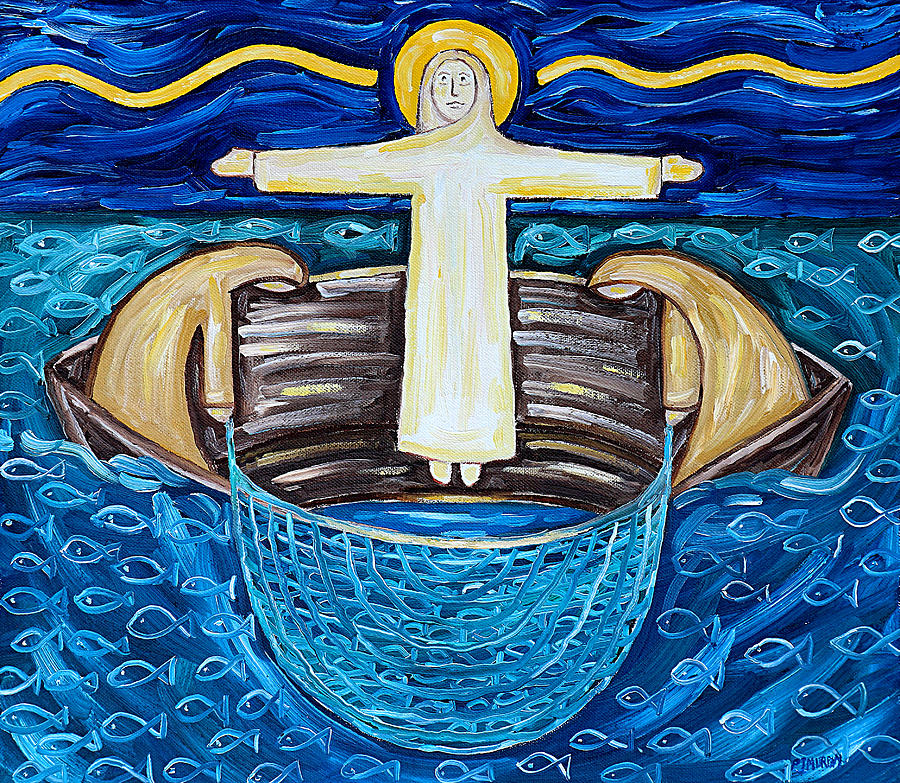
The Miraculous Catch of Fish by Patrick J. Murphy

One day Jesus was standing beside Lake Gennesaret when the crowd pressed in around him to hear God’s word. Jesus saw two boats sitting by the lake. The fishermen had gone ashore and were washing their nets. Jesus boarded one of the boats, the one that belonged to Simon, then asked him to row out a little distance from the shore. Jesus sat down and taught the crowds from the boat. When he finished speaking to the crowds, he said to Simon, “Row out farther, into the deep water, and drop your nets for a catch.”

Simon replied, “Master, we’ve worked hard all night and caught nothing. But because you say so, I’ll drop the nets.”

So, they dropped the nets, and their catch was so huge that their nets were splitting. They signaled for their partners in the other boat to come and help them. They filled both boats so full that they were about to sink. When Simon Peter saw the catch, he fell at Jesus’ knees and said, “Leave me, Lord, for I’m a sinner!” Peter and those with him were overcome with amazement because of the number of fish they caught. James and John, Zebedee’s sons, were Simon’s partners and they were amazed too.

Jesus said to Simon, “Don’t be afraid. From now on, you will be fishing for people.” As soon as they brought the boats to the shore, they left everything and followed Jesus. (Common English Bible)

One of the most fundamental characteristics of God is generosity. God’s benevolent nature defines the divine stance toward humanity. This may not seem overly remarkable. Yet, when the infinite holiness of God intersects with the prideful arrogance of sinful people, gracious generosity is the unpredictable and amazing result.

Many people on planet earth have been raised with a god who is aloof and something of an old cranky curmudgeon. Such a god gets easily angry and zaps people with lightning or some natural disaster. It is no wonder so many persons have fled from belief in God.

Can we, however, entertain the notion that the Creator God of the universe is quite the opposite of the perpetually upset deity?

In Jesus, we have displayed for us what the basic disposition of the Divine truly is.

On one occasion, Peter (a guy who could raise the ire of most gods) was going about his business, fishing in the Sea of Galilee. Having not yet encountered Jesus, yet stopping to listen to his words, Peter ended up having this uninvited stranger literally get in the boat with him.

There was something remarkably different and compelling about Jesus since Peter did not immediately toss him out. Such a calm, confident, and gracious nature – nothing like Peter had expected. So, here is this ordinary fisherman face-to-face with the Christ of God. 

Jesus told Peter to put the boat out and cast the nets. Peter, an experienced fisherman and knowledgeable about the water, knew for certain that he would not catch anything. But, out of deference to Jesus, he did so, anyway. The result was such a large catch of fish that the nets nearly broke from the weight.

The Great Catch by John August Swanson (1938-2021)

Peter’s response is instructive. He fell at the feet of Jesus in a profound sense of his own smallness and sinfulness. Next to Jesus. Peter saw how little faith he really had. He rightly discerned that he did not deserve such generosity from Jesus, an overflowing abundance given to him despite his unbelief. 

In the face of such grace, in the vortex of an incredible mercy, having seen the generosity of God directed squarely at him, Peter left it all behind to follow Jesus.

So, here we have the nature and character of God before us. No perturbed deity. No exasperated god ready to raise a storm and toss the boat over with Peter in it. No, Jesus, the Son of God, does not operate that way. There is no strong-arming people into faith. God’s tactics steer clear of base manipulation through guilt, or mind-twisting others through shaming them. 

Instead, God is beautifully and simply present with people – showing grace and generosity in places where one would least expect to find it. 

If confronted with such love, what would you do?

Early in my life, I viewed God as some eternally bored deity who would occasionally get out his divine BB gun and shoot people in the rear, just for something to do. God, in my understanding, cared nothing for the real lived experiences of people on earth.

But much like Peter of old, Jesus showed up unannounced in my life. And what I found was like Peter – a kind, benevolent Being who showered such generous love on me that my heart was immediately captured. I have never looked back since.

We intuitively know, down deep in our gut, in the very marrow of our bones, when genuine Love is among us. Generously true Love immediately connects with the deepest needs of our lives. No evangelist must convince us with offering free gold crosses or promised blessings. None of that matters when Love incarnate is present, when the great God of all is among us.

Peace, hope, and faith are the results of the divine loving presence. They cannot be conjured or ginned up through excessive asceticism or extreme discipline. Love is a gift. Love is a person. And it is given generously and graciously from the One whose very nature is charitable and hospitable.

Praise be to God!

Gracious God, you sent your Son to me even though I was neither looking for him nor expecting anything from him. Thank you for breaking-in to my life so that I could break-out for you with glory, honor, and praise.  Amen