
Luke 5:1-11 – Surprised by Generosity

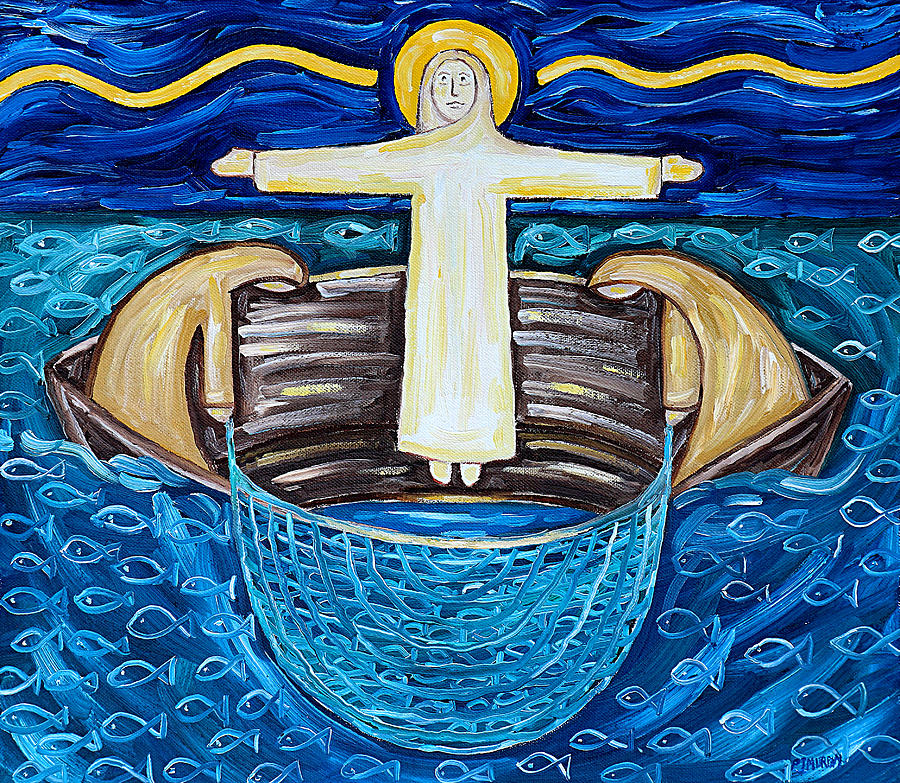
The Miraculous Catch of Fish by Patrick J. Murphy

One day Jesus was standing beside Lake Gennesaret when the crowd pressed in around him to hear God’s word. Jesus saw two boats sitting by the lake. The fishermen had gone ashore and were washing their nets. Jesus boarded one of the boats, the one that belonged to Simon, then asked him to row out a little distance from the shore. Jesus sat down and taught the crowds from the boat. When he finished speaking to the crowds, he said to Simon, “Row out farther, into the deep water, and drop your nets for a catch.”

Simon replied, “Master, we’ve worked hard all night and caught nothing. But because you say so, I’ll drop the nets.”

So, they dropped the nets, and their catch was so huge that their nets were splitting. They signaled for their partners in the other boat to come and help them. They filled both boats so full that they were about to sink. When Simon Peter saw the catch, he fell at Jesus’ knees and said, “Leave me, Lord, for I’m a sinner!” Peter and those with him were overcome with amazement because of the number of fish they caught. James and John, Zebedee’s sons, were Simon’s partners and they were amazed too.

Jesus said to Simon, “Don’t be afraid. From now on, you will be fishing for people.” As soon as they brought the boats to the shore, they left everything and followed Jesus. (Common English Bible)

One of the most fundamental characteristics of God is generosity. God’s benevolent nature defines the divine stance toward humanity. This may not seem overly remarkable. Yet, when the infinite holiness of God intersects with the prideful arrogance of sinful people, gracious generosity is the unpredictable and amazing result.

Many people on planet earth have been raised with a god who is aloof and something of an old cranky curmudgeon. Such a god gets easily angry and zaps people with lightning or some natural disaster. It is no wonder so many persons have fled from belief in God.

Can we, however, entertain the notion that the Creator God of the universe is quite the opposite of the perpetually upset deity?

In Jesus, we have displayed for us what the basic disposition of the Divine truly is.

On one occasion, Peter (a guy who could raise the ire of most gods) was going about his business, fishing in the Sea of Galilee. Having not yet encountered Jesus, yet stopping to listen to his words, Peter ended up having this uninvited stranger literally get in the boat with him.

There was something remarkably different and compelling about Jesus since Peter did not immediately toss him out. Such a calm, confident, and gracious nature – nothing like Peter had expected. So, here is this ordinary fisherman face-to-face with the Christ of God. 

Jesus told Peter to put the boat out and cast the nets. Peter, an experienced fisherman and knowledgeable about the water, knew for certain that he would not catch anything. But, out of deference to Jesus, he did so, anyway. The result was such a large catch of fish that the nets nearly broke from the weight.

The Great Catch by John August Swanson (1938-2021)

Peter’s response is instructive. He fell at the feet of Jesus in a profound sense of his own smallness and sinfulness. Next to Jesus. Peter saw how little faith he really had. He rightly discerned that he did not deserve such generosity from Jesus, an overflowing abundance given to him despite his unbelief. 

In the face of such grace, in the vortex of an incredible mercy, having seen the generosity of God directed squarely at him, Peter left it all behind to follow Jesus.

So, here we have the nature and character of God before us. No perturbed deity. No exasperated god ready to raise a storm and toss the boat over with Peter in it. No, Jesus, the Son of God, does not operate that way. There is no strong-arming people into faith. God’s tactics steer clear of base manipulation through guilt, or mind-twisting others through shaming them. 

Instead, God is beautifully and simply present with people – showing grace and generosity in places where one would least expect to find it. 

If confronted with such love, what would you do?

Early in my life, I viewed God as some eternally bored deity who would occasionally get out his divine BB gun and shoot people in the rear, just for something to do. God, in my understanding, cared nothing for the real lived experiences of people on earth.

But much like Peter of old, Jesus showed up unannounced in my life. And what I found was like Peter – a kind, benevolent Being who showered such generous love on me that my heart was immediately captured. I have never looked back since.

We intuitively know, down deep in our gut, in the very marrow of our bones, when genuine Love is among us. Generously true Love immediately connects with the deepest needs of our lives. No evangelist must convince us with offering free gold crosses or promised blessings. None of that matters when Love incarnate is present, when the great God of all is among us.

Peace, hope, and faith are the results of the divine loving presence. They cannot be conjured or ginned up through excessive asceticism or extreme discipline. Love is a gift. Love is a person. And it is given generously and graciously from the One whose very nature is charitable and hospitable.

Praise be to God!

Gracious God, you sent your Son to me even though I was neither looking for him nor expecting anything from him. Thank you for breaking-in to my life so that I could break-out for you with glory, honor, and praise.  Amen

Breakfast In the Liminal Space

Welcome, friends! John 21:1-19 is a story of Jesus and the disciples in the six weeks between Christ’s resurrection and ascension. It’s an awkward time for the disciples, as they try and come to grips with a new reality in which all the old rules have changed. Click the videos below and let’s help each other move into a new reality….

Pastor Tim Ehrhardt, John 21:1-19

Before us it is blessed, behind us it is blessed,
below us it is blessed, above us it is blessed,
around us it is blessed as we set out with Christ.
Our speech is blessed as we set out for God.
With beauty before us, with beauty behind us,
with beauty below us, with beauty above us,
with beauty around us, we set out for a holy place indeed. Amen. –A traditional Navajo blessing

John 21:1-19 – Breakfast in the Liminal Space

Miraculous Draught of Fishes by John Reilly, 1978

Afterward Jesus appeared again to his disciples, by the Sea of Galilee. It happened this way: Simon Peter, Thomas (also known as Didymus), Nathanael from Cana in Galilee, the sons of Zebedee, and two other disciples were together. “I’m going out to fish,” Simon Peter told them, and they said, “We’ll go with you.” So, they went out and got into the boat, but that night they caught nothing.

Early in the morning, Jesus stood on the shore, but the disciples did not realize that it was Jesus.

He called out to them, “Friends, haven’t you any fish?”

“No,” they answered.

He said, “Throw your net on the right side of the boat and you will find some.” When they did, they were unable to haul the net in because of the large number of fish.

Then the disciple whom Jesus loved said to Peter, “It is the Lord!” As soon as Simon Peter heard him say, “It is the Lord,” he wrapped his outer garment around him (for he had taken it off) and jumped into the water. The other disciples followed in the boat, towing the net full of fish, for they were not far from shore, about a hundred yards. When they landed, they saw a fire of burning coals there with fish on it, and some bread.

Jesus said to them, “Bring some of the fish you have just caught.” So, Simon Peter climbed back into the boat and dragged the net ashore. It was full of large fish, 153, but even with so many the net was not torn. Jesus said to them, “Come and have breakfast.” None of the disciples dared ask him, “Who are you?” They knew it was the Lord. Jesus came, took the bread and gave it to them, and did the same with the fish. This was now the third time Jesus appeared to his disciples after he was raised from the dead.

When they had finished eating, Jesus said to Simon Peter, “Simon son of John, do you love me more than these?”

“Yes, Lord,” he said, “you know that I love you.”

Jesus said, “Feed my lambs.”

Again, Jesus said, “Simon son of John, do you love me?”

He answered, “Yes, Lord, you know that I love you.”

Jesus said, “Take care of my sheep.”

The third time he said to him, “Simon son of John, do you love me?”

Peter was hurt because Jesus asked him the third time, “Do you love me?” He said, “Lord, you know all things; you know that I love you.”

Jesus said, “Feed my sheep. Very truly I tell you, when you were younger you dressed yourself and went where you wanted; but when you are old you will stretch out your hands, and someone else will dress you and lead you where you do not want to go.” Jesus said this to indicate the kind of death by which Peter would glorify God. Then he said to him, “Follow me!” (New International Version)

The Miraculous Catch of Fish by Belgian artist Erik Tanghe

Sometimes, maybe oftentimes, it takes a bit of time to wrap both our heads and our hearts around a new reality. After all, if you’ve been used to operating a particular way for a long time, it can be hard to come around to embracing something different – even if that change is really good.

Good ol’ Peter, bless his heart, you’ve got to love him. The Lord Jesus is risen from death and he, along with some of the other disciple fishermen, are not quite up to speed on resurrection. Christ is alive, the disciples have already seen him on two separate occasions, yet they seem like a dog who has chased a rabbit and now don’t know what to do with it once they’ve surprisingly gotten it cornered.

So, Peter goes fishing. Yep, when all else seems upside-down and topsy-turvy, just go fishing. The problem is: Peter and the boys are going back to a life that doesn’t exist anymore. And that’s pretty much what we all tend to do when we are stuck in a liminal space (to be at the threshold of something new, but not quite there yet) caught in a situation of uncertainty without much of a clue what to do. We simply go back to what we’ve always done and hope we catch some fish.

But we can’t catch fish. It isn’t the same anymore. There’s a new reality. The resurrection of Jesus has completely upended the world. There is no going back to any sort of pre-resurrection days. All has changed. I’m not sure if the disciples believed they were going to catch any fish, or not. Seems they just had to go do something familiar.

Unbeknown to them, the rules changed. The old way of fishing won’t work, anymore. While they’re off trying to live from the familiar confines of the old life, Jesus shows up on shore. The disciples don’t realize its him. So, they don’t anticipate that when Jesus calls out and encourages them that they’ll end up with a nice haul of fish.

While the old life yields nothing, the new life with Christ brings abundance, blessing, and fellowship. After the big catch of fish, here are the disciples now eating breakfast with the King of Kings, yet they’re still scratching their heads. What’s going on? Who is it? Well, of course, it’s Jesus, but is it? What’s the plan? I’m so confused.

In the passage and through the journey from one reality to another – the place of familiarity to a place of a future we’ve never seen – there is both the shadow of doubt which makes everything feel so uncertain and the confidence of faith which keeps us going forward.

In this middle passage, this liminal space, there is a continual vacillating between doubt and faith. Rarely is there ever a black-and-white existence. Instead, it’s wise to become friends with the gray because most lessons we learn come while inhabiting this weird in-between space.

When the disciples encountered Christ in today’s Gospel story, it was an experience of Jesus in the middle – a six-week time between resurrection and ascension. It was also an experience of the disciples in the middle. There was no going back to a pre-resurrection time of walking and talking with Jesus as they had done before. And there is also no future where they can live in the past or pick up the fishing business just like before.

Although we have the advantage of knowing how the story shakes-out with Christ’s ascension, the giving of the Spirit, and a robustly bold group of disciples going out to change the world – the disciples cannot picture that future in their present liminal space on the beach.

This is why Jesus helps and coaxes Peter along with three consecutive questions – enabling this Rock of a disciple to move through his own liminal space to a new place of the bold and confident apostle that we find in the book of Acts.

We, too, inhabit a middle space. We are in-between the two advents of Christ. This truly is an awkward time in which we, along with disciples, experience a mix of belief and doubt because we are not yet at the end of the story.

So, a strange combination of worship and wondering exists in the here-and-now. Jesus did not chide the disciples for sometimes believing and sometimes not. And, what’s more, our Lord isn’t exasperated with us. That’s because one of the certainties for the Christian is that grace overcomes and overwhelms literally everything. Sitting down with Word and Meal creates a new space where we can begin to make sense of our sometimes very nonsensical lives.

Great God of Resurrection, help me to embrace both the meaning and the mystery of faith as I negotiate and interpret every situation in my life through the light of Jesus Christ, your Son, my Lord, who lives and reigns with you and the Holy Spirit, one God, now and forever. Amen.

Luke 14:12-14 – Abundance and Inclusion For All

The Great Banquet by Hyatt Moore

Then Jesus said to his host, “When you give a luncheon or dinner, do not invite your friends, your brothers or sisters, your relatives, or your rich neighbors; if you do, they may invite you back and so you will be repaid. But when you give a banquet, invite the poor, the crippled, the lame, the blind, and you will be blessed. Although they cannot repay you, you will be repaid at the resurrection of the righteous.” (New International Version)

A lot of people live by the old adage, “You scratch my back and I’ll scratch yours.” It’s a phrase referring to reciprocity. In other words, if you give me something I want, I will then respond by giving you something you want.

That old adage works fine, that is, unless you have no ability to give or give back to another. If we only operate by the principle of reciprocity, a large chunk of people automatically get left out. And this situation is untenable and unacceptable to Jesus.

Christ observed that the religious insiders of his day were keeping entire groups of people on the outside through their practice of scratching one another’s backs.

We need to get ahold of the reality that God loves us, as well as everyone else – even the people we may not give the time of day to. God so loved the world that he sent his Son. Jesus has come to feed us. 

The kingdom of God is about food. The food given by Jesus is to feed the hungry by staging a banquet. It is a feast of God’s abundance. Yet, many seem to hoard the resources they have, only thinking about their friends, family, and people just like them. They act as if there is no need to invite outsiders, consumed as they are with their own daily lives.

We have an incredible abundant feast contained in Scripture – in fact, Jesus said that his food and drink was to do the Father’s will, that Scripture was his bread. (Matthew 4:4; John 4:34) 

It’s much too easy to take our blessings of food for granted. After all, when we are well-fed, it’s easy to assume that everyone else is, too. Feeling healthy, it’s easy to forget that others are hurting. Making money, it’s easy to think there are not many poor people around. Living in a community with plenty of churches and more bibles than people, it’s natural to assume that everyone knows the gospel of Jesus – but they don’t!

Then, whenever we get around to acknowledging there are people who need Jesus, we keep devising ways to reach them without having to change or accommodate our own lives to do it.

Christ’s call to faithful discipleship requires people to change from having a narrow focus on our small circle of friends, to including those who have no means to pay us back.

The gospel of Jesus Christ is open to outcasts and failures, to problem people and to unimpressive persons. People with needs and flaws are especially dear to Jesus. It’s the people who outwardly have it all together who are being replaced wholesale with those who admit their need. 

We must not be picky about who we invite to participate in the largess of abundance we possess. We are to avoid the spiritual snobbery of looking down our noses at the needy and less fortunate, who have nothing to offer us in return.

St. John Chrysostom (348-407, C.E.) was a Bishop of Constantinople and arguably one of the greatest preachers in the history of Christianity. John always thought of both the recipient and the giver in his sermons, insisting that both need God’s mercy.

With a concern for the giver’s soul, John insisted that givers provide for all – even the lazy, the fool, and the sinner. By opening our hearts in almsgiving, we open ourselves to Christ, who is present in the least of those among us. Refusing mercy to people deemed as unworthy, givers then actually shut themselves off from the very mercy God desires for them.

There is no reward from God when there is only reward from others.

“If we are going to examine lives, we will never have mercy upon any human being; rather, hindered by this inopportune meddlesomeness, we will remain fruitless and destitute of all help ourselves.”

St. John Chrysostom, On Repentance and Almsgiving

It’s not only the poor who suffer when the rich fail to give. In judging whether or not a particular person is worthy of love and aid, the wealthy person rejects the spiritual fruit that he would have received by giving with humility.

Giving to the poor, simply to relieve our own conscience, is not real charity; it doesn’t consider the other. We attend fully to the other by observing their spiritual and holistic needs for community, purpose, respect, and dignity. Dispassionate giving from a distance, without relationship, refuses to acknowledge the whole person. It exploits the poor for the mental comfort of the rich.

We need to be involved in people’s lives, and that takes a lot of blood, sweat, and tears. There are too many lost people who need Jesus, and too many Christians who are the walking wounded and need the healing touch of Jesus, for us to pay scant attention to the call of Jesus to invite the needy into our lives. 

Seeing people come into God’s great banquet, and into a joyous and vital relationship with Christ, probably takes about ten times more work than what you are thinking it does right now. Yet, this is the pathway of true blessing – to having God’s stamp of approval on our lives.

Merciful God, thank you for the abundance of life, relationships, health, comfort, and wealth you have provided to so many. Thank you that, even in times of need, despair, and brokenness, you are there. Please, put your arms around children and families in  poverty and disability so that they feel your comfort and hope. Meet their needs both physically and spiritually. And guide me so I can be your hands and feet pursuing justice for the poor and upholding the cause of the needy, in the way of Jesus Christ our Lord. Amen.