Luke 9:18-27 – Jesus Makes All the Difference

Christ the Redeemer, Rio De Janeiro, Brazil

Once when Jesus was praying in private and his disciples were with him, he asked them, “Who do the crowds say I am?”

They replied, “Some say John the Baptist; others say Elijah; and still others, that one of the prophets of long ago has come back to life.”

“But what about you?” he asked. “Who do you say I am?”

Peter answered, “God’s Messiah.”

Jesus strictly warned them not to tell this to anyone. And he said, “The Son of Man must suffer many things and be rejected by the elders, the chief priests and the teachers of the law, and he must be killed and on the third day be raised to life.”

Then he said to them all: “Whoever wants to be my disciple must deny themselves and take up their cross daily and follow me. For whoever wants to save their life will lose it, but whoever loses their life for me will save it. What good is it for someone to gain the whole world, and yet lose or forfeit their very self? Whoever is ashamed of me and my words, the Son of Man will be ashamed of them when he comes in his glory and in the glory of the Father and of the holy angels.

“Truly I tell you, some who are standing here will not taste death before they see the kingdom of God.” (New International Version)

In my work as both a church pastor and hospital chaplain, not to mention just being a regular guy, I rarely encounter people who characterize Christians as setting self-interest aside to follow Jesus completely with humble ministry which is willing to suffer on behalf of others.

Instead, I daily interact with folks who have long left the Church with stories of Christians squelching genuine questions about God and faith; being judgmental toward others who are not like them; having a hypocritical double-standard approach to most issues; and verbally abusing individuals who don’t conform to their cultural ideas and biblical interpretations.

We need Christians who make a difference in this world. We need Jesus.   

A right and real confession of Jesus by his Church speaks a relevant word into the culture; proclaims the gospel of grace (not judgment); and consistently and lives what it believes.

Confessing Jesus as Lord makes all the difference.

After interacting with a lot of people on their ministry journeys, Jesus asked two questions of his disciples: “Who do people say I am?” and “Who do you say I am?” Out of all the questions we can ask people, these are two good ones: “Who do others say Jesus is?” and “Who do you say Jesus is?”  

The disciples gave a variety of answers, which is to be expected. Today, you will also get variegated answers, such as, Jesus is a good teacher, a model humanitarian, a myth or a legend. A few times I’ve been told that Jesus was an alien from another planet. My all-time personal favorite response is that Jesus was a nudist and that if we all just took off our clothes, there would be peace in the world.

Although the disciples are sometimes clueless, Peter as the spokesperson, gave an insightful answer: “You are God’s Messiah.” 

Messiah or Christ literally means, “The Answer.”  Peter confessed Jesus as being The Answer, the person for whom it all comes down to. Peter may not have fully understood what he was saying, but he said it, nevertheless.

Being called by God makes all the difference.

“The Answer” was revealed to Peter by the heavenly Father. Faith in Jesus Christ is a gift given to us by God.

“My Father has entrusted everything to me. No one truly knows the Son except the Father, and no one truly knows the Father except the Son and those to whom the Son chooses to reveal him.” (Matthew 11:27, NLT)

Peter was blessed – not because he did anything to deserve it – but because of sheer grace. It was revealed to Peter who Jesus really is, The Answer. We know who God is and who Jesus is by revelation, by God’s gracious self-revealing to people. Scripture is God’s revelation, a self-disclosure. It is through Scripture that we know. 

Revelation isn’t just a matter of waiting for some spiritual zap to occur, in which God bonks me in the brain and deposits the knowledge and understanding of who Jesus is. 

Peter put himself in a position to know by obeying the voice of Jesus to follow him. Then, Peter got to know Jesus over time.

Since it took years of being with Jesus for Peter and the other disciples to make a right confession of faith, then we need to have a great deal of patience for others, as well as ourselves. Others need time to get to know us, they need some time in the Scriptures, and they need some time with Jesus, too.

People do not typically come to a right confession of Jesus without having spent a good deal of time around us and within Holy Scripture.

Denying self, taking up our cross, and following Jesus makes all the difference.

God chooses to use you and me. The Lord only knows why. We are most certainly an imperfect people. Yet, it seems that our imperfections are the very thing God keeps using to reveal Jesus to others. Another way to put the matter is this: Genuine openness and vulnerability is needed, and not perfection or keeping up a tidy appearance.

Most people aren’t crazy about the word “vulnerable.”  We might expect openness in others yet have no intention of being vulnerable ourselves. If you have ever poured out your heart to someone or a group of people and only got blank stares in return; sincerely loved someone and they did not love you back; shared your genuine thoughts on something important to you and received only criticism; well then, we may believe vulnerability is a bad thing and not worth the emotional effort.

However, Jesus became vulnerable – descending from heaven, submitting to the machinations of evil persons, and exposed on a cruel cross. (Philippians 2:5-11)

In the Gospel of John, Mary displayed vulnerability in pouring expensive perfume on Jesus’ feet and wiping them with her hair, all the while exposing her true feelings for her Lord. In return, Mary got pushback and criticism from Judas. But Jesus upheld Mary’s actions and told Judas to leave her alone. (John 12:1-8).

In the Psalms, even a cursory reading reveals a boatload of vulnerability on the part of the psalmists. They were unafraid to explore the depth of human emotion, misery, joy, and praise of God.

Maybe we need the person who will stand up and say they are finally learning patience by being among a group of really annoying co-workers. Perhaps instead of laboring so hard to keep our thoughts and emotions in check, we need a church environment that lends itself to a person bawling their eyes out, while others just sit and cry with them.

That kind of vulnerability won’t happen unless we ourselves are real with God, who is never fooled by our deceitful hearts. Our evil-radar might be carefully attuned to others’ sin, but we are woefully inept at identifying the blackness within ourselves.

Jesus became completely exposed, naked, abandoned, alone and vulnerable on a cruel cross. Yet, instead of being shamed by the whole thing, Jesus scorned the shaming power of his crucifixion and embraced the suffering as the means of victory for our salvation. 

Vulnerability might seem ugly, but it turns whatever it touches into beauty. God can change our weakest, worst, and most shameful places into incredible strength and newfound love.

The broken and despised, the struggling and the lost, are the ones worthy of God’s kingdom. 

Whenever we are too afraid to walk into the mud of people’s lives, including our own, and are enamored instead with every spiritual shiny thing that comes along, we may have lost sight of our Lord, whom we are to imitate in his vulnerability. 

Christians don’t  have all the answers. But we do know the One who knows all things.

Methinks people will be drawn to Jesus when they observe Christians forsaking the path of the self-righteous prick, in favor of the humble servant who loses their life, only to find it.

John 17:20-26 – The Need for and Importance of Unity

“My prayer is not for them alone. I pray also for those who will believe in me through their message, that all of them may be one, Father, just as you are in me, and I am in you. May they also be in us so that the world may believe that you have sent me. I have given them the glory that you gave me, that they may be one as we are one—I in them and you in me—so that they may be brought to complete unity. Then the world will know that you sent me and have loved them even as you have loved me.

“Father, I want those you have given me to be with me where I am, and to see my glory, the glory you have given me because you loved me before the creation of the world.

“Righteous Father, though the world does not know you, I know you, and they know that you have sent me. I have made you known to them and will continue to make you known in order that the love you have for me may be in them and that I myself may be in them.” (New International Version)

What is the Church’s identity?

What is the Church all about?

Why is the Church important?

The Church’s Identity

The Church is made up of people who have been reconciled to God through Christ’s sacrificial death on the cross and brought to new life in the Spirit. This special relationship that believers and Jesus enjoy with their God is a covenant relationship, and, so, the Church is a covenant community – receiving the blessings first promised to Abraham in the Old Testament that all nations would be blessed by grace through faith. 

God mercifully acts on the Church’s behalf through choosing, adopting, and redeeming people. This new covenant community receives the promises of God and exists to follow Jesus Christ in all things. 

So then, the Church is not a voluntary society, like other human institutions. Rather, it is divinely called by God. The Church is the community of the redeemed whom God has joined through the Spirit to Christ. Therefore, an individual, theologically speaking, does not join a church; instead, God joins the Church to Jesus.

The Nicene Creed

This ancient ecumenical creed describes the Church with four identifying marks:

  1. The Church is one. The unity of the Church comes from being in fellowship with God through Jesus in the Spirit – expressed through the bond of love and a common worship which includes the spiritually forming practices of preaching, liturgy, and sacraments. Since believers serve a triune God of Father, Son, and Spirit who exists in unity, so Christians are to work toward maintaining their unity through the bond of peace.
  2. The Church is holy. The Church is holy by virtue of Christ’s finished work. Therefore, the members of the Church are saints, called by God to live in holiness and participate with him in carrying out his purposes on earth. As God is holy, so believers are to be holy in all they do. Since Christians are holy through God’s justification in Christ, so the Church as saints must uphold justice in the world.
  3. The Church is catholic. This means that God’s people are found in all parts of the world throughout all times in history, including every race, class, gender, and ethnicity. Since the Church includes all kinds of people from different cultures, these believers must work together. The Church, across all kinds of denominations, ought to minister together to the total life of all people through gospel proclamation and good works done in the Spirit.
  4. The Church is apostolic. Apostolic means “to be sent.” The Church is not only a people who are gathered for worship and teaching; they are also sent into the world as salt and light to those who remain in darkness. Where the Church goes, the rule and reign of Jesus goes with them so that good news is spread to all nations.

The Church’s Mission

  1. The Church is called to love God.  The Church is the temple of the Holy Spirit, and the house where God dwells. The Church exists to glorify God and enjoy him forever. Christians are to develop intimacy with Jesus through the Spirit.
  2. The Church is called to love one another. The Church is the Body of Christ and is to be a haven for saints. The Church exists for community and is the place where believers are strengthened in faith through the proclamation of the Word in preaching and sacrament.
  3. The Church is called to love its neighbors. The Church is the people of God, being a hospital for sinners. The Church exists to serve the kingdom of God so that God’s benevolent and gracious rule might extend to all creation.

These three dimensions define the Church as being a “missional” community of redeemed persons who are concerned and focused on making disciples of Jesus Christ. The forward direction of the Church is to come ever closer to Christ through faith, be strengthened in that faith together through the Word of God, confidently stepping into the world to engage it with the love and grace of God so that others may come to faith in Jesus Christ.

The Church’s Importance

  1. The Church is a Trinitarian community, birthed as a free expression of God’s love through Word and Spirit. As people created in the image and likeness of God and redeemed for his purposes, believers reflect the image of the triune God.  The Church was important enough for Christ to die for.
  2. What the Church “does” flows from its identity as a redeemed community, being the people of God. So, then, the Church’s mission is not so much about establishing evangelistic programs so much as it is to listen to the Spirit of God and live in the power of the Spirit as it rubs shoulders with unbelievers.
  3. Just as the Father sent the Son, and the Son sent the Spirit, so the Church is sent into the world armed with the grace and love of God as if believers were ambassadors for Christ in a ministry of reconciliation.
  4. God has moved in a “downwardly mobile” way to bring reconciliation to all of creation. God has gathered the Church on earth to be sent as witnesses of Christ’s person and work through humility, meekness, and gentleness so that God’s mercy and peace might become realities in this world.

Therefore, the Church is to glorify the triune God by embracing its missional identity and mandate by making disciples of Jesus Christ through worship, community, and outreach. The Church is to aim its love toward God, one another, and neighbor through Jesus Christ in the power of the Spirit.

The Belhar Confession

This Reformed Confession of faith directly addresses the need for and importance of Christian unity, which was of great significance to Jesus in his high priestly prayer.

We believe in one holy, universal Christian church, the communion of saints called from the entire human family.

We believe that Christ’s work of reconciliation is made manifest in the church as the community of believers who have been reconciled with God and with one another.

We believe that this unity of the people of God must be manifested and be active in a variety of ways:

That we love one another;

That we experience, practice, and pursue community with one another; that we are obligated to give ourselves willingly and joyfully to be of benefit and blessing to one another;

That we share one faith, have one calling, are of one mind; have one God and Father, are filled with one Spirit, are baptized with one baptism, eat of one bread and drink of one cup, confess one name, are obedient to one Lord, work for one cause, and share one hope.

That together we come to know the height and the breadth and the depth of the love of Christ;

Together are built up to the stature of Christ, to the new humanity;

Together know and bear one another’s burdens, thereby fulfilling the law of Christ that we need one another and upbuild one another, admonishing and comforting one another;

That we suffer with one another for the sake of righteousness; pray together; together serve God in this world; and together fight against all which may threaten or hinder this unity.

Amen.

John 1:14-18 – This Is the One

The Word became flesh and blood,
    and moved into the neighborhood.
We saw the glory with our own eyes,
    the one-of-a-kind glory,
    like Father, like Son,
Generous inside and out,
    true from start to finish.

John pointed him out and called, “This is the One! The One I told you was coming after me but in fact was ahead of me. He has always been ahead of me, has always had the first word.”

We all live off his generous abundance,
    gift after gift after gift.
We got the basics from Moses,
    and then this exuberant giving and receiving,
This endless knowing and understanding—
    all this came through Jesus, the Messiah.
No one has ever seen God,
    not so much as a glimpse.
This one-of-a-kind God-Expression,
    who exists at the very heart of the Father,
    has made him plain as day. (The Message)

This is an astounding passage of Holy Scripture! These are verses to savor and not quickly read through. The Apostle John’s opening comments to his Gospel are theologically rich, lovingly beautiful, and missionally sensitive. 

The high and holy God has chosen to come and show himself to us in the person of Jesus. We know God through Christ. We learn about what God is like through Jesus. God has condescended to us, bent down and communicated to us through means we can understand and discern, through the Lord Jesus. 

In the biggest cities of the world, like Mexico City, Mexico and Manilla, Philippines, there are huge garbage dumps that cover several square miles. On top of these heaps of waste there live thousands of families who have made this their home. 

Each day they send their kids out to forage for scraps so they can have something to eat and survive. Few others tread where these families are. Yet, there are believers who make the journey and try to bring the love of God to such a place.

As incredible and sad a situation this is, the journey from heaven to earth that Jesus made has no comparison.  Christ came to the sin-soaked dump of this world, to us who were living on a heap of garbage and entered into our lives to save us from our wretched condition.

“The Self-revealing of the Word is in every dimension – above, in creation; below, in the Incarnation; in the depth, in Hades; in the breadth, throughout the world. All things have been filled with the knowledge of God.”

St. Athanasius, On the Incarnation

Jesus did not just appear to be human. He actually became one of us. Christ, the rightful King of the universe, chose to live with all the same things we face from day to day.  He “tabernacled” with us, using the imagery of God’s presence with the ancient Israelites through their desert journey.

John and the other Gospel writers were evangelists; they wrote so that people might believe in Jesus and clearly see what God is doing for them amidst the grinding spiritual and physical poverty of this fallen world.

The Apostle John saw and experienced first-hand Jesus interacting with families in the dump. John knew what was happening; God was coming to save the people. 

The way to reach people, who are so concerned for scurrying about their business and trying to survive apart from God, is through the incarnation. Christ’s descent to this earth – his earthly ministry, his crucifixion, death, resurrection and subsequent ascension back to heaven – demonstrated how we, as his followers, are to live our lives.

Believers in Jesus testify to what God has done in Christ. They do so through being little incarnations, entering fully into people’s lives with the grace and compassion given them by their Lord. Christians are to be like the moon, not we ourselves producing light, but in the middle of darkness, reflecting the light of the sun (Son) so that the earth may know that Jesus cares and can deliver them.

The sort of God that Christians worship and serve is an over-the-top gracious and generous God who has gone to the most incredible lengths possible to restore lost humanity. 

Since God has bridged the great chasm between heaven and earth, the very least we can do is walk across the street, or across the room, and develop a new relationship with someone who needs the sort of deliverance Jesus can expertly provide. 

This is the One, Jesus, who shows us the glory of God.

God’s loving initiative can become our own motivation. Sit and soak with this wonderful passage of the New Testament today. Let it seep deep into your soul. Allow it to shape how you live your life.

Almighty God, whose blessed Son, our Savior Jesus Christ, ascended far above all heavens that he might fill all things: Mercifully give us faith to perceive that, according to his promise, he abides with his Church on earth, even to the end of the ages; through Jesus Christ our Lord, who lives and reigns with you and the Holy Spirit, one God, in glory everlasting. Amen.

Acts 1:1-11 – Ascension of the Lord

In my first book I told you, Theophilus, about everything Jesus began to do and teach until the day he was taken up to heaven after giving his chosen apostles further instructions through the Holy Spirit. During the forty days after he suffered and died, he appeared to the apostles from time to time, and he proved to them in many ways that he was actually alive. And he talked to them about the Kingdom of God.

Once when he was eating with them, he commanded them, “Do not leave Jerusalem until the Father sends you the gift he promised, as I told you before. John baptized with water, but in just a few days you will be baptized with the Holy Spirit.”

So, when the apostles were with Jesus, they kept asking him, “Lord, has the time come for you to free Israel and restore our kingdom?”

He replied, “The Father alone has the authority to set those dates and times, and they are not for you to know. But you will receive power when the Holy Spirit comes upon you. And you will be my witnesses, telling people about me everywhere—in Jerusalem, throughout Judea, in Samaria, and to the ends of the earth.”

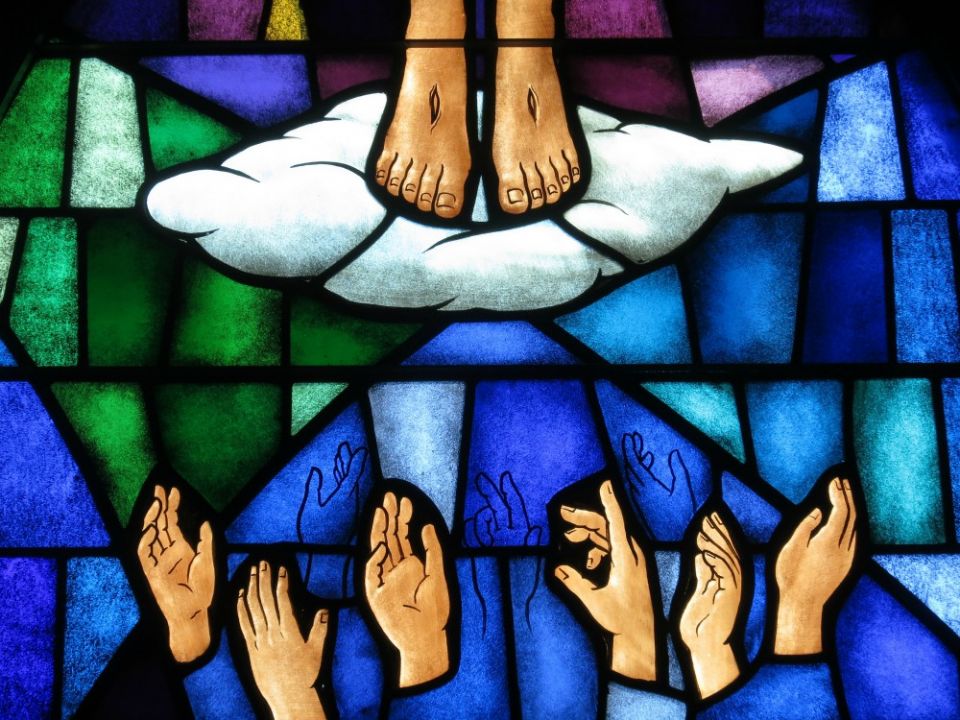
After saying this, he was taken up into a cloud while they were watching, and they could no longer see him. As they strained to see him rising into heaven, two white-robed men suddenly stood among them. “Men of Galilee,” they said, “why are you standing here staring into heaven? Jesus has been taken from you into heaven, but someday he will return from heaven in the same way you saw him go!” (New Living Translation)

“At his Ascension, our Lord entered Heaven, and he keeps the door open for humanity to enter.”

Oswald Chambers

Jesus was taken up to heaven in what Christians celebrate as the “Ascension of the Lord.” This is a hugely important event for followers of Jesus.

The Ascension means that Christ is now presently sitting at God’s right hand, offering continual prayers on our behalf to the Father. We have an advocate, a champion, who has gone before us and secured deliverance from sin, death, and hell.

On top of it all, Christ’s ascension means that Jesus is the universal ruler; he commands a kingdom that will never end. Yes, the Ascension of the Lord is a big deal.

So, why does a day set aside on the Christian Calendar celebrating the Lord’s mighty and redemptive ascension over all creation garner such scant attention from many churches?

Maybe the church has A.D.D. (Ascension Deficit Disorder).

Our clue to the inability to focus on such a grand redemptive event is the disciples’ response when Jesus ascended.

The picture St. Luke paints for us in the account of our Lord’s ascension, is a group of guys looking up into the sky slack-jawed and shoulders hunched.

It took a couple of angels to come along and ask them what in the world they were doing just standing there. Now is not the time to stand and gawk at the clouds, the angels insisted. Jesus will come back when he comes back. You aren’t going to know when. So, now is the time to get busy with what Jesus just told you to do two minutes ago: Tell everyone about me.

Christ’s ascension to heaven is a deeply theological event. It’s freighted with major implications for our prayer lives. And it means Christ is the King to whom we must obey.

Jesus is coming again. In the meantime, there’s to be no cloud-gawking. Instead, there is to be a well-developed and well-cultivated connection with Jesus which proclaims the good news that Christ died, rose from death, and ascended to heaven for mine and your forgiveness of sins and a new clean slate on life.

Trying to peer into the future about how the end of history will shake-out is, frankly, not the job we are called to do. Believers in Jesus aren’t supposed to stand and gawk at the clouds waiting for the Lord’s return, as if we are in some earthly holding tank until heaven. 

Rather, we are to bear witness about the person and work of Jesus. The Ascension of the Lord means we are God’s people blessed with deliverance from the realm of sin, and the hope of Christ’s coming again. The Church everywhere recognizes together the rule and reign of the Lord Jesus.

The world, as we know it, shall eventually come to an end. Until that time, Christians since the time of the ascension have been proclaiming Christ crucified, died, risen, ascended, and coming again.

This is a day of joy and celebration for us. Jesus is our ascended and glorified king! The fate of the earth is with the benevolent and mighty Ruler of all. Jesus is Lord, and no other human leader is. Thank you, Jesus.

The great Reformed Confession, the Heidelberg Catechism, question and answer 49, states:

Q: How does Christ’s ascension to heaven benefit us?

A: First, he is our advocate

            in heaven

            in the presence of his Father.

Second, we have our own flesh in heaven

            as a sure pledge that Christ our head

            will also take us, his members,

            up to himself.

Third, he sends his Spirit to us on earth

            as a corresponding pledge.

            By the Spirit’s power

                        we seek not earthly things

                        but the things above, where Christ is,

                                    sitting at God’s right hand.

Amen.