A (Needed) Perspective on the Christian Life (Acts 27:39-44)

Paul’s Shipwreck, by Ludolf Backhuysen (1630–1708)

When daylight came, they did not recognize the land, but they saw a bay with a sandy beach, where they decided to run the ship aground if they could. Cutting loose the anchors, they left them in the sea and at the same time untied the ropes that held the rudders. Then they hoisted the foresail to the wind and made for the beach. But the ship struck a sandbar and ran aground. The bow stuck fast and would not move, and the stern was broken to pieces by the pounding of the surf.

The soldiers planned to kill the prisoners to prevent any of them from swimming away and escaping. But the centurion wanted to spare Paul’s life and kept them from carrying out their plan. He ordered those who could swim to jump overboard first and get to land. The rest were to get there on planks or on other pieces of the ship. In this way everyone reached land safely. (New International Version)

Saul was an up and rising star among the Jewish Pharisees. He was committed to his religion to the point of approving the death of the first Christian martyr, Stephen. Saul saw followers of Jesus as an aberration to Judaism, and did whatever he could to stamp out the sect.

During one of his travels to do just that, he was confronted by a vision of Christ himself, who said to Saul, “Why do you persecute me?” (Acts 9:4-5) For days Saul was blind, mimicking his spiritual blindness. Both his physical and spiritual eyesight were restored when he came to faith in Christ and began following the words and ways of Jesus. His name changed from Saul to Paul the Apostle.

Paul’s conversion was a complete transformation of life. Yet, this in no way meant that the rest of his life was all rainbows and butterflies. Just the opposite. Saul the Persecutor ended up becoming Paul the Persecuted One.

With the same drive and desire that he once had to do away with Christians altogether, so now the Apostle Paul put all that energy into proclaiming the good news of grace and forgiveness in Jesus Christ his Savior and Lord. And, as one might expect, this put Paul in the crosshairs of his former partners, the Jewish Pharisaical leadership. They now despised Paul.

The Jewish religious authorities hated Paul so much that they made sure to stir up trouble for him everywhere he went, even when it was way out in the Gentile sticks of Galatia and the Gentile strongholds of Greece. And that is essentially why Paul landed in prison. He was portrayed as a rebel and a troublemaker, an enemy of the social order (even though Paul himself was actually a citizen of Rome).

As a Roman citizen, Paul invoked his right to appeal to Caesar. And so, he was put on a Roman prison ship, bound from Palestine to Italy. And that is where we pick up today’s New Testament lesson.

Paul had been through an awful lot of adversity, hardship, and persecution. His faith had become so robust that a terrible storm and a shipwreck could not at all wreck his commitment to Christ. In fact, it only strengthened it.

It’s not always easy to see, but Paul’s words to the Roman Christians are true, even for us today:

And we know that God causes everything to work together for the good of those who love God and are called according to his purpose for them.

The Apostle Paul (Romans 8:28, NLT)

This is an understanding of God, a deep theological perspective, which is informed by years of walking with Jesus in the crucible of suffering and difficulty. It discerns the Lord as caring and loving, even when it appears on the surface that God is mean and capricious.

Many Christians today tend to believe that the redemption which Christ secured is a mere life insurance policy for heaven. And, if it has anything to do with the here-and-now, it means we ought to have all our desires met for earthly peace and abundance. If that were true, both Jesus and Paul were miserable failures as godly people.

God, however, cares about our salvation, our wholeness and integrity as people on this earth. Yes, we have eternal life, yet that life has already begun, and we are to live into it now.

Christianity is a paradoxical faith. The way to gain your life is to lose it. The path to glory is through suffering.

This, my friends, means that we do not gain a good and blessed life by attempting to make everything in life go our way, without any difficulty. Instead, the good life comes by acknowledging the grit and grist of life. It is in the full acceptance of suffering, persecution, illness, death, and our own psychological infirmities that leads us into becoming who God wants us to be – and thus more open to what joy really is.

On the practical level, this means that our failures, our missed expectations, and our dashed hopes are very important pieces to our faith and it’s development. All of this is what awakens us to compassion – both for others and ourselves.

So then, Paul’s perspective on all the difficulties in his life is that they are significant spiritual incubators of faith for him. Paul accepted his sufferings and hardships – and more than that – he valued them for the ways they developed his faith in God and ability to minister to others.

As one old Rabbi once put it:

“There are many rooms in God’s castle. There is, however, one key that opens every room, and that key is a broken heart.”

Ba’al Shem Tov (1698-1760)

Sovereign God, let our love be genuine; help us to hate what is evil, and to hold on to what is good; and empower us to love one another with mutual affection. Strengthen our spirits so that we might serve our Lord Jesus. With you as our faith, we choose to rejoice in hope; be patient in affliction; and persevere in prayer, by means of your blessed Holy Spirit. Amen.

Resist the World, the Flesh, and the Devil (Acts 6:8-15)

St. Stephen Before the Sanhedrin, by Mariotti di Nardo (1394–1424)

Now Stephen, a man full of God’s grace and power, performed great wonders and signs among the people. Opposition arose, however, from members of the Synagogue of the Freedmen (as it was called)—Jews of Cyrene and Alexandria as well as the provinces of Cilicia and Asia—who began to argue with Stephen. But they could not stand up against the wisdom the Spirit gave him as he spoke.

Then they secretly persuaded some men to say, “We have heard Stephen speak blasphemous words against Moses and against God.”

So they stirred up the people and the elders and the teachers of the law. They seized Stephen and brought him before the Sanhedrin. They produced false witnesses, who testified, “This fellow never stops speaking against this holy place and against the law. For we have heard him say that this Jesus of Nazareth will destroy this place and change the customs Moses handed down to us.”

All who were sitting in the Sanhedrin looked intently at Stephen, and they saw that his face was like the face of an angel. (New International Version)

Stephen was a squeaky clean guy – ethical, upright, above board, honest, spiritual – and a profoundly wise and devoted follower of Jesus. Because of his integrity, Stephen was acutely attuned to systemic evil in all its insidious institutional forms; alert and wise to the sinful nature of humanity; and aware of the devil’s evil intentions and machinations in the world.

And because Stephen had a well-developed Christian spirituality, it put him on the radar of the world, the flesh, and the devil – and ended up getting him killed as the first Christian martyr.

The big three enemies of every Christian are: 

  1. a sinful world system (1 John 2:15-16)
  2. the inherent sinful nature (Ephesians 4:22)
  3. the devil, who seeks to exploit the world and the sinful nature to tempt and move us into rebellion against God (1 Peter 5:8-9) 

However, the good news of Christianity is that Jesus Christ has obtained deliverance and freedom for people from each of those enemies. For this deliverance and freedom to be a practical reality in daily experience, each believer in Jesus must know and practice the truth.

In the original Fall of humanity, there was a passive response to the temptation of the serpent, along with an acceptance of doubt concerning God’s Word. There was also an acceptance of insinuations concerning God’s goodness and wisdom, and a deliberate choice to follow the suggestions of Satan and disobey God. 

The seriousness of that Fall into disobedience cannot be overemphasized. The Fall introduced the dimensions of sin, lust, depravity, slavery, ignorance, death and every form of evil into the human race. People became alienated from God and enslaved to the devil. 

The final effects of this sinful bondage will not be completely severed until the final judgment. The hold of the devil is so profound that it took the death and resurrection of Jesus Christ to break that hold and make it possible for humanity to be redeemed.

The descriptive titles given to Satan indicate his activity and what he is up to: 

  • Tempter (Matthew 4:3)
  • Deceiver (Revelation 12:9)
  • Accuser (Revelation 12:10)
  • Adversary (1 Peter 5:8)
  • Murderer and Liar (John 8:44)
  • The god of this world (Ephesians 2:2) 

Holy Scripture indicates that people can be significantly influenced – both personally and corporately – by Satan through: 

  • giving the devil a foothold (Ephesians 4:27)
  • lying (Acts 5:3)
  • physical and spiritual attacks (Job 1-2; 2 Corinthians 12:7)
  • deception (Revelation 12:9-10; 2 Corinthians 11:3)
  • temptation (1 Corinthians 7:5; 1 Thessalonians 3:5)
  • pride (1 Timothy 3:6)
  • corruption (2 Corinthians 11:3)
  • accusations (Revelation 12:10)
  • hypocrisy (Acts 5:1-11) 

People ignore the activity of Satan at their peril.

Just like the religious leaders trying to keep Stephen’s mouth shut, Satan’s purpose and aim is to keep each and every person from spiritual progress and maturity, and from the daily experience of living in faith, hope, and love. 

Unfortunately, the evidence of Satan’s success is all around us, even in the church. Whenever well-meaning Christians experience difficulty in prayer, in reading Scripture, in living for Christ, in overcoming sins, and in maintaining right fellowship with other believers, then this is a reminder of the subtle and powerful effect evil has upon us. 

It is imperative that we know and understand the provision we possess in overcoming the evil one.

Basic knowledge for combating the devil is this:

  • The crucifixion and resurrection the Lord Jesus Christ defeated Satan (Colossians 2:15) 
  • Jesus has destroyed the power of death and delivered those held in bondage (Hebrews 2:14-15) 
  • Christ came to this earth so that he might destroy the works of the devil (1 John 3:8) 
  • Through Christ’s ascension, Jesus is now seated in triumph over Satan (Ephesians 1:19-21; 2:5-6)

In order for this incredible access to become reality, there must be a complete and honest confession which repents and renounces past and present sins. 

If we confess our sins, he is faithful and just and will forgive us our sins and purify us from all unrighteousness.

1 John 1:9, NIV

There must be a complete and honest obedience to God in faith, hope, and love by standing with the truth (Ephesians 6:10-18); and there also needs to be an aggressive resistance of the work of Satan through constant vigilance by being rooted and established in truth. (1 Peter 5:8-9)

If you feel guilty, but don’t know what you’ve done or why you feel this way, then be aggressive about rejecting it. 

If you accuse yourself (“If you were really a Christian you would not be thinking a thought like that…”) then be pugnacious about refusing it. 

If your thoughts, emotions, and desires threaten to get out of hand – then take charge of them and bring them into subjection to Jesus – because you have the authority of Christ’s death, resurrection, and ascension behind you to reject and refuse all error and every satanic whisper.

Know the enemy’s lies and deceptions. Be hawkish about dealing with false guilt and unwarranted shame according to the truth of the gospel. 

Do not attempt to always do this alone; you are not an army of one. Seek the help and assistance of others who will, along with you, pray and practice the truth.

This is the sort of wisdom Stephen teaches us. So, let us learn from him and submit ourselves to the truth we know.

Almighty God, in you are hidden all the treasures of wisdom and knowledge. Open our eyes that we may see the wonders of your Word; and give us grace that we may clearly understand and freely choose the way of your wisdom; through Christ our Lord. Amen.

Jesus Shows Up (John 20:19-31)

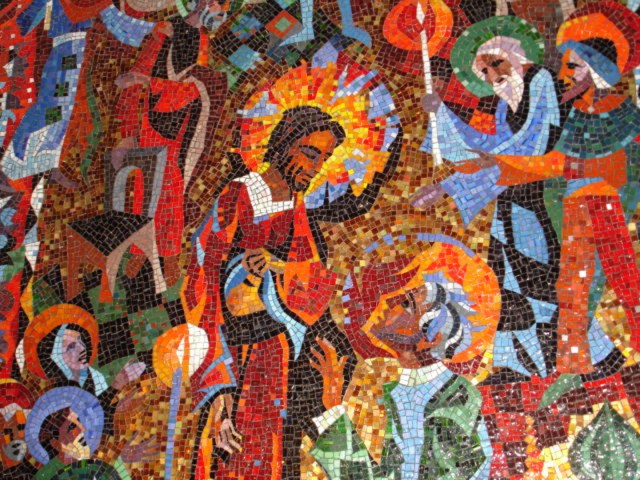
Jesus shows himself to Thomas, by Rowan and Irene LeCompte

On the evening of that first day of the week, when the disciples were together, with the doors locked for fear of the Jewish leaders, Jesus came and stood among them and said, “Peace be with you!” After he said this, he showed them his hands and side. The disciples were overjoyed when they saw the Lord.

Again Jesus said, “Peace be with you! As the Father has sent me, I am sending you.” And with that he breathed on them and said, “Receive the Holy Spirit. If you forgive anyone’s sins, their sins are forgiven; if you do not forgive them, they are not forgiven.”

Now Thomas (also known as Didymus), one of the Twelve, was not with the disciples when Jesus came. So the other disciples told him, “We have seen the Lord!”

But he said to them, “Unless I see the nail marks in his hands and put my finger where the nails were, and put my hand into his side, I will not believe.”

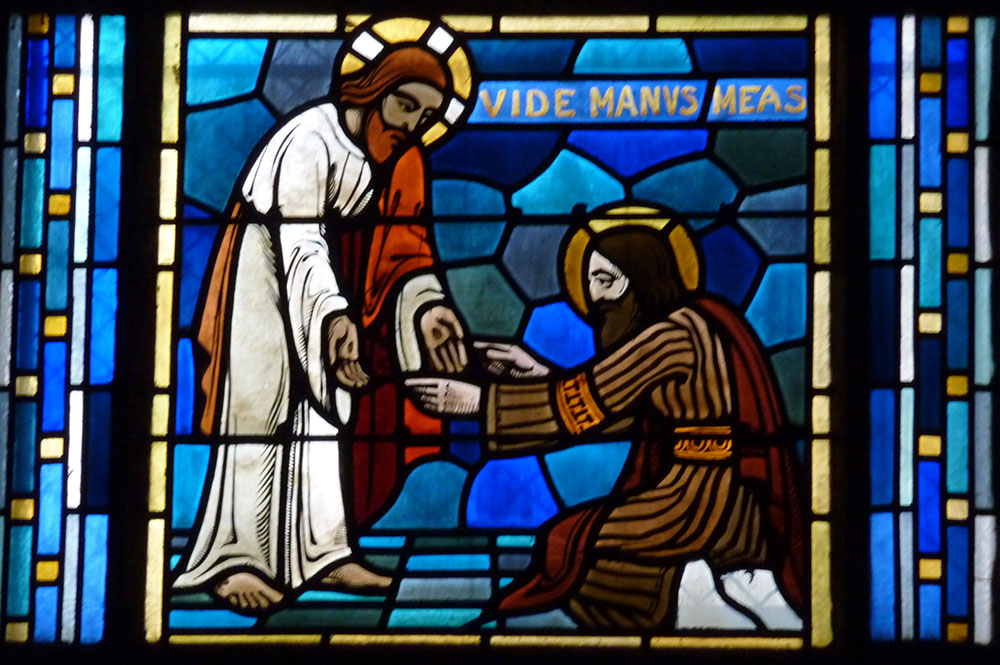
A week later his disciples were in the house again, and Thomas was with them. Though the doors were locked, Jesus came and stood among them and said, “Peace be with you!” Then he said to Thomas, “Put your finger here; see my hands. Reach out your hand and put it into my side. Stop doubting and believe.”

Thomas said to him, “My Lord and my God!”

Then Jesus told him, “Because you have seen me, you have believed; blessed are those who have not seen and yet have believed.”

Jesus performed many other signs in the presence of his disciples, which are not recorded in this book. But these are written that you may believe that Jesus is the Messiah, the Son of God, and that by believing you may have life in his name. (New International Version)

When Jesus shows up, there is peace. Wherever Jesus goes, the Spirit of God is there. When Jesus appears, people believe.

The Meeting

After the crucifixion of Christ, the disciples were huddled together, mostly in fear of being found out and put out by the religious authorities. Out of nowhere, Jesus showed up, smack in the middle of the anxious group of men.

Christ in the center makes all the difference. From this central place, Jesus bestowed to the disciples his peace. The very first word the risen Christ spoke to his disciples was neither a command to stop being afraid, nor a rebuke for sitting around and doing nothing, or disappointment that they all ran away in the final hour of need at the crucifixion; instead, the first word of Christ was a gift of peace.

The presence and peace of Christ melted the disciples’ fear. Christ-centered peace is graciously given; so let us gratefully receive it.

The Reality

Jesus showed up, then showed off his hands and his side. He was not fabricated out of the disciples’ imagination; he was not some ghostly apparition. Rather, Christ was standing in the middle of them, very real, very physical, and very alive.

Christ gave his disciples real truth: actual wounded hands and side on a real body. Christ is risen and alive – not just spiritually, but physically. Since the resurrection of Jesus really happened, then nothing else matters; our joy is complete. We have what we need.

The Mission

As Jesus was sent by the Father, so Jesus sent his disciples; and is still sending us out into the world. And as Jesus came not to condemn the world but to save it, so we go out with words of grace and peace. The church exists for the life of the world – to bless it with the presence and peace of Christ.

“Whoever believes in me does not believe in me only, but in the one who sent me. The one who looks at me is seeing the one who sent me. I have come into the world as a light, so that no one who believes in me should stay in darkness.” (John 12:44-46, NIV)

Our spiritual DNA makes us little Christ’s walking around, doing the will of God, for the benefit of a world in darkness. We bear the name of Christ: Christians, proclaiming a message of life, delighting in God and creation; and not destroying the earth and its inhabitants.

The Gift

Right now, we are not alone. The Holy Spirit has been graciously given to us by Jesus. Although our mission is a big one, our resource for accomplishing it is even bigger. Jesus gives the Spirit in the same way he gives himself – as a sheer gift with no strings attached. Just as God breathed life into the very first people on earth, so Jesus breathes on the disciples and gives them new life and a new heart.

I will give you a new heart and put a new spirit in you; I will remove from you your heart of stone and give you a heart of flesh. And I will put my Spirit in you and move you to follow my decrees and be careful to keep my laws… and you will be my people, and I will be your God. (Ezekiel 36:26-28, NIV)

The Privilege

Christ has redeemed us, forgave us of our guilt and shame. Now, we have the privilege of passing the forgiveness to others. The special mission of the Church is giving Jesus to others with grace and peace, so that they may believe he is truly the risen Lord; and so, receive Jesus, the Spirit, forgiveness, and purpose in life, with Christ at the center of all things.

For the one whom God has sent speaks the words of God, for God gives the Spirit without limit. The Father loves the Son and has placed everything in his hands. Whoever believes in the Son has eternal life, but whoever rejects the Son will not see life, for God’s wrath remains on them.” (John 3:34-36, NIV)

The Risen Lord, by He Qi

The Appearance

When Jesus appears, its good if we also show up to see him. It seems Thomas was late for church and missed the beginning of the service. He wasn’t with the other gathered disciples. Nobody knows where he was or what he was doing. But the important thing is that he did eventually show up, because showing up is the beginning of a changed life.

The Witness

After Jesus showed up, the disciples bore witness to what they saw and heard to Thomas. Yet Thomas, bless his doubting heart, wasn’t having it. He’s a realist. He wants proof, some actual physical evidence. Thomas was clearly a tactile learner because he needs some touch to believe any of this crazy talk of his disciple brothers.

Sometimes Thomas gets a bad rap, but he is really our Everyman. Doubt and skepticism are an important part of a full-orbed and honest faith. Jesus gave Thomas some space, time, and respect to begin wrapping his head and heart around this new reality of resurrection. I wonder if we all can do the same with others.

The Middle

A second time, Jesus shows up in the middle of the disciples. The Word became flesh and dwelt among us – and didn’t become a ghost and hang out in secret places. Once again, peace is given by Jesus to his followers.

Both appearances happen on a Sunday (which is why Christians have always worshiped on Sundays); and both meetings are literally Christ-centered (which every Christian meeting is supposed to be). Every Sunday. Christ always in the middle. Keep those two, and keep them together, and you can’t go wrong.

Jesus appears to Thomas with the Latin words, “See my hands,” in Notre-Dame-du-Rosaire Church, Saint-Ouen, France 

The Invitation

There’s no beating around the bush with Jesus. He immediately engaged Thomas and invited him to touch the wounds on his very real body. Christ knew Thomas’ hang-up, and went right to it. Thomas wanted evidence; Jesus offered it. If we get anything out of this encounter, it is that risen Christ honors honest doubt.

The evidence is here. Now believe it, and stop disbelieving. We have documentary evidence of the Old and New Testaments; the Church’s witness in Creeds, Confessions, and contemporary narratives of changed lives; and the internal testimony of the Holy Spirit. Therefore, look into them carefully and draw a sound conclusion.

The Confession

“My Lord and my God!” That’s the confession and the conclusion Thomas drew from the evidence – not only that Jesus is real, alive, existed, a good teacher; or other people’s Lord and God – but that he is my Lord and my God.

Jesus cared enough for Thomas to specifically meet him personally at his point of need. The grace of God keeps coming and never runs out. Jesus is filled up to the full in both grace and truth.

The Believer

Thomas had the physical evidence. But it doesn’t take that to truly believe. God blesses those who’ve never seen nor touched, but still believe. Jesus was thinking of you and me, and not only the people in front of him at the time. The Lord Jesus blesses us with the gift of peace, grace, and faith.

Though you have not seen him, you love him; and even though you do not see him now, you believe in him and are filled with an inexpressible and glorious joy, for you are receiving the end result of your faith, the salvation of your souls. (1 Peter 1:8-9, NIV)

The Conclusion

All this is for our benefit, so that we, too, may believe that Jesus is the Christ, the Son of the living God. Since Jesus is alive, he continues to bless us with his presence, power, and peace.

Jesus is with us:

  • through the Word of God, giving us his peace, showing up and meeting needs people.
  • at the Table in the sacrament of communion, bringing grace and forgiveness
  • in the person of the Holy Spirit, enabling and energizing us for mission and ministry to the world

It’s a life worth living, a Christ-centered life, full of God’s blessing.

O God and Father of our Lord Jesus Christ, in whom we receive the legacy of a living hope, born again not only from his death but also from his resurrection. May we who have received forgiveness of sins, set others free, until we enter the inheritance that is imperishable and unfading, where Christ lives and reigns with you and the Holy Spirit, one God, now and forever. Amen.

Monday of Holy Week (Psalm 36:5-11)

The Via Dolorosa (Latin: the way of sorrows) is a narrow path through the streets of the Old Jerusalem, the final route traveled by Jesus of Nazareth on the way to his crucifixion.

Your steadfast love, O Lord, extends to the heavens,
    your faithfulness to the clouds.
Your righteousness is like the mighty mountains;
    your judgments are like the great deep;
    you save humans and animals alike, O Lord.

How precious is your steadfast love, O God!
    All people may take refuge in the shadow of your wings.
They feast on the abundance of your house,
    and you give them drink from the river of your delights.
For with you is the fountain of life;
    in your light we see light.

O continue your steadfast love to those who know you
    and your salvation to the upright of heart!
Do not let the foot of the arrogant tread on me
    or the hand of the wicked drive me away. (New Revised Standard Version)

The desert journey is almost over. The sojourn with Jesus in his life and ministry will soon culminate in the ultimate experience of sorrow and joy. The Christian season of Lent is nearly at the end. We are in it’s final days, known as Holy Week.

We have a Holy Week because of love. There is yet another journey we must take, along the Via Dolorosa to the hill of Golgotha, because of God’s steadfast love.

Love suffers. Every parent knows this. Because of a parent’s committed and faithful love toward a child, they feel not only the joys but also the sorrows and pain of their children. I can say that this feeling does not go away, even with adult children. And it’s compounded with grandchildren. Just as our love is big enough to hold multiple children and grandchildren, so our capacity for experiencing deep emotion for their welfare is equally large.

Holy Week reminds us that God’s committed parental love suffers. It is because of God’s immense and steadfast love that there is a road to the cross and a tortured death for Jesus. The cost of our salvation involves a very bloody affair. Deliverance comes at the price of horrible violence. Jesus Christ lived and died for us, because of love.

He suffered much because he loved much.

God’s people, walking in the way of love, quickly discover that it is simultaneously walking in the way of suffering. From Old Testament times through the New Testament era and into the present day, the faithful have always experienced suffering as a central part of their piety and devotion in showing steadfast love. 

The medieval mystics of the Church understood quite well the connection between suffering and love. They could not imagine a Christian life without hardship, difficulty, and persecution. Thomas à Kempis, a sort of pastor to pastors, wrote in the fifteenth century:

“Sometimes it is to our advantage to endure misfortunes and adversities, for they make us enter into our inner selves and acknowledge that we are in a place of exile and that we ought not to rely on anything in this world.  And sometimes it is good for us to suffer contradictions and know that there are those who think ill and badly of us, even though we do our best and act with every good intention….  When men ridicule and belittle us, we should turn to God, who sees our innermost thoughts, and seek His judgment….  It is when a man of good will is distressed, or tempted, or afflicted with evil that he best understands the overwhelming need he has for God, without whom he can do nothing….  It is in such times of trial that he realizes that perfect security and full peace are not to be found in this world.”

Thomas à Kempis, The Imitation of Christ

And yet, it is because of love that suffering is transformed and endured as something wholly other than sheer pain or hurt. Thomas à Kempis went on to say:

“Love is a mighty power, a great and complete good; Love alone lightens every burden and makes the rough places smooth. It bears every hardship as though it were nothing and renders all bitterness sweet and acceptable. The love of Jesus is noble and inspires us to great deeds; it moves us always to desire perfection. Love aspires to high things and is held back by nothing base. Love longs to be free, a stranger to every worldly desire, lest its inner vision become dimmed, and lest worldly self-interest hinder it, or ill-fortune cast it down…. Love knows no limits, but ardently transcends all bounds. Love feels no burden, takes no account of toil, attempts things beyond its strength; love sees nothing as impossible, for it feels able to achieve all things. Love therefore does great things; it is strange and effective; while he who lacks love faints and fails.”

Thomas à Kempis, The Imitation of Christ

Holy Week’s message is certainly one of suffering love. Jesus went to the greatest lengths possible to give Divine steadfast love to humanity. So, let us not shy away from the cross, but journey with Jesus to Golgotha, embracing the love of God for us. In so doing, we will find the inner resources needed to love the world, even in all its unloveliness.

Grant, we pray, almighty God, that, though in our weakness we fail, we may be revived through the Passion of your Only Begotten Son. Who lives and reigns with you in the unity of the Holy Spirit, God, for ever and ever. Amen.