The Via Dolorosa(Latin: the way of sorrows) is a narrow path through the streets of the Old Jerusalem, the final route traveled by Jesus of Nazareth on the way to his crucifixion.
Your steadfast love, O Lord, extends to the heavens, your faithfulness to the clouds. Your righteousness is like the mighty mountains; your judgments are like the great deep; you save humans and animals alike, O Lord.
How precious is your steadfast love, O God! All people may take refuge in the shadow of your wings. They feast on the abundance of your house, and you give them drink from the river of your delights. For with you is the fountain of life; in your light we see light.
O continue your steadfast love to those who know you and your salvation to the upright of heart! Do not let the foot of the arrogant tread on me or the hand of the wicked drive me away. (New Revised Standard Version)
The desert journey is almost over. The sojourn with Jesus in his life and ministry will soon culminate in the ultimate experience of sorrow and joy. The Christian season of Lent is nearly at the end. We are in it’s final days, known as Holy Week.
We have a Holy Week because of love. There is yet another journey we must take, along the Via Dolorosa to the hill of Golgotha, because of God’s steadfast love.
Love suffers. Every parent knows this. Because of a parent’s committed and faithful love toward a child, they feel not only the joys but also the sorrows and pain of their children. I can say that this feeling does not go away, even with adult children. And it’s compounded with grandchildren. Just as our love is big enough to hold multiple children and grandchildren, so our capacity for experiencing deep emotion for their welfare is equally large.
Holy Week reminds us that God’s committed parental love suffers. It is because of God’s immense and steadfast love that there is a road to the cross and a tortured death for Jesus. The cost of our salvation involves a very bloody affair. Deliverance comes at the price of horrible violence. Jesus Christ lived and died for us, because of love.
He suffered much because he loved much.
God’s people, walking in the way of love, quickly discover that it is simultaneously walking in the way of suffering. From Old Testament times through the New Testament era and into the present day, the faithful have always experienced suffering as a central part of their piety and devotion in showing steadfast love.
The medieval mystics of the Church understood quite well the connection between suffering and love. They could not imagine a Christian life without hardship, difficulty, and persecution. Thomas à Kempis, a sort of pastor to pastors, wrote in the fifteenth century:
“Sometimes it is to our advantage to endure misfortunes and adversities, for they make us enter into our inner selves and acknowledge that we are in a place of exile and that we ought not to rely on anything in this world. And sometimes it is good for us to suffer contradictions and know that there are those who think ill and badly of us, even though we do our best and act with every good intention…. When men ridicule and belittle us, we should turn to God, who sees our innermost thoughts, and seek His judgment…. It is when a man of good will is distressed, or tempted, or afflicted with evil that he best understands the overwhelming need he has for God, without whom he can do nothing…. It is in such times of trial that he realizes that perfect security and full peace are not to be found in this world.”
Thomas à Kempis, The Imitation of Christ
And yet, it is because of love that suffering is transformed and endured as something wholly other than sheer pain or hurt. Thomas à Kempis went on to say:
“Love is a mighty power, a great and complete good; Love alone lightens every burden and makes the rough places smooth. It bears every hardship as though it were nothing and renders all bitterness sweet and acceptable. The love of Jesus is noble and inspires us to great deeds; it moves us always to desire perfection. Love aspires to high things and is held back by nothing base. Love longs to be free, a stranger to every worldly desire, lest its inner vision become dimmed, and lest worldly self-interest hinder it, or ill-fortune cast it down…. Love knows no limits, but ardently transcends all bounds. Love feels no burden, takes no account of toil, attempts things beyond its strength; love sees nothing as impossible, for it feels able to achieve all things. Love therefore does great things; it is strange and effective; while he who lacks love faints and fails.”
Thomas à Kempis, The Imitation of Christ
Holy Week’s message is certainly one of suffering love. Jesus went to the greatest lengths possible to give Divine steadfast love to humanity. So, let us not shy away from the cross, but journey with Jesus to Golgotha, embracing the love of God for us. In so doing, we will find the inner resources needed to love the world, even in all its unloveliness.
Grant, we pray, almighty God, that, though in our weakness we fail, we may be revived through the Passion of your Only Begotten Son. Who lives and reigns with you in the unity of the Holy Spirit, God, for ever and ever. Amen.
In the beginning was the Word and the Word was with God and the Word was God. The Word was with God in the beginning. Everything came into being through the Word, and without the Word nothing came into being. What came into being through the Word was life, and the life was the light for all people.
The light shines in the darkness, and the darkness doesn’t extinguish the light.
A man named John was sent from God. He came as a witness to testify concerning the light, so that through him everyone would believe in the light. He himself wasn’t the light, but his mission was to testify concerning the light.
The true light that shines on all people was coming into the world. (Common English Bible)
Jesus lives here. And that’s because he chose to – so that we might have an abundant life out in the bright sunshine of grace.
The Word has always been and always will be. The Word decided to show up on this earth in an unexpected way, to bring light, illumination, and awareness to a dark world and the shadowy places of our hearts.
Frankly, my friends, Jesus abides with your every dream about life and happiness, hope and fulfillment, purpose and direction, emotional healing and wholeness. Christ is for you, to experience a thriving and flourishing daily life. And what’s more:
To live the Christian life, to center your entire life totally and completely around the person and work of Jesus Christ, is an act of rebellion against all that is dark, unjust, and broken in this world.
Jonathan Edwards, one of the greatest intellects in American history, was a pastor, theologian, and scholar. He insisted that the hope of humanity lies with turning to and dwelling with Jesus:
“Conversion to Jesus Christ is a great and glorious work of God’s power, at once changing the heart, and infusing life into the dead soul…. Jesus Christ is the highest good of the reasonable creature. The enjoyment of him is our proper focus; and is the only happiness with which our souls can be satisfied.”
Jonathan Edwards
St. Augustine lived centuries ago. A big chunk of his life was apart from Christianity. He knew what it felt like to be without Jesus. Yet, after his conversion, life with Jesus was so compelling for Augustine, that his vigorous intellect and spiritual devotion were put to work, leaving an enormous footprint that can be found even today, in both the church and the academy.
Reflecting upon his life, and all he had experienced and accomplished, Augustine uttered this simple prayer to God:
“You have made us for yourself, Lord Jesus, and our hearts are restless until they rest in you.”
St. Augustine
Arguably, Christianity’s greatest convert was the Apostle Paul. Once a vehement opponent to Christ and Christ’s followers, Paul had a dramatic encounter that left him completely undone. He gave his life to Jesus and became Christianity’s most influential missionary. Here is a smattering of his thoughts on Jesus:
Though he [Christ] was in the form of God, he did not consider being equal with God something to exploit. But he emptied himself by taking the form of a slave and by becoming like human beings. When he found himself in the form of a human, he humbled himself by becoming obedient to the point of death, even death on a cross. (Philippians 2:6-8, CEB)
His glorious power will make you patient and strong enough to endure anything, and you will be truly happy… For God has rescued us from the dark power of Satan and brought us into the kingdom of his dear Son, who forgives our sins and sets us free. (Colossians 1:11, 13, CEV)
Nothing is as wonderful as knowing Christ Jesus my Lord… God accepted me simply because of my faith in Christ. (Philippians 3:8-9, CEV)
We find ourselves standing where we always hoped we might stand—out in the wide open spaces of God’s grace and glory, standing tall and shouting our praise… Christ arrives right on time to make this happen. He didn’t, and doesn’t, wait for us to get ready. He presented himself for this sacrificial death when we were far too weak and rebellious to do anything to get ourselves ready. (Romans 5:2, 6, MSG)
Jesus is the One who fills our hearts with love, delivers our wayward souls from emptiness, and sets our feet on the solid rock of faith and hope in God. The love of God is found in Jesus. And Jesus so closely identifies with us, that we enjoy God’s peace and healing in our lives. Not just personal transformation, but systemic change in institutions and corporations, families and neighborhoods, is possible in Christ.
To live for Jesus is an act of subversion against all that is evil, dark, and unjust. Imagine a world where love rules, not hate; where creativity and faith abound, and are not squelched; and, hope, not hurt, fuels progress into a bright future. It is a world where the light of Jesus brings life.
“I am the light for the world! Follow me, and you won’t be walking in the dark. You will have the light that gives life.”
Jesus (John 8:12, CEV)
The God who said, “Out of darkness the light shall shine!” is the same God who made his light shine in our hearts, to bring us the knowledge of God’s glory shining in the face of Christ. (2 Corinthians 4:6, GNT)
I am grateful that God so loved the world, loved me and loved you, that he gave his one and only Son – the Sun of Righteousness for our benefit so that we might have life.
Praise God from whom all blessings flow Praise Him, all creatures here below Praise Him above, ye heavenly host Praise Father, Son, and Holy Ghost. Amen.
So he came to a town in Samaria called Sychar, near the plot of ground Jacob had given to his son Joseph. Jacob’s well was there, and Jesus, tired as he was from the journey, sat down by the well. It was about noon.
When a Samaritan woman came to draw water, Jesus said to her, “Will you give me a drink?” (His disciples had gone into the town to buy food.)
The Samaritan woman said to him, “You are a Jew and I am a Samaritan woman. How can you ask me for a drink?” (For Jews do not associate with Samaritans.)
Jesus answered her, “If you knew the gift of God and who it is that asks you for a drink, you would have asked him and he would have given you living water.”
“Sir,” the woman said, “you have nothing to draw with and the well is deep. Where can you get this living water? Are you greater than our father Jacob, who gave us the well and drank from it himself, as did also his sons and his livestock?”
Jesus answered, “Everyone who drinks this water will be thirsty again, but whoever drinks the water I give them will never thirst. Indeed, the water I give them will become in them a spring of water welling up to eternal life.”
The woman said to him, “Sir, give me this water so that I won’t get thirsty and have to keep coming here to draw water.”
He told her, “Go, call your husband and come back.”
“I have no husband,” she replied.
Jesus said to her, “You are right when you say you have no husband. The fact is, you have had five husbands, and the man you now have is not your husband. What you have just said is quite true.”
“Sir,” the woman said, “I can see that you are a prophet. Our ancestors worshiped on this mountain, but you Jews claim that the place where we must worship is in Jerusalem.”
“Woman,” Jesus replied, “believe me, a time is coming when you will worship the Father neither on this mountain nor in Jerusalem. You Samaritans worship what you do not know; we worship what we do know, for salvation is from the Jews. Yet a time is coming and has now come when the true worshipers will worship the Father in the Spirit and in truth, for they are the kind of worshipers the Father seeks. God is spirit, and his worshipers must worship in the Spirit and in truth.”
The woman said, “I know that Messiah” (called Christ) “is coming. When he comes, he will explain everything to us.”
Then Jesus declared, “I, the one speaking to you—I am he.”
Just then his disciples returned and were surprised to find him talking with a woman. But no one asked, “What do you want?” or “Why are you talking with her?”
Then, leaving her water jar, the woman went back to the town and said to the people, “Come, see a man who told me everything I ever did. Could this be the Messiah?” They came out of the town and made their way toward him.
Meanwhile his disciples urged him, “Rabbi, eat something.”
But he said to them, “I have food to eat that you know nothing about.”
Then his disciples said to each other, “Could someone have brought him food?”
“My food,” said Jesus, “is to do the will of him who sent me and to finish his work. Don’t you have a saying, ‘It’s still four months until harvest’? I tell you, open your eyes and look at the fields! They are ripe for harvest. Even now the one who reaps draws a wage and harvests a crop for eternal life, so that the sower and the reaper may be glad together. Thus the saying ‘One sows and another reaps’ is true. I sent you to reap what you have not worked for. Others have done the hard work, and you have reaped the benefits of their labor.”
Many of the Samaritans from that town believed in him because of the woman’s testimony, “He told me everything I ever did.” So when the Samaritans came to him, they urged him to stay with them, and he stayed two days. And because of his words many more became believers.
They said to the woman, “We no longer believe just because of what you said; now we have heard for ourselves, and we know that this man really is the Savior of the world.” (New International Version)
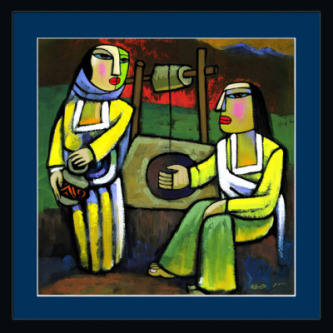
Samaritan Woman and Jesus at the Well, by He Qi
Samaria, back in Christ’s day, was viewed by many as an infamous place, full of untrustworthy people who were a mongrel mix of Jewish and ancient Assyrian blood. And their religion was most suspect of all – an unholy blend of Jewish and Gentile practices. So, no respectable Jewish person ever got near Samaria or even talked with a Samaritan.
Jesus, however, saw things differently. He did not avoid the territory but confidently walked through Samaria. Christ had no problem stopping to rest on his journey in a foreign area. That’s because Jesus didn’t class people into groups, nor did he attach adjectives to people, such as “those” Samaritans. He had no obstacles between himself and others.
Which is why an organic conversation happened between Jesus and a Samaritan woman. Christ simply saw a human being who happened to be a woman and a Samaritan. He acknowledged both her gender and her ethnicity without those being a problem. Not even Christ’s knowledge of her string of husbands was an issue in conversing with her.
Every time I read this narrative of Jesus interacting with the Samaritan woman, I imagine what all the non-verbal communication was like. I’m sure the conversation was as much about Christ’s affect, gestures, and tone of voice, as it was his well-placed words. I fully believe both his verbal and non-verbal communication was perfectly congruent with each other, giving the woman a compelling sense that her ultimate needs could be met with the living well of a person in front of her.
Water gives life. And Jesus, as living water, gives new life. A bunch of failed relationships testified to the woman’s dissatisfaction. Even though we hear no more about her after this story in the Bible, we as readers get the overwhelming sense that the woman finally found satisfaction. The love which kept slipping through her fingers now had staying power.
Jesus stood and said in a loud voice, “Let anyone who is thirsty come to me and drink. Whoever believes in me, as Scripture has said, rivers of living water will flow from within them.” (John 7:37-38, NIV)
We need the living water of Jesus as a river flowing straight from him to us — replenishing, renewing, sustaining, and breaking through every barrier in its path like a mighty flood overcoming and pushing everything out of the way that blocks its path so that our love can overflow onto all sorts of people, like a Samaritan woman.
The disciples come along, seemingly confused about this scene of Jesus and a Samaritan woman. So they blurt out something like the stereotypical mother concerned for her son saying, “Sit down and eat some of Mama’s pasta. You need some food!” As if preparing and serving a meal will make everything better.
Food has both the power to bring us together, as well as separate us. A meal can create the conditions for fellowship, acceptance, and enjoyment. On the other hand, sitting down to eat can also be a way to avoid painful emotions, and so, becomes an obstacle, keeping love at bay.
The disciples were uncomfortable and maybe a bit stressed. Looking to fill up with food instead of with God, their sense of unfulfillment was coming out sideways by opening the pantry and looking for comfort food. Jesus saw through the situation and put the focus on the disciples’ spiritual hunger.
Paying attention to our vocation and discovering humble work in the service of God, rather than a vacation to the fridge to cover unwanted feelings, is the essence of Christ’s interaction with his disciples.
People are much more ready for the gospel than we think. There are times we can become insular, lost within our own heads, that we are then unable to see the world as ripe for a harvest of people who are eager to be gathered into a community of redemption and love.
Jesus had a significant interaction with the Samaritan woman – despite the social prohibitions of the time. Shenanigans like this, by Christ, got a lot of people’s undies in a bundle. The disciples, having a front seat to most of Christ’s ways, did a few too many palms to the forehead, believing their Rabbi’s behavior was going to make him unpopular. They feared no one would follow him.
Looks like the disciples didn’t quite get that one right.
The Samaritan woman received Jesus as Living Water, having her ultimate needs met by the Lord of all. The disciples hadn’t quite caught up to this, so fell back on their old ways of physical food and drink to assuage the awkward uncomfortable feelings happening inside them.
The woman became a wellspring of good news to her community. Whereas the disciples eventually became a fountain of the gospel after Christ’s death and resurrection, they are here only an annoying drip from the kitchen faucet. A non-descript ethnically suspect woman of dubious character coming to faith was meant by Jesus to open the disciples’ eyes to a new reality:
The good news of Christ is meant for the world, not just Jewish men.
The disciples were given the opportunity to participate a mission of bringing the love of God where love wasn’t present, of helping all kinds of people awaken to the deep spirituality within them, of lifting their downcast faces of guilt and shame to see the Living God bless the world with the body and blood of Jesus.
All of our work, no matter how big or small, is made possible by God, the great Chef of the universe. God has done all the preparations of chopping the onions, mincing the garlic, slicing the carrots, and peeling the potatoes so that we, his followers, can make a savory stew of diverse people sharing a common pot of God’s love and hospitality. It is, therefore, our privilege to be the wait staff who serves the meal to a whole host of persons.
O God, you made us in your own image, and you have redeemed us through your Son Jesus Christ: Look with compassion on the whole human family; take away the arrogance and hatred which infect our hearts; break down the walls that separate us; unite us in bonds of love; and work through our struggle and confusion to accomplish your purposes on earth; that, in your good time, all nations and races may serve you in harmony around your heavenly throne; through Jesus Christ our Lord. Amen.
The woman caught in adultery, by Chinese artist He Qi
[The earliest manuscripts and many other ancient witnesses do not have John 7:53—8:11. A few manuscripts include these verses, wholly or in part, after John 7:36, John 21:25, Luke 21:38 or Luke 24:53.]
Then they all went home,but Jesus went to the Mount of Olives.
At dawn he appeared again in the temple courts, where all the people gathered around him, and he sat down to teach them.The teachers of the law and the Pharisees brought in a woman caught in adultery. They made her stand before the groupand said to Jesus, “Teacher, this woman was caught in the act of adultery.In the Law Moses commanded us to stone such women.Now what do you say?”They were using this question as a trap,in order to have a basis for accusing him.
But Jesus bent down and started to write on the ground with his finger.When they kept on questioning him, he straightened up and said to them, “Let any one of you who is without sin be the first to throw a stoneat her.”Again he stooped down and wrote on the ground.
At this, those who heard began to go away one at a time, the older ones first, until only Jesus was left, with the woman still standing there.Jesus straightened up and asked her, “Woman, where are they? Has no one condemned you?”
“No one, sir,” she said.
“Then neither do I condemn you,”Jesus declared. “Go now and leave your life of sin.” (New International Version)
“Do you ever wonder what the greatest gift is that has ever been given? It is this: mercy. If you wonder what this means, practice mercy and your questions will fade. Live into mercy and you will become what you love. For love unites us in our loving, not in our being. So give yourself to love and love yourself in giving. The rest will follow of its own.”
Meister Eckhart (1260–1328, C.E.)
Mercy is scandalous. I wish it weren’t. It seems crazy that this is the case. But here we are, living in an unmerciful world. And even more absurd is that many religious leaders want nothing to do with mercy. The leaders in Christ’s day were trying to get Jesus to depart from his normal routines of grace so that he would appear fickle, unsteady, and weak.
The religious leaders got together and decided to put a woman forward who was clearly a sinner, caught in the act. What to do with her? they asked Jesus. They were, of course, trying to trap him. On the one hand, if Jesus didn’t condemn her, the leaders could say Christ was not upholding the Law. And, on the other hand, if Christ acquiesced in killing the adulterous woman, then the leaders could say that Jesus was inconsistent and unreliable.
The response of Jesus was to stoop down and say nothing. I believe Christ was demonstrating how utterly unworthy the religious leaders were to be heard on the subject. I don’t think there’s anything to conjecture about writing in the sand. It was like taking the physical posture of turning his back on them or putting up a hand, as if he isn’t going to watch the silly circus scene that’s happening.
Jesus wasn’t about to be deterred from his ministry of mercy, from preaching grace, and from hobnobbing with “sinners.” But, since the religious leaders kept up their questioning like a pack of obnoxious yippee dogs, Jesus straightened up and decided to deal with this unmerciful display happening in front of him.
He simply stated that if they want judgment, not mercy, then the one who is without any sin ought to throw the first stone to kill the woman and execute judgment upon her. If innocence is so all-fired important, then it will take an innocent person to punish the guilty.
Whoever accuses another person ought to first look in the mirror to see if there is any innocence reflecting back. And the stark truth is that any old Tom, Dick, or Harry is not qualified to level judgment on another and condemn them. Christ is unmasking the hypocrite who flatter themselves with the supposed high ground of their innocence.
In reality, they are excessively severe and harsh, spiritual felons who have no right to censure others. There is a place for loving correction and appropriate judgment. However, there is never a place in the kingdom of God for eliminating mercy and punishing others with either our hands or our tongues.
Although the wicked and hypocritical religious leaders intended to entrap Jesus by their unholy shenanigans, the tables were quickly turned and their true shame was exposed for what it is – being so darned unmerciful and unloving. Their own guilt is proved by walking away from the scene.
No one has the right to be a jerk. And it is definitely not okay for any person, of all things, to tempt Jesus Christ! And yet, too many religious folk through the centuries have done just that.
None of this means that sin is okay and we can do whatever we want. No, Christ calls us to go and sin no more. Mercy frees us to do just that. Mercy is the key which unlocks the door of freedom and allows us to leave one room for another, to arise from the dark basement of disobedience and despair and enter the bright living room of forgiveness, grace, and life.
Let us then imbibe mercy as the elixir of life – because it is. The world cannot survive without mercy.
We are not the arbiters of who can or cannot have mercy. God said:
“I will have mercy on whom I will have mercy, and I will have compassion on whom I will have compassion.” (Exodus 33:19, NIV)
The Lord has always been characterized as merciful:
Remember, Lord, your great mercy and love, for they are from of old. Do not remember the sins of my youth and my rebellious ways; according to your love remember me, for you, Lord, are good. (Psalm 25:6-7, NIV)
Mercy is of high value to God, who said:
“For I desire mercy, not sacrifice, and acknowledgment of God rather than burnt offerings.”
Hosea 6:6, NIV
Because God is merciful, the Lord calls people to show mercy, as well:
He has shown you, O mortal, what is good. And what does the Lord require of you? To act justly and to love mercy and to walk humbly with your God. (Micah 6:8, NIV)
“Then the master called the servant in. ‘You wicked servant,’ he said, ‘I canceled all that debt of yours because you begged me to. Shouldn’t you have had mercy on your fellow servant just as I had on you?’” (Matthew 18:32-33, NIV)
Speak and act as those who are going to be judged by the law that gives freedom, because judgment without mercy will be shown to anyone who has not been merciful. Mercy triumphs over judgment. (James 2:12-13, NIV)
May the gracious and almighty God have mercy on you and forgive you all your sins through our Lord Jesus Christ. Amen.











 Rev. Tim Ehrhardt