
The Need to Defend a Ministry (2 Corinthians 10:1-11)

Mosaic of St. Paul Preaching, 12th century, Duomo, Monreale, Sicily, Italy

By the humility and gentleness of Christ, I appeal to you—I, Paul, who am “timid” when face to face with you, but “bold” toward you when away! I beg you that when I come I may not have to be as bold as I expect to be toward some people who think that we live by the standards of this world. 

For though we live in the world, we do not wage war as the world does. The weapons we fight with are not the weapons of the world. On the contrary, they have divine power to demolish strongholds. We demolish arguments and every pretension that sets itself up against the knowledge of God, and we take captive every thought to make it obedient to Christ. And we will be ready to punish every act of disobedience, once your obedience is complete.

You are judging by appearances. If anyone is confident that they belong to Christ, they should consider again that we belong to Christ just as much as they do. So even if I boast somewhat freely about the authority the Lord gave us for building you up rather than tearing you down, I will not be ashamed of it. I do not want to seem to be trying to frighten you with my letters. 

For some say, “His letters are weighty and forceful, but in person he is unimpressive and his speaking amounts to nothing.” Such people should realize that what we are in our letters when we are absent, we will be in our actions when we are present. (New International Version)

I don’t know about you, but I’m not a fan of feeling like I have to defend my ministry – my philosophy of how to go about things, my hermeneutics, my words, my actions, my clothes, my food – and pretty much everything about me. Believe it or not, I’ve been criticized for things like not having shiny enough shoes (and having too nice of shoes), the make and model of the car I drive (and don’t drive), being too serious (and not being serious enough).

So, for me, I detect in the Apostle Paul’s retort to the Corinthian Church, an exasperation. Reading between the lines, I can hear him saying something like, “I can’t believe I’m even talking about this stuff because you guys are about as spiritually aware as a bowling ball – and bowling balls haven’t even been invented yet. Heck, I don’t even know what a bowling ball is! That’s about how much you know what you’re talking about. Sheesh!”

Yet, despite Paul’s annoyance and displeasure with the Corinthians’ line of thinking, the Apostle still made up his mind to craft a response that was as humble and gentle as he could possible come up with.

A modern archaeological site at Corinth, Greece

The Church’s first criticism toward Paul is that he is bold from a distance, but up close and personal, rather weak and unimpressive as an Apostle. I’m willing to be that every church pastor in the U.S. is more than able to know what this feels like in putting themselves in the Apostle’s shoes.

It’s an age old criticism that every preacher faces at various points, or at least with some sermons or writings. The people just don’t appreciate or like what they’re hearing or reading. It often comes out in the ubiquitous phrase, “I’m just not getting spiritually fed.” Wrapped up in that phrase is not only the criticism of oratorical skills, but also that they don’t like something about the preacher’s physical appearance, particular idiosyncrasies, or interaction with other people.

The second criticism of Paul by the Corinthians is that he acts too much according to human standards. In other words, the Apostle is just too worldly for them. If you happen to know anything about the ancient Corinthian Church, you’re either doing a major eye roll right now, or you’re just plain busting a gut in laughter.

There’s no more worldly church in the New Testament than the Corinthian Church. To have them bringing this point up to Paul is both laughable and downright sad. But again, every preacher nowadays knows the criticism all too well. For example, many pastors aren’t paid well with the convoluted reasoning that they shouldn’t be tempted toward worldliness – even though the parishioners themselves have no problem owning large homes, multiple cars, and high paying jobs.

The Corinthians were likely also concerned about Paul’s egoism – that he’s too much into worldly power and philosophies. Again, laughable stuff, considering the source. Yet again, these sorts of criticisms are rife within many churches. And the critics themselves tend to be ones who are enamored with wanting power and control for themselves, wanting to ensure that no one, including an upstart pastor, never treads upon their mastering of a very small world.
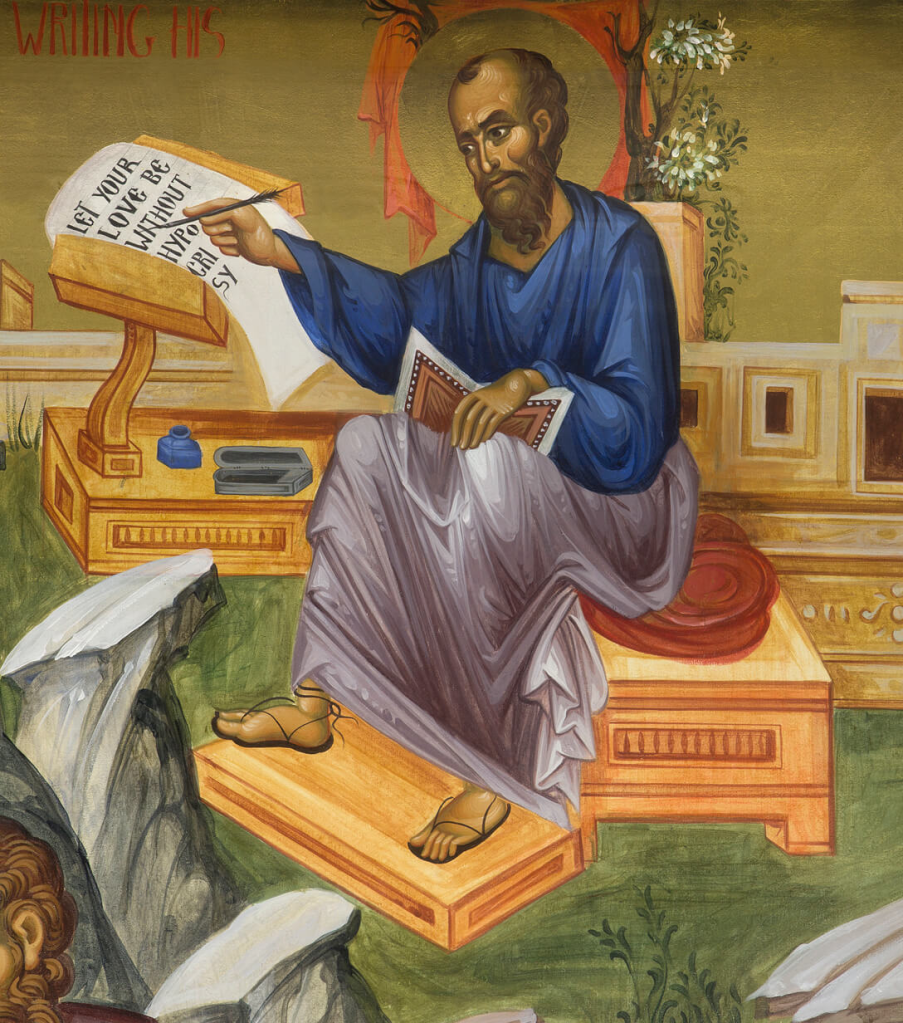
Orthodox icon of St. Paul writing to the churches

Paul responds to this by stating that he is, of course, a human being. However, he wields a different kind of power. Employing military metaphors, the Apostle describes the weapons that he uses as capable of destroying spiritual strongholds of arguments, and obstacles of pride against the knowledge of God – the very sorts of strongholds that were present among the Corinthians.

What’s more, Paul takes captive every thought and makes it obedient to Christ, and not to a self-serving agenda of worldly control and power. And he will use those weapons, if necessary, if the Corinthians keep up their petty criticisms and worldly behavior.

The bottom line of it all is that Christ made Paul an Apostle; and nobody in the Corinthian Church was made one. Paul’s authority was given, not taken, and he will use it to build up and not tear down. In other words, the Apostle Paul was committed to fulfilling his apostolic commission by establishing churches, building up those churches in the strength of faith, and protecting them from misguided and wrongheaded ways of operating.

All I have to say to this is that I am very glad that the Church belongs to Christ. Because that’s the only way we can still be talking about the Church still existing all these centuries later. God works, despite all the human foibles and nonsense.

Even though I talk like this (as does Paul!) there are still good Christian believers and good Christian churches in this world. Not every parishioner lacks self-awareness, is short-sighted, and has a plank in their eye. Nor are all pastors just in it for attention and some sort of worldly gain.

I’m still living and breathing, ministering and mentoring, after decades of Christian labor because of many good people who treated me well, spent good time with me, as well as those who received my teaching and my love, put it into practice, and have produced a harvest of righteousness beyond what I could imagine.

It would be good for all of us to experience supportive community, spiritual maturity, and wise ministry to others. If we can go through any process – no matter what it is – with the humility and meekness of Christ, then no matter what the end is, we have brought some peace and goodness into this old fallen world of ours.

And there is no shame in that!

Almighty and eternal God: Every good and perfect gift comes from you. Send down upon our pastors and parishioners alike a healthy spirit of grace and goodness, so that we all together may truly please you in all we say and do; and continually pour out your divine blessing upon us all. We ask this for the honor of your Son, our Advocate and Friend, Jesus Christ our Lord. Amen.

The Son (Hebrews 1:1-4)

In the past God spoke to our ancestors through the prophets at many times and in various ways, but in these last days he has spoken to us by his Son, whom he appointed heir of all things, and through whom also he made the universe. The Son is the radiance of God’s glory and the exact representation of his being, sustaining all things by his powerful word. After he had provided purification for sins, he sat down at the right hand of the Majesty in heaven. So he became as much superior to the angels as the name he has inherited is superior to theirs. (New International Version)

For Christians everywhere, we are only a few days until the culmination of Advent season: observing, remembering, and celebrating the birth of our Lord and Savior, Jesus Christ.

Christianity discerns that all of history hinges on it’s midpoint of the incarnation and birth, life and ministry, death and resurrection, and ascension and glorification of Jesus. Everything in the Bible looks to Christ.

The entire Old Testament Scriptures point forward to the time of Christ; the Gospels focus upon him; and all the rest of the New Testament points back to Jesus as the fulfillment of all God’s good promises to people.

Indeed, the Lord Jesus is central to everything in the Christian’s world and life view. Jesus Christ is the center of all Christian worship, Christian belief, Christian practice, Christian ethics, and the entirety of the Christian life.

The New Testament book of Hebrews has a lot to do with this approach to life. It’s overarching theme and focus is to point out and demonstrate the superiority of Jesus over everything and everyone in all of history.

And the reason the author of Hebrews takes pains to do this for a lengthy thirteen chapters, is that his recipients needed the reminder and the exhortation that their difficulties and hardships in living the Christian life is worth it. Jesus is worth completely centering our lives around because he is indeed the central figure of literally everything.

Historically, God spoke through many prophets. Yet, Jesus is the ultimate prophet, because he is not merely a servant of God; Christ is the very Son of God who is over all of God’s big world – and even participated in making the world.

Like Father, like Son. Jesus Christ exemplifies and shows us the very nature of God. He is the light of God’s glory, representing God in all his words and ways of being in the world.

What’s more, Jesus not only came to reveal God to us, but also to get involved in saving us from ourselves by actually becoming one of us. And after all his work was done, and his earthly life over, he sat down in his rightful place – showing us that it is finished, once and for all.

We need no longer try and purify or perfect ourselves, to try and fix all that we have messed up in this life, or to prop up our fragile egos to make it at least look like we have it all together. None of this is needed because the Lord Jesus Christ became our Savior, delivering us from a hole so deep that there was no way we could ever climb out of it on our own.

So, it is rather ironic that people (even and especially Christians) can let Jesus get pushed out of the Advent and Christmas seasons as less than superior to our worries about finances, discouragements about family, and wonderings about the future. Advent is intended to put our focus and our delight where it rightly belongs, in Jesus Christ, our Lord and Savior.

Embedded within the season of Advent are a message and a mission. The Gospel of John begins with the great proclamation that the Word became flesh and made his dwelling among us. God enters into human history in the person of Jesus. It is a message of grace and hope, completely centering around Christ. 

It is also a story – the greatest ever told – of the Creator God loving the creatures so much as to become one of them. This redemption narrative gives shape to our own witness. We simply tell the story of God’s love to humanity through the sending of the Son, Jesus, to deliver us from sin, death, and hell and bring us into a kingdom full of grace, joy, wholeness, and love.

Some may believe that Jesus laid aside his glory in order to be among us. I disagree. I believe that coming to this earth was the logical and loving thing to do in order to show and live into the radiance of God’s glory.

The word “glory” in the Hebrew Scriptures literally means to be “heavy.” In other words, God carries a lot of weight, namely because God is able to do so. That is, God is glorious. To enter this world and bear the great burden of human suffering and sin is perhaps the most glorious thing that God could ever do.

So, when we talk of the glory of God in Jesus Christ, we are really talking about the ultimate burden bearer showing who God is really like. The God, who is Love, is the God of glory, and the two are actually both sides of the same coin.

Therefore, Christians, the little Christs who walk about this earth, show the light of the glory of God in Jesus Christ when they carry one another’s burdens:

Carry each other’s burdens, and in this way you will fulfill the law of Christ. (Galatians 6:2, NIV)

In a few days, gift giving and receiving will take place. And that is appropriate. What is also more than appropriate is to be able to relate to each other in such a way that we are showing the radiance of Jesus Christ in helping others carry their heavy emotional and/or spiritual loads.

As light comes into this world through the birth of the Son, so also let your light shine before others, so that they may see your good deeds and glorify your Father in heaven. (Matthew 5:16) Amen.

The Parable of the Two Sons (Matthew 21:28-32)

Wheatfield with Crows, by Vincent van Gogh, 1890

“What do you think about this? A man had two sons. He went to the first and said, ‘Son, go to work in the vineyard today.’

“His son replied, ‘I don’t want to!’ But later he changed his mind and went.

“The father went to the other son and told him the same thing. He replied, ‘I will, sir,’ but he didn’t go.

“Which of the two sons did what the father wanted?”

“The first,” they answered.

Jesus said to them, “I can guarantee this truth: Tax collectors and prostitutes are going into God’s kingdom ahead of you. John came to you and showed you the way that God wants you to live, but you didn’t believe him. The tax collectors and prostitutes believed him. But even after you had seen that, you didn’t change your minds and believe him. (God’s Word Translation)

I once cheated on a college exam. It was a required class for which I was not much interested, so my grade was rather tenuous going into the final exam of the semester. When the professor stepped out of the classroom for a few minutes during the final, my fellow students began sharing answers. I gave in and went with the others.

I got an “A” on the exam and passed the class easily. However, I royally flunked God’s test. After a few days of misery, I went to the professor’s office and confessed what I had done. I was prepared to take a failing grade for both the exam and the class, yet I think the professor was so shocked that I would come and admit such a thing that he worked up my grade right there in front of me… I passed, but just barely.

I originally said “no” to what was right, but then said “yes” and made it right.  For those who practice repentance, there is a God of grace waiting for them. God has no tolerance for those who profess truth with a big “yes” on the outside but are passive-aggressive on the inside and say “no,” undermining the truth by how they live. 

The Sower, by Vincent Van Gogh, 1888

Today’s Gospel lesson highlights entrance into the kingdom of God – and the people entering might surprise us. Turns out, there are spiritual insiders on the outside of the kingdom, and spiritual outsiders as the ones who really inherit the kingdom.

Christ’s parable is a warning to all the spiritually serious: Beware, lest our insider energies be spent in correctness, conformity of belief, and cockiness rather than following Jesus. At the same time, the parable encourages outsiders with the wonderful possibilities of a changed life. 

Jesus was warning those who arrogantly assume they have the inside track by what they believe, and not by doing God’s will. It may be challenging for us to imagine how truly offensive Christ’s story was to the original hearers of the parable, so I restate it in a more contemporary form:

There was a man who was well respected in the community and had two sons. One son grew up and became a respectable member of the community, too. He was a successful businessman and gave lots of money to causes in his community, including new lights for the school football field – which was no small cost.  He only asked that appropriate and prominent recognition be given him with a plaque bearing his name on each of the light poles. 

The other son was not so successful.  He was the one in school who the teachers said, “Why can’t you be more like your brother?”  There was nothing spectacular about this son.  In fact, he lived an ‘alternate lifestyle’ and people murmured behind his back. 

One day the father said to this son: “Son, go and work at my place of business today; I am going away and need you to do some of the tedious paperwork I have gotten behind on.” “No way!” he answered, but later felt heartsick about the way he spoke to his father and decided to go and do all the grunt work his father needed done.

The father went to the well-respected son and said the same thing about needing him to do all the thankless paperwork that was piled up. That son answered, “Yes, sir, I will; anything you need I will do.” But that son did not go. Instead, he chose to go golfing with some people whom he was trying to coy favor with.

After telling the story, Jesus asked all the upstanding faith leaders and the people listening: “Which of the two did what his father wanted?” “The first,” they answered.

Jesus said, “I tell you the truth, folks with different sexual orientations, unemployed persons on the low rung of society, and the religiously different with esoteric beliefs are entering the kingdom of God ahead of you. For you have had heard thousands of sermons about grace and the way of righteousness, yet you did not believe by putting God’s Word into practice; but the others did. And even after you saw how God can change a person’s life from the inside-out, you yourselves did not repent and believe.

For Jesus to tell such a story was so scandalous that, frankly, it got him killed. Specifically, the scandal is this: Merely believing rightly and living as an upstanding citizen is not the way of salvation. Tax collectors and prostitutes were some of the most despised people in Christ’s time. It was assumed they were outside of God.

However, the proof of genuine belief is not lip service but actively obeying God when no one is looking:

My friends, what good is it to say you have faith, when you don’t do anything to show that you really do have faith? Can that kind of faith save you? If you know someone who doesn’t have any clothes or food, you shouldn’t just say, “I hope all goes well for you. I hope you will be warm and have plenty to eat.” What good is it to say this, unless you do something to help? 

Faith that doesn’t lead us to do good deeds is all alone and dead! Suppose someone disagrees and says, “It is possible to have faith without doing kind deeds.” I would answer, “Prove that you have faith without doing kind deeds, and I will prove that I have faith by doing them.” You surely believe there is only one God. That’s fine. Even demons believe this, and it makes them shake with fear. (James 2:14-19, CEV)

The Christian life comes down to obedience, not cheap talk. Jesus wants to bless a lost world in need of God’s love and grace.

If we have ears to listen, we can hear numerous lost souls crying in the dark. If we have eyes to see, there are people caught in addictions standing in front of us. If we have hands willing to labor, needy folks surround us who can neither help themselves nor ask for it.

The Potato Eaters, by Vincent Van Gogh, 1885

Honestly, I am heartsick over the grinding loneliness of so many people; the boatloads of shame which thousands secretly carry; and the silent pain experienced by individuals everywhere. I feel this way because I genuinely believe my Lord feels the same. Jesus is looking to activate grace through his people to a world sinking in the depths of incredible human need.

Christ’s parable, however, is more than a warning; it is a story that opens the door of mercy for unlikely people seemingly far from God – people who ruined their lives by saying “no” to God. The parable is an invitation for all the screw-ups and those with little faith to come to Jesus.

There is a rather obscure Scripture reference, tucked away in the Old Testament. David was on the outside looking in. King Saul was on the inside trying to capture and kill him, even though David had done nothing wrong. Here is what happened:

David got away and escaped to the Cave of Adullam. When his brothers and others associated with his family heard where he was, they came down and joined him. Not only that, but all who were down on their luck came around—losers and vagrants and misfits of all sorts. David became their leader. There were about four hundred in all. (1 Samuel 22:1-2, MSG)

This rag-tag group of outsiders in Israel became Israel’s insiders as David eventually became king and these were the “mighty men,” the ones who helped bring Israel into prominence. 

Jesus Christ came into this world and identified himself as the Savior to the outsider when he quoted the prophet Isaiah:

Jesus went to the synagogue on the sabbath day, as was his custom. He stood up to read, and the scroll of the prophet Isaiah was given to him. He unrolled the scroll and found the place where it was written:

“The Spirit of the Lord is upon me,
    because he has anointed me
        to bring good news to the poor.
He has sent me to proclaim release to the captives
    and recovery of sight to the blind,
        to let the oppressed go free,
to proclaim the year of the Lord’s favor.”

And he rolled up the scroll, gave it back to the attendant, and sat down. The eyes of all in the synagogue were fixed on him. Then he began to say to them, “Today this scripture has been fulfilled in your hearing.” (Luke 4:16-21, NRSV)

In Christ, there are no lost causes and no persons too far on the outside to be redeemed. Therefore, now is the time to act on what we believe – to not only affirm right doctrine, but to live out that doctrine in obedience to God’s call.

May it be so, to the glory of God.

Real Life (1 Thessalonians 3:6-13)

But Timothy has just now come to us from you and has brought good news about your faith and love. He has told us that you always have pleasant memories of us and that you long to see us, just as we also long to see you. Therefore, brothers and sisters, in all our distress and persecution we were encouraged about you because of your faith. 

For now we really live since you are standing firm in the Lord. How can we thank God enough for you in return for all the joy we have in the presence of our God because of you? Night and day we pray most earnestly that we may see you again and supply what is lacking in your faith.

Now may our God and Father himself and our Lord Jesus clear the way for us to come to you. May the Lord make your love increase and overflow for each other and for everyone else, just as ours does for you. May he strengthen your hearts so that you will be blameless and holy in the presence of our God and Father when our Lord Jesus comes with all his holy ones. (New International Version)

What does it mean to really live? Everyone has their own conceptions of what the good life is. But to live life to the full, to really live in sync with how life actually is (and is supposed to be) brings us true satisfaction, contentment, and meaning.

In the radical individualism of the West, it may seem foreign or strange to us that the Apostle Paul’s life was very much bound up in the lives of others – in the churches he established and with the believers who had come to faith in Christ. For Paul, to really live was to see spiritual growth and development in the places where he ministered.

The thing that really got Paul excited, what really melted his butter, was leading others to Christ, forming them into churches, and watching them carry out their missional mandate by doing the same things that he did with them. I can relate to Paul’s joy and satisfaction over Christian discipleship.

There’s nothing quite like mentoring others in the faith, helping them mature in that faith, and sending them out to live according to the model of faith that you’ve demonstrated for them. To see the Word of God take root in individuals and communities of people is like no other sort of joy and contentment.

In the midst of discouraging circumstances of persecution and distressing situations of opposition, it was gratifying, encouraging, and motivating for Paul to hear a good spiritual report from his protégé Timothy about the Thessalonian church’s faith.

Whether we acknowledge it or not, or like it or not, every one of us is inextricably connected to the other. And that is especially true in families, and in the family of God. The Thessalonian believers’ steadfast commitment to Christ and the Christian faith was a crucial and important dimension of Paul’s own persevering faith.

The Apostle had been on the front lines of faith – taking the good news of grace and forgiveness in Christ to the nations. To have his churches endure through all their own troubles and challenges is a great boon to Paul. They each derive confidence and inspiration from the other. Everyone’s faith is confirmed and strengthened when everyone is striving to live for Christ.

All the believers in Christ were really living because they stood firm in the Lord and were immovable in their faith commitments. Assurance and reassurance comes not in isolation, but through the interdependence and interaction with others who share the same values.

Parents don’t really live, unless they see their children living a life of abundant joy and satisfaction. And it’s the same with spiritual mothers and fathers; they truly live when their spiritual children are walking in faith and patience with the Lord.

This is why Paul was grateful and could not thank God enough for the Thessalonians’ life of faith. God’s powerful and gracious work in the church brought out all kinds of thanksgiving. With that sort of dynamic happening, Paul could face any tribulation with the confidence and trust needed to keep going.

Prayer is the logical response to a healthy spiritual and relational dynamic of faith. The greater the good relations, the greater the desire to come and keep imparting needed teaching and encouragement for the Christian life. In other words, spiritual growth begets spiritual growth.

The best way the Thessalonian converts and all the churches become rooted in faith is by God helping them to have their love increase and overflow for each other, and for everyone else. What’s more, God intends that the love Christians have for one another be a model and a witness to and for the world.

Christian community is the place we learn to love. As we practice again and again how to love one another in the church, we then take this love into the world in loving even our enemies. For if we are to follow our model and leader, Jesus Christ, then we will infuse each word and every action with the love of God in Christ – which is the light that draws others into a healthy spiritual and relational dynamic.

We must pray, as Paul did, for love to increase amongst us, so that our hearts are strengthened with genuine purity and holiness of life. For unless love grows and flowers, selfish desires will increase and turn our love inward to the point of taking love away from God and the world.

It is imperative that we have a genuinely loving stance toward each other as believers, and toward others in the world. Apart from this love – given graciously to us through the cross and resurrection of Christ – there is little hope for anything bad in this old fallen world to ever be better.

The bottom line is that churches wither and die because they lose sight of love; Christians lose faith and go their own way because they forget about love; and believers throughout the world continue on because loving prayers, loving ways, and loving words come their way, despite difficulty and hardship they face.

So, let us love one another as Christ loved us. For this is the way our faith is strengthened and our hope is kindled to keep enduring until Jesus returns to this earth and makes all things new and right. This is real life.

May almighty God give you grace to persevere with joy, so that the work of love begun in you may be completed, through Jesus Christ our Lord. Amen.