Real Life (1 Thessalonians 3:6-13)

But Timothy has just now come to us from you and has brought good news about your faith and love. He has told us that you always have pleasant memories of us and that you long to see us, just as we also long to see you. Therefore, brothers and sisters, in all our distress and persecution we were encouraged about you because of your faith. 

For now we really live since you are standing firm in the Lord. How can we thank God enough for you in return for all the joy we have in the presence of our God because of you? Night and day we pray most earnestly that we may see you again and supply what is lacking in your faith.

Now may our God and Father himself and our Lord Jesus clear the way for us to come to you. May the Lord make your love increase and overflow for each other and for everyone else, just as ours does for you. May he strengthen your hearts so that you will be blameless and holy in the presence of our God and Father when our Lord Jesus comes with all his holy ones. (New International Version)

What does it mean to really live? Everyone has their own conceptions of what the good life is. But to live life to the full, to really live in sync with how life actually is (and is supposed to be) brings us true satisfaction, contentment, and meaning.

In the radical individualism of the West, it may seem foreign or strange to us that the Apostle Paul’s life was very much bound up in the lives of others – in the churches he established and with the believers who had come to faith in Christ. For Paul, to really live was to see spiritual growth and development in the places where he ministered.

The thing that really got Paul excited, what really melted his butter, was leading others to Christ, forming them into churches, and watching them carry out their missional mandate by doing the same things that he did with them. I can relate to Paul’s joy and satisfaction over Christian discipleship.

There’s nothing quite like mentoring others in the faith, helping them mature in that faith, and sending them out to live according to the model of faith that you’ve demonstrated for them. To see the Word of God take root in individuals and communities of people is like no other sort of joy and contentment.

In the midst of discouraging circumstances of persecution and distressing situations of opposition, it was gratifying, encouraging, and motivating for Paul to hear a good spiritual report from his protégé Timothy about the Thessalonian church’s faith.

Whether we acknowledge it or not, or like it or not, every one of us is inextricably connected to the other. And that is especially true in families, and in the family of God. The Thessalonian believers’ steadfast commitment to Christ and the Christian faith was a crucial and important dimension of Paul’s own persevering faith.

The Apostle had been on the front lines of faith – taking the good news of grace and forgiveness in Christ to the nations. To have his churches endure through all their own troubles and challenges is a great boon to Paul. They each derive confidence and inspiration from the other. Everyone’s faith is confirmed and strengthened when everyone is striving to live for Christ.

All the believers in Christ were really living because they stood firm in the Lord and were immovable in their faith commitments. Assurance and reassurance comes not in isolation, but through the interdependence and interaction with others who share the same values.

Parents don’t really live, unless they see their children living a life of abundant joy and satisfaction. And it’s the same with spiritual mothers and fathers; they truly live when their spiritual children are walking in faith and patience with the Lord.

This is why Paul was grateful and could not thank God enough for the Thessalonians’ life of faith. God’s powerful and gracious work in the church brought out all kinds of thanksgiving. With that sort of dynamic happening, Paul could face any tribulation with the confidence and trust needed to keep going.

Prayer is the logical response to a healthy spiritual and relational dynamic of faith. The greater the good relations, the greater the desire to come and keep imparting needed teaching and encouragement for the Christian life. In other words, spiritual growth begets spiritual growth.

The best way the Thessalonian converts and all the churches become rooted in faith is by God helping them to have their love increase and overflow for each other, and for everyone else. What’s more, God intends that the love Christians have for one another be a model and a witness to and for the world.

Christian community is the place we learn to love. As we practice again and again how to love one another in the church, we then take this love into the world in loving even our enemies. For if we are to follow our model and leader, Jesus Christ, then we will infuse each word and every action with the love of God in Christ – which is the light that draws others into a healthy spiritual and relational dynamic.

We must pray, as Paul did, for love to increase amongst us, so that our hearts are strengthened with genuine purity and holiness of life. For unless love grows and flowers, selfish desires will increase and turn our love inward to the point of taking love away from God and the world.

It is imperative that we have a genuinely loving stance toward each other as believers, and toward others in the world. Apart from this love – given graciously to us through the cross and resurrection of Christ – there is little hope for anything bad in this old fallen world to ever be better.

The bottom line is that churches wither and die because they lose sight of love; Christians lose faith and go their own way because they forget about love; and believers throughout the world continue on because loving prayers, loving ways, and loving words come their way, despite difficulty and hardship they face.

So, let us love one another as Christ loved us. For this is the way our faith is strengthened and our hope is kindled to keep enduring until Jesus returns to this earth and makes all things new and right. This is real life.

May almighty God give you grace to persevere with joy, so that the work of love begun in you may be completed, through Jesus Christ our Lord. Amen.

Living in the Spirit (1 Corinthians 12:1-3)

What I want to talk about now is the various ways God’s Spirit gets worked into our lives. This is complex and often misunderstood, but I want you to be informed and knowledgeable. Remember how you were when you didn’t know God, led from one phony god to another, never knowing what you were doing, just doing it because everybody else did it? It’s different in this life. God wants us to use our intelligence, to seek to understand as well as we can. For instance, by using your heads, you know perfectly well that the Spirit of God would never prompt anyone to say, “Jesus be damned!” Nor would anyone be inclined to say, “Jesus is Master!” without the insight of the Holy Spirit. (The Message)

Summer is nearly upon us. In Christianity, this means we are entering the longest season in the Christian Year. By it’s sheer length alone, it behooves us to give it some recognition. We can only do that if we realize where we’ve come from so far.

The Christian Year

The Christian Year began with Advent – a time of anticipating Christ’s incarnation and remembering that Jesus will come again in a second advent.

We have celebrated the twelve days of Christmas, the birth of the Christ child, leading to the season of Epiphany. We kept up the celebration through rejoicing in God’s revelation to the entire world – all peoples everywhere – in having Christ’s earthly ministry of teaching and healing on our behalf.

Lent has come, beginning with Ash Wednesday and moving through six weeks of focusing on spiritual disciplines which prepared us for Christ’s death, and hopefully, our own death to sin, as well.

Then, we rejoiced in the Lord’s resurrection on Easter Sunday, and experienced a fifty day observance of Eastertide, including the Ascension of the Lord.

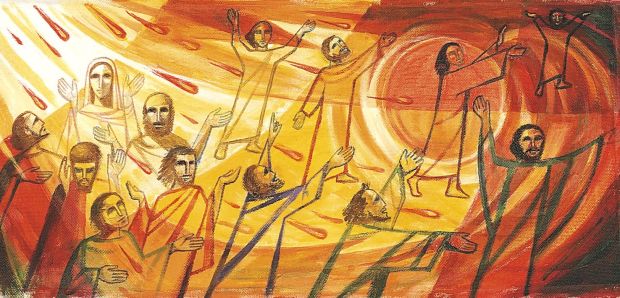
The Day of Pentecost has come, as we celebrated the gift of the Holy Spirit and the birth of the church, acknowledging our personal and communal spiritual power.

Now, we revel in this season of Pentecostal power, known as “Ordinary Time” or “Proper Time.” It is a time of engaging in the ongoing work of the church to spread the gospel of Jesus Christ. This is the Christian’s “proper” and “ordinary” work of ministry.

The Christian Life

All of the work of Jesus in securing redemption for us is directed toward using the spiritual gifts given to us for the life of the church and the world. There’s no going back. We move forward, utilizing everything provided for a godly life in this present difficult age.

Now we develop our ability to walk and live in the Spirit for the rest of our lives – working out our salvation with reverence and respect.

What I’m getting at, friends, is that you should simply keep on doing what you’ve done from the beginning. When I was living among you, you lived in responsive obedience. Now that I’m separated from you, keep it up. Better yet, redouble your efforts. Be energetic in your life of salvation, reverent and sensitive before God. That energy is God’s energy, an energy deep within you, God himself willing and working at what will give him the most pleasure. (Philippians 2:12-13, MSG)

What the Apostle Paul was getting at with the Corinthian Church was that inspired speech from God always exalts the Lord Jesus – and doesn’t point to someone else, especially the speaker.

In their pre-Christian days, many of the Corinthian believers were involved in pagan worship practices which also involved some inspired speech. But the issue for Paul is less about the speaker and more about the direction of the speech. If the inspirational talk only points to self, or someone else other than Christ, then that speech isn’t from God’s Spirit. Any true divine utterance will clearly point to Jesus.

In a society which was continually angling for personal display and a sort of one-upmanship, the Corinthians were prone and/or tempted to fall back into old ways of drawing attention to themselves. But the entire point of spiritual gifts is that that they are given by God to be used for helping others center their lives around the Lord Jesus. Anything short of that is simply non-Christian.

The Christian Commitment

Which is why I bring us back once again to the Christian Year with its seasons that follow the life and ministry of Jesus. Christian time revolves around Christ. Christian commitment centers in Christ. In Christianity, literally everything has Christ in the middle of it. To do otherwise is something other than Christianity.

We may not (and do not) all hold to the liturgical year as Christians, and that’s okay. Yet what isn’t okay is going off to do your own thing by making salvation something you made the choice to have, giving some of your time, money, and abilities at your leisure, as if you’re really the one in control, not God.

The demands of Christian discipleship are complete and total. Christianity is a life, not a hobby. Christians are followers of Christ’s words and ways, not fans cheering him from a distance without getting their hands dirty in Christian service and love.

“Cheap grace is the preaching of forgiveness without requiring repentance, baptism without church discipline, Communion without confession, absolution without personal confession. Cheap grace is grace without discipleship, grace without the cross, grace without Jesus Christ, living and incarnate.”

Dietrich Bonhoeffer, The Cost of Discipleship

Everything we have is a gift given by a gracious God to be stewarded well for the glory and exaltation of the Lord Jesus Christ. Our penultimate gift is the Holy Spirit, who helps complete a renovation of the heart so that it revolves thoroughly around Christ.

Almighty God and Father, who gave your only Son to die for our sins and to rise for our justification: Give me grace so to put away selfishness and wickedness so that I may always serve you in holiness and truth, through Jesus Christ my risen and ascended Lord, who lives with you and the Holy Spirit, one God, now and forever. Amen.

In the Place of Life (1 Peter 4:1-6)

Therefore, since Christ suffered in his body, arm yourselves also with the same attitude, because whoever suffers in the body is done with sin. As a result, they do not live the rest of their earthly lives for evil human desires, but rather for the will of God. For you have spent enough time in the past doing what pagans choose to do—living in debauchery, lust, drunkenness, orgies, carousing and detestable idolatry. They are surprised that you do not join them in their reckless, wild living, and they heap abuse on you. But they will have to give account to him who is ready to judge the living and the dead. For this is the reason the gospel was preached even to those who are now dead, so that they might be judged according to human standards in regard to the body, but live according to God in regard to the spirit. (New International Version)

I haven’t been a confessing Christian my entire life. And so, I can relate to Peter’s exhortation. I still remember what it feels like to live my life without any thought to God or spiritual matters. I also have many memories of giving my life to Christ and, for years, having people puzzled as to why I didn’t want to join them in activities which would clearly diminish my spirit and suck the soul out of me.

The thing about partying and immorality is that it’s a life filled with constant movement. Slowing down only makes one come face-to-face with what is truly inside the soul. And if someone has an empty vacuous soul, or a damaged spirit, or a broken heart, then attempting to drink or work away the inner pain makes sense when there’s no regard for God. 

The last thing I ever wanted to do was suffer, yet before my own spiritual awakening, it seemed I could never outrun the hurt no matter how hard I tried, even with all the constant locomotion.

But I found in a committed Christianity the slow and quiet place I so desperately needed. I discovered in ancient Christian practices of solitude, silence, and stillness the opportunity of finding my true self.

There are times in our lives when we need to explore the place between our hurting hearts and the hunting for joy. It’s actually a quiet place sandwiched between the ignominy of the cross and the celebration of resurrection. 

Within the geography of the soul, this is something of a lost country for many folks. Some people have never had the thought that such a place even exists. Yet, this is the very place which gives meaning and focus to a disjointed and frenetic lifestyle.

To be even more specific and focused, there cannot be a better life, a new life without a death to the old life and dying to self. There must be suffering before there can be glory.

I’m a heady sort of guy. Most things, for me, have to go through my brain. Although I have come to appreciate and value my heart and my gut, I still find myself sometimes gravitating toward my intellect as the answer for my stress. Yet, there are many times (maybe even most times) when I really need to get out of my head, connect to my gut, and wrap my heart around whatever problem or challenge is before me. 

I have been a devoted follower of Jesus for many decades now. Yet, I still encounter a sizable chunk of Christians who devalue the place between the real suffering on Good Friday, along with the very real death of Holy Saturday. In the tomb, there is no movement. All is silent and still. 

Jesus was in the solitude of a dark tomb. So, there’s no getting around it. If we want a Resurrection Day with all its celebration and glory, then we cannot circumvent the place of darkness and stillness.

To be a Christian means a readiness to follow Jesus and suffer as he did. It involves a willingness to stop our striving, manifested through constant movement, and embrace the disciplines of solitude, silence, and stillness with its contemplation and radical acceptance of what is – and not just what we want something to be. 

This requires the sense enough to pray and please a higher power than fair weather friends. It demands a Christian counter-cultural shift to face the ridicule of friends so that we might take some much-needed time to be with Jesus in his life, ministry, suffering, death, resurrection, and ascension.

Put plainly and bluntly: If you and I want to live with Jesus, we must die with Jesus.

I could give you ten steps to having a better life, but this would ultimately mean nothing apart from the willingness to spend some time and sit in the place of suffering and death.

And, ironically, in doing so, we find the life that is truly life, and discover a way of existence which is far greater and better than we could have ever dreamed.

Merciful and almighty God and Father of our Lord Jesus Christ, we submit ourselves to you, knowing that our lives are in the hands of a gracious and sovereign Being who cares deeply for all creation and every creature. May our longings for transcendence result in the deep and good desires of our hearts to be met fully in Christ, who with you and the Holy Spirit are one God, now and forever. Amen.

Speak Up In Faith (Acts 7:1-16)

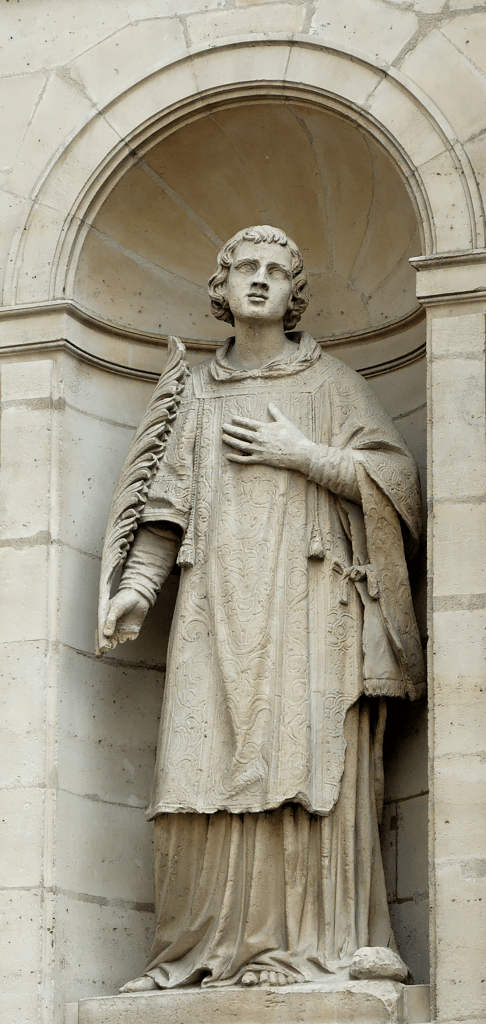
Statue of St. Stephen, by Joseph Marius Ramus (1805–1888) at the Saint-Étienne-du-Mont Church in Paris

Then the Chief Priest said, “What do you have to say for yourself?”

Stephen replied, “Friends, fathers, and brothers, the God of glory appeared to our father Abraham when he was still in Mesopotamia, before the move to Haran, and told him, ‘Leave your country and family and go to the land I’ll show you.’

“So he left the country of the Chaldees and moved to Haran. After the death of his father, he immigrated to this country where you now live, but God gave him nothing, not so much as a foothold. He did promise to give the country to him and his son later on, even though Abraham had no son at the time. God let him know that his offspring would move to an alien country where they would be enslaved and brutalized for four hundred years. ‘But,’ God said, ‘I will step in and take care of those slaveholders and bring my people out so they can worship me in this place.’

“Then he made a covenant with him and signed it in Abraham’s flesh by circumcision. When Abraham had his son Isaac, within eight days he reproduced the sign of circumcision in him. Isaac became father of Jacob, and Jacob father of twelve ‘fathers,’ each faithfully passing on the covenant sign.

“But then those ‘fathers,’ burning up with jealousy, sent Joseph off to Egypt as a slave. God was right there with him, though—he not only rescued him from all his troubles but brought him to the attention of Pharaoh, king of Egypt. He was so impressed with Joseph that he put him in charge of the whole country, including his own personal affairs.

“Later a famine descended on that entire region, stretching from Egypt to Canaan, bringing terrific hardship. Our hungry fathers looked high and low for food, but the cupboard was bare. Jacob heard there was food in Egypt and sent our fathers to scout it out. Having confirmed the report, they went back to Egypt a second time to get food. On that visit, Joseph revealed his true identity to his brothers and introduced the Jacob family to Pharaoh. Then Joseph sent for his father, Jacob, and everyone else in the family, seventy-five in all. That’s how the Jacob family got to Egypt.

“Jacob died, and our fathers after him. They were taken to Shechem and buried in the tomb for which Abraham paid a good price to the sons of Hamor. (The Message)

“What do you have to say for yourself?” conjures up for me women in a church basement with hands on hips, fingers pointing, staring at my 4-year-old self, after I ran through a bunch of old clothes at their annual rummage sale. And it wouldn’t be the last time I’d be asked that question throughout my life.

It’s a question that wants an accounting of something we’ve said or done. It’s not a polite question – more rhetorical than anything else.

Stephen was asked the question – and displayed a non-plussed presence that used the opportunity to turn it around back on his accusers and, indeed, of all humanity and human history.

Throughout Jewish history (and everyone else’s history, too!) there are human movements of good, inspired by divine initiatives; and alongside the good, there also are streams of resistant humanity who seek to thwart the good.

St. Stephen delivered a speech to the religious leaders, highlighting these two developments of human activity in the lives of two major figures in Jewish history.

Abraham

The patriarch of the Jewish people, Abraham, demonstrated faith by listening to the call of God to go to a country he knew nothing about. The Lord’s promises included both blessing and hardship. Although Abraham would be faithful to God’s covenant, his descendants would still find themselves as slaves in Egypt for four-hundred years.

Opposition to faith is always hanging in the shadows, ready to spring when there is an opportunity. Even though Abraham was a devoted follower of God, there were faithless people around him who had a different agenda than the Lord’s. His name continued into the New Testament with the faithless using it.

But invoking the ancient name of Abraham isn’t a protective amulet that makes everything okay. Doing the will of God is what really matters; and exhibiting faith like Abraham is the real issue.

“Produce fruit in keeping with repentance. And do not begin to say to yourselves, ‘We have Abraham as our father.’ For I tell you that out of these stones God can raise up children for Abraham. The ax is already at the root of the trees, and every tree that does not produce good fruit will be cut down and thrown into the fire.” (John the Baptist, Luke 3:8-9, NIV)

A good and right life comes through faith, and not by willpower nor in lifting up oneself by the bootstraps.

If, in fact, Abraham was justified by works, he had something to boast about—but not before God. What does Scripture say? “Abraham believed God, and it was credited to him as righteousness.” (Romans 4:2-3, NIV)

Joseph

Abraham, Isaac, and Jacob are the original pillars of Judaism. Jacob had twelve sons, known as the twelve patriarchs, from whom all Jews come from. The history of the brothers, like many families, is complicated. Joseph, next to the youngest of the brothers, was intensely disliked by several of the others.

Joseph found himself in Egypt because his brothers sold him into slavery. Like Abraham, Joseph had a robust faith, yet this did not inoculate him from trouble. Eventually, however, through a round-about turn of events, Joseph became in charge of the very empirical power that originally received him as a slave.

Through the eyes of faith, Joseph was not bitter, but understood why he needed to go through such terrible adversity. As administrator over all of Egypt, Joseph was able to handle severe years of drought with wisdom and confidence, thus saving many lives from hunger and starvation. And so, he was able to say to his brothers, many years later:

“You intended to harm me, but God intended it for good to accomplish what is now being done, the saving of many lives. “

(Genesis 50:20, NIV)

So, what do you have to say for yourself? Let you and I have the ability to say that we have been people of faith and patience. Let us be those who tenaciously hold to God, and steadfastly do good, speaking up in faith, no matter the situation, and regardless of faithless people who oppose us.

Because, in the end, the words of Jesus are true:

“So do not be afraid of them, for there is nothing concealed that will not be disclosed, or hidden that will not be made known. What I tell you in the dark, speak in the daylight; what is whispered in your ear, proclaim from the roofs. Do not be afraid of those who kill the body but cannot kill the soul. Rather, be afraid of the One who can destroy both soul and body in hell. Are not two sparrows sold for a penny? Yet not one of them will fall to the ground outside your Father’s care. And even the very hairs of your head are all numbered. So don’t be afraid; you are worth more than many sparrows.” (Matthew 10:26-31, NIV)

Just and right God, when we are faithless, you are faithful, because your very character is faithfulness. Help us to be faithful – not fearful – to the end, exhibiting the same commitment as your martyr Stephen, who fully entrusted himself to the Lord Jesus Christ, in whose name we are bold to pray. Amen.