Whoever Believes (John 3:14-21)

Interview Between Jesus and Nicodemus, by James Tissot (1836-1902)

Just as Moses lifted up the snake in the wilderness, so the Son of Man must be lifted up,that everyone who believes may have eternal life in him.”

For God so loved the world that he gave his one and only Son, that whoever believes in him shall not perish but have eternal life. For God did not send his Son into the world to condemn the world, but to save the world through him. Whoever believes in him is not condemned, but whoever does not believe stands condemned already because they have not believed in the name of God’s one and only Son. 

This is the verdict: Light has come into the world, but people loved darkness instead of light because their deeds were evil. Everyone who does evil hates the light, and will not come into the light for fear that their deeds will be exposed. But whoever lives by the truth comes into the light, so that it may be seen plainly that what they have done has been done in the sight of God. (New International Version)

For many, the truth about God’s purposes in Christ is confusing, even troubling. It was for Nicodemus. And even though there many today who simplify the exchange between Jesus and Nicodemus with a single Bible verse of John 3:16, taking a good look at the Gospel of John puts most of us with Nicodemus.

Nicodemus, a learned Jewish scholar, a Pharisee, found Christ’s words both confusing and troubling because it required him to let go of everything he understood – to let go and become like a newborn baby, receiving and discovering the world on new and different terms. In other words, Nicodemus had to unlearn some things before he could learn truth.

There are some things that are hard to grasp, not because they are so intellectually challenging, but because those things ask a lot of us, demanding our very lives. And so, we don’t so much want to understand; it would require a radical change.

But why would anyone not want to understand the good news that God so loved the world that gave the Son so that we may believe and have eternal life? Because we would then have to contend with the ways Jesus describes himself.

Jesus likened himself to the serpent that Moses lifted up in the desert (John 3:14; Numbers 21:4-9). In that story of Moses in the Old Testament book of Numbers, God sent poisonous snakes into the Israelite camp as punishment for the people’s incessant complaining against God.

Then, when the people repented, God told Moses to make a bronze snake, put it on a pole, and lift it up, so that anyone bitten by one of the poisonous snakes could see it and live. Jesus likened himself to the story. In the same way the bronze snake was lifted on a pole, Jesus explained that so must the Son of Man be lifted up, or exalted high above the people.
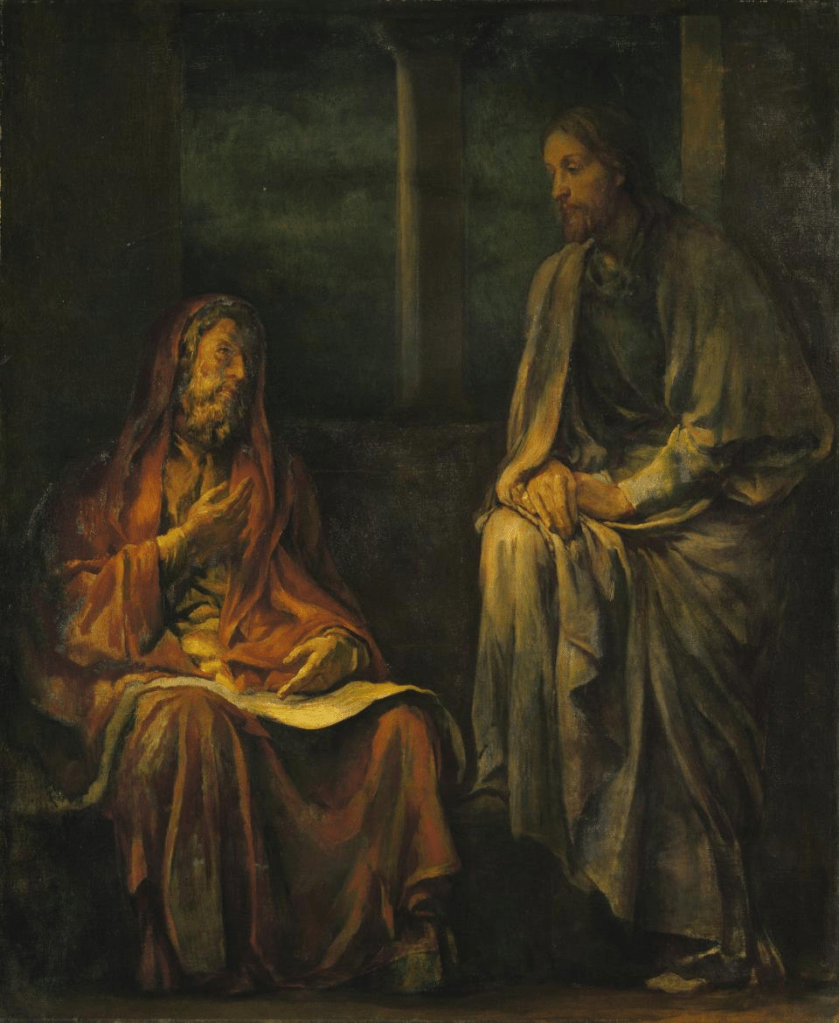
Visit of Nicodemus to Christ, by John La Farge, 1880

In the typical language of the Apostle John, using double meanings to a single concept, he meant to communicate that Jesus would be physically lifted onto the cross, above the people; and also that Jesus would be lifted up by God as the exalted One above all creation. (John 8:28; 12:32)

Just as the ancient Israelites were facing death because of their sin, and deliverance because of God’s action through Moses, so people everywhere in every age face the consequences of their sinful complaining; yet through the action of God through Christ’s crucifixion, resurrection and ascension, they can look up to the exalted and glorified Lord and receive deliverance from sin, death, and hell.

There is more to looking up at the lifted One than a mere incline of the head and eyes. In modern terms, we would refer to the sheer action of looking as an intellectual assent to faith. The Apostle John, however, means to have us believe, not simply acknowledge.

Jesus did not tell Nicodemus to simply acknowledge him as Savior, to accept him into the heart, and so, be saved. No, this was an encounter that left an intelligent man and an accomplished scholar scratching his head in bewilderment as he went back out into the darkness.

Today’s Gospel lesson is a story about how any one of us might reject the light offered to us because of the way it exposes what is dark within us. Therefore, to believe requires ultimate trust in another. It isn’t to acknowledge that Jesus was real and had an actual ministry on earth; it’s more than believing something happened in history in the ancient world of the first century.

To believe is to let our own lives be transformed by the Jesus we encounter in this story. And here is what that means:

  1. Realizing and becoming aware of the ways we are complicit in and benefit from having our loyalties elsewhere, other than Jesus. To believe demands us answering the question: Whom shall you serve?
  2. Placing our ultimate trust, allegiance, and loyalty in Jesus Christ. To believe begs the question: To whom will you commit all that you have, and all that you are?
  3. Forsaking all other competing loyalties and “gods,” including both secular and religious deities. To believe means a single-minded devotion, which asks of us all: To whom and to what will you forsake in order to embrace Jesus?
  4. Confronting inconvenient truths of our own personal values which clash with Christ’s ideals of righteousness. To believe presses us to answer the question: To whom and for what are you truly living for?
  5. Willing to die to self and to anything that would hinder knowing Jesus and him crucified, risen, ascended, and coming again. To believe forces us to ask ourselves: Am I willing to die for Jesus?

While there is nothing in this world worth killing for, there are things worth dying for. The lifting up of Jesus lets us know that the true life God has promised us is not the life that we can secure for ourselves through self-interest, caution, and theological debate.

Most merciful God,
we confess that we have sinned against you
in thought, word, and deed,
by what we have done,
and by what we have left undone.
We have not loved you with our whole heart;
we have not loved our neighbors as ourselves.
We are truly sorry and we humbly repent.
For the sake of your Son Jesus Christ,
have mercy on us and forgive us;
that we may delight in your will,
and walk in your ways,
to the glory of your Name. Amen.

Parable of the Ten Bridesmaids (Matthew 25:1-13)

The Parable of the Ten Virgins, by Lilibeth Kindle

“When the end comes, the kingdom of heaven will be like ten bridesmaids. They took their oil lamps and went to meet the groom. Five of them were foolish, and five were wise. The foolish bridesmaids took their lamps, but they didn’t take any extra oil. The wise bridesmaids, however, took along extra oil for their lamps. Since the groom was late, all the bridesmaids became drowsy and fell asleep.

“At midnight someone shouted, ‘The groom is here! Come to meet him!’ Then all the bridesmaids woke up and got their lamps ready.

“The foolish ones said to the wise ones, ‘Give us some of your oil. Our lamps are going out.’

“But the wise bridesmaids replied, ‘We can’t do that. There won’t be enough for both of us. Go! Find someone to sell you some oil.’

“While they were buying oil, the groom arrived. The bridesmaids who were ready went with him into the wedding hall, and the door was shut.

“Later the other bridesmaids arrived and said, ‘Sir, sir, open the door for us!’

“But he answered them, ‘I don’t even know who you are!’

“So stay awake because you don’t know the day or the hour. (God’s Word Translation)

Here’s the point of Christ’s parable, up front, so that we know what we are dealing with:

We prepare for things we really care about; we anticipate things that are important to us.

For example, people who really care about hunting make careful preparations for the season and anticipate opening day. Those who care about professional football look forward to game-day, plan for special food to eat, and set aside normal activities to watch them play.

And, of course, weddings are events that take lots of preparation because families care about the upcoming marriage. Since I have raised three girls, I can testify first-hand that wedding plans begin in third grade for many females.

The Wise and the Foolish Virgins, by Charles Haslewood Shannon, 1920

Here’s the point of Christ’s parable, stated in the negative: People show up to things unprepared mostly because they don’t value the event enough to be ready for it.

Casual hunters and fair-weather football fans go home when it gets too cold. That’s because they are not adequately prepared for the conditions.

Quickie weddings happen in Las Vegas where two people are not prepared to have a marriage for a lifetime. 

People drop out of impromptu events when there is no fun or gets too hard. However, if they really care about it, they prepare for it, have patience through it, and persevere in it when things get tough.

The true test of authentic commitment comes when things are not easy and it takes blood, sweat, and tears to see something through.

A Christian is one who not only professes Christ as Lord and Savior, but also backs the words up with a resolve to:

  • live into their baptism
  • avail themselves of communion
  • plan and prepare for both personal and public worship
  • make it their aim to love God, one another, and neighbor

There are few human events more freighted with emotion and preparation than weddings. Parents invest a lot of time, energy, resources, and love to have a meaningful wedding for their kids. There’s also the potential for disaster at a wedding.

A Greek Orthodox fresco of Jesus and the Parable of the Ten Virgins

Since I have done many weddings, I can tell you that a lot of things go sideways in the preparation process and even at the wedding itself. I have seen bridesmaids pass out, grooms forget the ring, and families fight like cats and dogs in the narthex just as the bride is ready to come down the aisle. All kinds of crazy stuff can happen with a wedding. 

At my own wedding, the bridesmaids were literally sown into their dresses by the seamstress just hours before the wedding; one of my groomsman did not show up because, I later found out, he was in jail; and, we were married on the hottest and most humid day of the year – 100 degrees – which did not go so well for a bunch of women trying to have their best ever hair day.

But you know what? We got married anyway. The wedding happened because it was important to us. I think it’s interesting that Jesus chose a parable about a wedding to tell us what the kingdom of God is really like. Weddings in Christ’s day were just as prone to mishap, maybe even more, than weddings today.

In ancient Israel, a couple would become engaged but not set a wedding date. The groom would take the time to busily prepare a home for himself and his bride to live. It might take days, or weeks, or months, even years. It is this imagery that Jesus picked up to communicate his point of being prepared for things we care about. 

No one knew when the groom would be finished with preparations. (Note: We are told in the Gospel of John that Jesus the bridegroom is busy preparing for a great wedding feast at the end of the age when he will come back and take us to be with him forever).

When the groom was ready, he left the home he had prepared and went to the bride’s house. Then, the two of them, along with their wedding party, would have a grand procession through the streets of the town, almost always after dark, and then back to the home of the groom. So, oil lamps were important to have ready, and on standby.

Here is the parable’s setting: The groom has left his house and begun his trek through town. He might come straightaway, and he might not, depending on what route he takes. The bridesmaids (virgins) have their oil lamps ready. Five of them have plenty of oil, and five of them do not.

The groom takes the circuitous route, so the virgins fell asleep waiting. At midnight the groom finally shows up at the bride’s house. Five virgins spring into action and are ready. The other five aren’t ready, at all. 

The five virgins without enough oil go out to find or buy some more, while the five virgins with plenty of oil join the celebration. The procession goes back to the groom’s house, posthaste, before the five virgins who were not part of the procession finally catch up to them at the house.

The five foolish bridesmaids knock on the door and expect to get in. But the door is shut and it isn’t going to be opened. The marriage will happen without them. Therefore, the bottom line of the story: The five foolish virgins were not ready because they did not care enough to be prepared.

Orthodox icon of Jesus and the Parable of the Ten Virgins

This, at face value, might seem harsh. Yet, in Christ’s time, not having the oil needed for the lamps would be like, in our day, having half the bridesmaids show up at the wedding at the last minute in jeans and t-shirts without having done their hair and expecting to stand up with the bride. No bride or groom and their family in our culture is going to roll with that kind of behavior. Why? Because it is deeply offensive.

As in all of Christ’s parables, the characters represent the people listening. The five wise and five foolish bridesmaids point to the mixed characters who were following Jesus. They consisted of both faithful authentic disciples of Jesus, as well as wedding crashers who were not there because they valued and respected Jesus.

Jesus told us to keep watch, because we do not know the day or the hour when he will return. So, today’s parable raises the big question: Are you prepared? 

We are to maintain constant vigilance, being always alert for Jesus to show up. It’s one thing to make a profession of Christ; and it is quite another thing to live each day doing God’s will and being prepared for Jesus to return.

Jesus wants more than fair-weather Christians. 

We cannot assume someone else will give us oil. No one can simply rely on another person to have everything they need to live the Christian life. Each one of us must listen and learn from God’s Word for ourselves, cultivate a life of prayer, and serve the church and the world in ways God has called us to – without relying on someone else to do the work that I should be doing. 

Every day is a fresh opportunity and privilege to serve Jesus. My personal practice is to rise each morning by 4:30am. I light a candle and spend some quiet unhindered time reading the lectionary passages for the day. I spend time in prayer. Throughout the day I pause to intentionally connect with God in prayer and some Scripture reading. 

I get up early in the morning regardless of how I feel. I engage in spiritual disciplines even when it does not strike my fancy. I go to work and do what it takes to get myself in a position to be a blessing to others.

Now, let’s come back to the message of Christ’s parable: We prepare for things we really care about, and we anticipate things that are important to us. The return of Jesus is a future reality. It’s up to each of us, whether it will be on our spiritual radar, or not.

Yet, I can tell you this: Jesus wants us to watch and pray, and to be prepared, because today the bridegroom may show up.

Jesus Is Greater (Hebrews 1:5-14)

Christ the Redeemer, in Rio de Janeiro, Brazil

For to which of the angels did God ever say,

“You are my Son;
    today I have become your Father”?

Or again,

“I will be his Father,
    and he will be my Son”?

And again when God brings his firstborn into the world, he says,

“Let all God’s angels worship him.”

In speaking of the angels he says,

“He makes his angels spirits,
    and his servants flames of fire.”

But about the Son he says,

“Your throne, O God, will last for ever and ever;
    a scepter of justice will be the scepter of your kingdom.
You have loved righteousness and hated wickedness;
    therefore God, your God, has set you above your companions
    by anointing you with the oil of joy.”

He also says,

“In the beginning, Lord, you laid the foundations of the earth,
    and the heavens are the work of your hands.
They will perish, but you remain;
    they will all wear out like a garment.
You will roll them up like a robe;
    like a garment they will be changed.
But you remain the same,
    and your years will never end.”

To which of the angels did God ever say,

“Sit at my right hand
    until I make your enemies
    a footstool for your feet”?

Are not all angels ministering spirits sent to serve those who will inherit salvation? (New International Version)

The people were weary. They were good and faithful Jews in Jerusalem, just trying to worship God and live their lives in faith, patience, and righteousness. And then, through incredible events, they came to believe that Jesus is the promised Messiah. They placed all their hopes and their very lives upon him.

And then, persecution broke out against the believers in Jesus. They were scattered. They fled Jerusalem. The people found themselves as Christian refugees in strange Gentile countries. In those places, they faced hardship and disrespect, not only for being Jews, but for being Christians. In many cases, their families disowned them; and the laws of the land were not good to them.

The believers started off well. But over time, the difficulty began to get to them. The people started wondering if all this commitment to Jesus Christ was worth it, or not. Their spiritual resolve was slowly ebbing away.

The author of Hebrews insists, biblically, that Jesus is superior over everything and everyone. The author stepped into the flagging believers’ situation, and went about answering that question of whether Jesus is truly all he’s cracked up to be. And he began the comparisons of superiority with Jesus over the angels.

Jesus Christ is greater than the angels

Jesus is the Son – the Son of God – which is a way of saying that Jesus is God. And he proved it through his life and ministry, his death and resurrection, his ascension and glorification.

When Jesus began his earthly ministry, he was sent into the desert for 40 days and nights. That experience demonstrated his true muster. Christ fully identified with the people, accomplished what no other human did, and became the pioneer of our salvation.

In bringing many sons and daughters to glory, it was fitting that God, for whom and through whom everything exists, should make the pioneer of their salvation perfect through what he suffered. Both the one who makes people holy and those who are made holy are of the same family. So Jesus is not ashamed to call them brothers and sisters. (Hebrews 2:10-11, NIV)

Jesus Christ has greater dignity than the angels

Unlike angels, Jesus, the Son, is worthy of worship. Angels may be exalted and immortal beings, but they are creatures, just like us humans. Jesus, however, as God, was there at creation. What’s more, Jesus presently holds all things together.

The Son is the image of the invisible God, the firstborn over all creation. For in him all things were created: things in heaven and on earth, visible and invisible, whether thrones or powers or rulers or authorities; all things have been created through him and for him. He is before all things, and in him all things hold together. (Colossians 1:15-17, NIV)

Jesus Christ has a greater status than the angels

Times change. Circumstances change. People are fickle. What is celebrated today is condemned tomorrow, and vice versa. But God never changes in the basic divine character. And God is eternal. Therefore, the Lord Jesus is a solid rock from which to construct a firm spiritual life.

Jesus Christ is the same yesterday and today and forever.

Hebrews 13:8, NIV

Jesus Christ has a greater function than the angels

As the Son of God, Jesus is the sovereign ruler over all things. We do not simply make him the Lord of our lives; he already is that. We just need to acknowledge this reality, submit to Christ’s authority, and persevere in faith. We must continually remember this, or we will become spiritually weary.

So do not throw away your confidence; it will be richly rewarded.

You need to persevere so that when you have done the will of God, you will receive what he has promised. For,

“In just a little while,
    he who is coming will come
    and will not delay.” And,

“But my righteous one will live by faith.
    And I take no pleasure
    in the one who shrinks back.”

But we do not belong to those who shrink back and are destroyed, but to those who have faith and are saved. (Hebrews 10:35-39, NIV)

Christians are never defenseless in this world. God has not only provided salvation through the Son, but has also given the angels to help us sustain our commitment to Christ. God cares so much about us that he has enlisted millions of angels for our benefit, so that we can continue to live out the words and ways of Jesus till the very end of our earthly lives.

God of wonder and of joy: grace comes from you, and you alone are the source of life and love. Without you, we cannot please you; without your love, our deeds are worth nothing. Send your Holy Spirit, and pour into our hearts that most excellent gift of love, that we may worship you now with thankful hearts and serve you always with willing minds; through Jesus Christ our Lord. Amen.

Family Dynamics (Matthew 12:46-50)

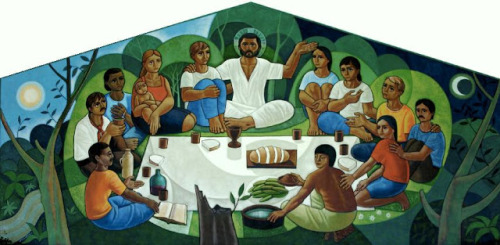
En la Cena ecológica del Reino (At the Ecological Kingdom Dinner) by Spanish artist Cerezo Barredo

While Jesus was speaking to the crowds, his mother and brothers stood outside trying to speak with him.Someone said to him, “Look, your mother and brothers are outside wanting to speak with you.”

Jesus replied, “Who is my mother? Who are my brothers?” He stretched out his hand toward his disciples and said, “Look, here are my mother and my brothers. Whoever does the will of my Father who is in heaven is my brother, sister, and mother.” (Common English Bible)

Jesus obviously did not get the cultural memo that blood is thicker than water.

When his own blood family were waiting outside for him, Jesus used the occasion to speak of what makes up a true follower of God. Christ boldly asserted that his true family is made up of people who do God’s will. By saying this, Jesus brought the point home that the kingdom of God turns on obedience.

Rather than merely confessing a belief, or appealing to a family heritage of faith, Jesus said that a genuine believer in God is one who listens to God’s words and then promptly obeys them. Therefore:

A Christian is defined by allegiance to Jesus, and not by having a certain bloodline. 

Identity determines activity. For example, if I identify myself primarily as…

  • a worker at my job, my activity will show it – I will spend long hours at my labor, and will do whatever it takes to please my boss and gain promotions.
  • an athlete, I will spend long hours honing my skills, and do whatever it takes to please the coach and to win.
  • a spouse and a parent, I will focus most of my attention on my family and seek to please them in all things. 

But if my identity is first and foremost as a Christian, I will seek to please Jesus. With my identity in Christ:

  • I will view my job as an opportunity to express the ethics of God’s kingdom, as a calling from God, and as a means for God to transform me for his glory.
  • I will view athletics as means to glorify God, and not as an end in and of itself but as a special gift for God to teach me about the importance of community and working together. 
  • I will view my kids as belonging to God and I will steward the trust of children given me by doing whatever it takes to teach and train them in the way of Jesus. I will thank God for my family and not confuse them with being God by idolizing them.

Jesus was inside a house, with his family on the outside. So, why were the family members of Jesus not inside the house sitting at his feet, taking the posture of a disciple?

The disciple Matthew wanted to communicate more than physical distance between Jesus and his physical family – being “outside” was meant to convey the posture of Christ’s family as spiritually distant, skeptical of him, and indecisive about who he was and what he was up to. The disciple Mark made this spiritual and emotional distance clear:

Jesus entered a house. A crowd gathered again so that it was impossible for him and his followers even to eat. When his family heard what was happening, they came to take control of him. They were saying, “He’s out of his mind!” (Mark 3:20-21, CEB)

Christ’s earthly family were not looking for Jesus to give them warm-fuzzies and have a big family hug. They were there to essentially say to him, “Cut it out, Jesus, because you’re acting like a nut-cake and embarrassing us all!”

Jesus was saying that identifying only with a biological family leads to only pleasing that family. However, identifying with Jesus leads to a radical form of following God that seeks to please him instead of submitting to family practices, mores, and beliefs which are inconsistent with the kingdom of God. 

Ethiopian Orthodox Church depiction of Christ and his disciples

For the Christian, the church is the family of God, and we are to act consistent with being in such a family.  We are to pursue God’s will, serve one another, and adopt outsiders into our family. The church is a family, not a restaurant. When we go to a restaurant, we either like the food and the service, or not. If the experience was unpleasant, we might complain to the waitress and may or may not come back. Try doing that with your mother and see where it gets you! 

As a biological family, we are committed to each other. There is no complaining about mom because of dad’s wrath. Instead, we are expected to clear our plates and put them in the dishwasher, to sweep the floor and clean the table, and to work together for the benefit of the entire family. In the same way, following Jesus means being committed to his family, the church.

Priority is to be given in doing God’s will, regardless of blood, because obedience to Christ identifies us as being in the family of God. Our actions and the way we live points to what we honestly believe and where our commitments truly lie. 

The first step of God’s desire for us is quality focused time in sitting at Christ’s feet and listening to him, because this is at the heart of all Christian discipleship. We can only do God’s will if we have clearly heard it; and we can only hear God’s will by taking the time to be at the feet of Jesus. 

Both listening and doing are necessary. Listening without engaging the world is a failure of mission; and doing without first listening leads to misguided acts and eventual burn-out. Allow Jesus to call the shots and let him instruct us so that we can live wisely and obediently. 

Jesus did not devalue blood relatives as irrelevant. Rather, the kingdom of God seeks to restore and redeem all things, including family. Both church and family are important. The relationships within each are to be nurtured.

The family of Jesus, the church, is important because Christ suffered and died for her. So, we are to be committed to the church, love the church, and serve the church because we are family. If we have a good grasp of this, we will make decisions based in what we believe God’s will is, instead of whether a relative will get upset, or not. 

We need to persistently pray for spiritually lost family members, and those whom we are estranged from. Most families have at least a few toxic persons in their orbit. Here is how we might pray for them:

  • That God will arrange divine appointments between them and others who love Jesus.
  • That God will draw them to the mercy of Christ.
  • That God will hinder the devil’s schemes against them.
  • That they will understand and respond to the good news of God’s grace.

O God, you made us in your own image and redeemed us through Jesus your Son: Look with compassion on the whole human family; take away the arrogance and hatred which infect our hearts; break down the walls that separate us; unite us in bonds of love; and work through our struggle and confusion to accomplish your purposes on earth; that, in your good time, all nations and races may serve you in harmony around your heavenly throne; through Jesus Christ our Lord. Amen.