It’s Time To Wake Up – First Sunday of Advent (Romans 13:11-14)

Besides this, you know what time it is, how it is already the moment for you to wake from sleep. For salvation is nearer to us now than when we became believers; the night is far gone; the day is near. Let us then throw off the works of darkness and put on the armor of light; let us walk decently as in the day, not in reveling and drunkenness, not in illicit sex and licentiousness, not in quarreling and jealousy. Instead, put on the Lord Jesus Christ, and make no provision for the flesh, to gratify its desires. (New Revised Standard Version)

But make sure that you don’t get so absorbed and exhausted in taking care of all your day-by-day obligations that you lose track of the time and doze off, oblivious to God. The night is about over; dawn is about to break. Be up and awake to what God is doing! God is putting the finishing touches on the salvation work he began when we first believed. We can’t afford to waste a minute, must not squander these precious daylight hours in frivolity and indulgence, in sleeping around and dissipation, in bickering and grabbing everything in sight. Get out of bed and get dressed! Don’t loiter and linger, waiting until the very last minute. Dress yourselves in Christ, and be up and about! (The Message)

I like metaphors, that is, word-pictures that help illustrate and visualize a concept or idea. That’s probably why I like the Apostle Paul, because I find in him a guy who appears to have the same affinity for metaphors that I do.

In the New Testament reading on this First Sunday of Advent, Paul gives four metaphors to help us grab ahold of what he wants to get across to us:

We are not in some holding pattern, passively awaiting heaven. This is because our salvation is not yet complete. Completeness won’t happen until Jesus returns, until the second advent of Christ. Therefore, we are to be active now, working on our faith commitment to Jesus and to his church.

In this advent season, as we remember Christ’s first “advent” (or “coming”) to this earth, we are equally anticipating the second coming of Christ – not knowing quite when that will occur. Only until this event happens will our salvation come in all of its fullness.

The church is a unique community of persons who continually have an eye toward the future return of Jesus. And this future orientation is supposed to give shape to how we live in the present time.

The world-wide Christian community presently follows the way of deliverance. This current time and place is not the arrival point. Today doesn’t mark the time in which our salvation is fully realized or acquired.

In other words, we are to avoid acting as if this is our permanent home. Rather, we are pilgrims on this earth, sojourning through it as if we were but camping out. Our true home is someplace else. And we will get there when Christ comes again.

There is a stark contrast between those who put all their eggs into the present earthly basket, and those who maintain a future orientation of working now with an eye out for Jesus to return. This contrast is illustrated by Paul with images of what it’s like to live for and in the Roman society; and what it’s like to live with Jesus as Lord, instead of Ceasar.

Are you asleep or awake, living for the night or in the day?

Therefore, keep awake, for you do not know when the master of the house will come, in the evening or at midnight or at cockcrow or at dawn, or else he may find you asleep when he comes suddenly. (Mark 13:35-36)

Paul, taking his cues from Jesus, exhorted the believers to stay alert and be prepared for the end when it comes. Living for the nighttime is a metaphor for giving-in to one’s personal sinful desires; whereas living in the daylight hours is a picture of following the words and ways of Jesus.

What are you wearing? What are you taking off, and what are you putting on?

Using the metaphor of clothes – undressing and dressing oneself – Paul is talking about exchanging one set of clothing for another. This isn’t merely putting on a different pair of jeans than what you already have on. It’s much more radical than that. It’s doffing the tuxedo and donning the overalls. The picture is one of doing something completely different than what you’ve been doing before.

Paul wanted a complete makeover, a total change of moral and ethical behavior that is consistent with the gospel of Christ, and not with typical Roman society. It involves taking up one’s cross and following Jesus. It’s gritty and dirty and gets down to it; instead of avoiding hard work and seeking to have someone else do what is unpleasant to me.

Our allegiance and commitment to Christ is on full public display – not in placards with Bible verses on them, but with the sweet aroma of living a humble and just life in all of its simplicity and holiness.

Will you do the works of darkness, or take up the armor of light?

The darkness represents the unjust life of lies, selfishness, conflicts of interest, relational discord, and immoral actions. The light is meant to convey a beautiful life of integrity, wholeness, righteousness, and peace through loving actions.

Christians are to progressively take on the character of Christ, and not of whatever political character happens to be in power.

Using the metaphor of armor points us not only toward the struggle we confront in living a moral and righteous life, but also toward Christ who is our Divine Warrior. Jesus is the One who fights the battle and wins the victory.

Our struggle is not against flesh and blood, but “against the rulers, against the authorities, against the cosmic powers of this present darkness, against the spiritual forces of evil in the heavenly places.” (Ephesians 6:12)

Do you know what time it is? Is there any hopeful expectation?

The Christian is one who knows the time is nearer now than when they first believed. We may not know the precise date on the calendar when Jesus will come again, yet we are convinced that he is returning soon.

Therefore, the believer has no business spending time in trying to predict the day of the end. Instead, the believer must remain faithful and persevere to the end with a firm commitment to Christ, and a dedication to doing what is good, right, and just.

So, herein lies the challenge for every believer: Those of us who name Jesus as Lord will continue to live in a world of injustice and unrighteousness. Christians are continually being pulled in differing directions all at once, all the time.

It’s a hard slog. Yet the Christian finds joy and satisfaction in knowing who they are, who they believe in, and who is coming back to make all things new.

Christianity involves a whole lot more than praying a salvation prayer once, then going on one’s merry way, doing whatever the heck one wants to do.

Rather, Christianity is a radical existence of waking from sleep and changing allegiances from immoral leaders to the true sovereign of the universe.

It’s like moving from seeing shadowy forms just before the dawn to seeing clearly in the sun’s full light of day.

It’s as if I’ve been given a completely new set of clothes to put on, giving up the rags of this world for the raiment of being adopted into royalty.

We remain continually vigilant, always watching, always praying, always believing, always loving – knowing that our salvation is at hand, nearly here, and could happen at any moment.

God of justice and peace, from the heavens you rain down mercy and kindness, so that all on earth may stand in awe and wonder before your marvelous deeds. Raise our heads in expectation, that we may yearn for the coming day of the Lord and stand without blame before your Son, Jesus Christ, who lives and reigns forever and ever. Amen.

For the Love of God, Not Money (2 Corinthians 8:1-7)

And now, brothers and sisters, we want you to know about the grace that God has given the Macedonian churches. In the midst of a very severe trial, their overflowing joy and their extreme poverty welled up in rich generosity. 

For I testify that they gave as much as they were able, and even beyond their ability. Entirely on their own, they urgently pleaded with us for the privilege of sharing in this service to the Lord’s people. 

And they exceeded our expectations: They gave themselves first of all to the Lord, and then by the will of God also to us. So we urged Titus, just as he had earlier made a beginning, to bring also to completion this act of grace on your part. 

But since you excel in everything—in faith, in speech, in knowledge, in complete earnestness and in the love we have kindled in you—see that you also excel in this grace of giving. (New International Version)

I’ll be honest: As a preacher and pastor, I don’t much like talking about money. Yet, money is always an issue, especially in churches.

Although there are contemporary pastors and churches who deal with millions of dollars, the vast majority of believers and faith communities struggle from Sunday to Sunday. Money is a topic that has to be addressed and talked about.

So, even though there are plenty of abuses out there when it comes to money, it’s good to gain a more biblical, reasonable, and compassionate view of financial resources.

Holy Scripture does not condemn economic wealth; but it does warn us against the love of money, and centering our lives around it. Perhaps Jesus said it best:

“No one can serve two masters. Either you will hate the one and love the other, or you will be loyal to the one and have contempt for the other. You cannot serve God and wealth.”

Jesus (Matthew 6:24, CEB)

Jesus clarified the issue of money as a matter of our values and commitments. To possess money in and of itself is neither good nor bad; it’s whether money is the master you serve, or God is, with money being a tool to serve the Lord.

In writing to Timothy about how to instruct the Ephesian Church concerning money, the Apostle Paul framed the issue this way:

But people who are trying to get rich fall into temptation. They are trapped by many stupid and harmful passions that plunge people into ruin and destruction. The love of money is the root of all kinds of evil. Some have wandered away from the faith and have impaled themselves with a lot of pain because they made money their goal. (1 Timothy 6:9-10, CEB)

Financial resources are tools to be used, not only in providing for oneself and one’s family, but also to do good and to think of the common good of all people.

And that is exactly what the Apostle Paul was intent on doing. He was gathering a collection for the believers in Jerusalem. So, he took some space (2 Corinthians 8-9) in writing to the Corinthian Church for addressing this issue, as well as money and wealth in general.

Paul unabashedly called upon the Corinthian Christians to give, and considered it their obligation to do so.

The Apostle broached the subject by challenging the Corinthians to follow the example of the Macedonian churches. Paul fully embraced his training in rhetoric in using the technique of comparison to evoke competition between Corinth and Macedonia.

He did so by alluding to the generosity of the Macedonians. Even though the Macedonian believers were themselves experiencing a severe ordeal of affliction and even poverty, they voluntarily gave quite generously.

What’s more, the Macedonians gave well beyond their means. Paul didn’t ask them to do that; and nobody expected it of them. If anything, the churches in Macedonia could have probably received a collection of money and resources themselves. Yet, instead, they stretched themselves financially and gave.

The motivation to give from such meager resources, and in such a difficult situation, was an overflow of the believers’ hearts. In other words, they really wanted to give, so they did. The Macedonian Christians discerned that their true calling was to give of themselves to the Lord, and therefore, to also give of themselves to the Apostle Paul.

So then, Paul encouraged the Corinthian Christians to demonstrate their own commitment and loyalty to both God and to the Apostle. Titus would show up in Corinth to receive the collection, and Paul expected them to be generous – mainly because he knew they could do so, and therefore, ought to do so.

Paul established the church in Corinth. He spent a good deal of time there amongst the people and the city. He knew them well. And Paul was often frustrated with them, even sometimes using sarcasm to get his point across.

I wonder if he was a bit sarcastic, appealing to the Corinthians’ sense of pride in their city and their wealth. After all, the Corinthians excelled in everything else – such gifted people! (or so they always thought). Surely, they would also take full advantage of this opportunity to excel in giving, and be as generous as they possibly could!

Throughout my years of pastoral ministry, I have found in every place I’ve been, ironically, that those with little give much; and those with much give little.

Indeed, the wealthy are able to give much more than the poor. But I have never seen a rich person give everything they have for a cause, whereas many times, I have seen a person in poverty give everything they have for another. That’s also the observation Jesus made when folks were giving their offerings at the Temple:

Jesus sat across from the collection box for the temple treasury and observed how the crowd gave their money. Many rich people were throwing in lots of money. One poor widow came forward and put in two small copper coins worth a penny.

Jesus called his disciples to him and said, “I assure you that this poor widow has put in more than everyone who’s been putting money in the treasury. All of them are giving out of their spare change. But she from her hopeless poverty has given everything she had, even what she needed to live on.” (Mark 12:41-44, CEB)

Indeed, money is very much needed in this life. And money isn’t everything. Economic wealth, financial resources, and money are temporary. God and relationships are permanent. Life is eternal, at least for those who haven’t centered their lives around money as their god.

Money is to be used for good in this world. It is a tool. So, let’s use it with wisdom and a generous heart, putting it in it’s proper place in our lives.

Lord of our lives, teach us how to use our money and our possessions. Deliver us from stinginess and wasteful extravagance; inspire our giving with the spirit of true generosity. Help us always to remember your generous love for us, that we may be wise and faithful stewards of the good gifts you have given us. Amen.

Born from Above (John 3:1-17)

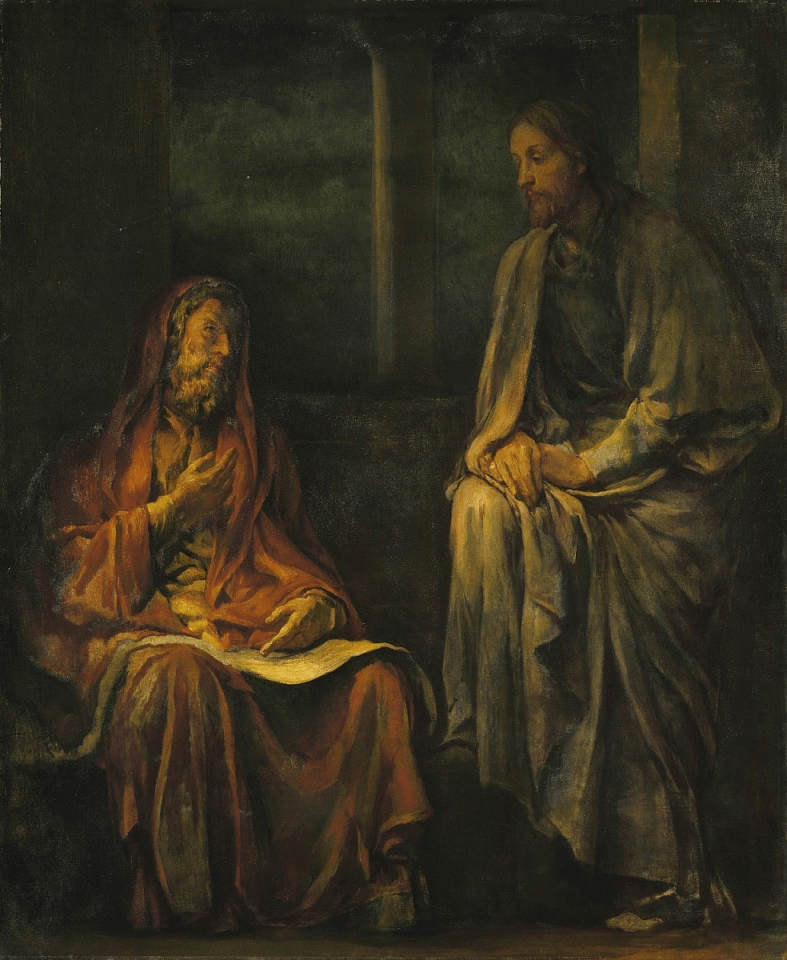
Visit of Nicodemus to Christ, by John LaFarge, 1880

Now there was a Pharisee named Nicodemus, a leader of the Jews. He came to Jesus by night and said to him, “Rabbi, we know that you are a teacher who has come from God, for no one can do these signs that you do unless God is with that person.” 

Jesus answered him, “Very truly, I tell you, no one can see the kingdom of God without being born from above.”

Nicodemus said to him, “How can anyone be born after having grown old? Can one enter a second time into the mother’s womb and be born?” 

Jesus answered, “Very truly, I tell you, no one can enter the kingdom of God without being born of water and Spirit. What is born of the flesh is flesh, and what is born of the Spirit is spirit. Do not be astonished that I said to you, ‘You must be born from above.’The wind blows where it chooses, and you hear the sound of it, but you do not know where it comes from or where it goes. So it is with everyone who is born of the Spirit.” 

Nicodemus said to him, “How can these things be?” 

Jesus answered him, “Are you the teacher of Israel, and yet you do not understand these things?

“Very truly, I tell you, we speak of what we know and testify to what we have seen, yet you do not receive our testimony. If I have told you about earthly things and you do not believe, how can you believe if I tell you about heavenly things? No one has ascended into heaven except the one who descended from heaven, the Son of Man. And just as Moses lifted up the serpent in the wilderness, so must the Son of Man be lifted up, that whoever believes in him may have eternal life.

“For God so loved the world that he gave his only Son, so that everyone who believes in him may not perish but may have eternal life.

“Indeed, God did not send the Son into the world to condemn the world but in order that the world might be saved through him. (New Revised Standard Version)

Christians serve a triune God – Father, Son, and Spirit. This Holy Trinity of three persons, yet one God, conspires to plan and orchestrate the deliverance of people from sin, death, and hell. The Lord makes it possible for people to be born again.

Maybe you’re ready to tune out with the phrase “born again” or “born from above” because either this is old hat to you; or you want to distance yourself from the obnoxious evangelist who is the pester pup toward others’ salvation.

However, today’s Gospel lesson is for me and you. So instead of tuning out, consider the person of Nicodemus in the story:

  • Served God
  • Good guy
  • Upstanding Jewish citizen
  • Devout and pious man
  • Faithful temple worship attendance
  • Member of a prestigious religious group 

And yet, it was to Nicodemus that Jesus said, “You must be born again.” But why? Because although Nicodemus was a really good egg, he was an adoring fan of Jesus, but not a committed follower of Jesus.

Nicodemus Visiting Christ, by Henry Ossawa Tanner, 1899

Admiration and kudos isn’t the same as taking up your cross and following Christ. Nicodemus didn’t need to adjust his life and make some tweaks here and there; it was time for a new life in walking the path of discipleship with Jesus.

The further away we are from birth, the easier it is to take God for granted; and to have a spiritually settled way of life in which the mystery, wonder, and awe of life is slowly drained from us. That’s why I think two year olds probably know more about God than anyone around – since they can articulate the wonder of life being only a few short years from their birth. 

One night I came home and walked into the kitchen to find my then four-year old grandson unashamedly crawling on all fours with his face barely off the floor. I said, “What in the world are you doing?” He looked up at me with a twinkle in his eye and a serious tone in his voice and said, “I’m sniffing for clues.” 

I honestly do not expect you to sniff for clues on your kitchen floor. But would any of us be found sniffing for clues of God? Would we seek hard and doggedly pursue the Lord? 

Because Nicodemus was such a good guy, he did not see himself in need of new life. Meeting Jesus at night is deeply symbolic of the fact that Nicodemus was literally in the dark about his spiritual condition. He was actually clueless to many of God’s ways, and how the world works in God’s kingdom. Nicodemus maintained a respectable distance as a fan of Jesus.

How do we move from being a fan to a follower of Jesus? 

Believe. To believe in Jesus means to move from only an intellectual faith of acknowledging doctrinal beliefs about Christ and God. There is to be movement from observing the works of God to a life of complete trust as a dedicated follower of Jesus.

Christian discipleship is more than asking Christ to help out in a jam or bad situation. And it is certainly more than praying a particular prayer. Rather, it’s letting Jesus decide what to do with us and remove any shortcomings, character defects, guilt, shame, and general crud from us.

We are to be made pure, to be cleansed – as if we were a new person or born again, from above. There is the willingness to depend on something other than myself, my resources, and my connections.

In Christianity, Jesus is much more than a wise teacher and a miracle worker; Christ is Savior for whom the follower gives complete allegiance to. In other words, we let Jesus use us for divine purposes, instead of us using Jesus for our own puny human purposes.

Let us intentionally and deliberately relinquish control of our lives, and of everything, to Jesus and become his faithful followers. Information is not transformation; and, seeing transformation in another person’s life is not a substitute for transformation in my own life.

Interview Between Jesus and Nicodemus, by James Tissot (1839-1902)

Nicodemus had to grab ahold of the reality that Jesus did not only come to save others, but to save him, as well.  We must be born from above, to have a new life, to be “born of water and spirit.” Nicodemus would have immediately been reminded of John the Baptist’s ministry of a baptizing for the repentance and forgiveness of sins. 

Jesus was letting Nicodemus know that he, too, needed repentance from trusting in those good deeds, and of simply acknowledging Christ. The practices of fasting, praying, and giving; and the dedication to thrift and morality is quite admirable. Yet, these are not the things which move a person from darkness to light. And they don’t give us a leg up to heaven.

Jesus is the One who has worked hard for us. God conceives us as Christians, and then nurtures us in the womb of faith. At some point, we come to full term, and God births us spiritually into new life. 

Maybe it’s time to move from darkness to light; from staying warm and cozy inside the womb to the bright outside world; from being a fan of Jesus to a follower of Jesus; from being in the dark audience to the bright lights of the stage for all to see. 

The issue is not in saving yourself, but to let God be God; and let God do the work in you that God wants to do. 

If there is no gestation from Jesus as Teacher to Jesus as Savior, there is no birth. If there is no gestation from Jesus as Miracle-Worker to Jesus as Savior, there is no birth. 

The Apostle John was making the point here in describing the conversation that if Nicodemus, who is the upstanding religious citizen, needed to be born again by Jesus, then how much more do we need to have a new life, to move from the comfortable confines of being a fan to the playing field of being a follower of Jesus?

Jesus does not need a bunch of groupies admiring him at night. But conversely, we need Jesus.

Fans sometimes confuse their admiration for devotion; people mistake their knowledge of Jesus for an actual relationship with Jesus. Fans assume that their good works and good intentions are sufficient. Yet, new life requires giving up an old life. And that, my friends, is what’s at stake in Christian discipleship.

May God the Holy Trinity make us strong in faith and love, and birth us into new life through Christ our Lord. Guide us in truth and peace; and may the blessing of God Almighty – Father, Son, and Holy Spirit – be among us, and remain with us always. Amen.

The Irony of Christ’s Followers (Mark 10:32-34, 46-52)

A 10th century depiction of Christ healing a blind man

The disciples were confused as Jesus led them toward Jerusalem, and his other followers were afraid. Once again, Jesus took the twelve disciples aside and told them what was going to happen to him. He said:

We are now on our way to Jerusalem where the Son of Man will be handed over to the chief priests and the teachers of the Law of Moses. They will sentence him to death and hand him over to foreigners, who will make fun of him and spit on him. They will beat him and kill him. But three days later he will rise to life….

Jesus and his disciples went to Jericho. And as they were leaving, they were followed by a large crowd. A blind beggar by the name of Bartimaeus son of Timaeus was sitting beside the road. When he heard that it was Jesus from Nazareth, he shouted, “Jesus, Son of David, have pity on me!” Many people told the man to stop, but he shouted even louder, “Son of David, have pity on me!”

Jesus stopped and said, “Call him over!”

They called out to the blind man and said, “Don’t be afraid! Come on! He is calling for you.” The man threw off his coat as he jumped up and ran to Jesus.

Jesus asked, “What do you want me to do for you?”

The blind man answered, “Master, I want to see!”

Jesus told him, “You may go. Your eyes are healed because of your faith.”

At once the man could see, and he went down the road with Jesus. (Contemporary English Version)

“Irony” and “ironic” are terms describing when an outcome of an event is contrary or different from what would be expected.

Here are a few examples of irony: The firehouse burnt down. The police officer got arrested. When I was a kid, my family physician’s name was Dr. Fail (really!). There is an overarching ironic lesson to our Gospel story today:

The people following Jesus with 20/20 vision were spiritually blind.

Their great need is the same as blind Bartimaeus: To have their eyes opened to Jesus and to what God was doing around them. Bartimaeus was marvelously and miraculously given sight by Jesus – the others, however, remained unchanged and in the dark. 

Irony #1: Many followed Jesus, but only a few were his followers.

All kinds of people physically followed Jesus around for various reasons while he was here on this earth. Some wanted to bask in the latest celebrity buzz that Jesus generated. Others wanted to see the cool stuff Jesus did, like healing people. Some were plain curious. And a few were interested in being like Jesus by showing selfless compassion.

Jesus continually sought to press the crowd following him into spiritual seekers who would learn to follow his teaching.

Many people conform to the group and go with the flow. That’s great if the crowd is good, and not so good if they’re going in a bad direction.

In the Old Testament, a few unruly complainers got the Israelites stirred up. The result was making a golden calf and turning away from God. Sometimes it is right and necessary to go against the crowd.

Irony #2: Out of all Christ’s followers, it is a blind man that sees Jesus for who he is: The Son of David.

Bartimaeus discerned it was Messiah who was walking by him. So, he went against the crowd and shouted to Jesus. Blind Bartimaeus didn’t care how he looked to others; it didn’t matter to him that he stuck out like a sore thumb to all the spiritually blind people.

Jesus often avoided crowds. Most of his earthly life occurred away from the centers of power and influence. Jesus swam upstream of the prevailing notions of righteousness. Christ did not cow-tow to the crowd. Instead, he paid attention to the needy and forgotten.

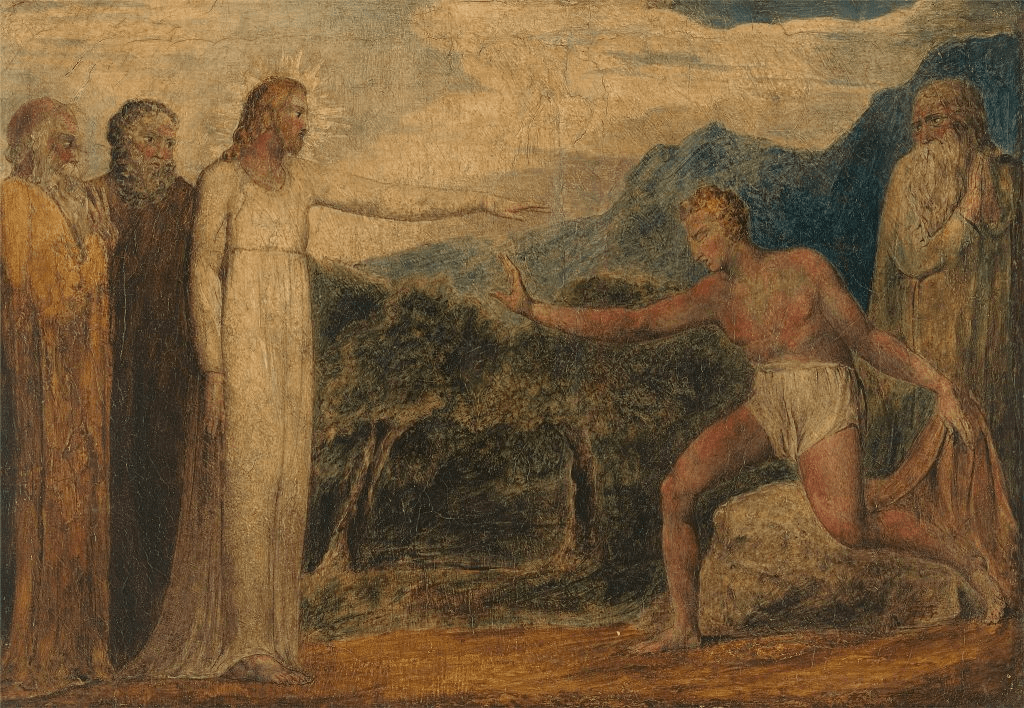
Christ Giving Sight to Bartimaeus, by William Blake (1757-1827)

And while in a large group of people, Jesus did not “work the crowd” to get ahead and further his agenda. He did not cozy-up to the rich and powerful. And Christ deliberately avoided celebrity status. Jesus showed extraordinary love to an overlooked person. He used his immense power for one powerless person.

Irony #3: The ones following Jesus were the ones trying to keep a blind man from Jesus.

One irony of the church is that Christ’s own followers can be the biggest obstacle to others following him.

I can just imagine a group of gossipy church folk shushing Bartimaeus: “Don’t bother Jesus, he is such a busy man! He has important work to do!” I can also picture them standing next to blind Bartimaeus saying, “Just stop, man, you’re embarrassing yourself.” 

But Bartimaeus would not stop. He shouted all the louder. That’s because true and genuine faith is a needy person crying out in desperation for Jesus to help.

Jesus asked a beautiful question: “What do you want me to do for you?”

“I want to see,” Bartimaeus responded. So, Jesus had compassion on him, and gave him his sight. Here we have two men, Jesus and Bartimaeus, ignoring all the people around them, and having a divine encounter.

This encounter raises my curiosity as to why it is so hard for us to simply say what we want.

It could be that we don’t want to buck the crowd, or to look different. Maybe we don’t want to admit our need in front of others. So, we simply stick to superficial conversations and insist that everything is okay, when it isn’t.

Jesus said, concerning the crowd, “Although they see, they don’t really see.” (Matthew 13:13)

If we are concerned about how we are seen by others, we will not be seen by God; we will miss Jesus when he walks by, right in front of us.

Conclusion

How might we raise our ability to see Jesus and truly follow him as he desires us to?

Listen to Jesus

Jesus was headed to Jerusalem and had a lot on his mind and heart with anticipating his passion and death. Christ became attentive to Bartimaeus, out of all the people around him, because he was listening.

If we want to see Jesus and follow him, we must be listeners,  and be attentive to compassion, like Jesus, to the needy and lowly among us. 

I recently read a story from a Christian who lived during Nazi Germany. He said:

“I considered myself a Christian. We heard stories of what was happening to the Jews, but we tried to distance ourselves from it, because what could anyone do to stop it? A railroad track ran behind our small church, and each Sunday morning we could hear the whistle in the distance and then the wheels coming over the tracks.

“We became disturbed when we heard the cries coming from the train as it passed by. We realized it was carrying Jews like cattle in the cars! Week after week the whistle would blow. We dreaded to hear those wheels because we knew we would hear the cries of the Jews in route to a death camp. Their screams tormented us.

“So, when we heard the whistle blow, we began singing hymns. By the time the train came past our church, we were singing at the top of our voices. If we heard the screams, we sang more loudly, and soon we heard them no more.

“Years have passed, and no one talks about it anymore. But I still hear that train whistle in my sleep. God forgive me. Forgive all of us who called ourselves Christians yet did nothing to intervene.” 

Respond to Jesus

Once Jesus listened, he responded by asking a question. Christ took the time to heal Bartimaeus.

Jesus could have simply healed him without even stopping. He could have started a healing factory where everyone with a need just moved through a line and got healed. But Jesus was doing more than giving sight; he was giving a blessing – the blessing of time and relationship.

The gospel is personal, which is why we ought to resist being non-relational in ministry to others.

Christian ministry is about blessing other people with the gift of relationship. It begins with recognizing self as the one who needs Jesus; and it starts with having our own eyes opened to see our own need, and then the great need of people around us.

God of all compassion, I confess that it is natural for me to do things my way. I recognize that I am limited, but that you know all things. I yield my spiritual eyesight to you so that my spiritual vision will be clear. Jesus Christ came to give sight to the blind and to open our eyes. I commit my ways to you so that I can see your ways and not just my own. Amen.