“Follow Me” (John 21:19b-24)

By Unknown Artist

Then he [Jesus] said to him [Peter], “Follow me!”

Peter turned and saw that the disciple whom Jesus loved [John] was following them. (This was the one who had leaned back against Jesus at the supper and had said, “Lord, who is going to betray you?”) When Peter saw him, he asked, “Lord, what about him?”

Jesus answered, “If I want him to remain alive until I return, what is that to you? You must follow me.” Because of this, the rumor spread among the believers that this disciple would not die. But Jesus did not say that he would not die; he only said, “If I want him to remain alive until I return, what is that to you?”

This is the disciple who testifies to these things and who wrote them down. We know that his testimony is true. (New International Version)

To actually follow Jesus around during his earthly ministry on this planet was amazing; yet singular, for just a few years of time. But to be called to follow Jesus in a post-resurrection world is, obviously, going to look different. It’s not the same.

It seems to me that the command from Jesus to “follow me” in such a world would take anyone a bit of time to wrap their head around. After all, Jesus had risen from death, and was about to ascend to heaven. How do you follow someone who is here, but not here?

Maybe Peter needed some space to try and make sense of it all by deflecting the command onto what’s going to happen with his fellow disciple John, who was hanging around following the two of them.

Jesus, undeterred by Peter trying to get Jesus on another subject, kept his focus on Peter. Again, Christ reiterated the command to Peter: “You follow me.”

It’s far too easy to look at others and wonder about their following, and to be overly concerned about somebody else’s Christian discipleship. If we are honest, oftentimes by doing that approach, we don’t have to deal with our own relationship with Jesus, and what he is saying specifically to me.

The beginning of Christ’s earthly ministry involved the command to “follow me.” And here, at the end of that phase of his ministry, he came back to the disciples, and to Peter, saying the very same thing: “Follow me.”

Even though so much had changed from the first time the disciples were called to follow Jesus, the basic nature of Christian discipleship had not really changed at all. In fact, even today, it still hasn’t much changed. The call still remains from the Lord Jesus to “follow me.”

“Whoever wants to be my disciple must deny themselves and take up their cross and follow me. For whoever wants to save their life will lose it, but whoever loses their life for me will find it.” (Matthew 16:24-25, NIV)

“I am the light of the world. Whoever follows me will never walk in darkness, but will have the light of life.” (John 8:12, NIV)

Anyone who loves their life will lose it, while anyone who hates their life in this world will keep it for eternal life. Whoever serves me must follow me; and where I am, my servant also will be. My Father will honor the one who serves me.” (John 12:25-27, NIV)

Unlike Christ’s earthly ministry, in this post-resurrection world, the call of discipleship and apprenticeship to Jesus, goes out into all the world. It’s for everyone, and not just a select few persons to follow Jesus physically as their rabbi and teacher.

Yet, what is similar, concerning the call to follow Christ, is that we can still today get sidetracked by rumors about other followers. Believers can become enamored with what is happening, or going to happen, with particular Christians and about whether Jesus is going to return today or tomorrow.

But our singular focus, as Christians, as people who embrace the name of Christ, is to follow Jesus. “Follow me” is just as relevant now as it was two millennia ago.

What is important for each of us is to actually focus on our own part in following Jesus. The Good Shepherd is perfectly capable of properly sorting the sheep and the goats. That’s not our job.

We have quite enough on our spiritual plate in dealing with our own Christian discipleship, without sticking our nose in another’s Christian walk with Jesus. There is a fine line between holding another accountable, and just plain old being a no-good spiritual busybody.

So, when it comes to Christian discipleship and following Jesus, we are to mind our own business. Butt out of other people’s walk of faith, and concentrate on your own special calling from God.

We are not to compare our discipleship with others, namely because we each have our place and particular set of spiritual gifts to edify the community. And if we will put our focus on our own specific call to follow, then the Body of Christ is healthy and works together in unity, harmony, and love. (1 Corinthians 12:4-11)

If we concentrate on Jesus, we will be fine. If we choose, however, to be a spiritual busybody, or the self-appointed spiritual police, then we are going to have Judge Jesus to contend with in a way you probably won’t like.

So, what is you calling? How will you relate to Jesus? Will you take up the command from Jesus to “follow me?”

Merciful Lord, give me the courage to take up my cross and follow you, even if it means sacrificing my own comfort and desires. Help me to be obedient to your commandments, to live a life of love, and to serve others with humility.

Thank you, Lord, for your faithfulness and your endless grace. Help me to follow you with all my heart and to live out your teachings in my daily life. Amen.

Why Are We Here? (Matthew 9:2-13)

Jesus heals and forgives a paralyzed man

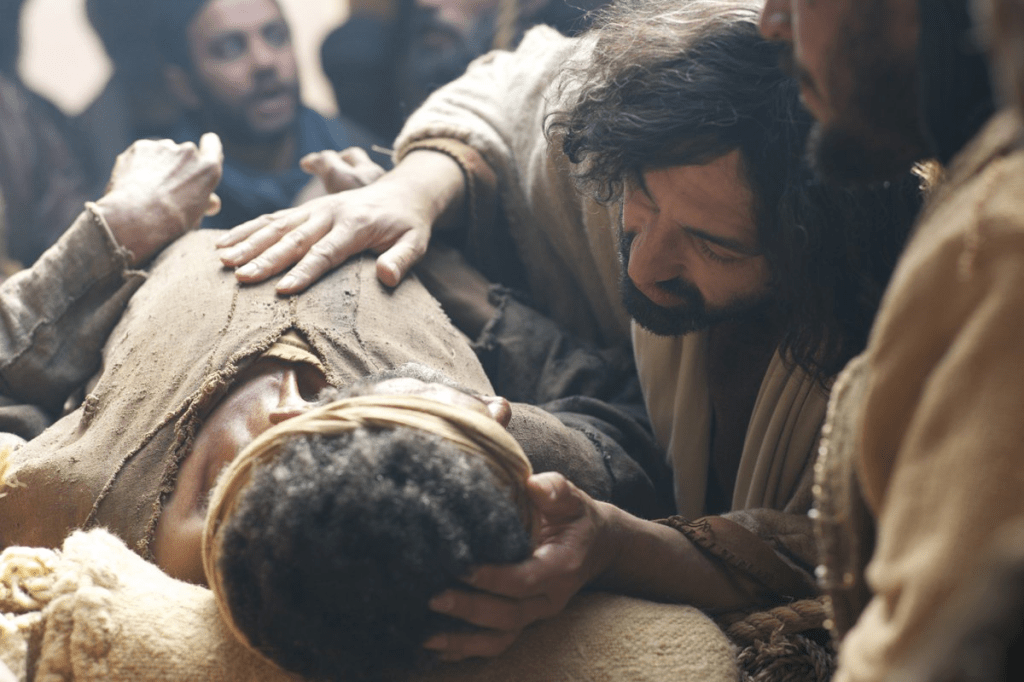
Some men brought to him a paralyzed man, lying on a mat. When Jesus saw their faith, he said to the man, “Take heart, son; your sins are forgiven.”

At this, some of the teachers of the law said to themselves, “This fellow is blaspheming!”

Knowing their thoughts, Jesus said, “Why do you entertain evil thoughts in your hearts? Which is easier: to say, ‘Your sins are forgiven,’ or to say, ‘Get up and walk’? But I want you to know that the Son of Man has authority on earth to forgive sins.” So he said to the paralyzed man, “Get up, take your mat and go home.” Then the man got up and went home. When the crowd saw this, they were filled with awe; and they praised God, who had given such authority to man.

As Jesus went on from there, he saw a man named Matthew sitting at the tax collector’s booth. “Follow me,” he told him, and Matthew got up and followed him.

While Jesus was having dinner at Matthew’s house, many tax collectors and sinners came and ate with him and his disciples. When the Pharisees saw this, they asked his disciples, “Why does your teacher eat with tax collectors and sinners?”

On hearing this, Jesus said, “It is not the healthy who need a doctor, but the sick. But go and learn what this means: ‘I desire mercy, not sacrifice.’ For I have not come to call the righteous, but sinners.” (New International Version)

“The church is a hospital for sinners, not a museum of saints.”

Abigail Van Buren (“Dear Abby”)

Why does the Church exist? Why did Jesus come to this earth? What are we supposed to be doing? Does Christianity make any difference in this world? Why are we here?

The Church is not on this earth solely for the benefit of Christians, any more than a hospital exists for the benefit of the doctors or insurance companies.

Rather, the Church is designed to extend the mission of Jesus through proclamation of good news with the restorative touch of grace. The Church is the community of the redeemed, gathered together for worship and encouragement, and then sent into the world to be the continuing presence of Jesus on this earth.

This mean that the Church’s calling is not to find others who can help them with their tithing and budget, or to keep the pews warm with fresh bottoms.

Some folks are not healthy. Some are sick physically, and others spiritually. Even more are emotionally brokenhearted. And then there are those who are sick-and-tired of being sick-and-tired.

Please know that Jesus came neither to condemn nor heap a pile of unrealistic expectations on us. Christ points us to the source of healing and transformation, and invites us to come to him. 

Conversely, there are many other people today who are healthy, spiritually alive, and have a good well-being. And they possess the opportunity to participate in ways that bring holistic healing to the world as Christians. The mission of Jesus is our mission, as well.

Jesus came to bring forgiveness and transformation. In today’s Gospel healing, it was a case where the person’s paralysis was both physical and spiritual. The paralytic found in Jesus healing of both body and soul.

The religious insiders observed the healing of the paralytic. Yet, they didn’t rejoice over it. Instead, they were hung up on Jesus claiming to be God. Although this may have been a hard truth to accept, Jesus labeled their response as evil – because of an inability to perceive the situation as a divine intervention. Since the religious insiders wrongly discerned who Jesus is, they wrongly interpreted the situation. 

It’s important to see Jesus as the Human One who extends compassion and forgiveness. If we fail to see this about Christ, we will get caught up in all kinds of silly matters concerning personal preferences and power plays, based in how we think things should go, rather than how God is shaking out things.

Jesus came to forgive our guilt and shame. Healing the body is good, but it’s not enough. Christ came to heal both the body and the spirit. At the heart of the human condition is spiritual brokenness, and Jesus wants to remove the obstacle of sin and create a new healthy society. This is a radical vision which seeks to encompass all persons – which means Jesus touched many people overlooked by others.

Jesus came to call the despised people of society, the “sinners.” He called Matthew, a tax collector. Tax collectors were hated. They were corrupt characters who extorted money from innocent people. And furthermore, Jesus had dinner with Matthew, along with all of his unsavory buddies. This kind of behavior by Jesus was deeply offensive to upstanding citizens.

However, Jesus did not back down, saying that it’s not the healthy who need a doctor, but the sick. And he backed up his social actions with Scripture by encouraging offended folks to meditate on what the biblical phrase, “I desire mercy, not sacrifice.” (Hosea 6:6)

It is possible to engage in outward rituals of worship, do all the right things, fulfill duty, yet still miss the heart of what God wants for humanity. Mercy is what God wants. Jesus knew this. So, Christ entangled himself with sinners to bring spiritual healing and restoration.

If we want to see God deliver people from their unhealthy situations, we must entangle ourselves with them, into complicated lives that are not pretty, with persons who have been tainted by sin. 

Lots of people are in awful predicaments. Christians, like their Lord, will need to get their hands dirty and their feet wet to extend Christ’s ministry of mercy and forgiveness.

The gospel was never intended to be proclaimed from afar, but up close and personal. The merciful mission of Jesus requires the following three activities:

  1. Intimacy with Jesus. Engaging in the spiritual disciplines of prayer, giving, fasting, reading, and meditating on Scripture. These practices help us to know Christ better and how to respond with mercy.
  2. Intimacy with fellow believers. We are hard-wired by God for community. Superficial relationships only provide superficial community. Christians need to help one another with spiritual growth, and to hold one another accountable for the mission of Christ.
  3. Intimacy with “sinners.” This world is filled with sick, needy, hurting, and lonely people who are locked in unhealthy patterns of living. They need a merciful change of life that comes from the merciful Jesus acting through merciful Christians. 

Mercy, not judgment, is at the heart of all change. For things to be different, we must be acquainted with mercy.

Most merciful God, we confess we have sinned against you in thought, word, deed, and neglect. We have not held fast to your commandments and have strayed from your teachings. We turn away from self-centered actions and pride. For the sake of your Son, Jesus, have mercy on us and forgive us so that we are released from all sinful obstacles. Empower us with your wisdom, revelation, and discernment so that we might be your merciful hands, feet, and words to one another and those who do not yet know you. Amen.

Jesus the Mentor (Mark 3:13-19)

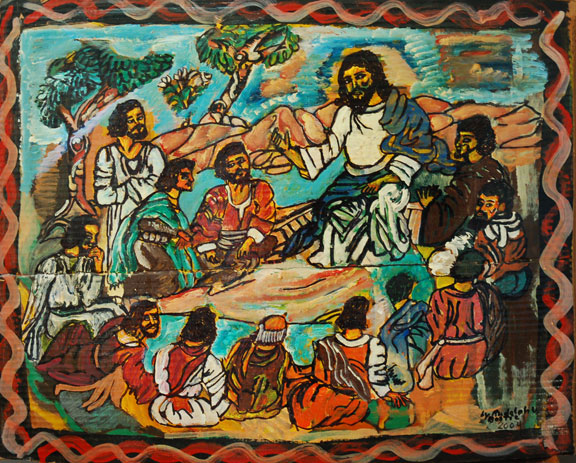
Jesus and the Disciples, by Rudolph Bostic

Jesus went up on a mountainside and called to him those he wanted, and they came to him. He appointed twelve that they might be with him and that he might send them out to preachand to have authority to drive out demons. These are the twelve he appointed: Simon (to whom he gave the name Peter), James son of Zebedee and his brother John (to them he gave the name Boanerges, which means “sons of thunder”), Andrew, Philip, Bartholomew, Matthew, Thomas, James son of Alphaeus, Thaddaeus, Simon the Zealotand Judas Iscariot, who betrayed him. (New International Version)

For me, every place in Holy Scripture is significant, even the seemingly mundane portions of it. Today’s verses might appear rather insignificant. However, there is some important meaning to recording who Christ called as his disciples and why he did it.

Jesus appointed twelve Jewish men to be his close disciples, his apostles. In choosing them, let’s not read into it something that isn’t there. This choosing, in no way, is meant to convey that church leadership boards are always supposed to have twelve men. It seems to me, that if such churches believe this, they ought to go all the way by insisting that they ought also to be Jewish Christians – no Gentiles on the election ballot at the annual meeting!

Excluding women, maintaining a particular number of people to a group, or considering only one ethnicity to leadership is nowhere to be interpreted in this text of Scripture. I can imagine Jesus sitting at the right hand of the Father raising a Spock-like eyebrow to such hermeneutical gymnastics and stating the lone word, “fascinating!”

A disciple is a follower. An apostle is one who is sent out with a specific purpose. Jesus called these particular people in order to send them out with a mission. In other words, Christ’s disciples are really missionaries. And these apostles, these missionaries, are appointed in order that they might be with Jesus, follow him everywhere, learn from him, and then have the received authority to go out and accomplish the mission given them to do.

An apostle can only properly carry out the instructions of the Teacher by first being a disciple who spends copious amounts of time in that Teacher’s presence. Indeed, if we are looking for some contemporary application in these more mundane texts of Scripture, let us find here an insight into our own Christian formation.

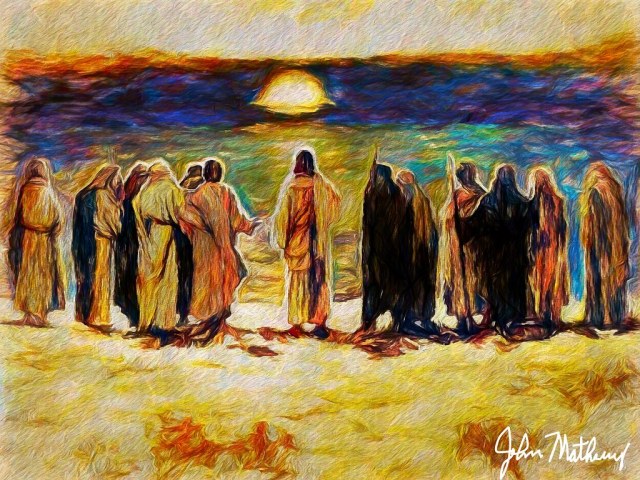
Jesus and the Disciples, by John Mathews

Christian ministry is rightly patterned after the Teacher we follow, Jesus our Lord. Christ himself demonstrated for us the way of mentoring or discipling, through his own words and actions. He called particular individuals, taught them, and equipped them for spiritual warfare in this world by granting them authority to do the work.

If we need a pattern, there it is. It’s a model of mentoring others in the ways of Christian mission and ministry. The idea is that we call, teach, equip, and authorize others in the words and ways of Jesus. I really don’t much care what you call it: Christian discipling, relational mentoring, small group teaching, spiritually forming, or any other word or phrase.

The important thing is to actually understand and do this very Christ-like work of developing mature followers of Jesus who can do the important work of spiritual warfare and ministry, then in turn, develop others. We are to pass on a body of faith and doctrine, of mission and ministry, to a group of people who will do the work. And they then do the same for others.

I rather like the word “mentoring” because for most people it evokes the idea of putting time and effort into some relationships for a specific purpose. And when we look at Christianity as a great mentoring project, perhaps we will see why church is becoming a byword in many parts of the Western world. This also ought to perhaps clue us into how we might move forward as Christians.

I am suggesting that, generally speaking, we have neglected this pattern of Jesus in calling, teaching, equipping, and authorizing. It is one large reason why there is such a decline in church attendance (and participation) in the West. And until we collectively take up this mantle of mentoring ministry, we shall continue to lessen, because we are irrelevant to people’s daily lives – both inside and outside the church.

As a first course of action, I invite you – no matter your age or stage in life – to make it a priority to simply “hang out” with individuals and groups of people. Maybe that sounds like an extrovertish sort of thing to do. However, this invitation is coming from me, an introvert. I didn’t say you have to be the life of the party, or engage in a lot of talking. But I am saying that mature followers of Jesus ought to strongly consider some intentional relationships with people other than family and a few friends.

Hang out around any given church, on any given Sunday, after any given worship service, and you are likely to see small groups of people talking with each other. Those groups typically center around friends according to age. What is often lacking are intentional interactions between the generations.  

Ethiopian Orthodox Church depiction of Christ and his disciples

The younger generations (particularly persons aged 18-29) often need and want to have relationships with more experienced (older!) believers in the faith. Younger adults, however, tend to lack the confidence to go after older adults in order to be mentored or influenced by them. I believe the onus is on the older generations to go after the younger.  

Maybe I’m just old, but it seems like younger generations have an incredible array of relationships, differing levels of friendship, and a complexity to their interactions that I didn’t have “back in my day.” What’s different, it seems, is that their relationships are more gray, and less black and white. And they appear to do a solid amount of hanging out.

Hanging out is typically sitting around with a group of people, eating and drinking, watching movies, studying (or doing bible study) or any other activity. Its doing just about anything, but doing it together with others. And this is the perfect environment for initially establishing how to begin living into the words and ways of Jesus to mentor others.

One of the things we older folks can do is to really understand the reality of younger generations’ relational interactions. For example, when I lived in a university town I used to often just “hang out” with college students, with no agenda other than just being with them. The local Perkins restaurant was at its busiest at midnight, filled with college students hanging out.

There are places in every town and city where young adults go, especially the bar scene. Bars aren’t just places to drink, but are locations of conviviality where persons have the chance to be around one another in a kind of secular church where fellowship happens, looking for a chance to relate meaningfully with others.

All people desire intimacy and want to know that someone else cares about them. This is a very real and felt need. How that need is going to be met can be either legitimate or illegitimate. And we can help with that.

One of the best things we can do for others is to communicate to them that we “have their back,” that we care, love, and genuinely like them.

No one can sniff out a disingenuous attitude quite like a young adult. So, our interactions have to be an authentic desire to be around them. Also, this does not mean we have to pretend to be younger than we are. Instead, one of the greatest needs a young person has is to be in a mentoring relationship with someone older and wiser who can help them navigate life and bring some sort of definition to relationships that they may lack.

The older generations could learn to “hang out” with younger generations and find individuals for whom they can build a solid one on one or group relationship with. If they can have such relationships now, it will serve them for a lifetime.

It seems to me that, as I look at the biblical text, being a mentor, and walking alongside another with love, grace, and wisdom, is built into Christianity by Jesus himself. So, let’s consider how we might best go about this important work.

May your love overflow more and more with knowledge and full insight to help you to determine what really matters, so that in the day of Christ you may be pure and blameless, having produced the harvest of righteousness that comes through Jesus Christ for the glory and praise of God. (Philippians 3:9-11, NRSV)

Follow Me (Mark 1:14-20)

Come Follow Me, by Jorge Cocco Santángelo 

Now after John was arrested, Jesus came to Galilee proclaiming the good news of God and saying, “The time is fulfilled, and the kingdom of God has come near; repent, and believe in the good news.”

As Jesus passed along the Sea of Galilee, he saw Simon and his brother Andrew casting a net into the sea, for they were fishers. And Jesus said to them, “Follow me, and I will make you fishers of people.” And immediately they left their nets and followed him. As he went a little farther, he saw James son of Zebedee and his brother John, who were in their boat mending the nets. Immediately he called them, and they left their father Zebedee in the boat with the hired men and followed him. (New Revised Standard Version)

For all the talk of leadership, developing leaders, and being a leader, there is precious little conversation these days about becoming a follower. Perhaps we have such a dearth of leadership for this very reason, because one can only become a good leader if they experientially know what being a follower is.

The Call of Jesus

The call of Jesus is to pursue him, and he will develop us. Follow Jesus, and he’ll show you how to fish for people. All of Christ’s original disciples listened to Jesus, dropped everything they were doing, and immediately followed him.

I am wondering what would make you drop literally everything you are presently doing to pursue an entirely new life. I am curious what would cause you to follow Jesus without any conditions attached whatsoever. 

I am impressed that Peter and Andrew immediately responded to Jesus. They didn’t question Jesus as to whether this was a short term project or a long term assignment he was calling them to. They did not seek a contract with Jesus or ask how he would impact their stock portfolio. 

The first disciples simply dropped everything and left with Jesus.

I suspect they followed Jesus for the same reason I originally decided to follow him – because Jesus is such a compelling person, so gracious, interesting, and loving, that it was really no decision at all. Everything else pales in comparison with Jesus.

Read all four Gospels and the book of Acts and you will find that believers in Jesus follow Jesus; and those who do not follow Jesus are not believers. Followers follow, and those who do not follow are not Christ’s followers.

Jesus still calls people. He calls us to follow him and he will make us fishers of humanity. Maybe you are concerned about this and say, “I have no idea how to fish for people.” The good news is that Jesus said he would make us fishers of people. Jesus is not looking for people with skills he can use; instead, he calls, then develops people into fishers.

Christ always forms people with the ability to follow his call. Jesus will train us; we only need to answer the call to follow. 

When I was five years old my Dad took the training wheels off my bike and told me to ride it. I told him I couldn’t. He told me to get on the bike and he would run beside me. I got on the bike and started to ride with him holding it. When I began to panic, approaching a tree, I started talking to my Dad. But he didn’t answer… because he wasn’t beside me. He dropped out from shagging me a long way back.

We are not called to follow Jesus based on our skills, but on the lack of them so that Jesus will do in us a work of total allegiance and loyalty to the kingdom of God. 

Jesus will make sure to develop the skills we need in order to do what he has called us to do. We only need to hear and answer the call of Jesus to follow. The following is a parable about the church and being fishers of people: 

“Now it came to pass that a group existed who called themselves fishermen. Week after week those who called themselves fishermen met in meetings and talked about their call to fish, the abundance of fish, and how they might go about fishing. They discussed the importance of fishing and that fishing is the task of every fisherman.  They listened to special speakers talk about fishing and they promoted fishing and looked at all the latest equipment for fishing. They built large buildings called ‘Fishing Headquarters’ so that they could tell as many people as possible about fishing. They organized boards of people to send out fishermen to other places. They offered teaching and classes on how to fish and the best and latest fishing methods. With much training a good many persons got their fishing licenses and became upstanding members of Fishing Headquarters. There was just one thing that they did not do: They didn’t fish. When one person dared to suggest that those who do not catch fish are really not fishermen, the group became angry and kicked that crazy person out their group.”

The Message of Jesus

Jesus said the kingdom of God is near, so repent and believe the good news. For Jesus, the word “kingdom” means God’s intentions and will for this world to come true. Jesus was saying that he is creating a new society – which meant Caesar was not Lord and that people’s loyalty was not ultimately to the Roman Empire. 

The kingdom of heaven, God’s dream society, will eventually spread across the entire earth so that the whole world is God’s sacred space, devoted to love, shaped by justice, living in peace, and abounding with wisdom.  Jesus encouraged us to pray consistent with this idea saying, “May your kingdom come and your will be done on earth as it is in heaven.” (Matthew 6:10)

If we find ourselves not really working toward Christ’s idea of kingdom, then we need to “repent and believe the good news” that God is working toward restoring all things to their original beauty and luster. The word “repent” means a change of mind which leads to a change of behavior. And “believe” means to put all your eggs in God’s kingdom basket.

None of this is a suggestion, but is rather a straightforward call to follow Jesus in his kingdom building enterprise on this earth. It would, therefore, be a travesty to simply think about the message for a while and follow Jesus if we feel like it, or get around to it.

Jesus wants to make fishers within family systems, workplaces, neighborhoods, and all the places within a typical sphere of living: This requires the following:

  1. Go where the fish are. Fishing would be easy if we could put a basket by the water and have the fish jump into them! But that is not how it works. Rather, it takes intentional activities that connect people together.
  2. Cast the nets. Peter and Andrew did more than take their boat out to the middle of the lake. To catch fish, they threw their nets into the water. Here is what I believe this means for us: We do what is fair and just to our neighbors. We extend compassion to them and are steadfast in our love, even when others are unlovely. And we do not take ourselves too seriously.
  3. Obey Jesus and walk with him. After Christ’s resurrection, Jesus came to some of the disciples, who had fished unsuccessfully all night. He told them to throw their nets on the other side of the boat – which seemed like nonsense, but they did it anyway. It resulted in a great catch (John 21:1-14). During the three years of Christ’s earthly ministry, the disciples did everything with him – they walked, talked, and ate with Jesus. And when he ascended to heaven, they acted on the Great Commission given to them by Jesus to make other disciples.

May God cleanse our lips and our lives so that we might proclaim the good news of Christ’s kingdom with glad and sincere hearts to the glory of Father, Son, and Spirit.

Eternal God, the refuge and help of all your children, we praise you for all you have given us, for all you have done for us, for all that you are to us. In our weakness, you are strength, in our darkness, you are light, in our sorrow, you are comfort and peace. We cannot number your blessings; we cannot declare your love: For all your blessings we bless you. May we live as in your presence, and love the things that you love, and serve you in our daily lives, through Jesus Christ our Lord. Amen.