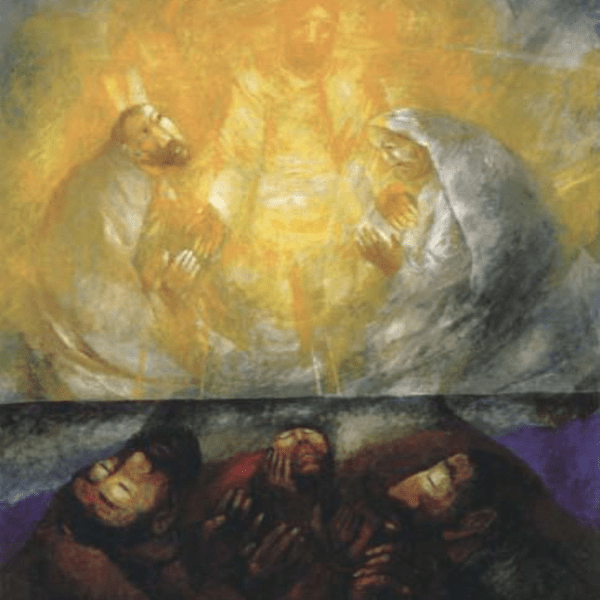
Don’t Be Afraid (Matthew 17:1-9)

Transfiguration by Sieger Köder (1925-2015)

After six days Jesus took with him Peter, James and John the brother of James, and led them up a high mountain by themselves. There he was transfigured before them. His face shone like the sun, and his clothes became as white as the light. Just then there appeared before them Moses and Elijah, talking with Jesus.

Peter said to Jesus, “Lord, it is good for us to be here. If you wish, I will put up three shelters—one for you, one for Moses and one for Elijah.”

While he was still speaking, a bright cloud covered them, and a voice from the cloud said, “This is my Son, whom I love; with him I am well pleased. Listen to him!”

When the disciples heard this, they fell facedown to the ground, terrified. But Jesus came and touched them. “Get up,” he said. “Don’t be afraid.” When they looked up, they saw no one except Jesus.

As they were coming down the mountain, Jesus instructed them, “Don’t tell anyone what you have seen, until the Son of Man has been raised from the dead.” (New International Version)

Fear is a universal feeling and experience. None of us has to work at being afraid – but we all have to work at being brave and having the courage to face our fears.

Sometimes, we adults teach children not to fear because we assume they are afraid of the dark, high places, and monsters in the closet. But I tend to think a lot of our own adult fear is projected on kids. Why? Because some of the bravest folks I have ever known are children. 

Kids don’t understand near as much as we adults do, yet they conquer their fears every day by facing the world with courage. If you were to go to any children’s hospital today, I believe you would be amazed at the kind of courage you would find amongst kids. We adults have a whole lot to learn about being brave because we have become far too sophisticated in hiding our fears and avoiding courage.

This is why the most repeated exhortation is all of Holy Scripture is to not be afraid. We need courage to live the way God wants. Every day is a fresh opportunity to practice courage.

We need the courage to stand alone

Korah son of Izhar, the son of Kohath, the son of Levi, and certain Reubenites—Dathan and Abiram, sons of Eliab, and On son of Peleth—became insolent,and rose up against Moses. With them were 250 Israelite men, well-known community leaders who had been appointed members of the council. They came as a group to oppose Moses and Aaron and said to them, “You have gone too far! The whole community is holy, every one of them, and the Lord is with them. Why then do you set yourselves above the Lord’s assembly?” (Numbers 16:1-3, NIV)

When Moses heard this, he responded with prayer to God – because he clearly understood that this was all a big power play by Korah, who got others stirred up to take action against him. 

Moses stood alone. Out of the millions of Israelites, not one single person stood with Moses. To be sure, the majority of Israelites did not side with Korah; but neither did they come and stand with Moses. Why? They were too afraid to be involved and took the posture of bystanders. 

God did a miraculous thing, never done before or since, by opening up the ground and having the earth swallow Korah and his followers. The Lord wasn’t only upset with Korah; God was also angry with the people for fearfully standing in the safety of numbers and doing nothing. In fact, God was so mad that he was ready to wipe them all off the face of the earth. But, yet again, Moses, in humility, prayed and pleaded with God to spare them – and God did.

There will always be someone opposing you when you are just trying to obey God and do the right thing. And there will always be a crowd of people who do not want to be involved because they are afraid.

The church everywhere needs to be what Jesus wants it to be, and not what a particular person or group of people want it to be. Courageous people need to stand up to people who want positions of power in order to lead in self-serving ways.

We need the courage to love people

Now while he was in Jerusalem at the Passover Festival, many people saw the signs he was performing and believed in his name. But Jesus would not entrust himself to them, for he knew all people. He did not need any testimony about mankind, for he knew what was in each person. (John 2:23-25, NIV)

Jesus did not get carried away with his own press. Whether people responded to him by the hundreds, or whether they refused him altogether and tried to throw him off a cliff, Jesus was consistently the same. He did not need people’s responsive affirmation in order to do his mission on earth. Christ loved people just because he wanted to, and not because he was trying to get them to love him in return, like insecure and fearful people do.

We need the courage to love the unlovely. And we must understand that perfect love casts out fear.

“We should not only love our brothers and sisters, but also not consider ourselves better than them. Instead, we should show compassion and acceptance to others. We want to have others strictly reprimanded for their offenses, but we will not be reprimanded ourselves. We are inclined to think the other person has too much freedom, but we ourselves will not put up with any restraint to our freedom. There must be rules for everyone else, but we must be given free rein. It is seldom that we consider our neighbor equally with ourselves. If everyone was perfect, what would we have to endure for the love of God?… for we cannot live in this world without adversity. Those who can suffer well will enjoy the most peace, for such persons are brave, courageous, not afraid of pain, have Christ as their friend, and heaven as their reward.”

Thomas à Kempis, The Imitation of Christ, c.1425, C.E.

It is no test of virtue to be on good terms with easy-going people. And, of course, all of us want to live in peace and prefer those who agree with us. Yet, in this mortal life, our peace consists in the humble bearing of suffering and contradictions, not in being free of them.

We need the courage to please God

The devil took him to a very high mountain and showed him all the kingdoms of the world and their splendor. “All this I will give you,” he said, “if you will bow down and worship me.” Jesus said to him, “Away from me, Satan! For it is written: ‘Worship the Lord your God, and serve him only.’” (Matthew 4:8-10, NIV)

Jesus is our model of courage. He sought to please the Father, and not anyone else. Jesus bravely resisted becoming someone other than he was called to be. 

On the Mount of Transfiguration, Jesus courageously refused to remain on the mountain, instead choosing to go into the valley and undertake a new and risky ministry. 

Christ fearlessly came to this earth in the incarnation and resisted the comfort of security. He valiantly confronted sin, overturned the money-changers’ tables, and did his Father’s will, instead of shrinking in fear about what people would think. 

Jesus heroically faced crucifixion, even though he was terribly stressed about it, in order to offer forgiveness in the face of persecution. Jesus gallantly said “No!” to the power of sin by rising from death. And he boldly ascended to heaven and confidently passed the work of ministry to a motley group of people who did not show any promise to carry the mantle of his teaching.

The Son found his identity in relation to the Father. For us to please God, we need the courage to play to an audience of One. 

If we need other people’s acceptance and approval in order to do anything, then we will never have the courage to act for God. 

We must live by conviction, and not by sticking our finger to the wind to see which way popular opinion is blowing.

Conclusion

History is filled with men and women who said “no” to destructive fear and changed the world. But imagine if they had succumbed to the paralyzing effects of fear in their lives. Imagine if…

The Apostle Paul, fearing resistance or rejection, chose to stay home rather than embarking on the missionary journeys that took the message of Christ throughout the known world.

Martin Luther King Jr. gave speeches filled with gentle hints about the evils of segregation, because he feared pushing too hard.

Jackie Robinson refused to enter major league baseball so as to not rock the boat; or Branch Rickey, the owner of the Brooklyn Dodgers, just going with the way baseball had always operated. But neither of them went that way. In the film, “42,” Robinson asks Rickey:

“You want a player that doesn’t have the guts to fight back?” “No. No.” replies Rickey. “I want a player who has the guts not to fight back. People aren’t going to like this. They’re going to do anything to get you to react. Follow a curse with a curse and they’ll hear only yours. Follow a blow with a blow and they’ll say the Negro lost his temper; that the Negro does not belong. Your enemy will be out in force and you cannot meet him on his own low ground. We win with hitting, running, fielding—only that. We win only if the world is convinced of two things: That you are a fine gentleman, and a great ball player. Like our Savior, you’ve got to have the guts to turn the other cheek. Can you do it?”  Robinson replies, “You give me a uniform; you give me a number on my back; and I’ll give you the guts.”

42 (2013 film)

Now imagine yourself, fully aware of the mission and vision God has placed in your heart to advance his gracious and benevolent rule in this world – and yet there is also present all the phobias, irrational worries, and destructive fears of failure, harm, or rejection. So I ask:

If you don’t fulfill the mission God assigned to you, who will?

A Reality Check (Hebrews 10:1-4)

The law is only a shadow of the good things that are coming—not the realities themselves. For this reason it can never, by the same sacrifices repeated endlessly year after year, make perfect those who draw near to worship. Otherwise, would they not have stopped being offered? For the worshipers would have been cleansed once for all and would no longer have felt guilty for their sins. But those sacrifices are an annual reminder of sins. It is impossible for the blood of bulls and goats to take away sins. (New International Version)

Sometimes, we silly people confuse the sign for the real deal. It’s important to distinguish between the two. We discern the difference all the time when it comes to more mundane affairs.

People generally know that looking at a movie poster is not watching the actual film; that wearing a string of cheap pearls is only mimicking the real and expensive ones; or that sitting in a doctor’s waiting room isn’t the same thing as being in the appointment.

However, when it comes to our religion, we seem to blur the lines between sign and substance. Praying a “sinners prayer” or making a profession of faith isn’t the same as growing, maturing, following, and living a committed Christianity.

Knowing some Christian lingo and/or going with the flow of cultural Christianity doesn’t necessarily mean that Christ’s words and ways are being followed.

And today’s New Testament lesson is a reminder, and not a guilt trip, that the law points to the actual substance of religious life – and is not life itself.

The laws surrounding the old system of animal sacrifice were never meant to be an end in itself. It pointed forward to the real deal and was, therefore, completely inadequate to bring deliverance from sin, death, and hell to anyone.

The very fact that sacrifices needed to be repeated year and after year demonstrated that they were ineffectual in saving a person. Rather, those sacrifices were designed to cause the worshiper to long for a sacrifice to end all sacrifices – to anticipate that the sin issue would be settled once and for all.

The only thing the sacrifices did was remind people they were sinners in need of a savior. Just as a slap on the hand is grossly inadequate for handling a murderer, so offering an animal was never going to do the trick in taking care of divine justice.

And besides, God has never been pleased with a bunch of sacrifices anyway. So, what is God really pleased with? The Lord is pleased with a heart devoted to obedience and fealty to Jesus Christ; God cares about inner attitudes and dispositions of the spirit which are inclined toward righteousness, holiness, mercy, humility, and justice for all.

Sacrifices, in and of themselves, have no power; they are like a toothless lion who couldn’t bite into you if he tried. The way to set things right is through the once for all mighty sacrifice of the Son – an offering to end all offerings.

God doesn’t want a checklist of daily sacrifices, any more than a spouse only wants supper on the table at night, or a paycheck every month. It’s nice but falls short of the full scope of marital interactions and relations. A marriage built on law won’t stand. It needs real flesh and blood relationship, complete with a devoted heart, sincere attitudes, and loving words and actions.

Since Christ has ably and permanently taken care of the sin issue, what sort of impact ought that to have on the Christian’s life? What kind of people are we to be?

To begin listing things to do is to go back to law and fail to grasp the gospel. And that’s where many churches and believers get tripped up and miss the grace of God altogether. Observing rules of cultural Christian activities or holding to some accepted Christian norms isn’t going to cut it.

Christ’s Sermon on the Mount by Jorge Cocco Santángelo

Jesus described the sort of people who go beyond ritual regulations and rules to embrace the true spirit and end of the law:

“You’re blessed when you’re at the end of your rope. With less of you there is more of God and his rule.

“You’re blessed when you feel you’ve lost what is most dear to you. Only then can you be embraced by the One most dear to you.

“You’re blessed when you’re content with just who you are—no more, no less. That’s the moment you find yourselves proud owners of everything that can’t be bought.

“You’re blessed when you’ve worked up a good appetite for God. He’s food and drink in the best meal you’ll ever eat.

“You’re blessed when you care. At the moment of being ‘care-full,’ you find yourselves cared for.

“You’re blessed when you get your inside world—your mind and heart—put right. Then you can see God in the outside world.

“You’re blessed when you can show people how to cooperate instead of competing or fight. That’s when you discover who you really are, and your place in God’s family.

“You’re blessed when your commitment to God provokes persecution. The persecution drives you even deeper into God’s kingdom. (Matthew 5:3-10, MSG)

That describes folk who have embraced faith as the fulfillment of law. It’s a summary of the law’s intended purpose and end.

So, let’s worship Christ; and not some caricature of him. Maybe carefully reading through the entire book of Hebrews in one sitting will help.

Blessed God, purify your people by your abiding presence. Enlighten the minds of your people with the light of your good news. Bring wandering souls to an awareness and knowledge of Jesus Christ; and those who are walking in the way of life, keep them steadfast to the end. Guard those who are strong and prosperous from forgetting you. Increase in us your many gifts of grace and make us all fruitful in good works for the sake of Christ in the power of the Holy Spirit. Amen.

Epiphany of the Lord (Matthew 2:1-12)

After Jesus was born in Bethlehem in Judea, during the time of King Herod, Magi from the east came to Jerusalem and asked, “Where is the one who has been born king of the Jews? We saw his star when it rose and have come to worship him.”

When King Herod heard this he was disturbed, and all Jerusalem with him. When he had called together all the people’s chief priests and teachers of the law, he asked them where the Messiah was to be born. “In Bethlehem in Judea,” they replied, “for this is what the prophet has written:

“‘But you, Bethlehem, in the land of Judah,
    are by no means least among the rulers of Judah;
for out of you will come a ruler
    who will shepherd my people Israel.’”

Then Herod called the Magi secretly and found out from them the exact time the star had appeared. He sent them to Bethlehem and said, “Go and search carefully for the child. As soon as you find him, report to me, so that I too may go and worship him.”

After they had heard the king, they went on their way, and the star they had seen when it rose went ahead of them until it stopped over the place where the child was. When they saw the star, they were overjoyed. On coming to the house, they saw the child with his mother Mary, and they bowed down and worshiped him. Then they opened their treasures and presented him with gifts of gold, frankincense and myrrh. And having been warned in a dream not to go back to Herod, they returned to their country by another route. (New International Version)

The light exists; it’s there. But not everyone likes it.

While many celebrate the light, such as Christians on the day of Epiphany, others wrap themselves in the cloak of darkness. There are various responses to Jesus as the Light of the World; not all of them are the same.

King Herod responds with anger

Herod was distressed with the news of a potential King of the Jews being born; he saw this as a threat to his rule. Herod, ever the narcissistic person who always sought to wipe out any threat to his throne, went over the top in seeking destroy Jesus. 

At the time of Christ’s birth, Herod had been the reigning king for about 30 years. During that time, his paranoia about losing power led him to kill his wife and three of his own sons because he saw them as threats to his authority. Herod feigned a desire to worship Christ, but this was really a sinister façade in order to get rid of Jesus by any means possible.

Jerusalem responds with anxiety

The people of Jerusalem felt that Jesus was going to upset the status quo. He was, for them, a threat to their security; any change within the system might cause Herod to take it out on them (which he had done before). 

Although the people were looking for a deliverer, they did not want things to shake up too much and arouse the Romans to abuse them.

Whenever we get caught up in maintaining the status quo, out of fear, then we have no room in the inn for Mary and Joseph. 

Always trying to keep people happy and not upset them is a tenuous way to live. Such an agenda will typically result in missing Jesus when he shows up. That’s because we’re not really looking for him to start with. 

For example, if our task as parents is to just keep our kids out of trouble, they’re going to miss Jesus; and if they find him, it will be in spite of us and not because of us. Yet, if our truest desire for them is to know Christ, then our prayers, our words, and our actions will reflect the ethics of God’s kingdom.

Religious leaders respond with apathy

The chief priests and teachers of the law had all the right answers; and responded to Herod’s questions with the correct information.

The sad part is that the guys who knew the most about Scripture, who actually had a handle on God’s law, were simply satisfied with that knowledge and nothing more. They seemed  unconcerned with getting off their butts and getting on their knees to worship the Son of God.

If we know the truth, we must act on it. Jesus wants people to worship in spirit and in truth. He wants more than a mere recognition; Jesus desires us.

The Magi respond with adoration

The Three Wise Men by He Qi

The Wise men, or Magi, were Gentiles and pagan astrologers (not kings). They devoted themselves to studying the stars and discerning what was happening. Because of this, they were often advisors and counselors to kings.

Some may find it scandalous that God used such persons, but that’s okay. The Lord typically uses the folks we believe are (or should be) unusable. Turns out it is the people such as the Magi that demonstrate their devotion and adoration through actual worship and giving of costly gifts.

Epiphany

Each year on January 6 in the Church Calendar, after the twelve days of Christmas, is the celebration of Epiphany. Christ’s coming to this earth as a child and becoming like us is much more than a baby in a manger.  Epiphany of the Lord helps to bring a vision and understanding of God’s glory to all kinds of people of the world.

The word “epiphany” means “manifestation” or “appearance” – which is exactly what happened with the Magi in visiting Jesus. The season of Epiphany has a special emphasis on the teaching and healing ministry of Jesus. The focus of these weeks is that salvation is not limited to Israel but extends to the Gentiles, as well.

With Epiphany’s light, we see that one of the most scandalous truths of Christianity is that God graces common ordinary people, who seem far from God, with the gift of Jesus. 

God grants life for all kinds of people – no matter their race, ethnicity, gender, class, or background. It’s a wondrous and astounding spiritual truth that God’s gracious concern is not limited to a certain type of person or a particular group of people.

Grace

Grace is and ought to be the guiding factor in how we interact with people. 

Losing sight of grace leads to being critical and defensive. Like King Herod of old, a graceless person becomes enamored with earthly power and control. But embracing grace leads to the humility of seeing the image of God in people quite different from us. 

Like the Apostle Peter, who learned in a vision to bring the gospel to non-Jews, old legalisms begin to wear away so that people from all walks of life can have access to Jesus and his gracious saving and healing ministry. (Acts 10-11:18)

Grace topples barriers and clears away unnecessary distinctions between others. Our appropriate response to such a grace is to glorify God for this marvelous and amazing work.

Light

A light was provided to lead the Magi to Jesus. Apart from God’s gracious intervention, they would have remained in darkness. 

This old broken world is enveloped in spiritual darkness. All kinds of people have no light at the end of the tunnel of their lives for hope and new life. Christ brings that light to those unable to see. And Jesus, in his teaching ministry, exhorted his followers not to hide their light but to let it shine for all to see. (Matthew 5:14-16)

Sometimes, maybe oftentimes, the best way to bring resolution to our own troubles and problems is through helping others make sense of their lives through the gracious light of Christ. Then, they can see an appearance, an epiphany, of what their lives could be in the gracious and benevolent rule and reign of God. 

In this season of Epiphany, let us journey with Jesus through his earthly upbringing, walk with him in his gracious ministry to people; and keep watch with him so that our own light does not grow dim.

Merciful God of life and light, you have gifted the Church through the goodness of your grace to be your hands; to do your work; to be your voice; to share your words; and to bring healing for broken lives. You have graciously gifted your people with the blessings of your Spirit, the power to transform lives and make all things new.

Now may our hearts receive, our mouths proclaim, our hands prepare for compassionate service so that the love we have will overflow into the hearts of others. May they receive your grace, your renewing Spirit, and your love, through Jesus Christ our Savior. Amen.

Jesus of Nazareth (Matthew 2:13-23)

Nazareth Village, Israel

When they had gone, an angel of the Lord appeared to Joseph in a dream. “Get up,” he said, “take the child and his mother and escape to Egypt. Stay there until I tell you, for Herod is going to search for the child to kill him.”

So he got up, took the child and his mother during the night and left for Egypt, where he stayed until the death of Herod. And so was fulfilled what the Lord had said through the prophet: “Out of Egypt I called my son.”

When Herod realized that he had been outwitted by the Magi, he was furious, and he gave orders to kill all the boys in Bethlehem and its vicinity who were two years old and under, in accordance with the time he had learned from the Magi. Then what was said through the prophet Jeremiah was fulfilled:

“A voice is heard in Ramah,
    weeping and great mourning,
Rachel weeping for her children
    and refusing to be comforted,
    because they are no more.”

After Herod died, an angel of the Lord appeared in a dream to Joseph in Egypt and said, “Get up, take the child and his mother and go to the land of Israel, for those who were trying to take the child’s life are dead.”

So he got up, took the child and his mother and went to the land of Israel. But when he heard that Archelaus was reigning in Judea in place of his father Herod, he was afraid to go there. Having been warned in a dream, he withdrew to the district of Galilee, and he went and lived in a town called Nazareth. So was fulfilled what was said through the prophets, that he would be called a Nazarene. (New International Version)

Jesus is the New Exodus

Joseph was told to take Jesus to Egypt. He obeyed the Lord and assumed the role of protecting the child Jesus, unlike King Herod’s demented attempt to murder Jesus. Whereas Herod sought only his own personal agenda, Jesus identified with the people of God and sought their best interests.

Just as God brought the Israelites out of Egypt through a great deliverance, so God brought up Jesus, the Great Deliverer, out of Egypt as the unique Son of God. Jesus is God’s divine Son, and so is the rightful Ruler in God’s kingdom.

In Christianity, Jesus is the special God Man who secures salvation for us. God preserved Israel from Pharaoh’s wrath; God protected Jesus from Herod’s wrath.

Flight to Egypt by He Qi

God’s kindness and loyalty preserves us from the wrath of the devil who seeks to keep as many people as possible in the realm of darkness. 

Our hope is in the Lord, specifically, in Jesus who has conquered the devil; and he did it by first establishing a beachhead on this earth through his incarnation as the Son of God.

Just as Hosea’s prophecy was an appeal to turn from other gods to the true and living God of mercy and grace, so Matthew calls us to turn from idolatry, from anything that would displace Jesus as the rightful Ruler of our lives.

Jesus brought us out of exile

King Herod massacred innocent toddlers in order to ensure the destruction of Jesus. Behind his atrocity was the devil himself who knew that Jesus was the coming King who would one day bring salvation, and the satanic agenda was set in place.

However, nothing can thwart the fulfillment of God’s promises – including Satan, whose most powerful weapon, death, has now lost its sting because of Jesus.

Just as the prophet Jeremiah spoke hope to the people that exile will not be forever, so Matthew speaks the fulfillment of that hope. The incarnation is here. Jesus has arrived. Salvation has come in the form of a child. He is the Deliverer, the Savior. Christ brings us from captivity into the promises of God.

Jesus came to save the littlest, the lowly, the least, the lost, the lonely, and the last. God demonstrated the commitment to deliver such persons through a humble existence in a backwater town called Nazareth.

Jesus is the new Moses

Joseph is, again, unexpectedly visited by an angel with instructions concerning Jesus. Herod, after all his sinister shenanigans, finally dies. The ancient Jewish historian, Josephus, described Herod’s death: 

He had a terrible craving to scratch himself, his bowels were ulcerated, and his privates were full of gangrene and worms. At Jericho he assembled the men of distinction from all parts of the nation and ordered them shut inside the hippodrome. He told his sister, Salome, that as soon as he died, all these men were to be killed, so that there would be grief throughout the country at his death rather than joy. (Paul Maier, Josephus: The Essential Works, 252)

The contrast between King Herod and King Jesus could not be any more pronounced; Jesus said in a clear demonstration of his humility and grace at his death:

“Father, forgive them, for they do not know what they are doing.” (Luke 23:24, NIV)

With Herod dead, it was safe to return to Israel. Matthew links Jesus to the exodus and deliverance of the Israelites as the new Moses. Just as Moses was by God to go back to Egypt because all the men who wanted to kill him were dead (Exodus 4:19) so Jesus is also told to return from Egypt because he will save the people from their sins.

Everything in Holy Scripture points to Jesus, in one way or another, on purpose, as the center from which all things hinge and revolve. 

Christ the Deliverer, Rio De Janeiro, Brazil

At the beginning of this New Year, in the middle of Christmastide, it is good to remember the incarnation of Jesus to help set the tone for the entire year.

Christ came to us so that he might set apart a holy people, dedicated to doing his will, and living according to the ethics of God’s kingdom. 

God doesn’t determine who is a good follow through the metrics of perfect attendance to church services, but in how we interact with people while we are there, and how we live our lives when we are outside the four walls of a church building. 

God has found us, and the purpose of our existence is to know God and enjoy the Lord forever.

Jesus of Nazareth

Nazareth was an obscure village, not a likely place for a king to settle down and live. Yet, this is in line with what the prophet said would occur:

Nevertheless, there will be no more gloom for those who were in distress. In the past he humbled the land of Zebulun and the land of Naphtali, but in the future he will honor Galilee of the nations, by the Way of the Sea, beyond the Jordan—

The people walking in darkness
    have seen a great light;
on those living in the land of deep darkness
    a light has dawned. (Isaiah 9:1-2, NIV)

The choice of settling in Nazareth underlines that the gospel is not only for particular people, not just for Jews, the wealthy, or the influential; the gospel is for everyone, especially for the lost, the least, and the lowly. 

Describing Christ as “Jesus of Nazareth” means we are expressing an important theological truth that God is with us, that the Lord identifies with us, that the universal Sovereign of all is concerned for the common person, the poor, needy, and powerless among humanity.

The settling in Nazareth also underscores that Jesus is a different kind of king – he rules over God’s kingdom as a servant leader, using his power to dispense grace. Christ shares that power by giving it away, and together with the Father, gives the Holy Spirit. 

Unlike earthly political kings who demanded outward allegiance, Jesus gains followers through touching the heart by means of grace and love. Christ doesn’t coerce and cajole but serves others. He is patient, not wanting any to perish but all to come to eternal life.

Jesus is the culmination and climax of history. Hope is not found in electing the right politicians or having the right boss at a workplace; hope is not in attending church services and doing all the acceptable Christian activities.

Rather, hope resides in the child Jesus who was born to die so that we might live. We aren’t saved by the right people in the right positions, or in doing the right things, or having the right ideas – because Jesus is the Savior; he is our hope.

Almighty Lord God, give us true faith, and make that faith grow in us day by day. Also give us hope and love, so that we may serve our neighbors according to your will; through your Son, Jesus Christ our Lord, who lives and reigns with you and the Holy Spirit, one God, now and forever. Amen.