A Laughable Faith (Genesis 18:1-14)

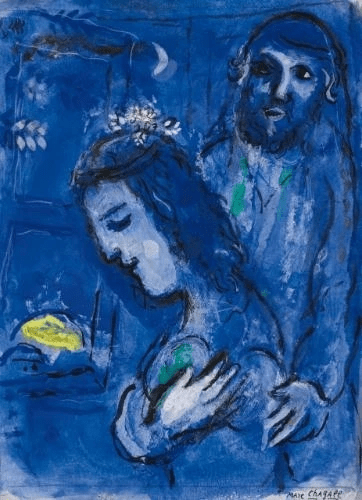
Abraham and Sarah, by Marc Chagall, 1956

One hot summer afternoon while Abraham was sitting by the entrance to his tent near the sacred trees of Mamre, the Lord appeared to him. Abraham looked up and saw three men standing nearby. He quickly ran to meet them, bowed with his face to the ground, and said, “Please come to my home where I can serve you. I’ll have some water brought, so you can wash your feet, then you can rest under a tree. Let me get you some food to give you strength before you leave. I would be honored to serve you.”

“Thank you very much,” they answered. “We accept your offer.”

Abraham went quickly to his tent and said to Sarah, “Hurry! Get a large sack of flour and make some bread.” After saying this, he rushed off to his herd of cattle and picked out one of the best calves, which his servant quickly prepared. He then served his guests some yogurt and milk together with the meat.

While they were eating, he stood near them under the tree, and they asked, “Where’s your wife Sarah?”

“She is right there in the tent,” Abraham answered.

One of the guests was the Lord, and he said, “I’ll come back about this time next year, and when I do, Sarah will already have a son.”

Sarah was behind Abraham, listening at the entrance to the tent. Abraham and Sarah were very old, and Sarah was well past the age for having children. So she laughed and said to herself, “Now that I am worn out and my husband is old, will I really know such happiness?”

The Lord asked Abraham, “Why did Sarah laugh? Does she doubt that she can have a child in her old age? I am the Lord! There is nothing too difficult for me. I’ll come back next year at the time I promised, and Sarah will already have a son.” (Contemporary English Version)

You never know what a day will bring.

Abraham and Sarah woke up one morning and went about their daily routines. But when they went to bed that night, their lives were turned upside-down. After all, God has a way of shaking up our lives, in a good way.

There’s nothing quite like an unsolicited promise. It seems the old couple, Abraham and Sarah, had come to grips with their childlessness. But the Lord was about to upset the status quo, in a good way.

“To one who has faith, no explanation is necessary. To one without faith, no explanation is possible.”

St. Thomas Aquinas

A divine promise was made. The only thing Abraham and Sarah needed to do was believe – and, well, do what a couple needs to do to conceive a child. I don’t know many couples who are sexually active at 100 years old. It certainly would take an act of faith to believe that you could become impregnated and give birth to a baby at that age.

True belief results in decisive action. Abraham and Sarah believed and God’s promise was activated in their lives, not only changing the couples’ life, but also transforming history. The experience taught them to keep their heads up and continue looking ahead for the fulfillment of all God’s good promises.

By faith Abraham obeyed when he was called to go out to a place that he was going to receive as an inheritance. He went out without knowing where he was going.

By faith he lived in the land he had been promised as a stranger. He lived in tents along with Isaac and Jacob, who were coheirs of the same promise. He was looking forward to a city that has foundations, whose architect and builder is God.

By faith even Sarah received the ability to have a child, though she herself was barren and past the age for having children, because she believed that the one who promised was faithful. So descendants were born from one man (and he was as good as dead). They were as many as the number of the stars in the sky and as countless as the grains of sand on the seashore. (Hebrews 11:8-12, CEB)

Sometimes faith seems laughable. Belief in God, or at least in God’s promise, might appear by some to be about as possible or relevant as getting a hamburger named after you at Burger King. But faith, nonetheless, is very real and very needed.

Without faith, there’s no hope, and no basis for love. Belief is the foundation from which we construct a life. Faith imagines and actualizes a new reality, even when that reality seems improbable, impossible, and far-fetched.

In the New Testament Gospels, there were people who believed Jesus could heal their paralyzed friend. They envisioned a different reality than the one their friend was experiencing.

Some people brought to him a paralyzed man on a mat. Seeing their faith, Jesus said to the paralyzed man, “Be encouraged, my child! Your sins are forgiven”…. Then Jesus turned to the paralyzed man and said, “Stand up, pick up your mat, and go home!” And the man jumped up and went home! (Matthew 9:2, 6b-7, NRSV)

The size of the faith is not the issue – it is in whom that faith is placed. The littlest of faith in Jesus can have massive results, whereas the biggest of faith in someone who cannot get you to the other side gets no results.  Small information put into action through placing complete trust in Jesus makes all the difference.

“I [Jesus] assure you that if you have faith the size of a mustard seed, you could say to this mountain, ‘Go from here to there,’ and it will go. There will be nothing that you can’t do.” (Matthew 17:20, CEV)

God is ready to open a new future to us. And, indeed, it will be a good, just, and right future beyond what we ourselves can even ask or imagine. We just need a bit of faith to see the impossible become possible.

You never know what a day will bring. Maybe today you’ll experience a faith so laughable that it will change your life forever.

O heavenly Father, in whom we live and move and have our being: We humbly pray you to guide and govern us by the Holy Spirit, so that in all the cares and occupations of our life we may not forget you, but may remember that we are ever walking in your sight, and so, trust in your grace and goodness, through Jesus Christ our Lord. Amen.

Jesus Shows Up (John 20:19-31)

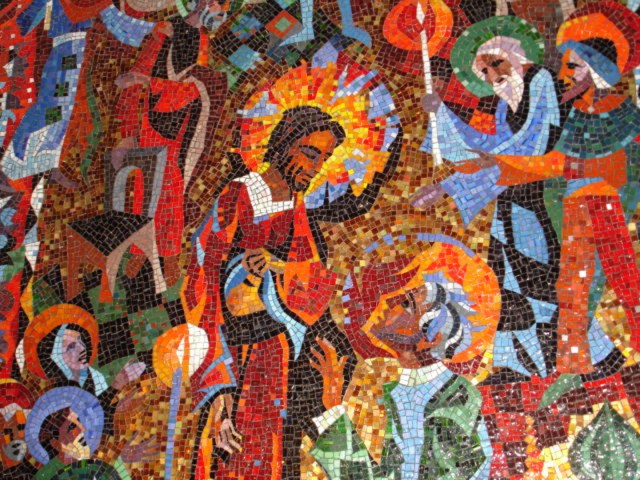
Jesus shows himself to Thomas, by Rowan and Irene LeCompte

On the evening of that first day of the week, when the disciples were together, with the doors locked for fear of the Jewish leaders, Jesus came and stood among them and said, “Peace be with you!” After he said this, he showed them his hands and side. The disciples were overjoyed when they saw the Lord.

Again Jesus said, “Peace be with you! As the Father has sent me, I am sending you.” And with that he breathed on them and said, “Receive the Holy Spirit. If you forgive anyone’s sins, their sins are forgiven; if you do not forgive them, they are not forgiven.”

Now Thomas (also known as Didymus), one of the Twelve, was not with the disciples when Jesus came. So the other disciples told him, “We have seen the Lord!”

But he said to them, “Unless I see the nail marks in his hands and put my finger where the nails were, and put my hand into his side, I will not believe.”

A week later his disciples were in the house again, and Thomas was with them. Though the doors were locked, Jesus came and stood among them and said, “Peace be with you!” Then he said to Thomas, “Put your finger here; see my hands. Reach out your hand and put it into my side. Stop doubting and believe.”

Thomas said to him, “My Lord and my God!”

Then Jesus told him, “Because you have seen me, you have believed; blessed are those who have not seen and yet have believed.”

Jesus performed many other signs in the presence of his disciples, which are not recorded in this book. But these are written that you may believe that Jesus is the Messiah, the Son of God, and that by believing you may have life in his name. (New International Version)

When Jesus shows up, there is peace. Wherever Jesus goes, the Spirit of God is there. When Jesus appears, people believe.

The Meeting

After the crucifixion of Christ, the disciples were huddled together, mostly in fear of being found out and put out by the religious authorities. Out of nowhere, Jesus showed up, smack in the middle of the anxious group of men.

Christ in the center makes all the difference. From this central place, Jesus bestowed to the disciples his peace. The very first word the risen Christ spoke to his disciples was neither a command to stop being afraid, nor a rebuke for sitting around and doing nothing, or disappointment that they all ran away in the final hour of need at the crucifixion; instead, the first word of Christ was a gift of peace.

The presence and peace of Christ melted the disciples’ fear. Christ-centered peace is graciously given; so let us gratefully receive it.

The Reality

Jesus showed up, then showed off his hands and his side. He was not fabricated out of the disciples’ imagination; he was not some ghostly apparition. Rather, Christ was standing in the middle of them, very real, very physical, and very alive.

Christ gave his disciples real truth: actual wounded hands and side on a real body. Christ is risen and alive – not just spiritually, but physically. Since the resurrection of Jesus really happened, then nothing else matters; our joy is complete. We have what we need.

The Mission

As Jesus was sent by the Father, so Jesus sent his disciples; and is still sending us out into the world. And as Jesus came not to condemn the world but to save it, so we go out with words of grace and peace. The church exists for the life of the world – to bless it with the presence and peace of Christ.

“Whoever believes in me does not believe in me only, but in the one who sent me. The one who looks at me is seeing the one who sent me. I have come into the world as a light, so that no one who believes in me should stay in darkness.” (John 12:44-46, NIV)

Our spiritual DNA makes us little Christ’s walking around, doing the will of God, for the benefit of a world in darkness. We bear the name of Christ: Christians, proclaiming a message of life, delighting in God and creation; and not destroying the earth and its inhabitants.

The Gift

Right now, we are not alone. The Holy Spirit has been graciously given to us by Jesus. Although our mission is a big one, our resource for accomplishing it is even bigger. Jesus gives the Spirit in the same way he gives himself – as a sheer gift with no strings attached. Just as God breathed life into the very first people on earth, so Jesus breathes on the disciples and gives them new life and a new heart.

I will give you a new heart and put a new spirit in you; I will remove from you your heart of stone and give you a heart of flesh. And I will put my Spirit in you and move you to follow my decrees and be careful to keep my laws… and you will be my people, and I will be your God. (Ezekiel 36:26-28, NIV)

The Privilege

Christ has redeemed us, forgave us of our guilt and shame. Now, we have the privilege of passing the forgiveness to others. The special mission of the Church is giving Jesus to others with grace and peace, so that they may believe he is truly the risen Lord; and so, receive Jesus, the Spirit, forgiveness, and purpose in life, with Christ at the center of all things.

For the one whom God has sent speaks the words of God, for God gives the Spirit without limit. The Father loves the Son and has placed everything in his hands. Whoever believes in the Son has eternal life, but whoever rejects the Son will not see life, for God’s wrath remains on them.” (John 3:34-36, NIV)

The Risen Lord, by He Qi

The Appearance

When Jesus appears, its good if we also show up to see him. It seems Thomas was late for church and missed the beginning of the service. He wasn’t with the other gathered disciples. Nobody knows where he was or what he was doing. But the important thing is that he did eventually show up, because showing up is the beginning of a changed life.

The Witness

After Jesus showed up, the disciples bore witness to what they saw and heard to Thomas. Yet Thomas, bless his doubting heart, wasn’t having it. He’s a realist. He wants proof, some actual physical evidence. Thomas was clearly a tactile learner because he needs some touch to believe any of this crazy talk of his disciple brothers.

Sometimes Thomas gets a bad rap, but he is really our Everyman. Doubt and skepticism are an important part of a full-orbed and honest faith. Jesus gave Thomas some space, time, and respect to begin wrapping his head and heart around this new reality of resurrection. I wonder if we all can do the same with others.

The Middle

A second time, Jesus shows up in the middle of the disciples. The Word became flesh and dwelt among us – and didn’t become a ghost and hang out in secret places. Once again, peace is given by Jesus to his followers.

Both appearances happen on a Sunday (which is why Christians have always worshiped on Sundays); and both meetings are literally Christ-centered (which every Christian meeting is supposed to be). Every Sunday. Christ always in the middle. Keep those two, and keep them together, and you can’t go wrong.

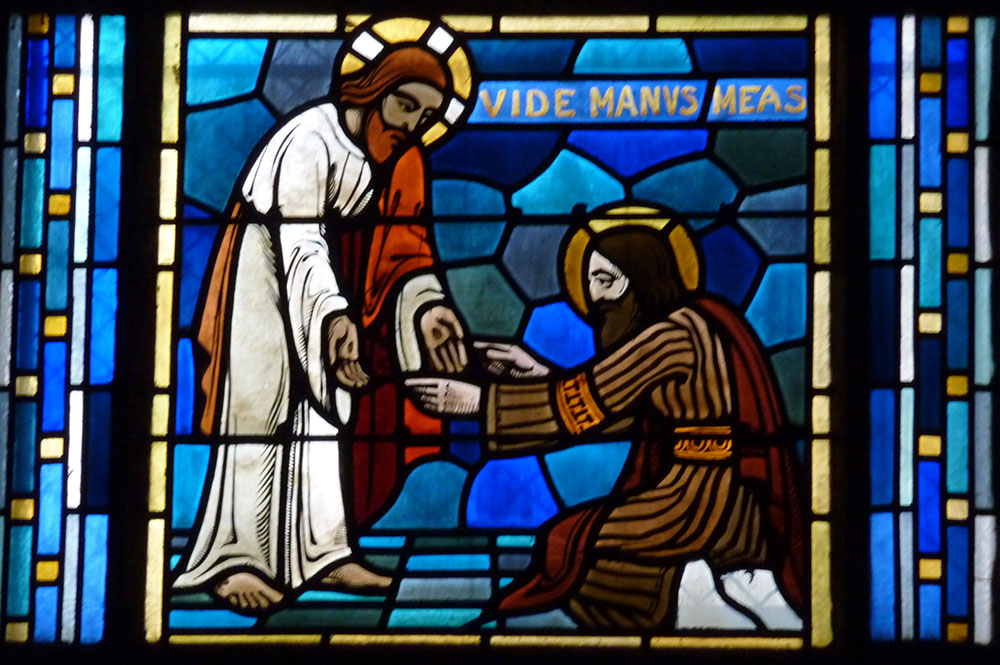
Jesus appears to Thomas with the Latin words, “See my hands,” in Notre-Dame-du-Rosaire Church, Saint-Ouen, France 

The Invitation

There’s no beating around the bush with Jesus. He immediately engaged Thomas and invited him to touch the wounds on his very real body. Christ knew Thomas’ hang-up, and went right to it. Thomas wanted evidence; Jesus offered it. If we get anything out of this encounter, it is that risen Christ honors honest doubt.

The evidence is here. Now believe it, and stop disbelieving. We have documentary evidence of the Old and New Testaments; the Church’s witness in Creeds, Confessions, and contemporary narratives of changed lives; and the internal testimony of the Holy Spirit. Therefore, look into them carefully and draw a sound conclusion.

The Confession

“My Lord and my God!” That’s the confession and the conclusion Thomas drew from the evidence – not only that Jesus is real, alive, existed, a good teacher; or other people’s Lord and God – but that he is my Lord and my God.

Jesus cared enough for Thomas to specifically meet him personally at his point of need. The grace of God keeps coming and never runs out. Jesus is filled up to the full in both grace and truth.

The Believer

Thomas had the physical evidence. But it doesn’t take that to truly believe. God blesses those who’ve never seen nor touched, but still believe. Jesus was thinking of you and me, and not only the people in front of him at the time. The Lord Jesus blesses us with the gift of peace, grace, and faith.

Though you have not seen him, you love him; and even though you do not see him now, you believe in him and are filled with an inexpressible and glorious joy, for you are receiving the end result of your faith, the salvation of your souls. (1 Peter 1:8-9, NIV)

The Conclusion

All this is for our benefit, so that we, too, may believe that Jesus is the Christ, the Son of the living God. Since Jesus is alive, he continues to bless us with his presence, power, and peace.

Jesus is with us:

  • through the Word of God, giving us his peace, showing up and meeting needs people.
  • at the Table in the sacrament of communion, bringing grace and forgiveness
  • in the person of the Holy Spirit, enabling and energizing us for mission and ministry to the world

It’s a life worth living, a Christ-centered life, full of God’s blessing.

O God and Father of our Lord Jesus Christ, in whom we receive the legacy of a living hope, born again not only from his death but also from his resurrection. May we who have received forgiveness of sins, set others free, until we enter the inheritance that is imperishable and unfading, where Christ lives and reigns with you and the Holy Spirit, one God, now and forever. Amen.

Victory Celebration (Exodus 15:1-18)

The Songs of Moses and Miriam, by Laura James

Then Moses and the Israelites sang this song to the Lord:

“I will sing to the Lord, for he has triumphed gloriously;
    horse and rider he has thrown into the sea.
The Lord is my strength and my might,
    and he has become my salvation;
this is my God, and I will praise him;
    my father’s God, and I will exalt him.
The Lord is a warrior;
    the Lord is his name.

Pharaoh’s chariots and his army he cast into the sea;
    his elite officers were sunk in the Red Sea.
The floods covered them;
    they went down into the depths like a stone.
Your right hand, O Lord, glorious in power—
    your right hand, O Lord, shattered the enemy.
In the greatness of your majesty you overthrew your adversaries;
    you sent out your fury; it consumed them like stubble.
At the blast of your nostrils the waters piled up;
    the floods stood up in a heap;
    the deeps congealed in the heart of the sea.
The enemy said, ‘I will pursue; I will overtake;
    I will divide the spoil; my desire shall have its fill of them.
    I will draw my sword; my hand shall destroy them.’
You blew with your wind; the sea covered them;
    they sank like lead in the mighty waters.

Who is like you, O Lord, among the gods?
    Who is like you, majestic in holiness,
    awesome in splendor, doing wonders?
You stretched out your right hand;
    the earth swallowed them.

In your steadfast love you led the people whom you redeemed;
    you guided them by your strength to your holy abode.
The peoples heard; they trembled;
    pangs seized the inhabitants of Philistia.
Then the chiefs of Edom were dismayed;
    trembling seized the leaders of Moab;
    all the inhabitants of Canaan melted away.
Terror and dread fell upon them;
    by the might of your arm, they became still as a stone
until your people, O Lord, passed by,
    until the people whom you acquired passed by.
You brought them in and planted them on the mountain of your own possession,
    the place, O Lord, that you made your abode,
    the sanctuary, O Lord, that your hands have established.
The Lord will reign forever and ever.” (New Revised Standard Version)

The ancient Israelites were freed from four hundred years of Egyptian bondage through the miraculous work of God. Then, as they were leaving Egypt, Pharaoh had a change of heart and decided to take his army and pursue the Israelites.

Literally sandwiched between the army and the sea, yet another miracle happened: God parted the Red Sea, allowing the Israelites to pass through on dry ground; and then God closed the sea up on the pursuing army. Today’s Old Testament lesson is the people’s victory chant of deliverance.

Portrayed here is Yahweh’s incomparable power over the mighty Egyptians, and protective presence with the Israelites. God was fulfilling the divine promise to bring the people out from bondage and into the Promised Land. Nothing can stand in the way of the Lord’s purpose.

By Stushie Art

God Rescues

Throughout the Bible, deliverance and celebration go hand in hand. For the Christian, this time of year is full of celebrating the resurrection of Christ from death. Because our redemption is secured, we rejoice in the once for all sacrifice of Jesus.

God rescued us from dead-end alleys and dark dungeons. He’s set us up in the kingdom of the Son he loves so much; the Son who got us out of the pit we were in, got rid of the sins we were doomed to keep repeating. (Colossians 1:13-14, MSG)

God Protects

The Lord showed up and wondrously delivered the Israelites from certain annihilation. And God has also entered into humanity’s world and brought emancipation from sin, death, and hell through Christ’s redemptive events of cross and resurrection. We are shielded by God’s glorious grace and goodness.

Praise be to the God and Father of our Lord Jesus Christ! In his great mercy he has given us new birth into a living hope through the resurrection of Jesus Christ from the dead, and into an inheritance that can never perish, spoil or fade. This inheritance is kept in heaven for you, who through faith are shielded by God’s power until the coming of the salvation that is ready to be revealed in the last time. (1 Peter 1:3-5, NIV)

God Establishes

Deliverance is provided, and then the divine presence is with us throughout life. God doesn’t expect us to be on our own after we are saved from a calamitous situation. Grace is given for all things, not just some things. So, the Lord helps to establish us in faith and perseverance for a lifetime.

His divine power has given us everything needed for life and godliness, through the knowledge of him who called us by his own glory and excellence. Thus he has given us, through these things, his precious and very great promises, so that through them you may escape from the corruption that is in the world because of lust and may become participants of the divine nature…. Therefore I intend to keep on reminding you of these things, though you know them already and are established in the truth that has come to you. (2 Peter 1:3-4, 12, NRSV)

Our victory chant comes from God’s redemptive events. For the Christian, we are rescued from our precarious spiritual plight, protected and established by divine power, through the person and work of Jesus Christ.

“Victory in Jesus” by E.M. Bartlett, 1939

I heard an old, old story
How a Savior came from glory
How He gave His life on Calvary
To save a wretch like me
I heard about His groaning
Of His precious blood’s atoning
Then I repented of my sins
And won the victory

Oh, victory in Jesus, my Savior forever
He sought me and bought me with His redeeming blood
He loved me ‘ere I knew Him and all my love is due Him
He plunged me to victory beneath the cleansing flood

I heard about His healing
Of His cleansing power revealing
How He made the lame to walk again
And caused the blind to see
And then I cried, “Dear Jesus, come and heal my broken spirit”
And somehow Jesus came and brought to me the victory

Victory in Jesus, my Savior forever
He sought me, and He bought me with His redeeming blood
He loved me ‘ere I knew Him and all my love is due Him
He plunged me to victory beneath the cleansing flood

Holy Saturday (Psalm 31:1-4, 15-16)

In you, O Lord, I seek refuge;
    do not let me ever be put to shame;
    in your righteousness deliver me.
Incline your ear to me;
    rescue me speedily.
Be a rock of refuge for me,
    a strong fortress to save me.

You are indeed my rock and my fortress;
    for your name’s sake lead me and guide me;
take me out of the net that is hidden for me,
    for you are my refuge….

My times are in your hand;
    deliver me from the hand of my enemies and persecutors.
Let your face shine upon your servant;
    save me in your steadfast love. (New Revised Standard Version)

Holy Saturday is a quiet place sandwiched between the ignominy of the Cross and the celebration of Resurrection – a day of solitude, silence, and stillness. 

This isn’t a particularly popular day. People don’t rave about Holy Saturday. Many Christians haven’t even a thought that this day could have any significance. Yet, this very day has its place in the scheme of the Christian life.

Whenever Christians quickly jump to triumphal language about victory, and speak little-to-nothing about suffering, then we are left with a cheap grace which has been purchased with the counterfeit currency of velocity. 

Today is meant for us to get of our heads and wrap our hearts around the important reality that Jesus Christ was truly and bodily dead in the grave. 

It was real suffering on Good Friday, and it’s a real death on Holy Saturday. There’s no movement. All is silent and still. Jesus is in the solitude of a dark graveyard tomb. 

There’s no getting around this: If we want Resurrection Day with all its celebration and glory, then we cannot circumvent Holy Saturday with its quiet silence and somber sadness. 

Holy Saturday must be observed if we are to experience real and practical freedom from the bondage of shame. And shame is powerful. It keeps a person locked within themselves, alone with their secrets hidden far from others.

Far too often we may try and cope with our shameful words or actions through promising to work harder, pledging to have greater willpower, or complaining that life is unfair. None of this gets to the root of our shame.

Unlike guilt, which our conscience identifies as specific behaviors to repent of, shame is the message of our inner critic who obnoxiously decries that we are somehow flawed, not enough, and inherently lacking intelligence, courage, or volition.

Shame is the insidious mechanism which interprets bad events we experience as the result of our own badness. In other words, we didn’t just do something bad – we ourselves are bad. We reason (wrongly) that if we were good, bad things wouldn’t happen to us.

If that were true, we would need a serious re-interpretation of Jesus, who suffered terribly and was killed. In actuality, he’s lying in a cold grave because of the power of evil in the world, and not because he was personally culpable.

Shame is the vampire who lives in the shadows and feeds on secrets – which is why the posture of shame is to hide our face in our hands. If shame persists, we withdraw from others and experience grinding loneliness. 

Therefore, the path out of shame is to openly name our shame and tell our stories, that is, nailing the stake of vulnerability into the heart of shame, and exposing it to the light, causes it to disintegrate and vaporize.

In contrast to the unhealthy hiding of ourselves within prison walls of shame is seeking refuge and hiding ourselves in God. Even a cursory look at today’s psalm evidences an open and vulnerable person who wants nothing to do with shame. The psalmist unabashedly and without shame is quite forward in presenting his wants to God.

The psalms are meant for repeated use, to be voiced aloud again and again. In doing this simple activity, we shame-proof our lives. God’s face shines upon us and takes away the shadows of shame. It is no coincidence that Jesus forsook the shame of the cross through publicly uttering the words of this psalm: “Into your hands I commit my spirit.” (Luke 23:46)

Unchecked verbal violence will eventually lead to physical violence.

If wordy persecution comes from others, the primary tactic will most likely be shaming the people such persons want to control. Such enemies will frame a justification for violence because the people for whom they are leveling shame are “bad,” even “monsters.” If verbal persecution comes from within, the shame can reach a critical mass of suicidal ideation and perhaps outright attempts at ending one’s life.

We cannot long co-exist with the living death of shame. But the good news is that we don’t have to. Instead, we can live in the strong fortress and the rock of refuge which is God.

The Lord traffics in redeeming mercy and steadfast love, not in the demeaning judgment of shame. We can flee to God and find grace to help us in our time of need. There is no shame in reaching out for help. We all need deliverance from something. It’s a matter of whether we are open to ask for it, or not.

Holy Saturday is here for you to know that Jesus Christ absorbed all of the world’s massive shame, yesterday, on Good Friday. Christ died. And the shame he took on, died with him. It’s no more and will rise no more.

But someone will rise….

Father God, into your hands I commit my spirit – everything I am and all that I hope to be – so that Jesus Christ might be exalted in me through the power of your Holy Spirit. I choose to leave shame where it belongs – nailed to the cross. With your divine enablement, I shall walk in the newness of life through expressing my needs and wants with courage, confidence, and candor. May it be so according to your steadfast love. Amen.