The Son (Hebrews 1:1-4)

In the past God spoke to our ancestors through the prophets at many times and in various ways, but in these last days he has spoken to us by his Son, whom he appointed heir of all things, and through whom also he made the universe. The Son is the radiance of God’s glory and the exact representation of his being, sustaining all things by his powerful word. After he had provided purification for sins, he sat down at the right hand of the Majesty in heaven. So he became as much superior to the angels as the name he has inherited is superior to theirs. (New International Version)

For Christians everywhere, we are only a few days until the culmination of Advent season: observing, remembering, and celebrating the birth of our Lord and Savior, Jesus Christ.

Christianity discerns that all of history hinges on it’s midpoint of the incarnation and birth, life and ministry, death and resurrection, and ascension and glorification of Jesus. Everything in the Bible looks to Christ.

The entire Old Testament Scriptures point forward to the time of Christ; the Gospels focus upon him; and all the rest of the New Testament points back to Jesus as the fulfillment of all God’s good promises to people.

Indeed, the Lord Jesus is central to everything in the Christian’s world and life view. Jesus Christ is the center of all Christian worship, Christian belief, Christian practice, Christian ethics, and the entirety of the Christian life.

The New Testament book of Hebrews has a lot to do with this approach to life. It’s overarching theme and focus is to point out and demonstrate the superiority of Jesus over everything and everyone in all of history.

And the reason the author of Hebrews takes pains to do this for a lengthy thirteen chapters, is that his recipients needed the reminder and the exhortation that their difficulties and hardships in living the Christian life is worth it. Jesus is worth completely centering our lives around because he is indeed the central figure of literally everything.

Historically, God spoke through many prophets. Yet, Jesus is the ultimate prophet, because he is not merely a servant of God; Christ is the very Son of God who is over all of God’s big world – and even participated in making the world.

Like Father, like Son. Jesus Christ exemplifies and shows us the very nature of God. He is the light of God’s glory, representing God in all his words and ways of being in the world.

What’s more, Jesus not only came to reveal God to us, but also to get involved in saving us from ourselves by actually becoming one of us. And after all his work was done, and his earthly life over, he sat down in his rightful place – showing us that it is finished, once and for all.

We need no longer try and purify or perfect ourselves, to try and fix all that we have messed up in this life, or to prop up our fragile egos to make it at least look like we have it all together. None of this is needed because the Lord Jesus Christ became our Savior, delivering us from a hole so deep that there was no way we could ever climb out of it on our own.

So, it is rather ironic that people (even and especially Christians) can let Jesus get pushed out of the Advent and Christmas seasons as less than superior to our worries about finances, discouragements about family, and wonderings about the future. Advent is intended to put our focus and our delight where it rightly belongs, in Jesus Christ, our Lord and Savior.

Embedded within the season of Advent are a message and a mission. The Gospel of John begins with the great proclamation that the Word became flesh and made his dwelling among us. God enters into human history in the person of Jesus. It is a message of grace and hope, completely centering around Christ. 

It is also a story – the greatest ever told – of the Creator God loving the creatures so much as to become one of them. This redemption narrative gives shape to our own witness. We simply tell the story of God’s love to humanity through the sending of the Son, Jesus, to deliver us from sin, death, and hell and bring us into a kingdom full of grace, joy, wholeness, and love.

Some may believe that Jesus laid aside his glory in order to be among us. I disagree. I believe that coming to this earth was the logical and loving thing to do in order to show and live into the radiance of God’s glory.

The word “glory” in the Hebrew Scriptures literally means to be “heavy.” In other words, God carries a lot of weight, namely because God is able to do so. That is, God is glorious. To enter this world and bear the great burden of human suffering and sin is perhaps the most glorious thing that God could ever do.

So, when we talk of the glory of God in Jesus Christ, we are really talking about the ultimate burden bearer showing who God is really like. The God, who is Love, is the God of glory, and the two are actually both sides of the same coin.

Therefore, Christians, the little Christs who walk about this earth, show the light of the glory of God in Jesus Christ when they carry one another’s burdens:

Carry each other’s burdens, and in this way you will fulfill the law of Christ. (Galatians 6:2, NIV)

In a few days, gift giving and receiving will take place. And that is appropriate. What is also more than appropriate is to be able to relate to each other in such a way that we are showing the radiance of Jesus Christ in helping others carry their heavy emotional and/or spiritual loads.

As light comes into this world through the birth of the Son, so also let your light shine before others, so that they may see your good deeds and glorify your Father in heaven. (Matthew 5:16) Amen.

Be Real, Not Fake (Titus 1:5-16)

The reason I left you in Crete was that you might put in order what was left unfinished and appoint elders in every town, as I directed you. 

An elder must be blameless, faithful to his wife, a man whose children believe and are not open to the charge of being wild and disobedient.Since an overseer manages God’s household, he must be blameless—not overbearing, not quick-tempered, not given to drunkenness, not violent, not pursuing dishonest gain. 

Rather, he must be hospitable, one who loves what is good, who is self-controlled, upright, holy and disciplined. He must hold firmly to the trustworthy message as it has been taught, so that he can encourage others by sound doctrine and refute those who oppose it.

For there are many rebellious people, full of meaningless talk and deception, especially those of the circumcision group. They must be silenced, because they are disrupting whole households by teaching things they ought not to teach—and that for the sake of dishonest gain. One of Crete’s own prophets has said it: “Cretans are always liars, evil brutes, lazy gluttons.” This saying is true.

Therefore rebuke them sharply, so that they will be sound in the faith and will pay no attention to Jewish myths or to the merely human commands of those who reject the truth. To the pure, all things are pure, but to those who are corrupted and do not believe, nothing is pure. In fact, both their minds and consciences are corrupted. They claim to know God, but by their actions they deny him. They are detestable, disobedient and unfit for doing anything good. (New International Version)

Everything in life needs some decency and order – including the church. The bulk of the Apostle Paul’s letter to Titus gives needed instructions about structuring the life of the church, along with some warnings about those who would attempt to disrupt that good order.

One of the most important aspects of church life and organization is to appoint competent persons with good character and sound doctrine to oversee and serve the congregation. The leaders of the church are to be mature, unselfish, concerned for the common good of all the parishioners, and able to handle Holy Scripture by strengthening the faithful and rebuking the faithless.

It takes solidly worthy leaders to counter people who are opposed to doing and believing things that are inconsistent with apostolic teaching. Paul had neither the tolerance nor the patience for rebellious folk who sought to deceive the faithful. So, he told Titus to silence, rebuke, and put a stop to such persons.

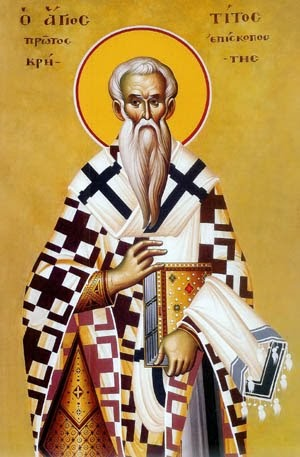
Orthodox icon of St. Titus the Apostle, the first Bishop of Crete

The rebellious persons, however, were not so easy to spot for many in the church – which is why Paul instructed Titus to deal with false teachers forcefully. They were not the real article, but came across as genuine.

Sometimes, you cannot tell a fake by the external appearance. In Christianity, and within the church, a person might give a good outward performance, but actually not be the real deal because they are full of bitterness and death on the inside with a heart far from God.

A sobering reality for devoted believers in God is that the church and Christianity can have people who are religious on the outside but not really Christ followers on the inside. Claiming to know God isn’t the same as actually knowing the Lord. It’s like putting perfume in a vase – it might smell like flowers but the flowers aren’t really there.  

The Apostle was pointed about how to handle those of the “circumcision group” because they were legalists who put heavy spiritual loads on people and were unwilling to help them carry those burdens. Paul, following the example of the Lord Jesus, was always laboring and challenging people into a genuine, real righteousness from the heart that would submit to God’s kingdom. 

And, much like Jesus before him, Paul kept having the Judaizers in the church undermining him, talking behind his back, and stirring up resentment against him. 

The rebellious people of the circumcision group were not helping believers know God better through active service, but only tried to talk a good line. Paul pointed them out to Titus because such persons were not strengthening the faith of others and enabling them to live a sound spiritual life.

The Judaizers did not practice what they preached – and even what they taught was neither gentle, nor had any grace. People need one another in the church to truly live for God; but if there are double standards, then heavy loads aren’t getting carried because some individuals think they are above helping, or think too little of themselves and believe God could not use them. 

In both cases the person declares, “Someone should do something!” Someone should give, someone should pray, someone should visit, someone should tell that person about Christ, someone should help. To which Paul (and Jesus) would say that someone is you.

We may believe we are genuine and think we are being helpful when we really are not. Whenever we plaster on fake smiles, only obey and serve when others are looking, and/or pretend like everything is just peachy keen when we are dying inside, then we are in the same category as the Judaizers. We have become in need of putting aside how we look to others and ask the God of grace to have mercy on us. 

It’s possible to be so obsessed about the right thing to say that we never say what is really on the inside because we think it isn’t spiritual enough and we fear looking bad. We then put up a spiritual façade, live into a false self, thereby and eventually becoming a false teacher.

The rebellious in the church are those who seek power, status, authority, and prestige. Respect and honor from others is everything to them, so they want the positions of prominence and insist on being recognized for whatever they say or do in the church.

But facades will not work for Christianity. The church is about integrity, mission, worship, and service – and not about acting with the spectator in mind, and seeking to elicit praise and respect from others. For such persons, it does not matter what’s on the inside as long as the outside looks good. 

Instead of being a liar (one whose outward actions and inner dispositions don’t match) and an evil brute (not acting with anyone else’s needs in mind or at heart) and a lazy glutton (always receiving but never giving) instead be a servant of others with a good character, a basic understanding of Holy Scripture, and a heart to know and love God. 

If there is a job that no one wants to do, I’ll do that job.

If there’s a lonely person, I’ll be with them.

If there’s a parking space up close, I’ll park in the back of the lot.

If there’s a need is someone’s life, I’ll meet that need.

If there’s a hardship someone has to endure, I’ll help carry that hardship.

If there’s a sacrifice to be made, I’ll make that sacrifice. Amen.

Dealing with Opposing Views (Romans 14:1-12)

Accept the one whose faith is weak, without quarreling over disputable matters. One person’s faith allows them to eat anything, but another, whose faith is weak, eats only vegetables. The one who eats everything must not treat with contempt the one who does not, and the one who does not eat everything must not judge the one who does, for God has accepted them. Who are you to judge someone else’s servant? To their own master, servants stand or fall. And they will stand, for the Lord is able to make them stand.

One person considers one day more sacred than another; another considers every day alike. Each of them should be fully convinced in their own mind. Whoever regards one day as special does so to the Lord. Whoever eats meat does so to the Lord, for they give thanks to God; and whoever abstains does so to the Lord and gives thanks to God. For none of us lives for ourselves alone, and none of us dies for ourselves alone. If we live, we live for the Lord; and if we die, we die for the Lord. So, whether we live or die, we belong to the Lord. For this very reason, Christ died and returned to life so that he might be the Lord of both the dead and the living.

You, then, why do you judge your brother or sister? Or why do you treat them with contempt? For we will all stand before God’s judgment seat. It is written:

“‘As surely as I live,’ says the Lord,
‘every knee will bow before me;
    every tongue will acknowledge God.’”

So then, each of us will give an account of ourselves to God. (New International Version)

Within the church at Rome were Jewish believers who had come to faith in Christ from their background steeped in the Old Testament. They had a rich two-thousand year history of a covenant with God that included ritual food laws, the keeping of certain feast days, and observing a calendar of events, especially the Sabbath.

Also within the Roman church were Gentiles (non-Jewish people) having come to faith in Christ from a background of paganism. They had no history with the God of the Bible. There were no previous generations of faithful believers in God. They were first generation Christians and basked in their newfound freedom.

The Apostle Paul’s vision was for one church, unified together around Jesus. And this unity would need to be worked on. Jew and Gentile were very different from one another; and here they were in the same church together, not understanding each other. 

The Jewish believers were appalled at Gentile thinking and behavior. Even though the Jewish Christians had come to embrace Jesus, they did not abandon their two-thousand year history of being with God. They still held to their food laws and special days. The Jewish members believed the Gentiles should be like them; the Jews wanted the Gentiles to embrace the same ritualistic behavior that they had done for centuries.

But the Gentiles did not comply. So, the Jewish believers passed judgment and condemnation on them for not being sensitive to the things of God.

On the other hand, the Gentile believers felt no compulsion to have such rules and regulations concerning their Christian lives. They ate what they pleased and saw no need to hold to special days. They could not understand why the Jewish Christians were so stuck in their traditions. So the Gentiles looked down on the Jews as hopelessly misguided. This was a potentially explosive situation that Paul was deeply concerned about.

The Apostle Paul’s message was to accept the person whose faith is weak without passing judgment on disputable matters. Sounds like easy counsel to follow. But the problem was that the people did not distinguish between what is a non-negotiable matter and what was a disputable matter. 

The guiding principle is that Christ died and returned to life so that he might be the Lord of both the dead and the living. The non-negotiable matter is Jesus Christ, his person and work.  Jesus is our core belief. Nothing else is to be in the center except him.

Therefore, we are to celebrate our unity around Jesus, our center. Anything outside of that center is a “disputable matter” and not worthy of Christians condemning each other or looking down on one another.

The root problem of any church conflict is the de-throning of Jesus and setting up our particular views as the center of Christianity.

The church has struggled with this teaching for its long two-thousand year history. Every church I have served had their particular issues that they felt so strongly about that it crowded Jesus out of the center. 

In one church, education was the big issue. Some believed in Christian schools as the only way to educate their kids. Others felt that home-schooling was the way to go because of the culture. Yet others thought public education needed the light of Christians participating in it, and sent their kids to public schools. The problem was that each group sincerely believed they were right and everyone else was wrong.

In another church I served, there were hard feelings about the place of men and women in the church who had been divorced and remarried. In yet another church, the issue was about whether church members could drink alcohol or not. And yet another church’s issue dealt with how we dress and what our attire is at church. 

I still remember one lady in that church talking with a woman who had recently given her life to Christ out of a life of prostitution. The woman was wearing jeans and a t-shirt. The church lady was giving her a lecture about how she should be “dressing up for Jesus.” As I heard this, I thought to myself, “Lady, I’m not sure you are going to like the woman’s idea of dressing up for Jesus….”

Whenever we want to place disputable matters on people’s “must-do” list, then there will be trouble. We will judge others who do not think as we think, and do as we do, because of the mistaken notion that our way is equal to the death and resurrection of Christ. If it isn’t done my way, the church will be lost.

We do not necessarily need to change our views on disputable matters; but we do need to change our attitude and our behavior toward those we disagree with.

Intolerance of others’ views and behaviors causes a lack of dialogue, to create special interest groups and cabals against others, to stereotype others, and to seek to get their way no matter what. Such intolerance moves church members from a concern for the Great Commission of Jesus to the Great Commode of Satan’s bathroom.

For the Apostle Paul, the issues that divide Christians are very important, not because he championed one over the other, but because the church’s identity was at stake. Paul was concerned for two questions:

  1. Will the church be, at its core, a community of redeemed persons by the grace of God who center all their lives around the person and work of Jesus?
  2. Or will the church be a community of opinionated individuals and groups all jockeying for position to have their way on how they believe things should go?

This is really a heart issue: humility versus pride, and gentleness versus stubbornness. You can tell what a person’s identity is by their “identity markers.”

For the Jewish Christians, Sabbath-keeping, circumcision, food laws, and holding to certain days on the calendar marked their identity as God’s people. Those issues were so important that if you took them away, there would be an identity crisis; the people felt totally lost without their traditions.

For Gentile Christians, their identity was built around being more free-thinking. So, if you take away their freedom and ability to choose, the Gentiles will go nuts and have an identity meltdown. 

Paul’s answer was for both Jew and Gentile to accept each other and build their unity around Jesus, period. They needed to be sensitive to one another and focus on their shared identity of Jesus as the center of the Christian life.

Both the church and the society need some civility. In a nation where we feel free to say whatever we want, we do. In doing so, we elevate self-expression and our opinions over self-control and the mission of the church.

We need some generous spaciousness which allows room for us to discuss issues and disputable matters in an atmosphere of generosity, hospitality, and acceptance, seeking to first listen and understand, before responding. 

The goal of the Christian is not to win an argument or have our way, but to uphold Jesus as Lord of everything and maintain our center in him. On that basis alone, we will be held accountable by God. So, let us live wisely and well, knowing and pursuing Jesus with heart, soul, mind, and strength.

Gracious God, it’s both settling and centering to focus on the assurance of your acceptance. You know everything about us, and despite our failures, fickleness, foolishness, and faithlessness, yet still we are fully and eternally accepted. As you have accepted us, help us to accept others. Grant us grace to love those whom we disagree with.

Merciful and mighty God, enlarge our hearts. Enable us to show kindness without compromising our convictions. Teach us the difference between essential and non-essential matters. Free us from the limitations of our individual perspectives, the prejudices of our heritage, the insecurities of our comfort zone, insincere niceness,and the need to be right. 

Blessed Holy Spirit, burn your holy Word indelibly into us so that we accept all things and everyone you give us, through Jesus Christ our Lord. Amen.

A Word of Faith (Genesis 15:1-20)

After this, the word of the Lord came to Abram in a vision:

“Do not be afraid, Abram.
    I am your shield,
    your very great reward.”

But Abram said, “Sovereign Lord, what can you give me since I remain childless and the one who will inherit my estate is Eliezer of Damascus?” And Abram said, “You have given me no children; so a servant in my household will be my heir.”

Then the word of the Lord came to him: “This man will not be your heir, but a son who is your own flesh and blood will be your heir.” He took him outside and said, “Look up at the sky and count the stars—if indeed you can count them.” Then he said to him, “So shall your offspring be.”

Abram believed the Lord, and he credited it to him as righteousness.

He also said to him, “I am the Lord, who brought you out of Ur of the Chaldeans to give you this land to take possession of it.”

But Abram said, “Sovereign Lord, how can I know that I will gain possession of it?”

So the Lord said to him, “Bring me a heifer, a goat and a ram, each three years old, along with a dove and a young pigeon.”

Abram brought all these to him, cut them in two and arranged the halves opposite each other; the birds, however, he did not cut them in half. Then birds of prey came down on the carcasses, but Abram drove them away.

As the sun was setting, Abram fell into a deep sleep, and a thick and dreadful darkness came over him. Then the Lord said to him, “Know for certain that for four hundred years your descendants will be strangers in a country not their own and that they will be enslaved and mistreated there. But I will punish the nation they serve as slaves, and afterward they will come out with great possessions. You, however, will go to your ancestors in peace and be buried at a good old age. In the fourth generation your descendants will come back here, for the sin of the Amorites has not yet reached its full measure.”

When the sun had set and darkness had fallen, a smoking firepot with a blazing torch appeared and passed between the pieces. On that day the Lord made a covenant with Abram and said, “To your descendants I give this land, from the Wadi of Egypt to the great river, the Euphrates—the land of the Kenites, Kenizzites, Kadmonites, Hittites, Perizzites, Rephaites, (New International Version)

Abrahamic Covenant II, by Wayne Forte, 2007

A Word about Abram and Sarai

We meet Abram and Sarai (later to be known as Abraham and Sarah) as a non-descript couple from a place called Ur of the Chaldees, a few chapters earlier in the opening biblical book of Genesis. It’s noted that Sarai is barren, or childless. (Genesis 11:30)

The Lord decided to choose a people for God’s own name, a singular people to become a kingdom of priest and a holy nation. The idea was that God would bless all the other nations through this one nation.

So, in what becomes something of a divine pattern, God chooses a most unlikely couple (old and childless) to become father and mother of this new nation to bless all other nations on earth. The Lord called them from their country of origin to leave and go to a new place. (Genesis 12:1-3)

Lo and behold, Abram and Sarai did just that. They left all they ever knew and journeyed to the new land, believing the promise of God, even though it didn’t make much sense. And there, they waited for a child, who would become the first of their many descendants, the child of promise.

And they waited. Time passed. They made a few sojourns into Egypt and back. But still no child. More time went by. Abram and Sarai were old when they came to the new land. Now, they’re really old! And still, no child. Then, finally, the Lord broke the silence.

The Word of the Lord

God’s initial words after all this time were, “Don’t be afraid.” We discover that anytime we hear that phrase spoken by the Lord, something good is about to happen. In fact, it’s great news.

But Abram seems discouraged, even with a fresh heart-to-heart with God. He and Sarai are still without a child. Instead of joy over God’s speech, Abram laments the ache of childlessness. Even though, by this time, Abram was wealthy, prosperous, and of good reputation, he feels the sting of a promise yet unfulfilled. God has still not granted him progeny for blessing the world.

A Word of Lament

Lament is, at its core, a complaint – an expression of grief in losing something or someone, or as in Abram’s case, of never having that something or someone to begin with.

It’s actually important for us to essentially make our problems into God’s problems. To tell God about our deepest hurts and unmet hopes is to implicate God in those hurts and hopes. It is to involve God in our disappointment.

In lament, we cry out to God in the belief that the Lord can and will respond to our painful cries and our deep desires. We believe God has the power and ability to respond. To complain to God is to have faith that God is faithful to divine promises—in spite of any nonsensical present circumstances.

Concerning matters about which God has made a promise, to complain is to remind the Lord of those unmet promises. In his lament, Abram was implying that God had not kept the promise, and had not yet proven faithful.

A Word of Response

Far from feeling perturbed that Abram laments instead of rejoices, God, in fact, responds by doubling-down on the original promise. Not only will there be a child, but that child’s descendants will be too many to even begin counting.

The Lord invited Abram to move his head from looking down at the bare ground to looking up at the magnificent stars. And in gazing upon the heavens, listening to the God whom he serves, Abram believed the Lord. And it was this faith which was credited to him as righteousness.

God is okay with being implicated in our problems. In fact, God welcomes it. Our deep grief, and our prayerful complaints, are a way of speaking which reminds God that God has promised to be faithful to divine promises. God doesn’t at all mind being held accountable to promises made.

Then, the Lord further responds by making a tangible expression of the intangible promise by means of a special sacrifice. God instructed Abram to involve some animal sacrifices and arrange them a certain way. When the sun had gone down and it was dark, a smoking fire pot and a flaming torch passed between the arranged pieces of the sacrifice.

A Covenant Word

On that day, through a ritual observance, God made a covenant with Abram.

To make a covenant in the ancient world, animals were cut in half, and then the persons making the covenantal commitment walked down the middle between the animals.

In Abram’s ritual, however, it was the Lord—in the form of a smoking pot and a flaming torch—who passed down the middle and thus was the one making the promise.

The symbolism of the covenant ritual is this: The one making the promise passes between dead animals as a ritual promise that, if they should be unfaithful to the terms of the covenant, they are to be cut in half just as the sacrificed animal.

In other words, when the Lord passed between the cleaved goat, sheep, ram and birds, God was pledging complete commitment to Abram.

A New Covenant Word

In Christianity, the gospel is a free promise by God that requires the death of God. The promise of God to Abram, Christians believe, ultimately led to the very death of the Son of God, Jesus.

In order to be faithful to the divine promise, to Abraham and Sarah and their descendants, and to David, God took on human flesh, walked between the pieces, and died so that we might have life.

Therefore, the promise comes by faith, so that it may be by grace and may be guaranteed to all Abraham’s offspring—not only to those who are of the law but also to those who have the faith of Abraham. He is the father of us all. As it is written: “I have made you a father of many nations.” He is our father in the sight of God, in whom he believed—the God who gives life to the dead and calls into being things that were not. (Romans 4:16-17, NIV)

Amen.