Living Bread from Heaven (John 6:51-58)

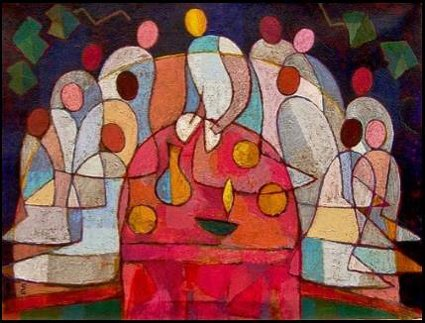
Art by Nigel Wynter (1957-2024)

I am the living bread that came down from heaven. Whoever eats of this bread will live forever, and the bread that I will give for the life of the world is my flesh.”

The Jews then disputed among themselves, saying, “How can this man give us his flesh to eat?” 

So Jesus said to them, “Very truly, I tell you, unless you eat the flesh of the Son of Man and drink his blood, you have no life in you. Those who eat my flesh and drink my blood have eternal life, and I will raise them up on the last day, for my flesh is true food, and my blood is true drink. Those who eat my flesh and drink my blood abide in me and I in them. Just as the living Father sent me and I live because of the Father, so whoever eats me will live because of me. This is the bread that came down from heaven, not like that which the ancestors ate, and they died. But the one who eats this bread will live forever.” (New Revised Standard Version)

To the religious leaders of Christ’s day, Jesus was making more noise than a couple of skeletons dancing on a tin roof. And they neither liked it, nor appreciated him drawing so much attention to himself.

Tensions had been escalating between Jesus and the religious establishment. The atmosphere was thick with grumbling leaders, as they tried to make some sense of Christ’s words to them.

Jesus offering his body for people to eat was causing far too much noise for the Jewish leaders. What in the world is this guy talking about?

Rather than making the meaning clear for them, Jesus added drinking his blood to the discussion. What’s more, Christ got up in their grill and confronted them with a choice, instead of a straightforward explanation.

Using some good old double negative language, Jesus flatly stated that there’s no life without any eating of his flesh and drinking of his blood. Then conversely, stated positively, Jesus affirmed that eternal life is found in those who eat his flesh and drink his blood.

This was next level communication of Jesus to the religious leaders. Earlier, Christ let them know that they needed to make the choice of coming to himself, of engaging in a life-giving relationship with him.

Yet now, it’s a matter of outright participation in Jesus, of eating and drinking the body and blood of Christ. Both the choice of relationship and of participation are radical decisions, which requires ditching some old traditions, and beginning some new ones.

Christ’s words are difficult, because they demand a change in thinking and behavior. Indeed, his words demand a change in our very way of being.

Christian discipleship requires that we stop the false ways of being in this world, and start a different way of being, according to the true self. In other words, Jesus was insisting on repentance and faith.

We are all on the hook to not just talk some theology and take some communion elements. It’s a lot more involved than that. Jesus demands our very lives, and not simply to sign off on some doctrinal statement about him. It’s about life itself, the power of life and death.

By eating and drinking Christ, there is meaningful relational connection, and ongoing participation in his life and ministry.

None of this is about literal cannibalism, and not even about actual bread and wine. This is deep metaphorical stuff which is meant to convey to us who Jesus is and how we can be related to him.

When we ingest food and drink, it goes into us and throughout our entire body. You cannot get much closer to something than by eating it and having it inside you. Just as eating bread goes to our very core and helps sustain life, so ingestingJesus is about allowing him to be as close to us as possible, into the very depths of our soul.

And by taking Christ into us, we will truly live and connect; and not be separated and die.

Art by Soiche Watanabe

We can no more spiritually live without taking Jesus into us, as we could live without eating on a regular basis. Christ is our breakfast, lunch, and dinner; our midnight snack and our birthday cake. Jesus is all that, and more.

Perhaps you are wondering why Jesus didn’t just state plainly who he is, why he came, and what will happen. Because it’s too much to handle.

We don’t simply accept Jesus into our heart, and then go on our merry way. Jesus Christ is someone to search for and discover, as if we were looking for fresh water or for the best baguette in the world.

Anyone can affirm a few belief statements, or do some good deeds. But it takes real courage to go hard after the spiritual life and find out what it’s all about:

It requires some solid bravery to explore the depths of your own true self and face the internal crud that’s been hiding in the shadows of your soul.

It demands identifying the bogus ways we prop up a false self for others to see – wanting to control how people view us and treat us.

It takes some real chutzpah to pursue the God life without worrying about where it will take you or who it will upset.

Jesus is a force to contend with. He is the Son of God, sent from above, to provide the world with real spiritual food and drink. Christ is the one who sustains life, and makes abundance possible. He is the Lord who speaks, calls out, and draws us to himself.

Jesus Christ helps us fit, even though we come from the island of misfit toys.

Even more pertinent than the question of “Who is Jesus?” is the probing question, “And what will you do with him?”

Christ cannot fit into your neat theological system, your tidy doctrinal statements, and on your nicely cleaned coffee table within the attractive Bible. Sooner or later, we all must contend with the divine force which gives life to everything. We cannot get away from him.

So, go after Jesus. Find out who he is. Determine how to deal with a mercy so powerful that it melts away guilt and shame as if it were in a 500 degree oven. After all, it’s better to have a tasty loaf of bread than to become a hard slice of burnt toast.

But let’s not worry about how hot it is in here, but how noisy it’s getting.

Gracious Lord, move us, your people, to experience your love more deeply. Fill us with the energy that comes from a desire for service. Connect us with creation to care for your world. Engage us in the scriptures and increase our knowledge of you. Raise up your power and come among us. May your bountiful grace and mercy equip us. Amen.

It’s About Love (1 Corinthians 8:1-13)

Now concerning meat that has been sacrificed to a false god: We know that we all have knowledge. Knowledge makes people arrogant, but love builds people up. If anyone thinks they know something, they don’t yet know as much as they should know. But if someone loves God, then they are known by God.

So concerning the actual food involved in these sacrifices to false gods, we know that a false god isn’t anything in this world, and that there is no God except for the one God. Granted, there are so-called “gods,” in heaven and on the earth, as there are many gods and many lords. However, for us believers,

There is one God the Father.
        All things come from him, and we belong to him.
And there is one Lord Jesus Christ.
        All things exist through him, and we live through him.

But not everybody knows this. Some are eating this food as though it really is food sacrificed to a real idol, because they were used to idol worship until now. Their conscience is weak because it has been damaged. Food won’t bring us close to God. We’re not missing out if we don’t eat, and we don’t have any advantage if we do eat.But watch out or else this freedom of yours might be a problem for those who are weak. 

Suppose someone sees you (the person who has knowledge) eating in an idol’s temple. Won’t the person with a weak conscience be encouraged to eat the meat sacrificed to false gods? The weak brother or sister for whom Christ died is destroyed by your knowledge. You sin against Christ if you sin against your brothers and sisters and hurt their weak consciences this way. This is why, if food causes the downfall of my brother or sister, I won’t eat meat ever again, or else I may cause my brother or sister to fall. (Common English Bible)

Consider an issue you care about… 

Likely, one of the big reasons you care is that you either see some abuse, neglect, inattention, or lack of love applied toward someone or a group of people. So, you want to see it be different. 

Now, here comes the interesting part: We are motivated by love, but we often end up addressing the problem or issue in the realm of thought and/or belief. We may rely on the political, theoretical, and intellectual to solve the problem.

Our hearts might be open and attuned, and yet we may turn to knowledge and rules to achieve the change we deeply desire.

The Apostle Paul knew that we are primarily lovers – not thinkers or believers. Thinkers and believers traffic in knowledge and belief systems. Although these are important, they are not the primary or ultimate ends for the Apostle. 

Instead of leading with the head, Paul led with the heart. He tackled the divisive issue in the Corinthian Church about whether one can eat food sourced from a pagan temple and originally sacrificed to idols by saying:

“Knowledge makes us proud of ourselves, while love makes us helpful to others.”

Paul began with love and ended with love. The issue of particular kinds of food was neither an intellectual nor a faith issue – it was a love issue. 

Paul’s answer to the problem dividing the Christian believers on food was that food is a secondary issue. Rather, to look at the food issue through the lenses of love, makes it clear what you ought to, or ought not to do. In coming at the issue from this angle, it doesn’t make our thinking and our believing somehow irrelevant; it just places it in its proper place, and supports love.

Whenever our opinions and thoughts, and our faith and beliefs are handled without love, then special interest groups begin to form. A division occurs based upon what we think and believe about certain things. But when love is supreme, knowledge is no longer the tail wagging the dog.

Love is meant to enlighten us. Love illumines not only to the problems among us, but love is also the answer to those issues we care about most. And if we will keep this in both our minds and in our hearts, then we have both added to our knowledge so that we can encourage and build-up others, without discouraging others and tearing them down. 

It really is all about love.

Love rejoices in the truth,
    but not in evil.
Love is always supportive,
loyal, hopeful,
    and trusting.
Love never fails! (1 Corinthians 13:6-8a, CEV)

Loving God, you demonstrated your own love for us through sending us your Son, the Lord Jesus, who is the perfect embodiment of love. May Christ be so manifested within me that love becomes not only the motivator to change, but also the answer to change; through the power and help of the Holy Spirit. Amen.

Dealing with Opposing Views (Romans 14:1-12)

Accept the one whose faith is weak, without quarreling over disputable matters. One person’s faith allows them to eat anything, but another, whose faith is weak, eats only vegetables. The one who eats everything must not treat with contempt the one who does not, and the one who does not eat everything must not judge the one who does, for God has accepted them. Who are you to judge someone else’s servant? To their own master, servants stand or fall. And they will stand, for the Lord is able to make them stand.

One person considers one day more sacred than another; another considers every day alike. Each of them should be fully convinced in their own mind. Whoever regards one day as special does so to the Lord. Whoever eats meat does so to the Lord, for they give thanks to God; and whoever abstains does so to the Lord and gives thanks to God. For none of us lives for ourselves alone, and none of us dies for ourselves alone. If we live, we live for the Lord; and if we die, we die for the Lord. So, whether we live or die, we belong to the Lord. For this very reason, Christ died and returned to life so that he might be the Lord of both the dead and the living.

You, then, why do you judge your brother or sister? Or why do you treat them with contempt? For we will all stand before God’s judgment seat. It is written:

“‘As surely as I live,’ says the Lord,
‘every knee will bow before me;
    every tongue will acknowledge God.’”

So then, each of us will give an account of ourselves to God. (New International Version)

Within the church at Rome were Jewish believers who had come to faith in Christ from their background steeped in the Old Testament. They had a rich two-thousand year history of a covenant with God that included ritual food laws, the keeping of certain feast days, and observing a calendar of events, especially the Sabbath.

Also within the Roman church were Gentiles (non-Jewish people) having come to faith in Christ from a background of paganism. They had no history with the God of the Bible. There were no previous generations of faithful believers in God. They were first generation Christians and basked in their newfound freedom.

The Apostle Paul’s vision was for one church, unified together around Jesus. And this unity would need to be worked on. Jew and Gentile were very different from one another; and here they were in the same church together, not understanding each other. 

The Jewish believers were appalled at Gentile thinking and behavior. Even though the Jewish Christians had come to embrace Jesus, they did not abandon their two-thousand year history of being with God. They still held to their food laws and special days. The Jewish members believed the Gentiles should be like them; the Jews wanted the Gentiles to embrace the same ritualistic behavior that they had done for centuries.

But the Gentiles did not comply. So, the Jewish believers passed judgment and condemnation on them for not being sensitive to the things of God.

On the other hand, the Gentile believers felt no compulsion to have such rules and regulations concerning their Christian lives. They ate what they pleased and saw no need to hold to special days. They could not understand why the Jewish Christians were so stuck in their traditions. So the Gentiles looked down on the Jews as hopelessly misguided. This was a potentially explosive situation that Paul was deeply concerned about.

The Apostle Paul’s message was to accept the person whose faith is weak without passing judgment on disputable matters. Sounds like easy counsel to follow. But the problem was that the people did not distinguish between what is a non-negotiable matter and what was a disputable matter. 

The guiding principle is that Christ died and returned to life so that he might be the Lord of both the dead and the living. The non-negotiable matter is Jesus Christ, his person and work.  Jesus is our core belief. Nothing else is to be in the center except him.

Therefore, we are to celebrate our unity around Jesus, our center. Anything outside of that center is a “disputable matter” and not worthy of Christians condemning each other or looking down on one another.

The root problem of any church conflict is the de-throning of Jesus and setting up our particular views as the center of Christianity.

The church has struggled with this teaching for its long two-thousand year history. Every church I have served had their particular issues that they felt so strongly about that it crowded Jesus out of the center. 

In one church, education was the big issue. Some believed in Christian schools as the only way to educate their kids. Others felt that home-schooling was the way to go because of the culture. Yet others thought public education needed the light of Christians participating in it, and sent their kids to public schools. The problem was that each group sincerely believed they were right and everyone else was wrong.

In another church I served, there were hard feelings about the place of men and women in the church who had been divorced and remarried. In yet another church, the issue was about whether church members could drink alcohol or not. And yet another church’s issue dealt with how we dress and what our attire is at church. 

I still remember one lady in that church talking with a woman who had recently given her life to Christ out of a life of prostitution. The woman was wearing jeans and a t-shirt. The church lady was giving her a lecture about how she should be “dressing up for Jesus.” As I heard this, I thought to myself, “Lady, I’m not sure you are going to like the woman’s idea of dressing up for Jesus….”

Whenever we want to place disputable matters on people’s “must-do” list, then there will be trouble. We will judge others who do not think as we think, and do as we do, because of the mistaken notion that our way is equal to the death and resurrection of Christ. If it isn’t done my way, the church will be lost.

We do not necessarily need to change our views on disputable matters; but we do need to change our attitude and our behavior toward those we disagree with.

Intolerance of others’ views and behaviors causes a lack of dialogue, to create special interest groups and cabals against others, to stereotype others, and to seek to get their way no matter what. Such intolerance moves church members from a concern for the Great Commission of Jesus to the Great Commode of Satan’s bathroom.

For the Apostle Paul, the issues that divide Christians are very important, not because he championed one over the other, but because the church’s identity was at stake. Paul was concerned for two questions:

  1. Will the church be, at its core, a community of redeemed persons by the grace of God who center all their lives around the person and work of Jesus?
  2. Or will the church be a community of opinionated individuals and groups all jockeying for position to have their way on how they believe things should go?

This is really a heart issue: humility versus pride, and gentleness versus stubbornness. You can tell what a person’s identity is by their “identity markers.”

For the Jewish Christians, Sabbath-keeping, circumcision, food laws, and holding to certain days on the calendar marked their identity as God’s people. Those issues were so important that if you took them away, there would be an identity crisis; the people felt totally lost without their traditions.

For Gentile Christians, their identity was built around being more free-thinking. So, if you take away their freedom and ability to choose, the Gentiles will go nuts and have an identity meltdown. 

Paul’s answer was for both Jew and Gentile to accept each other and build their unity around Jesus, period. They needed to be sensitive to one another and focus on their shared identity of Jesus as the center of the Christian life.

Both the church and the society need some civility. In a nation where we feel free to say whatever we want, we do. In doing so, we elevate self-expression and our opinions over self-control and the mission of the church.

We need some generous spaciousness which allows room for us to discuss issues and disputable matters in an atmosphere of generosity, hospitality, and acceptance, seeking to first listen and understand, before responding. 

The goal of the Christian is not to win an argument or have our way, but to uphold Jesus as Lord of everything and maintain our center in him. On that basis alone, we will be held accountable by God. So, let us live wisely and well, knowing and pursuing Jesus with heart, soul, mind, and strength.

Gracious God, it’s both settling and centering to focus on the assurance of your acceptance. You know everything about us, and despite our failures, fickleness, foolishness, and faithlessness, yet still we are fully and eternally accepted. As you have accepted us, help us to accept others. Grant us grace to love those whom we disagree with.

Merciful and mighty God, enlarge our hearts. Enable us to show kindness without compromising our convictions. Teach us the difference between essential and non-essential matters. Free us from the limitations of our individual perspectives, the prejudices of our heritage, the insecurities of our comfort zone, insincere niceness,and the need to be right. 

Blessed Holy Spirit, burn your holy Word indelibly into us so that we accept all things and everyone you give us, through Jesus Christ our Lord. Amen.

Dealing with Spiritual Blindness (John 9:1-41)

Coptic Church depiction of Jesus healing the man born blind

As he went along, he saw a man blind from birth. His disciples asked him, “Rabbi, who sinned, this man or his parents, that he was born blind?”

“Neither this man nor his parents sinned,” said Jesus, “but this happened so that the works of God might be displayed in him. As long as it is day, we must do the works of him who sent me. Night is coming when no one can work. While I am in the world, I am the light of the world.”

After saying this, he spit on the ground, made some mud with the saliva, and put it on the man’s eyes. “Go,” he told him, “wash in the Pool of Siloam” (this word means “Sent”). So the man went and washed, and came home seeing.

His neighbors and those who had formerly seen him begging asked, “Isn’t this the same man who used to sit and beg?” Some claimed that he was.

Others said, “No, he only looks like him.”

But he himself insisted, “I am the man.”

“How then were your eyes opened?” they asked.

He replied, “The man they call Jesus made some mud and put it on my eyes. He told me to go to Siloam and wash. So I went and washed, and then I could see.”

“Where is this man?” they asked him.

“I don’t know,” he said.

They brought to the Pharisees the man who had been blind. Now the day on which Jesus had made the mud and opened the man’s eyes was a Sabbath. Therefore the Pharisees also asked him how he had received his sight. “He put mud on my eyes,” the man replied, “and I washed, and now I see.”

Some of the Pharisees said, “This man is not from God, for he does not keep the Sabbath.”

But others asked, “How can a sinner perform such signs?” So they were divided.

Then they turned again to the blind man, “What have you to say about him? It was your eyes he opened.”

The man replied, “He is a prophet.”

They still did not believe that he had been blind and had received his sight until they sent for the man’s parents. “Is this your son?” they asked. “Is this the one you say was born blind? How is it that now he can see?”

“We know he is our son,” the parents answered, “and we know he was born blind. But how he can see now, or who opened his eyes, we don’t know. Ask him. He is of age; he will speak for himself.” His parents said this because they were afraid of the Jewish leaders, who already had decided that anyone who acknowledged that Jesus was the Messiah would be put out of the synagogue. That was why his parents said, “He is of age; ask him.”

A second time they summoned the man who had been blind. “Give glory to God by telling the truth,” they said. “We know this man is a sinner.”

He replied, “Whether he is a sinner or not, I don’t know. One thing I do know. I was blind but now I see!”

Then they asked him, “What did he do to you? How did he open your eyes?”

He answered, “I have told you already and you did not listen. Why do you want to hear it again? Do you want to become his disciples too?”

Then they hurled insults at him and said, “You are this fellow’s disciple! We are disciples of Moses! We know that God spoke to Moses, but as for this fellow, we don’t even know where he comes from.”

The man answered, “Now that is remarkable! You don’t know where he comes from, yet he opened my eyes. We know that God does not listen to sinners. He listens to the godly person who does his will. Nobody has ever heard of opening the eyes of a man born blind. If this man were not from God, he could do nothing.”

To this they replied, “You were steeped in sin at birth; how dare you lecture us!” And they threw him out.

Jesus heard that they had thrown him out, and when he found him, he said, “Do you believe in the Son of Man?”

“Who is he, sir?” the man asked. “Tell me so that I may believe in him.”

Jesus said, “You have now seen him; in fact, he is the one speaking with you.”

Then the man said, “Lord, I believe,” and he worshiped him.

Jesus said] “For judgment I have come into this world, so that the blind will see and those who see will become blind.”

Some Pharisees, who were with him, heard him say this and asked, “What? Are we blind too?”

Jesus said, “If you were blind, you would not be guilty of sin; but now that you claim you can see, your guilt remains. (New International Version)

Jesus healing blind Bartimaeus by Johann Heinrich Stöver, 1861. St John’s Church, Hesse, Germany

Assuming Blindness

Behind everything we believe and talk about, there are pre-suppositions or assumptions. The disciples had an assumption about blindness: its sin – not just a result of living in a fallen world, but personal sin. That is, an individual sinner whom we can point the finger to. The disciples demonstrated they were just as blind as the physically blind man.

Jesus had a clear and concise response to that assumption: nobody is at fault here, nobody. Which, to me, begs the question:

Have you considered that your thoughts are subjective, not objective?

Too many people treat their thoughts, ideas, and beliefs as if they were pure gospel truth (which is probably why they feel justified in assuming they are always right and are arbiters of truth!). Reality check: You, nor I, have the corner on truth. Jesus is the truth, not anybody else.

Healing Blindness

Since Jesus is the way, the truth, and the life, he has the power and authority to heal, making the blind to see. Sin wasn’t the issue; the true issue was an opportunity to showcase the gracious work of God. So, Jesus healed the man’s eyes so that he could see again. Healing is not a one-size-fits-all, which is why Jesus did something unique with the blind man, and then gave specific instructions on what to do.

Therefore, we must not assume that we know how a healing is supposed to happen. There’s no codifying a particular process or prayer in order to leverage God into performing one.

Investigating Blindness

The religious leaders always seem to have a problem about something. They, like the disciples, assumed sin was at the core of the man’s blindness. The leaders were befuddled that a sinner like Jesus (who doesn’t keep the Sabbath properly) could ever heal another sinner (a blind man). That’s a conundrum they couldn’t live with, and so, the questions kept getting heaped on the poor guy who was healed.

The religious leaders were trying to make sense out of what they thought was a nonsensical situation. It’s only nonsensical to them because they didn’t have any good sense to begin with. Their interaction with the healed man, and then with Jesus, only demonstrated their profound lack of awareness resulting in spiritual blindness.

Remaining in Blindness 

Many of the religious leaders, heretics in the early church, and spiritual phonies of today are not deliberately trying to deceive or lead others astray; they think they are doing the right thing when they are actually not. 

An eye-opening reality I discovered when I first studied church history is that the early heresies, condemned at church councils, were doctrines promoted by men who were not evil – they were just sincerely misguided. The heretics believed they were helping the church better understand the nature of God and Christ. However, they were unaware and blind to the actual nature of their teachings. 

Back when I wrote my master’s thesis in nineteenth century American Religious History, I read hundreds of sermons from southern preachers before the American Civil War. They had a “biblical” defense of Black chattel slavery. Many of them were influential pastors of large churches who led many people to Christ, that is, white people. Yet, at the same time, they were blind to how they slammed the door of God’s kingdom in the faces of Black folk, were complicit in slaveholder abuse, and fueled antagonisms between North and South.

Churches and Christians may be unaware and blind to how they keep people out of God’s kingdom by saying God’s grace is for all, and then avoid certain people; by having explicit written statements or rules that exclude people from service; or by binding people to human traditions and practices instead of Holy Scripture.

Our Eyes

“The eye is the lamp of the body. If your eyes are healthy, your whole body will be full of light. But if your eyes are unhealthy, your whole body will be full of darkness. If then the light within you is darkness, how great is that darkness! (Matthew 6:22-23, NIV)

In the ancient world, the eye represented what you fixed your gaze on, or what your focus was. In our culture, we could replace the word “eye” with the word “goal.” The word “body” represents the entirety of one’s life.  So, we might interpret Christ’s words in this way: 

A goal is the focus of a life. If your goals are good, your whole life will be full of proper focus. But if your goals are bad, your whole life will be full of blindness. If then, the focus within you is only really blindness, how great is that darkness!

If goals and dreams are toward earthly treasure, one will blindly move in that direction and have misplaced values. Today’s Gospel story portrays the need to be self-aware as individual Christians and as a church. We can choose to:

  1. Be open to new information
  2. Entertain the notion that you might be wrong
  3. Embrace a full range of knowing (head, heart, and gut)
  4. Allow the light of Christ to shine on every person and each situation
  5. Stick to your experience of others and events
  6. Consider how your words and actions affect others
  7. Keep accountable to others and ask for feedback

Monitoring ourselves and our own emotional landscape will help us to become aware of what’s happening inside us. And then, in turn, having our eyes opened enables us to truly see others and be aware of their needs.