It’s All About Jesus (Luke 24:44-53)

“Road to Emmaus” by He Qi

Jesus said to them, “These are my words that I spoke to you while I was still with you—that everything written about me in the Law from Moses, the Prophets, and the Psalms must be fulfilled.” Then he opened their minds to understand the scriptures. He said to them: 

“This is what is written: the Christ will suffer and rise from the dead on the third day, and a change of heart and life for the forgiveness of sins must be preached in his name to all nations, beginning from Jerusalem. You are witnesses of these things. Look, I’m sending to you what my Father promised, but you are to stay in the city until you have been furnished with heavenly power.”

He led them out as far as Bethany, where he lifted his hands and blessed them. As he blessed them, he left them and was taken up to heaven. They worshipped him and returned to Jerusalem overwhelmed with joy. And they were continuously in the temple praising God. (Common English Bible)

Perhaps you are feeling lost, maybe overwhelmed. Likely, you have experienced the feeling, even many times in your life, of being ungrounded, lacking a solid foundation under your feet – not quite knowing what’s up or down.

You sense there needs to be a great unifying force in your life – something to orient yourself around and make sense of the world, others, and especially yourself.

From the standpoint of Christianity, all of Holy Scripture – both Old and New Testaments – are focused upon and have their centrality in the person and work of Jesus the Christ. And it is this same Christ who opens us to understanding the scriptures.

My earliest memories of the Bible are in the church in which I grew up. I remember Bible stories from Sunday School and the pastor talking about particular verses from the Bible while I sat in our regular family pew. 

It wasn’t until my late teen years that I took up the task of reading the Scriptures for myself. And, I have to tell you, it absolutely changed my life. I found that many of the stories I heard as a kid were a lot juicier than I realized. I also discovered that there were simply a lot of things in the Bible I didn’t know even existed. 

However, the most profound breakthrough for me was plowing through all four Gospels and seeing the life and ministry of Jesus. My adoration and appreciation of Christ rose exponentially after watching him in action throughout Matthew, Mark, Luke, and John.

Rowan LeCompte (1925–2014) and Irene Matz LeCompte (1926–1970), The Walk to Emmaus. Resurrection Chapel, National Cathedral, Washington, DC. Photo: Victoria Emily Jones

I was so impressed with reading the Gospels that I moved into the rest of the New Testament. Then, I went back to the Old Testament and read the entire thing. In a matter of months I had read the entire Bible. Yet, I had more questions than when I started. There was just far too much I didn’t understand about it. 

So, I read the whole thing again… then again… and again… somewhere along the line, I’ve lost count of how many times I have read the Bible – I estimate around four-hundred times for the New Testament and the Old Testament about two hundred. And I still have so much more to learn and discover!

I’m not telling you this to impress anyone. In fact, many feel as if all that reading of the Bible is over the top. I assure you that it isn’t. 

After all, how could the living Christ ever open my mind to understanding the scriptures if I never bothered to read them?

And, after having read it once, why in the world would I spend so much of my life in plain straightforward reading of the Bible? I offer several reasons for my practice:

I can only lay hold of God’s promises if I know what they are. 

Living from a place of faith and calm in the midst of uncertainty and unrest doesn’t just happen. It comes from knowing the words of Scripture and allowing Christ to permeate my soul. The promises of Scripture are like an asthmatic’s inhaler, enabling us to slow down and take a deep breath.

I can only be like Jesus if I am getting to intimately know him. 

Reading Scripture about Jesus is like eating food. I have to do it regularly. It nourishes me for the day. Bible reading is stored energy, stockpiled emotional and psychological capital.   can speak and act like Jesus throughout the day by making moment-by-moment withdrawals from that vast reservoir of stored Scripture knowledge.

I can only be wise if I am connected to wisdom literature. 

By nature, we are all ignorant, and have to learn what is wise, just, and good through humility and experience. Over time, we can shed folly and become wise. I need help with becoming wise. I need a word from God each and every day to face life’s challenges, its ups-and-downs, as well as its mediocrity and mundane nature. Every day the Bible tweaks my life and prompts fresh mid-course corrections.

I need to see Jesus for who he is, and not what I think he is. 

Everyone has an idea about Jesus. But I believe the Christian Scriptures tell me who Jesus really is in all of his attributes, character, and sovereignty – which then tells me who God actually is. God is pretty big – so big that I can read the Bible for a lifetime and never exhaust knowing the Lord. I read my Bible in order to sharpen my vision of God and to think more accurately about all that matters most in this life.

I need to see the Church for what it is, and not what I think it is. 

Everybody and their dog have an opinion about how church should be and operate. But I must take my cues from the Bible about what is most important about the church and what it should be doing. I read the Bible in order to better know and understand who God’s people really are, and what they ought to be doing in this world. That’s important because the church is Christ’s Body.

I need Jesus. 

Reading the Bible is a personal experience — an actual encounter with the author. Daily Bible reading requires routine and structure, but it’s not mechanical—just as a body requires a bony skeleton, but it’s not the skeleton that gives it life. We do with the Bible what the Psalms guide us in doing—adore God, thank God, complain to God, wrestle with God, express perplexity to God, etc. Without God I am lost. Which is why, apart from Scripture, I am lost.

Reading the Bible is an investment of time, energy, reflection, meditation, and prayer. Struggling through its contents can change your life. It did mine. 

One of the great tasks you could ever do is to read the entire Bible from Genesis to Revelation, because it is God’s Word that reveals to us Jesus, the center of it all, the way, the truth, and the life.  

Anxiety In the System (Acts 9:1-20)

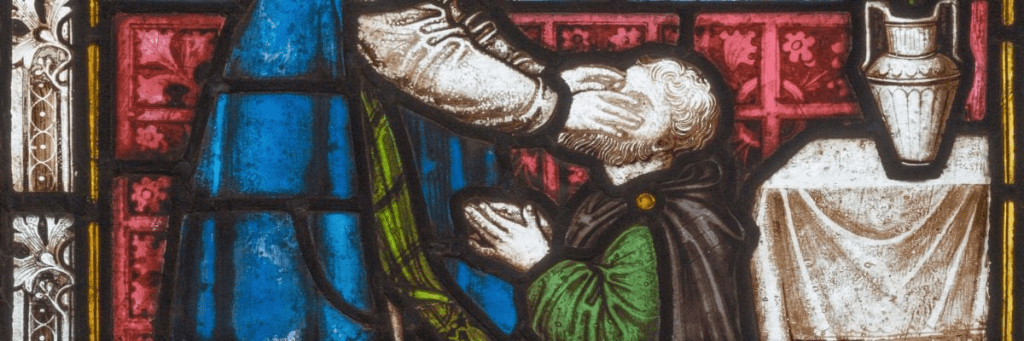
Ananias restoring sight to Saul, stained glass in St Mary Abbot`s Church, London, UK

Meanwhile, Saul was still spewing out murderous threats against the Lord’s disciples. He went to the high priest, seeking letters to the synagogues in Damascus. If he found persons who belonged to the Way, whether men or women, these letters would authorize him to take them as prisoners to Jerusalem. During the journey, as he approached Damascus, suddenly a light from heaven encircled him. He fell to the ground and heard a voice asking him, “Saul, Saul, why are you harassing me?”

Saul asked, “Who are you, Lord?”

“I am Jesus, whom you are harassing,” came the reply. “Now get up and enter the city. You will be told what you must do.”

Those traveling with him stood there speechless; they heard the voice but saw no one. After they picked Saul up from the ground, he opened his eyes but he couldn’t see. So they led him by the hand into Damascus. For three days he was blind and neither ate nor drank anything.

In Damascus there was a certain disciple named Ananias. The Lord spoke to him in a vision, “Ananias!”

He answered, “Yes, Lord.”

The Lord instructed him, “Go to Judas’ house on Straight Street and ask for a man from Tarsus named Saul. He is praying. In a vision he has seen a man named Ananias enter and put his hands on him to restore his sight.”

Ananias countered, “Lord, I have heard many reports about this man. People say he has done horrible things to your holy people in Jerusalem. He’s here with authority from the chief priests to arrest everyone who calls on your name.”

The Lord replied, “Go! This man is the agent I have chosen to carry my name before Gentiles, kings, and Israelites. I will show him how much he must suffer for the sake of my name.”

Ananias went to the house. He placed his hands on Saul and said, “Brother Saul, the Lord sent me—Jesus, who appeared to you on the way as you were coming here. He sent me so that you could see again and be filled with the Holy Spirit.” Instantly, flakes fell from Saul’s eyes and he could see again. He got up and was baptized. After eating, he regained his strength.

He stayed with the disciples in Damascus for several days. Right away, he began to preach about Jesus in the synagogues. “He is God’s Son,” he declared. (Common English Bible)

A telltale sign of spiritual blindness, a lack of awareness, and an unwillingness to change is to put all the focus on another person or group as the real problem of a society.

That’s exactly what Saul did. And that’s precisely why he needed a conversion.

Family Systems Theory

Murray Bowen was an influential psychiatrist of the twentieth century. His family systems theory, also known as Bowen theory, views a family (or any group of persons) as an emotional unit. Within this unit, a change in any of the individual persons results in the others compensating for the emotional functioning that’s been altered. 

Like touching one part of a spider web, the entire thing shakes. Bowen’s focus was that, rather than trying to change the other person, one can change themselves without becoming part of the problem. The theory states that if any family or group member can change their emotional functioning within the system, the whole family will improve its corporate functioning in response to that change. 

In short, we must learn to function in a healthy way within the group system. Personal transformation becomes the best approach to handling family crises and problems.

Saul the Pharisee to Paul the Apostle

Bowen’s statement of the human condition could be said of Saul and his conversion:

“The human is a narcissistic creature who lives in the present and who is more interested in his own square inch of real estate, and more devoted to fighting for his rights than in the multigenerational meaning of life itself. As the human throng becomes more violent and unruly, there will be those who survive it all….  I think the differentiation of self (remaining connected to others, yet separate from their problems) may well be one concept that lives into the future.”

Murray Bowen

Saul the Pharisee was an anxious soul. He was determined to keep the Christian sect from infecting his Jewish way of life. As the followers of Jesus grew, so did the anxiety of Saul and the Pharisees. Saul turned his attention to unhealthy ways of handling the situation – to the point that Christ himself showed up and let Saul know that his harassment needed to stop.

Our Need for Change

Whatever you think of Bowen’s theory, it’s easy to see that anxiety plays a major role in many individuals, families, and even churches. Whenever worry, fear, and anxiety take over a person or group of people, things become emotionally charged. 

The church is an emotional unit. Typically, the response to anything we don’t like is to try and change the other person who is rocking the boat or upsetting the status quo. The converted and changed Apostle Paul learned his lesson about the intricate web of anxious emotions: 

Don’t be anxious about anything; rather, bring up all of your requests to God in your prayers and petitions, along with giving thanks. Then the peace of God that exceeds all understanding will keep your hearts and minds safe in Christ Jesus. (Philippians 4:6-7, CEB)

Learning to manage our own anxiety, and cope with the incessant worry within ourselves, is imperative to dealing with relational problems in the group. The peace of God, not the peace of others, is what makes the difference. 

People are all for change, that is, we want others to change so that we don’t have to. The Christian, however, is to conform to Jesus, and not the other way around. Because the Lord is near to us, we have a consistent and continual presence to anchor ourselves, no matter whether the circumstances are to my liking, or not. 

Prayer becomes the means of casting anxiety away so that peace can take its place. Sounds easy – it’s anything but.

It’s only human to want everyone else to change when there are problems, adversity, or challenge. Yet the change most needed is quite personal, perhaps even an outright conversion.

Our focus must be on finding ways to remain connected to God and others without resorting to passive-aggressive tactics, cutting-off relationships altogether, or bullying others into changing with our violent or manipulative words.

Faced with unwanted change and/or difficult circumstances, rather than looking for others to alter their lives, try asking yourself one of these questions: 

  • What is one small step I can take to improve my situation?
  • If I were guaranteed not to make the situation worse, what would I do differently?
  • Is there a person in my life whose voice and input I haven’t heard in a long time?
  • What is one positive trait I possess that can serve me well in this situation?

Are there other questions you could ask that would be helpful? A journey that seems a thousand miles must begin with one step. What will that step be?

Don’t Be Afraid (Matthew 17:1-9)

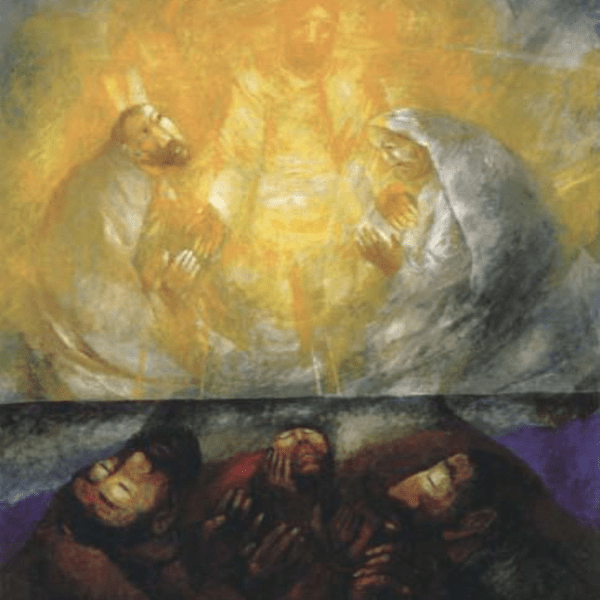
Transfiguration by Sieger Köder (1925-2015)

After six days Jesus took with him Peter, James and John the brother of James, and led them up a high mountain by themselves. There he was transfigured before them. His face shone like the sun, and his clothes became as white as the light. Just then there appeared before them Moses and Elijah, talking with Jesus.

Peter said to Jesus, “Lord, it is good for us to be here. If you wish, I will put up three shelters—one for you, one for Moses and one for Elijah.”

While he was still speaking, a bright cloud covered them, and a voice from the cloud said, “This is my Son, whom I love; with him I am well pleased. Listen to him!”

When the disciples heard this, they fell facedown to the ground, terrified. But Jesus came and touched them. “Get up,” he said. “Don’t be afraid.” When they looked up, they saw no one except Jesus.

As they were coming down the mountain, Jesus instructed them, “Don’t tell anyone what you have seen, until the Son of Man has been raised from the dead.” (New International Version)

Fear is a universal feeling and experience. None of us has to work at being afraid – but we all have to work at being brave and having the courage to face our fears.

Sometimes, we adults teach children not to fear because we assume they are afraid of the dark, high places, and monsters in the closet. But I tend to think a lot of our own adult fear is projected on kids. Why? Because some of the bravest folks I have ever known are children. 

Kids don’t understand near as much as we adults do, yet they conquer their fears every day by facing the world with courage. If you were to go to any children’s hospital today, I believe you would be amazed at the kind of courage you would find amongst kids. We adults have a whole lot to learn about being brave because we have become far too sophisticated in hiding our fears and avoiding courage.

This is why the most repeated exhortation is all of Holy Scripture is to not be afraid. We need courage to live the way God wants. Every day is a fresh opportunity to practice courage.

We need the courage to stand alone

Korah son of Izhar, the son of Kohath, the son of Levi, and certain Reubenites—Dathan and Abiram, sons of Eliab, and On son of Peleth—became insolent,and rose up against Moses. With them were 250 Israelite men, well-known community leaders who had been appointed members of the council. They came as a group to oppose Moses and Aaron and said to them, “You have gone too far! The whole community is holy, every one of them, and the Lord is with them. Why then do you set yourselves above the Lord’s assembly?” (Numbers 16:1-3, NIV)

When Moses heard this, he responded with prayer to God – because he clearly understood that this was all a big power play by Korah, who got others stirred up to take action against him. 

Moses stood alone. Out of the millions of Israelites, not one single person stood with Moses. To be sure, the majority of Israelites did not side with Korah; but neither did they come and stand with Moses. Why? They were too afraid to be involved and took the posture of bystanders. 

God did a miraculous thing, never done before or since, by opening up the ground and having the earth swallow Korah and his followers. The Lord wasn’t only upset with Korah; God was also angry with the people for fearfully standing in the safety of numbers and doing nothing. In fact, God was so mad that he was ready to wipe them all off the face of the earth. But, yet again, Moses, in humility, prayed and pleaded with God to spare them – and God did.

There will always be someone opposing you when you are just trying to obey God and do the right thing. And there will always be a crowd of people who do not want to be involved because they are afraid.

The church everywhere needs to be what Jesus wants it to be, and not what a particular person or group of people want it to be. Courageous people need to stand up to people who want positions of power in order to lead in self-serving ways.

We need the courage to love people

Now while he was in Jerusalem at the Passover Festival, many people saw the signs he was performing and believed in his name. But Jesus would not entrust himself to them, for he knew all people. He did not need any testimony about mankind, for he knew what was in each person. (John 2:23-25, NIV)

Jesus did not get carried away with his own press. Whether people responded to him by the hundreds, or whether they refused him altogether and tried to throw him off a cliff, Jesus was consistently the same. He did not need people’s responsive affirmation in order to do his mission on earth. Christ loved people just because he wanted to, and not because he was trying to get them to love him in return, like insecure and fearful people do.

We need the courage to love the unlovely. And we must understand that perfect love casts out fear.

“We should not only love our brothers and sisters, but also not consider ourselves better than them. Instead, we should show compassion and acceptance to others. We want to have others strictly reprimanded for their offenses, but we will not be reprimanded ourselves. We are inclined to think the other person has too much freedom, but we ourselves will not put up with any restraint to our freedom. There must be rules for everyone else, but we must be given free rein. It is seldom that we consider our neighbor equally with ourselves. If everyone was perfect, what would we have to endure for the love of God?… for we cannot live in this world without adversity. Those who can suffer well will enjoy the most peace, for such persons are brave, courageous, not afraid of pain, have Christ as their friend, and heaven as their reward.”

Thomas à Kempis, The Imitation of Christ, c.1425, C.E.

It is no test of virtue to be on good terms with easy-going people. And, of course, all of us want to live in peace and prefer those who agree with us. Yet, in this mortal life, our peace consists in the humble bearing of suffering and contradictions, not in being free of them.

We need the courage to please God

The devil took him to a very high mountain and showed him all the kingdoms of the world and their splendor. “All this I will give you,” he said, “if you will bow down and worship me.” Jesus said to him, “Away from me, Satan! For it is written: ‘Worship the Lord your God, and serve him only.’” (Matthew 4:8-10, NIV)

Jesus is our model of courage. He sought to please the Father, and not anyone else. Jesus bravely resisted becoming someone other than he was called to be. 

On the Mount of Transfiguration, Jesus courageously refused to remain on the mountain, instead choosing to go into the valley and undertake a new and risky ministry. 

Christ fearlessly came to this earth in the incarnation and resisted the comfort of security. He valiantly confronted sin, overturned the money-changers’ tables, and did his Father’s will, instead of shrinking in fear about what people would think. 

Jesus heroically faced crucifixion, even though he was terribly stressed about it, in order to offer forgiveness in the face of persecution. Jesus gallantly said “No!” to the power of sin by rising from death. And he boldly ascended to heaven and confidently passed the work of ministry to a motley group of people who did not show any promise to carry the mantle of his teaching.

The Son found his identity in relation to the Father. For us to please God, we need the courage to play to an audience of One. 

If we need other people’s acceptance and approval in order to do anything, then we will never have the courage to act for God. 

We must live by conviction, and not by sticking our finger to the wind to see which way popular opinion is blowing.

Conclusion

History is filled with men and women who said “no” to destructive fear and changed the world. But imagine if they had succumbed to the paralyzing effects of fear in their lives. Imagine if…

The Apostle Paul, fearing resistance or rejection, chose to stay home rather than embarking on the missionary journeys that took the message of Christ throughout the known world.

Martin Luther King Jr. gave speeches filled with gentle hints about the evils of segregation, because he feared pushing too hard.

Jackie Robinson refused to enter major league baseball so as to not rock the boat; or Branch Rickey, the owner of the Brooklyn Dodgers, just going with the way baseball had always operated. But neither of them went that way. In the film, “42,” Robinson asks Rickey:

“You want a player that doesn’t have the guts to fight back?” “No. No.” replies Rickey. “I want a player who has the guts not to fight back. People aren’t going to like this. They’re going to do anything to get you to react. Follow a curse with a curse and they’ll hear only yours. Follow a blow with a blow and they’ll say the Negro lost his temper; that the Negro does not belong. Your enemy will be out in force and you cannot meet him on his own low ground. We win with hitting, running, fielding—only that. We win only if the world is convinced of two things: That you are a fine gentleman, and a great ball player. Like our Savior, you’ve got to have the guts to turn the other cheek. Can you do it?”  Robinson replies, “You give me a uniform; you give me a number on my back; and I’ll give you the guts.”

42 (2013 film)

Now imagine yourself, fully aware of the mission and vision God has placed in your heart to advance his gracious and benevolent rule in this world – and yet there is also present all the phobias, irrational worries, and destructive fears of failure, harm, or rejection. So I ask:

If you don’t fulfill the mission God assigned to you, who will?

Jesus Is Better (Hebrews 8:1-7)

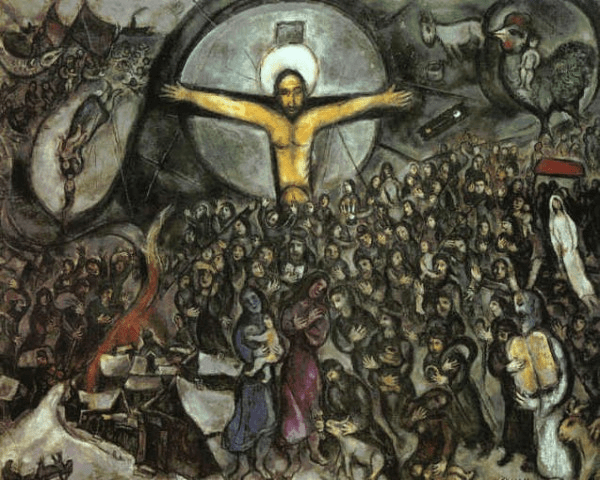
Exodus by Marc Chagall, 1952

Now the main point of what we are saying is this: We do have such a high priest, who sat down at the right hand of the throne of the Majesty in heaven, and who serves in the sanctuary, the true tabernacle set up by the Lord, not by a mere human being.

Every high priest is appointed to offer both gifts and sacrifices, and so it was necessary for this one also to have something to offer. If he were on earth, he would not be a priest, for there are already priests who offer the gifts prescribed by the law. They serve at a sanctuary that is a copy and shadow of what is in heaven. This is why Moses was warned when he was about to build the tabernacle: “See to it that you make everything according to the pattern shown you on the mountain.” But in fact the ministry Jesus has received is as superior to theirs as the covenant of which he is mediator is superior to the old one, since the new covenant is established on better promises.

For if there had been nothing wrong with that first covenant, no place would have been sought for another. (New International Version)

Jesus Christ is superior to everyone and everything – that is the overarching theme of the New Testament book of Hebrews. Jesus is above the angels, over Moses, and the great high priest of a new covenant. In Christ, the sin issue has been taken care of, once and for all.

Through Jesus, every good promise of God is fulfilled. Christ’s priesthood and intercessory ministry is permanent. His sacrifice for sin is thorough and complete. Jesus lives forever. He saves completely. Christ meets our need. He has been made perfect forever. (Hebrews 7:23-28). 

Frankly, these bold statements from the author of Hebrews are some audacious claims. In fact, they’re downright radical. And yet, say any of those statements in the typical church, and hardly an eyebrow gets raised – they almost seem ho-hum. Our blank affect testifies that we have lost a great deal of the original force and impact of Christianity.

In the first century, to have one sacrifice to end all sacrifices was unthinkable. Every ancient person understood that sacrifices were temporary; you had to keep offering them over and over again. 

Christianity, however, asked the world to have a new understanding of sacrifice. No longer would there be any sacrifice – no grain sacrifice; no offerings of first fruits; no animal sacrifices; no sacrifices, period. There was no longer any need for them because Jesus himself is the sacrifice to end all sacrifices. 

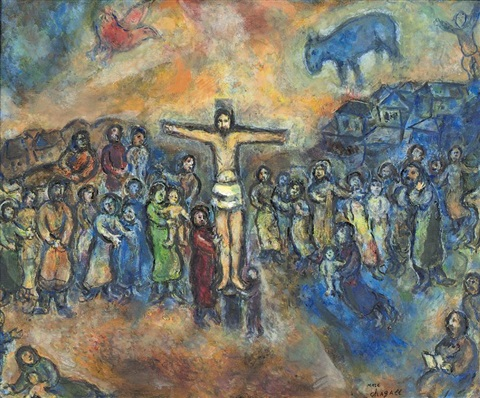
Crucifixion by Marc Chagall, 1966

This was such a ridiculous notion for so many people that they mocked Christians for it. Both Jews and pagans could barely wrap their minds around such a progressive idea. It would be like saying to us today that there is no longer any need for money because somebody just became the underwriter for everything everybody does.

Despite this incredible spiritual reality, we in the contemporary church sometimes go back to the old sacrificial system, not by physically offering animal sacrifices, but treating Christ’s finished work as if it were just too good to be true. 

We reason that we need to do something to help save ourselves. However, Jesus has not just saved us partially, but fully. Grace has always been scandalous, and so, we try to tone it down a bit, mitigate it’s actual force:

  • Church attendance can subtly be looked upon as a sacrifice to appease God, as if he needed to be soothed into not becoming angry at us. 
  • Giving can become a non-bloody sacrifice that is meant to satisfy God’s furrowed brow against us. 
  • Service can degenerate into a sacrifice to assuage our guilty conscience. 

In all these kinds of instances, and more, we go back to an old sacrificial system that is obsolete. Nonetheless, the biblical and theological truth is that Jesus has thoroughly saved us from our sin, and, so, has cleansed us from all guilt, including a guilty conscience. 

Jesus meets our need and has completely satisfied God’s wrath against the power and deceit of sin. 

Jesus is our mediator and intercedes for us as we come to God’s throne of grace. That means we do not need to try and get God’s attention with performing spiritual cartwheels or some incredible sacrifice that will somehow obligate him to take notice of us. That’s because there is never a time in which we lack attention from God.

Since we have been justified by faith in Jesus, we need not worry anymore about being good enough. Since Jesus is perfect, his work is made complete in us. A constant anxiety of feeling like we don’t measure-up does not come from God. Jesus is sufficient and has taken our place so that we can live in the freedom and joy of a complete deliverance from sin, death, and hell. There is no longer any necessary sacrifice to make!

“Well,” I have been told by some, “if everybody in the church believed that then nobody would ever do anything!” No, it is just the opposite. When we feel like we don’t measure up, we do less, not more. A low level discouragement sets in and we do nothing because we intuitively know it will never be enough. We do just enough to squeak by, never quite knowing if it is doing anything. 

In such a state, we may consider giving up because Christianity doesn’t work for us (which was the state of the believers in the book of Hebrews). But when we grasp the New Covenant of Christ’s sacrifice to end all sacrifices, and are overwhelmed by grace, then everything we do in the Christian life is a “thank you” with our life and our lips. 

It is the grace, and not the wrath, of God that teaches us to say “no” to ungodliness and worldly passions and to live upright and godly lives (Titus 2:11-12).

We are justified and made right by faith in Jesus Christ, and not by our own accomplishments, pedigree, or effort.  Trusting in our heritage, relying on our family’s faith, or believing our hard work gives us a leg-up toward heaven will only end in despair. 

But if we trust in Christ’s perfect sacrifice, then a whole new world of mercy opens before us. Because the grace of God in Christ is superior to everything.

Soli Deo Gloria