1 John 3:11-16 – Live in the Realm of Love

Love One Another

For this is the message you heard from the beginning: We should love one another. Do not be like Cain, who belonged to the evil one and murdered his brother. And why did he murder him? Because his own actions were evil and his brother’s were righteous. Do not be surprised, my brothers and sisters, if the world hates you. We know that we have passed from death to life because we love each other. Anyone who does not love remains in death. Anyone who hates a brother or sister is a murderer, and you know that no murderer has eternal life residing in him.

This is how we know what love is: Jesus Christ laid down his life for us. And we ought to lay down our lives for our brothers and sisters. (NIV)

It would be good for us to get a few words defined and explained before we look at the message of the Apostle John. “Death” and “life” are full of meaning in Holy Scripture. Whereas we tend to use death and life as referring chiefly to the body, they are primarily relational terms in the Bible. So, then, death is a separation from God and others; and, life is connection with God and others. In addition, death and life are biblically understood as forces or realms of being within or without. When someone moves from death to life, they are leaving the realm of separation with its loneliness, lostness, lethargy, and lack of meaningful and helpful interaction with God and others to a place of connection in which there is love.

There is no love in the realm of death. Love is not a solitary affair – it requires another. Death is awful in the sense that it places one outside of love. Like death and life, love is also a relational term and a force or power which exists. In fact, love is such a huge realm of being and such a large domain that it almost defies definition. We are mostly left to describe love because all attempts to nail down love with a precise definition will never do it justice. Therefore, the Apostle Paul, in his great ode to love, did not even try to define it, but merely attempted to characterize love:

Love is patient. Love is kind. Love isn’t jealous. It doesn’t sing its own praises. It isn’t arrogant. It isn’t rude. It doesn’t think about itself. It isn’t irritable. It doesn’t keep track of wrongs. It isn’t happy when injustice is done, but it is happy with the truth. Love never stops being patient, never stops believing, never stops hoping, never gives up. (1 Corinthians 13:4-7, GW)

Consistent with the force and relational nature of death, life, and love, hate is not primarily a feeling toward another but exists as a stance toward another within the domain of darkness and death. To hate is to deliberately and volitionally separate from another person and/or from God. It is to consider someone as the “other” who is not like me, and so, I will neither associate nor interact with “those” people.

Love, however, thrives in the vast multi-dimensional realm of life. Love seeks connection with another and desires to act through discovering needs and meeting them. Although emotions of love are very real, those feelings are the result of calculated actions and words which benefit humanity and the common good of all persons.

With all the understanding of hate and death, love and life, now plug that into the Apostle John’s message. We need to make clear decisions to pursue life and love others. And Jesus is our model for this. Christ is the ultimate Connector, bringing vibrant life, even eternal life, through loving actions. Jesus intentionally entered the dark realm of death and absorbed all the hate of the world for you and me. In a great and loving reversal, Jesus Christ’s death – his separation from God and others – brought connection with God and others.

MLK quote 3

Likewise, followers of Jesus will learn to take on the world’s hatred, not fearing death’s ability to disconnect, and love others as they themselves have been loved by Christ. Christians are known by the way they act toward those in the realm of death who use the tool of hatred to stay there.

On the flip side of love, the biblical character Cain is Exhibit A of modeling the way of hatred and death. He separated himself from his brother, Abel, in every way possible – relationally, emotionally, mentally, and finally, physically through outright killing of the body.

The message from John is this: Do not be like Cain. Be like Jesus. Love others, and not hate them. Live for others, die to self.

Murder is also a relational term in Scripture. It is, of course, a tool forged from the flames of hell to be used by the hand of hatred to bring death’s realm of separation. Jesus clearly understood murder in this manner:

You know that our ancestors were told, “Do not murder” and “A murderer must be brought to trial.” But I promise you that if you are angry with someone, you will have to stand trial. If you call someone a fool, you will be taken to court. And if you say that someone is worthless, you will be in danger of the fires of hell. (Matthew 5:21-22, CEB)

Christians are people who put love where love is not – which means they brave death’s door to pull others from the flames. As the little New Testament book of Jude says:

But you, dear friends, must build each other up in your most holy faith, pray in the power of the Holy Spirit, and await the mercy of our Lord Jesus Christ, who will bring you eternal life. In this way, you will keep yourselves safe in God’s love. And you must show mercy to those whose faith is wavering. Rescue others by snatching them from the flames of judgment. Show mercy to still others, but do so with great caution, hating the sins that contaminate their lives. (Jude 20-23, NLT)

May your soul be blessed with love’s kiss.

May the grace and kindness of love bring you life and continue to be life-giving for you.

May the hardness of hatred be far from you.

May death’s destructive power dwindle to nothing in the face of Christ’s love working in and through you to the glory of God.

Matthew 21:18-22 – Faith and Prayer

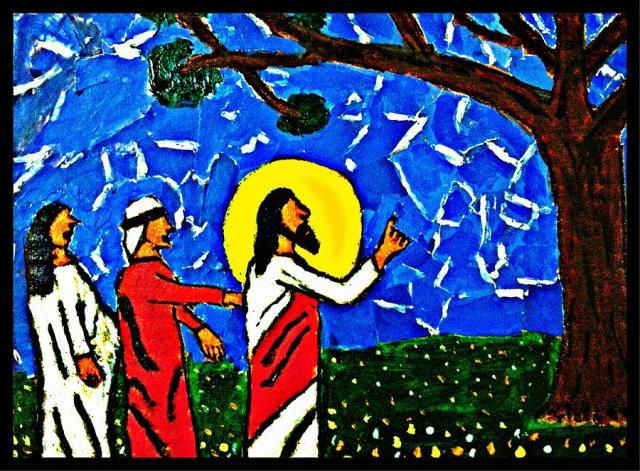
Jesus Cursing the Fig Tree
Jesus Cursing the Fig Tree by Ganosh Kelagina Beedu Shenay, 2016

Early in the morning, as Jesus was on his way back to the city, he was hungry. Seeing a fig tree by the road, he went up to it but found nothing on it except leaves. Then he said to it, “May you never bear fruit again!” Immediately the tree withered.

When the disciples saw this, they were amazed. “How did the fig tree wither so quickly?” they asked.

Jesus replied, “Truly I tell you, if you have faith and do not doubt, not only can you do what was done to the fig tree, but also you can say to this mountain, ‘Go, throw yourself into the sea,’ and it will be done. If you believe, you will receive whatever you ask for in prayer.” (NIV)

God wants us to pray! Prayer happens from a place of faith because to pray, one must believe that God is good and answers prayer. Conversely, prayerlessness is faithlessness.  A person of little faith prays only a little. A person full of faith cannot stop praying.

God’s world revolves more around promise than command – which means that Jesus merely exhorting the disciples to pray would fall flat; they needed a deep change of heart. God calls us all to transformation. Lasting change takes place at the roots of our lives. When there is a drought, pouring lots of water on our backyard trees at the first sign of withering leaves is too late. The tree may look fine on the outside, but on the inside, it is dying from lack of water. Real change comes from the inside-out.  It is the root of a person’s life, below the surface where others do not see, that needs change, and not merely the outward behavior.  Prayer must be directed to the root, to the heart of the issue.

In today’s Gospel story, Jesus was up early and going to Jerusalem. He was hungry and wanted some breakfast, so he approached a fig tree. Figs were known back in Christ’s day as the poor man’s food. Fig trees were everywhere. Approaching a certain fig tree, Jesus found one that looked fine, but no figs. He chose to use the tree as a teachable moment for his disciples. Christ cursed the tree and immediately the entire tree withered.  So, why did Jesus curse the tree?

Jesus cursed the fig tree because it looked good on the outside, but it was already dead on the inside. The tree had everything a tree needed: branches, leaves, and a trunk – except fruit.  The tree served as an illustration for the disciples of believing prayer. The tree looked fine, and had the promise of fruit, yet, none was found.  The point of the tree illustration is this: Jesus is looking for faith in his followers.

In the prophet Jeremiah’s day, the nation of Judah had enjoyed a long stretch of prosperity and good circumstances. By all outward appearances they were doing fine. Temple attendance was at its peak and everyone was offering their sacrifices. But something was wrong….

I will put an end to them,
declares the Lord;
there are no grapes on the vine,
no figs on the tree,
only withered leaves.
They have squandered what I have given them!
(Jeremiah 8:13, CEB)

Although fine on the outside, the people of Judah trusted in themselves, their ability to produce a harvest, and their outward show of how many cattle and sheep they brought to the temple. But what God was looking for was fruit, not nice leaves. He was watching for offerings of believing prayer, born of a faith that is confident in the goodness of God. And the Lord is still looking for people’s faith in God alone – rather than in religiously outward forms of success.

Jesus wants his followers to understand and believe that our words and prayers can have the immediate effect of changing the world.  We can even speak to a mountain and it will have to move if we tell it to. We probably do not go around talking to mountains, but all of us go around talking to ourselves about mountain-like problems. The power that levels mountains is prayer that speaks confidence and boldness.  If you believe, you will receive whatever you ask for in prayer.

Doubt sometimes stands in the way of prayer – not doubt in ourselves because we do not answer our own prayers. The Apostle James said:

“If any of you needs wisdom, you should ask God for it. He is generous to everyone and will give you wisdom without criticizing you. But when you ask God, you must believe and not doubt. Anyone who doubts is like a wave in the sea, blown up and down by the wind. Such doubters are thinking two different things at the same time, and they cannot decide about anything they do. They should not think they will receive anything from the Lord.” (James 1:5-8, NCV)

Both James and his brother Jesus refer to an unshakable faith in the goodness of God. This is faith in the person of God, and not faith in faith itself. If we are honest, every one of us who has made a difficult prayer request, mustering-up all the faith we can, and then being disappointed when it did not happen, has been hurt. The unstable person vacillates when this happens, doubting whether God is good (playing the he-loves-me, he-loves-me-not game). The person of faith believes God answers prayers according to his will, and that if the prayer is not answered, God knows what he is doing and will answer it in his own good timing and purposes.

Maybe you have even indulged your inner-critic, a Job-like friend, telling you that you have a failure of faith, or not enough faith, and that is why your prayer was not answered. Yet, positive thinking is not the same as Christian faith.  It is neither a matter of being optimistic, nor of sending $19.95 to some hack preacher who promises to give you the secret of answered prayer, along with a free gold cross.

God’s will for our lives is sometimes, maybe even oftentimes, a mystery. However, we do know what God’s will is for a lot of things. For example, God is not willing that any should perish but all be brought to eternal life.  So, we can pray with confidence for a person’s deliverance from sin.  We can be bold about trusting in God’s promises – he will do what he says he will do.  Boldness is only as good as the truth it is based upon.

Imposing Mountain View and Lake Glacier National Park
Imposing Mountain View and Lake Glacier National Park. Many Glacier Area. Swiftcurrent Lake.

We have every right, based in our union with Jesus Christ and our redemption in him, to ask God confidently and boldly for the removal of mountains.  We have the authority in Christ to do so.  Therefore, we do not need to offer tepid, milquetoast, mumbling prayers with sighs and hunched shoulders (i.e. “Well, God, if it is your will, could you help me?”).

It is time for men to step out and give God some healthy hairy-chested prayers.  And, this is not the time for women to be worried about what the men do, or not do. Everyone is to be bold in prayer.

“God desires of us nothing more ardently than that we ask many and great things of him, and he is displeased if we do not confidently ask and entreat.” –Martin Luther

Jesus wants faithful and fruitful prayer. He still scans the horizon of our spiritual lives looking for believing prayer. Christ desires from those who follow him bold prayers which curse and wither fruitless and feckless places. When my children were small there was an adult store in our neighborhood. It disturbed my spirit. Each time I passed it I confidently prayed that the pornography and exploitation of women would dry up and cease in Jesus’ name, and that those who worked in that establishment would find more gainful and ethical employment. And that is exactly what happened.

Aggressive prayer against the enemy of our souls is needed, prayer that claims the authority which has been given us in Christ, prayer that is based in solid biblical truth and robust theology. So, let us pray in faith and confidence….

Heavenly Father, we praise you for the grace we possess through the Lord Jesus Christ.  We rejoice in Christ’s teaching and the victory you have provided for us to live above sin and failure.  We come before you in confession and to plead your mercy over our sins, the sins of other believers, and the sins of our world.  We confess the sin of prayerlessness, faithlessness, apathy, complacency, and indifference to those who are lost.  We also acknowledge before you the wickedness of our world through the evil machinations of injustice, oppression, and exploitation of others.

We praise your holy name, O God, that there is plenty of grace through the person and work of the Lord Jesus.  We plead the blood of the cross and the power of the resurrection against the sins and rebellion of people against you.  We pray and wait for you, Holy Spirit, to bring us all to new life in Jesus Christ. 

We recognize that Satan and the kingdom of darkness have plotted and laid strategies against new spiritual life, keeping your people from believing prayer.  So, in the name of the Lord Jesus Christ, we claim our place as children of God. We smash and pull down all the strongholds which Satan has erected against humanity – and pray that the power of Christ’s resurrection would hinder and frustrate the plans formed against us. 

We pull down demonic strongholds of prayerlessness and carelessness with the Word of God. We claim back for the Lord Jesus Christ the ground Satan is claiming as a means of hindering faith, hope, and love; and, we affirm that Satan’s plans were fully defeated through the cross and resurrection of Jesus. We pull down all of Satan’s plans to divert fresh faith when it comes. Blessed Holy Spirit, may you send a renewal to the hearts and souls of all people. May it bring a wondrous season of peace and joy.

We, your people, accept the role of standing in the gap for others in prayer.  You yourself, God, said that we, in Christ, are mighty through God to the pulling down of strongholds.  So, we bring all the work of the Lord Jesus Christ to focus directly against the powers of darkness that blind people and keep them in bondage.  We pray the victory of Christ’s incarnation, crucifixion, resurrection, ascension, and glorification directly against all of Satan’s power in their lives.  We now bind all powers of darkness set to destroying them, and we unbind those demonic bonds and blinders from them in the mighty name of Jesus. 

By faith we claim humanity for fruitful lives of spiritual abundance, social justice, and sanctified relationships in the name of Jesus Christ our Lord, who defeated all powers and principalities of this world.  Amen.


How to Handle a Sinner, Part 2

Reconciliation Statue
Reconciliation Statue, placed in the ruins of Coventry Cathedral, England, bombed by the Nazis in World War II.

Being emotionally and/or spiritually wounded by another downright hurts. So, what do we do when it happens? Gratefully, Jesus provided some clear teaching on how to handle a victimizing person. (Matthew 18:15-20)

In part one, we considered the initial step to be taken when a person has been offensive and brought damage to another and/or the community. In their straying from the law of love, we are to respond by speaking to the person privately, to attempt a one-on-one reconciliation and restoration. This effort may be repeated several times over.

These next two steps are only to be undertaken when it has become evident that the person’s intransigence about hurting others will not budge.

The Second Step – Take One or Two Others (Matthew 18:16).

Reconciliation Statue Berlin
Statue outside of the Church of Reconciliation in Berlin, Germany.

“If they will not listen, take one or two others along, so that ‘every matter may be established by the testimony of two or three witnesses.'” –Jesus

The idea here is not to get a few buddies together who agree with our assessment. Rather, we seek others who know the person and can provide loving and objective help. This upholds the ethics of the Old Testament:

A solitary witness against someone in any crime, wrongdoing, or in any sort of misdeed that might be done is not sufficient. The decision must stand by two or three witnesses. (Deuteronomy 19:15, CEB)

When a person fails to respond to reproof privately, then others need to get involved so that there is not a situation of “he said, she said.”  The witnesses are to help establish the nature of the problem. This is purposely meant to be a rather drawn out process because the goal is restoration. We are to give the person every chance to respond to correction.  People need to be given the grace of time to be effectively wooed back to the flock.

The Third Step – Tell It to the Church (Matthew 18:17-18).

Reconciliation Statue Hiroshima
Reconciliation Statue in Hiroshima, Japan

“If they still refuse to listen, tell it to the church; and if they refuse to listen even to the church, treat them as you would a pagan or a tax collector.” –Jesus

If the person ignores the group of witnesses, the group is to report the problem to the church. If the person still refuses to listen, then the person is to be treated like “a pagan or tax collector,” that is, the person is to be excommunicated and treated as though they are an unbeliever who has different needs. Jesus did not mean that we never talk to the person again. It is just the opposite: We communicate to them the need for grace just as we would to anyone.

The sixteenth-century Reformed Confession, the Heidelberg Catechism, took up this this matter (Question and Answer 85):

Q: How is the kingdom of heaven closed and opened by Christian discipline?

            A: According to the command of Christ:

Those who, though called Christians, profess unchristian teachings or live unchristian lives, and after repeated and loving counsel refuse to abandon their errors and wickedness, and after being reported to the church, that is, to its officers, fail to respond also to their admonition – such persons the officers exclude from the Christian fellowship by withholding the sacraments from them, and God himself excludes them from the kingdom of Christ.  Such persons, when promising and demonstrating genuine reform, are received again as members of Christ and of his church.

This approach is also germane with groups of people, churches, or Christian organizations. In the last century, churches around the world ostracized the South African Dutch Reformed Church for their refusal to bend concerning their racism and stance on apartheid.  Restoration did occur.  Not only that, but the Belhar Confession was eventually crafted from this church, a document which stands as a thorough biblical stand against structural racism and racist actions.

The Power of the Small Group (Matthew 18:19-20).

“Again, truly I tell you that if two of you on earth agree about anything they ask for, it will be done for them by my Father in heaven. For where two or three gather in my name, there am I with them.” –Jesus

Jesus reiterated his point about binding and loosing; opening and closing; banning and forgiving. One of the great Reformation teachings is the priesthood of all believers.  The beauty of this is that we may confess our sins to one another in a close, intimate setting so that the steps do not need be done. Small gatherings of believers coming together to confess sin and pray together is the most powerful setting there is.  If we neglect this, we are missing out on the power of God.

Conclusion

Once upon a time, there were two brothers. Their father had a large farm and when he became too old to work, he called his sons to him. “I am too old to work anymore,” he said. “I will divide my farm in half and give each of you one half. I know that you will always work together and will be good friends.”

When the brothers first started farming on their adjoining farms, they were the best of friends and would share everything together. Then, one day there was an argument between the two brothers, and they stopped speaking to one another. For many years, not a word was spoken between them.

One day, one of the brothers was at his house when a carpenter came to his door and said, “I would like to do some work. Do you have any work that I can do?” The brother thought for a moment and then replied, “I would like for you to build a fence on my property. Build it down near the stream that separates my farm from my brother’s. I do not want to see my brother and I would like for you to build a high fence there. I am going into town and I will return this evening.

Bridge over stream

When he came back that evening, he was shocked to see that the carpenter had not followed his instructions. Instead of building a high fence he built a bridge over the stream. The man walked down to look at the bridge, and as he did, his brother walked toward him from the other side. His brother said, “After all the terrible things I’ve done to you over the years, I can’t believe that you would build a bridge and welcome me back.” He reached out to his brother and gave him a big hug.

The brother then walked back up to his farmhouse to talk to the carpenter. “Can you stay?” he asked. “I have more work for you to do.” The carpenter answered, “I’m sorry but I can’t stay. I have to go, for I have many other bridges to build.”

Sometimes you and I have hurts and wounds from our brothers and sisters in Christ. When that happens, we often build a fence between ourselves and them. We stop talking to them. We do not want to see them. We do not want to be around them. However, Jesus wants something different. Instead of fences, he wants us to build a bridge of love.  He wants us to connect and work it out.

How to Handle a Sinner, Part 1

Christ teaching the disciples
A medieval portrait of Christ teaching his disciples.

We live in a fundamentally broken world.  It is filled with broken people. And broken people tend to hurt each other. None of us are immune.  What do you do when you are hurt?

Jesus had something to say on the subject (Matthew 18:15-20). It would be good to hear him out on it because all of us get hurt at some time or another and we need to know how to handle the offending person. We need to get this right. If we do not, the cycle of pain, hurt, damage, and brokenness gets perpetuated.

Just before Jesus offered some teaching on how to handle a sinner, he a parable about a lost sheep – communicating that he is not willing that any sheep should be lost to the sheepfold (Matthew 18:10-14). The teaching on dealing with a person who wounds us is simply the logical extension of the parable. That is, Jesus told us in clear terms what must be done to bring the straying sheep back into the fold.

When attempting to retrieve a wandering person, the tools of guilt, gossip, nagging, and punishment are not consistent with the gospel of grace. Standing at a distance and lobbing verbal grenades toward an erring person is not mentioned by Jesus as an acceptable means of proceeding with those who have caused us suffering.

Jesus offered a three-step process of gracious intervention and a compassionate confrontation with the aim to rescue and restore. Radical independence has no place in the Church.  Strays must be lovingly pursued, carefully rescued, and gently restored.  Anytime someone wanders from the Lord, they hurt another or a group of people, and that wayfaring sheep’s life gets worse. We are not to add to their misery by going to the extremes of either being obnoxiously passive-aggressive to get them to change, or simply ignoring the person altogether, doing nothing, and just hanging back and licking our own wounds.

What others call an “intervention” Christians call “church discipline.”  It seems to be rarely practiced today, which is one reason why we have growing legions of de-churched people. In this post, I focus on step one of this process, because nine out of ten times this first step takes care of the situation. A subsequent post shall deal with the second and third steps.

Cartoon Matthew 18

The First Step – One on One (Matthew 18:15). 

Here are several observations about this step:

  • Approach the person privately. We are never to confront an individual in a group, having not first talked to the offending person one on one. We do not start with step two because these are progressive steps.  Furthermore, we are to avoid what I call the “Middle School adolescent way” of confrontation by having someone else do it for you and report back.
  • Focus on the sin event. We are to show the person their fault, and not make a list of all the things the person has done wrong in the last ten years; or, talk about how terrible they are. We must stick to the offense.  What is more, confrontation is not to be done simply with something we do not like. A person’s individual idiosyncrasies or personality is just that, and we need to have the maturity to allow people to be who they are.
  • Be vigilant to avoid overreactions. Steer clear of accusing others of wrongdoing based in some disputable matter. Let us be sure to face the person about a clear sin which has been committed. On the contrary, if we tend to dodge conflict at all costs, we must watch for our own denial and rationalization by saying “it wasn’t so bad.” The health of the church, not to mention our own personal well-being, may very well require that we do the risky thing and talk directly to the one who has affronted us.
  • Pay attention to the approach. The manner in which we oppose another person is critical. The bull-in-the-china-shop approach is nothing more than responding to a sin with another sin. For example, rather than saying, “You need to stop and get right with God or you’ll go to hell,” you could say instead, “When you did that I felt sad and upset because I need to be in a place that values love. Will you please stop this unloving action?” In other words, knee-jerk reactions rarely go over well. But well-placed words said in love and wisdom go a long way toward restoration.
  • Confront our brother or sister. No one is to be the self-appointed ethics Nazi for people outside the church.
  • Confrontation is commanded. If we are to take the words of Jesus seriously, this is not a matter which is open for debate on whether we do it or not. We are to take the attitude that I am my brother’s keeper.  I am not to let a person run rampant with their sin over myself or others. When we are abused and offended, we do not wait for the person to come to us. Even as the victim, we are to initiate the reconciliation and restoration. “Go” to the person, Jesus said. Face-to-face is the way, without reliance on email or voice mail.  It is to be a conversation, not a drive-by comment or accusation.
  • Confrontation is not negotiation. This is a matter of restoring a person who has sinned.  Having differing positions on certain issues in a church or Christian community is a matter for negotiating, not confronting.
  • Do it more than once. This first can (and should) be repeated many times over. The goal is restoration, not get-this-step-out-of-the-way-so-I-can-see-you-get-in-trouble attitude.

Jesus did not invent something new with his teaching but upheld and restated Old Testament ethics about our attitudes in reproving others:

Do not secretly hate your neighbor. If you have something against him, get it out into the open; otherwise you are an accomplice in his guilt. Do not seek revenge or carry a grudge against any of your people. Love your neighbor as yourself. I am God.” (Leviticus 19:17-18, MSG).

In most situations, this first step takes care of the issue and mends the problem with a genuinely restored relationship. If, however, this does not occur, yet other steps ought to be taken. These will be handled in the next post.

May the grace of the Lord Jesus, the love of God our heavenly Father, and the encouragement of the Holy Spirit be with you, today and always. Amen.