Walk in the Way of Love (Ephesians 5:1-6)

Follow God’s example, therefore, as dearly loved children and walk in the way of love, just as Christ loved us and gave himself up for us as a fragrant offering and sacrifice to God.

But among you there must not be even a hint of sexual immorality, or of any kind of impurity, or of greed, because these are improper for God’s holy people. Nor should there be obscenity, foolish talk or coarse joking, which are out of place, but rather thanksgiving. For of this you can be sure: No immoral, impure or greedy person—such a person is an idolater—has any inheritance in the kingdom of Christ and of God. Let no one deceive you with empty words, for because of such things God’s wrath comes on those who are disobedient. (New International Version)

You are loved. There may not be a lot of things I know, and much of life might be a mystery with few answers, yet the one unshakable truth I have absolutely no doubt about is that you and I are loved by a good and loving God.

Humanity is loved and is therefore meant to love one another as the ultimate rule and guide of life.

Just as God loves, so we are to do the same. We are to mimic divine love in our daily lives. The healthiest of relationships are characterized by a continual dynamic of giving love and receiving love.

Whenever love fails to be the basic rule of life, people are exposed to the gravity of God’s wrath – which exists as the extension of God’s love, in order to put a stop to unloving words and actions in the world.

Unfortunately, as a hospital chaplain and church pastor, I daily see the sad effects of individuals who have experienced a paucity of love and, so, have taken on a false self to try and find love in all the wrong places – with damaging consequences.

Three inappropriate unloving ways of acting are mentioned in today’s New Testament lesson:

  • Sexual immorality is the illegitimate attempt to get the legitimate need for erotic love met without any strings attached. It is a misguided belief that one-night stands and clandestine trysts will protect against being too committed to another and getting hurt.
  • Impurity is any other illicit, illegal, or improper kind of behavior toward others which tries to do the same thing as immorality: Seeking to meet legitimate needs in an illegitimate way – to turn a trick for love, trying to avoid emotional, spiritual, or even physical pain.
  • Greed is an insatiable pursuit of addictive behavior meant to numb or stuff all the unwanted emotions which reside deep in the soul because of engaging in the immoral or impure actions.

Three inappropriate unloving words of speaking are mentioned:

  • Obscenity is filthy speech which is a cover for the agonizing unmet needs of love deep within the human heart. Obscene words are nothing more than verbal sexual immorality. They are a twisted attempt at trying to give and get loving words in an illicit manner.
  • Foolish talk, much like impurity, is any other illicit or improper words crafted to manipulate or cajole another. It is the hustle for love. The original Greek word means literally “to talk like a moron,” that is, a person who lacks sound judgment.
  • Coarse joking is crude and addictive speech, much like greed, envy, and coveting, which verbally trolls for love without unveiling any real feelings.

The antidote to all these baseless actions and distasteful words is to realize the true self, created by God, through receiving the love of God and of others with thanksgiving. Within genuine loving relationships, people can express their legitimate needs to each other and satisfy one another. Yet, with the false self, there is secrecy, hiding, and massive amounts of shame.

Love opens us to all that is good and beautiful. Love also opens us to the possibility of devastating hurt and loss. It is when we try to obtain the good and beautiful, while trying to build walls of protection against potential pain, that we get in trouble. The sinister tools we must use to try and get that impossible job done are manipulation and control with both verbal and physical immorality.

There is no true and authentic love apart from openness and vulnerability. Cheap imitations of love will only lead to hopeless despair.

“To love at all is to be vulnerable. Love anything and your heart will be wrung and possibly broken. If you want to make sure of keeping it intact you must give it to no one, not even an animal. Wrap it carefully round with hobbies and little luxuries; avoid all entanglements. Lock it up safe in the casket or coffin of your selfishness. But in that casket, safe, dark, motionless, airless, it will change. It will not be broken; it will become unbreakable, impenetrable, irredeemable. To love is to be vulnerable.”

C.S. Lewis

The way of love is the way of Christ. Imitating his example of a holy life, compassionate service, helpful speech, and healing actions – with a humble heart of gratitude – is to be our guide, rule, and direction in life. It is to realize our true selves and nudge the world just a bit closer back to Eden.

O Lord, in the name of Jesus Christ your Son our God, give us the love which never ceases so that our hearts will be enlightened and always burning with holy passion for the common good of all.

O Christ, our loving Savior, set our souls aflame so that they may shine brightly with the warmth and glow of unquenchable divine love, and lessen the darkness of the world. Lord Jesus, we pray, give us the light of your love so that we might always see you, desire you, look on you in love, and long after you.

Blessed Holy Spirit, send the fire of your love and empower us for loving service so that we may emulate and follow the example of our loving Lord, for the sake of Jesus Christ. Amen.


I Am the Gate (John 10:1-10)

“Very truly I tell you Pharisees, anyone who does not enter the sheep pen by the gate, but climbs in by some other way, is a thief and a robber. The one who enters by the gate is the shepherd of the sheep. The gatekeeper opens the gate for him, and the sheep listen to his voice. He calls his own sheep by name and leads them out. When he has brought out all his own, he goes on ahead of them, and his sheep follow him because they know his voice. But they will never follow a stranger; in fact, they will run away from him because they do not recognize a stranger’s voice.” Jesus used this figure of speech, but the Pharisees did not understand what he was telling them.

Therefore Jesus said again, “Very truly I tell you, I am the gate for the sheep. All who have come before me are thieves and robbers, but the sheep have not listened to them.I am the gate; whoever enters through me will be saved. They will come in and go out, and find pasture. The thief comes only to steal and kill and destroy; I have come that they may have life, and have it to the full. (New International Version)

In an idyllic world, we would never have to contend with thieves and interlopers within the flock of God. But, as you well know, we live in a less than perfect world. The spiritual robber-baron is the one who poses as a religious figure, yet is really around to fleece the sheep.

Obviously, anyone who has to jump the fence, instead of entering through the gate, has something nefarious up their dastardly sleeve. In fact, these interlopers feel they have a right to get in, by any means, because of their inflated sense of self-importance.

Jesus, of course, is using metaphor and figure of speech to communicate something important: The thieves are robbing God’s honor for themselves and bringing harm to God’s people. By trying to take away the way, the truth, and the life, the religious leaders were spiritual burglars attempting to be both gate and gatekeeper.

In short, the religious leaders believed they were more important than Jesus; and they tried to keep Christ and the people from connecting with each other.

And that is the insidious form of all religious quackery – to keep people separated from what can help them the most so that the charlatan can soak up all the attention, authority, and accolades.

But a faithful and true shepherd enters through the gate with confidence and care. Such a person has no other agenda and no other concern than Jesus and what Christ has said, has done, and will do.

The pastoral ministers amongst us help lead the flock through the gate so that they might enjoy safety, security, and succulence. The shepherd calls people by name, and doesn’t generically yell at nameless folk, to bring them alongside the Good Shepherd.

Thus, we are to have a faithful concentration and commitment to Christ; a voice which is discernibly oriented toward pointing people’s attention to Christ; and a teaching and leadership which moves into the world in order to bring Christian speech and action that blesses the world.

One of the problems many persons experience is that they listen to strange voices, instead of the familiar voice of their trusted pastor and the voice of Scripture, reason, and history. They follow a pet preacher’s or person’s interpretation of everything without reservation, rather than seeking to hear the voice of God in everything which is said.

Big churches, large ministries, and eloquent people are not necessarily the vocal chords of God. We must be discerning and wise. Not everyone who says, “Lord, Lord,” will enter the kingdom of heaven. It’s only the person and the faith community which does the will of God that’s able to get in.

Wolves in sheep’s clothing exist. So, we must beware.

Idioms, figures of speech, and metaphors get lost on some folk. That’s what happened for Christ’s original hearers. A lot of head-scratching was happening because they couldn’t figure out what in the world Jesus was talking about. “They” are the people who interpret all of life through personal agendas and selfish means. Their self-absorption prevented them from seeing the person right in front of them, who he really was, and what he was actually saying to them.

I Am the Gate of the Sheepfold, by Kathrin Burleson

So, Jesus plainly told them that he himself is the gate of the sheep. “I am” the gate. Deliverance, reconciliation, freedom, and protection all come together in Christ to provide a good life, a life of abundance that is worth living. We have peace with God through the Lord Jesus.

In today’s Gospel lesson, we learn from Jesus the following:

  • The key to being a good shepherd is being faithful to Jesus Christ
  • The concerns of a good shepherd are to attract, bring in, protect, free, feed, and lead God’s people into a good life through Jesus Christ
  • The way for a good shepherd is to love the sheep, care for them, and be with them through thick and thin, as Christ does
  • The preoccupations of those who ignore entering through the gate, which is Jesus, are to gain for themselves what rightly belongs to God: glory, honor, praise, power, authority, accolades, and devotion.

Everything hinges on Jesus as the gate of life. In centering ourselves completely around Christ, and by giving up the false self of keeping up appearances to others, we find our true self, connected to God in which all our needs are fully met and satisfied.

Merciful Father, you gave your Son Jesus Christ to be the Good Shepherd. In his love for us, he laid down his life and rose again. Keep us always under his protection, and give us grace to follow in his steps, in the strength and enablement of the Holy Spirit. Amen.

Jesus Shows Up (John 20:19-31)

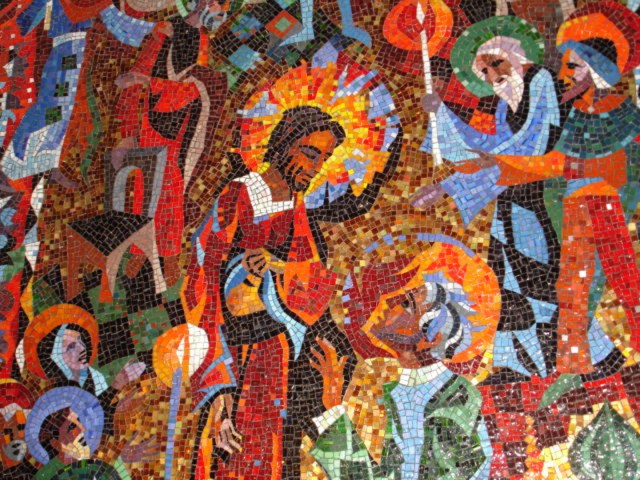
Jesus shows himself to Thomas, by Rowan and Irene LeCompte

On the evening of that first day of the week, when the disciples were together, with the doors locked for fear of the Jewish leaders, Jesus came and stood among them and said, “Peace be with you!” After he said this, he showed them his hands and side. The disciples were overjoyed when they saw the Lord.

Again Jesus said, “Peace be with you! As the Father has sent me, I am sending you.” And with that he breathed on them and said, “Receive the Holy Spirit. If you forgive anyone’s sins, their sins are forgiven; if you do not forgive them, they are not forgiven.”

Now Thomas (also known as Didymus), one of the Twelve, was not with the disciples when Jesus came. So the other disciples told him, “We have seen the Lord!”

But he said to them, “Unless I see the nail marks in his hands and put my finger where the nails were, and put my hand into his side, I will not believe.”

A week later his disciples were in the house again, and Thomas was with them. Though the doors were locked, Jesus came and stood among them and said, “Peace be with you!” Then he said to Thomas, “Put your finger here; see my hands. Reach out your hand and put it into my side. Stop doubting and believe.”

Thomas said to him, “My Lord and my God!”

Then Jesus told him, “Because you have seen me, you have believed; blessed are those who have not seen and yet have believed.”

Jesus performed many other signs in the presence of his disciples, which are not recorded in this book. But these are written that you may believe that Jesus is the Messiah, the Son of God, and that by believing you may have life in his name. (New International Version)

When Jesus shows up, there is peace. Wherever Jesus goes, the Spirit of God is there. When Jesus appears, people believe.

The Meeting

After the crucifixion of Christ, the disciples were huddled together, mostly in fear of being found out and put out by the religious authorities. Out of nowhere, Jesus showed up, smack in the middle of the anxious group of men.

Christ in the center makes all the difference. From this central place, Jesus bestowed to the disciples his peace. The very first word the risen Christ spoke to his disciples was neither a command to stop being afraid, nor a rebuke for sitting around and doing nothing, or disappointment that they all ran away in the final hour of need at the crucifixion; instead, the first word of Christ was a gift of peace.

The presence and peace of Christ melted the disciples’ fear. Christ-centered peace is graciously given; so let us gratefully receive it.

The Reality

Jesus showed up, then showed off his hands and his side. He was not fabricated out of the disciples’ imagination; he was not some ghostly apparition. Rather, Christ was standing in the middle of them, very real, very physical, and very alive.

Christ gave his disciples real truth: actual wounded hands and side on a real body. Christ is risen and alive – not just spiritually, but physically. Since the resurrection of Jesus really happened, then nothing else matters; our joy is complete. We have what we need.

The Mission

As Jesus was sent by the Father, so Jesus sent his disciples; and is still sending us out into the world. And as Jesus came not to condemn the world but to save it, so we go out with words of grace and peace. The church exists for the life of the world – to bless it with the presence and peace of Christ.

“Whoever believes in me does not believe in me only, but in the one who sent me. The one who looks at me is seeing the one who sent me. I have come into the world as a light, so that no one who believes in me should stay in darkness.” (John 12:44-46, NIV)

Our spiritual DNA makes us little Christ’s walking around, doing the will of God, for the benefit of a world in darkness. We bear the name of Christ: Christians, proclaiming a message of life, delighting in God and creation; and not destroying the earth and its inhabitants.

The Gift

Right now, we are not alone. The Holy Spirit has been graciously given to us by Jesus. Although our mission is a big one, our resource for accomplishing it is even bigger. Jesus gives the Spirit in the same way he gives himself – as a sheer gift with no strings attached. Just as God breathed life into the very first people on earth, so Jesus breathes on the disciples and gives them new life and a new heart.

I will give you a new heart and put a new spirit in you; I will remove from you your heart of stone and give you a heart of flesh. And I will put my Spirit in you and move you to follow my decrees and be careful to keep my laws… and you will be my people, and I will be your God. (Ezekiel 36:26-28, NIV)

The Privilege

Christ has redeemed us, forgave us of our guilt and shame. Now, we have the privilege of passing the forgiveness to others. The special mission of the Church is giving Jesus to others with grace and peace, so that they may believe he is truly the risen Lord; and so, receive Jesus, the Spirit, forgiveness, and purpose in life, with Christ at the center of all things.

For the one whom God has sent speaks the words of God, for God gives the Spirit without limit. The Father loves the Son and has placed everything in his hands. Whoever believes in the Son has eternal life, but whoever rejects the Son will not see life, for God’s wrath remains on them.” (John 3:34-36, NIV)

The Risen Lord, by He Qi

The Appearance

When Jesus appears, its good if we also show up to see him. It seems Thomas was late for church and missed the beginning of the service. He wasn’t with the other gathered disciples. Nobody knows where he was or what he was doing. But the important thing is that he did eventually show up, because showing up is the beginning of a changed life.

The Witness

After Jesus showed up, the disciples bore witness to what they saw and heard to Thomas. Yet Thomas, bless his doubting heart, wasn’t having it. He’s a realist. He wants proof, some actual physical evidence. Thomas was clearly a tactile learner because he needs some touch to believe any of this crazy talk of his disciple brothers.

Sometimes Thomas gets a bad rap, but he is really our Everyman. Doubt and skepticism are an important part of a full-orbed and honest faith. Jesus gave Thomas some space, time, and respect to begin wrapping his head and heart around this new reality of resurrection. I wonder if we all can do the same with others.

The Middle

A second time, Jesus shows up in the middle of the disciples. The Word became flesh and dwelt among us – and didn’t become a ghost and hang out in secret places. Once again, peace is given by Jesus to his followers.

Both appearances happen on a Sunday (which is why Christians have always worshiped on Sundays); and both meetings are literally Christ-centered (which every Christian meeting is supposed to be). Every Sunday. Christ always in the middle. Keep those two, and keep them together, and you can’t go wrong.

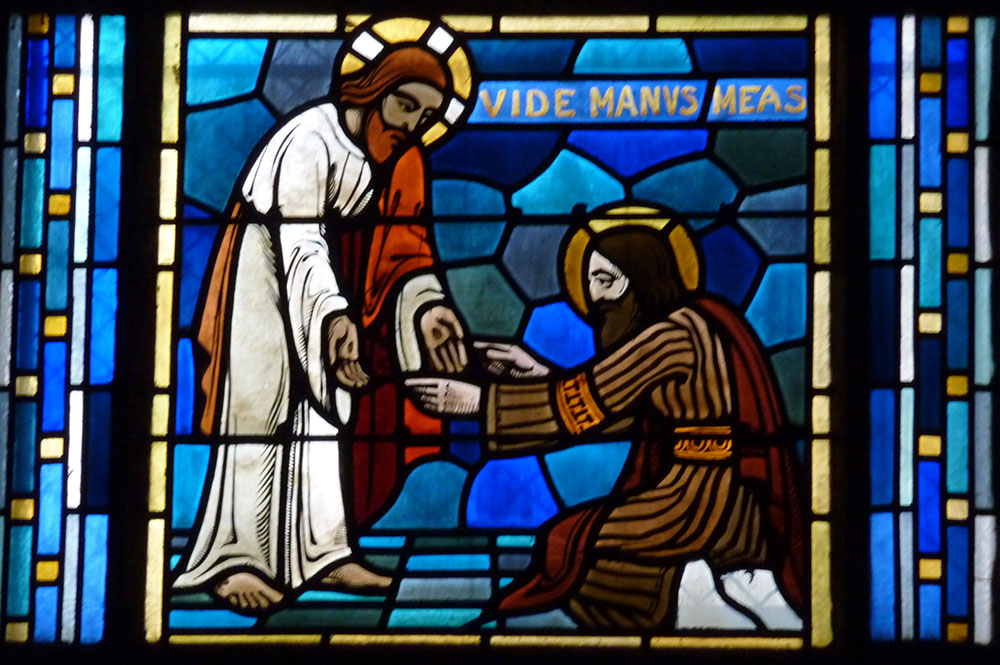
Jesus appears to Thomas with the Latin words, “See my hands,” in Notre-Dame-du-Rosaire Church, Saint-Ouen, France 

The Invitation

There’s no beating around the bush with Jesus. He immediately engaged Thomas and invited him to touch the wounds on his very real body. Christ knew Thomas’ hang-up, and went right to it. Thomas wanted evidence; Jesus offered it. If we get anything out of this encounter, it is that risen Christ honors honest doubt.

The evidence is here. Now believe it, and stop disbelieving. We have documentary evidence of the Old and New Testaments; the Church’s witness in Creeds, Confessions, and contemporary narratives of changed lives; and the internal testimony of the Holy Spirit. Therefore, look into them carefully and draw a sound conclusion.

The Confession

“My Lord and my God!” That’s the confession and the conclusion Thomas drew from the evidence – not only that Jesus is real, alive, existed, a good teacher; or other people’s Lord and God – but that he is my Lord and my God.

Jesus cared enough for Thomas to specifically meet him personally at his point of need. The grace of God keeps coming and never runs out. Jesus is filled up to the full in both grace and truth.

The Believer

Thomas had the physical evidence. But it doesn’t take that to truly believe. God blesses those who’ve never seen nor touched, but still believe. Jesus was thinking of you and me, and not only the people in front of him at the time. The Lord Jesus blesses us with the gift of peace, grace, and faith.

Though you have not seen him, you love him; and even though you do not see him now, you believe in him and are filled with an inexpressible and glorious joy, for you are receiving the end result of your faith, the salvation of your souls. (1 Peter 1:8-9, NIV)

The Conclusion

All this is for our benefit, so that we, too, may believe that Jesus is the Christ, the Son of the living God. Since Jesus is alive, he continues to bless us with his presence, power, and peace.

Jesus is with us:

  • through the Word of God, giving us his peace, showing up and meeting needs people.
  • at the Table in the sacrament of communion, bringing grace and forgiveness
  • in the person of the Holy Spirit, enabling and energizing us for mission and ministry to the world

It’s a life worth living, a Christ-centered life, full of God’s blessing.

O God and Father of our Lord Jesus Christ, in whom we receive the legacy of a living hope, born again not only from his death but also from his resurrection. May we who have received forgiveness of sins, set others free, until we enter the inheritance that is imperishable and unfading, where Christ lives and reigns with you and the Holy Spirit, one God, now and forever. Amen.

Jesus Is the Cornerstone (Psalm 118:1-2, 14-24)

Give thanks to the Lord, for he is good;
    his love endures forever.

Let Israel say:
    “His love endures forever….”

The Lord is my strength and my defense;
    he has become my salvation.

Shouts of joy and victory
    resound in the tents of the righteous:
“The Lord’s right hand has done mighty things!
    The Lord’s right hand is lifted high;
    the Lord’s right hand has done mighty things!”
I will not die but live,
    and will proclaim what the Lord has done.
The Lord has chastened me severely,
    but he has not given me over to death.
Open for me the gates of the righteous;
    I will enter and give thanks to the Lord.
This is the gate of the Lord
    through which the righteous may enter.
I will give you thanks, for you answered me;
    you have become my salvation.

The stone the builders rejected
    has become the cornerstone;
the Lord has done this,
    and it is marvelous in our eyes.
The Lord has done it this very day;
    let us rejoice today and be glad. (New International Version)

Jesus The Cornerstone, by Gloria Ssali, 2016

Indeed, today we rejoice with gladness and celebrate that Christ is risen! Christians have a firm foundation of faith that gives us strength and stability.

Everyone’s life is constructed on some sort of foundational support. If we consider a building, it’s foundation has four cornerstones. For us as people, those stones consist of the body, the mind, the emotions, and the spirit. Each of these stones is holding up the one building of our life, and so therefore, they each need our attention in order to be well maintained.

Physical

Jesus is the

Mental Spiritual

Cornerstone

Emotional

We can neither treat them as if they are different sizes (which then would never hold up the building of our life) nor as of different importance.

For example, if we get a crack in the physical stone of our life, it is insufficient to examine the mental stone and try to repair the crack through positive thinking or mindfulness. Or, if our emotional stone is damaged, it won’t get fixed by focusing on the spirit stone by only praying.

These days, a lot of people have had bad, even traumatic, religious experiences, and so they’ve jettisoned the spirit cornerstone altogether. And as their building begins to collapse, they wonder why this is all happening.

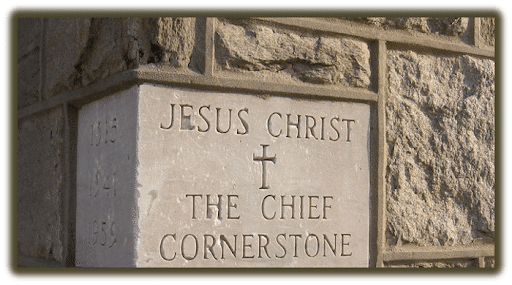
The spirit cornerstone is Jesus. We need him. We need his whole entire life – not just parts of it. Christ is not a tool that we can use and then store in the garage for next time; he’s the whole garage, and the entire hardware store. We can no more set him aside than we can set aside our lungs or our heart.

So, why do so many resist facing the cracked and damaged stones? Why resist, or even reject, Jesus? Why do so many Christians want the victory of this Resurrection Day without the hard suffering of Good Friday?

Because we are still coming to grips with what it takes to live into the victory of the Cross – yes, the Cross. There’s no new life without a death. If we want a miracle, we need to die – die to our expectations, dreams, desires, and anything we believe we need, other than Jesus.

The builders rejected the stone because it was too hard. But the reality is that you cannot build on a foundation of marshmallows. Love isn’t actually soft, but hard; it’s permanent, like solid marble; it’s not going anywhere. We need that firm base of love to construct a soul that’s worth living.

Christ’s earthly life had incredible times of miraculous healings, provisions of food and necessities, and relational connections. But that’s only part of it. There was also hardship, adversity, rejection, mockery, torture, abuse, and death. When the Apostle Paul considered it all, he said:

But whatever were gains to me I now consider loss for the sake of Christ. 

What is more, I consider everything a loss because of the surpassing worth of knowing Christ Jesus my Lord, for whose sake I have lost all things.

I consider them garbage, that I may gain Christ and be found in him, not having a righteousness of my own that comes from the law, but that which is through faith in Christ—the righteousness that comes from God on the basis of faith. 

I want to know Christ—yes, to know the power of his resurrection and participation in his sufferings, becoming like him in his death, and so, somehow, attaining to the resurrection from the dead. (Philippians 3:7-11, NIV)

Both suffering and resurrection go together for a spiritually sound life, free of cracks and damage. A new life is fresh, hopeful, and full of promise – and it’s downright hard; there is nothing easy about it. We don’t get to pick and choose which parts of Jesus we want – we must take him wholesale just as he is, the entire thing.

It’s from the person and work of Jesus Christ as our cornerstone – both his cross and resurrection – that a new building is being built into a spiritual house which is the place of hospitality for the entire world.

As you come to him, the living Stone—rejected by humans but chosen by God and precious to him—you also, like living stones, are being built into a spiritual house to be a holy priesthood, offering spiritual sacrifices acceptable to God through Jesus Christ. For in Scripture it says:

“See, I lay a stone in Zion,
    a chosen and precious cornerstone,
and the one who trusts in him
    will never be put to shame.”

Now to you who believe, this stone is precious. But to those who do not believe,

“The stone the builders rejected
    has become the cornerstone,”

and,

“A stone that causes people to stumble
    and a rock that makes them fall.”

They stumble because they disobey the message—which is also what they were destined for.

But you are a chosen people, a royal priesthood, a holy nation, God’s special possession, that you may declare the praises of him who called you out of darkness into his wonderful light. Once you were not a people, but now you are the people of God; once you had not received mercy, but now you have received mercy. (1 Peter 2:4-10, NIV)

Jesus is our cornerstone, the center of life and worship. Our priority as believers, is allowing God to build us into a community of faith that worships Jesus with lives dedicated to knowing him and making him known.

Christian worship is the expression of a relationship in which God the Father reveals himself and his love in Christ, and by his Holy Spirit gives grace, to which we respond in faith, gratitude, obedience, and love to one another and the world. 

People, at their core, exist for worship. Firmly built on Christ the cornerstone, worship becomes less about gaining truth, and more about letting truth gain us and capture us. The more we pay attention to the presence of Jesus Christ through song, prayer, Scripture, and sacrament, the more we will experience the centrality and power of God. Jesus becomes very precious to us when we align ourselves to him as the cornerstone of our faith and worship.

I urge you, brothers and sisters, in view of God’s mercy, to offer your bodies as a living sacrifice, holy and pleasing to God—this is your true and proper worship (Romans 12:1, NIV)

Jesus, as the cornerstone upon which all is supported, means that acceptable worship can happen anywhere. Everywhere can become a sanctuary and a sacred space – home, neighborhood, and marketplace – as well as church. In all these locations, Christian discipleship will prove itself.

Several years ago, a man named Matt had an aunt who had struggled for years to make ends meet. When her health started to decline, she was forced to sell her fifty acres of property to pay for health care. As an act of kindness, Matt traveled to Massachusetts and bought the land from his aunt for the appraised value of $50,000. While exploring the land to see about building a house, he discovered outcroppings of stone ledges.

Matt contracted a geologist, who surveyed the land and informed him the stone was actually Goshen stone, a type of mica used for sidewalks, patios, and landscapes. At the time, it sold for $100 a ton – and Matt had about 24 million tons on the land. The appraised value on the surface was $50,000, but experts estimated that the land was worth up to $2 billion.

Jesus is the precious cornerstone. He is much too valuable to be left in on a piece of property undiscovered. And he’s also much too needed to merely remain in a church building. He’s the cornerstone who has the resurrection power to be the foundation for all the world. So, let’s let him.

Almighty God, who through your only Son Jesus Christ overcame death and opened to us the gate of everlasting life: Grant that we, who celebrate with joy the day of the Lord’s resurrection, may be raised from the death of sin by your life-giving Spirit; through Jesus Christ our Lord, who lives and reigns with you and the Holy Spirit, one God, now and forever. Amen.