Pass It On

I am the youngest of five children, and because of that reality I had to follow my siblings in school with many of the same teachers they had. I heard these statements more than once: “Why can’t you be more like your sister?” (the studious valedictorian) and “Why aren’t you like your brother?” (the nice quiet one).  I sometimes had this icky feeling in school that I somehow fell short because I wasn’t like them. 

The task of the Christian is to imitate Christ – not impersonate Jesus by being someone we are not. God created each of us uniquely and has sovereignly gathered us together as the church. So, we need to strive to be the best individual person possible in imitating Jesus by means of who we are, learning to work together, appreciating one another as we seek to follow Christ. 

The Apostle Paul wrote the New Testament letter to the Philippian Church because the fellowship had broken down into some rancorous in-fighting. This left the believers disillusioned. So, Paul passed on four imitations of Christ (not impersonations) to help them (and us) experience the unity God desires for his people.  

1. We are to imitate Christ through passing on the right values (Philippians 2:1-2).   

Shared values, not smooth sailing, keeps a group of people together. Paul appealed to lived experience. If anyone has experienced encouragement, comfort, fellowship, tenderness, or compassion, then we need to recognize it, remember it, and then pass it on to others. Those values happened because God granted blessings to us through other people. In other words, we owe to others what God has done through others for us.   

These common valued experiences occur as we participate in the life of our triune God. They come from the perfect relational dynamic that endlessly occurs within God himself as Father, Son, and Spirt. As we spend time with God and are filled with the divine life, these relational values spill-over in our human interactions.   

Passing on encouragement and compassion is not a function of willpower in trying to impersonate Jesus; it is a matter of spending time with God – because people tend to imitate those they hang around. If we spend time with people who typically complain, we will end up constantly cranky. If we hang out with people who continually pray, we will find ourselves reflexively praying about everything. If we are around chronically negative people, we will become constantly unhappy. If we make it a regular practice to hang out with Jesus, we discover that we are imitating him in our relationships through encouragement, love, comfort, and compassion. 

The word “joy” pops up a lot in Paul’s letter to the Philippians, yet it is never an exhortation to be joyful but rather an exhortation to unity. The by-product of unity is joy. Joy and happiness are the direct result of unity, and unity comes from embracing the shared common values Paul expressed. 

2. We are to imitate Christ through passing on the right service (Philippians 2:3-4).   

Humility is the remedy for dissension and disunity. Strife comes from stubbornly guarding our own opinions. Humility, however, considers others better than oneself. We are to do nothing out of selfishness or vain conceit. Instead, we are to imitate Jesus – to take up our crosses and follow him through dying to things which create disunity. Trying to impersonate Jesus results in lording over people and circumstances. It leads to division. However, imitating Jesus results in being like him in his humility and gentleness. It brings unity and peace.   

Nik Wallenda is a Christian and a high wire artist. In 2012 he walked a tightrope across Niagara Falls; and, in 2013 he became the first person to high wire walk across the Grand Canyon. Nearly a combined billion people saw those two incredible feats. After every tight rope walk for the crowds, Nik Wallenda engages in a simple spiritual discipline: he walks where the throngs of people just stood and watched him, and quietly picks up their trash.  

Wallenda says about this practice, “My purpose is simply to help clean up after myself. The huge crowd left a great deal of trash behind, and I feel compelled to pitch in. Besides, after the inordinate amount of attention I sought and received, I need to keep myself grounded. Three hours of cleaning up debris is good for my soul. Humility does not come naturally to me. So, if I must force myself into situations that are humbling, so be it …. I know that I need to get down on my hands and knees like everyone else. I do it because it is a way to keep from tripping. As a follower of Jesus, I see him washing the feet of others. I do it because if I don’t serve others, I’ll be serving nothing but my ego.” 

3. We are to imitate Christ by passing on the right attitude (Philippians 2:5-11).   

The Apostle Paul bluntly stated that our attitude is to be the same as Jesus: laying down life for the benefit of others. Impersonating Jesus leads to a martyr complex that wants others see our good works. However, imitating Christ’s attitude is to serve without being concerned who sees it or who gets the credit. It is an attitude of passing on what we have received from God. 

In the way of Jesus, the way up is down; the way to gain is by giving; the way to life is through death; the way to praise God is humble service for others. When my grandson was in one of his many hospital stays in the epilepsy ward, I watched him (3 years old at the time and without any prompting) make his way from room to room encouraging other patients and serving them. In the room where a ten year old girl had just had brain surgery with no hair and unattractive bandages, I overheard him say, “Oh, I like your new hat; it looks great on you!”  Making his way to the next room of a twelve-year-old boy who was near death, he said, “Would you like a drink?  I can get a drink for you!”   

I saw parents in the epilepsy ward who were as different from one another as you could imagine. Yet, we all shared a common purpose which gave us a common attitude. We all wanted these kids to be seizure free, and we were doing whatever it took to help each other realize that dream. 

Jesus humbled himself and became a man, being obedient to death on a cross, because his purpose was for humanity to be sin-free. Christ did whatever it took to make that happen.  If a small little boy can be used of God, then how much can you and I adopt the attitude of Jesus and do whatever it takes to see that people realize freedom in Jesus Christ!? 

4. We are to imitate Christ through passing on the right commitments (Philippians 2:12-13).   

The Christian life is meant to be lived together with other believers. We can try to impersonate Jesus, which will result in trying to impress the wrong crowd. However, when we imitate Christ, we commit ourselves to the people God has placed in our lives. Just as it was not our choice which family we were born into, so it is not our choice which spiritual family we are born again into. The church is not a voluntary society, any more than a family is. The church belongs to Jesus and we are neither to just fluidly move in and out of it as if it were a hobby that we toy with once-in-a-while, nor treat it as a spectator sport just watching what happens and playing arm-chair quarterback on Monday morning. 

Paul exhorted the believers to work out their salvation with fear and trembling. That means we are to live-out our collective salvation together in being mindful of each other. In other words, unity takes a lot of work – work which requires imitating Christ through a shared commitment to one another. 

The promise we have is that when we do this kind of good work that it is God who acts to bend everything to his good purposes. This is a wonderful promise, one we need to take to heart with a good dose of godly reverence and awe. 

Conclusion 

My oldest sister was the valedictorian of her class. I did not follow in her steps. My brother was the kind of kid that teachers envied to have in their classes. I think my teachers wondered if we were from the same family. My other sister was friends with all her teachers, and they all enjoyed her. I just remember getting a lot of sighs and eye-rolling from my teachers. I often struggled with my identity as a kid.   

I found my identity in Christ. I discovered I did not have to be like anyone else. God used me for who I am right where I was, learning to imitate Jesus. We need not be worried or discouraged about how far short we fall in comparison to others. Instead, we are to be concerned about how God wants to fulfill all his good promises in Christ through us – because at the name of Jesus every knee will bow and every tongue will confess that Jesus is Lord to the glory of God.  We are to pass on to others every good thing we have in Jesus Christ. 

Mark 11:27-33 – Dueling Authorities

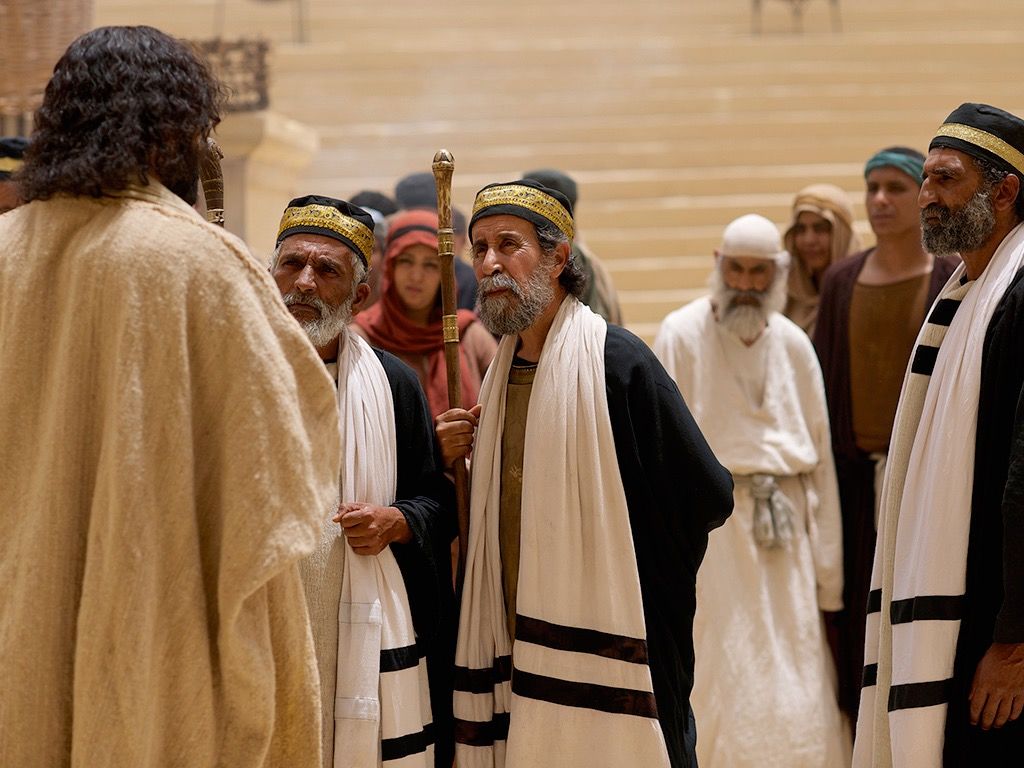
They arrived again in Jerusalem, and while Jesus was walking in the temple courts, the chief priests, the teachers of the law and the elders came to him. “By what authority are you doing these things?” they asked. “And who gave you authority to do this?”

Jesus replied, “I will ask you one question. Answer me, and I will tell you by what authority I am doing these things. John’s baptism—was it from heaven, or of human origin? Tell me!”

They discussed it among themselves and said, “If we say, ‘From heaven,’ he will ask, ‘Then why didn’t you believe him?’ But if we say, ‘Of human origin’ …” (They feared the people, for everyone held that John really was a prophet.)

So, they answered Jesus, “We don’t know.”

Jesus said, “Neither will I tell you by what authority I am doing these things.” (NIV)

Because Christ is Lord, we might overlook that Jesus, in his earthly ministry, was an outsider. Although a teacher, a rabbi, Jesus was neither a priest nor a member of any Jewish religious sect. He walked around as if he owned the place (which he did) and this gave no end of consternation from the established status quo religious leadership.

Jesus made significant inroads into people’s lives, especially with outsiders like himself, and this created anger and jealousy with many of the religious ruling class. Since Jesus was not a card-carrying member, the leaders wanted to hear from him why he kept acting confidently and deliberately on their religious turf, as if he had authority to do so.

The established authorities are depicted in today’s Gospel lesson as a craven bunch who did not want to alienate the crowds yet were eager to get the upstart Jesus out the way. This appears to be an age-old situation of leaders putting their fingers to the wind to go with whatever will keep them popular and in power. Since Jesus consistently refused to play such games, the authorities believed he needed to go. They, however, had no intention of risking an outright confrontation and showing their shadow motives.

Jesus clearly connected himself with John the Baptist, both coming from the same authority. John was yet another figure for whom the established leaders could not control. We ought never to underestimate that threats to status quo leadership who have no inkling of being public servants when true moral authority comes along. The lack of conformity from both John and Jesus would cost them their very lives.

Speaking truth to power while not becoming defensive is a tricky art. Yet, Jesus did it. Continual challenges to his authority left him unfazed as to his mission and purpose on this earth. Christ was assertive without becoming despotic; forward without taking the bait of useless arguments; confident with no hint of arrogance.

For me, the contrast between Jesus and the religious authorities is trenchant. The confident, wise, and calm authority of Christ is in direct opposition to the fear, anxiety, and worry of the ruling leaders. Whereas they kept anxiously ruminating about what to do about this threat to their established authority, Jesus exhibited a non-anxious presence which maintained a steadfast focus on God’s righteous, holy, and benevolent rule and reign.

Sometimes, continual fear is a clue that one is so worried about losing the person, place, or position they possess that the divine gets pushed aside.

Questioning Christ’s credentials was the giveaway that the existing religious authorities were concerned about their power and privilege, and not the people. The wise person will see such queries for what they are.

Wherever we observe those who refuse to share power, have a xenophobic bent toward outsiders, and will seem to do just about anything to maintain the status quo, there we will find the abuse of authority. Conversely, where we observe a deep concern for equity, justice, and the common good of all persons, there we see compassionate leadership who will champion ethical leadership and espouse moral authority.

In any democratic society, we must choose our leaders wisely.

Great God of hope, in these times of change and uncertainty, unite your people and guide our leaders with your wisdom. Give us courage to overcome our fears and help us to build a future in which all may prosper and share together through Jesus Christ our Lord in the strength of your Holy Spirit. Amen.

Matthew 18:1-5 – On Humility

At that time, the disciples came to Jesus and asked, “Who, then, is the greatest in the kingdom of heaven?”He called a little child to him and placed the child among them. And he said: “Truly I tell you, unless you change and become like little children, you will never enter the kingdom of heaven. Therefore, whoever takes the lowly position of this child is the greatest in the kingdom of heaven. And whoever welcomes one such child in my name welcomes me. (NIV)

God’s benevolent, gracious, and ethical realm is accessed and rests upon humility. Wherever there are humble hearts, there is change, transformation, and new life. Where there is the presence of pride, there you will find posturing, positioning, and peacocking – nothing changes.

Humility enables a person to see beyond the end of their nose. A humble posture allows an individual to observe the wounds and pains of those with little power and low societal status. A preoccupation with being great and believing we are indispensable is to amble down a blind path.

In the ancient world, children were on the lowest rung of society’s ladder. They were mostly looked upon as potential adults – little people who would someday contribute to the welfare of the family business and the community. Until then, kids were expected to begin learning their future trade with full submission and obedience. They had no power or leverage over others.

So, when Jesus told his disciples to take the lowly position of a child, he was not talking about innocence or cuteness. Christ meant for his followers to divest themselves of prideful positioning for greatness and embrace the helplessness and vulnerability of children. For Jesus, a child was closer to God’s rule and reign because they existed in truly humble circumstances, whereas an adult had too much concern with looking good and seeking every advantage possible.

Life is more upside-down than we sometimes realize. Adults have more to learn from kids than kids do from adults. To listen to a child is about as near to hearing the voice of God as you will get.

Let us consider how pride and humility work out in our daily lives. For example, when down and hurting, maybe you have had the experience of another person trying to one-up your pain, as if what they experienced was worse than you. In their pride, they ignore that pain is personal, as if it’s a one-size-fits-all. 

Invalidating a person’s state of being or feelings does no one any good.  It happens because of pride and a lack of humility. Imagine going to see a doctor who turns out to be arrogant in his approach. He fails to really listen to you. He just gives a quick exam and offers his diagnosis with a regimen of more pills to take. You are left sitting there while he is off to another patient, colonizing another person’s mind and emotions with his expertise.

I am not giving doctors a hard knock. I work in a hospital and have great respect for medical professionals who provide wise care plans. Yet, it is likely that you, like me, have had that occasional experience of the doctor full of him/herself with all the right answers on your pain and situation.

You may have also had the unfortunate experience of having a pastor, therapist, or counselor assess your situation with little information and even smaller compassion.  Like writing a script for pills, they give you a few Bible verses and tell you to quit sinning and live obediently.

If pride and arrogance are the original sin, then the remedy to that malady is humility. No matter who we are – whether doctors, pastors, laypersons, patients, or whomever – we are meant and designed by our Creator God to live a humble life.  That means we are to both give and receive humility-based care.

Humility is the cornerstone to every good thing in this life.  Jesus said:

“Blessed are the poor in spirit, for theirs is the kingdom of heaven.” (Matthew 5:3, NIV)

The door of God’s kingdom swings-open on the hinges of humility.

The Apostle Paul, seeking to follow his Master Jesus in his teaching and humility said:

“Since God chose you to be the holy people he loves, you must clothe yourselves with tenderhearted mercy, kindness, humility, gentleness, and patience.” (Colossians 3:12, NLT)

Basic human interaction with one another is grounded in humility. The old prophet made his expectations clear:

“He has told you, O mortal, what is good; and what does the Lord require of you but to do justice, and to love kindness, and to walk humbly with your God?” (Micah 6:8, NRSV)

Life is truly life when it is humility-based.

Therefore, caring for another person is not a simple linear matter of offering your opinion or expertise; it is believing that the one needing care is the expert on herself.  The caregiver has as much to learn from the care-seeker. The beauty of humility-based care is that two people discover together how to grow, thrive, and flourish in a situation where it is not currently happening.

Breakthroughs occur in the soil of humility when the care-seeker comes out of the darkness and into the light through mutual discovery and insight.

We live with the confidence of the Psalmist:

“God leads humble people to do what is right and teaches them the way.” (Psalm 25:9, GW)

In the end, God saves and heals, not you or me.  That God chooses to use us to bring care to others ought to elicit the utmost of humility within us.

Lord God let me have too deep a sense of humor to be proud. Let me know my absurdity before I act absurdly. Let me realize that when I am humble, I am most human, most truthful, and most worthy of your serious consideration. Amen.

Matthew 20:1-16 – The Parable of the Vineyard Workers

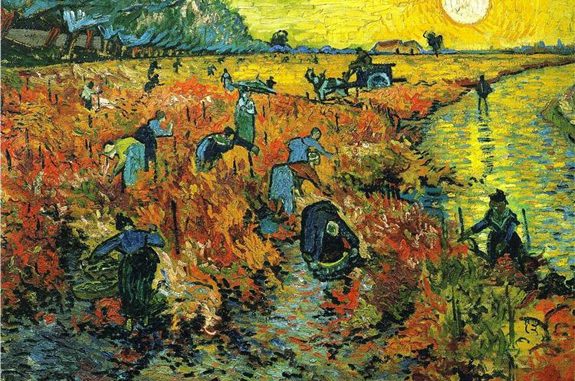
The Red Vineyard by Vincent Van Gogh, 1888

“For the kingdom of heaven is like a landowner who went out early in the morning to hire workers for his vineyard. He agreed to pay them a denarius for the day and sent them into his vineyard.

“About nine in the morning he went out and saw others standing in the marketplace doing nothing. He told them, ‘You also go and work in my vineyard, and I will pay you whatever is right.’ So, they went.

“He went out again about noon and about three in the afternoon and did the same thing. About five in the afternoon he went out and found still others standing around. He asked them, ‘Why have you been standing here all day long doing nothing?’

“‘Because no one has hired us,’ they answered.

“He said to them, ‘You also go and work in my vineyard.’

“When evening came, the owner of the vineyard said to his foreman, ‘Call the workers and pay them their wages, beginning with the last ones hired and going on to the first.’

“The workers who were hired about five in the afternoon came and each received a denarius. So, when those came who were hired first, they expected to receive more. But each one of them also received a denarius. When they received it, they began to grumble against the landowner. ‘These who were hired last worked only one hour,’ they said, ‘and you have made them equal to us who have borne the burden of the work and the heat of the day.’

“But he answered one of them, ‘I am not being unfair to you, friend. Didn’t you agree to work for a denarius? Take your pay and go. I want to give the one who was hired last the same as I gave you. Don’t I have the right to do what I want with my own money? Or are you envious because I am generous?’

“So, the last will be first, and the first will be last.” (NIV)

We as humans have an innate sense of right and wrong, justice and injustice. We want life to be fair. It disturbs us when there is favoritism, discrimination, and preferential treatment. When things seem askew and others seem more privileged, envy can creep in and settle in our bones.

The envy can go even deeper. For example, is it fair that any child should struggle with health issues like cancer, epilepsy, and mental disorders?  Is it fair to have healthcare disparities? Is it fair to have a spouse taken from you before their time?  Is it fair to lose your job because of a pandemic? Is it ever fair to be treated like a second-class citizen?

Pat answers to people’s genuine struggles will not do, such as “Well, you just need to work hard and hope for the best;” “We have to take what is given us and accept these things;” “Think of all those starving children in India;” or the more crass, “Suck it up buttercup; life was never meant to be a rose garden.”  Those statements simply do not help.

At the heart of envy is the belief that others are getting something that I deserve.

Plenty of jerks have healthy grandkids, grow old with their spouses, and retire in comfort with plenty of money. “It isn’t fair!” we cry.

God does not always operate according to our standards of fairness. God’s very nature is to be generous and full of grace. The parable which Jesus told about the vineyard workers is a story not of unfairness, but a story of generosity and grace. It is all in how you look at it.

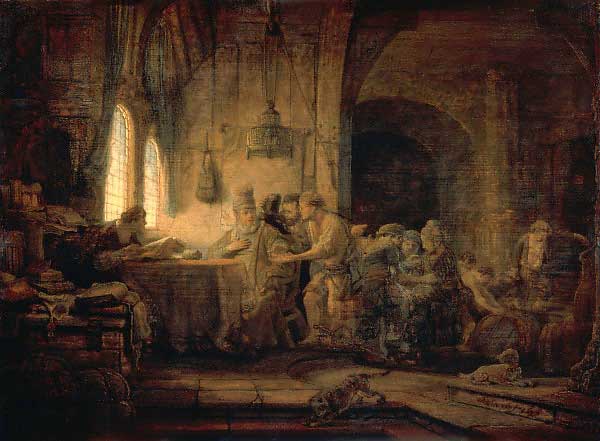
Parable of the Workers in the Vineyard by Rembrandt, 1637

A normal workday in the ancient world was ten hours, not counting breaks. The workday began at 6:00am. A denarius was a typical day’s wage for laborers. The landowner went out at the third hour, 9:00am; the sixth hour, noon, etc. He kept returning to hire more workers even up to the last hour of the workday. Laborers were always paid at the end of the day. In this parable, the last workers were paid first, which prompted the first workers hired to think they would be getting more, even though they had been promised a denarius. So, they grumbled about not getting more. They thought the landowner was not being fair.

Grumbling. Complaining. Murmuring. It is the bane of our existence. Decades ago, when gas station attendants still filled tanks for customers, I was working at a station and had a lady go berserk on me for not checking her oil and cleaning her windshield, because I did it for the car in front of her. Even though there was a sign right in front of her that said checking oil and cleaning windshields is only done upon request, the lady thought she was getting gypped. 

In truth, the landowner did not cheat or defraud the workers in any way. He paid the agreed upon wage, just like he promised. Should he want to pay everyone the same even though the amount of work was different was his own business. The problem was not with the owner, it was with the worker’s envy of the owner’s generosity toward the others. God distributes gifts because he is gracious, not because we have earned anything.

Our standard of fairness is not the rule of the kingdom of God – grace is.

The founder of Methodism, John Wesley, was physically thrown out of a church one Sunday because of a sermon he was preaching on the grace of God. Afterwards, when Wesley wrote about this to a friend, he said, “There is no Christian Doctrine more repugnant than the affirmation that we are saved by the grace of God through faith.”

Deep down many believe we control our destiny, and that we save ourselves by what we do. We discern that if we serve God all our lives, in the end, God will reward us. We believe that our pious activities, our acts of service and our work for the Lord, will bring us salvation, or, at least a leg up in the kingdom of God over others who have not worked as hard or as long as we have. After all, we do the right thing.

So, what about those who have not figured out Christianity… those who do not have the correct or proper beliefs… or those who have not straightened out their lives? According to a worldview of human fairness, they are out of luck. They should be in church. They should work harder, faster, and better. Then, they could get their lives in order. If they would only understand fairness, we reason, then all would be well.

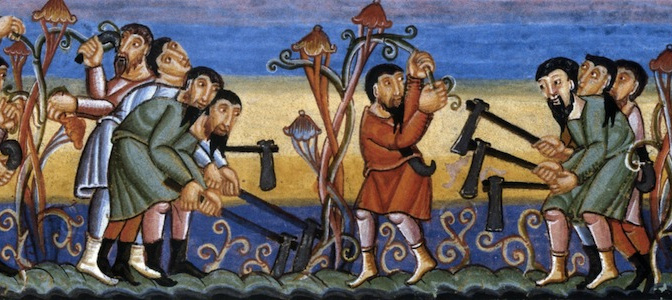
Parable of the Vineyard Workers from unknown artist in the Middle Ages

But there is a problem, because the parable of the workers told by Jesus seems to be saying that is not how it works, at all.  Jesus seems to be saying that grace and grace alone saves, that God’s amazingly naive and irresponsible grace is available to anyone and everybody. And that troubles the workers to no end. 

Whenever we run headlong into God’s unfair grace and see that God’s way of doing things is so far removed from our way, there is bound to be grumbling.  After all, if God is going to run a vineyard like the one in the gospel lesson and give everybody the same pay regardless of their actual work hours, then what’s the use of getting up early in the morning to work? 

What is the good of sitting in church, listening to sermons from a crazy preacher who is no better than us, if these outsiders, these Johnny-and Jane-come-lately’s can waltz in at the last minute and receive the same treatment as the rest of us?  For many church folks who diligently serve, it is not fair to pay so much attention to outsiders and build ministry around people who aren’t even here, who don’t yet know Jesus.

The conclusion and point of the parable: The last will be first, and the first will be last. In Luke’s prodigal story, the elder brother grumbles and gripes: “All these years I’ve been slaving for you and never disobeyed your orders.  But when this son of yours who has squandered your property with prostitutes comes home, you kill the fatted calf!”  It is the firstborn son that complains. (Luke 15:11-32)

In both the parable of the prodigal son and the parable in today’s lesson, “good” people are the ones who fail to see the heart of the Father and of the landowner. The “firsts” got off track because, over time, they forgot the kingdom hinges on grace, not effort, on not simply doing the right things over a long period of time.

God controls the flow of mercy, not us. 

We will likely be surprised in heaven with those already sitting at God’s banquet table, and equally surprised with who is not there. Resentment can move us away from the table of mercy God is preparing. The problem comes whenever we think we are above other people.  We might be sinners, but we are not as bad as some other people are!  We commit ordinary sins, not mass murder!

Here is the unvarnished truth: God does not owe you or I a thing, and God cares about all kinds of people, not just us and people who think and live like we do. Our hearts need to be big enough to center ministry around other people who are different than us.

If our hearts are small, we easily get jealous when God pays attention to prodigals and profligates. Grace becomes too repugnant a doctrine for us.

The gospel of Jesus Christ is about grace. Life is not all about being decent. It is not all about morality, and it is certainly not about our own goodness. The gospel is about being steeped in and surrounded by the grace of God in Christ, so that we, in turn, can show others grace. Grace is the way God deals with us beyond what we deserve or feel we have earned. 

Grace is unfair; we get what we do not deserve. 

May we allow God’s grace to so permeate our hearts and lives so that we will give it to others as freely as we have received.Praise be to you, almighty and everlasting Father of our Lord Jesus Christ. In Christ, you have given us every spiritual blessing in heaven. In Christ, you chose us before the world was made. You chose us in love to be your holy people—people who could stand before you without any fault. And before the world was made, you decided to make us your own children through Jesus Christ. It pleased you to do it. And this brings praise from us because of your wonderful grace, given to us freely, in Christ, the one you love. We have forgiveness of sins because of this lavishly rich grace. Thank you, O my Father, for your grace extending to me in Christ! Amen