Luke 4:42-44 – Holding onto Jesus

Journey with Jesus by He Qi

At daybreak, Jesus went out to a solitary place. The people were looking for him and when they came to where he was, they tried to keep him from leaving them. But he said, “I must proclaim the good news of the kingdom of God to the other towns also, because that is why I was sent.” And he kept on preaching in the synagogues of Judea. (New International Version)

A domesticated Jesus is nothing more than a fictional character, part of the panoply of old classic literature, and just another person in the Christian writings of the New Testament.

Many so called Christians want to control Jesus, to have him serve their purposes. Like some magical entertainer, they want to hold onto him, keep him around, trotting him out occasionally to impress friends and family.

Such persons have not yet come to terms with the spiritual reality that Jesus belongs to others, to everyone, not just me or people I like.

Whenever we grab hold of Jesus to keep him from going to others, we play the role of Mary Magdalene, who did not recognize her Lord when he was standing in front of her face. Then, when realizing who he was, did not want Jesus going anywhere. Yet, the Lord responded:

“Do not hold on to me, because I have not yet ascended to the Father. But go to my brothers and say to them, ‘I am ascending to my Father and your Father, to my God and your God.’” (John 20:17, NRSV)

Mosaic of Jesus and Mary Magdalene, Washington National Cathedral

Jesus did more than proclaim good news; he was the good news itself, embodied, for the life of the world – and not only for the life of a particular race or ethnicity or gender, or even religion. As the Lord of Life, there is enough Jesus for everyone.

Maybe the true mark of a Christian is not having bumper sticker messages or a bobblehead Christ or an impressive Bible on the living room coffee table or erudite theological ideas. Maybe its in telling others about Jesus from our own mouth, from a heart that overflows with the gospel of grace.

We must let God be God. Yes, there is a very important place for us to ask, seek, and knock on the door of heaven. And there is also an equal necessity for solitude, silence, and patience, in waiting for the Lord to say, “Come here to me.”

The wisdom to know when to practice solitude, and when to actively seek, arises by purposely engaging in both. We must have an action/reflection model in which we seek to do the will of God, then step back and reflect upon the experience and learn from it. And, at the same time, we are to practice a contemplation/response model that communes in solitude with God, then responds with active involvement of just and merciful acts toward others.

Our Gospel lesson today highlights the need for solitude as a Christian spiritual practice because our Lord practiced it. The solitude, however, is not to be unending. At some point, we must descend from the mountain peak and enter the valley, just as we ascended it from the activity below.

Good news needs proclamation. And for that to happen, it must be proclaimed from both the top of the mountain, as well as the lowest valley. The gospel cannot be chained so that it is tethered for only my group of cronies. No, Jesus is for all, and so, good news is meant to spread to every corner of the earth.

Perhaps we need to sit still long enough, without allowing our inner anxiety to rule the day, to let Jesus call to us and invite us to come. Then, maybe we will be able to hear the gracious words of the Lord:

“Come to me, all you who are struggling hard and carrying heavy loads, and I will give you rest. Put on my yoke and learn from me. I’m gentle and humble. And you will find rest for yourselves. My yoke is easy to bear, and my burden is light.” (Matthew 11:28-30, CEB)

Come Unto Me by Wayne Pascall

There’s no need to break down doors, trying to squeeze ourselves into the kingdom of God. We need only respond to the gracious invitation of Jesus and let him invite others. Truly receiving amazing grace changes us, and we then do not seek to keep Jesus from leaving.

“How amazing, amazing that the one who has help to bring is the one who says: Come here! What love! It is already loving, when one is able to help, to help the one who asks for help, but to offer the help oneself! And to offer it to all! Yes, and to the very ones who are unable to help in return! To offer it, no, to shout it out, as if the helper himself were the one who needed help, as if he who can and wants to help everyone were nevertheless in one respect himself a needy one, that he feels need, and thus needs to help, needs those who suffer in order to help them!”

Søren Kierkegaard, Practice in Christianity

Coming and going, silencing and proclaiming, holding and letting go. We allow Jesus to do it all. And we simply follow in his footsteps.

Lord Jesus Christ, Son of God, Son of Humanity, your presence here on earth never becomes a thing of the past – thus never becoming distant. Our faith and experience of you is very present and very much real in the here and now.

Might all people see you in your true form and in the way you walked this earth – not in an empty or meaningless way of mere thoughts or distortions. May all people see you as you are, a lowly man, yet the Savior and Redeemer of humanity – who out of love came to earth to seek the lost, to suffer and die, to call the straying soul, and to absorb the opposition of others without raising a hand in defense.

Would that we might see you in this way, and not be offended at you and your gracious gathering of all kinds of people into your glorious kingdom. Amen.

Why Is Our Ministry Important?

Welcome, friends! Luke 4:14-30 is the account of Jesus reading the words of Isaiah the prophet to proclaim good news to the poor, freedom for prisoners, recovery of sight for the blind, and release for prisoners. How Christ used those words caused a huge commotion, and still does. Let’s find out together what happened. Click the videos below and let us consider Jesus….

Pastor Tim Ehrhardt, Luke 4:14-30

Gracious God, you bring glad tidings to the poor, heal the brokenhearted and free prisoners from jails. Please come to us and send us out, as forgiven people, to the poor, the brokenhearted, and the imprisoned. Amen.

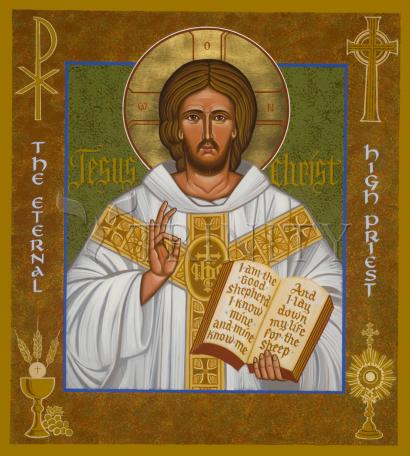
Hebrews 4:12-16 – Jesus Is Our Great High Priest

Jesus, the Eternal High Priest, by Joan Cole

For the word of God is alive and active. Sharper than any double-edged sword, it penetrates even to dividing soul and spirit, joints and marrow; it judges the thoughts and attitudes of the heart. Nothing in all creation is hidden from God’s sight. Everything is uncovered and laid bare before the eyes of him to whom we must give account.

Therefore, since we have a great high priest who has ascended into heaven, Jesus the Son of God, let us hold firmly to the faith we profess. For we do not have a high priest who is unable to empathize with our weaknesses, but we have one who has been tempted in every way, just as we are—yet he did not sin. Let us then approach God’s throne of grace with confidence, so that we may receive mercy and find grace to help us in our time of need. (New International Version)

Church Persecution and Christian Suffering

The book of Hebrews was originally a sermon preached to a group of believers who had come to Christ out of Judaism. From the book of Acts, we know there were thousands of Jewish Christians who were dispersed from Jerusalem when Stephen was martyred.  A great persecution broke out, and many believers fled west to places like Galatia, Ephesus, Greece and Rome. 

The Jewish believers were immigrants in a foreign land, looking to practice their faith without harm. Yet, their experience was anything but ideal. These followers of Christ found fellow ethnic Jews in the places where they went, yet those Jews had no use for these people that they believed were in some sort of aberrant cult.

What is more, the surrounding Gentile culture did not understand Christianity, at all, and many of those who held to pagan religions bought into rumors, such as, that Christians were cannibals who ate at what’s called the Lord’s Table.

So, here we have a situation where these displaced Christians had no respect from both Jews and Gentiles. As a result, they had a difficult time carrying out business because no one trusted them. They were essentially alone in the world. 

Losing Their Grip

Initially, they embraced their identity as Christians and held up quite well under the stress. However, over time, their resolve began to slowly erode. The followers of Jesus began to question their adverse situation. 

They began listening to their fellow Jews throw doubts on their faith. The hard life was not improving, maybe even becoming worse.  Eventually, the church came to a point where they began re-considering their whole way of life as Christians, and their faith commitment started slipping. The Christians actually considered leaving the Church and Christianity and going back to their old life in Judaism.

The Message of Hebrews

It was at this point that a vigorous believer in Jesus came to town, saw the situation of the church, and preached a spirited message to them. The preacher called them to hold tight to their commitment – to see Jesus afresh and anew as superior over all the Old Testament, as the fulfillment of all the promises of God. 

So, then, throughout the book of Hebrews we have this wonderful explanation and exposition of how to make sense of Jesus and the Old Testament, and of what Jesus really means to the church. Throughout his sermon, the preacher occasionally paused his teaching and gave the people a stiff warning about falling away from Christ. He called the church to be bold and confident in Christ, to stand up to the suffering, and to confront their temptations so that they would persevere in their commitment to Jesus Christ for the rest of their lives.

God’s Word and Work

We pick up the teaching and the exhortation in chapter four. Hebrews 4:12-16 is composed of two distinct sections that are paired together for a reason.  Verses 12-13 give us a graphic visual of the penetrating work of God’s Word, of the reality that God can get deep inside us. The next section, verses 14-16, lays out God’s response to our being under divine scrutiny – that there is grace and mercy available because of Jesus, our great high priest who is superior to every priest of the Old Testament to the point of being the last and permanent priest forever! 

These verses are bound together because we all need to struggle with the tension between God’s Word to us, and our words to God; between God’s judgment that opens our souls on a spiritual operating table, and God’s grace which jumpstarts our broken hearts. Our most fundamental need is for God’s mercy in Jesus Christ.

The Christian Life

It is important that our outer lives and our inner lives match each other. Whenever the two are out of sync, we come under the judgment of God’s Word. These early Hebrew Christians had slowly drifted from the truth so that their inner and outer lives did not line up well.

Some of them still performed the outward duties of being a Christian yet were inwardly despising their hard situation. A growing vacuum developed on their insides as they slowly started letting go of Jesus as their object of devotion. Their hearts began to harden because of their hard lives. 

On the other hand, there were other Hebrew Christians who began drifting in a different way. Inwardly, they tried to maintain their devotion and commitment to Christ. Yet these believers began compromising their outward life to match the culture around them. In both cases of hardening inwardly, and of compromising outwardly, they each shared the situation of drifting away from their original commitment to Christ.

Even today, it is a real temptation to try and avoid suffering, to grow weary of our present circumstances and look for a way to get out from under the pain and find a quick fix.  Whenever we find ourselves in such a situation, the remedy is to be reminded that we must continue to hold firmly to the faith we profess because of who Jesus is.

15th Century Orthodox icon of Christ the Great High Priest

Jesus As Permanent High Priest

Jesus is our great high priest. In the Old Testament, among the twelve tribes of the ancient Israelites, the tribe of Levi made up the class of priests. One of those Levites, always a descendent of the original Levite priest, Aaron, had the task of once a year entering a place called the Holy of Holies, which was at the center of the Temple, to offer a bloody sacrifice on behalf of the people, to atone for their sins from the previous year.

Jesus is our great and ultimate high priest. He did not enter the temporary sacrificial system to deal with sins for only a year. Jesus not only took on the role of high priest, but became the sacrifice, as well. As a result, we now have a thorough and permanent forgiveness of sins through Christ. So, the Hebrew Christian who considered going back to an old outdated system needed to be brought back to his senses and embrace again the once-for-all sacrifice of Jesus. 

As they considered Jesus, the believers needed to remember that Christ was not so far removed from them that the church could not relate to Jesus. Rather, Jesus is able to sympathize with each and every trouble, trial, and temptation we face because he faced the very same kind of sufferings. 

The only difference between Christ and his followers is that Jesus did not succumb to the trouble, but persevered and secured for us deliverance from sin, death, and hell. Jesus is the One who deserves every bit of our commitment, allegiance, and devotion. Christ is the One whom we are to worship inside and out.

Approaching God with Boldness

Let us then approach Jesus with confidence, with boldness, knowing that with him there is mercy and grace. Jesus not only suffered for us in the past; he also suffers with us now, in the present. We, as believers, are in union with Jesus. Christ is our great high priest, the One intimately involved in every nook and cranny of our lives. He knows what you and I are going through and is ready to give grace to help right now. 

Approaching Jesus has nothing to do with being good enough to do so. Coming to Jesus is about grace. Whenever we drift from Jesus and are confronted with God’s Word cutting us to the heart, the end result is not wrath or judgment; the result is mercy and grace.

Like the early Hebrew Christians, we all face situations out of our control that wear us down and cause us to become weary. In our tired state, we can be tempted to let our commitment to Christ slide in some small way. Over time, the small compromises of faith can snowball into a big slide away from God. 

Yet, Jesus is not sitting in heaven frustrated or confounded. God is not looking for a reason to punish people. It is just the opposite. Jesus, the Son of God, our great high priest, is looking for a reason to give grace and help us in our time of need. Christ is waiting for us to approach the throne of grace with confidence. Right now, Jesus is alive. He is scanning the world and the church, looking to extend mercy to those who need it. 

Asking for Help

We must avoid a spiritual hardening of heart which estranges us from approaching Jesus. Every one of us needs help. We are not God. We have weaknesses. We have confusion. We have limitations of all kinds. We need help.  And every one of us has something else: guilt and shame. At the bottom of our hearts, we feel undeserving, and so, avoid coming to Jesus. Yet, we need with family, loneliness, work, health, finances.

So, what to do? I can try to deny it all and be a superman who doesn’t need any help. I can try to drown it all with alcohol. I can be obsessive and compulsive about controlling events and/or people. I can simply succumb to discouragement. Here is what God declares: Jesus Christ became a High Priest to shatter despair with hope, to rescue that drowning person and that anxious individual.

God planned for a High Priest, a Savior, a Redeemer, and a gracious Helper. You and I are not trapped. We have Jesus. 

The book of Hebrews is all about a call to commitment – an invitation to come to Jesus.  And it is the most important invitation you will ever receive. Let us approach the throne of grace with confidence….

This is the confidence we have in approaching God: That if we ask anything according to his will, he hears us.  And if we know that he hears us – whatever we ask – we know that we have what we asked of him. Spirit of God, lead us into your will. Help us in all things. Fill our hearts and lives to overflowing with divine mercy and grace so that what comes out of our mouths and the actions we do are compassionate, kind, and good, through our great High Priest, Jesus Christ. Amen.

Luke 22:24-30 – Just Shadow Jesus

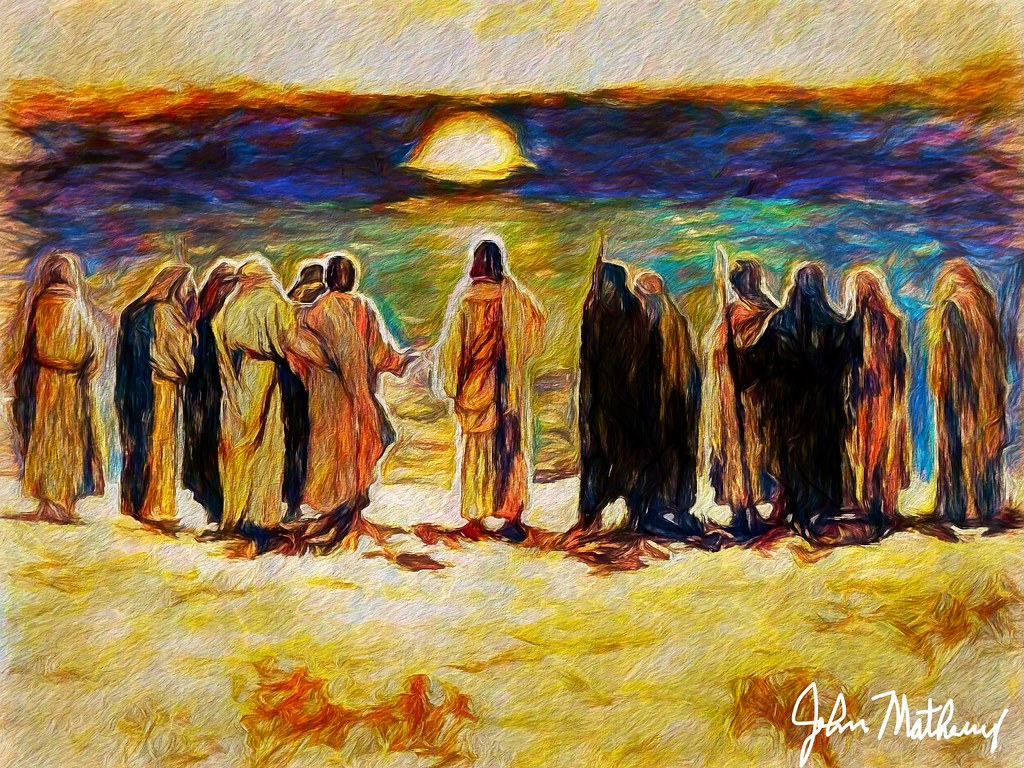
Digital painting of Jesus and the disciples by John Mathews

A dispute also arose among them as to which of them was considered to be greatest. Jesus said to them, “The kings of the Gentiles lord it over them; and those who exercise authority over them call themselves Benefactors. But you are not to be like that. Instead, the greatest among you should be like the youngest, and the one who rules like the one who serves. For who is greater, the one who is at the table or the one who serves? Is it not the one who is at the table? But I am among you as one who serves. You are those who have stood by me in my trials. And I confer on you a kingdom, just as my Father conferred one on me, so that you may eat and drink at my table in my kingdom and sit on thrones, judging the twelve tribes of Israel. (NIV)

Jesus is a different sort of leader.

While the kings of his day were concerned with power and using their authority to ensure even more power and privilege, Jesus went about things differently. In a world of patronage where it was necessary for the lower classes to connect with and suck-up to the higher classes, Jesus operated by a different system.

Jesus, Lord of the universe, King of creation, absolute Leader of the Church, and Ruler over God’s realm was and is a servant of the people.

“Follow my example: Even the Son of Man did not come for people to serve him. He came to serve others and to give his life to save many people.”

mark 10:45, erv

On the surface, striving to be the best might seem noble and good. Yes, working toward being the greatest might motivate us to do all things with excellence. It can solve a lot of problems and issues. On the other hand, it may also result in attitudes and behavior which fosters unhealthy competition and an inordinate focus on becoming the greatest.

Think about it. Not everyone can be the greatest. If everyone is, nobody is. This results in lower self-esteem for nearly everybody. And it creates ripe conditions for leadership paranoia in which the greatest is always looking over their shoulder worrying about being toppled from their lofty position. At the least, all this ballyhoo about greatness only takes away from caring for the people who most need our efforts – family members get the shaft from someone with an imbalanced life who is laser-focused on getting to the top and staying there.

It’s as if a person is living a one-dimensional existence in a three-dimensional world. It won’t work. Fortunately, we don’t have to live like that.

Jesus shows us a better way.

Jesus was present to his disciples. He is present to us in the person of the Holy Spirit. Christ encouraged relational connections and using one’s gifts, talents, and abilities for the common good of all people. For Jesus Christ, the dynamics of power and authority are not to be leveraged for personal greatness but for collective uplift. Authority is to be carefully applied for everyone’s benefit, including those we think don’t deserve it.

The disciples understood far too little about the community their leader was trying to build. Judas Iscariot is likely the one disciple who first realized what Jesus was truly up to. The greatest are the least and the least are the greatest. It wasn’t what Judas signed up for, so he cut his losses and betrayed Jesus.

True exaltation is a gift of grace. The kingdom of God turns on mercy and operates on the economy of grace. It is those who faithfully serve who will sit with Jesus, the ultimate Servant, at the table. Peacocks and pretenders will never realize their dream to be the center of attention.

In a great twist of irony, those who wish to compete and occupy a high standing will discover they have worked to obtain the lowest rung on the ladder leaning against the wall of Satan’s kingdom.

Jesus consistently, patiently, and carefully established the kingdom of God on earth. He went about his task in a manner none of us would even consider. He focused on character, not skills; willing hearts, not intelligent brains; new life, not reformed habits. On the job orientation involved following Jesus around everywhere.

Just shadow Jesus.

Here I am washing your feet. Do the same. Here I am being present to and serving the poor, the lonely, the outcast, the moral failure, and the lowest of society. Do the same. Here I am showing sacrificial self-emptying unconditional love. Do the same. Just shadow me. Do what I do, period.

An obsession with greatness will inevitably lead to petty kingdom building enterprises. Instead, we are to love the neighbor next to us. We make room at the committee table for somebody who looks, acts, and talks different than me. We freely let Jesus live through us, thus, giving the gift of him to those we encounter. We purposely look for ways to serve underprivileged communities rather than use the people living there in ways to make us look better.

Indeed, this following Jesus thing is subversive – even for many professing Christians.

What will you do?

Go in peace to love and serve the Lord, in the name of Christ. Amen.