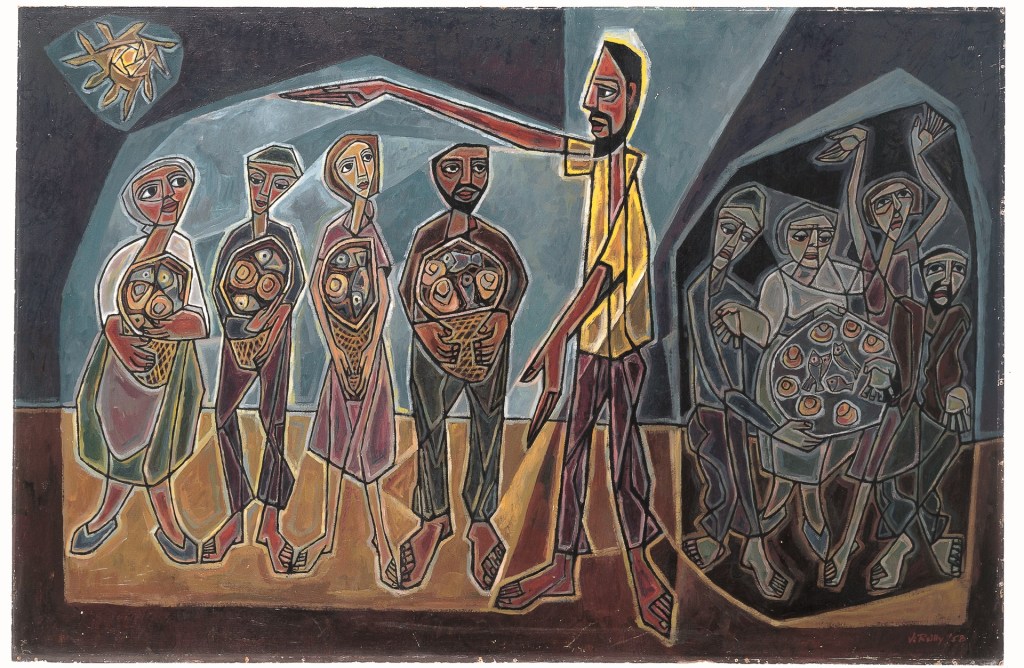
Luke 9:10-17 – Jesus Feeds Five-Thousand

The Feeding of the Five Thousand by John Reilly, 1958

When the apostles returned, they reported to Jesus what they had done. Then he took them with him, and they withdrew by themselves to a town called Bethsaida, but the crowds learned about it and followed him. He welcomed them and spoke to them about the kingdom of God and healed those who needed healing.

Late in the afternoon the Twelve came to him and said, “Send the crowd away so they can go to the surrounding villages and countryside and find food and lodging, because we are in a remote place here.”

He replied, “You give them something to eat.”

They answered, “We have only five loaves of bread and two fish—unless we go and buy food for all this crowd.” (About five thousand men were there.)

But he said to his disciples, “Have them sit down in groups of about fifty each.” The disciples did so, and everyone sat down. Taking the five loaves and the two fish and looking up to heaven, he gave thanks and broke them. Then he gave them to the disciples to distribute to the people. They all ate and were satisfied, and the disciples picked up twelve basketfuls of broken pieces that were left over. (New International Version)

Jesus feeding five thousand people is not just an incredible story that happened a long time ago. Today, Jesus is still in the miracle business because he is still in the kingdom business. Christ still takes our meager resources and turns them into something that has a large impact on a lot of people. 

For that to happen, all we need do, is follow the Lord’s simple instructions: “You give them something to eat,” and, “Bring them [five loaves and two fish] here to me.” Jesus, using a simple act of obedience by his disciples, did one of the most famous miracles in history.

Jesus can multiply whatever little we possess to accomplish his kingdom work through us. 

It is true that Jesus most certainly can do miracles without us. And yet, Christ chooses to use us simple folk to participate in his work. God uses our simple prayers for the miracle of a transformed life. The Lord uses our imperfect speech to bring new life to others. Jesus takes our miniscule bank account to bring a river of financial resources to many through a small act of giving. 

Faith is our true work – to believe God can do the extraordinary through our ordinary loaf of bread and piece of fish.

The Compassion of Jesus Motivates Him To Do Miracles

Jesus withdrew to a solitary place. The crowd, however, did not leave him alone. But rather than being annoyed by the situation because this interruption was not on his divine day planner, Jesus looked at the large group of people and had compassion on them. 

Christ’s heart went out to thousands of people, so he set about the work of healing the sick. Please know that God does not begrudgingly deal with you, as if you were an interruption to his day; the Lord has compassion for you.

The Desire of Jesus is For Us to Participate in the Miracles He Does

After a full day of healing, Christ’s disciples came to him as if he was unaware of the people’s need for food.  They had a very rational and realistic answer to the problem of hunger in front of them; dismiss the crowd so they can go out to eat. 

Jesus calmly responded, “They don’t need to go away; you give them something to eat.” 

I detect perhaps a hint of sarcasm and a slight eye roll in the reply of the disciples, “We have only five loaves of bread and two fish.” But their math was way off because they did not count Jesus. 

The Five Thousand by Eularia Clarke, 1962

Jesus simply said, “Bring them here to me.” My friends, if we have ears to hear, Jesus is still saying this today to us – bring them here to me. Through simple prayer and active obedience, we must give Jesus what we have, no matter how little or insignificant.

Most of what happens in Western Christianity, much like the ancient disciples, is a reasonable doing of rational ministry. Many ministries have little to nothing to do with the impossibility of faith and seeing God work in ways that are incomprehensible to our modern sensibilities.

The earthly miracles of Christ were not an isolated instance. God has always been taking the impossible and making it possible.

Now there was a woman who had been married to a member of a group of prophets. She appealed to Elisha, saying, “My husband, your servant, is dead. You know how he feared the Lord. But now someone he owed money to has come to take my two children away as slaves.”

Elisha said to her, “What can I do for you? Tell me what you still have left in the house.”

She said, “Your servant has nothing at all in the house except a small jar of oil.”

He said, “Go out and borrow containers from all your neighbors. Get as many empty containers as possible. Then go in and close the door behind you and your sons. Pour oil into all those containers. Set each one aside when it’s full.”

She left Elisha and closed the door behind her and her sons. They brought her containers as she kept on pouring. When she had filled the containers, she said to her son, “Bring me another container.”

He said to her, “There aren’t any more.” Then the oil stopped flowing, and she reported this to the man of God.

He said, “Go! Sell the oil and pay your debts. You and your sons can live on what remains.” (2 Kings 4:1-7, CEB)

What if we were to live as if God was interested in doing the miraculous? Would it change the way we pray, and the way we act? 

What if we understood just enough of Jesus, of what he can and wants to do, that we are bold to say:

  • “This might sound crazy, but what if we found out the names of everyone in our community who needs food and go love on them and feed them?” (instead of only the rational means of a food pantry)
  • “This might sound crazy, but what if we used our property to create a community garden and help people grow their own food?” (instead of only the rational means of government aid) 
  • “This might sound crazy, but what if we prayed for one-hundred people, by name, to be healed?” (instead of only the rational means of relying on the pastor to pray)

Most of our plans are humanly possible and doable. Maybe we ought, instead, to seek the impossible.

We may often do nothing out of a sense that God either cannot or does not want to use me or what I have. However, it just won’t do to stand afar off and expect God to work without us giving what we have, whether that something is time, money, conversation, food, hospitality, or whatever. 

Our excuses won’t do for Jesus – my home is too small, I don’t have enough money, I am not smart enough, my schedule won’t allow it, I don’t have enough resources…. In God’s economy you don’t need much, at all. Just a mustard seed worth of faith will do. Jesus wants us to be a part of the miracles he is doing.

Conclusion

I can visualize the disciples befuddled by Christ’s words. I can imagine hearing their excuses. “You want me to do what?  Feed thousands?  Lead someone to Jesus?  Pray in front of others?….” 

The miracle for many a believer is to be open, real, and transparent enough to believe that Christ can do the impossible through confessing sin, participating in ministry, having a spiritual conversation with an unbeliever, or just naming out loud what one actually thinks and feels.  

The question is never, “Can God use me?” The real question is, “What miracle does God want to do through me, and through us as a community of faith?”

It is no accident that when Jesus distributed the bread, it sounds a lot like communion. The Lord’s Supper may seem to be irrelevant – only something we do to remember Jesus, or a mere ritual. But God’s design is much bigger. The Lord wants to do a miracle. 

God wants our observance of Christian communion to bring a healing which the world cannot give. It appears irrational that Jesus can use a small Table to feed and reach thousands. Yet, we don’t serve a God who is limited to work through rational means. 

O God, our heavenly Father, you have blessed us and given us dominion over all the earth. Increase our faith and our reverence for the mystery of life. Give us new insight into your purposes for the human race, and new wisdom and determination in making provision for its future, no matter whether it makes sense, or not, in accordance with your goodwill, through Jesus Christ our Lord. Amen.

Luke 13:1-9 – Jesus Will Have None of It

Now there were some present at that time who told Jesus about the Galileans whose blood Pilate had mixed with their sacrifices. Jesus answered, “Do you think that these Galileans were worse sinners than all the other Galileans because they suffered this way? I tell you, no! But unless you repent, you too will all perish. Or those eighteen who died when the tower in Siloam fell on them—do you think they were more guilty than all the others living in Jerusalem? I tell you, no! But unless you repent, you too will all perish.”

Then he told this parable: “A man had a fig tree growing in his vineyard, and he went to look for fruit on it but did not find any. So, he said to the man who took care of the vineyard, ‘For three years now I’ve been coming to look for fruit on this fig tree and haven’t found any. Cut it down! Why should it use up the soil?’

“‘Sir,’ the man replied, ‘leave it alone for one more year, and I’ll dig around it and fertilize it. If it bears fruit next year, fine! If not, then cut it down.’” (New International Version)

Jesus stood in a crowd of thousands of people. They peppered him with questions about all kinds of issues and situations. Christ responded with a combination of direct exhortations and pointed parables, designed to leave the people reflecting and thinking about what he said.

Christ’s direct exhortation is this: Repent. Change your mind. Christ’s pointed parable message is this: Bear fruit. Change your behavior.

The two go together. A fruitless life points to the need for repentance; and repentance results in bearing the fruit of love, joy, peace, patience, kindness, goodness, gentleness, and self-control.

Jesus, throughout his earthly ministry, relentlessly went after the fruitless dead religion of his day. Jesus believed that such religion needed to be cut out and thrown away. 

Therefore, the Lord exposed the assumptions that people have about sin, faith, and judgment. Jesus challenged four false assumptions or presuppositions that people often hold. In dealing with them, Jesus wanted to foster a change of heart which would lead to a change in behavior.

First Wrong Assumption: Other people’s sin is more serious than mine.

It’s a common human tendency to focus on the bad things in the world what other people do, rather than focus on our own heart and life. We can always identify people who are worse sinners than us! 

The crowd believed Pontius Pilate was a terrible sinner who needed to be dealt with, and they wanted Jesus to get on board to their way of thinking. The people wanted to talk trash about the Romans.

“Repentance is nothing else but a reformation of the whole life according to the Law of God.”

John Calvin

We must beware of people who constantly bemoan the state of the world and the sins of others, while ignoring their own issues or how they might be contributing to the problem. It’s so much easier to scapegoat a person or group of people, believing that if “those people” change, then everything will be okay.

But Jesus will have none of it.

Christ steered the discussion to personal repentance. Although you and I cannot control, change, or fix anyone, we can practice self-control, change our personal habits, and be the solution to our own problems.

Everywhere we go, the world is rife with criticisms and accusations of others. It’s always somebody else’s fault for the ills of the world and even the church.

Republicans blame Democrats. Democrats blame Republicans. Anti-vaxers blame the government. The vaccinated blame the previous government. Everyone thinks that if the other changes, all will be well. 

In the church, when things aren’t right, Christians might ask things like, “Who sinned, the pastor or the congregation, the church or the denomination?” With the decline of religion in the land, we look for a scapegoat. 

But Jesus will have none of it.

Christ cut through all the scapegoating and blame-shifting by saying that every single person needs to repent, without exception. Then, Jesus upped the ante with a parable by challenging us with a very probing thought: 

Are we bearing fruit, or just taking up space? 

Whenever we howl for judgment on others, but insist on grace for ourselves, we are the ones in need of repentance.

Second Assumption: My sin isn’t that serious.

When King Frederick II, an eighteenth-century King of Prussia, was visiting a prison in Berlin, the inmates insisted they had been unjustly imprisoned – all except one. That one sat quietly in a corner, while all the rest protested their innocence. Seeing him sitting there oblivious to the commotion, the king asked him what he was there for:

“Armed robbery, your Honor.”

The king asked, “Were you guilty?”

“Yes, Sir,” he answered. “I entirely deserve my punishment.”

The king then gave an order to the guard: “Release this guilty man. I don’t want him corrupting all these innocent people.”

We may concede that we are all sinners, but then struggle with believing that our personal sin really deserves imprisonment. So, we see no need for repentance. It isn’t that bad.

But Jesus will have none of it. 

Here are some questions raised by today’s Gospel lesson: 

Do I continually locate sin outside of my life, or do I discern the sinfulness of my own heart? 

Do I believe people in hardship are more sinful than me? 

Can I envision that I must change for the church and the world to change? 

Is my life fruitful, or fruitless? 

How can I become fruitful? 

What must I repent of? 

What will happen if I don’t repent?

Third Assumption: God will not judge me.

Some might concede we are all sinners, and my own sin is bad. “But is it really so bad that God would judge me?”  Again, the two big ideas Jesus is working with here is that everyone needs repentance, and everyone needs to bear spiritual fruit in keeping with such repentance. 

Jesus alerts us that the future involves a Judgment Day. All shall be held accountable for fruit-bearing, or the lack thereof. No fruit on the branch means it will be cut down and thrown into the fire.

Jesus was talking to a crowd of people who were quite religious. They were faithful temple worshipers, and had weekly practices of giving, fasting, and prayer. But they needed to repent of trusting in self and stuff. 

They believed God would judge the evil Romans and everyone else who did not live or think like them. They were God’s people; the Lord would not judge them!

But Jesus will have none of it.

The Lord almighty looked for justice, but saw bloodshed;
    for righteousness, but heard cries of distress. (Isaiah 5:7, NIV)

Learn to do right; seek justice.
    Defend the oppressed.
Take up the cause of the fatherless;
    plead the case of the widow.

Isaiah 1:17, NIV

Jesus wants spiritual fruit in keeping with repentance. Believing the right things and doing the right service never justifies indulging in hate, rage, anger, discord, selfish ambition, envy, impatience, unkindness, and ungraciousness. Doing a particular set of religious duties never gives one a license to use their attitude, their tongue, or their life in whatever way they want.

Fourth Assumption: I have plenty of time.

Okay, other people’s sin is not worse than mine. My sin is serious. God will deal with my sin if I do not repent. But I have time to deal with it, right? I will get around to it when I get a chance. 

But Jesus will have none of it.

Jesus was establishing a sense of urgency into the crowd. Repentance is not something to put off until tomorrow. Today is the day to deal with sin. If a lack of fruitfulness persists, judgment is imminent. Jesus was not trying to scare people into repentance; he was just letting them know that procrastination puts us in a precarious position. We don’t have unlimited time. We are on the clock.   

Just because God is gracious, merciful, kind, and patient does not mean that he won’t cut the dead religion tree down.

Today is the day of repentance, the day to quit looking for everyone else to repent and change, the day to take our own sin seriously, the day to discern that God does not show favoritism and will judge all persons equally and fairly. 

Today is the day because the hour is almost here when Jesus will return to judge the living and the dead.

Conclusion

So, we must repent of a lack of fruitfulness. The spiritual fruit God is looking for is love, joy, peace, patience, kindness, goodness, faithfulness, gentleness and self-control. 

When an apple trees bear fruit, some of those apples do not just bear the apple’s skin, some the apple’s core, some the apple’s meat. No! When an apple tree bears fruit, it bears apples – whole ones with all the things that make an apple an apple. 

There is no leg to stand on with the notion that I have love, but no patience; or display a lack of peace, but practice self-control. We either have the fruit of the Spirit, or we do not! If we have some of these, but not others, we have genetically modified fruit which has not been raised in the soil of the gospel.

Each one of us needs to look in our heart in this season of Lent and accurately assess the current state of our lives before God. Then, we need to repent, to change those things which the Spirit of God identifies. And, like a farmer, we are to cultivate, fertilize, and tend to our hearts in ways that will produce a crop.

Gracious God, our sins are too heavy to carry, too real to hide, and too deep to undo. Forgive what our lips tremble to name, what our hearts can no longer bear, and what has become for us a consuming fire of judgment. Set us free from a past that we cannot change; open to us a future in which we can be changed; and grant us grace to grow more and more in your likeness and image, through Jesus Christ, the light of the world. Amen.

Revelation 3:1-6 – Remember, Hold On, and Change

Ruins in the ancient city of Sardis (present day Sart, Turkey)

Write this to the angel of the church in Sardis:

These are the words of the one who holds God’s seven spirits and the seven stars: I know your works. You have the reputation of being alive, and you are in fact dead. Wake up and strengthen whatever you have left, teetering on the brink of death, for I’ve found that your works are far from complete in the eyes of my God. So, remember what you received and heard. Hold on to it and change your hearts and lives. If you don’t wake up, I will come like a thief, and you won’t know what time I will come upon you. But you do have a few people in Sardis who haven’t stained their clothing. They will walk with me clothed in white because they are worthy. Those who emerge victorious will wear white clothing like this. I won’t scratch out their names from the scroll of life but will declare their names in the presence of my Father and his angels. If you can hear, listen to what the Spirit is saying to the churches. (Common English Bible)

Many Christians reflexively think of good old Apostle Paul when it comes to biblical epistles (letters) to churches. Yet, contained within the first three chapters of Revelation are seven succinct letters to seven different churches. These letters are short and packed with a punch – and they don’t come from Paul.

What makes these short bursts of exhortation so powerful is that they come from Jesus himself. Yes, that Jesus – the Lord Jesus Christ, the head of the church. So, it seems to me that Christ’s observations about the church ought to carry more weight than anybody else’s thoughts.  

Christ was concerned about how far the church was from completing the work of God. So, he gave a pointed admonition, almost like a parent trying to awaken a teenager in the morning. “Wake up!” said Jesus because he found the church’s obedience incomplete and lacking strength. If this were the Apostle Paul talking, he would likely have framed it this way: “You have sinned and fallen short of the glory of God.” (Romans 3:23)

Our Lord went directly to the heart of the church’s life… and it’s death. The stark reality is that these statements from Jesus remain penetrating and relevant for today’s church.

So, what is to be done about the situation of spiritual deadness in the church? 

Jesus did not leave the church hanging but in a few compact words let them know exactly what they are to do to remedy their spiritual malady: Remember. Hold on. Change. Keep the memory of sound instruction alive, always adjusting the life of the church to it. The Christian term for this is “repentance.”

Sometimes, if not many times, we may tend to forget the things we need to remember and remember the things we must forget. We are to follow God in a pattern of remembering and forgetting. God has said:

I wipe away your sins because of who I am. And so, I will forget the wrongs you have done. (Isaiah 43:25, CEV)

I will forgive their wrongdoing and never again remember their sins. (Jeremiah 31:34, CEB)

I will forget their sins and never again remember the evil they have done. (Hebrews 10:17, ERV)

Concerning those who have wronged us, we are to emulate God’s grace, mercy, and kindness through forgiveness. To “forget” does not mean performing a personal lobotomy but simply not to hold an offense against another by continually bringing it to mind. On the other hand, God remembers divine promises made to people. Likewise, we are to constantly bear in mind what God has put before us to remember:

For I received from the Lord what I also handed on to you, that the Lord Jesus on the night when he was betrayed took a loaf of bread, and when he had given thanks, he broke it and said, “This is my body that is for you. Do this in remembrance of me.” In the same way he took the cup also, after supper, saying, “This cup is the new covenant in my blood. Do this, as often as you drink it, in remembrance of me.” For as often as you eat this bread and drink the cup, you proclaim the Lord’s death until he comes. (1 Corinthians 11:23-26, NRSV)

We need an abiding remembrance of the Lord Jesus, the very person who spoke to the church hundreds of years ago. It is in those times when we become distressed that we must center our memory on Christ:

We must focus on Jesus, the source and goal of our faith. He saw the joy ahead of him, so he endured death on the cross and ignored the disgrace it brought him. (Hebrews 12:2, GW)

Remembering Jesus Christ sets us on the path to fulfilling the work of God and completing that which has been given us to do. This is precisely why I choose to follow the Christian Year and remember time by having it centered around the life and ministry of Jesus.

Always think about Jesus Christ. He was brought back to life and is a descendant of David. This is the Good News that I tell others. (2 Timothy 2:8, GW)

I have been a constant example of how you can help those in need by working hard. You should remember the words of the Lord Jesus: “It is more blessed to give than to receive.” (Acts 20:35, NLT)

Let us remember together in prayer:

Awesome Lord Jesus, your words penetrate to the core my being. Strengthen me by the continuing presence of yourself through the Holy Spirit so that my every thought, word, and deed is done in your holy Name. Kindle in my heart a vision of your love and shine the light of your victory over sin, death, and hell over this dark world. Continually take me to yourself. Keep me in your wounds and mindful of your presence so that I shall fulfill all the will of God for my life through your divine enablement. Amen.

Romans 4:1-12 – Saved by Grace Through Faith

“Abraham Journeying to the Land of Canaan” by Giovanni Benedetto Castiglione (1609-1664); The Fitzwilliam Museum; http://www.artuk.org/artworks/abraham-journeying-to-the-land-of-canaan-5550

So how do we fit what we know of Abraham, our first father in the faith, into this new way of looking at things? If Abraham, by what he did for God, got God to approve him, he could certainly have taken credit for it. But the story we’re given is a God-story, not an Abraham-story. What we read in Scripture is, “Abraham entered into what God was doing for him, and that was the turning point. He trusted God to set him right instead of trying to be right on his own.”

If you’re a hard worker and do a good job, you deserve your pay; we don’t call your wages a gift. But if you see that the job is too big for you, that it’s something only God can do, and you trust him to do it—you could never do it for yourself no matter how hard and long you worked—well, that trusting-him-to-do-it is what gets you set right with God, by God. Sheer gift.

David confirms this way of looking at it, saying that the one who trusts God to do the putting-everything-right without insisting on having a say in it is one fortunate man:

Fortunate those whose crimes are whisked away,
    whose sins are wiped clean from the slate.
Fortunate the person against
    whom the Lord does not keep score.

Do you think for a minute that this blessing is only pronounced over those of us who keep our religious ways and are circumcised? Or do you think it possible that the blessing could be given to those who never even heard of our ways, who were never brought up in the disciplines of God? We all agree, don’t we, that it was by embracing what God did for him that Abraham was declared fit before God?

Now think: Was that declaration made before or after he was marked by the covenant rite of circumcision? That’s right, before he was marked. That means that he underwent circumcision as evidence and confirmation of what God had done long before to bring him into this acceptable standing with himself, an act of God he had embraced with his whole life.

And it means further that Abraham is father of all people who embrace what God does for them while they are still on the “outs” with God, as yet unidentified as God’s, in an “uncircumcised” condition. It is precisely these people in this condition who are called “set right by God and with God”! Abraham is also, of course, father of those who have undergone the religious rite of circumcision not just because of the ritual but because they were willing to live in the risky faith-embrace of God’s action for them, the way Abraham lived long before he was marked by circumcision. (The Message)

“Abraham Journeys Forth into the Unknown” by Yoram Raanan

We all need help. Yes, we like our independence and would rather give help than receive it. Yet, there are some things which we can do nothing about without some divine intervention. This is where faith comes into the picture.

“Faith” is a big word in Holy Scripture and in the Christian life. Faith encompasses the totality of how we come to Jesus Christ, and then how we live for him. In talking about faith, it is important to distinguish between the faith which saves us from guilt, shame, sin, death, and hell, and the faith which sanctifies and makes us holy. 

“Salvation” and “sanctification” are also big words in Scripture and in life. If we are fuzzy on our understanding and application of these two spiritual realities of salvation and sanctification, we are going to end up sleepwalking through life as spiritual zombies.

Christianity’s answer to the vital help we need for deliverance is the death and resurrection of Jesus Christ. This deliverance, or salvation, only occurs by faith. A person is “saved” by knowing about Jesus and his finished work on the cross and trusting that this work has taken care of my need for salvation, once for all. 

Christ sacrificed himself for us. He took our place. The punishment that belonged to us, he bore. When we acknowledge our lost and wayward lives, and believe Jesus is the way, the truth, and the life, then we are delivered and experience salvation from the awful emptiness of life. 

A person cannot earn this deliverance; they cannot buy it or work for it. No, salvation is a gift that comes only by faith in the person and work of Jesus. That is the essence of saving faith in Christianity. It is a one-time event of trust.

“Sanctification,” on the other hand, is what begins when becoming a believer in Jesus. The word simply means “to become holy,” or, “to be set apart for God.” Sanctification is not a singular event, but a process Christians engage in for the rest of their earthly lives. 

Whereas saving faith is a gift given to us without effort, sanctification requires a great deal of effort. We work and struggle and expend lots of energy to live the Christian life. 

“Grace [God’s gift to us in granting forgiveness] is not opposed to effort, it is opposed to earning. Earning is an attitude. Effort is an action. Grace, you know, does not just have to do with forgiveness of sins alone.” 

Dallas Willard

When a student gets a college scholarship at a university, the giving of the scholarship is a one-time event. It is granted to the student. They now possesses it and are able to attend school without trying to earn the money to pay for it. 

But that scholarship has been given for a reason – so that the student can now focus entirely on their studies and/or sport. The work has just begun. More blood, sweat, and tears will take place living into that scholarship than the student could ever imagine. It won’t be easy, and it will consume the student’s waking hours for the next four years.

Our life is a matter of faith, not of sight.

2 Corinthians 5:7, GNT

The biblical character of Abraham is Exhibit A of faith. He was delivered from an empty way of life in a pagan country and given a gift of grace to move to the country God would show him. Abraham did nothing to earn this favor. Before Abraham chose God, God chose him. 

Abraham sojourned as a pilgrim throughout the land God gave him, which mirrored his spiritual sojourning and learning to be a follower of God. Abraham likely faced the greatest test of faith a person could ever experience; he was asked to sacrifice his son. He responded to God with complete obedience.

Abraham’s faith was made complete by what he did; and it occurred well before his circumcision of being physically marked as belonging to God. 

We are made right not on our own but through the sheer grace of God in Christ by faith. Then, we continue to exercise faith by living into the righteousness given to us by the mercy of God.

God’s mercy is so abundant, and his love for us is so great, that while we were spiritually dead in our disobedience he brought us to life with Christ. It is by God’s grace that you have been saved. In our union with Christ Jesus he raised us up with him to rule with him in the heavenly world. He did this to demonstrate for all time to come the extraordinary greatness of his grace in the love he showed us in Christ Jesus. For it is by God’s grace that you have been saved through faith. It is not the result of your own efforts, but God’s gift, so that no one can boast about it.

Ephesians 2:4-9, GNT

God grants his faith scholarships to whomever he wants: rich and poor, men and women, from every race, ethnicity, and background imaginable across the entire earth. 

From the standpoint of faith, Abraham did nothing to receive God’s gracious scholarship of faith. He did not work for it. It was granted to him solely because of God’s grace. Then, his faith was confirmed and proven as genuine by his life of faith and obedience.

Therefore, our own deliverance and ability to live rightly is firmly rooted in faith – and not by holding a prominent position, having a particular pedigree, or expending personal power. All of humanity needs the saving help of Jesus Christ. Salvation is in Christ alone, by grace alone, through faith alone.

Lord Jesus Christ, I am sorry for the things I have done wrong in my life. Please forgive me. I now turn from everything that I know is wrong. Thank you that you died on the cross for me, so that I could be forgiven and set free. Thank you that you offer me forgiveness and the gift of your Spirit. I receive that gift with a grateful heart. Amen.