Listen to Lady Wisdom (Proverbs 9:1-12)

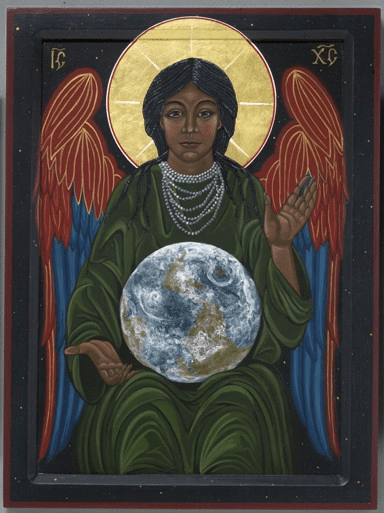
Sophia, Divine Wisdom, by Mary Plaster

Wisdom has built her house;
    she has set up its seven pillars.
She has prepared her meat and mixed her wine;
    she has also set her table.
She has sent out her servants, and she calls
    from the highest point of the city,
    “Let all who are simple come to my house!”
To those who have no sense she says,
    “Come, eat my food
    and drink the wine I have mixed.
Leave your simple ways and you will live;
    walk in the way of insight.”

Whoever corrects a mocker invites insults;
    whoever rebukes the wicked incurs abuse.
Do not rebuke mockers or they will hate you;
    rebuke the wise and they will love you.
Instruct the wise and they will be wiser still;
    teach the righteous and they will add to their learning.

The fear of the Lord is the beginning of wisdom,
    and knowledge of the Holy One is understanding.
For through wisdom your days will be many,
    and years will be added to your life.
If you are wise, your wisdom will reward you;
    if you are a mocker, you alone will suffer. (New International Version)

Life is full of choices. Whether we quibble about how much free will or deterministic fate a person actually has, or has not, we are still left with the ability to choose how we shall proceed and/or respond to basic life situations.

The two basic choices in life were often displayed in early film and television cartoons by having an angel on one shoulder and a devil on the other. The stereotypical portrayal helps us see that there is always a choice between good and evil.

Although our choices in life are quite personal and specific to a particular situation, the choice between good and evil is much bigger than this. It is choosing a certain way to look at the world, which then influences and informs the concrete decisions we make in life.

In our lesson for today, wisdom is personified as a lady calling out to us as people. In contrast, foolishness or folly is equally personified. The two ladies are continually speaking to us.

Lady Wisdom leads the community of sages who know how to live a right, just, and good life; she invites others to join her at the table and learn her ways. On the other hand, Lady Folly heads a group of simpletons who are driven by the passions of the moment; she easily attracts those who want cheap and easy solutions.

Wisdom’s message is a passionate appeal to take the path of insight through God’s revealed will. We are encouraged to leave empty-headed ways of thinking, and live with awareness, insight, and direction. The term “wisdom” in Scripture is the ability to apply sound biblical instruction and divine commands to concrete situations in our lives. 

For the spiritual person, especially, it is vital and imperative to daily listen to Lady Wisdom and follow her instructions.

The fact of the matter for too many people is that they are too impatient to let Lady Wisdom teach them her ways. It takes too much time, and is too hard for them. So, they turn to Lady Folly, who makes bogus promises of satisfaction without all the time and effort.

Idolatry (running toward other gods) immorality (running to victimize another) lying (running the mouth without any truth to it) and arrogance (running to get quick power and authority) often results from the inability to wait on the lessons that Lady Wisdom deeply desires to impart to us. 

Wisdom is not gained quickly; her teachings must be learned slowly with careful application over time. We are much too prone to wanting the simple solutions to complex problems that Lady Folly offers. But Lady Wisdom calls us to leave such simplistic thinking and take the high road of authenticity, self-awareness, and attention to the common good of all persons.

Therefore, rather than rushing to Google for answers to our questions; instead of allowing another person to make decisions for us; in place of implementing sheer pragmatic plans; allow Lady Wisdom to penetrate the mind and the heart so that what comes out is thoroughly good, benevolent, just, and helpful. 

And the best place to begin in starting down the road of wisdom is to give the Lord proper place in our lives. The skills for a good life gets its start through respect of God and obedience to the Lord. To truly have understanding and a wise life, one must get to know God. 

Nobody can talk themselves into wisdom, because it takes a reverent spirit, listening ears, and measured words to be able to put Lady Wisdom’s instruction into practice. There are no substitutes.

All-Wise God, the One who is never in a hurry and who is always holy, create in me a wise mind and a wise heart. Help me to sit still long enough for wisdom to bring spiritual growth and maturity to my life, through Jesus Christ my Lord, in the power of the Holy Spirit. Amen.

Use Your Freedom For Good (Exodus 33:1-6)

Then the Lord said to Moses, “You and the people you brought out of Egypt must leave this place. Go to the land I promised to Abraham, Isaac, and Jacob with an oath, saying, ‘I will give it to your descendants.’ I will send a Messenger ahead of you, and I will force out the Canaanites, Amorites, Hittites, Perizzites, Hivites, and Jebusites. Go to that land flowing with milk and honey. But I will not be with you, because you are impossible to deal with, and I would destroy you on the way.”

When the people heard this bad news, they acted as if someone had died. No one wore any jewelry. The Lord had said to Moses, “Tell the Israelites, ‘You are impossible to deal with. If I were with you, I might destroy you at any time. Now take off your jewelry, and I’ll decide what to do with you.’” After they left Mount Horeb, the Israelites no longer wore their jewelry. (God’s Word Translation)

It took little time for the covenant between God and the Israelites to be violated. The relationship between the Lord and the people was meant to be cemented through a special covenant in which Yahweh makes promises to them and gives them instructions and commandments; and the Israelites pledge their fealty and promise to obey.

But the people quickly reneged on the relationship. While Moses was up on Mount Sinai, receiving the Law from God, the Israelite grumbles and complaints came to full flower. They went their own way and made a calf idol out of gold.

So, the Lord’s judgment broke out amongst them. The Levites, to their credit, rallied around Moses and the Lord, and took out the rabble rousers in the camp. What’s more, God sent a plague that killed many.

In the aftermath of the rebellion against Moses and the Lord, God ordered the people to leave Mount Sinai – the place where everyone was to have a positive experience of Yahweh’s presence. God’s anger and wrath were so aroused that it became impossible for the divine presence to go with the people. Only Moses, as God’s emissary, would be able to guide the Israelites so that they are not completely eradicated.

Mount Sinai, by Sefira Lightstone

Yet, even after all the bad attitudes, rebellious actions, and an idolatrous spirit among the Israelites, Yahweh will still keep the divine promise to Abraham, Isaac, and Jacob to deliver them and bring them to the Promised Land.

Today’s story has the feel of a chastened child sitting in the corner, having to think about what they just did to raise the ire of the parent. The Israelites moved from Sinai in a somber mood, realizing more clearly than ever how much their lives are tied and linked to God’s divine presence.

At God’s command, the people removed their jewelry and took off their party clothes from the celebration that got them into so much trouble. It began to sink in, that the Lord departed from them because of their great sin. They started to realize, albeit too late, that they really screwed up their relationship with God.

The Israelites didn’t know how good they had it with the divine pillar of cloud by day and fire by night to lead them – and how much they actually depended on the God-given manna for their sustenance and existence.

It’s all too typical for us humans that we fail to realize what we have, until it’s gone. The ancient Israelites were freed from a cruel slavery in Egypt. They clearly did not handle their freedom well, at all. Perhaps the people were so used to being in bondage that, when they go their freedom, they just adopted a different sort of slavery – to their sinful passions.

Let’s handle our freedom with some responsibility and accountability, so that we do not go down the same rebellious path as the ancient people of God. You and I are free to choose what we do, what we think, and how we spend our time. It’s easy to blame outside forces when circumstances are hard; and to grumble whenever we don’t like something.

Freedom is a spiritual discipline; we must learn how to intentionally practice it and use it for good. The following are four areas to purposefully work on with our freedom by making good choices:

Choose your words carefully. What comes out of your own mouth is up to you. Let those words reflect who you truly are; and let your speech impact others around you for good, and not evil.

Choose your attitude with some self-awareness. With awareness comes choices. For example, if we are not aware of our own anger, it will eventually come out sideways on another person. Our sullen attitude and jaded perspective will color our relational interactions. But if we are aware of our emotions, we can choose to effectively work through them, and then decide what sort of attitude we’re going to have.

Choose your actions before you do them. Seemingly insignificant choices turn into small actions. The small actions become habits. And habits shape character and create a life. We make choices every day about what we’ll do and not do. In every sort of situation we have choices to act, such as: Will I let go, or will I try and control others? Will I walk, or drive? Will I spend, or save? Shall I prepare, or procrastinate? Be fit, or be fat? Talk or listen?… and a thousand other choices of action.

Choose your beliefs with care. Our beliefs and our faith determines how we act and behave. If we believe in a good God who has our best interests at heart, we will freely trust such a God. But if we believe God to be a capricious Being who is aloof from my concerns, then we will make choices to watch out for number one and view others with suspect.

If you are behaving in ways that aren’t working for you, examine what belief is causing that behavior. Then decide whether that’s a belief you really need to have, or not, then change it, if necessary.

Every choice we make, contributes to the person we want to become, and sets us on the path to where we want to be in life. Maybe if the ancient Israelites had more awareness of this, they might have chosen very differently.

Gracious God, grant me clarity and awareness to make wise decisions. Enlighten my heart and mind, as I seek to follow your divine guidance. In the face of uncertainty, give me the courage to trust your promises. Help me embrace the path set before me, with a spirit of love and grace. Amen.

Who’s In Charge? (Romans 9:6-13)

I am not saying that the promise of God has failed; for not all the people of Israel are the people of God. Nor are all of Abraham’s descendants the children of God. God said to Abraham, “It is through Isaac that you will have the descendants I promised you.” This means that the children born in the usual way are not the children of God; instead, the children born as a result of God’s promise are regarded as the true descendants. For God’s promise was made in these words: “At the right time I will come back, and Sarah will have a son.”

And this is not all. For Rebecca’s two sons had the same father, our ancestor Isaac. But in order that the choice of one son might be completely the result of God’s own purpose, God said to her, “The older will serve the younger.” He said this before they were born, before they had done anything either good or bad; so God’s choice was based on his call, and not on anything they had done. As the scripture says, “I loved Jacob, but I hated Esau.” (Good News Translation)

My friend, I want to break this to you as gently as possible yet as straightforward as I can: Neither you nor I are in control or in charge! 

Any semblance of control we think we have is merely a delusion. Now, before you push back, its important to make the distinction between control and responsibility. We are to own our decisions and take responsibility for their outcome. The Bible describes this as “self-control.”

God’s saving kindness has appeared for the benefit of all people. It trains us to avoid ungodly lives filled with worldly desires so that we can live self-controlled, moral, and godly lives in this present world. (Titus 2:11-12, GW)

Attempting to control others is not our job – never was, isn’t now, and never will be – that’s God’s business. 

God makes choices. This was the Apostle Paul’s point to the church at Rome. The congregation was a volatile mix of Jew and Gentile. There was some bad history between them that stretched back centuries. Yet, here they were together in one church worshiping Jesus. 

Paul made a responsible choice to step into the mess between them and let each group know something important: It is neither their choice about who’s in and who’s out as God’s people, nor their choice about how someone gets in to start with. Those sorts of decisions are God’s choice. 

The Jews needed to know that Gentiles are in the kingdom because God does the work of choosing, calling, and including Gentiles just as much as Jews. 

The Gentiles needed to know that they were not replacing Jews as chosen people. The point? God chooses whomever he darn well pleases to choose, and the choice is not up to you or me.

This speaks on so many levels about how to conduct ourselves with one another in the church. The foundation of all good church dynamics is the recognition that God is the one who calls and gathers people together. That always needs to be the starting point in our relations with each other. The church is not a random collection of persons who happen to be in the same place at the same time. God puts us where we are.

He has made everything beautiful in its time. He has also set eternity in the human heart; yet no one can fathom what God has done from beginning to end. (Ecclesiastes 3:11, NIV)

The Church is a covenantal community. Believers in Jesus are receiving the blessings first promised by God’s covenant relationship with Abraham in the Old Testament that all nations would be blessed by grace through faith. God is committed to acting on their behalf through election, adoption, and redemption. The new covenant community, the Church, receives the promises of God and exists to follow Jesus Christ in all things. 

The Church is not a voluntary society, like every other human institution. Rather, the Church is the divinely called community of the redeemed whom God has joined through the Spirit to Christ. Therefore, an individual, theologically speaking, does not join a church; instead, God joins the Church to Jesus.

The Nicene Creed (325 C.E.) describes the Church with four identifying marks:

  1. The Church is one.  The unity of the Church comes from God’s covenant people being in fellowship with the Lord through Jesus in the Spirit. This unity is expressed through the bond of love and a common worship that includes the spiritually forming practices of preaching, liturgy, and sacraments.  Since believers serve a triune God of Father, Son, and Spirit who exists in unity, so Christians are to work toward maintaining their unity through the bond of peace.
  2. The Church is holy.  The Church is holy by virtue of Christ’s finished work. Therefore, the members of the Church are saints, called by God to live in holiness and participate with him in carrying out his purposes on earth. As God is holy, so believers are to be holy in all they do. Since Christians are holy through God’s justification in Christ, so the Church as saints must uphold justice in the world.
  3. The Church is catholic.  This means that God’s people are found in all parts of the world throughout all times in history, including every race, class, gender, and ethnicity. Since the Church includes all kinds of people from different cultures, these believers must work together. The Church, across all kinds of denominations, ought to minister together to the total life of all people through gospel proclamation and good works done in the Spirit.
  4. The Church is apostolic.  Apostolic means “to be sent.” The Church is not only a people who are gathered for worship and teaching; they are also sent into the world as salt and light to those who are in darkness. Where the Church goes, the rule and reign of Jesus goes with them so that the gospel is spread to all nations.

Sovereign God, you choose whomever you want to include in your kingdom. Allow me to see Jesus in each person you call and save so that I can love and encourage them in the faith which is mutually and graciously given to us all; through Christ our Lord, and the ministry of the Holy Spirit. Amen.

Develop a Virtuous Ethic (Matthew 7:15-20)

“Beware of false prophets who come disguised as harmless sheep but are really vicious wolves. You can identify them by their fruit, that is, by the way they act. Can you pick grapes from thornbushes, or figs from thistles? A good tree produces good fruit, and a bad tree produces bad fruit. A good tree can’t produce bad fruit, and a bad tree can’t produce good fruit. So every tree that does not produce good fruit is chopped down and thrown into the fire. Yes, just as you can identify a tree by its fruit, so you can identify people by their actions.” (New Living Translation)

God has always been concerned for ethical virtue. And Jesus was always careful to take that ethic and help others identify it and apply it.

Virtuous ethics was well-known in the ancient world, especially thanks to the Greeks and Aristotle – who espoused that a person’s character is the determinative factor in discerning the extent to which that person is a good person.

For Aristotle, ethics includes moral virtues such as courage, temperance, compassion, generosity, honesty, and justice. The person in whom these moral virtues are to be found as steadfast dispositions can be relied on to exhibit a good character, and therefore, is able to make morally correct actions in moral decision-making situations.

For Jesus, religious legalism was a clear outward sign of the lack of inward moral virtue. Bad religion was a result of bad character. Therefore, everyone ought to beware of the religious leaders who exhibited stifling religious legalism.

Nothing can choke the heart and soul out of a person’s true spirituality, and hinder the development of virtue, like the legalist who teaches a precise extra-biblical list of do’s and don’ts.

For many folks, it seems easier to live by the list than to pursue the harder road of developing the character qualities needed for a solid and virtuous religious ethic. Christian discipleship involves growing into spiritual maturity and allowing a seasoned character to shape how we make decisions. 

To do so, we must patiently and consistently follow in the way of Jesus, which is the way of grace and of life.

Today’s Gospel lesson is Christ’s conclusion to his Sermon on the Mount. It is a sermon that sets forth the values of God’s kingdom and devalues the core of legalistic thought. 

I define legalism as a compulsion to spell out, in great detail, how everyone is to live a godly life; purposely going beyond the stated commands of Holy Scripture so that all persons can know exactly what they are supposed to do in any situation.

The problem with this approach to the Christian life is that godliness is merely an outward expression of our ability to hold to the list. It really has nothing to do with cultivating a virtuous ethic of life.

“Do not do what they do, for they do not practice what they preach. They tie up heavy, cumbersome loads and put them on other people’s shoulders, but they themselves are not willing to lift a finger to move them. Everything they do is done for people to see.”

Jesus on the legalist (Matthew 23:3-5, NIV)

The legalistic way of life and religion feeds human pride and boasting; it goes against the inner heart values of humility and meekness in Christ’s Beatitudes. The teaching of Jesus ends up getting lost in trying to do everything right or perfect.

Jesus, through the Sermon on the Mount, led the crowd to a point of decision, letting them know they are at a crossroads. There are two alternatives: Choose the way of life as expressed in Christ’s teaching, or else choose the way of destruction through the legalistic list. In order to press the crowd toward the necessity of choosing wisely, Jesus used metaphors to make his point.

False teaching in the form of legalism is like a wolf in sheep’s clothing. Be wary of people who seem pious and sincere, yet who do not quite pass the smell test. After all, Satan himself, the Apostle Paul once said, masquerades as an angel of light, appearing righteous, yet, is intent on deceiving many. (2 Corinthians 11:13-15)

So, how do we recognize a wolf who spiritually and emotionally devours people, and has no intention of helping but harming? Look at the fruit of the tree. 

Jesus is the good tree. Christ advocates for a searching of the heart. This leads to the result of righteous fruit. The bad tree is also seen by its fruit. Anyone who fails to live the Beatitudes of Jesus will be seen by the rotten fruit of boasting and pride.

False teachers tend to believe they are above others. After all, they are experts at keeping the list of do’s and don’ts! Yet, a false disciple will always be shown by their profound lack of grace, gentleness, and genuine humility. They inevitably advocate for holding to their brand of religion and keeping the unscriptural list. The absence of true righteousness and justice in their lives eventually results in their being cut down and thrown into the fire.

For Jesus, there is no riding the fence between the two alternatives presented – and it is a matter for him of life and death. The way of Jesus leads to life, good fruit, entrance into the kingdom of heaven, and stability. The other alternative ends in destruction, bad fruit and fire, exclusion from the kingdom, and being ruined.

The sobering reality of Christ’s teaching is that many people can be deceived with a devil’s bargain: “Take the nice handy legalistic list and you will become godly. Here are twelve principles to change your life. Follow these rules, pray this prayer, give your money to this, and all will be well.” It is, however, a highway to the grave.

The false teacher proclaims himself a “fruit inspector” and then goes on to judge everyone by his own contrived legalistic list. So then, there is a need to repent of religious lists, political agendas, and teachings which ignore and demean Christ’s Sermon on the Mount.

One of the telltale signs of holding to a conjured list is when we are not honest with one another about our struggles. The bald fact of list-living is that we cannot fulfill it. So, when we know we are not measuring up to the list, the temptation is to keep up appearances as if we are doing just fine. 

List-living eschews showing any weakness or imperfection:

  • I cannot admit my sin to anyone because the list pronounces me a failure if I do. 
  • I cannot enter a deep and prolonged grief over my loss because the list says I need to stay strong. 
  • I cannot profess my doubts about God because the list says if I doubt, I am not a real Christian.

My response and recommendation to legalistic list-living is this: To hell with the list! 

Instead, give praise to Jesus Christ who has given us the way of grace! For it is grace which transforms hearts, turns lives around, and provides genuine joy and satisfaction. If grace is not the answer, we are not asking the right question. The tree of life has an abundant supply of gracious fruit.

The greatest anti-legalistic prayer we can pray is the tried and true ancient prayer of the Church: “Lord Jesus Christ, Son of God, have mercy on me a sinner.”