Learn To Do Good (Isaiah 1:1, 10-20)

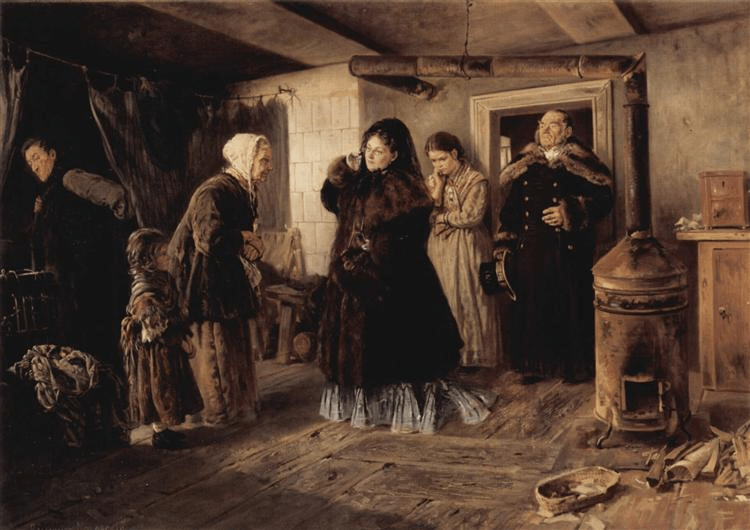
Visiting a Poor People, by Vladimir Makovsky, 1874

The vision of Isaiah son of Amoz, which he saw concerning Judah and Jerusalem in the days of Uzziah, Jotham, Ahaz, and Hezekiah, kings of Judah…

Hear the word of the Lord,
    you rulers of Sodom!
Listen to the teaching of our God,
    you people of Gomorrah!
What to me is the multitude of your sacrifices?
    says the Lord;
I have had enough of burnt offerings of rams
    and the fat of fed beasts;
I do not delight in the blood of bulls
    or of lambs or of goats.

When you come to appear before me,
    who asked this from your hand?
    Trample my courts no more!
Bringing offerings is futile;
    incense is an abomination to me.
New moon and Sabbath and calling of convocation—
    I cannot endure solemn assemblies with iniquity.
Your new moons and your appointed festivals
    my soul hates;
they have become a burden to me;
    I am weary of bearing them.
When you stretch out your hands,
    I will hide my eyes from you;
even though you make many prayers,
    I will not listen;
    your hands are full of blood.
Wash yourselves; make yourselves clean;
    remove your evil deeds
    from before my eyes;
cease to do evil;
    learn to do good;
seek justice;
    rescue the oppressed;
defend the orphan;
    plead for the widow.

Come now, let us argue it out,
    says the Lord:
If your sins are like scarlet,
    will they become like snow?
If they are red like crimson,
    will they become like wool?
If you are willing and obedient,
    you shall eat the good of the land,
but if you refuse and rebel,
    you shall be devoured by the sword,
    for the mouth of the Lord has spoken. (New Revised Standard Version)

Today’s Old Testament lesson is a stout and ancient warning against an age-old problem: Worshiping properly on a high holy day, yet living an evil and unjust life the rest of the days. It’s the mentality of “I give to God what’s required on the Sabbaths and festivals, so I can therefore do what I want the rest of the time, because that’s my stuff and my time.”

Just to be clear: That sort of evil thinking and behavior will raise the ire of the Lord every time. It’s dichotomous messed-up thinking. It’s the wrongheaded notion of believing that my financial and professional success is obviously a validation of God’s blessing upon me.

However, motives of gaining more wealth, rather than being motivated by humility, meekness, righteousness, purity, mercy, and peacemaking, will end badly, no matter who we are.

One of the problems here is an arrogant assumption that we’re right in what we are doing. We feel justified in living a duplicitous life. I have power, authority, and wealth; you do not. Thus, I’m right; you’re wrong; and I can do whatever the heck I want because God is on my side, not yours.

In terms of contemporary Christianity, this is the megachurch mentality: Since there are so many church attenders and money being placed in the offering plates, this is an unquestioned sanction from God of our rightness.

Then, when Sunday passes and Monday comes, both parishioner and pastor feel justified in using their wealth in ways that are inconsistent with the ways and words of Jesus.

Indeed, many times the name of Jesus is rarely (if ever) used in justifications of living the rich life. A blind eye is turned away from the poor and needy. When pressed, far too many parishioners admit to the belief that the poor are underprivileged because of their own personal sin.

Such “Christians” get away with their injustice before God, largely because there is a mass of churchgoers who honor the wealthy and give them places of authority and power.

They think God has shown favor by “blessing” particular people and communities with wealth (because God would never bless someone with poverty!). This can even go so far as to elect a leader of a nation because he is exorbitantly rich. Never mind his daily immorality, meanness, and lying; God has blessed him, right?

Wrong! So says the prophet Isaiah. Judah and Jerusalem, in their hubris, claimed special status. They are God’s people; others are not. They believed they had divine immunity from judgment. After all, only the Judeans worshiped the Lord; all other nations were pagan worshipers.

But their worship and sacrifices, in Isaiah’s day, were offered with no concern for justice and righteousness. So, God called them to repent; and gave them a chance to learn how to please the Lord.

And what pleases God is removing evil and learning to do good.

“Good” is defined by God as seeking to meet the needs of the common people; rescuing those who are oppressed; defending the cause of the orphan, and pleading the case of the widow. There’s no mention of wealth as a sign of divine blessing.

In reality, Judah’s situation before God was pitiful. They failed, even refused, to do justice, love mercy, and walk humbly. Therefore, the Lord called them to repentance and reformation.

Just because Jerusalem had the temple, this sacred space didn’t inoculate the people from judgment. The bald fact of the matter is that the people were living with self-destructive habits of stupidity. And God had enough of it.

In essence, the Lord said to Judah, “Let’s get serious about this.” Despite all the disobedience, God was willing to entertain the people’s change of heart and life – that is, if they themselves were willing to do so.

It’s important for all of us to “have it out with God,” to engage the Lord forthrightly, passionately, intelligently, and realistically.

There are really only two choices: Choose life or choose death. Choose to connect in meaningful, right, good, and just ways with God and neighbor; or choose to disconnect from others and do whatever the heck you want.

Each of our choices impacts what will happen tomorrow and into the future.

Decisions consistent with justice, righteousness, and goodness will ultimately go well for us. Decision-making borne of selfishness, a lack of mercy, and callousness toward others will create all sorts of problems.

Judah’s practical and existential decision came down to whether they wanted a just and productive society, or an invading Assyrian army. Which would you rather have?

To have a public daily life of disrespect and disregard for the needs of others (and of God!) is to invite being up a stinking creek without a paddle, and no one around to hear the yells for help.

Nothing can ever replace good old-fashioned turning away from hate, unforgiveness, bitterness, and pride; and turning toward what is good, right, just, and godly – and then ordering our collective public life around caring for the least and the lost among us.

May it be so, to the glory of God.

God of judgment and grace, you ask not for sacrifices but lives of trusting faith that acknowledge Your power and mercy. Give us a deep belief in Your sovereign goodness, so that we may follow You all the days of our lives, as did Jesus Christ our Savior and Lord. Amen.

Showing Kindness (Ruth 2:10-14)

Calling in the Gleaners, by Jules Breton, 1859

Then she fell prostrate, with her face to the ground, and said to him, “Why have I found favor in your sight, that you should take notice of me, when I am a foreigner?” But Boaz answered her, “All that you have done for your mother-in-law since the death of your husband has been fully told me, how you left your father and mother and your native land and came to a people that you did not know before. May the Lord reward you for your deeds, and may you have a full reward from the Lord, the God of Israel, under whose wings you have come for refuge!” Then she said, “May I continue to find favor in your sight, my lord, for you have comforted me and spoken kindly to your servant, even though I am not one of your servants.”

At mealtime Boaz said to her, “Come here and eat some of this bread and dip your morsel in the sour wine.” So she sat beside the reapers, and he heaped up for her some parched grain. She ate until she was satisfied, and she had some left over. (New Revised Standard Version)

Ruth and her mother-in-law Naomi were widows, living in the land of Moab. But Naomi decided to go back to Judah, to her hometown of Bethlehem. She and her husband had originally left because of a great famine.

Naomi had encouraged Ruth to remain in her own country, among her own people. But Ruth insisted on remaining and being with Naomi. But just because the two of them had each other, and they were in Naomi’s native land, it did not mean things were going to be easy or better.

The truth was that that Ruth and Naomi had next to nothing. It was common that during the harvest, the less fortunate folk would walk a ways behind the workers who were gleaning the fields, in order to pick up what was left behind.

Picking up after the workers in the field is precisely what Ruth went out to do. Naomi was too old for the work, so it was up to Ruth. The field that Ruth ended up walking, belonged to a man named Boaz.

Depending upon the owner of the land, the poor folk who came to walk the fields were treated either with kindness or contempt. Boaz was the sort of person who was attentive to God’s law, and sought to do what was right. He knew what Torah said:

“‘When you reap the harvest of your land, do not reap to the very edges of your field or gather the gleanings of your harvest. Leave them for the poor and for the foreigner residing among you. I am the Lord your God.’” (Leviticus 23:22, NIV)

Boaz had taken notice of Ruth. He approached her and told her to remain in his field and stay close to his workers. Boaz also commented to Ruth that he instructed the young men working for him to leave her alone and not bother her. He let Ruth know that she could drink from the vessels appropriated for his laborers.

This was a kindness which was overwhelming to Ruth. As a foreigner and a widow, she was not expecting anything from anyone in Judah. And yet, here is this man extending mercy to her.

One of the reasons Boaz showed kindness to Ruth is because he had heard about her commitment to Naomi, and admired her courage and spunk in coming to a land which was not her own.

Indeed, the picture we gain is that Ruth was a modest and faithful person, upright, diligent, and full of kindness. She understood who she was, where she was, and she was willing to do whatever she could for the sake of her dear mother-in-law.

Ruth had faith that Naomi would lead her well, and to a life of commitment to both God and God’s people. Ruth’s bravery and willingness to submit to Naomi is a beautiful portrayal of faith, hope, and love.

We can be inspired from such courage. For we, too, must take risks and allow ourselves to venture out into places we aren’t familiar with.

We will do well to understand that it was Ruth’s willingness to act, and her commitment to the life she chose, that helped bring about a family and an adopted community which she did not think possible.

It would be good for each of us to take the time to get a long look at our own lives. We must decide what risks we will take, and which things to avoid, and then go out in faith and perform those actions to the best of our ability, and with the grace which God grants us.

In stepping out and acting with kindness and commitment, Ruth discovered God’s care when she and Naomi were in poverty.

The blameless spend their days under the Lord’s care,
    and their inheritance will endure forever.
In times of disaster they will not wither;
    in days of famine they will enjoy plenty. (Psalm 37:18-19, NIV)

Boaz eventually found the blessing of family through his own act of kindness toward Ruth. He was well-off and had plenty, yet he used his privilege to bless others.

Command those who are rich in this present world not to be arrogant nor to put their hope in wealth, which is so uncertain, but to put their hope in God, who richly provides us with everything for our enjoyment. Command them to do good, to be rich in good deeds, and to be generous and willing to share. In this way they will lay up treasure for themselves as a firm foundation for the coming age, so that they may take hold of the life that is truly life. (1 Timothy 6:17-19, NIV)

So, whether we are poor or rich, underprivileged or privileged, we all can find ways to show kindness and live on this earth in peace and goodwill.

How, then, will you live?

O Lord, give me strength today to show kindness in all that I do. Help me to open my arms to those less fortunate and extend my hand to those who may need it, so that they may see You in my kind words and actions. Amen.

Wisdom for Life (Proverbs 11:1-31)

The Lord detests dishonest scales,
    but delights in an accurate weight.
When pride comes, so does shame,
    but wisdom brings humility.
Integrity guides the virtuous,
    but dishonesty ruins the treacherous.
Riches don’t help in the day of wrath,
    but righteousness rescues from death.
The righteousness of the innocent makes their path straight,
    but the wicked fall in their wickedness.
Those who do right are saved by their righteousness,
    but the untrustworthy are caught by their own desires.
When the wicked die, their hope perishes.
    Yes, any hope based on money perishes.
The righteous are saved from distress,
    and the wicked take their place.
The godless destroy their neighbors by their words,
    but the righteous are saved by their knowledge.
When the righteous succeed, a city rejoices;
    when the wicked perish, there are shouts of joy.
A city is honored by the blessing of the virtuous;
    it is destroyed by the words of the wicked.
Whoever despises their neighbor lacks sense;
    a sensible person keeps quiet.
A slanderer walks around revealing secrets,
    but a trustworthy person keeps a confidence.
Without guidance, a people will fall,
    but there is victory with many counselors.
Guaranteeing the debt of a stranger brings big trouble,
    but the one who refuses to shake hands will be secure.
A gracious woman gains honor;
    violent men gain only wealth.
Kind persons benefit themselves,
    but cruel people harm themselves.
The wicked earn false wages,
    but those who sow righteousness receive a true reward.
The righteous are headed toward life,
    but those who pursue evil, toward death.
The Lord detests a crooked heart,
    but he favors those whose path is innocent.
The evil person will surely not go unpunished,
    but the children of the righteous will escape.
Like a gold ring in a pig’s nose
    is a beautiful woman who lacks discretion.
The desires of the righteous end up well,
    but the expectations of the wicked bring wrath.
Those who give generously receive more,
    but those who are stingy with what is appropriate will grow needy.
Generous persons will prosper;
    those who refresh others will themselves be refreshed.
People curse those who hoard grain,
    but they bless those who sell it.
Those who look for good find favor,
    but those who seek evil—it will come to them.
Those who trust in their wealth will wither,
    but the righteous will thrive like leafy trees.
Those who trouble their family will inherit the wind.
    The fool will be servant to the wise.
The fruit of the righteous is a tree of life,
    and the wise gather lives.
If the righteous receive their due on earth,
    how much more the wicked and sinners? (Common English Bible)

The good and the bad, the wise and the foolish, the righteous and the wicked. When it comes to proverbial wisdom, there are two kinds of people: Those who take a right, just, and good path of life; and those who take the wrong exit, practice injustice, and embrace being bad.

We are all, of course, a strange amalgam of sinner and saint. Everyone has some altruism, along with a devious bent. So, life really comes down to our choices. Will our decision-making be wise, or foolish?

This is where the Book of Proverbs helps us. It lays out a prudent course of action for us, so that we can gain a perspective on the consequences of those actions, whether good or bad.

We have to carefully weigh our decisions and consider the likely outcomes of the choices we make.

As we decide, keep in mind that honesty is the best policy (11:1-4); choices have consequences (11:5-6); certain choices lead to rewards (11:7-10); good brings good, and bad brings bad (11:11-31).

Honesty Is the Best Policy

Making the decision to be honest in all things is what builds our capacity to resist evil. Poor choices often come from simply giving in, because we don’t have our resistance to saying “no” built up yet.

Humility enables us to keep our minds on the task at hand, rather than compromise on our integrity in order to achieve something we believe we need or want. The humble person understands that all things are a gift from God – and that the Lord can give, and the Lord can take away. Humility teaches us to say, “Blessed be the name of the Lord.”

When we are emptied of self-promotion, and filled with honest humility, righteousness results. And the righteous person automatically and reflexively denies all evil and wickedness.

Choices Have Consequences

Just because no one sees it, doesn’t mean there won’t be consequences. And just because there was no lightning strike from God immediately after a transgression, doesn’t mean that God’s judgment isn’t coming later.

I talk to far too many people, in my line of work as a hospital chaplain, who are filled with regret about some decision they made earlier in their life. Because now they are experiencing the physical consequences of that choice (and the emotional and relational consequences, as well).

A set of choices made earlier in life not only have real consequences later that one can see and feel; those decisions also erode the ability to make sound decisions in the present. It is a tough uphill struggle to gain some spiritual and emotional health, whenever any reserve of righteousness was not properly developed and maintained.

Certain Choices Lead to Rewards

Conversely, however, consistently good decisions, made over a stretch of time, provide solid spiritual and emotional dividends from which we can draw from in difficult times.

The chief reward for the righteous is that they have a robust life of faith and goodness because of their relationship to the Lord and a good supportive community of persons.

Foolish living leads to punishment; wise living leads to reward. A good life is really a reward itself. That’s because we are meant to live this way, to be merciful and just in all we do, walking humbly with our God. (Micah 6:8)

When the wicked die, that’s it. But when the righteous die, they leave a profound legacy in the form of others who have been encouraged, helped, and loved by their righteousness. They carry on the legacy of good. It makes a big difference.

I cannot imagine any greater reward than to know that I have been faithful to my God, and good to my fellow humanity. Such persons become like a great cloud of witnesses, testifying to the worth of investing in wisdom and humility.

Good Brings Good, Bad Brings Bad

A just and good life inspires others, invigorates groups of people, and leads to holistic health of individuals. Purity of heart is beneficial to the individual, and is contagious to the community.

A foolish life trusts in their own bad attitudes and personal opinions – and then they will wonder why they don’t get anywhere in life, and nobody wants to be around them.

King Solomon himself, gatherer of the biblical proverbs, knew all too well about both the good and the bad, and their eventual outcomes.

Solomon was quite humble and wise at the beginning of his reign. He did everything his father David asked of him, and more. But his wild success as king gradually brought him to acquire more stuff, more wives, and to fudge on the responsibilities and requirements of being king.

If a guy like King Solomon, who was the wisest person who ever lived, can ignore his own nation’s God and Holy Scripture to get whatever he wanted, then how much more do we, who have less wisdom, need the grace of loving people speaking truth to our hearts?

The people we surround ourselves with, no matter who we are, is vitally important. Everyone needs loving persons around them who will tell them what they need to hear in a spirit of love and grace. 

None of us do well with success unless we have humble and wise persons close to us who have the gumption and the grace to speak into our lives to help us, not hurt us. When we don’t have that, things go sideways.

I encourage you to go back and read Proverbs chapter 11 again, slowly, letting its wisdom seep into you. Also, a good practice is to read a chapter of Proverbs each day for the next month; and to occasionally, in the future, come back to this practice.

May the proverbial biblical wisdom fill your heart and your mind, so that you are able to make sage decisions in all of the various circumstances you encounter in this life. Amen.

Keep Hold of Wisdom (Proverbs 4:10-27)

Hear, my child, and accept my words,
    that the years of your life may be many.
I have taught you the way of wisdom;
    I have led you in the paths of uprightness.
When you walk, your step will not be hampered,
    and if you run, you will not stumble.
Keep hold of instruction; do not let go;
    guard her, for she is your life.
Do not enter the path of the wicked,
    and do not walk in the way of evildoers.
Avoid it; do not go on it;
    turn away from it and pass on.
For they cannot sleep unless they have done wrong;
    they are robbed of sleep unless they have made someone stumble.
For they eat the bread of wickedness
    and drink the wine of violence.
But the path of the righteous is like the light of dawn,
    which shines brighter and brighter until full day.
The way of the wicked is like deep darkness;
    they do not know what they stumble over.
My child, be attentive to my words;
    incline your ear to my sayings.
Do not let them escape from your sight;
    keep them within your heart.
For they are life to those who find them
    and healing to all their flesh.
Keep your heart with all vigilance,
    for from it flow the springs of life.
Put away from you crooked speech,
    and put devious talk far from you.
Let your eyes look directly forward
    and your gaze be straight before you.
Keep straight the path of your feet,
    and all your ways will be sure.
Do not swerve to the right or to the left;
    turn your foot away from evil. (New Revised Standard Version)

Life is not a sprint; it is a marathon. Only those who persevere, and have patience over the course of their lives, will know what wisdom is, and how to live a good life.

We never get to a point in life in which we can simply rest on our laurels and slide effortlessly into end of life, and beyond to eternal life. The wisdom of endurance and humility is needed all the time, because decision-making is continually required.

The Book of Proverbs brings up some constant themes for us to keep in mind with our choices in life: There is always a choice of contrasting ways between wisdom and foolishness. That choice typically involves either a quick solution, or waiting for a good outcome.

In some ways, wisdom is the teacher who keeps giving us remedial instruction. The sage advice of the biblical proverbs continues to remind us of the connection between righteousness, justice, and the good life. Over and over we are instructed to remember the consequences to foolish decisions.

Four times in today’s lesson is the repeated exhortation to “keep:” keep hold of instruction; keep it close to your heart; keep your heart; and keep straight the path of your feet. This has the idea of valuing and treasuring the wise sayings given. To have a hold of the heart is to have hold of the life. For we do what we love.

But store up for yourselves treasures in heaven, where moths and vermin do not destroy, and where thieves do not break in and steal. For where your treasure is, there your heart will be also. (Matthew 6:20-21, NIV)

The orientation of one’s heart happens from the bottom up, through the formation of habits of desire. Learning to love God takes practice. Walking in the way of wisdom takes time.

The best way to avoid the path of evil, and not throw in your lot with the wicked, is to love righteousness, goodness, and justice. Our love for what is right, good, and just shall win out in the competing voices around us and within us. Peer pressure is no pressure at all, whenever our love is oriented toward wisdom.

You will see evil for the sheer foolishness it is, and will steer clear of it, at all costs. Love brings meaning and connection to life. Love, in the path of wisdom, clarifies one’s own spiritual sense, that there is a moral order to this universe; such a person is determined to not violate that good order.

To reach anyone, the heart must be moved to right thinking and right action. Fear of punishment is a poor means of swaying any person. A parent who threatens a child is being foolish. But a parent who gives wise instruction, along with why it’s important, with a heavy dose of love, is building a relationship which will strengthen the child’s resolve to live justly.

Rules without relationship leads to rebellion. However, the time and attention given to a loving relationship with a child helps them understand the rules, so that they have no intention of stoking a rebellious spirit.

When parents, teachers, faith leaders, mentors, and even corporate bosses aptly communicate a real love and concern, with humility and gentleness, then they are learning the way of wisdom. And this sort of leadership is needed medicine to a sick soul. It makes life good; and work, family, and church a blessing, not a burden.

Do not be anxious about anything, but in everything by prayer and supplication with thanksgiving let your requests be made known to God. And the peace of God, which surpasses all understanding, will guard your hearts and your minds in Christ Jesus. (Philippians 4:6-7, NRSV)

The wise person guards their heart and protects it as the precious possession that it is. They keep to a right and good path of life. Wisdom is their food and drink, their eyes and ears, their thoughts and intentions.

Wise persons refuse to let bitterness and grudge-bearing enter their hearts. Instead, they pay attention to what wisdom teaches them:

Teach us to realize the brevity of life, so that we may grow in wisdom.

Psalm 90:12, NLT

I have hidden your word in my heart, that I might not sin against you. (Psalm 119:11, NIV)

Since, then, you have been raised with Christ, set your hearts on things above, where Christ is, seated at the right hand of God. (Colossians 3:1, NIV)

In a sense, we are all curators of our own hearts. That is, we decide what goes into it, and what goes out. We choose what others will experience of us, and what they won’t. Through curating our hearts, we display what is truly valuable and important to us.

It’s up to you and me to decide whether we will keep on the sure, yet narrow, road of wisdom. Or whether we will take an exit onto another road that leads to the graveyard of souls.

Choose wisely, my friends. Choose wisely.

All-wise and good God: I will trust You for generous wisdom straight paths, and a peaceful heart. I praise you for being a great decision-making God. For it is Your right choices which make all the difference. And I will trust You to order my steps according to the way of justice and righteousness. Amen.