
Let the Little Children Come (Luke 18:15-17)

People were also bringing babies to Jesus for him to place his hands on them. When the disciples saw this, they rebuked them. But Jesus called the children to him and said, “Let the little children come to me, and do not hinder them, for the kingdom of God belongs to such as these. Truly I tell you, anyone who will not receive the kingdom of God like a little child will never enter it.” (New International Version)

I happen to believe that kids are closer to the kingdom of God than most adults.

Us big people have developed a lot of baggage over the years. And all that stuff tends to obscure God’s kingdom and the light of Christ within us.

Kids, however, especially small children, still haven’t discerned any veil between the seen and unseen worlds. They freely move between them both without any problem.

So, of course, Jesus wanted to be around children. If he had any homesickness at all, I’m sure the presence of kids made him feel at home more than anywhere else on this earth.

Jesus is our Immanuel, God with us.

The kingdom of God is here within us.

The disciples of Jesus had some difficulty with Christ’s branding of the message because it was not exclusive enough for them. They wanted limits on the us part.
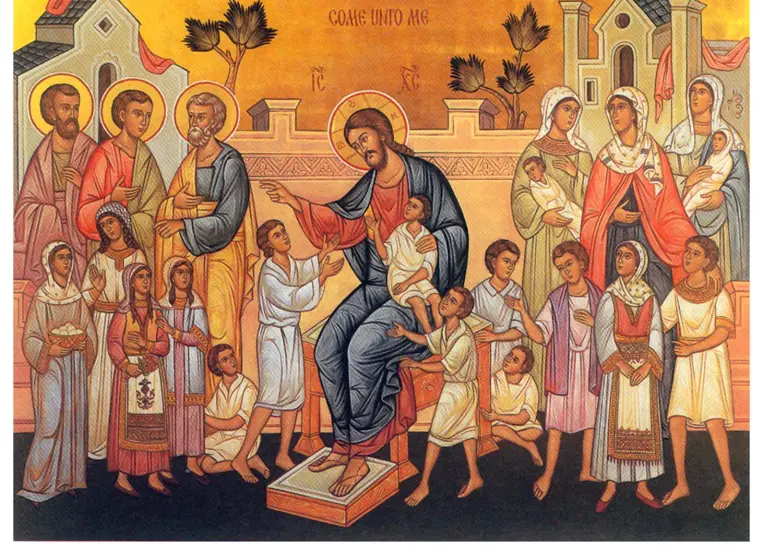
Kids are part of that mass of people that God is with. Children deserve as much or more attention than adults. More than simply saying that we care about kids, we need to be like Jesus. He let the children come to him and was intolerant of anyone preventing kids from doing so.

Since the disciples were, ironically, still living in a small world, they rebuked those who brought little children to Jesus.

We aren’t specifically told why the disciples rebuked the adults bringing children to Jesus. Maybe the children were making a lot of noise and were being a nuisance in the middle of Jesus’ teaching. Perhaps the disciples had Jesus on a tight time schedule and this bringing kids to Christ thing was causing a delay. It could be that the disciples simply saw children as an interruption to the “important” work of ministry. 

I tend to think that the disciples simply failed to appreciate the children. The dominate view of kids in the ancient world was to see them as potential adults. Kids were pretty low on the ladder of society. The disciples likely saw no reason for children to be involved in what was happening.

The babies and toddlers and small children were brought so that Jesus might place his hands on them and pray for them. That still seems to me to be the best reason to bring kids to Jesus. 

“This story teaches us that Christ does not receive only those who voluntarily come to Him of a holy desire and moved by faith, but also those who might not yet be old enough to realize how much they need His grace….  From this we gather that His grace reaches to this age of life also….  It would be cruel to exclude that age from the grace of redemption.”

John Calvin

“Jesus does not only save repentant adults; he also saves dependent children and all those whom we think are incompetent to respond to Jesus.”

Frederick Dale Bruner

Jesus flat out rebuked his disciples for hindering the little children from coming to him. He wanted just the opposite of what was taking place. Why? Because the kingdom of heaven belongs to such little people as these. 

As mentioned, children were at the bottom of the societal pecking order in the ancient world. Their place in that society was to be respectful and quiet, to speak only when spoken to, and to never interrupt an adult.

Yet, Jesus took the time to touch them and pray for them. He invited this interruption to his schedule. Christ bluntly told his disciples that they were the ones being the hindrance, not the kids.

I baptize all sorts of people, including kids and babies. Why? Because in baptism, I recognize that the smallest ones among us can come to this holy sacrament. I understand that in baptism the Holy Spirit begins and initiates the process of salvation that will take that little one from infancy to adulthood and eventual death. I discern that, ideally, the child grows to live into their baptism by recognizing by faith that Jesus died and rose from the dead and grants grace and forgiveness to all who come to him. 

In that process of salvation, of coming to know Jesus, we have the sacrament of the Lord’s Table to strengthen our faith and demonstrate to us that the saving work of Jesus that has been accomplished. It is a Table of grace for all the members of Christ’s Church. 

In my Reformed Christian tradition, we believe that Jesus is not physically, but spiritually present at the Table.  Because Jesus is present, we are able to receive the grace available to us as Christ’s members. So why, in light of this reality, and the words and practice of Jesus toward children, would we ever hinder and prevent the smallest members among us from participating at the Table?
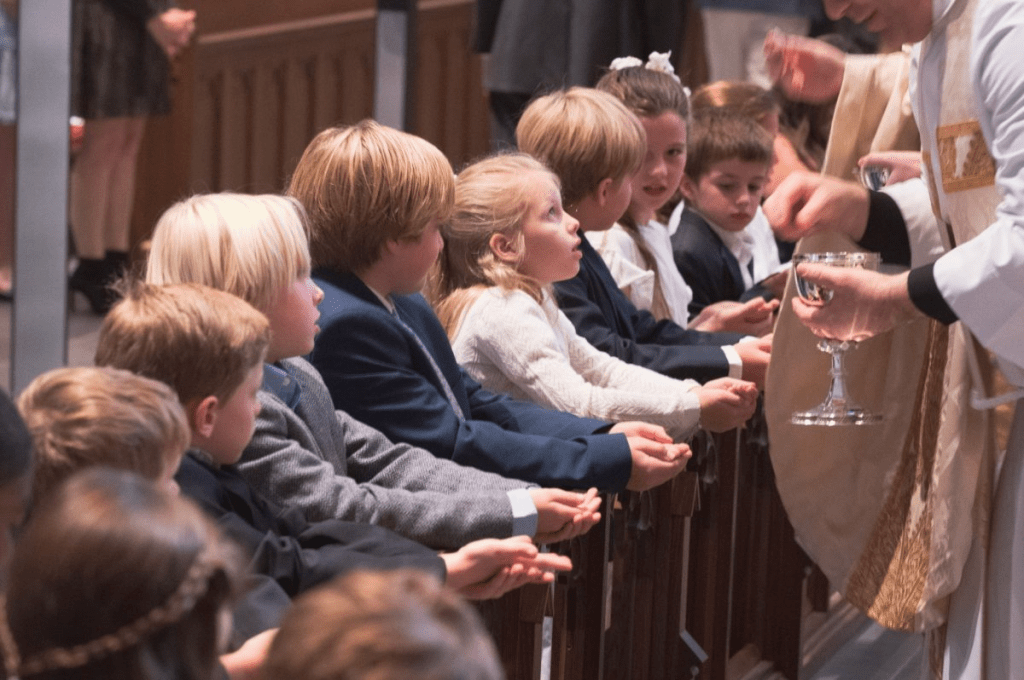
Here’s a thought: If Jesus himself were serving communion in a church, and a group of 2-year-old children came toddling up to the Table to see Jesus, would you stop them from doing so? Or much like the disciples, would you rebuke those bringing children to Jesus?

As for me, I’d rather not be rebuked by my Lord.

Jesus gave children the three gifts they most need: time, touch, and prayer. Parenting and teaching are holy vocations, and we have the wonderful privilege of bestowing these same gifts on our children, grandchildren, and students.

Time, touch, and prayer are ways we bless children. And, what’s more, as God’s children, we are all to approach Jesus and spend time with him, allow him to touch us, and interact with him through prayer. 

May we all have the humility to bend down at eye level to the littlest among us so that we and others will know that the kingdom of God is among us.

1 John 3:1-7 – Children of God, Loved by God

Welcome, friends! The Christian’s true status and identity cannot be changed any more than a tiger can change his stripes. An abundant life of love flows freely and organically from the person secure in their identity in Christ. Click the videos below and let us bask in the reality of our position in Jesus Christ….

1 John 3:1-7, Pastor Tim Ehrhardt
Who You Say I Am Lyric Video – Hillsong Worship, 2018. Written by Reuben Morgan and Ben Fielding.

May the love of the Lord Jesus draw you to himself.
May the power of the Lord Jesus strengthen you in his service.
May the joy of the Lord Jesus fill your hearts.
And may the blessing of God almighty – the Father, the Son, and the Holy Spirit – be among you and remain with you always. Amen.

Children of God, Loved by God

By Unknown artist

See what great love the Father has lavished on us, that we should be called children of God! And that is what we are! The reason the world does not know us is that it did not know him. Dear friends, now we are children of God, and what we will be has not yet been made known. But we know that when Christ appears, we shall be like him, for we shall see him as he is. All who have this hope in him purify themselves, just as he is pure.

Everyone who sins breaks the law; in fact, sin is lawlessness. But you know that he appeared so that he might take away our sins. And in him is no sin. No one who lives in him keeps on sinning. No one who continues to sin has either seen him or known him.

Dear children, do not let anyone lead you astray. The one who does what is right is righteous, just as he is righteous. (1 John 3:1-7, NIV)

True children of God, Christians, are loved by God – that is their status and identity. This cannot be changed any more than a tiger can change his stripes.

True children of God live, remain, abide, and continue in their identity as Christians. They know who they are and how they are to live.

Who We Are

When Jesus was on this earth, he was misunderstood by a lot of people. Christians must learn to expect the same. True children loved by God will neither fit in with the world nor seek the world’s affirmation and accolades. The practical difference between Christianity and the world is that Christians locate their primary identity, allegiance, and purpose in Christ, whereas the world finds their identity elsewhere.

Being loved by God brings assurance, peace, security, and hope. These qualities cannot be manufactured by us because they are results of being loved. The world cannot give us these characteristics. This does not mean that Christians always have it all together. We are continually in a process of discovering our identity and growing more and more into that uniqueness. The reason Jesus lived his life without needing the world’s recognition is that he was firmly and securely assured of the Father’s love and care for him. 

Christians continue to learn what it means to be loved by God in Christ. This love helps fortify our faith so that we will not find our identities in worldly roles, however intrinsically good those roles might be. For example, a parent with the primary identity as mother or father will view salvation as coming through the family. Or a person with the primary identity as teacher will see deliverance coming through education. 

When Christians have their primary identity as children of God, loved by God, then they see deliverance from guilt, shame, darkness, and oppression as coming through Jesus. When the church, living and serving together, secure in their identity as children of God, loved by God, then she can withstand any adulterous flirtations from the world to woo them away from Jesus.

We are children of God. We are not children of the world’s institutions, systems, organizations, ethos, mores, and values. Everyone who has hope in Christ is pure and holy. When we locate our primary identity in being loved by God, we avoid defiling ourselves with the world’s grime. We take regular spiritual baths which cleanse us from the world’s crud. We keep reminding ourselves and each other of our true status as God’s children. We do not allow any other identity to topple or replace our wonderful reality of being loved by God.

How we view ourselves will determine how we live our lives.

How We Are to Live

True children of God abide by the law because they abide in Christ. Jesus said all the law could be summed up in two commands: Love God. Love neighbor. Breaking the law means:

  • Hating instead of loving.
  • Working to undermine someone instead of seeking their best interests.
  • Excluding others instead of including others.
  • Dividing and opposing instead of unifying and cooperating. 

No one abiding in Christ continues the same trajectory they had before knowing Christ. Jesus came to take care of the sin issue once for all through the cross. Therefore, Christians, loved by God, cannot be lawbreakers if they are abiding; the two cannot co-exist with each other.

So, our primary task as Christians is to abide in Jesus and remain firmly in our identity as children of God, loved by God. We are to love by remaining in God’s love and allowing love to shape all our thoughts, words, and actions. We will continue to be steadfast in that love. We will not be led astray. We will abide in Christ.

Identity and life work together. For example, I am currently a citizen of the state of Wisconsin. I not only geographically live in Wisconsin, but I am to abide in the state as a responsible person. Being a Wisconsinite is different from the rest of the world. Wisconsinites are readily identifiable by their sports and their food.

Lambeau Field, home of the Green Bay Packers

Diehard Green Bay Packer fans forsake any identification as Lions, Bears, or the god-forsaken pagan Vikings. They like their prep and collegiate sports, flock to curling clubs, get married in bowling alleys, and observe time through the various hunting seasons. Citizens of Wisconsin like their food and drink. Nothing compares to the Friday night fish fry, cheese curds, venison, mustard – all washed down with either a Spotted Cow, Leinenkugel’s, or a trip to the bubbler.

We are to become more and more like Christ. Our identity as loved by God means we will seek to live in Christ by living a life of love. The people of Wisconsin have a general reputation of being polite and helpful, not rude and unhelpful. All their citizens should live into this identity and behavior. And as Christians whose primary identity is in being children of God, loved by God, we should abide in Christ through love and obedience. 

“I am the true vine, and my Father is the gardener. He cuts off every branch in me that bears no fruit, while every branch that does bear fruit, he prunes so that it will be even more fruitful. You are already clean because of the word I have spoken to you. Remain in me, as I also remain in you. No branch can bear fruit by itself; it must remain in the vine. Neither can you bear fruit unless you remain in me.

I am the vine; you are the branches. If you remain in me and I in you, you will bear much fruit; apart from me you can do nothing. If you do not remain in me, you are like a branch that is thrown away and withers; such branches are picked up, thrown into the fire and burned. If you remain in me and my words remain in you, ask whatever you wish, and it will be done for you. This is to my Father’s glory, that you bear much fruit, showing yourselves to be my disciples.

As the Father has loved me, so have I loved you. Now remain in my love. If you keep my commands, you will remain in my love, just as I have kept my Father’s commands and remain in his love. I have told you this so that my joy may be in you and that your joy may be complete. My command is this: Love each other as I have loved you. Greater love has no one than this: to lay down one’s life for one’s friends. You are my friends if you do what I command. I no longer call you servants because a servant does not know his master’s business. Instead, I have called you friends, for everything that I learned from my Father I have made known to you. You did not choose me, but I chose you and appointed you so that you might go and bear fruit—fruit that will last—and so that whatever you ask in my name the Father will give you. This is my command: Love each other.” (John 15:1-17, NIV)

Conclusion

A true Christian is a child of God, not the world. Our behavior flows from who we are. If our primary identity is securely in being a loved child of God, then what comes out of us will be loving words and actions, even to those in the world who might not believe or understand.

When we think about our world, it can be a sad place, devoid of love. People from different cultures and backgrounds often do not get along with each other. Political parties have difficulty finding common ground. Some Christians cannot seem to get along with other Christians. In the world, differences often divide us. Can people different from each other get along? 

The early church did. And they did it without all the stuff we have – sanctuaries, church buildings, programs. Those early believers did it through the message of the cross using the basic tool of love. Not every Christian will serve on the foreign mission field or serve in a professional ministry position. However, every Christian can be loving.

True children of God are loved by God. They are characterized by the Christian practices of hospitably loving the immigrant and stranger, loving their enemies, forgiving those who have sinned against them, and obeying God’s commands. These practices stem the tide of evil and hate in the world and usher in the love of God in Christ.