The Power of Deliverance (Exodus 14:10-31, 15:20-21)

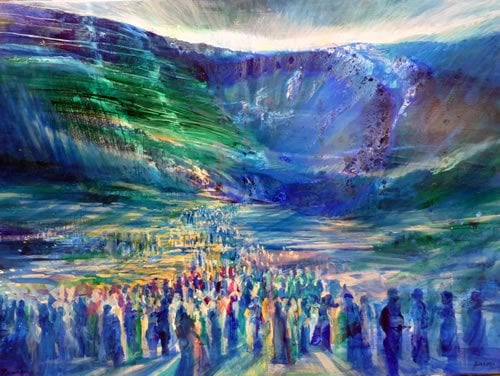
The Parting of the Sea, by Yoram Ranaan

As Pharaoh approached, the Israelites looked up and saw that the Egyptians were coming after them. Terrified, the Israelites cried out to the Lord. They said to Moses, “Did you bring us out into the desert to die because there were no graves in Egypt? Look what you’ve done by bringing us out of Egypt! Didn’t we tell you in Egypt, ‘Leave us alone! Let us go on serving the Egyptians’? It would have been better for us to serve the Egyptians than to die in the desert!”

Moses answered the people, “Don’t be afraid! Stand still, and see what the Lord will do to save you today. You will never see these Egyptians again. The Lord is fighting for you! So be still!”

Then the Lord said to Moses, “Why are you crying out to me? Tell the Israelites to start moving. Raise your staff, stretch out your hand over the sea, and divide the water. Then the Israelites will go through the sea on dry ground. I am making the Egyptians so stubborn that they will follow the Israelites. I will receive honor because of what I will do to Pharaoh, his entire army, his chariots, and cavalry. The Egyptians will know that I am the Lord when I am honored for what I did to Pharaoh, his chariots, and his cavalry.”

The Messenger of God, who had been in front of the Israelites, moved behind them. So the column of smoke moved from in front of the Israelites and stood behind them between the Egyptian camp and the Israelite camp. The column of smoke was there when darkness came, and it lit up the night. Neither side came near the other all night long.

Then Moses stretched out his hand over the sea. All that night the Lord pushed back the sea with a strong east wind and turned the sea into dry ground. The water divided, and the Israelites went through the middle of the sea on dry ground. The water stood like a wall on their right and on their left.

The Egyptians pursued them, and all Pharaoh’s horses, chariots, and cavalry followed them into the sea. Just before dawn, the Lord looked down from the column of fire and smoke and threw the Egyptian camp into a panic. He made the wheels of their chariots come off so that they could hardly move. Then the Egyptians shouted, “Let’s get out of here! The Lord is fighting for Israel! He’s against us!”

Then the Lord said to Moses, “Stretch out your hand over the sea so that the water will flow back over the Egyptians, their chariots, and their cavalry.”

Moses stretched his hand over the sea, and at daybreak the water returned to its usual place. The Egyptians tried to escape, but the Lord swept them into the sea. The water flowed back and covered Pharaoh’s entire army, as well as the chariots and the cavalry that had followed Israel into the sea. Not one of them survived.

Meanwhile, the Israelites had gone through the sea on dry ground while the water stood like a wall on their right and on their left. That day the Lord saved Israel from the Egyptians, and Israel saw the Egyptians lying dead on the seashore. When the Israelites saw the great power the Lord had used against the Egyptians, they feared the Lord and believed in him and in his servant Moses….

Then the prophet Miriam, Aaron’s sister, took a tambourine in her hand. All the women, dancing with tambourines, followed her. Miriam sang to them:

“Sing to the Lord.
He has won a glorious victory.
He has thrown horses and their riders into the sea.” (God’s Word Translation)

Things can change quickly.

One day, you’re living in slavery, and the next, you’re free. One minute, you’re celebrating freedom, then the next minute, you’re backed into a corner, and it looks like the end – only to be dramatically delivered from calamity.

One day (Holy Saturday) the disciples were lower than a snake’s belly in a wagon wheel rut; the next day (Easter Sunday) they’re wondrously slack-jawed with hopes higher than the sky.

Today’s Old Testament reading impresses on us the necessity of trusting God one day at a time, one minute at a time. Circumstances will change; God’s basic character will not change. Therefore, we have the continual opportunity of exercising our faith, and practicing trust in the Lord, by living into a new reality.

In this Christian season of Eastertide (spanning the next 50 days until the Day of Pentecost) we discover resurrection power in putting to death old unhealthy practices and adopting new healthy life-giving habits. Eastertide’s intentional focus is to recognize and celebrate the resurrection of the Lord Jesus Christ, and so, to exult in our own new life in him.

Revisiting both Christ’s resurrection, and the Red Sea deliverance, helps to remind us God’s invisible power to save is stronger and greater than any visible powers on this earth. Both of these deliverance stories keep us focused on the hope of individual renewal, corporate revitalization, and worldwide revival.

Eastertide is the season to engage in some renewal practices. The following are a few ideas for living into our deliverance from God:

  • Pray for revival of spirituality. Christ brings salvation and life, so praying to God for revival is a deliberate way of connecting with God.
  • Pay attention to words. Gossip, back-biting, slander, and other sins of the tongue kill people. Instead, consider how to use your speech for encouragement, love, mercy, forgiveness, and building up one another. This promotes growth, health, and life.
  • Proclaim resurrection. I believe the church is meant to be the hope of the world because Christ is the risen Lord. Graciously proclaim the resurrected Christ and how the spiritual life makes a difference in life.
  • Put yourself out there. Start the new ministry you always believed would make a difference. Take a risk. You’ve been given eternal life, so can you really fail?
  • Promote daily habits of spiritual health and life. Develop a realistic and workable plan for yourself when it comes to basic spiritual practices of Scripture reading, prayer, worship, etc. And stick to it by involving others.

There will always be people in our lives who try and pull us from what’s most important, even persons who want to keep the status quo to the point of seeking to destroy us. Be ready. Keep Eastertide in front of you; God has raised us to new life.

Allow Christ’s resurrection take root in your heart to such an extent that life itself informs all your thinking, speaking, feeling, and acting. The victory is won. So, sing to the Lord!

It’s All About Jesus (Luke 24:44-53)

“Road to Emmaus” by He Qi

Jesus said to them, “These are my words that I spoke to you while I was still with you—that everything written about me in the Law from Moses, the Prophets, and the Psalms must be fulfilled.” Then he opened their minds to understand the scriptures. He said to them: 

“This is what is written: the Christ will suffer and rise from the dead on the third day, and a change of heart and life for the forgiveness of sins must be preached in his name to all nations, beginning from Jerusalem. You are witnesses of these things. Look, I’m sending to you what my Father promised, but you are to stay in the city until you have been furnished with heavenly power.”

He led them out as far as Bethany, where he lifted his hands and blessed them. As he blessed them, he left them and was taken up to heaven. They worshipped him and returned to Jerusalem overwhelmed with joy. And they were continuously in the temple praising God. (Common English Bible)

Perhaps you are feeling lost, maybe overwhelmed. Likely, you have experienced the feeling, even many times in your life, of being ungrounded, lacking a solid foundation under your feet – not quite knowing what’s up or down.

You sense there needs to be a great unifying force in your life – something to orient yourself around and make sense of the world, others, and especially yourself.

From the standpoint of Christianity, all of Holy Scripture – both Old and New Testaments – are focused upon and have their centrality in the person and work of Jesus the Christ. And it is this same Christ who opens us to understanding the scriptures.

My earliest memories of the Bible are in the church in which I grew up. I remember Bible stories from Sunday School and the pastor talking about particular verses from the Bible while I sat in our regular family pew. 

It wasn’t until my late teen years that I took up the task of reading the Scriptures for myself. And, I have to tell you, it absolutely changed my life. I found that many of the stories I heard as a kid were a lot juicier than I realized. I also discovered that there were simply a lot of things in the Bible I didn’t know even existed. 

However, the most profound breakthrough for me was plowing through all four Gospels and seeing the life and ministry of Jesus. My adoration and appreciation of Christ rose exponentially after watching him in action throughout Matthew, Mark, Luke, and John.

Rowan LeCompte (1925–2014) and Irene Matz LeCompte (1926–1970), The Walk to Emmaus. Resurrection Chapel, National Cathedral, Washington, DC. Photo: Victoria Emily Jones

I was so impressed with reading the Gospels that I moved into the rest of the New Testament. Then, I went back to the Old Testament and read the entire thing. In a matter of months I had read the entire Bible. Yet, I had more questions than when I started. There was just far too much I didn’t understand about it. 

So, I read the whole thing again… then again… and again… somewhere along the line, I’ve lost count of how many times I have read the Bible – I estimate around four-hundred times for the New Testament and the Old Testament about two hundred. And I still have so much more to learn and discover!

I’m not telling you this to impress anyone. In fact, many feel as if all that reading of the Bible is over the top. I assure you that it isn’t. 

After all, how could the living Christ ever open my mind to understanding the scriptures if I never bothered to read them?

And, after having read it once, why in the world would I spend so much of my life in plain straightforward reading of the Bible? I offer several reasons for my practice:

I can only lay hold of God’s promises if I know what they are. 

Living from a place of faith and calm in the midst of uncertainty and unrest doesn’t just happen. It comes from knowing the words of Scripture and allowing Christ to permeate my soul. The promises of Scripture are like an asthmatic’s inhaler, enabling us to slow down and take a deep breath.

I can only be like Jesus if I am getting to intimately know him. 

Reading Scripture about Jesus is like eating food. I have to do it regularly. It nourishes me for the day. Bible reading is stored energy, stockpiled emotional and psychological capital.   can speak and act like Jesus throughout the day by making moment-by-moment withdrawals from that vast reservoir of stored Scripture knowledge.

I can only be wise if I am connected to wisdom literature. 

By nature, we are all ignorant, and have to learn what is wise, just, and good through humility and experience. Over time, we can shed folly and become wise. I need help with becoming wise. I need a word from God each and every day to face life’s challenges, its ups-and-downs, as well as its mediocrity and mundane nature. Every day the Bible tweaks my life and prompts fresh mid-course corrections.

I need to see Jesus for who he is, and not what I think he is. 

Everyone has an idea about Jesus. But I believe the Christian Scriptures tell me who Jesus really is in all of his attributes, character, and sovereignty – which then tells me who God actually is. God is pretty big – so big that I can read the Bible for a lifetime and never exhaust knowing the Lord. I read my Bible in order to sharpen my vision of God and to think more accurately about all that matters most in this life.

I need to see the Church for what it is, and not what I think it is. 

Everybody and their dog have an opinion about how church should be and operate. But I must take my cues from the Bible about what is most important about the church and what it should be doing. I read the Bible in order to better know and understand who God’s people really are, and what they ought to be doing in this world. That’s important because the church is Christ’s Body.

I need Jesus. 

Reading the Bible is a personal experience — an actual encounter with the author. Daily Bible reading requires routine and structure, but it’s not mechanical—just as a body requires a bony skeleton, but it’s not the skeleton that gives it life. We do with the Bible what the Psalms guide us in doing—adore God, thank God, complain to God, wrestle with God, express perplexity to God, etc. Without God I am lost. Which is why, apart from Scripture, I am lost.

Reading the Bible is an investment of time, energy, reflection, meditation, and prayer. Struggling through its contents can change your life. It did mine. 

One of the great tasks you could ever do is to read the entire Bible from Genesis to Revelation, because it is God’s Word that reveals to us Jesus, the center of it all, the way, the truth, and the life.  

Anyone Can Change (Jonah 3:1-10)

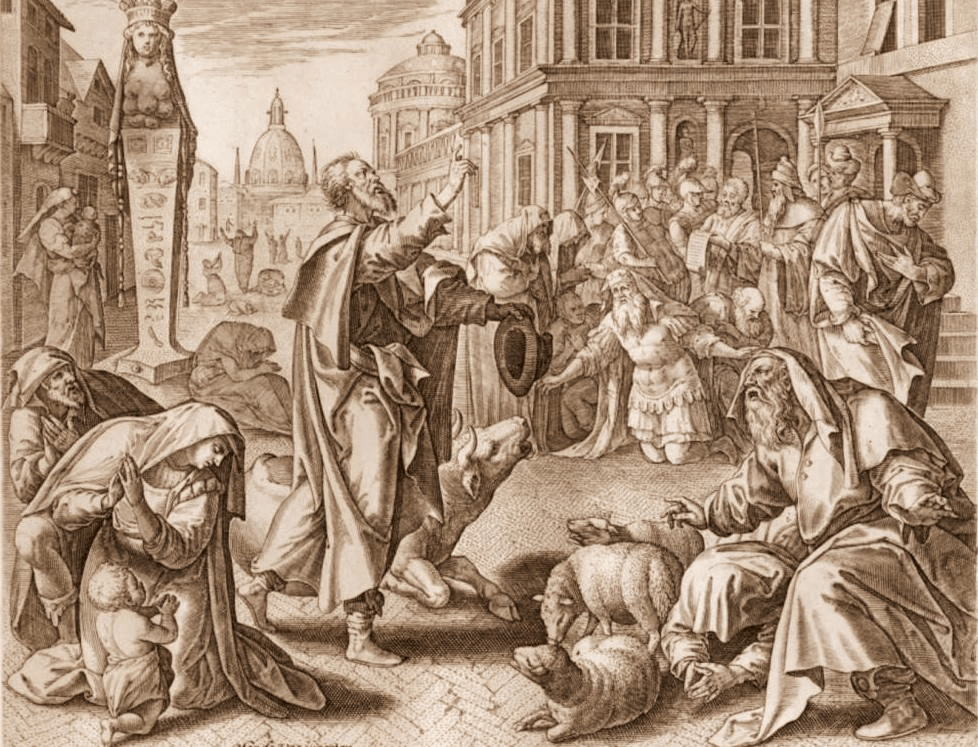
Print of Jonah preaching to the Ninevites and their repenting, by Philip Galle 1547–1612 

The Lord’s word came to Jonah a second time: “Get up and go to Nineveh, that great city, and declare against it the proclamation that I am commanding you.” And Jonah got up and went to Nineveh, according to the Lord’s word. (Now Nineveh was indeed an enormous city, a three days’ walk across.)

Jonah started into the city, walking one day, and he cried out, “Just forty days more and Nineveh will be overthrown!” And the people of Nineveh believed God. They proclaimed a fast and put on mourning clothes, from the greatest of them to the least significant.

When word of it reached the king of Nineveh, he got up from his throne, stripped himself of his robe, covered himself with mourning clothes, and sat in ashes. Then he announced, “In Nineveh, by decree of the king and his officials: Neither human nor animal, cattle nor flock, will taste anything! No grazing and no drinking water! Let humans and animals alike put on mourning clothes, and let them call upon God forcefully! And let all persons stop their evil behavior and the violence that’s under their control!” He thought, Who knows? God may see this and turn from his wrath, so that we might not perish.

God saw what they were doing—that they had ceased their evil behavior. So God stopped planning to destroy them, and he didn’t do it. (Common English Bible)

Anyone can turn around, even the nastiest of people.

Lent (the Christian season lasting six weeks from Ash Wednesday to Easter Sunday) is the ideal time of year to change, to turn around, to repent — to return to God and re-focus our lives.

The season of Lent is something like a forty-day trial run in changing your lifestyle and letting God change your heart. Repentance is the key that unlocks the soul’s ability to connect with God. To repent means to stop going in one direction and start going in another one. It makes all the difference in the orientation of our souls. 

Repentance leads to a real change of direction, a complete re-orientation of life. The evidence of such a change is this:

  • Owning up to the problem and confronting it
  • An eagerness to make things right
  • Indignation over what has been done or said
  • A desire and energy to do what is best for those we have wronged
  • A willingness to accept whatever consequences that might result from the offense

There’s nothing romantic about repentance; it’s typically messy, usually ugly, and often painful. Yet, there must be suffering before glory. Trying to take repentance out of the equation is to eviscerate life and leave our souls vacuous and empty.

Sometimes, we may not even realize we need to repent because we get caught up in the drama of whatever we’re doing – school, relationships, family, church, or work. Our lives can become filled with distractions that take us away from the spiritual life and the need to change.

But our soul knows it’s empty. And so, often unaware, we try to fill the vacuum with meaningless stuff, busywork, and mindless activities. What we’re really doing is running from real life and from God. 

We need to connect with the Divine; we need repentance. The Ninevites instinctively knew what to do; they fasted, prayed, and changed their ways. If a group of people who were experts at human torture and abuse could know this and intentionally pay attention to God, then how much more ought we to connect with what is most important?

Godly sorrow brings repentance that leads to salvation and leaves no regret.

2 Corinthians 7:10, NIV

Throughout Holy Scripture, whenever people were confronted with divine realities, they were completely undone; they began to see their own sin for what it truly is. 

When the Apostle Peter saw the Lord Jesus in his immensity and power through a miraculous catch of fish he fell at Jesus’ knees and said, “Go away from me, Lord; I am a sinful man.” (Luke 5:8) 

When the Apostle John had a vision of Jesus Christ in all his glory, and heard his voice, he fell at the Lord’s feet as though dead. (Revelation 1:12-17)

When the prophet Ezekiel had a vision of God and saw the appearance of God’s glory, he fell facedown. (Ezekiel 1:25-28) 

Even Daniel, perhaps the most righteous prophet and person of all time, saw a vision of God in all his glory, he fell prostrate with his face to the ground, totally overwhelmed with God’s holiness and human sinfulness. (Daniel 8:15-18)

We must put ourselves in a position to hear God so that we can turn from all the obstacles that prevents us from experiencing life as it is meant to be lived. And the all the things which hinder us from repenting are legion:

  • inattention to God’s words and God’s creation
  • constant and prolonged preoccupations and daydreams that prevents availability to God
  • lack of sleep and good health habits that dulls the spiritual senses and prevents awareness of God
  • a paucity of spiritual practices and disciplines that would put us in a position to experience God

Let us, then, take a lesson from the repenting Ninevites and pay attention to God. For God is calling, yet we do not hear him. So, let’s put ourselves in a position to hear the message of God; identify the things that grieve God’s heart; and repent.

God has gone out of the way to reach us so that we can change for the better. And anyone, no matter who they are, can experience it – even a terribly sinful nation of people.

What will you do with this grace?

Almighty and everlasting God, the One who freely pardons all who repent: Redeem and renew every penitent heart with your infinite mercy and grace, forgiving all our sins, and cleansing us from an evil conscience. Amen.

A Changed Life (Galatians 1:11-24)

A mosaic of the Apostle Paul in St Isaac’s Cathedral, St. Petersburg, Russia

I want you to know, brothers and sisters, that the gospel I preached is not of human origin. I did not receive it from any man, nor was I taught it; rather, I received it by revelation from Jesus Christ.

For you have heard of my previous way of life in Judaism, how intensely I persecuted the church of God and tried to destroy it. I was advancing in Judaism beyond many of my own age among my people and was extremely zealous for the traditions of my fathers. But when God, who set me apart from my mother’s womb and called me by his grace, was pleased to reveal his Son in me so that I might preach him among the Gentiles, my immediate response was not to consult any human being. I did not go up to Jerusalem to see those who were apostles before I was, but I went into Arabia. Later I returned to Damascus.

Then after three years, I went up to Jerusalem to get acquainted with Cephas and stayed with him fifteen days. I saw none of the other apostles—only James, the Lord’s brother. I assure you before God that what I am writing you is no lie.

Then I went to Syria and Cilicia. I was personally unknown to the churches of Judea that are in Christ. They only heard the report: “The man who formerly persecuted us is now preaching the faith he once tried to destroy.” And they praised God because of me. (New International Version)

I didn’t ask God for this

Saul wasn’t looking to change anything – except maybe to keep those confounded Christians, the group known as “The Way,” out of his beloved religion. He didn’t wake up one morning, sit on the edge of his bed and say, “Well, now, gee-whillikers, I think I’ll become the Apostle Paul, follow Jesus, and rankle a bunch of my fellow Jews with establishing churches all over the place.”

The only well-thought out plan Saul had was to ensure that Christians stayed away by any means possible. He had quite the turn around by actually joining the Christian movement. (Acts 9:1-19)

From the very get-go of his conversion, the new Paul faced skepticism, doubts, and opposition from both church and synagogue. Christians knew how Saul breathed all kinds of threats against them; so, understandably, they were reticent to receive him, perhaps wondering if it were some sort of ruse to topple the church. If it were not for the insight and encouragement of Barnabas, Paul may not have ever entered the ranks of the church. (Acts 9:26-27)

Paul’s fellow devout Jews were so upset with him for becoming a turncoat that they sought to kill him – which became a theme of Paul’s life – getting rocks thrown at him, whipped, beaten, and left for dead more than once. (Acts 9:23-24; 2 Corinthians 11:24-29)

Although Paul never asked for a dramatic conversion to Christianity, a missionary life, and continual suffering at the hands of others, he nevertheless embraced it with all the gusto of faith God gave him.

So, the gospel that the Apostle Paul proclaimed wasn’t something he sought; it was given to him. God graciously revealed the good news to Paul. For three years, he received it. Considering Paul’s background and former life, we can see why it might not be a good idea for him to hang out in Jerusalem and learn about Jesus.

Arabia is a desert. That is precisely where Paul needed to be in his early life as a Christian. Eventually, the churches and believers came around to seeing the authenticity of Paul’s faith and embraced him as a disciple. Paul is considered an Apostle because he had direct contact with Jesus himself in the Arabian desert.

God called me through the grace of Jesus

That phrase is Paul’s spiritual autobiography in a nutshell. It represents his dramatic transformation — from persecutor to preacher — and gives evidence of the hand of God at work in his life.

The fundamental conviction of being called by God, anchors Paul’s faith story. He tells that story in order to remind the Galatian Church of their own experience of being called by God’s grace.

Paul wrote his letter to the Church to help keep them on the track of grace; they were saved by grace, so therefore, they needed to also be sanctified by grace (and not law). He feared they were being led astray by believers who twisted the gospel for their own ends in order to avoid suffering. (Galatians 6:12)

The question Paul tackled head on was: Do the Gentiles have to become Jewish in order to be Christians? “Absolutely not!” Paul insisted. Neither circumcision nor uncircumcision counts for anything; the only thing that counts is faith working through love. (Galatians 5:6)

I connected with God, and you can, too

Paul was arguably the most influential Christian who ever lived. He shared his faith story in order to encourage the Galatians to examine their own experiences for signs of God’s call.

How has God called you?

It matters little whether it’s a dramatic call, like Paul’s, or whether it seems mundane, as if you don’t remember a time that you didn’t believe. And everything in between.

The important point is that we all need moments, events, and experiences of life transformation; and God’s grace must be the defining center of our personal and collective narratives.

Grace makes all the difference and is what leads to a changed life.

Once you were separated from God. The evil things you did showed your hostile attitude. But now Christ has brought you back to God by dying in his physical body. He did this so that you could come into God’s presence without sin, fault, or blame. (Colossians 1:21-22, GW)

Almighty God, transform us – not for our benefit, but for the benefit of the world. Do your work in changing us to be the new creation you have called us to be in Jesus Christ.  

Holy Spirit of God, do your sanctifying work in the church and help us to be the Body of Christ – engaged in mission, testifying to our faith, and bearing witness to the presence of our Savior, Jesus Christ. 

Lord Jesus, enable us to surrender the church back to you. It is yours, not ours. Help us lay aside our personal agendas and preferences so we can be fully committed to your calling for us. 

Blessed Holy Trinity – Father, Son, and Spirit – the God whom we serve: Do your work in our world and give to us a vision of transformed lives, renewed neighborhoods, and restored communities – bringing blessings and redemption for the glory of God. Amen.