A Psalm of Lament For the Government of the United States of America

Many, if not most, people fail to acknowledge their grief, and therefore fail to lament their significant changes and losses in life.

What’s more, many, if not most, Christians do the same thing because they focus too much upon triumphalism to the exclusion of dealing with suffering. “Just get over it!” is the mantra to themselves and others.

But that is not a biblical approach to change and loss. 62 out of the 150 Psalms in the Old Testament are laments; some are communal, and others are individual expressions of grief.

Even God laments. We must never forget that a major role of God in our own loss is that the Lord grieves and laments along with us.

Keep in mind that grief can attach itself to any significant change or loss; it is the normal emotional, spiritual, physical, and relational reaction to that loss.

Lament is an intentional process of letting go of relationships and dreams, and living into a new identity after the loss or change.

Please know that everyone’s grief is personal; there is no one-size-fits-all. Thus, the following psalm of lament is my own. It is not meant to be a dig on someone else who rejoices in what I happen to lament. It’s just simply my own sadness over the state of affairs in my beloved nation…

O Lord, I’ll get right down to it: Help!

          I have always taken my refuge in You.

Rescue us, the American people;

          free us from the injustice and unrighteousness rampant in our government.

Be a strong rock to which the oppressed may rely upon;

be a place where I may always go.

You, O God, have saved us many times in the past,

          and Your divine providence has guided us, despite our past and many sins.

My God, free the innocent and the poor from the hands of wicked persons,
         from the grasp of the cruel and unjust President of the United States.

For decades, members of both political parties agreed to safely regulate business;

they’ve decided to provide a social safety net, promote infrastructure, and protect civil rights.

Ideally, the U.S. government has sought to protect every American,

by access to education, healthcare, transportation, communication, employment, and resources.

And elected officials thought primarily of the common good,

so that every American could work hard and prosper.

But what is happening today in the United States,

is the same thing which occurred so long ago in ancient times.

We are in similar situations when the Old Testament prophets called out greed,

          injustice, and abuse in Israel and Judah.

Hear this word that I take up over you in lamentation, O house of Israel…  

They [the rich and powerful] hate the one who reproves in the gate,
    and they abhor the one who speaks the truth.
Therefore because you trample on the poor
    and take from them levies of grain,
you have built houses of hewn stone,
    but you shall not live in them;
you have planted pleasant vineyards,
    but you shall not drink their wine.
For I know how many are your transgressions
    and how great are your sins—
you who afflict the righteous, who take a bribe
    and push aside the needy in the gate.

Hate evil and love good,
    and establish justice in the gate. (Amos 5:1, 10-12, 15a, NRSV)

Perhaps because so few persons even read the prophetic books anymore,

our ignorance has allowed evil means and ways to take over the government.

We are in a nation and in a world full of oligarchs,

who care only for their exorbitant wealth, abuse of power, and self-interest.

As for me, I will not amble down the path of injustice,

          but walk the path of light and life.

I will embrace truth and harmony,

          unlike so many Republican politicians and their lackeys.

They say one thing and then do another;

          lies and corruption are on their lips.

If we say we are in harmony with him [God] yet walk a path of darkness,
we are living a lie and not following the truth…
If we say that we have no broken ways,
we are lying to ourselves,
and the truth is not alive in us.

(1 John 1:6, 8, First Nations Version)

I must, I will, view our problems differently,

because You are my hope, O Almighty Lord.

You have been my confidence ever since I was young;
          I depended on You through many hard times.

My songs of praise constantly speak about You,

for You are my strong refuge,

the Rock I have built my life upon.

Therefore, my mouth is filled with your praise,

and with your glory all day long.

I make my appeal to You, merciful God;

          I ask for divine intervention and deliverance,

          from the ignorant and sinister machinations of the U.S. President.

Do not reject us forever, O Lord,

or abandon us whenever we are too weak to carry on.

My political (and spiritual) enemies talk about me behind my back,

and plot their evil schemes to silence the truth.

They say, “God is not with him and his nonsense;

          put him in his place because no one will help him.”

O God, be close to me, and to all who love the truth;

          O Lord, come quickly to my aid.

Let those who traffic in lies come to a shameful end;

          let them be covered with disgrace and humiliation.

As for me, I will always have hope,

          because You are the God of all hope.

I vow to testify when Your righteousness wins the Day;

          I will never cease to praise Your sacred way of life.

Even when I am old and my mind is no longer clear,

          do not abandon me, O God.

Let me continue to tell the people of this age

what Your divine strength has accomplished,

to someday tell about how Your power delivered us from evil leadership.

Your righteousness and justice reaches to the heavens, O God;

You have done great things.

O Lord, who is like You?

          saving the poor from injustice,

          and delivering the oppressed from evil.

We, indeed, are enduring many terrible troubles;

          yet You, God, are expert at restoration, right relations, and harmonious ways.

You are the One who comforts the afflicted,

and the One who afflicts the comfortable.

Because of your faithful and steadfast love, O God,

          I will give thanks to You as long as I live.

As long as I have a mouth to speak,

          I will tell about your righteousness all day long.

Evil will not prevail;

          ungodly leadership shall not endure.

May Your divine and loving ways come to this country, O God,

          and may your moral will be done,

          on this earth, as it is always done in Your heaven. Amen.

“Follow Me” (John 21:19b-24)

By Unknown Artist

Then he [Jesus] said to him [Peter], “Follow me!”

Peter turned and saw that the disciple whom Jesus loved [John] was following them. (This was the one who had leaned back against Jesus at the supper and had said, “Lord, who is going to betray you?”) When Peter saw him, he asked, “Lord, what about him?”

Jesus answered, “If I want him to remain alive until I return, what is that to you? You must follow me.” Because of this, the rumor spread among the believers that this disciple would not die. But Jesus did not say that he would not die; he only said, “If I want him to remain alive until I return, what is that to you?”

This is the disciple who testifies to these things and who wrote them down. We know that his testimony is true. (New International Version)

To actually follow Jesus around during his earthly ministry on this planet was amazing; yet singular, for just a few years of time. But to be called to follow Jesus in a post-resurrection world is, obviously, going to look different. It’s not the same.

It seems to me that the command from Jesus to “follow me” in such a world would take anyone a bit of time to wrap their head around. After all, Jesus had risen from death, and was about to ascend to heaven. How do you follow someone who is here, but not here?

Maybe Peter needed some space to try and make sense of it all by deflecting the command onto what’s going to happen with his fellow disciple John, who was hanging around following the two of them.

Jesus, undeterred by Peter trying to get Jesus on another subject, kept his focus on Peter. Again, Christ reiterated the command to Peter: “You follow me.”

It’s far too easy to look at others and wonder about their following, and to be overly concerned about somebody else’s Christian discipleship. If we are honest, oftentimes by doing that approach, we don’t have to deal with our own relationship with Jesus, and what he is saying specifically to me.

The beginning of Christ’s earthly ministry involved the command to “follow me.” And here, at the end of that phase of his ministry, he came back to the disciples, and to Peter, saying the very same thing: “Follow me.”

Even though so much had changed from the first time the disciples were called to follow Jesus, the basic nature of Christian discipleship had not really changed at all. In fact, even today, it still hasn’t much changed. The call still remains from the Lord Jesus to “follow me.”

“Whoever wants to be my disciple must deny themselves and take up their cross and follow me. For whoever wants to save their life will lose it, but whoever loses their life for me will find it.” (Matthew 16:24-25, NIV)

“I am the light of the world. Whoever follows me will never walk in darkness, but will have the light of life.” (John 8:12, NIV)

Anyone who loves their life will lose it, while anyone who hates their life in this world will keep it for eternal life. Whoever serves me must follow me; and where I am, my servant also will be. My Father will honor the one who serves me.” (John 12:25-27, NIV)

Unlike Christ’s earthly ministry, in this post-resurrection world, the call of discipleship and apprenticeship to Jesus, goes out into all the world. It’s for everyone, and not just a select few persons to follow Jesus physically as their rabbi and teacher.

Yet, what is similar, concerning the call to follow Christ, is that we can still today get sidetracked by rumors about other followers. Believers can become enamored with what is happening, or going to happen, with particular Christians and about whether Jesus is going to return today or tomorrow.

But our singular focus, as Christians, as people who embrace the name of Christ, is to follow Jesus. “Follow me” is just as relevant now as it was two millennia ago.

What is important for each of us is to actually focus on our own part in following Jesus. The Good Shepherd is perfectly capable of properly sorting the sheep and the goats. That’s not our job.

We have quite enough on our spiritual plate in dealing with our own Christian discipleship, without sticking our nose in another’s Christian walk with Jesus. There is a fine line between holding another accountable, and just plain old being a no-good spiritual busybody.

So, when it comes to Christian discipleship and following Jesus, we are to mind our own business. Butt out of other people’s walk of faith, and concentrate on your own special calling from God.

We are not to compare our discipleship with others, namely because we each have our place and particular set of spiritual gifts to edify the community. And if we will put our focus on our own specific call to follow, then the Body of Christ is healthy and works together in unity, harmony, and love. (1 Corinthians 12:4-11)

If we concentrate on Jesus, we will be fine. If we choose, however, to be a spiritual busybody, or the self-appointed spiritual police, then we are going to have Judge Jesus to contend with in a way you probably won’t like.

So, what is you calling? How will you relate to Jesus? Will you take up the command from Jesus to “follow me?”

Merciful Lord, give me the courage to take up my cross and follow you, even if it means sacrificing my own comfort and desires. Help me to be obedient to your commandments, to live a life of love, and to serve others with humility.

Thank you, Lord, for your faithfulness and your endless grace. Help me to follow you with all my heart and to live out your teachings in my daily life. Amen.

Third Sunday of Advent – The Ministry of John the Baptist (Luke 3:7-18)

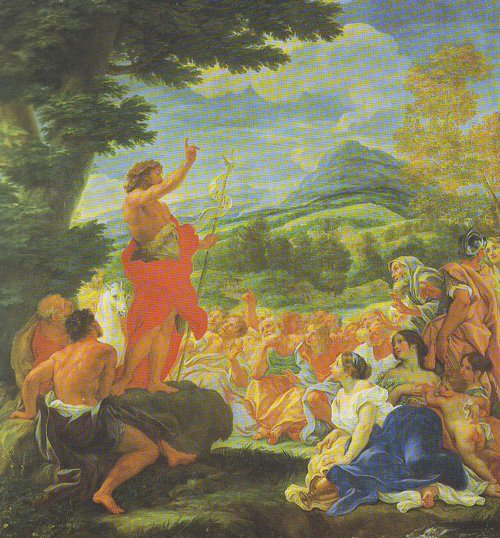
St. John the Baptist Preaching, by Giovanni Battista Gaulli (1639-1709)

John said to the crowds coming out to be baptized by him, “You brood of vipers! Who warned you to flee from the coming wrath? Therefore, bear fruits worthy of repentance, and do not begin to say to yourselves, ‘We have Abraham as our ancestor,’ for I tell you, God is able from these stones to raise up children to Abraham. Even now the ax is lying at the root of the trees; therefore every tree that does not bear good fruit will be cut down and thrown into the fire.”

And the crowds asked him, “What, then, should we do?” In reply he said to them, “Whoever has two coats must share with anyone who has none, and whoever has food must do likewise.” Even tax collectors came to be baptized, and they asked him, “Teacher, what should we do?” He said to them, “Collect no more than the amount prescribed for you.” Soldiers also asked him, “And we, what should we do?” He said to them, “Do not extort money from anyone by threats or false accusation, and be satisfied with your wages.”

As the people were filled with expectation and all were questioning in their hearts concerning John, whether he might be the Messiah, John answered all of them by saying, “I baptize you with water, but one who is more powerful than I is coming; I am not worthy to untie the strap of his sandals. He will baptize you with the Holy Spirit and fire. His winnowing fork is in his hand to clear his threshing floor and to gather the wheat into his granary, but the chaff he will burn with unquenchable fire.”

So with many other exhortations he proclaimed the good news to the people. (New Revised Standard Version)

John’s ministry was meant to be one of preparing people for the Lord’s coming. His understanding of that preparation may seem odd, even harsh, to us.

Yet, John believed that the coming of the Lord meant that Judgment Day was at hand. So, his words are consistent with that sort of theological understanding.

What John did not see at the time – nor anyone else, for that matter – was that the coming of the Lord was happening in two advents, and not just one.

The first advent, or coming, was the incarnation and earthly life of Jesus. This first coming is not yet the time for judgment. The second advent, however, will be all about judgment for both the living and the dead.

That reality, however, doesn’t mean John’s feisty words have no meaning for us. In fact, they have more meaning than ever, because the judgment he foresaw is still yet to come.

We need to hear John’s words, and have the ears to receive those words, because we are in a world that seems ripe for divine judgment.

Repentance – a change of mind and heart that leads to a new life of active justice (not judgment) – is the appropriate preparation for us in this current Advent season.

Amongst the crowds who gathered around John, some recognized how they had fallen short of loving God and neighbor. Some had a profound sense of failing to live faithfully. Others were overwhelmed and came to see and hear the Baptist preach.

Above all, however, John had a warning to the people about relying on their privilege as Jews. It isn’t pedigree that gets anyone anywhere in God’s kingdom.

Instead of putting faith in something like ethnicity or religious beliefs, people ought to be putting their efforts into living a good, right, and just life.

For us today, nobody can rely on special privileges either. It has always been humanity’s responsibility and obligation to love, not hate; serve, not always looking to be served; and showing mercy, not revenge.

The axe comes in many forms, yet it consistently exists to cut off something. Far too many persons, during this time of year, and especially in this season, feel cut off from family or friends. Many sense they are cut off from light, or sanity, as if the world is a surreal place filled with clowns and oligarchs who care nothing for others.

There’s a lot of suffering going on. And any threats of axes and separation are already a reality for too many persons. So, what are we to do with all these icky and unwanted thoughts, feelings, and situations?

John said to the crowd that they were to bear fruit that is worthy of repentance. That is a very biblically language-based way of saying that, for God’s sake, we had better start practicing forgiveness, and see one another from a different angle.

We need a changed viewpoint that leads to a changed heart and life.

There must be a new, or renewed, relationship with God.

If there is doubt about what to do, the answer lies within the problem:

  • For the money-hungry, don’t be greedy, but learn to give away resources
  • For those in authority, don’t abuse power through extortion, but learn to give it away, along with your wages
  • For those who talk a good line, don’t manipulate others, but learn to give your hands and feet to working for a better world, and for your neighbor next door

Learning how to change and be different in this season of Advent is the very best way of preparing to receive the Christ child at Christmas.

One greater than John is coming, with something better than anyone can imagine. It is the gift of a different baptism – fire and spirit – that breathes the power of God into everything it touches.

The axe may be at the root of the tree. There may already be plenty of separation and disconnection. But this year doesn’t have to end in disaster or destruction or disappointment.

You and I, along with everyone who calls on the name of the Lord, can experience deliverance from evil, and freedom to be the people we were always meant to be.

O God of the lost and the displaced, you promise restoration and wholeness through the power of Jesus Christ. Give us faith to live joyfully, sustained by your promises, as we eagerly await the day when they will be fulfilled for all the world to see; through the coming of your Son, Jesus Christ. Amen.

Implementing Reform (2 Kings 23:1-14)

Then the king [Josiah] called together all the elders of Judah and Jerusalem. He went up to the temple of the Lord with the people of Judah, the inhabitants of Jerusalem, the priests and the prophets—all the people from the least to the greatest. He read in their hearing all the words of the Book of the Covenant, which had been found in the temple of the Lord. 

The king stood by the pillar and renewed the covenant in the presence of the Lord—to follow the Lord and keep his commands, statutes and decrees with all his heart and all his soul, thus confirming the words of the covenant written in this book. Then all the people pledged themselves to the covenant.

The king ordered Hilkiah the high priest, the priests next in rank and the doorkeepers to remove from the temple of the Lord all the articles made for Baal and Asherah and all the starry hosts. He burned them outside Jerusalem in the fields of the Kidron Valley and took the ashes to Bethel. He did away with the idolatrous priests appointed by the kings of Judah to burn incense on the high places of the towns of Judah and on those around Jerusalem—those who burned incense to Baal, to the sun and moon, to the constellations and to all the starry hosts. 

He took the Asherah pole from the temple of the Lord to the Kidron Valley outside Jerusalem and burned it there. He ground it to powder and scattered the dust over the graves of the common people. He also tore down the quarters of the male shrine prostitutes that were in the temple of the Lord, the quarters where women did weaving for Asherah.

Josiah brought all the priests from the towns of Judah and desecrated the high places, from Geba to Beersheba, where the priests had burned incense. He broke down the gateway at the entrance of the Gate of Joshua, the city governor, which was on the left of the city gate. Although the priests of the high places did not serve at the altar of the Lord in Jerusalem, they ate unleavened bread with their fellow priests.

He desecrated Topheth, which was in the Valley of Ben Hinnom, so no one could use it to sacrifice their son or daughter in the fire to Molek. He removed from the entrance to the temple of the Lord the horses that the kings of Judah had dedicated to the sun. They were in the court near the room of an official named Nathan-Melek. Josiah then burned the chariots dedicated to the sun.

He pulled down the altars the kings of Judah had erected on the roof near the upper room of Ahaz, and the altars Manasseh had built in the two courts of the temple of the Lord. He removed them from there, smashed them to pieces and threw the rubble into the Kidron Valley. 

The king also desecrated the high places that were east of Jerusalem on the south of the Hill of Corruption—the ones Solomon king of Israel had built for Ashtoreth the vile goddess of the Sidonians, for Chemosh the vile god of Moab, and for Molek the detestable god of the people of Ammon. Josiah smashed the sacred stones and cut down the Asherah poles and covered the sites with human bones. (New International Version)

An engraving of King Josiah tearing down the idols, by Philip Galle (1537-1612)

The actions and reforms of King Josiah were bold, pervasive, and challenging.

The Book of Law was found in the Temple. Incredibly, over time, it had been lost. No one had read the words from that large scroll for a very long time. Yet, when Josiah decided to repair the dilapidated Temple, the Torah scroll was found.

Having heard the Torah’s words read to him, Josiah was cut to the heart. He quickly realized that he and the people had strayed far from the laws and commands of their God. So, Josiah was determined to do something about it.

The king decided to reinstate the provisions of the Torah. He assembled people from all levels of Jewish leadership and made a formal covenant to reinstitute the laws found in the scroll.

Over the centuries, other Jewish kings had introduced foreign deities, and built altars to those gods, even within the house of the Lord. There were sacrificial worship practices happening in Judea, from an array of nations with gods at odds with Yahweh, the one true God of Israel.

King Josiah’s purpose was to completely restore the worship of Yahweh, centered in Jerusalem. This meant that all the other gods and their worship practices had to be eliminated. They were defiling the worship of Yahweh.

Beginning in Jerusalem, and going throughout the entire land, Josiah enacted his reforms by removing the altars of foreign gods, high places of worship, and the priests who officiated at them.

Josiah’s reforms had their foundation in a clear set of values. The king knew exactly what he wanted the nation of Judah to be like, which warranted a thorough riddance of everything that was an obstacle to the values espoused in the Torah scroll.

Since Josiah had an objective standard, he was able to aggressively change anything which did not align with those values of worship and practice. And a lot of things had to go in order for the scriptural standard to be enacted and remain.

Most of us are never going to be in a position as Josiah. Yet, we can still bring about the sort of values change that is needed. Change always begins with us personally.

There may be a lot of things in your life, presently, which are obstacles to what you really want. We tend to accumulate a lot of extraneous things in our lives that are not adding to what is most important to us. This is why we often feel so loaded down with all sorts of busyness and activity.

Josiah’s reforms were a national large-scale pruning, so that the true worship of Yahweh could happen. A good place to begin for many of us is to do a regular pruning of our lives, so that we can keep ourselves free of the stuff that doesn’t really matter.

We must rid ourselves of guilt and shame, of the sin which weighs down the soul.

Let us throw off everything that hinders and the sin that so easily entangles. And let us run with perseverance the race marked out for us. (Hebrews 12:1b, NIV)

We need to carefully prune our religious activities, so that we can spiritually grow and mature.

“I am the true vine, and my Father is the gardener. He cuts off every branch in me that bears no fruit, while every branch that does bear fruit he prunes so that it will be even more fruitful… Remain in me, as I also remain in you. No branch can bear fruit by itself; it must remain in the vine. Neither can you bear fruit unless you remain in me.” (John 15:1-4, NIV)

It is good to identify and toss out plans that don’t achieve what we really need and want in life; and are not in sync with what God wants to do in our lives.

In him we were also chosen, having been predestined according to the plan of him who works out everything in conformity with the purpose of his will. (Ephesians 1:11, NIV)

Like a good gardener, it is imperative we keep the garden of our soul free of weeds, insects, and critters that would either choke out or eat away at what is most important in life.

Blessed God, I will try this day to live a simple, sincere and serene life, repelling promptly every thought of discontent, anxiety, discouragement, impurity, and selfishness; cultivating cheerfulness, encouragement, love, and the habit of holy silence; exercising restraint in purchasing, generosity in giving, carefulness in conversation, diligence in work, faithfulness in every task, and faith in all things.

And as I cannot in my own strength do this, nor even with a hope of success attempt it, I look to you, O Lord God my Father, in Jesus my Savior, through the enablement of the Holy Spirit. Amen.