
Communicate with Clarity and Care (Genesis 35:1-4)

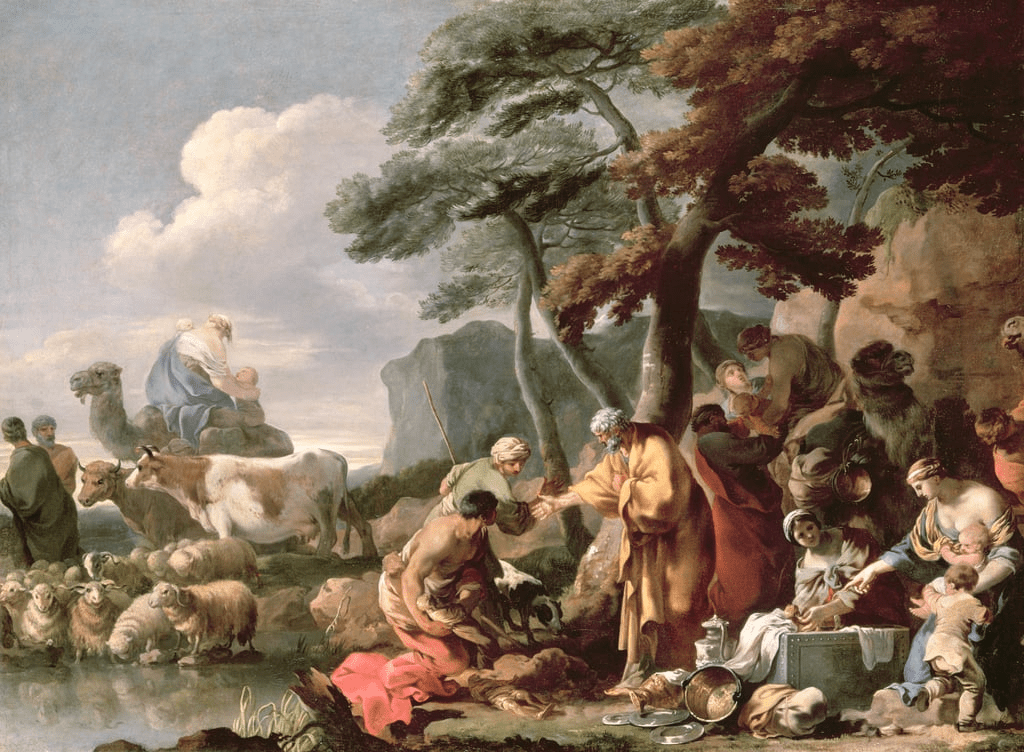
Jacob burying the false gods under the oak by Shechem, by Sébastien Bourdon (1616-1671)

Then God said to Jacob, “Go to Bethel and live there. Make an altar there. I am the God who appeared to you when you were fleeing from your brother Esau.”

So Jacob said to his family and those who were with him, “Get rid of the foreign gods which you have, wash yourselves until you are ritually clean, and change your clothes. Then let’s go to Bethel. I will make an altar there to God, who answered me when I was troubled and who has been with me wherever I’ve gone.” So they gave Jacob all the foreign gods that they had in their possession as well as the earrings that they had on. Jacob buried these things under the oak tree near Shechem. (God’s Word Translation)

Christianity has existed for 2,000 years; Judaism for 4,000 years or more. That’s a long time. On the one hand, this is a tremendous legacy of faith, grounded in several millennia of solid religious tradition. And on the other hand, something existing for so long is bound to accumulate some barnacles that get encrusted on the faith.

And if those barnacles are there for too long, it becomes assumed that they’re just part of the ship of faith. But they’re not; they need to be removed so we can see the real thing and move through life unencumbered and not dragged by extraneous stuff.

The familiar, over time, is taken for granted. And when that happens, we lose sight of what is most important, of what is most needed.

God helped Jacob – the son of Isaac, the son of Abraham – to reconnect with a seminal experience from earlier in his life. That experience was a vison of God, and an assurance that God was with Jacob. He was not alone.

But, years later, after accumulating two wives, twelve sons, and many flocks of sheep and other animals, it was time to move and make a home and an altar elsewhere. Instead of taking the Lord for granted, and forgetting the difficulties of the past, God intervened and called the whole crew to go and live in another place.

The communication from God brought Jacob to a spiritual place of realizing what had happened over the years; slowly and perhaps imperceptibly, the barnacles of idolatry had become encrusted amongst his family. And they were obstacles which needed to be jettisoned before they could move on.

Jacob needed to hear from God. Jacob’s family needed to hear from him. And that communication had to be a helpful way of scraping the barnacles off from decades of misplaced living.

Our world today is marked by unfeeling meanness to strangers, a profound lack of empathy, respect, and basic human kindness toward one another. Individuals, groups, communities, and entire nations don’t know how to talk to each other in a way that is helpful and life-giving.

We need a process which helps us have a way of being with others that is compassionate. It is imperative that we have communication that guides us in both expressing ourselves and listening to others. And that process must focus on what we are observing, feeling, and needing.

It is essential that humanity creates deeper personal relationships and maintains them. If not, we will be overcome by the barnacles of suspicion, hate, distrust of others, as well as distance from God.

Unless we are with each other in helpful ways, we will devolve into judgmental and critical speech directed toward others or even ourselves. Violent words are the main obstacle to having compassion on others.

Comparisons and classifications of people, denial of responsibility for words and behaviors, and making demands, leads to estranged relationships. Instead, we can do better. We can be with one another and talk to each other by communicating observations, feelings, needs, and requests.

Observation

  • Observe, rather than evaluate. Whenever we observe something, and then quickly evaluate it, the other person will tend to hear criticism and resist what we are saying.
  • Be specific, not general. It’s helpful to make a specific observation instead of a general one. For example, God was specific about what Jacob was to do. And Jacob was quite specific about the situation of idolatry and what to do about it before the family could move to Bethel.

Feeling

  • Acknowledge and express your emotion. Clearly and specifically identify and name your emotions because this is the way we connect more easily with others. Jacob told his family of feeling troubled in the past and that God helped him deal with it.
  • Be vulnerable. Expressing our feelings can help resolve conflicts. The old adage is true: People don’t care how much you know until they know how much you care.

Need

  • What do you need? Take responsibility for your feelings. Connect your feeling with your need. Jacob was devoted to God because his emotions were tethered with how God had met his needs throughout his life.
  • Others do not cause our feelings, and they are not responsible for our emotions. Jacob’s family did exactly what Jacob told them to do – and did not buck him or resist him – mainly because he let them know how he was feeling, and why he was telling them to rid themselves of idols and move on with him to Bethel.
  • Listen to yourself. Judgments of others are projections of our own unmet needs; and conversely, being kind to ourselves, listening to our thoughts, and paying attention to how we carry stress in our bodies, allows us to be helpful to others and present to them in whatever they are going through.
  • We are not responsible for other people’s feelings. We can never meet our own needs by trying to make others feel guilt or shame.

Request

  • Ask for what you need and want. We honor ourselves by making requests in clear, positive, and concrete language of what we really need. The clearer we are about what we want, the more likely it is that we’ll get it.
  • The message we send is not always the message which is received by another. Be clear about the response you want so that there is no confusion about what we truly need.

The objective of communication is not to change people and their behavior in order to get our way. Rather, it is to establish relationships based on honesty and empathy that will eventually fulfill everyone’s needs.

There is a need to express honestly and clearly our observations, feelings, needs, and requests, as well as receive another’s communication with focused attention and empathy.

So then, how we talk to and about God, and how we talk to ourselves, becomes a template for how we talk to others. A lack of clear communication is a surefire way of allowing the barnacles of displeasure and disappointment to attach to our souls.

However, clear communication is life-giving and even lifesaving. It’s worth putting significant effort into it.

Blessed Lord, in your infinite wisdom, you created us with the gift of communication. May we use this gift to foster love, understanding, and unity amongst ourselves and with you.

Guide our hearts to speak words of kindness and encouragement. May our tongues be instruments of love, grace and compassion to those around us.

Open our ears, so that we may truly listen and understand the needs and desires of our fellow humanity. Grant us the patience to hear their stories and the wisdom to respond with love and empathy.

Enlighten our minds to be clear and thoughtful in our affect and speech. As we share our thoughts and ideas, may we be ever mindful of your presence, seeking your holy and good will in all we say and do.

Fill our conversations with honesty and vulnerability. May we find the strength and courage to speak our truth while always remaining respectful and considerate of the feelings of others.

Bind us together in unity and love through our shared communication. May our words build bridges and forge bonds that reflect your divine love and mercy. Amen.


The Sheep Need Boundaries (Jeremiah 23:1-8)

“What sorrow awaits the leaders of my people—the shepherds of my sheep—for they have destroyed and scattered the very ones they were expected to care for,” says the Lord.

Therefore, this is what the Lord, the God of Israel, says to these shepherds: “Instead of caring for my flock and leading them to safety, you have deserted them and driven them to destruction. Now I will pour out judgment on you for the evil you have done to them. But I will gather together the remnant of my flock from the countries where I have driven them. I will bring them back to their own sheepfold, and they will be fruitful and increase in number. Then I will appoint responsible shepherds who will care for them, and they will never be afraid again. Not a single one will be lost or missing. I, the Lord, have spoken!

“For the time is coming,”
    says the Lord,
“when I will raise up a righteous descendant
    from King David’s line.
He will be a King who rules with wisdom.
    He will do what is just and right throughout the land.
And this will be his name:
    ‘The Lord Is Our Righteousness.’
In that day Judah will be saved,
    and Israel will live in safety.

“In that day,” says the Lord, “when people are taking an oath, they will no longer say, ‘As surely as the Lord lives, who rescued the people of Israel from the land of Egypt.’ Instead, they will say, ‘As surely as the Lord lives, who brought the people of Israel back to their own land from the land of the north and from all the countries to which he had exiled them.’ Then they will live in their own land.” (New Living Translation)

All of the Old Testament prophets have something to say on the subject of caring for the flock, that is, on the religious leaders of the people and their sacred responsibility to spiritually meet the needs of others.

God cares for each and every sheep (person) and will do whatever it takes to ensure the flock has everything they need for life and godliness.

So, the Lord’s ire is raised whenever shepherd-leaders don’t do their proper job and fail to live into their vocation of responsibly caring for the flock by watching over it and providing for them.

One of the modern forms this takes is expecting worshipers to serve the institution, rather than the institution existing to serve the worshiper. The telltale signs of institutional centrality in the Church (instead of Christo-centric religion) is continually pursuing the priorities of attendance, money, and the church building.

To put it more crassly, some churches seem to only care about buildings, budgets, and butts in the pew. This makes the people the burden-bearers of supporting the system, rather than the system of leaders supporting the people.

“You get what you tolerate.”

Henry Cloud

Admittedly, I just painted a picture with a broad stroke; furthermore, there is nothing inherently wrong with institutional religion (after all, I’m part of the established religion scene). It’s just that shepherds need to be continually vigilant about focusing their pastoral goals and efforts in ways which spiritually care for the common good of all the flock.

A major reason why there is so much fear and anxiety amongst believers is twofold:

  1. Spiritual leaders have too much power and responsibility over too many things, and so, less time and effort is put into pastoral care and compassionately ministering to the flock of God
  2. Churches give spiritual leaders too much power and responsibility, having unreasonable expectations for pastors
  3. Believers aplenty have given up on church

You might conclude (wrongly) that institutional forms of religion, such as churches, just need to be avoided. However, none of us can completely avoid systemic sin because it resides everywhere. Instead, we need to clarify what we will tolerate and not tolerate.

Abusive situations occur when there are no fences to keep everyone safe, secure, and well-fed. It’s important to have boundaries in place for the life and health of everyone.

What are “boundaries?”

Boundaries define who we are. A boundary shows me where I end and someone else begins, leading me to a sense of ownership. Knowing what I am to take and not take responsibility for gives me freedom.

No is a complete sentence.”

Anne Lamott

Why is it important to set boundaries?

  • Boundaries help us keep the good in and the bad out. Setting boundaries involves taking responsibility for your choices. You are the one who makes them, and the one who must live with their consequences.
  • Boundaries help protect us from “gaslighting.” Gaslighting is a form of emotional abuse in which one person manipulates another into doubting their thoughts, feelings, judgments, perceptions, and/or memories. Gaslighting convinces someone to accept the gaslighter’s version of reality at the expense of their own.
  • Boundaries hold people accountable for their words and actions. Without boundaries, we can easily feel used and mistreated.

What are some ways to set healthy boundaries?

  1. Clarify your values. Is this about preserving personal space? Do you want to make sure your emotions are not dismissed or invalidated? Are you trying to take back control of your time, energy, or resources?
  2. Decide where the fence will go. Where is your boundary line? What behaviors can you tolerate?  At what point does someone cross the line with you?
  3. Identify specific, problematic behaviors. What specific behaviors constitute unwanted trespassing on your life?
  4. Identify how a boundary violation is handled. Will you remove yourself from the situation, or step away from an unfinished argument?
  5. Follow through on the consequences. This is essential. If you’ve stated clearly what your boundaries are and they are crossed, make sure to do what you said you will do.

God makes and keeps boundaries and puts up reasonable fences in order that God’s people will be safe and cared for. The Lord also enforces those boundaries and has clear consequences when they are crossed.

The sooner we respect those divine fences, the better off we will be.

Almighty and everlasting God, breathe your Holy Spirit into our hearts and inspire us with love for goodness and truth. May we respect and honor you, and have no fear to hinder us from doing your will. Help us to be compassionate leaders and followers, knowing your compassion, being mindful of your love, and serving you faithfully, through Jesus Christ our Lord. Amen.

God Will Take Care of You (Ezekiel 34:23-31)

I will give them a king like my servant David to be their one shepherd, and he will take care of them. I, the Lord, will be their God, and a king like my servant David will be their ruler. I have spoken. I will make a covenant with them that guarantees their security. I will get rid of all the dangerous animals in the land, so that my sheep can live safely in the fields and sleep in the forests.

“I will bless them and let them live around my sacred hill. There I will bless them with showers of rain when they need it. The trees will bear fruit, the fields will produce crops, and everyone will live in safety on his own land. When I break my people’s chains and set them free from those who made them slaves, then they will know that I am the Lord. The heathen nations will not plunder them anymore, and the wild animals will not kill and eat them. They will live in safety, and no one will terrify them. I will give them fertile fields and put an end to hunger in the land. The other nations will not sneer at them anymore. Everyone will know that I protect Israel and that they are my people. I, the Sovereign Lord, have spoken.

“You, my sheep, the flock that I feed, are my people, and I am your God,” says the Sovereign Lord. (Good News Translation)

We all need a safe place to live and our needs provided. When protection from harm and provision of needs are realized, we call this “peace.”

So many people long for peace, simply because they aren’t experiencing it. They feel unsafe – either physically, mentally, emotionally, or spiritually – and are separated from the sort of resources which would give them what they need to live well.

God is the expert on security and safety, peace and protection. The Lord has provided what we need.

His divine power has given us everything we need for a godly life through our knowledge of him who called us by his own glory and goodness. Through these he has given us his very great and precious promises, so that through them you may participate in the divine nature, having escaped the corruption in the world caused by evil desires. (2 Peter 1:3-4, NIV)

The Shepherd Ruler

God made a covenant with David that was to last forever. There was the anticipation of a leader, even the Messiah, who would come from the line of King David. Such a ruler will bring unity to the people. This leader shall be a servant of the people, a shepherd, characterized by humility. And, most of all, the hoped for ruler will usher in an unprecedented time of peace.

The flock of sheep – the people – will not have a care in the world. The new divine shepherd will not live off the sheep, but will instead live for the sheep. The shepherd shall be the ultimate non-anxious presence among the sheep, assuaging their fears and keeping them well-fed.

“I am the good shepherd; I know my sheep and my sheep know me—just as the Father knows me and I know the Father—and I lay down my life for the sheep.”

Jesus (John 10:14-15, NIV)

From the standpoint of Christianity, this great restoration project of the Lord finds its fulfillment in the person and work of Jesus. We needed a faithful shepherd, a merciful ruler, and we now have one.

The Settled Rest

Wholeness, integrity, thriving, flourishing, satisfaction, contentment, and a good life are all wrapped up in the biblical concept of peace and rest. And that is what the shepherd does for the sheep.

There is no peace when shepherds view the sheep as merely animals to be fleeced and used. But with a good shepherd, predators are kept away from the flock, plenty of pasture is provided to feed upon, and other shepherds in other fields attempting to steal sheep don’t stand a chance against the Good Shepherd.

A large chunk of humanity lives in a state of fear and anxiety because of violence, lack of basic necessities, disease, or natural disaster. Life can become so overwhelming that the future seems bleak and without hope. People long for peace – personal peace, family peace, world peace. They’re tired, and just want some rest.

“Come to me, all you who are weary and burdened, and I will give you rest.”

Jesus (Matthew 11:28, NIV)

Although the list of stressors may seem endless, divine blessings shall create the conditions in which humanity can live without fear and with hope in the world. No one will make them afraid, ever again.

“Peace I leave with you; my peace I give you. I do not give to you as the world gives. Do not let your hearts be troubled and do not be afraid.” (John 14:27, NIV)

The Sure Restoration

The divine/human relationship, so marred and messed up by the presence and power of sin, will be perfectly restored. The Lord is God; and God is with us. The divine energy is no longer against us, but is for us. And if God is for us, who can be against us?

Who shall separate us from the love of Christ? Shall trouble or hardship or persecution or famine or nakedness or danger or sword? As it is written:

“For your sake we face death all day long;
    we are considered as sheep to be slaughtered.”

No, in all these things we are more than conquerors through him who loved us. For I am convinced that neither death nor life, neither angels nor demons, neither the present nor the future, nor any powers, neither height nor depth, nor anything else in all creation, will be able to separate us from the love of God that is in Christ Jesus our Lord. (Romans 8:35-39, NIV)

God will care for you. Along with you, the Lord will care for your loved ones who need a faithful leader, a place of peace and rest, and a new life.

O God, the source of all holy desires, all good counsels, and all just works: Give to your servants the peace which the world cannot give, so that our hearts may obey your commandments, and that we, being defended from the fear of our enemies, may pass our time in rest and quietness, through the merits of Jesus Christ our Savior. Amen.

Pastoral Care (Ezekiel 34:17-23)

“Now then, my flock, I, the Sovereign Lord, tell you that I will judge each of you and separate the good from the bad, the sheep from the goats. Some of you are not satisfied with eating the best grass; you even trample down what you don’t eat! You drink the clear water and muddy what you don’t drink! My other sheep have to eat the grass you trample down and drink the water you muddy.

“So now, I, the Sovereign Lord, tell you that I will judge between you strong sheep and the weak sheep. You pushed the sick ones aside and butted them away from the flock. But I will rescue my sheep and not let them be mistreated any more. I will judge each of my sheep and separate the good from the bad. I will give them a king like my servant David to be their one shepherd, and he will take care of them. (Good News Translation)

“Only through love can we obtain communion with God.”

Albert Schweitzer

I have a zero tolerance for bullying. And, I believe, this is a conviction which must be shared together with everyone. If not, we will continue to see spiritual abuse in the news, so-called Christians and churches throwing their weight around, and a world enveloped in the darkness of mean-spirited persons who only care about themselves and getting their way.

It is most necessary that spiritual folk let compassionate pastoral care have its way in the world.

Pastoral care, for me, is rooted in the compassion of Jesus Christ. It is my connection and relationship with this living Savior, Teacher, Healer, and Lord which enables me to extend genuine care to others. 

I believe that it is the grace and mercy of God in Christ through the enablement of the Holy Spirit which brings comfort, hope, and encouragement to people in need. My philosophy of pastoral care addresses three significant factors, in this order:

  1. Being in a safe environment is paramount. Building trust and connection is important. The caring relationship needs confidence so that the pastor can compassionately encourage and help the person to pursue being in a secure place – whether that is a physical moving away or out, or finding a safe and sacred place within one’s own soul from which healing and holistic health can begin. Bullying can be physical, verbal, emotional, mental, or personal in talking abusively to oneself; and it must be stood up to and stopped.
  2. Grieving is necessary. Mourning and lamenting a significant change or loss must occur to learn to thrive and flourish again in a new situation. This requires being open about one’s feelings, communing freely with God, and being vulnerable with a pastor, therapist, church group, or some other secure human connection. It is common to get “stuck” in grief and believe our situation can never change. But it can, so we must not remain there. 
  3. Reconnecting with the world is vital. Bullying and belligerent people can take a lot out of us and from us. Therefore, we need to find joy in the simple pleasures of life again; to reach out and relate to others who have gone through similar experiences; and, to regain ordinary rhythms and routines of life are all crucial to being alive. The compassionate pastor gently assists, encourages, exhorts, and walks with others toward relating well with the world once again.

Recovery is not an event, and not even a process; it is a way of life. 

All of us are vulnerable to the brokenness of this fallen world. We must learn to navigate troubled times with someone who cares, and not by ourselves. 

We all struggle to live out our faith commitments in a complex web of various family, work, social, and neighborhood relationships.

“If I were to wish for anything, I should not wish for wealth and power, but for the passionate sense of the potential, for the eye which, ever young and ardent, sees the possible. Pleasure disappoints, possibility never. And what wine is so sparkling, what so fragrant, what so intoxicating as possibility!”

Søren Kierkegaard

I am passionate about a biblical understanding of living in the world for its betterment and blessing as a pastoral minister. The following is a kind of manifesto of what I feel called to be and to do….

With God as my help, and with the Old and New Testaments of the Bible as my guide for grateful living, I seek with all my heart, soul, mind, and strength:

  • To foster, support, and realize spiritual healing in the world
  • To cultivate the human spirit and do the work of soul-craft deliberately, carefully, and patiently
  • To consult and collaborate with others who share a spiritual vision for blessing the world
  • To engage in spiritual practices which strengthen faith, enlarge a compassionate heart, and expand the soul’s capacity for growth
  • To walk in the way of Jesus through engrafting silence, solitude, fasting, giving, and prayer into regular and habitual rhythms of life
  • To wed integration of learning with an alignment of head, heart, and gut.
  • To embrace suffering and adversity as sacred Teachers of the soul
  • To continually pursue self-awareness and utilize that awareness for the common good of all persons
  • To liberally use the spiritual tools of faith, hope, and love; and, to sharpen those implements with great care
  • To weep with those who weep
  • To keep vigilant presence with the dying
  • To extend mercy, respect, and hospitality to those considered by society as the least, the last, and the lost
  • To eradicate loneliness in all its forms
  • To extend basic human dignity and divine grace to all with mental illness, cognitive disorders, soul-sucking addictions, and suicidal ideation
  • To embody the Beatitudes of Jesus and live by Christ’s Sermon on the Mount (Matthew 5-7)
  • To embrace humble service as demonstrated and taught by Jesus in his Upper Room Discourse (John 13-17)
  • To picture a world without poverty, racism, patriarchy, gender bigotry, verbal and physical violence, religious wars, and emotional immaturity
  • To imagine a future with an abundance of the Fruit of the Spirit, clean water, creativity, beauty, and equity of resources
  • To promote an egalitarian spirit and social justice, especially for those without power and/or privilege in the world
  • To see the image of God in persons very different from me
  • To grieve and lament my unwanted changes and losses
  • To express daily affirmations of faith
  • To exercise gratitude in all circumstances
  • To live in a healthy rhythm of receiving and giving
  • To encourage the telling and listening of stories
  • To champion women everywhere and alleviate all barriers to their voice in the world
  • To reform and keep reforming
  • To choose vulnerability and courage in life and leadership
  • To perpetuate, in both word and deed, the ancient Scriptures and ecumenical Creeds, paying attention to the worldwide church’s contribution to scriptural understanding
  • To use Holy Scripture for the encouragement of others and the strengthening of faith, and not as a weapon to damage others and create divisions
  • To observe the Christian Year and conform to its liturgical rhythms.
  • To die well, with no regrets and with a legacy of faith