Acts 12:20-25 – Don’t Be Worm Food

Herod had been furious with the people of Tyre and Sidon for some time. They made a pact to approach him together, since their region depended on the king’s realm for its food supply. They persuaded Blastus, the king’s personal attendant, to join their cause, then appealed for an end to hostilities. On the scheduled day Herod dressed himself in royal attire, seated himself on the throne, and gave a speech to the people. Those assembled kept shouting, over and over, “This is a god’s voice, not the voice of a mere human!” Immediately an angel from the Lord struck Herod down, because he didn’t give the honor to God. He was eaten by worms and died.

God’s word continued to grow and increase. Barnabas and Saul returned to Antioch from Jerusalem after completing their mission, bringing with them John, who was also known as Mark. (Common English Bible)

Accountability is important. People need to be held to a clear, right, and just standard of attitude and behavior – especially when they mess with the food supply.

Herod Agrippa Is Worm Food

The King Herod in our New Testament story today, known as Herod Agrippa, was a grandson to Herod the Great. Simply put, King Herod Agrippa was a self-absorbed jerk. Although he only reigned four years, he was something like a modern day evangelical huckster. Herod knew how to turn a phrase and play on the emotions of people to get what he wanted while keeping up appearances with both the Empire and the Jewish people.

Yet, despite or because of his eloquence and power, Herod was vain and ruled for self – and neither for God nor country. So, he was stricken by God and died an unpleasant death. The connection is clear: Herod used the food people depended upon as a means of controlling the politics of the region, so God hit him directly in his intestines with a complete lack of control over his own body.

Just as Herod was an unwanted agent manipulating the food supply for his own ends, so the king received some unwanted guests in the form of worms. In the ancient world, when any ruler used food to control the people, there were individuals and families who ended up starving to death. For Herod, the worm turned, it was he who died.

Jesus Is Gospel Food

The swift judgment from God was both a rebuke to Herod’s personal kingdom building, as well as a means of protecting the fledgling church from severe persecution. With Herod Agrippa off the scene, the Apostles could freely move with regularity (pun intended) and proclaim the good news of Jesus Christ.

Paul, Barnabas, and Mark were able to go on a missionary journey. Nothing can thwart God’s good news and sovereign intentions for humanity – especially not an upstart demigod king who, as a Jew, knew better than to go rogue and mess with people’s food.

The church is to give literal and spiritual food – following the footsteps of their Lord Jesus who said:

“The bread of God is the one who comes down from heaven and gives life to the world…. I am the bread of life. Whoever comes to me will never go hungry, and whoever believes in me will never be thirsty…. I am the bread of life. Your ancestors ate manna in the wilderness, and they died. This is the bread that comes down from heaven so that whoever eats from it will never die. I am the living bread that came down from heaven. Whoever eats this bread will live forever, and the bread that I will give for the life of the world is my flesh…. I assure you, unless you eat the flesh of the Human One and drink his blood, you have no life in you. Whoever eats my flesh and drinks my blood has eternal life, and I will raise them up at the last day. My flesh is true food, and my blood is true drink. Whoever eats my flesh and drinks my blood remains in me and I in them. As the living Father sent me, and I live because of the Father, so whoever eats me lives because of me. This is the bread that came down from heaven. It isn’t like the bread your ancestors ate, and then they died. Whoever eats this bread will live forever.” (John 6:33-58, CEB)

God’s purpose and intent is to provide sustenance. Divine retribution is likely to happen when puny humans try and play their power games, putting entire people groups at risk for starvation. Jesus came to this earth for the provision of food that will nourish to eternal life.

The Lord will provide. God shall ultimately topple all systems of repression which deny people basic life needs. Almighty God seeks to eat away, like an intestinal worm, at contemporary political regimes and oppressive governments which put people in impossible situations of trying to fend for themselves.

Jesus is both Bread and Judge. Christ came in his first advent bringing food for the hungry. There is a time coming when he shall return in his second advent to bring the worm – good news to the suffering, and bad news for the ones who create the suffering.

Be encouraged with the spiritual reality that Christ brings spiritual sustenance and eternal life. And be assured that he knows the condition of all people and will extend grace or judgment with sage wisdom.

Grant, O God, that your holy and life-giving Spirit may so move every human heart, especially the hearts of political authorities, that barriers which divide us may crumble, suspicions disappear, and hatreds cease; that our divisions being healed, we may live in justice and peace so that everyone’s need for food is met, through Jesus Christ our Lord. Amen.


John 6:35-40 – The Bread of Life

I Am the Bread of Life by Joseph Matar

Jesus said, “I am the Bread of Life. The person who aligns with me hungers no more and thirsts no more, ever. I have told you this explicitly because even though you have seen me in action, you don’t really believe me. Every person the Father gives me eventually comes running to me. And once that person is with me, I hold on and don’t let go. I came down from heaven not to follow my own agenda but to accomplish the will of the One who sent me.

“This, in a nutshell, is that will: that everything handed over to me by the Father be completed—not a single detail missed—and at the wrap-up of time I have everything, and everyone put together, upright and whole. This is what my Father wants: that anyone who sees the Son and trusts who he is and what he does and then aligns with him will enter real life, eternal life. My part is to put them on their feet alive and whole at the completion of time.” (The Message)

Bread has always been a food staple throughout human history. Whereas many people today try and avoid bread because of either carbohydrates or gluten, a lack of bread in the ancient world usually meant people would starve to death. Bread is a big deal.

So, when Jesus gave a self-description as the Bread of Life, he was saying a lot.

The cup we use in the Lord’s Supper and for which we give thanks to God: when we drink from it, we are sharing in the blood of Christ. And the bread we break, when we eat it, we are sharing in the body of Christ. (1 Corinthians 10:16, GNT)

After the Israelites were delivered by God from their bondage in Egypt, and found themselves in the desert without food, the divine provision of manna – a unique kind of bread – literally showed up on the desert floor every morning. It was just enough for everyone for that day. Once the Israelites entered the Promised Land, the manna disappeared.

As Jesus entered fully into his earthly ministry, throngs of people began following him. At one point, the thousands of men, women, and children were together with nothing but a couple of fish and a few loaves of bread. Much like the miraculous provision of manna which sustained their ancestors centuries earlier, Jesus multiplied the measly morsels of bread into enough to feed the entire bunch, with leftovers.

Little is much when God is in it. Just a smidgeon of Jesus is enough to fill a crowd of growling stomachs.

The Lord Jesus is not like a loaf of bread bought in a grocery store which has all kinds of funky additives, loaded up with sugars, and questionable ingredients you can’t even pronounce. Christ is fortified with everything we need to thrive and flourish. Jesus is so packed with good stuff that a seemingly paltry communion wafer is filling and satisfying.

The bread that comes down from heaven isn’t like what your ancestors ate. They died, but whoever eats this bread will live forever. (John 6:58, CEV)

Just as bread is a simple mixture of water and flour, so partaking of Jesus is rather uncomplicated. There aren’t hoops to jump through or lengthy recipes to follow. If we simply align ourselves with Christ, come to him and believe, we will never be hungry again.

The world needs bread. They ask for bread. In response, Jesus gave them himself.

Give us the bread we need for today. (Matthew 6:11, CEB)

All the world has to offer, and of which so many humans strive to obtain and accumulate treasures on earth, money and possessions, does not bring ultimate satisfaction. The drive for more is never satiated. Humanity is afflicted with boredom, dissatisfaction, anxiety, and worry over losing what they have and fretting about how they can obtain just one more thing in the misguided belief their fear will finally melt.

But it doesn’t. So, like a hamster running in a wheel and going nowhere, there is the constant activity of racing thoughts and workaholic behavior to try and somehow keep ahead. Yet, authentic rest never comes. The more the striving, the more the anxiety.

There is a divine/human responsibility and cooperative at work. Jesus will hold us secure. And we need to let him do it, and fully align our lives according to Christ’s words and ways. The divine bread is available. God isn’t going to force feed us. We will need to take and eat.

It requires faith to take and eat. We might wonder: Will I like it? Is it really going to satisfy me? What if I’m allergic to it? Do I need some other food handy to eat in case I gag or vomit? Will there be pie? Mac & cheese? Bacon? (insert your own comfort food) Do I have to eat alone?

Try it. You’ll like it.

My own experience of having tasted much of what the world has to offer, and tasting the good flavor of God’s grace, I can say that I never want to go back to the gruel of guilt and shame.

I have tasted and seen that the Lord is good. And that is what I want for you, too.

Taste and see that the Lord is good; blessed is the one who takes refuge in him. (Psalm 34:8, NIV)

The bread is for me, and it is for you. There is plenty of bread for the life of everyone in the world. No rationing is necessary. This is the place of abundance.

“I am the living bread which came down from heaven. If anyone eats of this bread, he will live forever; and the bread that I shall give is My flesh, which I shall give for the life of the world.” (John 6:51, NKJV)

Almighty and everlasting God, I thank and praise you for feeding me with Jesus, the Bread of Life. Send your Holy Spirit so that I may by faith obtain and eternally enjoy your divine grace, the forgiveness of sins, unity with Christ, and everlasting life; through Jesus Christ my Lord. Amen.

Micah 5:1-5a – The Shepherd Leader

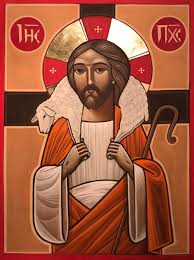
Coptic Church icon of Jesus the Good Shepherd

Jerusalem, enemy troops
    have surrounded you;
they have struck Israel’s ruler
    in the face with a stick.

Bethlehem Ephrath,
you are one of the smallest towns
    in the nation of Judah.
But the Lord will choose
one of your people
    to rule the nation—
someone whose family
    goes back to ancient times.
The Lord will abandon Israel
    only until this ruler is born,
and the rest of his family
    returns to Israel.
Like a shepherd
    taking care of his sheep,
this ruler will lead
    and care for his people
by the power and glorious name
    of the Lord his God.
His people will live securely,
and the whole earth will know
    his true greatness,
because he will bring peace. (CEV)

In Micah’s day there was no peace on earth, goodwill to all. In the eighth century B.C.E. the powerful Assyrian Empire came and conquered the northern kingdom of Israel, deporting many of the people and re-populating the cities with their own.

The Assyrian takeover of Israel not only left the northern kingdom in shambles but had a large impact on the southern kingdom of Judah.  All of Judah and Jerusalem were in extreme duress.  Even though Judah had not been conquered and was intact, they were still forced to pay tribute to the Assyrians to keep them at bay. 

The problem became even more exacerbated because the leadership of Judah sought to maintain their power and lifestyle.  The leaders neither looked to God for help nor looked out for the interests of the people.  Instead, they expected the already burdened poor to shoulder the burden of the tribute to the Assyrians.

What is more, thousands of refugees from Israel flooded into Judah and Jerusalem.  So, the already scant resources in Judah were pushed to the brink. Those in authority, the ones with resources who could make something of a difference, ended up taking advantage of the situation by buying fields and land at a fraction of its worth.  In some cases, they leveraged their power by simply pushing people of their land and taking it over. It was anything but a time of security, peace, and actions of goodwill.

Into this terrible situation of hardship and survival, Micah prophesied judgment upon the leaders who were oppressing the poor and displaced.  Micah’s message of hope was that a new kind of leader will come from humble origins, just like the common oppressed people of Judah.  The refugees, the displaced farmers, and the poor will have a champion.  He will feed and shepherd them, leading them to green pastures.  This leader will serve the people instead of the people serving the leader.

Christians see Jesus in Micah’s prophecy. Just as the ancient Jews needed hope and the promise of a different ruler, so today we, too, need hope and the anticipation of the leader who will come again using his power for security, peace, and goodwill.

Christ’s authority is different than earthly politicians and officials.  Israel and Judah had been so filled with bad kings and self-serving leadership over the centuries that Christ’s disciples could barely conceive of a different kind of rule. So, Jesus called his disciples together and said:

“You know that those who are regarded as rulers of the Gentiles lord it over them, and their high officials exercise authority over them.  Not so with you.  Instead, whoever wants to become great among you must be your servant, and whoever wants to be first must be slave of all.  For even the Son of Man did not come to be served, but to serve, and to give his life as a ransom for many” (Mark 10:42-43, NIV).

The people of Micah’s day needed to see beyond their terrible circumstances to hope of better days with food, peace, and protection.  We, too, feel insecure and anxious. We want leaders to be wise and just toward the vulnerable, the poor, and the displaced.  But while we look to our politicians and election cycles for our hope, the prophet Micah is jumping up and down, pointing us to a different leader – a shepherd leader.

Micah said the shepherd leader will come from Bethlehem.  When Micah proclaimed this, King David, the original shepherd king, had been dead for nearly three-hundred years. The people immediately made the connection between the coming leader and David.  There would be restoration and renewal!  A benevolent kingly reign is coming! 

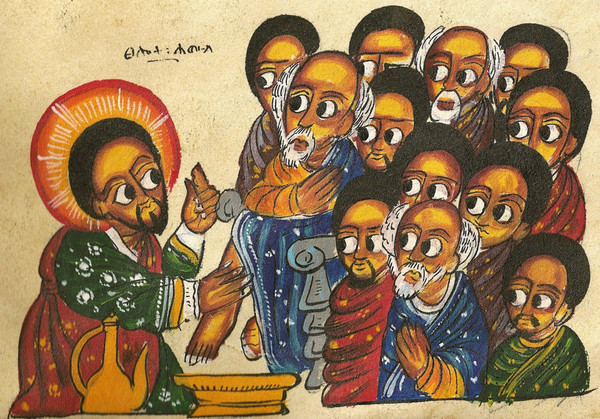
Ethiopian Orthodox Church depiction of Jesus the Bread of Life

“Bethlehem” is two Hebrew words put together: beth (“house”) and lechem (“bread”) thus being “House of Bread.” God was communicating that the coming shepherd leader would provide abundant food and care for them. God wanted, and still wants, a society that does not feed on itself, but is a house of bread for others. Jesus is the Bread of Life. Christ feeds us so that we will become a people who offer bread to others – both physical and spiritual bread.

Jesus is the bread for all the hungers we have in this life. We hunger for security in our world; satisfaction in our daily work; loved ones to be healthy and happy. In short, we hunger for peace. Our spiritual stomachs growl with hunger for spiritual food.  Many are spiritually starving because they are searching for peace and goodwill in places without food.

Satisfaction, contentment, and peace have come from the most unlikely places of Bethlehem and Nazareth. Can anything good come from villages in Judea that do not even show up on most maps of the ancient world?  Peace, hope, and goodwill can and do come from the least expected places and people. 

Christ was not born in the halls of power. Yet, through him there is peace, in the complete sense of the word. Jesus is the One who brings a full-orbed wholeness and wellness to life, no matter the situations around us. Jesus is our peace:

Like a shepherd, God will tend the flock; he will gather lambs in his arms and lift them onto his lap. He will gently guide the nursing ewes. (Isaiah 40:11, CEB)

“Yes, I will feed my flock, and I will lead them to a place of rest. I will search for the lost sheep. I will bring back the sheep that were scattered and put bandages on the sheep that were hurt. I will make the weak sheep strong, but I will destroy the fat and powerful shepherds. I will feed them the punishment they deserve.” (Ezekiel 34:15-16, ERV)

 “I am the Good Shepherd. I know my own sheep and my own sheep know me. In the same way, the Father knows me, and I know the Father. I put the sheep before myself, sacrificing myself if necessary. You need to know that I have other sheep in addition to those in this pen. I need to gather and bring them, too. They’ll also recognize my voice. Then it will be one flock, one Shepherd.” (John 10:14-16, MSG)

“I am the bread of life. He who comes to Me shall never hunger.” (John 6:35, NKJV)

When Jesus originally said those words, it was scandalous, unheard of rhetoric. So, Jesus, the stinker he could be, pressed it even more:

“I am the bread of life. Your ancestors ate the manna in the wilderness, yet they died. But here is the bread that comes down from heaven, which anyone may eat and not die. I am the living bread that came down from heaven. Whoever eats this bread will live forever. This bread is my flesh, which I will give for the life of the world… Very truly I tell you, unless you eat the flesh of the Son of Man… you have no life in you. (John 6:48-51, 53, NIV)

We are to ingest Jesus – to be filled with him. We need Jesus because he is our house of bread, our peace, our shepherd, and our king. Believing in him is to give our lives to him. The greatest Christmas gift we can give this season is the gift of our lives to Jesus Christ, the promised Messiah.

Lord Jesus, I have strayed far from your flock and taken matters into my own hands. I have chosen to feed in pastures that will never take care of my real hunger.  I need Your forgiveness. I believe You died on the cross for all the things I have done and left undone.  You rose from the grave to give me life. So, I want to stop going my own way and start going yours. Amen.

John 6:25-35 – The Bread of Life

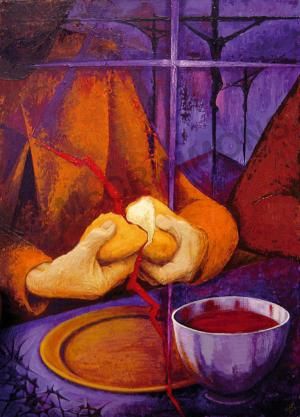
The Breaking of the Bread by Sr. Mary Stephen

When they found him on the other side of the lake, they asked him, “Rabbi, when did you get here?”

Jesus answered, “Very truly I tell you, you are looking for me, not because you saw the signs I performed but because you ate the loaves and had your fill. Do not work for food that spoils, but for food that endures to eternal life, which the Son of Man will give you. For on him God the Father has placed his seal of approval.”

Then they asked him, “What must we do to do the works God requires?”

Jesus answered, “The work of God is this: to believe in the one he has sent.”

So, they asked him, “What sign then will you give that we may see it and believe you? What will you do? Our ancestors ate the manna in the wilderness; as it is written: ‘He gave them bread from heaven to eat.’”

Jesus said to them, “Very truly I tell you, it is not Moses who has given you the bread from heaven, but it is my Father who gives you the true bread from heaven. For the bread of God is the bread that comes down from heaven and gives life to the world.”

“Sir,” they said, “always give us this bread.”

Then Jesus declared, “I am the bread of life. Whoever comes to me will never go hungry, and whoever believes in me will never be thirsty. (NIV)

Christians everywhere hold to Jesus as the Son of God, Lord of the universe, and Savior of all. However, for most people who were following Jesus around in the first century, this was not their understanding of Christ.  In his earthly ministry, Jesus spoke in ways that introduced people to who he really was and sought to bring them to a point of following him based on his identity. 

Jesus wanted the crowds to him for who he really is – themselves for what they really needed – and follow him based on the deepest needs of their lives. I believe Jesus is the hope of all nations and all people, and in him humanity’s most basic and profound needs are met for forgiveness, love, and purpose in life. To address this, I ask three basic philosophical and theological questions of life:

What should human beings seek the most and work the hardest for in life?

The responses in history are legion. The ancient Greek philosopher Aristotle thought a proper appreciation for an ethical and virtuous life found in practical wisdom was where people’s most concerted efforts should be.  Karl Marx, the father of communism and socialism believed the proletariat should use their heads and their hands to rise above their economic conditions and oppression. In the late 1960’s, Bobby Kennedy said we ought to be working the hardest to achieve justice and not advance ourselves on the misfortunes of others. In more recent times, the Harvard Business Review is continually on the lookout for the best ways of being efficient, productive, and making the most of time because work itself is paramount.

Jesus said people are not to work for food that spoils, but for food that endures to eternal life.

He said this coming off one of his most famous miracles of all, the feeding of the five thousand.  Afterward, Jesus withdrew overnight to a place of solitude and prayer. He did another miraculous event by walking on water out to his disciples in a boat. In the morning, he and they were on the other side of the lake. The crowd did not know where he was and went looking for him.

Jesus knew the crowd of people wanted more. What they got was perhaps unexpected. Jesus told them to put their efforts into getting the bread that keeps on feeding. Jesus wanted the people to pursue and follow him not only for the things he could do for them, but to seek him for who he is. 

Jesus had further aspirations for the people beyond providing a supper – he desired the people to feast on himself – to ingest him, to take him into their lives in a deep and profound way as the fulfillment of all the hope and promises of the Old Testament. 

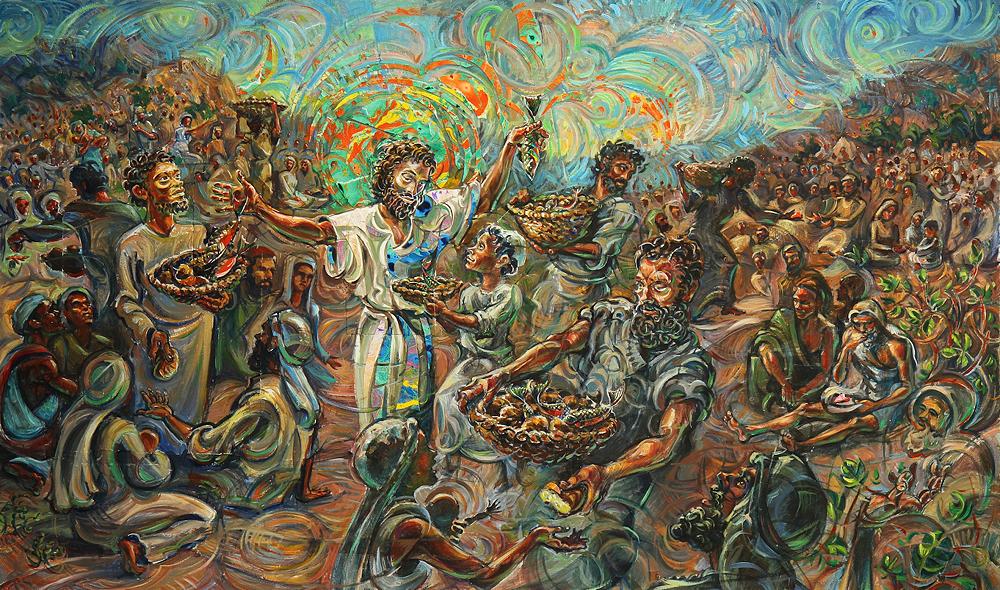
Jesus Feeds the Crowd by American artist Eric Feather

Jesus is the bread, the basic staple of life, that meets the cravings and needs of all people everywhere. Starving people, both in body and spirit, find in Jesus a meal which keeps on giving, a feast of grace that is both delectable and unending.

The answer to my own question is that, for me, one’s highest pursuit and greatest quest is Jesus. Apart from Christ, I will starve. Furthermore, Jesus is not some cheap fast food off a value menu; he is real soul food to be ingested and enjoyed with others.

I believe people need Jesus. A passionate seeking of Jesus, to follow him, live for him, center life around him, is my most ardent desire. I do not simply desire Jesus for what he can do for me; I vigorously chase after him because if I do not have Jesus, I will die, I will starve to death. 

For me, Jesus is so much more than a nice addition to my life, like a new puppy; Jesus is Lord and Savior. I must consume him, or I will be completely undone, and I will not survive! Jesus is my bread, my food, my life!  I cannot survive on a daily crumb, but I feast on every word that comes from the mouth of Jesus because in Christ there is the life that is truly life.

What should human beings be doing to do the works of God?

The short answer: believe. To have and keep faith in the One God has sent, Jesus, is the primary “work” that pleases God. Jesus communicated to the crowd that they can do so much more than follow him for another earthly meal – they can place their faith and hope in him for food that will last, food that will transcend the three-dimensional world.

Faith is more than an intellectual recognition to some facts about Christianity. And belief is not about always having clarity and certainty to every facet and loci of Christian doctrine. No, Christian faith is complete trust in Jesus as our hope and our life. Education, economic uplift, political stability, and institutional peace and justice are important activities for this world. For the Christian, the accomplishment of these and so much more comes from the grace of God in Christ. As people come to the end of themselves with their homebrewed and half-baked attempts at being satisfied, Jesus stands at the door and knocks, the Living Bread who offers himself for humanity’s deepest needs.

Giving kudos to Jesus might be nice, yet Christ himself cares about folks placing their trust in him for grace, forgiveness, and hope in their world. Jesus longs to reconnect people with God through giving himself as the means of making that happen. All the works we do in this life, every good deed we accomplish, and each positive action we do are all helpful and necessary… and they all pale in comparison to the greatest work of all, to believe in Jesus Christ as the hope of this world, the hope of your family, the hope of the church, and the hope of your life and mine. And it is all accessed by faith in the Son of God who loved me and gave himself for me.

Who really does the will of God?

Answer: Those who come to God through Christ. The person who comes to Jesus will never go hungry, and the one who believes in Christ will never be thirsty. Such persons do the will of God. They do not settle for signs of Jesus but desire him and find their ultimate satisfaction in him.

Yet far too many people settle for signs of Jesus rather than Jesus himself. It would be silly if I drove to a sign on Interstate 94 that said, “Milwaukee” and sat there under it, believing I was really in the city of Milwaukee. And it would be weird if I looked around for the art museum or other places underneath the sign.

Church buildings and furniture, stained-glass windows, pews, and even the Bible are not Jesus – they are simply and hopefully signs which point to him. They are all designed to lead us to Christ so that we may come to him. And coming to Christ is what the Lord’s Supper, Holy Communion, the Eucharist, and any other description you want to give about ingesting Jesus is about. The elements of bread and cup bring us to Christ so that we can experience Jesus and be joined to him by faith in a mystical union of human and divine in the unseen heaven.

Conclusion

Where will you find true satisfaction and hope? Probably not in the clearance aisle at Wal-Mart. Likely not in conforming to cultural Christianity or embracing generic forms of Jesus as merely good teacher and moral example. Furthermore, life’s ultimate satisfaction and hope are not to be found in a spotless house and perfect kids; in working more hours and making more money. Nor will we find contentment and peace in the radical independence of doing things my way.

Jesus is the Bread of Life. Through ingesting him, passionately pursuing him, believing in him, and coming to him in everything, we find the life that is truly life. Do not settle for any substitutes to Jesus. Come to the real person.

Lord God, you said that when we seek you with all our hearts, you will be found.  As the deer pants for streams of water, so we, your people, long for you in a dry and weary land.  We hunger and thirst for your righteousness.  We deeply desire your presence in all things. So, we die to ourselves and surrender to your will and way for us, by faith trusting you will come into our lives and completely take over. May your blessing rest upon us as we seek Jesus. Amen.

By Forever Be Sure