Forgotten, but Blessed (Genesis 40:1-23)

Joseph, the cupbearer, and the baker in prison, by Gerbrand van den Eeckhout, 1643

Sometime later, Pharaoh’s chief cupbearer and chief baker offended their royal master. Pharaoh became angry with these two officials, and he put them in the prison where Joseph was, in the palace of the captain of the guard. They remained in prison for quite some time, and the captain of the guard assigned them to Joseph, who looked after them.

While they were in prison, Pharaoh’s cupbearer and baker each had a dream one night, and each dream had its own meaning. When Joseph saw them the next morning, he noticed that they both looked upset. “Why do you look so worried today?” he asked them.

And they replied, “We both had dreams last night, but no one can tell us what they mean.”

“Interpreting dreams is God’s business,” Joseph replied. “Go ahead and tell me your dreams.”

So the chief cupbearer told Joseph his dream first. “In my dream,” he said, “I saw a grapevine in front of me. The vine had three branches that began to bud and blossom, and soon it produced clusters of ripe grapes. I was holding Pharaoh’s wine cup in my hand, so I took a cluster of grapes and squeezed the juice into the cup. Then I placed the cup in Pharaoh’s hand.”

“This is what the dream means,” Joseph said. “The three branches represent three days. Within three days Pharaoh will lift you up and restore you to your position as his chief cupbearer. And please remember me and do me a favor when things go well for you. Mention me to Pharaoh, so he might let me out of this place.For I was kidnapped from my homeland, the land of the Hebrews, and now I’m here in prison, but I did nothing to deserve it.”

When the chief baker saw that Joseph had given the first dream such a positive interpretation, he said to Joseph, “I had a dream, too. In my dream there were three baskets of white pastries stacked on my head. The top basket contained all kinds of pastries for Pharaoh, but the birds came and ate them from the basket on my head.”

“This is what the dream means,” Joseph told him. “The three baskets also represent three days. Three days from now Pharaoh will lift you up and impale your body on a pole. Then birds will come and peck away at your flesh.”

Pharaoh’s birthday came three days later, and he prepared a banquet for all his officials and staff. He summoned his chief cupbearer and chief baker to join the other officials. He then restored the chief cupbearer to his former position, so he could again hand Pharaoh his cup. But Pharaoh impaled the chief baker, just as Joseph had predicted when he interpreted his dream. Pharaoh’s chief cupbearer, however, forgot all about Joseph, never giving him another thought. (New Living Translation)

Joseph, the cupbearer, and the baker, by Alexander Ivanov (1806-1858)

It is a sinking (and stinking) feeling to be forgotten, as if no one cares. But we know God cares. And we also know Joseph did nothing wrong. How did he get to this point of being left in a prison? What’s up with that?

Joseph’s Story

The story of Joseph (Genesis 37, 39-50) is one of the longest narratives in the Old Testament. Joseph was next to the youngest of 12 sons born to their father Jacob. Rachel was Jacob’s favorite wife and Joseph’s mother – which also made Joseph one Jacob’s favorites. This didn’t go down well with the rest of the sons. Joseph’s brothers (unbeknownst by Jacob) sold him into slavery.

Joseph was taken to Egypt and became the servant of Pharaoh’s captain of the guard, Potiphar. Joseph distinguished himself as competent, skillful, and virtuous. It was actually his integrity which got him into prison. Refusing to sleep with Potiphar’s wife, she became an angry woman and accused Joseph of something he didn’t do. The captain promptly dispatched him to jail.

Human Hatred and Unfaithfulness

Joseph became a slave in Egypt because of jealousy, hatred, and lack of faithfulness on the part of Joseph’s brothers. They disowned him, sold him, and rid themselves of him. The brothers wanted to forget Joseph, and they did.

Furthermore, Joseph became a prisoner in Egypt because of anger, hate, and betrayal of faith. Potiphar’s wife didn’t get what she wanted from Joseph, so she lied and fumed, landing Joseph in a dank prison. He was left without another thought – forgotten and jailed for no fault of his own.

And just when we think the story might turn around, and Joseph will be freed from his unjust imprisonment, the chief cupbearer (wine steward) promptly forgot him and said nothing to Pharaoh after he was out of jail and restored to his position. Once again, Joseph is the undeserved recipient of unfaithfulness. He remains in prison for another two years. Oy.

As much as we might like to get past all these unjust and maddening situations, Holy Scripture does not let us off the hook so easily. We have to sit with Joseph for a while, and feel what he feels, experience what he experiences, so that we can learn our own lessons from him.

Whether we like it, or not, suffering is a reality. And yet, although sometimes forgotten by humanity, we are remembered by divinity….

Divine Presence in the Middle of Suffering

God is present with us through hardship and adversity. Joseph’s story sets up the contrast between fickle humans and a faithful God. A lot of people in Joseph’s life let him down. But God was there as the continual divine presence throughout every circumstance, both good and bad…

  • God gifted Joseph and had special plans for him. God was with Joseph in his dreams. (Genesis 37:5-11) 
  • God was with Joseph, so that he succeeded in everything he did; the Lord caused all that Joseph did to prosper. (Genesis 39:2-3)
  • God showed Joseph steadfast love, and gave him favor in the sight of the chief jailer. The jailer did not worry about anything, because the Lord was with Joseph and made him successful in all that he did. (Genesis 39:21, 23)
  • God was present with Joseph in helping him interpret dreams, even in difficult situations. (Genesis 40:8)

God’s presence makes a difference. The Lord met Joseph in his suffering – yet did not leave him there. God entered Joseph’s suffering, was present with him while in it, and eventually brought him out of it, to another and better place. And in the process, God blessed others through Joseph.

Not only did Joseph survive, but he also thrived in the middle of injustice. God quietly went about the business of using Joseph as an agent of blessing everywhere he was sent: To Potiphar and his household; to the chief jailer and all those in prison; and then to Pharaoh and all of Egypt.

In the end, even the conniving and caballing brothers receive blessing — through Joseph. In this way, the Lord was fulfilling the divine promise to Abraham — that he and Sarah and their descendants would be blessed; and that through them, all the nations of the earth would also be blessed.

God is present with those in suffering. Yet, the way God works almost never seems fast enough for those who are suffering. We, along with the psalm writers, cry out, “How long, O Lord!?”

In situations, such as Joseph’s, it won’t do to offer platitudes to “Let go, and let God,” “Everything works for good,” or “God never gives us more than we can handle.” Sheesh. I doubt anyone in life-or-death situations relies on nifty phrases. They want God, and they understandably want God now.

Whether quick or slow, hard or unbearable, the biblical promise nevertheless stills stands that God meets us in our suffering. And God does not leave us there. God also calls us and moves us to more pleasant places. And know this: In the process and in the journey, God will bless others through us.

O God:
Give me strength to live another day;
Let me not turn coward before its difficulties or prove passive to its duties;
Let me not lose faith in other people;
Keep me sweet and sound of heart, in spite of ingratitude, treachery, or meanness;
Preserve me from minding little stings or from giving them;
Help me to keep my heart clean, and to live so honestly and fearlessly that no outward failure can dishearten me or take away the joy of conscious integrity;
Open wide the eyes of my soul that I may see good in all things;
Grant me this day some new vision of truth;
Inspire me with a spirit of joy and gladness;
and make me the cup of strength to suffering souls;
in the name of the strong Deliverer, our Lord and Savior, Jesus Christ. Amen.

Trust vs. Trickery (Genesis 30:25-36)

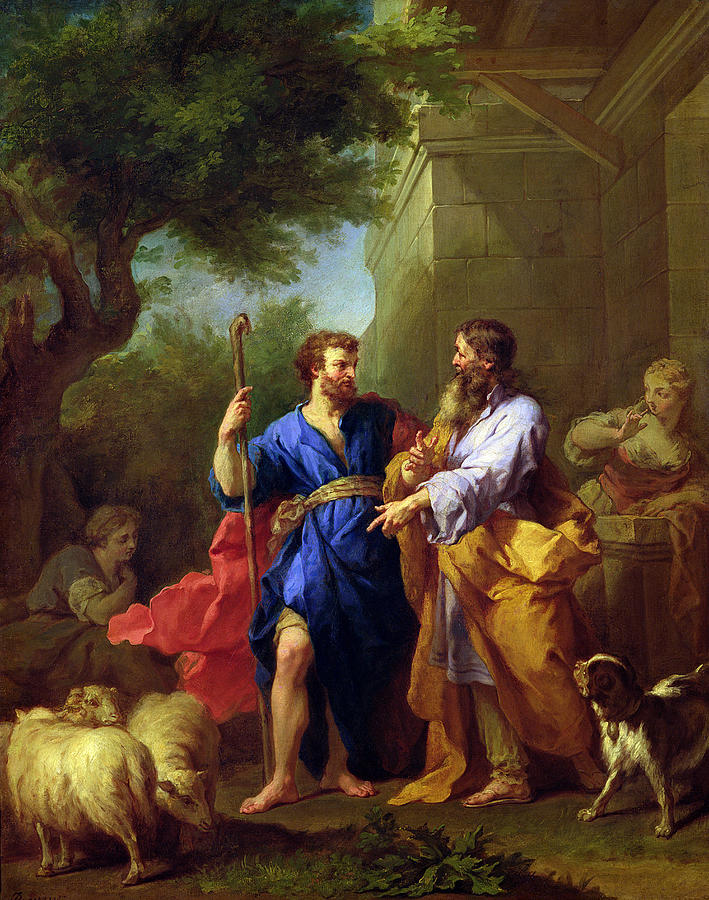
Jacob and Laban, by Pietro da Cortona (1596-1669)

After Joseph was born, Jacob said to Laban, “Release me from our agreement and let me return to my own country. You know how hard I’ve worked for you, so let me take my wives and children and leave.”

But Laban told him, “If you really are my friend, stay on, and I’ll pay whatever you ask. I’m sure the Lord has blessed me because of you.”

Jacob answered:

You’ve seen how hard I’ve worked for you, and you know how your flocks and herds have grown under my care. You didn’t have much before I came, but the Lord has blessed everything I have ever done for you. Now it’s time for me to start looking out for my own family.

“How much do you want me to pay you?” Laban asked.

Then Jacob told him:

I don’t want you to pay me anything. Just do one thing, and I’ll take care of your sheep and goats. Let me go through your flocks and herds and take the sheep and goats that are either spotted or speckled and the black lambs. That’s all you need to give me. In the future you can easily find out if I’ve been honest. Just look and see if my animals are either spotted or speckled, or if the lambs are black. If they aren’t, they’ve been stolen from you.

“I agree to that,” was Laban’s response. Before the end of the day, Laban had separated his spotted and speckled animals and the black lambs from the others and had put his sons in charge of them. Then Laban made Jacob keep the rest of the sheep and goats at a distance of three days’ journey. (Contemporary English Version)

Jacob left home by himself and went to his mother’s family. After twenty years away, he had two wives and twelve sons by four different women. He had worked for his father-in-law Laban for all that time – all to Laban’s advantage. During those twenty years, there was plenty of complicated and awkward family drama.

Now Jacob was ready to be done with all that. He wanted to move on and go back to the place of his family origin. But, of course, Laban had a good thing going and did not want Jacob to leave. So, he did his best to convince him to stay. Jacob was able to set his own terms. And there was some space put between his burgeoning family and his in-law’s.

But returning is a lot more difficult than leaving. When I left home as a young man I had all my worldly possessions in a ’74 Chevy Vega. And when I returned to the land of my origins, it was in a large rental truck with a wife a three kids. There was a lot of logistics involved, not to mention all the relationships we left.

For twenty years, Jacob and Laban did a weird relational dance. They were both tricky dudes, and were continually attempting to maneuver and outmaneuver the other. Yet, Jacob mostly got the brunt of unfairness.

In reality, Jacob owed Laban nothing. He had agreed to work for him fourteen years in total. But he could take nothing with him except his family – which would leave him with no means of support. And Laban was not about to give his son-in-law any support outside of his fatherly-in-law control.

Jacob came up with a strange set of terms concerning the flocks of sheep. Laban logically calculates that Jacob is unlikely to gain much profit from the plan, and can still keep the status quo going. So it becomes a done deal.

In a typical relational dynamic which they have become accustomed to, Laban himself sorts the flock, removes all the spotted and speckled sheep to a safe distance, and leaves Jacob with the rest.

So, if Jacob is to acquire any flock of his own, he needs to discover a way of breeding multicolored sheep from monochrome ones – a task which seems to be improbable if not impossible. But that’s exactly what Jacob does in the end, and that is yet the subject of another Old Testament lesson….

So, exactly what is today’s lesson? Life is anything but a nice, neat trajectory upwards toward achieving goals. Rather, life is a series of twists and turns, leading us to often take three steps forward and two steps backward in a herky-jerky sort of journey. Yet, behind it all, the Lord’s promises are still there, still in effect, still being worked out, in order to be fully realized. Nothing and no one is going to derail the plans and purposes of God.

Sometimes we need to be reminded that God is the giver of prosperity, and not anyone or anything else.

When you become successful, don’t say, “I’m rich, and I’ve earned it all myself.” Instead, remember that the Lord your God gives you the strength to make a living. That’s how he keeps the promise he made to your ancestors. (Deuteronomy 8:17-18, CEV)

To the person who pleases him, God gives wisdom, knowledge and happiness, but to the sinner he gives the task of gathering and storing up wealth to hand it over to the one who pleases God. (Ecclesiastes 2:26, NIV)

If any of you lacks wisdom, you should ask God, who gives generously to all without finding fault, and it will be given to you. (James 1:5, NIV)

We may, at times, feel the need to acquire what we want through trickery or manipulation. However, there is a God in heaven who sees and who cares. The Lord delights is being generous and giving to us, that is, if we are aware and attentive enough to ask. We might not get what we want immediately, and it likely won’t be easy, but we shall nonetheless receive it. We only need to trust.

Heavenly Father, source of all life, we thank you for the many ways in which you have blessed and enriched our lives: Keep us from possessiveness and greed, and lead us into the greater joy of sharing your gifts with others, through Jesus Christ, in whom is perfect peace. Amen.

The Power of a Blessing (Genesis 27:30-46)

Isaac Blesses Jacob, by Yoram Raanan

After Isaac had finished blessing Jacob, and just as Jacob left his father Isaac, his brother Esau came back from his hunt. He too made some delicious food, brought it to his father, and said, “Let my father sit up and eat from his son’s game so that you may bless me.”

His father Isaac said to him, “Who are you?”

And he said, “I’m your son, your oldest son, Esau.”

Isaac was so shocked that he trembled violently. He said, “Who was the hunter just here with game? He brought me food, and I ate all of it before you came. I blessed him, and he will stay blessed!”

When Esau heard what his father said, he let out a loud agonizing cry and wept bitterly. He said to his father, “Bless me! Me too, my father!”

Isaac said, “Your brother has already come deceitfully and has taken your blessing.”

Esau said, “Isn’t this why he’s called Jacob? He’s taken me twice now: he took my birthright, and now he’s taken my blessing.” He continued, “Haven’t you saved a blessing for me?”

Isaac replied to Esau, “I’ve already made him more powerful than you, and I’ve made all of his brothers his servants. I’ve made him strong with grain and wine. What can I do for you, my son?”

Esau said to his father, “Do you really have only one blessing, Father? Bless me too, my father!” And Esau wept loudly.

His father Isaac responded and said to him,

“Now, you will make a home
    far away from the olive groves of the earth,
        far away from the showers of the sky above.
You will live by your sword;
        you will serve your brother.
But when you grow restless,
        you will tear away his harness
        from your neck.”

Esau was furious at Jacob because his father had blessed him, and Esau said to himself, When the period of mourning for the death of my father is over, I will kill my brother.

Rebekah was told what her older son Esau was planning, so she summoned her younger son Jacob and said to him, “Esau your brother is planning revenge. He plans to kill you. So now, my son, listen to me: Get up and escape to my brother Laban in Haran. Live with him for a short while until your brother’s rage subsides, until your brother’s anger at you goes away and he forgets what you did to him. Then I will send for you and bring you back from there. Why should I suffer the loss of both of you on one day?”

Rebekah then said to Isaac, “I really loathe these Hittite women. If Jacob marries one of the Hittite women, like the women of this land, why should I go on living?” (Common English Bible)

Jacob and Esau

The twins Esau and Jacob are the very definition of sibling rivalry. Even at their birth, they jostled and positioned for their entry into the world. Although brothers, they were different from one another in every way. As their aged father, Isaac, was near the end of his days, he was looking to pass on a family blessing to Esau, the firstborn. And that’s where things got dicey.

Jacob, always the trickster, was still playing out the rivalry. When his brother Esau was out hunting and preparing to receive his father’s blessing, Jacob posed as his brother and deceitfully gained the blessing of Isaac.

Both Isaac and Esau were shocked to discover what happened. Esau’s response was one of grief, disappointment, bitterness, with tears and weeping. Despite Esau not being known for his sensitivity to God or family before this event, we can certainly feel his cry: “Do you have only one blessing, my father? Bless me too, my father!”

The Blessing

As a Pastor and a Chaplain who works with a variety of people, I have heard many times over the lament of individuals without a blessing from their father. As people created in the image and likeness of God, we were meant to be blessed – to have a loving and enduring stamp of approval from both our heavenly Father and our earthly fathers.

And when an earthly father, or father figure, either cannot or will not extend a vital blessing to children, it is a terrible wound – like an invisible open putrid abscess which continually leaves the person emotionally and spiritually sick.

Blessing is needed. Without blessing we flounder in the world, struggling to see hope, wondering if we are loved, and lacking confidence in our faith. To be blessed is to receive a beautiful gift.

The term “blessing” in Scripture is a powerful communication of God’s presence and approval.

So, when humans bless one another, we offer commitments of love and connection. We provide powerful words of encouragement and picture a special future for those we are close to.

None of this is optional. To bless others is the way of building up one another and fortifying each other for the rigors of this world. When blessing is withheld, and even worse, when it is replaced with cursing, then individuals are left untethered, bereft of support to face stressful situations. Like a ship adrift without any power or wind, so the person trying to live in this world without blessing is dead in the water.

Jesus Blesses

Where there is no blessing, like Esau, revenge fills our hearts. But Jesus clearly understood the need and the power of blessing, and he was not deterred in deliberately offering it:

People were bringing little children to Jesus for him to place his hands on them, but the disciples rebuked them. When Jesus saw this, he was indignant. He said to them, “Let the little children come to me, and do not hinder them, for the kingdom of God belongs to such as these. Truly I tell you, anyone who will not receive the kingdom of God like a little child will never enter it.” And he took the children in his arms, placed his hands on them and blessed them. (Mark 10:13-16, NIV)

I wonder how this simple encounter affected the lives of those children on that day in which Jesus blessed them. I am curious in what ways they grew-up and how Christ’s blessing shaped their lives. Because that is what blessing does: it forms us into the kind of people we were meant to be.

So, receive today this blessing from Holy Scripture:

The Lord bless you and keep you;
the Lord make his face to shine upon you, and be gracious to you;
the Lord lift up his countenance upon you, and give you peace. Amen. (Numbers 6:24-26)

The Connection of Faith, Obedience, and Blessing (Genesis 22:15-18)

The angel of the Lord called to Abraham a second time from heaven and said, “By myself I have sworn, says the Lord: Because you have done this, and have not withheld your son, your only son, I will indeed bless you, and I will make your offspring as numerous as the stars of heaven and as the sand that is on the seashore. And your offspring shall possess the gate of their enemies, and by your offspring shall all the nations of the earth gain blessing for themselves, because you have obeyed my voice.” (New Revised Standard Version)

Faith

The biblical character of Abraham is synonymous with faith. And for good reason.

God had told Abraham that he would have a son with his wife Sarah. This was especially unusual because the couple were well advanced in age, and Sarah was incapable of having children. Infertility is not just a modern problem; it has always existed. 

Yet, despite all the contrary evidence of age and ability, Abraham believed God. Years later, and with a mix of patience and impatience from the would-be parents, the promise from God was realized.  Abraham and Sarah had a son, Isaac.

“The child of the promise.” This was Isaac’s moniker – which made the command from God so perplexing: “Take your son, your only son, whom you love—Isaac—and go to the region of Moriah. Sacrifice him there as a burnt offering on a mountain I will show you.” (Genesis 22:2) Huh?

I can easily imagine Abraham saying to himself, perhaps not out loud, “What the [insert favorite expletive]!”  But it only seems strange and super-weird to us. We get no reaction from Abraham, no questioning, no talk back. He just goes about the business of saddling up the donkey, chopping some wood for the sacrifice, and takes his only son with him on the journey to the mountain.

While you and I might try and figure out if we really heard God or not, Abraham had a history of talking with God. He knew God’s voice as well as he knew his own.

Abraham was well down the road of relationship with the God he served. We get an insight from the author of Hebrews into Abraham’s thought process, a line of thinking that is consistent with a person who has a regular habit of talking with God:

Abraham had been promised that Isaac, his only son, would continue his family. But when Abraham was tested, he had faith and was willing to sacrifice Isaac, because he was sure that God could raise people to life. This was just like getting Isaac back from death. (Hebrews 11:17-18, CEV)

Obedience

Abraham did not try and figure out God’s mind. He picked no fights and chose not to debate with God about the contradiction of ethics he was being asked to do.

Abraham simply obeyed. He reasoned that it did not matter if Isaac were killed, because God could raise him from death.

This, of course, is not what happened. It was all a test of faith. Abraham knew beyond a shadow of a doubt that God is the Lord who provides. After God stepped in and provided a ram for the sacrifice instead of Isaac, Abraham named that place “The Lord Will Provide.” (Genesis 22:14)

You and I most certainly do not always know why we are facing the circumstances we must endure. We are rarely privy to know what in the world God is thinking. Yet, like Abraham, if we have a spiritual history of walking with God and hearing God’s voice, there is no hesitation; we respond with obedience. We are convinced that God will provide. Obedience for the follower of Christ is not a burden; it is a privilege, even when we are being tested beyond our seeming emotional ability to do it.

Blessing

Blessings come through obedience. They are not willy-nilly thrown into a crowd like some cheap stadium trinket between innings of a baseball game. When the Israelites were about to enter the Promised Land, the connection between obedience and blessing was re-emphasized:

If you fully obey the Lord your God and carefully follow all his commands I give you today, the Lord your God will set you high above all the nations on earth. All these blessings will come on you and accompany you if you obey the Lord your God…. The Lord will establish you as his holy people, as he promised you on oath, if you keep the commands of the Lord your God and walk in obedience to him. (Deuteronomy 28:1-2, 9, NIV)

Here’s a simple observation about the blessing of Abraham: It took nearly five-hundred years before that blessing was realized. Furthermore, in the Christian tradition, it then took another fifteen-hundred years before the blessing was fulfilled in the person of Jesus.

And, I might add, all the promises of God to the people will be fully consummated at the end of the age when Christ returns. For a contemporary society which prides itself on timeliness, speed, and efficiency, taking the much broader scope of all history might seem unacceptable.

So, we come back around again to trust. Just as Abraham trusted God, even when it seemed like nonsense fraught with major moral implications, so we are to exhibit patient and persevering faith.

Although the scope of history is massively large, the only moment we have is the now. It is now, today, in which we put one foot in front of the other and toddle forward into the next moment – by faith.

We simply obey. Then, we obey again… and, again. It is in these continual small steps of faith and obedience that we discover the blessings of God in the middle of our path.

Sovereign Lord, your ways are sometimes strange. Yet, I know that everything you do is always right, just, and good. It is to your gracious and merciful character that I know you will guide and provide. My allegiance is to you as I anticipate divine blessings in my life through the Name of Jesus Christ, in the power of the Holy Spirit. Amen.